
keyword
predictive uncertainty
Predictive uncertainty is the quantifiable degree of doubt, variability, or lack of confidence associated with a statistical or machine learning model when generating an output for a specific input. It reflects the total expected error or dispersion of potential outcomes for a given prediction and is broadly decomposed into two primary components: aleatoric uncertainty, which arises from irreducible noise and inherent randomness in the data-generating process, and epistemic uncertainty, which stems from incomplete knowledge, limited training data, or parameter ambiguity within the model itself. Accurately quantifying and calibrating predictive uncertainty is essential for evaluating model trustworthiness, detecting out-of-distribution data, preventing misclassifications, and enabling safe, informed decision-making in high-stakes environments.
12 items
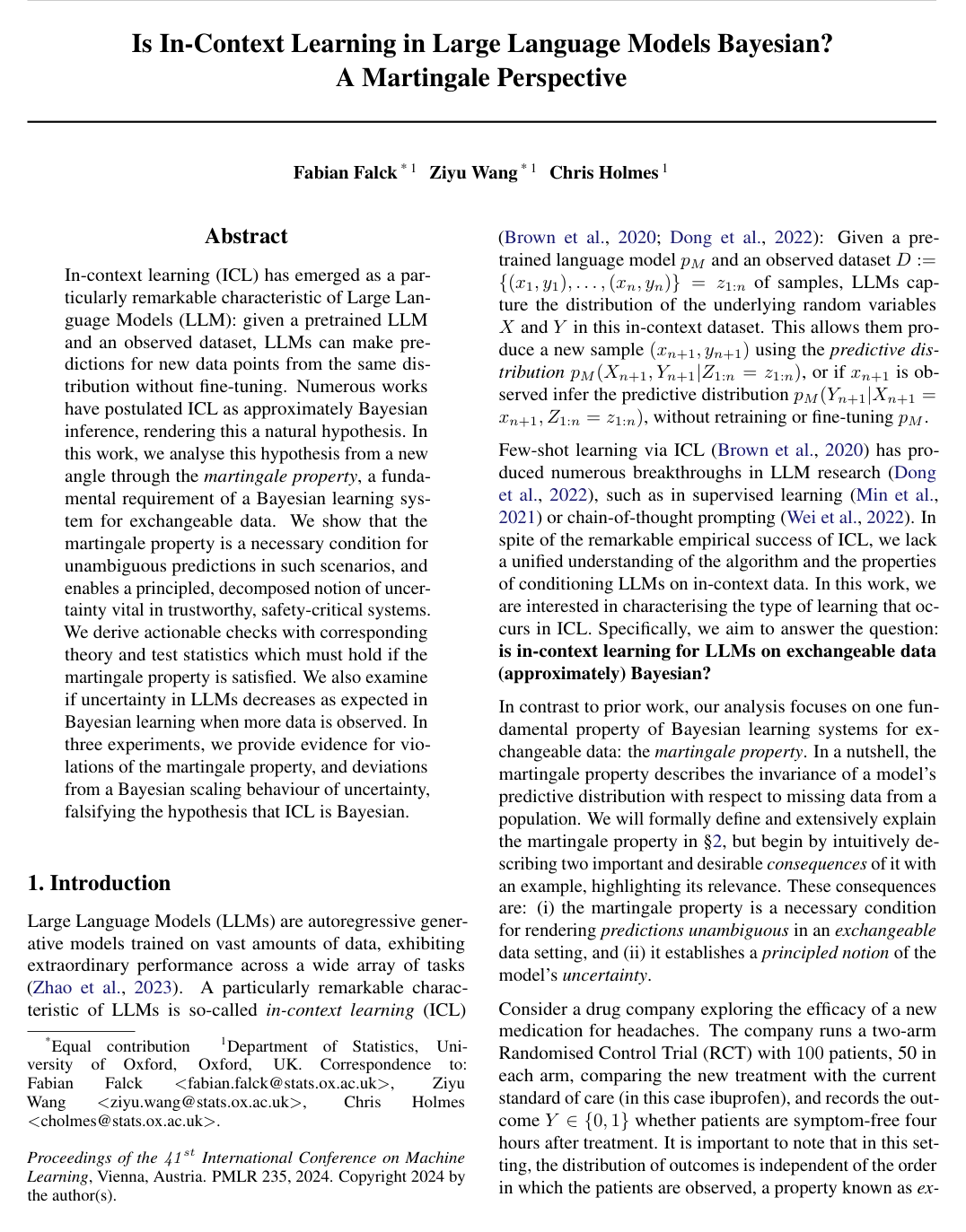
Is In-Context Learning in Large Language Models Bayesian? A Martingale Perspective
Fabian Falck, Ziyu Wang, Christopher C. Holmes
Why you should read this
Falsifies the widely held belief that in-context learning is Bayesian by deriving martingale-based diagnostic tests and showing that large language models violate the fundamental predictive invariance and uncertainty scaling expected of exchangeable Bayesian systems.
In-context learning (ICL) has emerged as a particularly remarkable characteristic of Large Language Models (LLM): given a pretrained LLM and an observed dataset, LLMs can make predictions for new data points from the same distribution without fine-tuning. Numerous works have postulated ICL as approximately Bayesian inference, rendering this a natural hypothesis. In this work, we analyse this hypothesis from a new angle through the martingale property, a fundamental requirement of a Bayesian learning system for exchangeable data. We show that the martingale property is a necessary condition for unambiguous predictions in such scenarios, and enables a principled, decomposed notion of uncertainty vital in trustworthy, safety-critical systems. We derive actionable checks with corresponding theory and test statistics which must hold if the martingale property is satisfied. We also examine if uncertainty in LLMs decreases as expected in Bayesian learning when more data is observed. In three experiments, we provide evidence for violations of the martingale property, and deviations from a Bayesian scaling behaviour of uncertainty, falsifying the hypothesis that ICL is Bayesian.
Added
2026-10-05
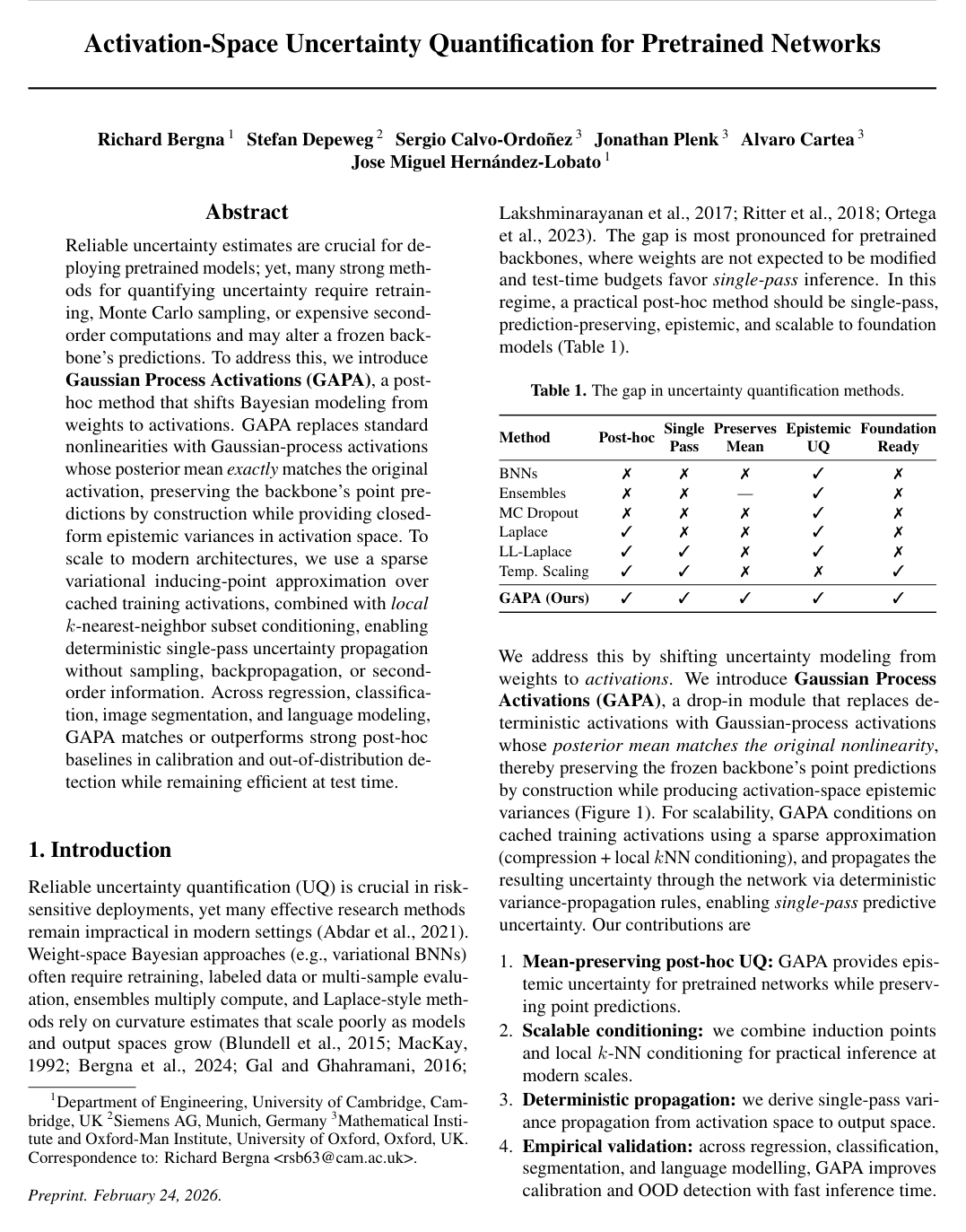
Activation-Space Uncertainty Quantification for Pretrained Networks
Richard Bergna, Stefan Depeweg, Sergio Calvo Ordoñez, Jonathan Plenk, Álvaro Cartea, Jose Miguel Hernández-Lobato
Why you should read this
Introduces Gaussian Process Activations, a post-hoc method that enables single-pass, closed-form uncertainty quantification for pretrained vision and language models while strictly preserving their original predictions without retraining or sampling.
Reliable uncertainty estimates are crucial for deploying pretrained models; yet, many strong methods for quantifying uncertainty require retraining, Monte Carlo sampling, or expensive second-order computations and may alter a frozen backbone's predictions. To address this, we introduce Gaussian Process Activations (GAPA), a post-hoc method that shifts Bayesian modeling from weights to activations. GAPA replaces standard nonlinearities with Gaussian-process activations whose posterior mean exactly matches the original activation, preserving the backbone's point predictions by construction while providing closed-form epistemic variances in activation space. To scale to modern architectures, we use a sparse variational inducing-point approximation over cached training activations, combined with local k-nearest-neighbor subset conditioning, enabling deterministic single-pass uncertainty propagation without sampling, backpropagation, or second-order information. Across regression, classification, image segmentation, and language modeling, GAPA matches or outperforms strong post-hoc baselines in calibration and out-of-distribution detection while remaining efficient at test time.
Added
2026-10-04
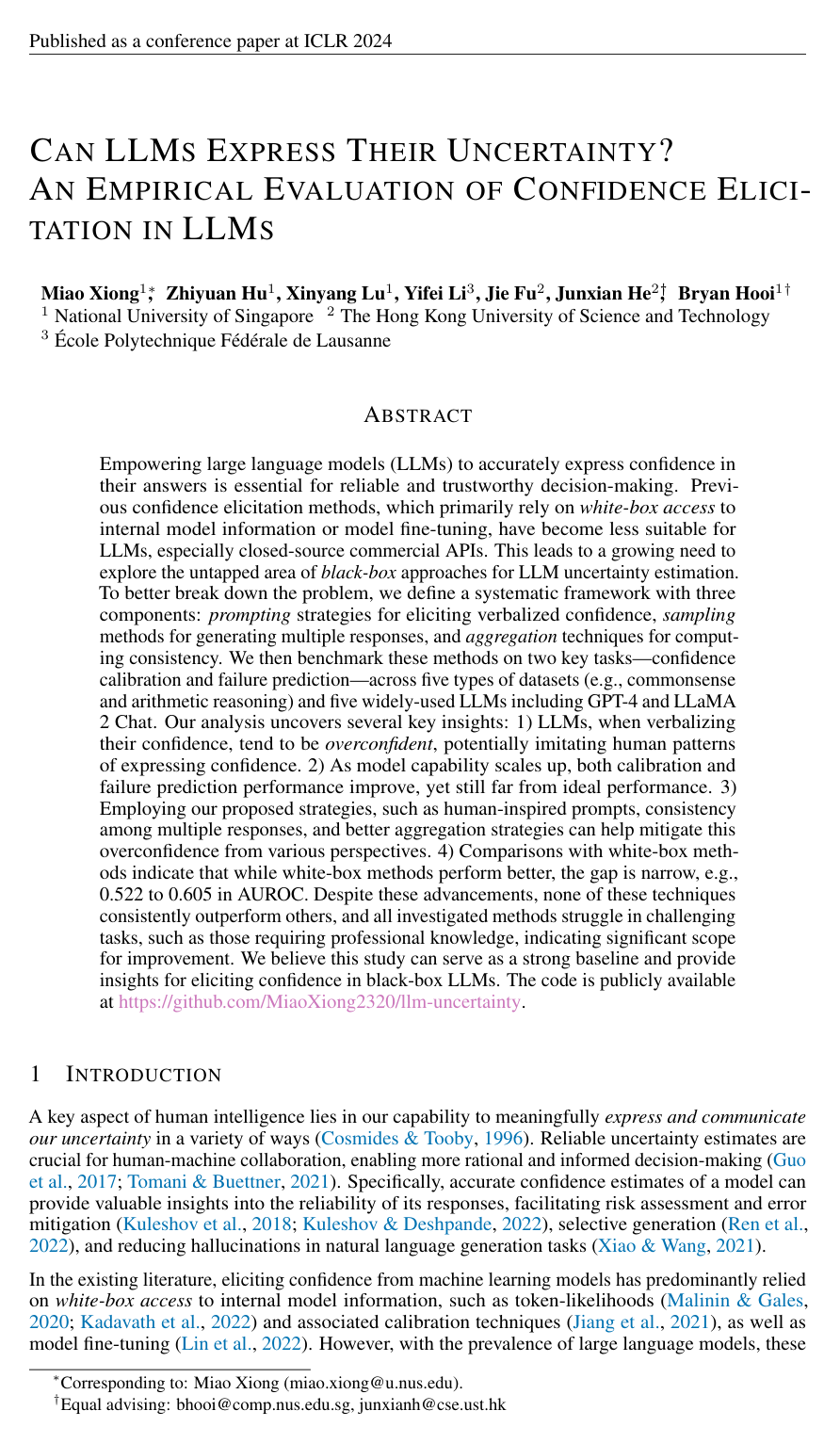
Can LLMs Express Their Uncertainty? An Empirical Evaluation of Confidence Elicitation in LLMs
Miao Xiong, Zhiyuan Hu, Xinyang Lu, Yifei Li, Jie Fu, Junxian He, Bryan Hooi
Why you should read this
Presents a systematic framework for evaluating black-box uncertainty estimation in large language models, showing that verbalized prompting and response consistency can effectively reduce overconfidence to rival white-box calibration methods.
Empowering large language models to accurately express confidence in their answers is essential for trustworthy decision-making. Previous confidence elicitation methods, which primarily rely on white-box access to internal model information or model fine-tuning, have become less suitable for LLMs, especially closed-source commercial APIs. This leads to a growing need to explore the untapped area of black-box approaches for LLM uncertainty estimation. To better break down the problem, we define a systematic framework with three components: prompting strategies for eliciting verbalized confidence, sampling methods for generating multiple responses, and aggregation techniques for computing consistency. We then benchmark these methods on two key tasks-confidence calibration and failure prediction-across five types of datasets (e.g., commonsense and arithmetic reasoning) and five widely-used LLMs including GPT-4 and LLaMA 2 Chat. Our analysis uncovers several key insights: 1) LLMs, when verbalizing their confidence, tend to be overconfident, potentially imitating human patterns of expressing confidence. 2) As model capability scales up, both calibration and failure prediction performance improve. 3) Employing our proposed strategies, such as human-inspired prompts, consistency among multiple responses, and better aggregation strategies can help mitigate this overconfidence from various perspectives. 4) Comparisons with white-box methods indicate that while white-box methods perform better, the gap is narrow, e.g., 0.522 to 0.605 in AUROC. Despite these advancements, none of these techniques consistently outperform others, and all investigated methods struggle in challenging tasks, such as those requiring professional knowledge, indicating significant scope for improvement. We believe this study can serve as a strong baseline and provide insights for eliciting confidence in black-box LLMs.
Added
2026-10-04
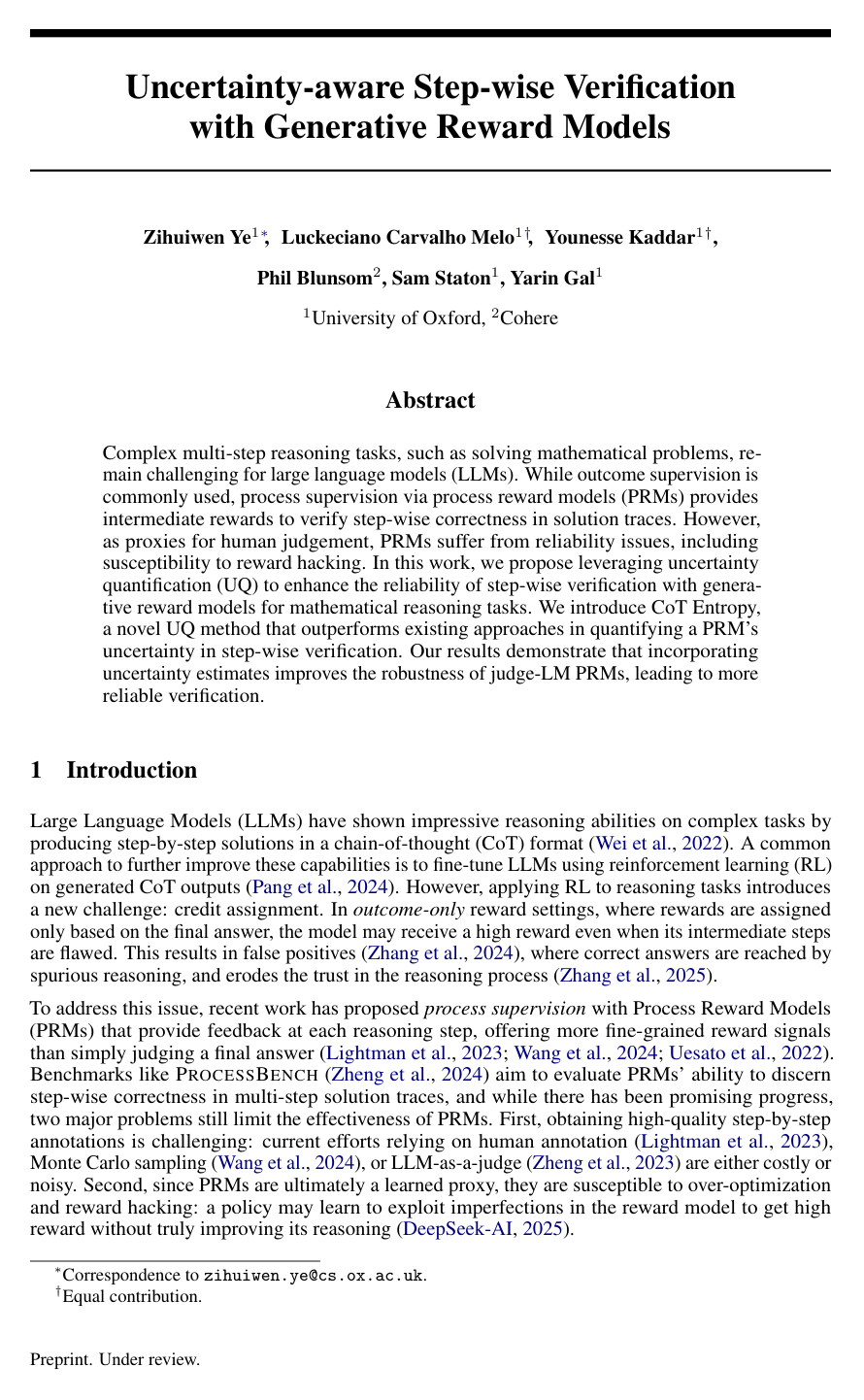
Uncertainty-Aware Step-wise Verification with Generative Reward Models
Daniella (Zihuiwen) Ye, Luckeciano Carvalho Melo, Younesse Kaddar, Phil Blunsom, Sam Staton, Yarin Gal
Why you should read this
Develops CoT Entropy, an uncertainty quantification method for generative process reward models that improves the reliability of step-wise verification and mitigates reward hacking in complex mathematical reasoning.
Complex multi-step reasoning tasks, such as solving mathematical problems, remain challenging for large language models (LLMs). While outcome supervision is commonly used, process supervision via process reward models (PRMs) provides intermediate rewards to verify step-wise correctness in solution traces. However, as proxies for human judgement, PRMs suffer from reliability issues, including susceptibility to reward hacking. In this work, we propose leveraging uncertainty quantification (UQ) to enhance the reliability of step-wise verification with generative reward models for mathematical reasoning tasks. We introduce CoT Entropy, a novel UQ method that outperforms existing approaches in quantifying a PRM's uncertainty in step-wise verification. Our results demonstrate that incorporating uncertainty estimates improves the robustness of judge-LM PRMs, leading to more reliable verification.
Added
2026-10-04
MARS: Meaning-Aware Response Scoring for Uncertainty Estimation in Generative LLMs
Yavuz Faruk Bakman, Duygu Nur Yaldiz, Baturalp Buyukates, Chenyang Tao, Dimitrios Dimitriadis, Salman Avestimehr
Why you should read this
Presents Meaning-Aware Response Scoring (MARS), a framework that weights each token by its semantic contribution to the answer rather than applying uniform length normalization, substantially improving uncertainty estimation and error detection across multiple large language models and question-answering benchmarks.
Generative Large Language Models (LLMs) are widely utilized for their excellence in various tasks. However, their tendency to produce inaccurate or misleading outputs poses a potential risk, particularly in high-stakes environments. Therefore, estimating the correctness of generative LLM outputs is an important task for enhanced reliability. Uncertainty Estimation (UE) in generative LLMs is an evolving domain, where SOTA probability-based methods commonly employ length-normalized scoring. In this work, we propose Meaning-Aware Response Scoring (MARS) as an alternative to length-normalized scoring for UE methods. MARS is a novel scoring function that considers the semantic contribution of each token in the generated sequence in the context of the question. We demonstrate that integrating MARS into UE methods results in a universal and significant improvement in UE performance. We conduct experiments using three distinct closed-book question-answering datasets across five popular pre-trained LLMs. Lastly, we validate the efficacy of MARS on a Medical QA dataset. Code can be found here.
Added
2026-10-04
Uncertainty Quantification for In-Context Learning of Large Language Models
Chen Ling, Xujiang Zhao, Xuchao Zhang, Wei Cheng, Yanchi Liu, Yiyou Sun, Mika Oishi, Takao Osaki, Katsushi Matsuda, Jie Ji, Guangji Bai, Liang Zhao, Haifeng Chen
Why you should read this
Presents a Bayesian framework that decomposes predictive uncertainty in large language model in-context learning into prompt-induced aleatoric and model-induced epistemic components, enabling unsupervised diagnostic evaluation of output reliability across both white-box and black-box settings.
In-context learning has emerged as a ground-breaking ability of Large Language Models (LLMs) and revolutionized various fields by providing a few task-relevant demonstrations in the prompt. However, trustworthy issues with LLM’s response, such as hallucination, have also been actively discussed. Existing works have been devoted to quantifying the uncertainty in LLM’s response, but they often overlook the complex nature of LLMs and the uniqueness of in-context learning. In this work, we delve into the predictive uncertainty of LLMs associated with in-context learning, highlighting that such uncertainties may stem from both the provided demonstrations (aleatoric uncertainty) and ambiguities tied to the model’s configurations (epistemic uncertainty). We propose a novel formulation and corresponding estimation method to quantify both types of uncertainties. The proposed method offers an unsupervised way to understand the prediction of in-context learning in a plug-and-play fashion. Extensive experiments are conducted to demonstrate the effectiveness of the decomposition. The code and data are available at: https://github.com/lingchen0331/UQ_ICL.
Added
2026-10-03
Uncertainty Estimation of Transformer Predictions for Misclassification Detection
Artem Vazhentsev, Gleb Kuzmin, Artem Shelmanov, Akim Tsvigun, Evgenii Tsymbalov, Kirill Fedyanin, Maxim Panov, Alexander Panchenko, Gleb Gusev, Mikhail Burtsev, Manvel Avetisian, Leonid Zhukov
Why you should read this
Develops computationally efficient uncertainty estimation methods for Transformer models in text classification and named entity recognition, demonstrating that a spectral-normalized Mahalanobis distance approach can rival or exceed heavy deep ensembles at detecting misclassifications.
Uncertainty estimation (UE) of model predictions is a crucial step for a variety of tasks such as active learning, misclassification detection, adversarial attack detection, out-of-distribution detection, etc. Most of the works on modeling the uncertainty of deep neural networks evaluate these methods on image classification tasks. Little attention has been paid to UE in natural language processing. To fill this gap, we perform a vast empirical investigation of state-of-the-art UE methods for Transformer models on misclassification detection in named entity recognition and text classification tasks and propose two computationally efficient modifications, one of which approaches or even outperforms computationally intensive methods1.
Added
2026-10-03
A Simple Approach to Improve Single-Model Deep Uncertainty via Distance-Awareness
Jeremiah Zhe Liu, Shreyas Padhy, Jie Ren, Zi Lin, Yeming Wen, Ghassen Jerfel, Zachary Nado, Jasper Snoek, Dustin Tran, Balaji Lakshminarayanan
Why you should read this
Proposes Spectral-normalized Neural Gaussian Process (SNGP), a method that combines spectral normalization with a Gaussian process output layer to achieve distance-aware, high-quality uncertainty estimation in a single deterministic network without the computational overhead of deep ensembles.
Uncertainty quantification is a key component of modern machine learning systems. A popular approach for quantifying predictive uncertainty on neural network models is deep ensembles. However, training multiple independently initialized networks leads to prohibitive computational costs at both train time and test time. Alternatively, single-model approaches such as MC-dropout and its variants have been proposed but typically underperform relative to their ensemble-based counterparts. In this work we propose a simple method which brings together distance-awareness and spectral normalization for improving robustness to distributional shift while retaining model calibration. We demonstrate significant gains over baseline methods on benchmark tasks including out-of-distribution detection.
Added
2026-10-02
Inducing Artificial Uncertainty in Language Models
Sophia Hager, Simon Zeng, Nicholas Andrews
Why you should read this
Demonstrates that training uncertainty probes on artificially induced uncertainty in language models significantly improves confidence calibration on difficult tasks where naturally challenging training data is scarce.
In safety-critical applications, language models should be able to characterize their uncertainty with meaningful probabilities. Many uncertainty quantification approaches require supervised data; however, finding suitable unseen challenging data is increasingly difficult for large language models trained on vast amounts of scraped data. If the model is consistently (and correctly) confident in its predictions, the uncertainty quantification method may consistently overestimate confidence on new and unfamiliar data. Finding data which exhibits enough uncertainty to train supervised uncertainty quantification methods for high-performance models may therefore be challenging, and will increase in difficulty as LLMs saturate datasets. To address this issue, we first introduce the problem of inducing artificial uncertainty in language models, then investigate methods of inducing artificial uncertainty on trivially easy data in the absence of challenging data at training time. We use probes trained to recognize artificial uncertainty on the original model, and find that these probes trained on artificial uncertainty outperform probes trained without artificial uncertainty in recognizing real uncertainty, achieving notably higher calibration on hard data with minimal loss of performance on easy data.
Added
2026-09-29
When and How Mixup Improves Calibration
Linjun Zhang, Zhun Deng, Kenji Kawaguchi, James Zou
Why you should read this
Establishes the theoretical foundation for why Mixup data augmentation reduces prediction calibration errors in high-dimensional settings and semi-supervised learning, showing that its calibration benefits grow alongside model capacity.
In many machine learning applications, it is important for the model to provide confidence scores that accurately capture its prediction uncertainty. Although modern learning methods have achieved great success in predictive accuracy, generating calibrated confidence scores remains a major challenge. Mixup, a popular yet simple data augmentation technique based on taking convex combinations of pairs of training examples, has been empirically found to significantly improve confidence calibration across diverse applications. However, when and how Mixup helps calibration is still a mystery. In this paper, we theoretically prove that Mixup improves calibration in high-dimensional settings by investigating natural statistical models. Interestingly, the calibration benefit of Mixup increases as the model capacity increases. We support our theories with experiments on common architectures and datasets. In addition, we study how Mixup improves calibration in semi-supervised learning. While incorporating unlabeled data can sometimes make the model less calibrated, adding Mixup training mitigates this issue and provably improves calibration. Our analysis provides new insights and a framework to understand Mixup and calibration.
Added
2026-09-26
Aleatoric and epistemic uncertainty in machine learning: an introduction to concepts and methods
Eyke Hüllermeier, Willem Waegeman
Why you should read this
Clarifies the critical distinction between irreducible data randomness and reducible model ignorance, providing a comprehensive framework for quantifying both aleatoric and epistemic uncertainty to build safer, more reliable machine learning systems.
The notion of uncertainty is of major importance in machine learning and constitutes a key element of machine learning methodology. In line with the statistical tradition, uncertainty has long been perceived as almost synonymous with standard probability and probabilistic predictions. Yet, due to the steadily increasing relevance of machine learning for practical applications and related issues such as safety requirements, new problems and challenges have recently been identified by machine learning scholars, and these problems may call for new methodological developments. In particular, this includes the importance of distinguishing between (at least) two different types of uncertainty, often referred to as aleatoric and epistemic. In this paper, we provide an introduction to the topic of uncertainty in machine learning as well as an overview of attempts so far at handling uncertainty in general and formalizing this distinction in particular.
Added
2026-09-16
Can You Trust Your Model's Uncertainty? Evaluating Predictive Uncertainty Under Dataset Shift
Yaniv Ovadia, Emily Fertig, Jie Ren, Zachary Nado, David Sculley, Sebastian Nowozin, Joshua V. Dillon, Balaji Lakshminarayanan, Jasper Snoek
Why you should read this
Establishes a critical large-scale benchmark for evaluating state-of-the-art predictive uncertainty quantification methods in machine learning, specifically under challenging dataset shift conditions, revealing that methods marginalizing over models significantly outperform traditional approaches.
Modern machine learning methods including deep learning have achieved great success in predictive accuracy for supervised learning tasks, but may still fall short in giving useful estimates of their predictive {\em uncertainty}. Quantifying uncertainty is especially critical in real-world settings, which often involve input distributions that are shifted from the training distribution due to a variety of factors including sample bias and non-stationarity. In such settings, well calibrated uncertainty estimates convey information about when a model's output should (or should not) be trusted. Many probabilistic deep learning methods, including Bayesian-and non-Bayesian methods, have been proposed in the literature for quantifying predictive uncertainty, but to our knowledge there has not previously been a rigorous large-scale empirical comparison of these methods under dataset shift. We present a large-scale benchmark of existing state-of-the-art methods on classification problems and investigate the effect of dataset shift on accuracy and calibration. We find that traditional post-hoc calibration does indeed fall short, as do several other previous methods. However, some methods that marginalize over models give surprisingly strong results across a broad spectrum of tasks.
Added
2026-04-27
License
Published with permission