
keyword
pattern classification
Pattern classification is the process of categorizing input data, observations, or signals into one of several predefined classes based on their measured characteristics or features. As a core branch of pattern recognition and machine learning, it involves designing algorithmic models that learn mathematical decision boundaries between different categories using representative sample data. The typical pattern classification workflow encompasses measuring physical or digital signals, extracting and selecting the most informative features to reduce dimensionality, training a classifier to map feature values to target labels, and evaluating the system on independent test data to ensure accurate generalization and low classification error.
2 items
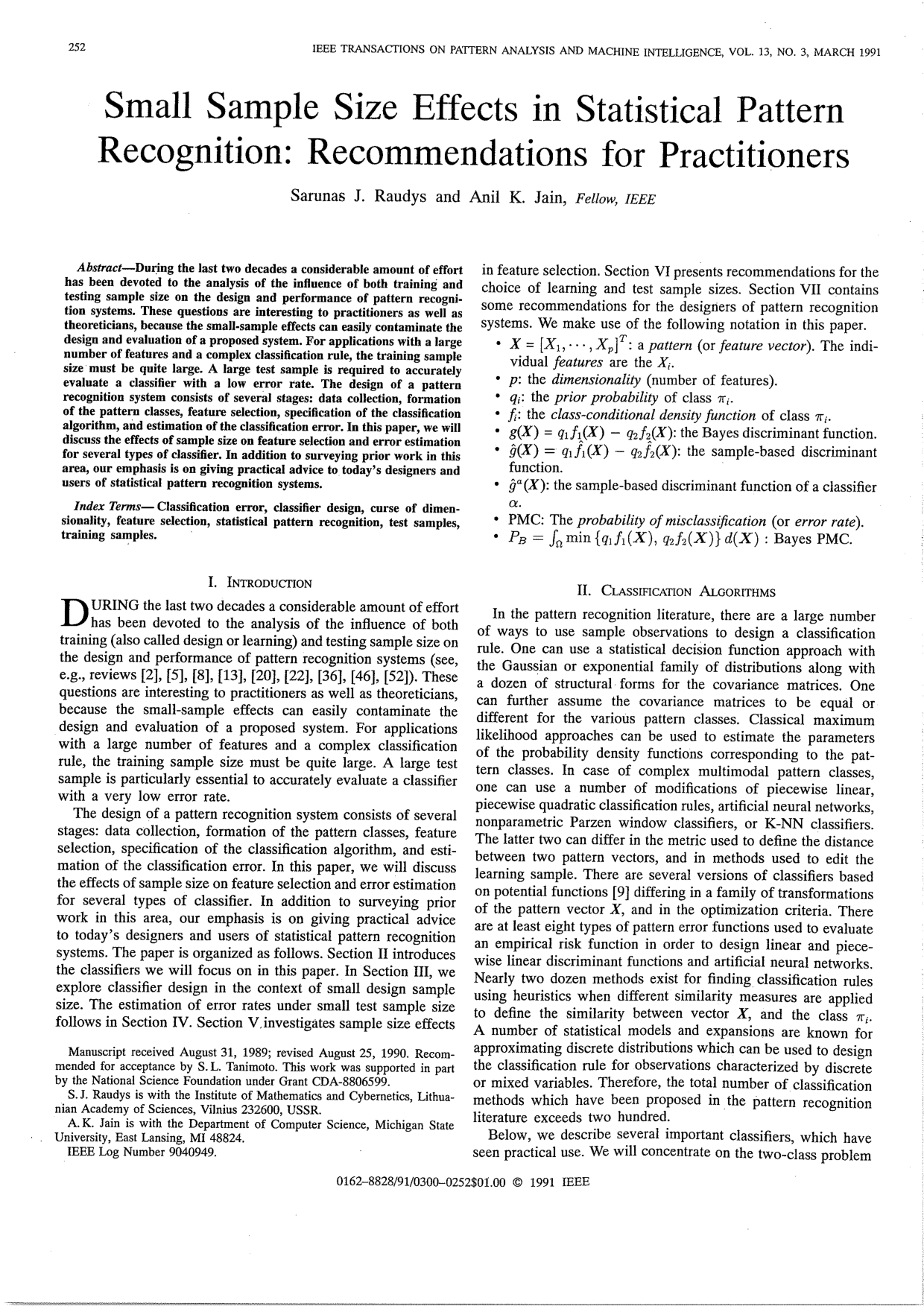
Small Sample Size Effects in Statistical Pattern Recognition: Recommendations for Practitioners
S. Raudys, Anil K. Jain
Why you should read this
Presents practical guidelines and quantitative analyses to help practitioners choose appropriate training and test sample sizes, avoid small-sample bias in classifier design and feature selection, and accurately estimate classification error rates.
During the last two decades a considerable amount of effort has been devoted to the analysis of the influence of both training and testing sample size on the design and performance of pattern recognition systems. These questions are interesting to practitioners as well as theoreticians, because the small-sample effects can easily contaminate the design and evaluation of a proposed system. For applications with a large number of features and a complex classification rule, the training sample size must be quite large. A large test sample is required to accurately evaluate a classifier with a low error rate. The design of a pattern recognition system consists of several stages: data collection, formation of the pattern classes, feature selection, specification of the classification algorithm, and estimation of the classification error. In this paper, we will discuss the effects of sample size on feature selection and error estimation for several types of classifier. In addition to surveying prior work in this area, our emphasis is on giving practical advice to today's designers and users of statistical pattern recognition systems.
Added
2026-09-25
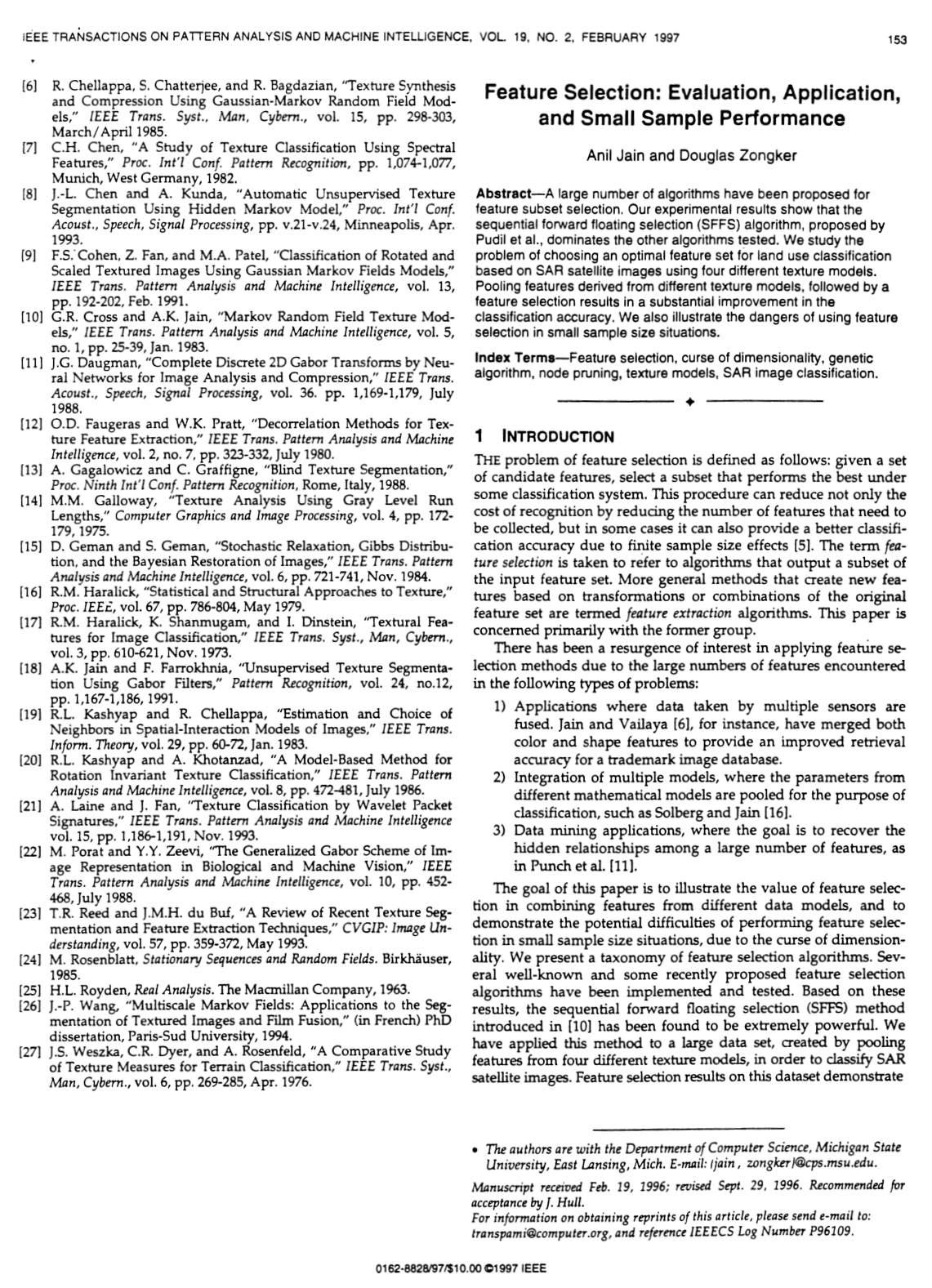
Feature Selection: Evaluation, Application, and Small Sample Performance
Anil K. Jain, Douglas E. Zongker
Why you should read this
Compares prominent feature subset selection methods on synthetic benchmarks and SAR satellite imagery, establishing the superior performance of sequential forward floating selection while identifying critical pitfalls of selection algorithms in small-sample scenarios.
A large number of algorithms have been proposed for feature subset selection. Our experimental results show that the sequential forward floating selection (SFFS) algorithm, proposed by Pudil et al., dominates the other algorithms tested. We study the problem of choosing an optimal feature set for land use classification based on SAR satellite images using four different texture models. Pooling features derived from different texture models, followed by a feature selection results in a substantial improvement in the classification accuracy. We also illustrate the dangers of using feature selection in small sample size situations.
Added
2026-09-14