
keyword
neural machine translation
Neural machine translation is an automated approach to translating text or speech from one natural language to another using deep artificial neural networks. Unlike traditional statistical machine translation methods that rely on separate, handcrafted components for phrase alignment and language modeling, neural machine translation operates as an end-to-end learning framework that jointly models the entire translation process. Modern systems typically employ sequence-to-sequence architectures, predominantly based on Transformer networks and attention mechanisms, to capture complex syntactic patterns and contextual relationships across languages. By learning representations directly from large bilingual or multilingual datasets, neural machine translation produces more fluent, coherent, and contextually accurate translations than earlier rule-based or statistical translation paradigms.
53 items
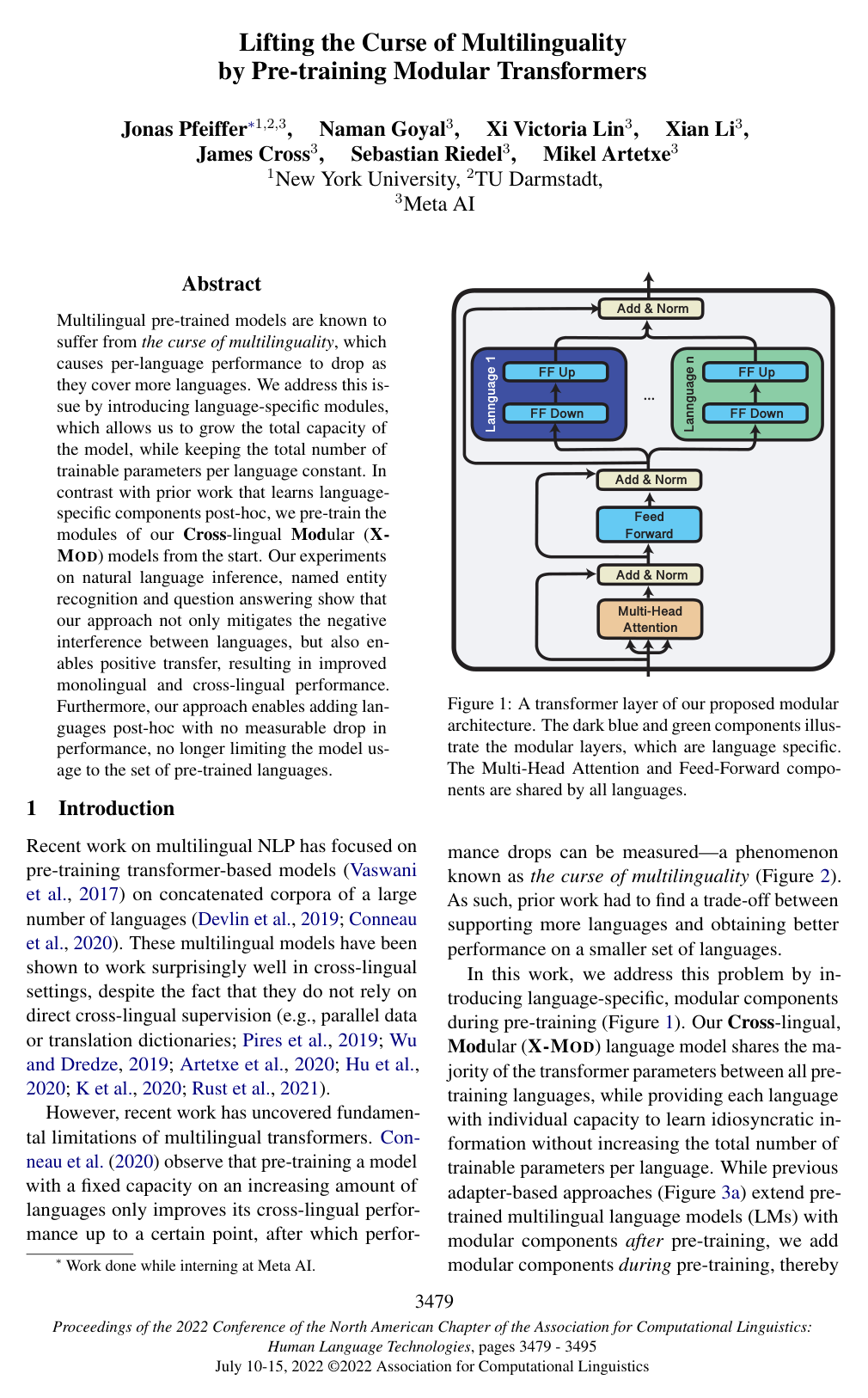
Lifting the Curse of Multilinguality by Pre-training Modular Transformers
Jonas Pfeiffer, Naman Goyal, Xi Victoria Lin, Xian Li, James Cross, Sebastian Riedel, Mikel Artetxe
Why you should read this
Proposes pre-training multilingual transformers with dedicated language-specific modules from the start, preventing capacity dilution across languages and enabling post-hoc extension to new languages without performance degradation.
Multilingual pre-trained models are known to suffer from the curse of multilinguality, which causes per-language performance to drop as they cover more languages. We address this issue by introducing language-specific modules, which allows us to grow the total capacity of the model, while keeping the total number of trainable parameters per language constant. In contrast with prior work that learns language-specific components post-hoc, we pre-train the modules of our Cross-lingual Modular (X-Mod) models from the start. Our experiments on natural language inference, named entity recognition and question answering show that our approach not only mitigates the negative interference between languages, but also enables positive transfer, resulting in improved monolingual and cross-lingual performance. Furthermore, our approach enables adding languages post-hoc with no measurable drop in performance, no longer limiting the model usage to the set of pre-trained languages.
Added
2026-10-05
Two-Stream Network for Sign Language Recognition and Translation
Yutong Chen, Ronglai Zuo, Fangyun Wei, Yu Wu, Shujie Liu, Brian Mak
Why you should read this
Introduces a dual-stream architecture combining RGB video and keypoint heatmap representations through bidirectional connections and frame-level self-distillation to achieve state-of-the-art performance in sign language recognition and translation.
Sign languages are visual languages using manual articulations and non-manual elements to convey information. For sign language recognition and translation, the majority of existing approaches directly encode RGB videos into hidden representations. RGB videos, however, are raw signals with substantial visual redundancy, leading the encoder to overlook the key information for sign language understanding. To mitigate this problem and better incorporate domain knowledge, such as handshape and body movement, we introduce a dual visual encoder containing two separate streams to model both the raw videos and the keypoint sequences generated by an off-the-shelf keypoint estimator. To make the two streams interact with each other, we explore a variety of techniques, including bidirectional lateral connection, sign pyramid network with auxiliary supervision, and frame-level self-distillation. The resulting model is called TwoStream-SLR, which is competent for sign language recognition (SLR). TwoStream-SLR is extended to a sign language translation (SLT) model, TwoStream-SLT, by simply attaching an extra translation network. Experimentally, our TwoStream-SLR and TwoStream-SLT achieve state-of-the-art performance on SLR and SLT tasks across a series of datasets including Phoenix-2014, Phoenix-2014T, and CSL-Daily.
Added
2026-10-05
MSP: Multi-Stage Prompting for Making Pre-trained Language Models Better Translators
Zhixing Tan, Xiangwen Zhang, Shuo Wang, Yang Liu
Why you should read this
Proposes a multi-stage continuous prompting framework that splits the translation process in decoder-only language models into separate encoding, re-encoding, and decoding stages, substantially improving translation quality over standard prompt-tuning approaches while requiring minimal parameter updates.
Prompting has recently been shown as a promising approach for applying pre-trained language models to perform downstream tasks. We present Multi-Stage Prompting, a simple and automatic approach for leveraging pre-trained language models to translation tasks. To better mitigate the discrepancy between pre-training and translation, MSP divides the translation process via pre-trained language models into multiple separate stages: the encoding stage, the re-encoding stage, and the decoding stage. During each stage, we independently apply different continuous prompts for allowing pre-trained language models better shift to translation tasks. We conduct extensive experiments on three translation tasks. Experiments show that our method can significantly improve the translation performance of pre-trained language models.
Added
2026-10-03
Data Scaling Laws in NMT: The Effect of Noise and Architecture
Yamini Bansal, Behrooz Ghorbani, Ankush Garg, Biao Zhang, Colin Cherry, Behnam Neyshabur, Orhan Firat
Why you should read this
Establishes empirical data scaling laws for neural machine translation across varying architectures and noise levels, demonstrating that data scaling exponents remain largely stable under architectural changes and noise while back-translation significantly degrades scaling efficiency.
Neural Machine Translation (NMT) has seen tremendous growth in usage and model size over the last few years. It is still unclear, however, how model and data size interact to affect performance. In this work we study the scaling behavior of NMT models. We train a standard transformer architecture with different data sizes and model sizes. We find that the test loss scales as a power-law in both data and model size. We also find that the scaling exponents are affected by the amount of noise in the data and by the architecture.
Added
2026-10-03
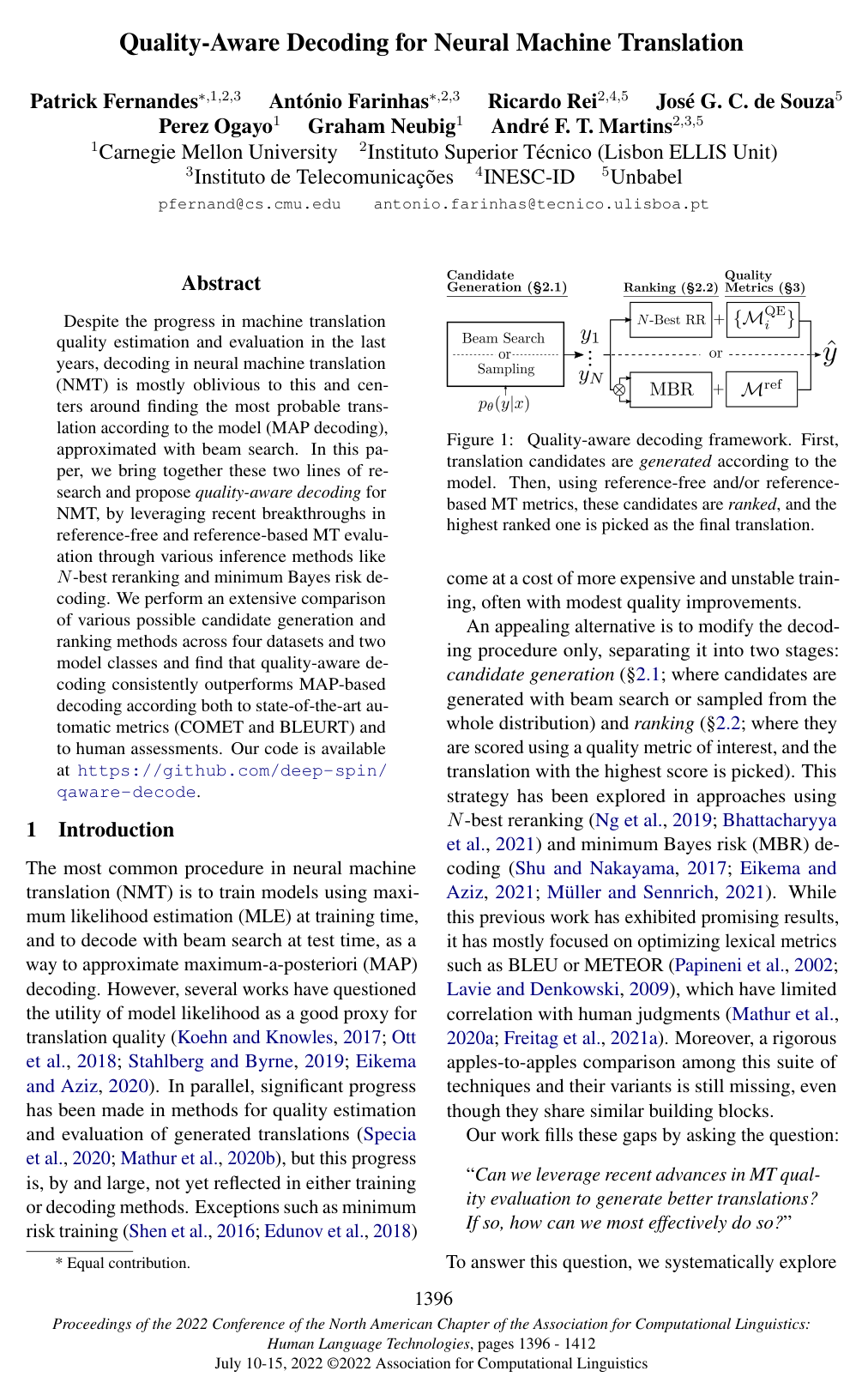
Quality-Aware Decoding for Neural Machine Translation
Patrick Fernandes, António Farinhas, Ricardo Rei, José Guilherme Camargo de Souza, Perez Ogayo, Graham Neubig, André F. T. Martins
Why you should read this
Proposes a unified quality-aware decoding framework that integrates modern reference-free and reference-based metrics into candidate reranking and Minimum Bayes Risk decoding, substantially outperforming standard beam search across modern neural translation benchmarks and human assessments.
Added
2026-10-03
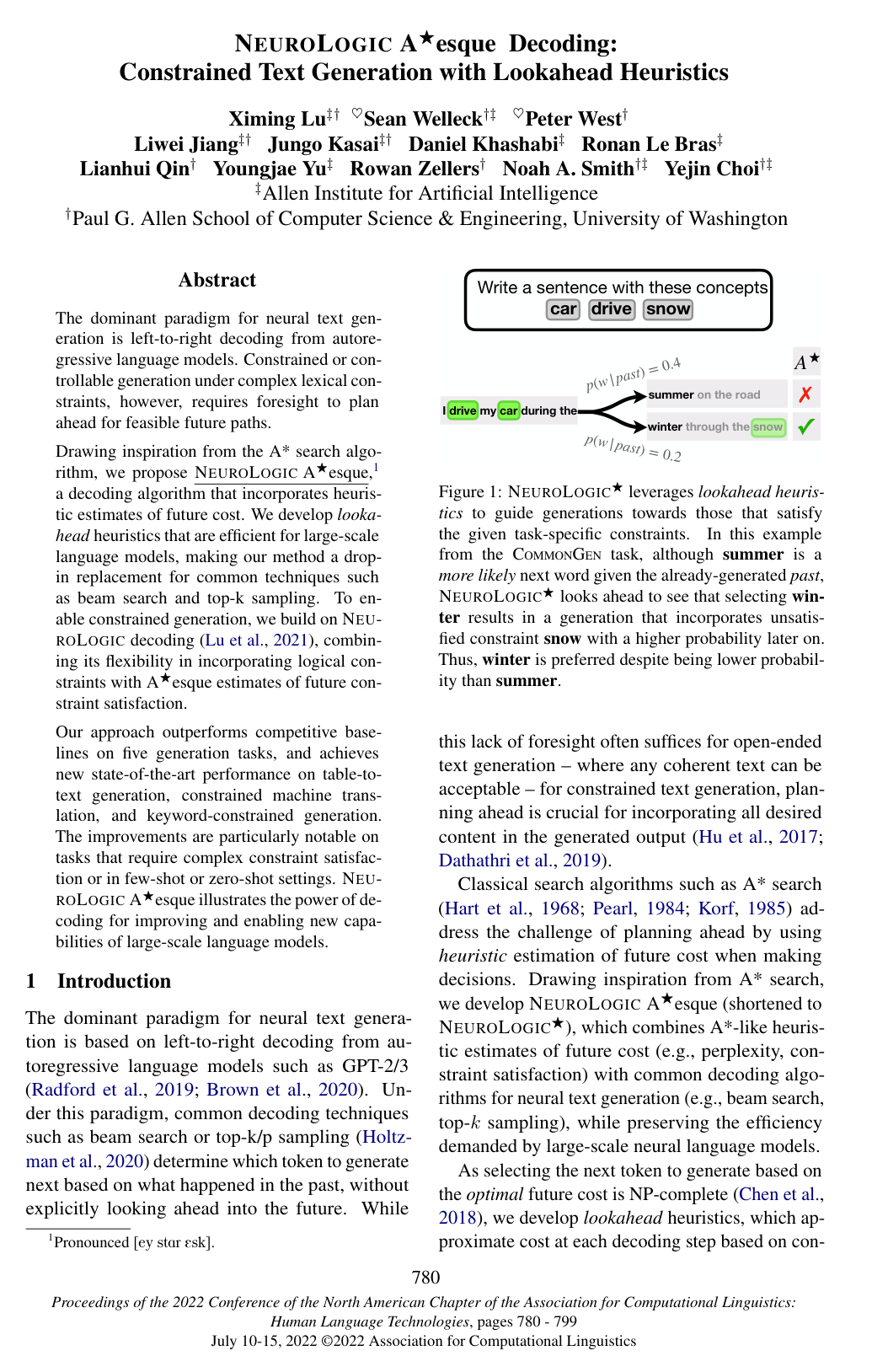
NeuroLogic A*esque Decoding: Constrained Text Generation with Lookahead Heuristics
Ximing Lu, Sean Welleck, Peter West, Liwei Jiang, Jungo Kasai, Daniel Khashabi, Ronan Le Bras, Lianhui Qin, Youngjae Yu, Rowan Zellers, Noah A. Smith, Yejin Choi
Why you should read this
Proposes an A*-inspired decoding algorithm with efficient lookahead heuristics that enables autoregressive language models to satisfy complex lexical constraints and achieve state-of-the-art performance across multiple text generation benchmarks without task-specific training data.
The dominant paradigm for neural text generation is left-to-right decoding from autoregressive language models. Constrained or controllable generation under complex lexical constraints, however, requires foresight to plan ahead for feasible future paths. Drawing inspiration from the A* search algorithm, we propose NEUROLOGIC A★esque,1 a decoding algorithm that incorporates heuristic estimates of future cost. We develop lookahead heuristics that are efficient for large-scale language models, making our method a drop-in replacement for common techniques such as beam search and top-k sampling. To enable constrained generation, we build on NEUROLOGIC decoding (Lu et al., 2021), combining its flexibility in incorporating logical constraints with A★esque estimates of future constraint satisfaction. Our approach outperforms competitive baselines on five generation tasks, and achieves new state-of-the-art performance on table-to-text generation, constrained machine translation, and keyword-constrained generation. The improvements are particularly notable on tasks that require complex constraint satisfaction or in few-shot or zero-shot settings. NEUROLOGIC A★esque illustrates the power of decoding for improving and enabling new capabilities of large-scale language models.
Added
2026-09-28
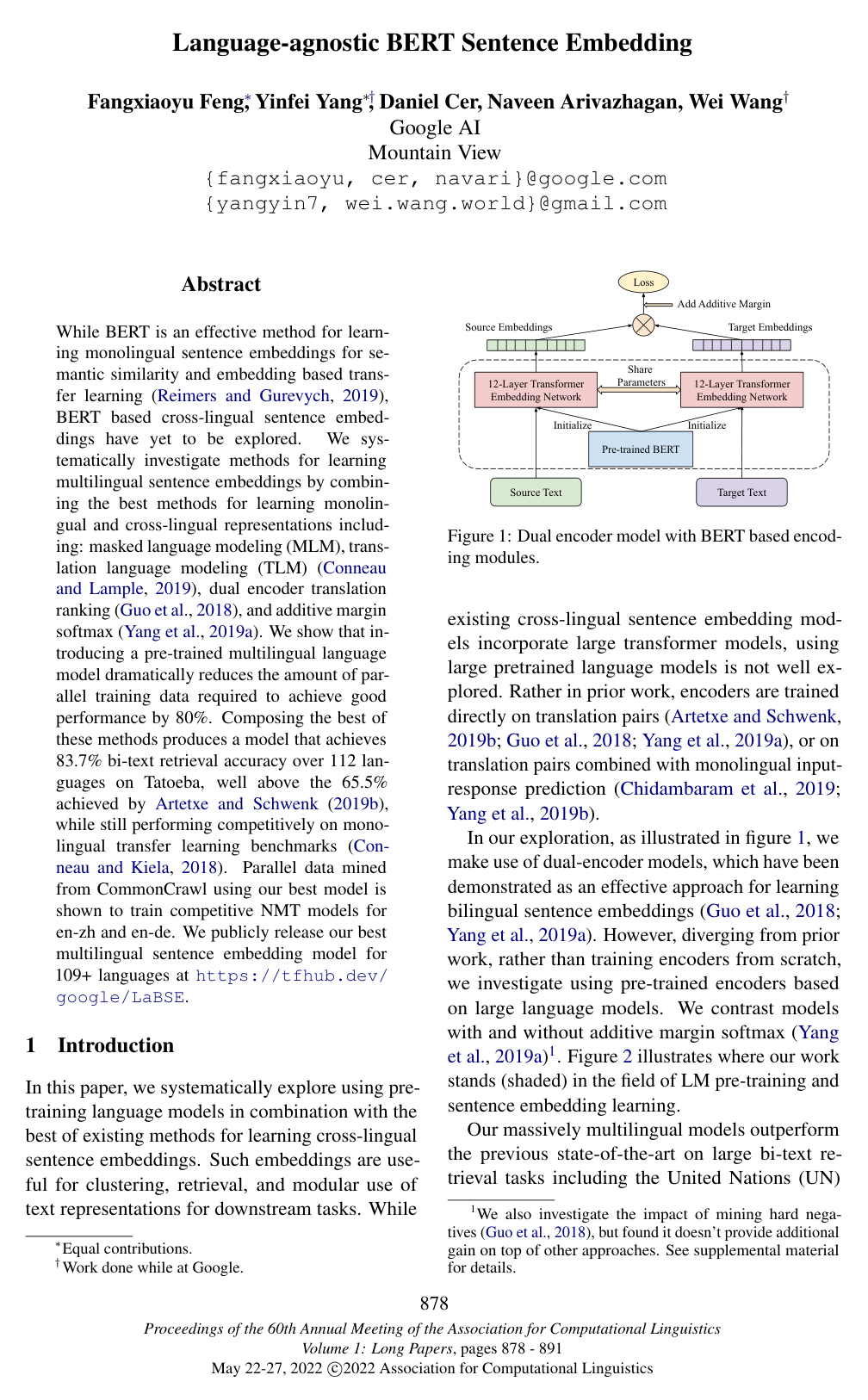
Language-agnostic BERT Sentence Embedding
Fangxiaoyu Feng, Yinfei Yang, Daniel Cer, Naveen Arivazhagan, Wei Wang
Why you should read this
Presents a multilingual sentence embedding framework combining pre-trained BERT models with dual-encoder translation ranking to reduce parallel data requirements by 80% while achieving state-of-the-art bitext retrieval performance across more than 100 languages.
While BERT is an effective method for learning monolingual sentence embeddings for semantic similarity and embedding based transfer learning (Reimers and Gurevych, 2019), BERT based cross-lingual sentence embeddings have yet to be explored. We systematically investigate methods for learning multilingual sentence embeddings by combining the best methods for learning monolingual and cross-lingual representations including: masked language modeling (MLM), translation language modeling (TLM) (Conneau and Lample, 2019), dual encoder translation ranking (Guo et al., 2018), and additive margin softmax (Yang et al., 2019a). We show that introducing a pre-trained multilingual language model dramatically reduces the amount of parallel training data required to achieve good performance by 80%. Composing the best of these methods produces a model that achieves 83.7% bi-text retrieval accuracy over 112 languages on Tatoeba, well above the 65.5% achieved by Artetxe and Schwenk (2019b), while still performing competitively on monolingual transfer learning benchmarks (Conneau and Kiela, 2018). Parallel data mined from CommonCrawl using our best model is shown to train competitive NMT models for en-zh and en-de. We publicly release our best multilingual sentence embedding model for 109+ languages at this https URL.
Added
2026-09-26

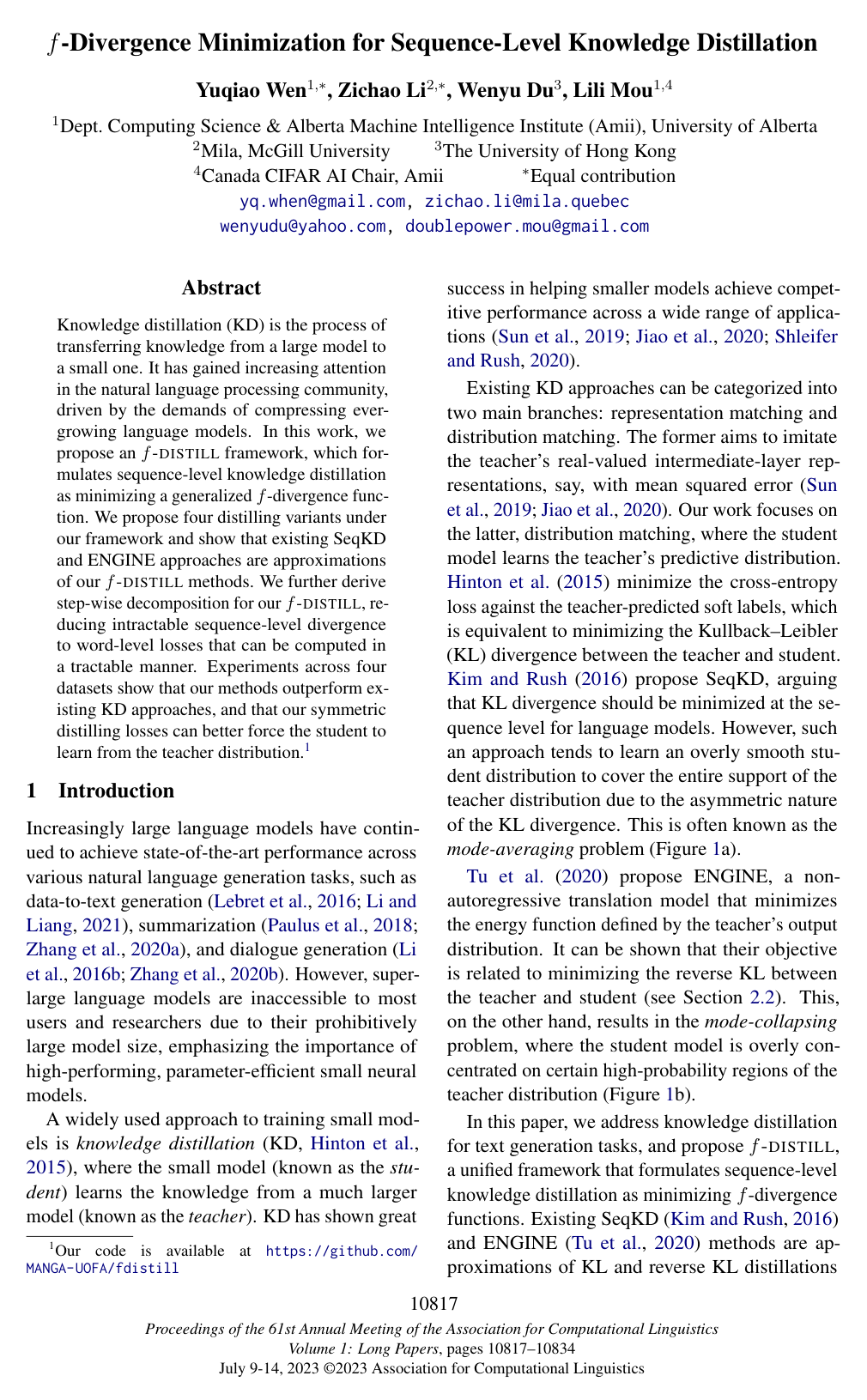
f-Divergence Minimization for Sequence-Level Knowledge Distillation
Yuqiao Wen, Zichao Li, Wenyu Du, Lili Mou
Why you should read this
Proposes a unified knowledge distillation framework that formulates sequence-level distillation as generalized f-divergence minimization, decomposing intractable sequence objectives into tractable word-level losses to mitigate mode averaging and mode collapse across text generation tasks.
Knowledge distillation (KD) is the process of transferring knowledge from a large model to a small one. It has gained increasing attention in the natural language processing community, driven by the demands of compressing ever-growing language models. In this work, we propose an f-DISTILL framework, which formulates sequence-level knowledge distillation as minimizing a generalized f-divergence function. We propose four distilling variants under our framework and show that existing SeqKD and ENGINE approaches are approximations of our f-DISTILL methods. We further derive step-wise decomposition for our f-DISTILL, reducing intractable sequence-level divergence to word-level losses that can be computed in a tractable manner. Experiments across four datasets show that our methods outperform existing KD approaches, and that our symmetric distilling losses can better force the student to learn from the teacher distribution.
Added
2026-09-26
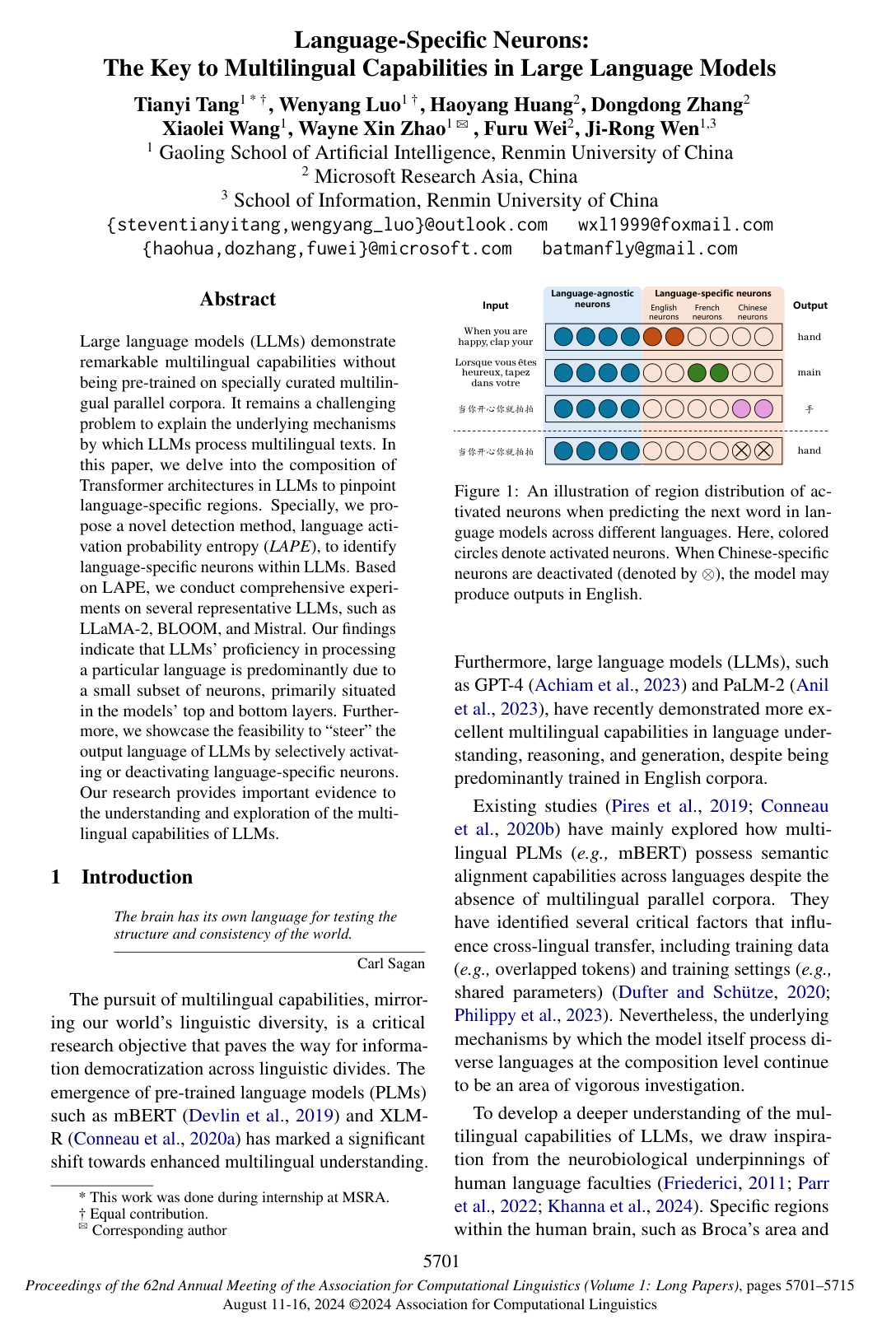
Language-Specific Neurons: The Key to Multilingual Capabilities in Large Language Models
Tianyi Tang, Wenyang Luo, Haoyang Huang, Dongdong Zhang, Xiaolei Wang, Xin Zhao, Furu Wei, Ji-Rong Wen
Why you should read this
Reveals that multilingual proficiency in large language models relies on a tiny subset of neurons located in the top and bottom layers, introducing an entropy-based detection method to identify and steer these language-specific units.
Large language models (LLMs) demonstrate remarkable multilingual capabilities without being pre-trained on specially curated multilingual parallel corpora. It remains a challenging problem to explain the underlying mechanisms by which LLMs process multilingual texts. In this paper, we delve into the composition of Transformer architectures in LLMs to pinpoint language-specific regions. Specifically, we propose a novel detection method, language activation probability entropy (LAPE), to identify language-specific neurons within LLMs. Based on LAPE, we conduct comprehensive experiments on several representative LLMs, such as LLaMA-2, BLOOM, and Mistral. Our findings indicate that LLMs' proficiency in processing a particular language is predominantly due to a small subset of neurons, primarily situated in the models' top and bottom layers. Furthermore, we showcase the feasibility to “steer” the output language of LLMs by selectively activating or deactivating language-specific neurons. Our research provides important evidence to the understanding and exploration of the multilingual capabilities of LLMs.
Added
2026-09-26
The Paradox of the Compositionality of Natural Language: A Neural Machine Translation Case Study
Verna Dankers, Elia Bruni, Dieuwke Hupkes
Why you should read this
Demonstrates that neural machine translation models fail to appropriately balance local and global compositionality when evaluated on natural data, exposing the limitations of assessing compositional generalization through rigid synthetic benchmarks alone.
Obtaining human-like performance in NLP is often argued to require compositional generalisation. Whether neural networks exhibit this ability is usually studied by training models on highly compositional synthetic data. However, compositionality in natural language is much more complex than the rigid, arithmetic-like version such data adheres to, and artificial compositionality tests thus do not allow us to determine how neural models deal with more realistic forms of compositionality. In this work, we re-instantiate three compositionality tests from the literature and reformulate them for neural machine translation (NMT). Our results highlight that: i) unfavourably, models trained on more data are more compositional; ii) models are sometimes less compositional than expected, but sometimes more, exemplifying that different levels of compositionality are required, and models are not always able to modulate between them correctly; iii) some of the non-compositional behaviours are mistakes, whereas others reflect the natural variation in data. Apart from an empirical study, our work is a call to action: we should rethink the evaluation of compositionality in neural networks and develop benchmarks using real data to evaluate compositionality on natural language, where composing meaning is not as straightforward as doing the math.^1
Added
2026-09-26
Speculative Decoding with Big Little Decoder
Sehoon Kim, Karttikeya Mangalam, Suhong Moon, Jitendra Malik, Michael W. Mahoney, Amir Gholami, Kurt Keutzer
Why you should read this
Proposes Big Little Decoder, a plug-and-play speculative decoding framework that pairs a small autoregressive model with an occasionally invoked large model via fallback and rollback policies to speed up text generation by up to 2.12× without requiring retraining or architectural changes.
The recent emergence of Large Language Models based on the Transformer architecture has enabled dramatic advancements in the field of Natural Language Processing. However, these models have long inference latency, which limits their deployment and makes them prohibitively expensive for various real-time applications. The inference latency is further exacerbated by autoregressive generative tasks, as models need to run iteratively to generate tokens sequentially without leveraging token-level parallelization. To address this, we propose Big Little Decoder (BiLD), a framework that can improve inference efficiency and latency for a wide range of text generation applications. The BiLD framework contains two models with different sizes that collaboratively generate text. The small model runs autoregressively to generate text with a low inference cost, and the large model is only invoked occasionally to refine the small model's inaccurate predictions in a non-autoregressive manner. To coordinate the small and large models, BiLD introduces two simple yet effective policies: (1) the fallback policy that determines when to hand control over to the large model; and (2) the rollback policy that determines when the large model needs to correct the small model's inaccurate predictions. To evaluate our framework across different tasks and models, we apply BiLD to various text generation scenarios encompassing machine translation on IWSLT 2017 De-En and WMT 2014 De-En, and summarization on XSUM and CNN/DailyMail. On an NVIDIA T4 GPU, our framework achieves a speedup of up to 2.12× speedup with minimal generation quality degradation. Furthermore, our framework is fully plug-and-play and can be applied without any modifications in the training process or model architecture. Our code is open-sourced¹.
Added
2026-09-26
Unified Speech-Text Pre-training for Speech Translation and Recognition
Yun Tang, Hongyu Gong, Ning Dong, Changhan Wang, Wei-Ning Hsu, Jiatao Gu, Alexei Baevski, Xian Li, Abdelrahman Mohamed, Michael Auli, Juan Miguel Pino
Why you should read this
Proposes a joint speech-text pre-training framework that integrates linguistic knowledge from text into speech models across four multi-task objectives, providing tailored encoder sharing strategies to resolve subtask interference and substantially boosting performance on speech translation and recognition.
We describe a method to jointly pre-train speech and text in an encoder-decoder modeling framework for speech translation and recognition. The proposed method incorporates four self-supervised and supervised subtasks for cross modality learning. A self-supervised speech subtask leverages unlabelled speech data, and a (self-)supervised text to text subtask makes use of abundant text training data. Two auxiliary supervised speech tasks are included to unify speech and text modeling space. Our contribution lies in integrating linguistic information from the text corpus into the speech pre-training. Detailed analysis reveals learning interference among subtasks. Two pre-training configurations for speech translation and recognition, respectively, are presented to alleviate subtask interference. Our experiments show the proposed method can effectively fuse speech and text information into one model. It achieves between 1.7 and 2.3 BLEU improvement above the state of the art on the MUST-C speech translation dataset and comparable WERs to wav2vec 2.0 on the LIBRISPEECH speech recognition task.
Added
2026-09-26
Composable Sparse Fine-Tuning for Cross-Lingual Transfer
Alan Ansell, Edoardo Maria Ponti, Anna Korhonen, Ivan Vulic
Why you should read this
Proposes Lottery Ticket Sparse Fine-Tuning, a parameter-efficient technique that learns and composes task- and language-specific parameter masks to achieve superior zero-shot cross-lingual transfer over adapter-based methods without altering model architecture or slowing inference.
Fine-tuning the entire set of parameters of a large pretrained model has become the mainstream approach for transfer learning. To increase its efficiency and prevent catastrophic forgetting and interference, techniques like adapters and sparse fine-tuning have been developed. Adapters are modular, as they can be combined to adapt a model towards different facets of knowledge (e.g., dedicated language and/or task adapters). Sparse fine-tuning is expressive, as it controls the behavior of all model components. In this work, we introduce a new fine-tuning method with both these desirable properties. In particular, we learn sparse, real-valued masks based on a simple variant of the Lottery Ticket Hypothesis. Task-specific masks are obtained from annotated data in a source language, and language-specific masks from masked language modeling in a target language. Both these masks can then be composed with the pretrained model. Unlike adapter-based fine-tuning, this method neither increases the number of parameters at inference time nor alters the original model architecture. Most importantly, it outperforms adapters in zero-shot cross-lingual transfer by a large margin in a series of multilingual benchmarks, including Universal Dependencies, MasakhaNER, and AmericasNLI. Based on an in-depth analysis, we additionally find that sparsity is crucial to prevent both 1) interference between the fine-tunings to be composed and 2) overfitting. We release the code and models at https://github.com/cambridgeltl/composable-sft.
Added
2026-09-26
Six Challenges for Neural Machine Translation
Philipp Koehn, Rebecca Knowles
Why you should read this
Exposes critical weaknesses in neural machine translation by benchmarking its failures against phrase-based systems across domain shifts, data scarcity, rare vocabulary, and decoding search errors.
We explore six challenges for neural machine translation: domain mismatch, amount of training data, rare words, long sentences, word alignment, and beam search. We show both deficiencies and improvements over the quality of phrase-based statistical machine translation.
Added
2026-09-25
Subword Regularization: Improving Neural Network Translation Models with Multiple Subword Candidates
Taku Kudo
Why you should read this
Proposes a unigram language model segmentation algorithm and a subword regularization technique that probabilistically samples multiple segmentations during training, significantly improving neural machine translation on low-resource and out-of-domain tasks.
Subword units are an effective way to alleviate the open vocabulary problems in neural machine translation (NMT). While sentences are usually converted into unique subword sequences, subword segmentation is potentially ambiguous and multiple segmentations are possible even with the same vocabulary. The question addressed in this paper is whether it is possible to harness the segmentation ambiguity as a noise to improve the robustness of NMT. We present a simple regularization method, subword regularization, which trains the model with multiple subword segmentations probabilistically sampled during training. In addition, for better subword sampling, we propose a new subword segmentation algorithm based on a unigram language model. We experiment with multiple corpora and report consistent improvements especially on low resource and out-of-domain settings.
Added
2026-09-25
Are Sixteen Heads Really Better than One?
Paul Michel, Omer Levy, Graham Neubig
Why you should read this
Reveals that a majority of attention heads in pretrained Transformer models can be pruned at test time without degrading performance, providing simple greedy algorithms that decrease inference latency and memory consumption.
Attention is a powerful and ubiquitous mechanism for allowing neural models to focus on particular salient pieces of information by taking their weighted average when making predictions. In particular, multi-headed attention is a driving force behind many recent state-of-the-art NLP models such as Transformer-based MT models and BERT. These models apply multiple attention mechanisms in parallel, with each attention "head" potentially focusing on different parts of the input, which makes it possible to express sophisticated functions beyond the simple weighted average. In this paper we make the surprising observation that even if models have been trained using multiple heads, in practice, a large percentage of attention heads can be removed at test time without significantly impacting performance. In fact, some layers can even be reduced to a single head. We further examine greedy algorithms for pruning down models, and the potential speed, memory efficiency, and accuracy improvements obtainable therefrom. Finally, we analyze the results with respect to which parts of the model are more reliant on having multiple heads, and provide precursory evidence that training dynamics play a role in the gains provided by multi-head attention.
Added
2026-09-25
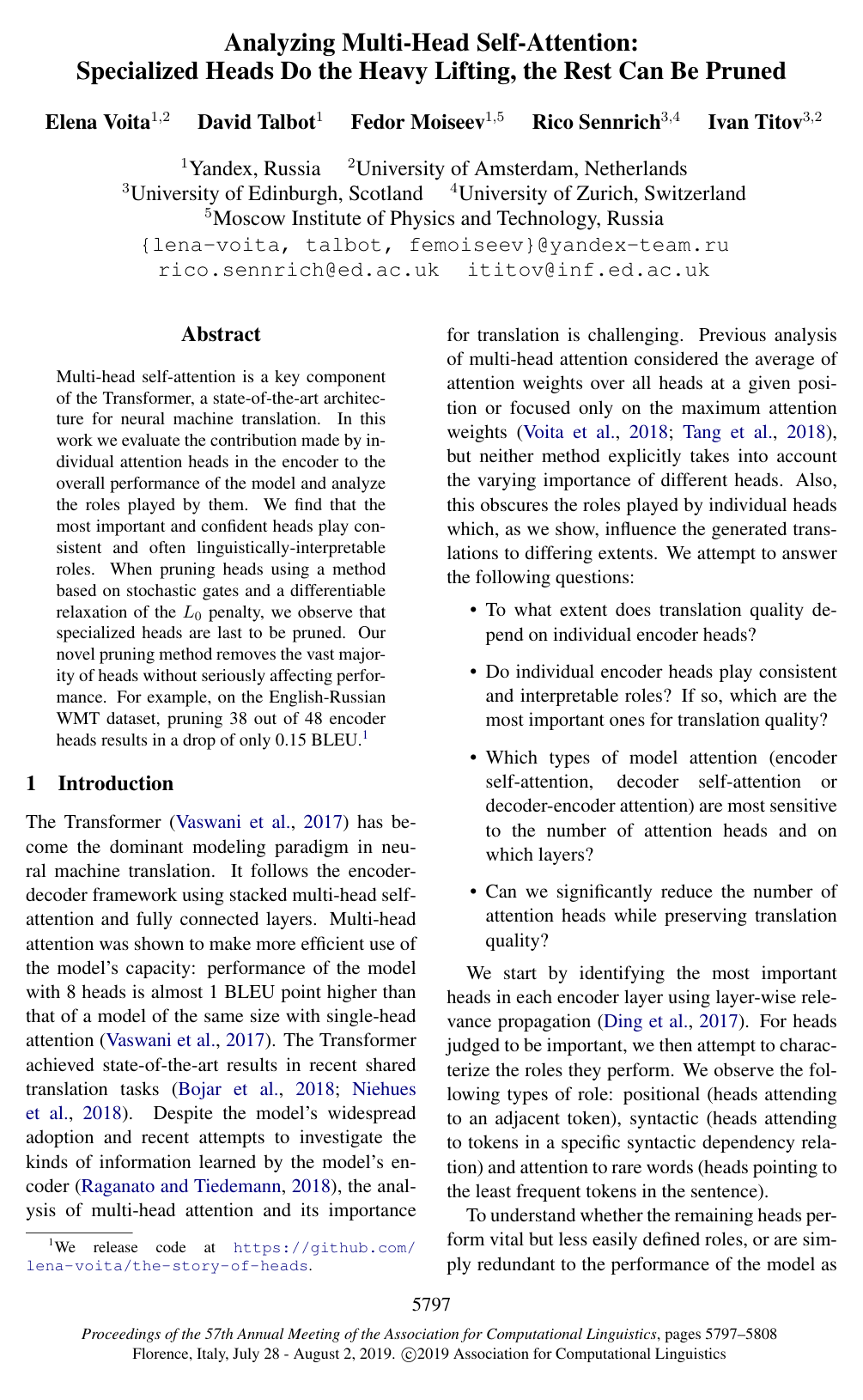
Analyzing Multi-Head Self-Attention: Specialized Heads Do the Heavy Lifting, the Rest Can Be Pruned
Elena Voita, David Talbot, Fedor Moiseev, Rico Sennrich, Ivan Titov
Why you should read this
Demonstrates that the vast majority of attention heads in Transformer models are redundant and can be pruned using an L0 regularization technique without degrading translation quality, while proving that the essential remaining heads perform interpretable linguistic functions.
Multi-head self-attention is a key component of the Transformer, a state-of-the-art architecture for neural machine translation. In this work we evaluate the contribution made by individual attention heads in the encoder to the overall performance of the model and analyze the roles played by them. We find that the most important and confident heads play consistent and often linguistically-interpretable roles. When pruning heads using a method based on stochastic gates and a differentiable relaxation of the L0 penalty, we observe that specialized heads are last to be pruned. Our novel pruning method removes the vast majority of heads without seriously affecting performance. For example, on the English-Russian WMT dataset, pruning 38 out of 48 encoder heads results in a drop of only 0.15 BLEU.
Added
2026-09-25
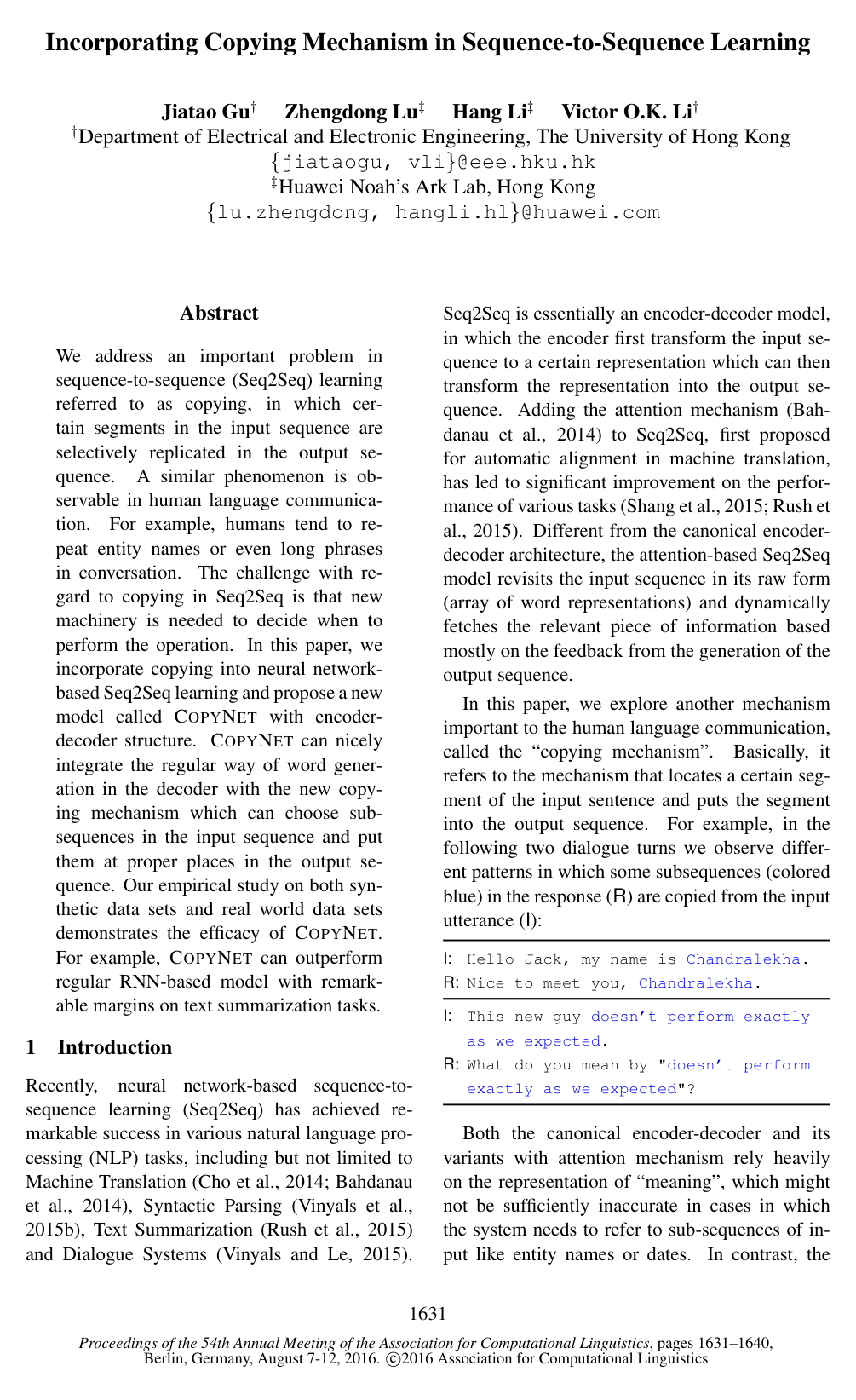
Incorporating Copying Mechanism in Sequence-to-Sequence Learning
Jiatao Gu, Zhengdong Lu, Hang Li, Victor O. K. Li
Why you should read this
Proposes CopyNet, an encoder-decoder model that integrates a copying mechanism directly with standard vocabulary generation to replicate input segments like entity names and phrases, resolving out-of-vocabulary and repetition challenges in sequence-to-sequence tasks like text summarization.
We address an important problem in sequence-to-sequence (Seq2Seq) learning referred to as copying, in which certain segments in the input sequence are selectively replicated in the output sequence. A similar phenomenon is observable in human language communication. For example, humans tend to repeat entity names or even long phrases in conversation. The challenge with regard to copying in Seq2Seq is that new machinery is needed to decide when to perform the operation. In this paper, we incorporate copying into neural network-based Seq2Seq learning and propose a new model called CopyNet with encoder-decoder structure. CopyNet can nicely integrate the regular way of word generation in the decoder with the new copying mechanism which can choose sub-sequences in the input sequence and put them at proper places in the output sequence. Our empirical study on both synthetic data sets and real world data sets demonstrates the efficacy of CopyNet. For example, CopyNet can outperform regular RNN-based model with remarkable margins on text summarization tasks.
Added
2026-09-24
Recent Advances in Natural Language Processing via Large Pre-trained Language Models: A Survey
Bonan Min, Hayley Ross, Elior Sulem, Amir Pouran Ben Veyseh, Thien Huu Nguyen, Oscar Sainz, Eneko Agirre, Ilana Heinz, Dan Roth
Why you should read this
Synthesizes how modern transformer-based language models are adapted across natural language processing tasks through fine-tuning, prompting, text generation, and data augmentation while identifying key limitations and open research directions.
Large, pre-trained transformer-based language models such as BERT have drastically changed the Natural Language Processing (NLP) field. We present a survey of recent work that uses these large language models to solve NLP tasks via pre-training then fine-tuning, prompting, or text generation approaches. We also present approaches that use pre-trained language models to generate data for training augmentation or other purposes. We conclude with discussions on limitations and suggested directions for future research.
Added
2026-09-24
Scaling Language Models: Methods, Analysis & Insights from Training Gopher
Jack W. Rae, Sebastian Borgeaud, Trevor Cai, Katie Millican, Jordan Hoffmann, Francis Song, John Aslanides, Sarah Henderson, Roman Ring, Susannah Young, Eliza Rutherford, Tom Hennigan, Jacob Menick, Albin Cassirer, Richard Powell, George van den Driessche, Lisa Anne Hendricks, Maribeth Rauh, Po-Sen Huang, Amelia Glaese, Johannes Welbl, Sumanth Dathathri, Saffron Huang, Jonathan Uesato, John Mellor, Irina Higgins, Antonia Creswell, Nat McAleese, Amy Wu, Erich Elsen, Siddhant Jayakumar, Elena Buchatskaya, David Budden, Esme Sutherland, Karen Simonyan, Michela Paganini, Laurent Sifre, Lena Martens, Xiang Lorraine Li, Adhiguna Kuncoro, Aida Nematzadeh, Elena Gribovskaya, Domenic Donato, Angeliki Lazaridou, Arthur Mensch, Jean-Baptiste Lespiau, Maria Tsimpoukelli, Nikolai Grigorev, Doug Fritz, Thibault Sottiaux, Mantas Pajarskas, Toby Pohlen, Zhitao Gong, Daniel Toyama, Cyprien de Masson d'Autume, Yujia Li, Tayfun Terzi, Vladimir Mikulik, Igor Babuschkin, Aidan Clark, Diego de Las Casas, Aurelia Guy, Chris Jones, James Bradbury, Matthew Johnson, Blake Hechtman, Laura Weidinger, Iason Gabriel, William Isaac, Ed Lockhart, Simon Osindero, Laura Rimell, Chris Dyer, Oriol Vinyals, Kareem Ayoub, Jeff Stanway, Lorrayne Bennett, Demis Hassabis, Koray Kavukcuoglu, Geoffrey Irving
Why you should read this
Analyzes the performance of Transformer language models scaled up to the 280-billion-parameter Gopher across 152 tasks, providing empirical evidence on which capabilities improve with size and where logical reasoning and safety limitations persist.
Language modelling provides a step towards intelligent communication systems by harnessing large repositories of written human knowledge to better predict and understand the world. In this paper, we present an analysis of Transformer-based language model performance across a wide range of model scales -- from models with tens of millions of parameters up to a 280 billion parameter model called Gopher. These models are evaluated on 152 diverse tasks, achieving state-of-the-art performance across the majority. Gains from scale are largest in areas such as reading comprehension, fact-checking, and the identification of toxic language, but logical and mathematical reasoning see less benefit. We provide a holistic analysis of the training dataset and model's behaviour, covering the intersection of model scale with bias and toxicity. Finally we discuss the application of language models to AI safety and the mitigation of downstream harms.
Added
2026-09-24