
keyword
neural fields
A neural field, also known as an implicit neural representation or coordinate-based neural network, is a mathematical field parameterized fully or partially by a neural network that maps continuous spatial, temporal, or spatiotemporal coordinates to corresponding physical, geometric, or visual quantities. Unlike traditional discrete representations such as pixel arrays, voxel grids, point clouds, or polygon meshes, neural fields evaluate signals continuously at arbitrary locations, making them resolution-independent, memory-efficient, and inherently differentiable. They are widely used across visual computing and computational physics to model continuous phenomena, including 3D surface geometry, color and volumetric radiance, material properties, and solutions to differential equations.
8 items
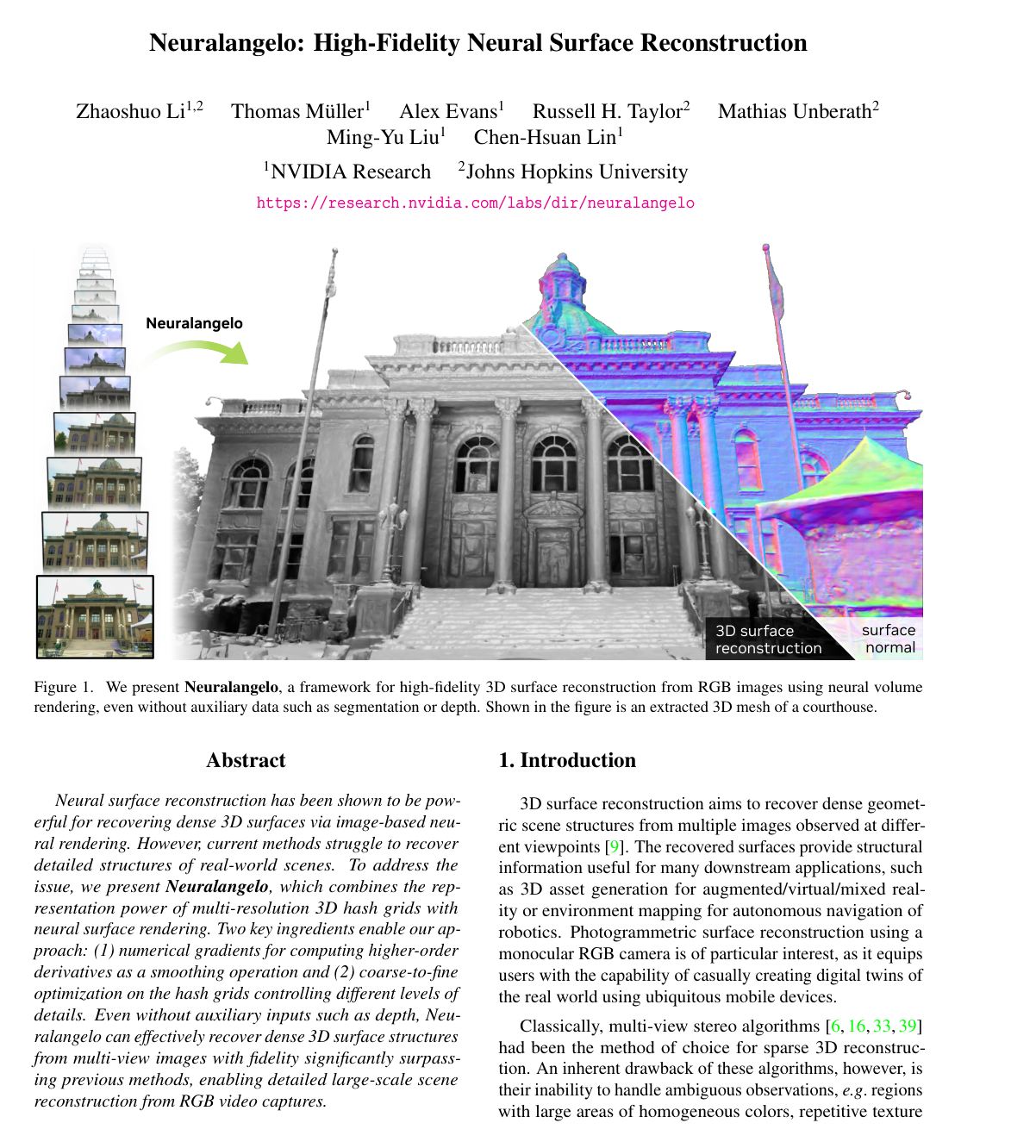
Neuralangelo: High-Fidelity Neural Surface Reconstruction
Zhaoshuo Li, Thomas Müller, Alex Evans, Russell H. Taylor, Mathias Unberath, Ming-Yu Liu, Chen-Hsuan Lin
Why you should read this
Presents Neuralangelo, a neural surface reconstruction method that combines multi-resolution 3D hash grids with numerical gradient optimization to recover highly detailed 3D surfaces from standard RGB video without auxiliary depth data.
Neural surface reconstruction has been shown to be powerful for recovering dense 3D surfaces via image-based neural rendering. However, current methods struggle to recover detailed structures of real-world scenes. To address the issue, we present Neuralangelo, which combines the representation power of multi-resolution 3D hash grids with neural surface rendering. Two key ingredients enable our approach: (1) numerical gradients for computing higher-order derivatives as a smoothing operation and (2) coarse-to-fine optimization on the hash grids controlling different levels of details. Even without auxiliary inputs such as depth, Neuralangelo can effectively recover dense 3D surface structures from multi-view images with fidelity significantly surpassing previous methods, enabling detailed large-scale scene reconstruction from RGB video captures.
Added
2026-10-05
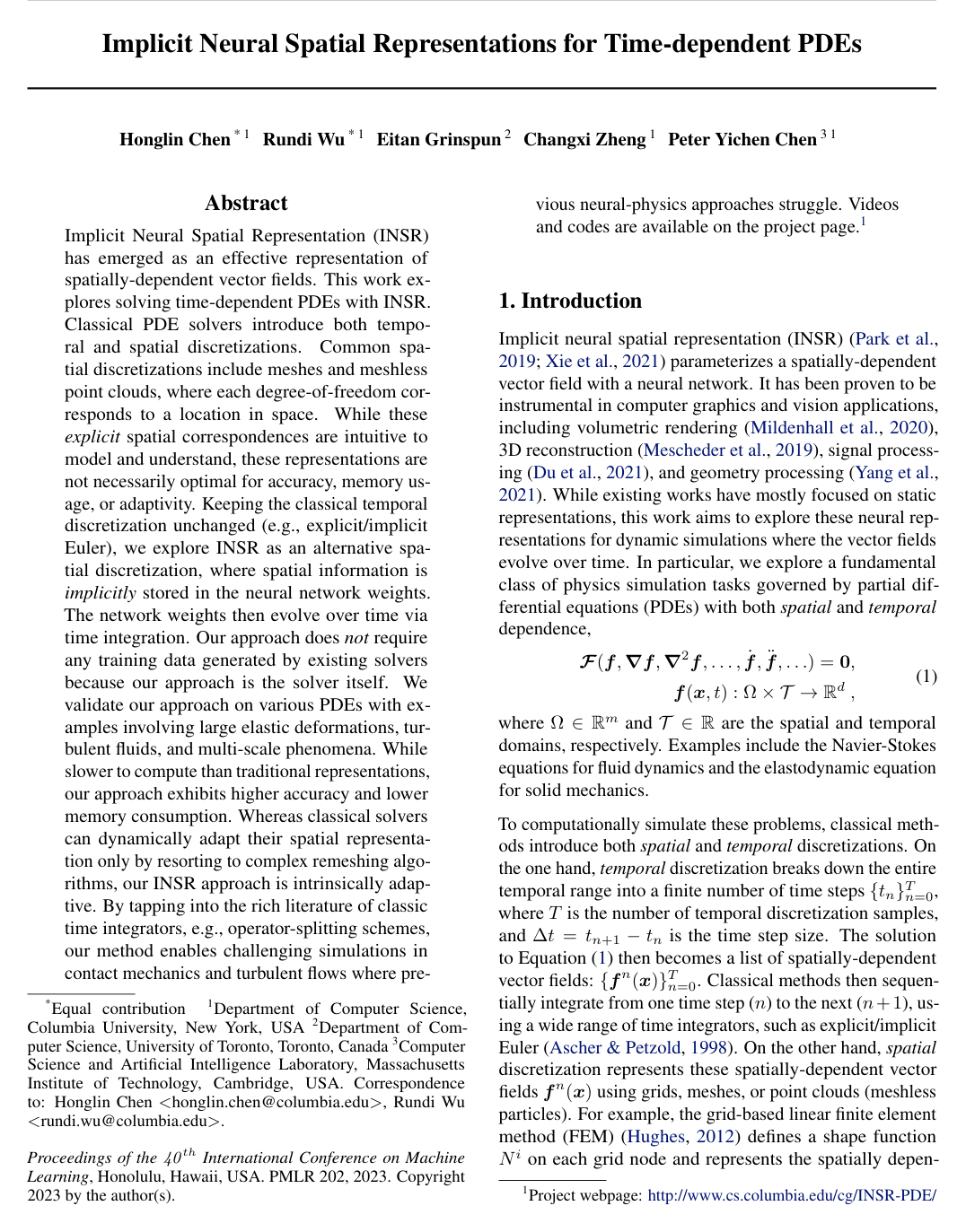
Implicit Neural Spatial Representations for Time-dependent PDEs
Honglin Chen, Rundi Wu, Eitan Grinspun, Changxi Zheng, Peter Yichen Chen
Why you should read this
Proposes replacing traditional spatial grids with implicit neural representations evolved through classical time integrators, enabling higher accuracy, lower memory usage, and intrinsic spatial adaptivity for time-dependent physics simulations without requiring pre-generated training data.
Implicit Neural Spatial Representation (INSR) has emerged as an effective representation of spatially-dependent vector fields. This work explores solving time-dependent PDEs with INSR. Classical PDE solvers introduce both temporal and spatial discretizations. Common spatial discretizations include meshes and meshless point clouds, where each degree-of-freedom corresponds to a location in space. While these explicit spatial correspondences are intuitive to model and understand, these representations are not necessarily optimal for accuracy, memory usage, or adaptivity. Keeping the classical temporal discretization unchanged (e.g., explicit/implicit Euler), we explore INSR as an alternative spatial discretization, where spatial information is implicitly stored in the neural network weights. The network weights then evolve over time via time integration. Our approach does not require any training data generated by existing solvers because our approach is the solver itself. We validate our approach on various PDEs with examples involving large elastic deformations, turbulent fluids, and multi-scale phenomena. While slower to compute than traditional representations, our approach exhibits higher accuracy and lower memory consumption. Whereas classical solvers can dynamically adapt their spatial representation only by resorting to complex remeshing algorithms, our INSR approach is intrinsically adaptive. By tapping into the rich literature of classic time integrators, e.g., operator-splitting schemes, our method enables challenging simulations in contact mechanics and turbulent flows where previous neural-physics approaches struggle. Videos and codes are available on the project page.
Added
2026-10-03
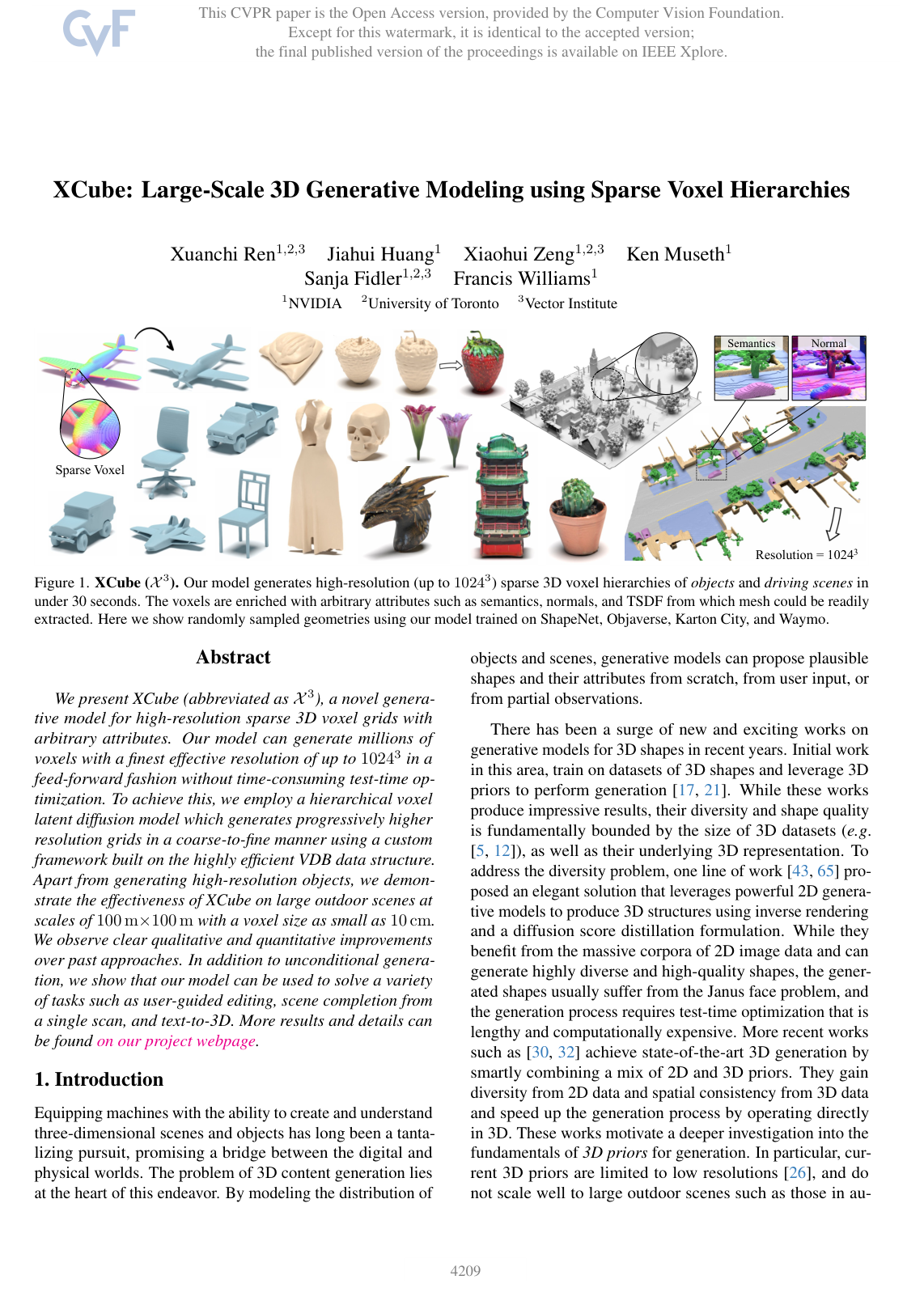
XCube: Large-Scale 3D Generative Modeling using Sparse Voxel Hierarchies
Xuanchi Ren, Jiahui Huang, Xiaohui Zeng, Ken Museth, Sanja Fidler, Francis Williams
Why you should read this
Presents a hierarchical sparse voxel latent diffusion framework built on VDB data structures that rapidly generates high-resolution 3D objects and large-scale outdoor scenes with rich geometric and semantic attributes without test-time optimization.
We present XCube (abbreviated as X3), a novel generative model for high-resolution sparse 3D voxel grids with arbitrary attributes. Our model can generate millions of voxels with a finest effective resolution of up to 10243 in a feed-forward fashion without time-consuming test-time optimization. To achieve this, we employ a hierarchical voxel latent diffusion model which generates progressively higher resolution grids in a coarse-to-fine manner using a custom framework built on the highly efficient VDB data structure. Apart from generating high-resolution objects, we demonstrate the effectiveness of XCube on large outdoor scenes at scales of 100 m×100 m with a voxel size as small as 10 cm. We observe clear qualitative and quantitative improvements over past approaches. In addition to unconditional generation, we show that our model can be used to solve a variety of tasks such as user-guided editing, scene completion from a single scan, and text-to-3D. More results and details can be found on our project webpage.
Added
2026-09-26
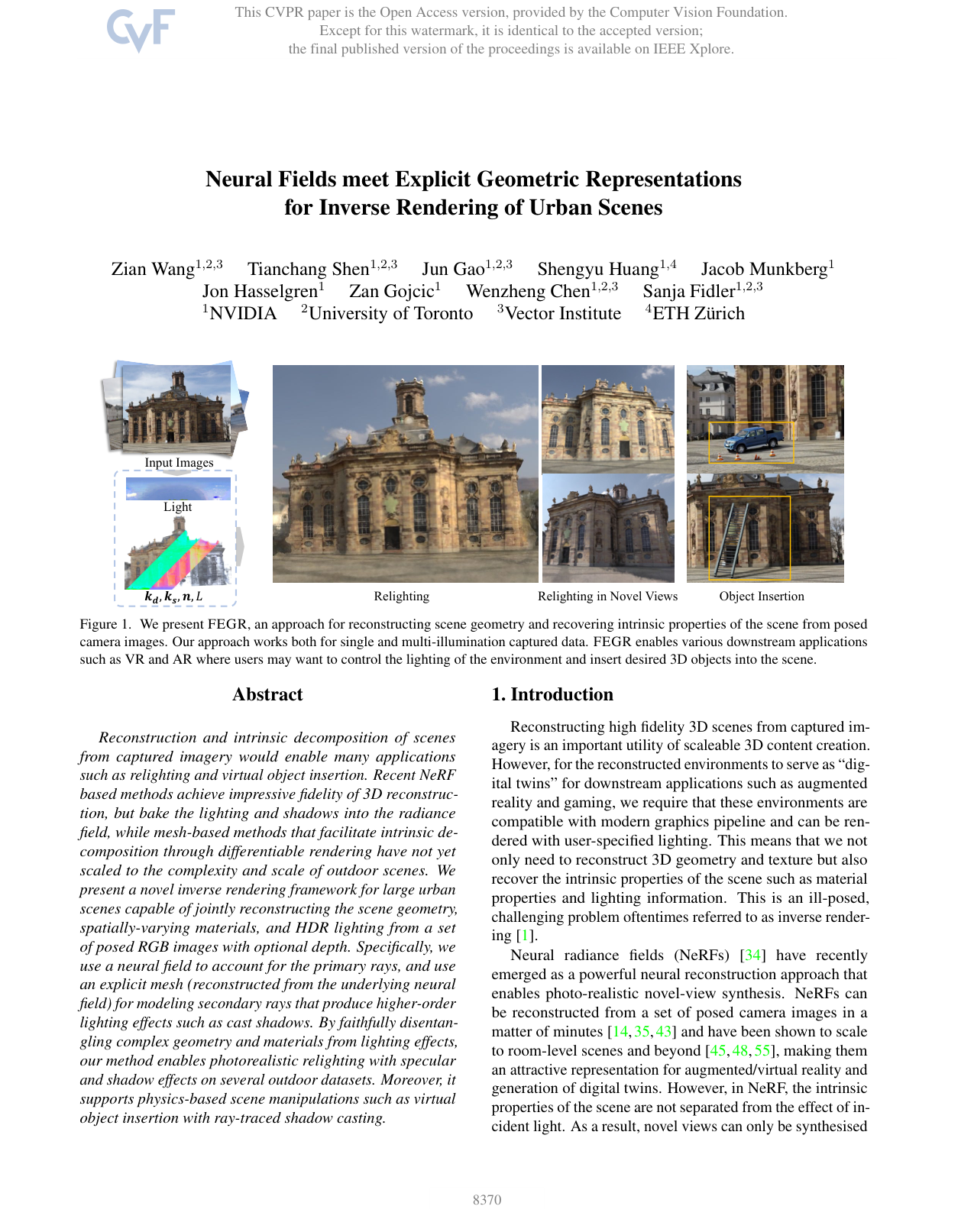
Neural Fields Meet Explicit Geometric Representations for Inverse Rendering of Urban Scenes
Zian Wang, Tianchang Shen, Jun Gao, Shengyu Huang, Jacob Munkberg, Jon Hasselgren, Zan Gojcic, Wenzheng Chen, Sanja Fidler
Why you should read this
Presents a hybrid inverse rendering framework that couples neural fields for primary ray representation with explicit reconstructed meshes for efficient secondary ray tracing, enabling photorealistic relighting, shadow casting, and virtual object insertion in large-scale urban environments.
Reconstruction and intrinsic decomposition of scenes from captured imagery would enable many applications such as relighting and virtual object insertion. Recent NeRF based methods achieve impressive fidelity of 3D reconstruction, but bake the lighting and shadows into the radiance field, while mesh-based methods that facilitate intrinsic decomposition through differentiable rendering have not yet scaled to the complexity and scale of outdoor scenes. We present a novel inverse rendering framework for large urban scenes capable of jointly reconstructing the scene geometry, spatially-varying materials, and HDR lighting from a set of posed RGB images with optional depth. Specifically, we use a neural field to account for the primary rays, and use an explicit mesh (reconstructed from the underlying neural field) for modeling secondary rays that produce higher-order lighting effects such as cast shadows. By faithfully disentangling complex geometry and materials from lighting effects, our method enables photorealistic relighting with specular and shadow effects on several outdoor datasets. Moreover, it supports physics-based scene manipulations such as virtual object insertion with ray-traced shadow casting.
Added
2026-09-26
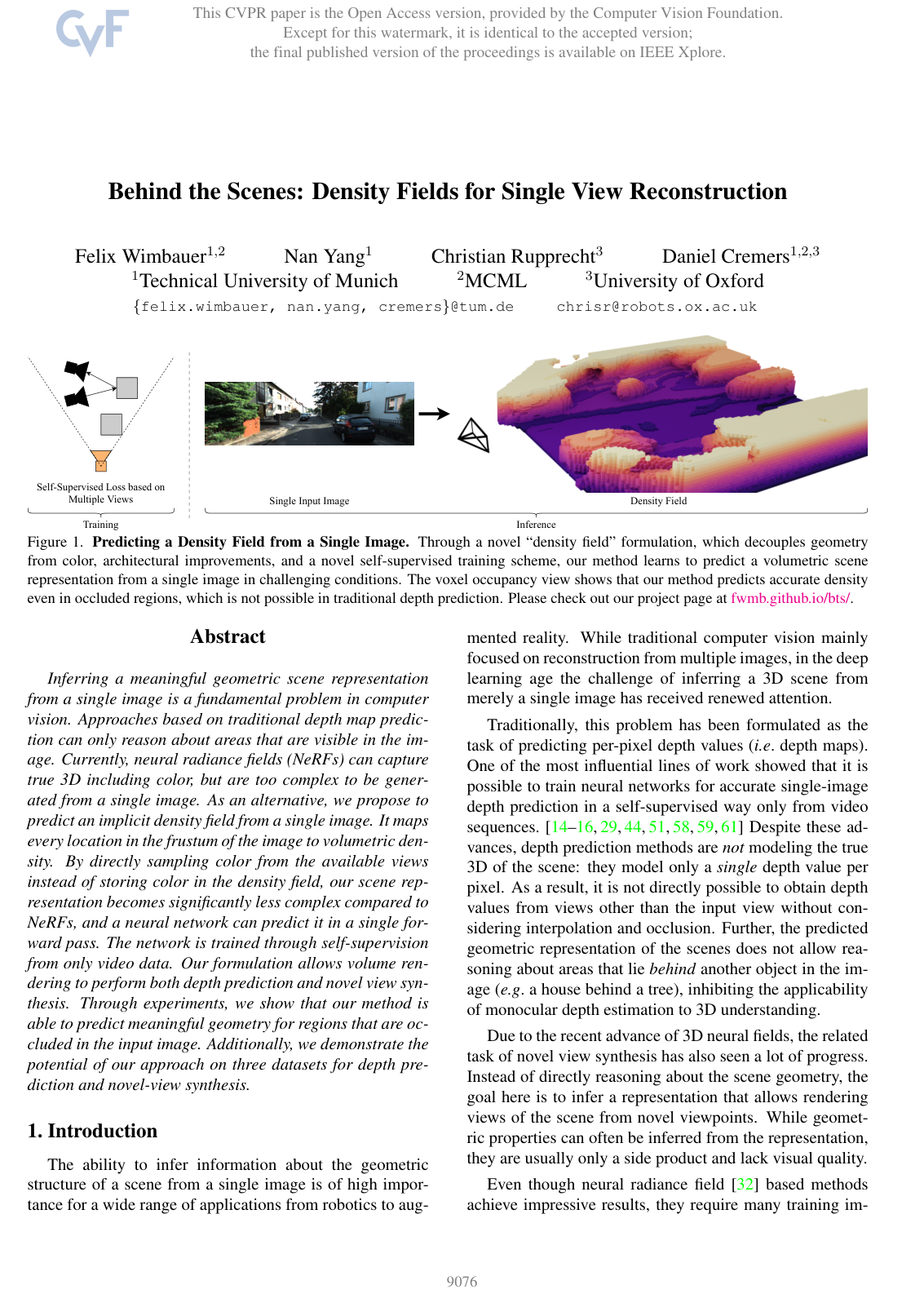
Behind the Scenes: Density Fields for Single View Reconstruction
Felix Wimbauer, Nan Yang, Christian Rupprecht, Daniel Cremers
Why you should read this
Proposes a self-supervised framework that predicts continuous 3D density fields from a single image by decoupling geometry from color, enabling accurate reconstruction of occluded scene structures and novel view synthesis in complex outdoor environments.
Inferring a meaningful geometric scene representation from a single image is a fundamental problem in computer vision. Approaches based on traditional depth map prediction can only reason about areas that are visible in the image. Currently, neural radiance fields (NeRFs) can capture true 3D including color, but are too complex to be generated from a single image. As an alternative, we propose to predict an implicit density field from a single image. It maps every location in the frustum of the image to volumetric density. By directly sampling color from the available views instead of storing color in the density field, our scene representation becomes significantly less complex compared to NeRFs, and a neural network can predict it in a single forward pass. The network is trained through self-supervision from only video data. Our formulation allows volume rendering to perform both depth prediction and novel view synthesis. Through experiments, we show that our method is able to predict meaningful geometry for regions that are occluded in the input image. Additionally, we demonstrate the potential of our approach on three datasets for depth prediction and novel-view synthesis.
Added
2026-09-26
Signal Processing for Implicit Neural Representations
Dejia Xu, Peihao Wang, Yifan Jiang, Zhiwen Fan, Zhangyang Wang
Why you should read this
Develops an implicit signal processing framework that uses analytical high-order differential operators to perform continuous convolutions, low-level filtering, and high-level classification directly on coordinate-based neural representations without requiring explicit decoding.
Implicit Neural Representations (INRs) encoding continuous multi-media data via multi-layer perceptrons has shown undebatable promise in various computer vision tasks. Despite many successful applications, editing and processing an INR remains intractable as signals are represented by latent parameters of a neural network. Existing works manipulate such continuous representations via processing on their discretized instance, which breaks down the compactness and continuous nature of INR. In this work, we present a pilot study on the question: how to directly modify an INR without explicit decoding? We answer this question by proposing an implicit neural signal processing network, dubbed INSP-Net, via differential operators on INR. Our key insight is that spatial gradients of neural networks can be computed analytically and are invariant to translation, while mathematically we show that any continuous convolution filter can be uniformly approximated by a linear combination of high-order differential operators. With these two knobs, INSP-Net instantiates the signal processing operator as a weighted composition of computational graphs corresponding to the high-order derivatives of INRs, where the weighting parameters can be data-driven learned. Based on our proposed INSP-Net, we further build the first Convolutional Neural Network (CNN) that implicitly runs on INRs, named INSP-ConvNet. Our experiments validate the expressiveness of INSP-Net and INSP-ConvNet in fitting low-level image and geometry processing kernels (e.g. blurring, deblurring, denoising, inpainting, and smoothening) as well as for high-level tasks on implicit fields such as image classification.
Added
2026-09-26
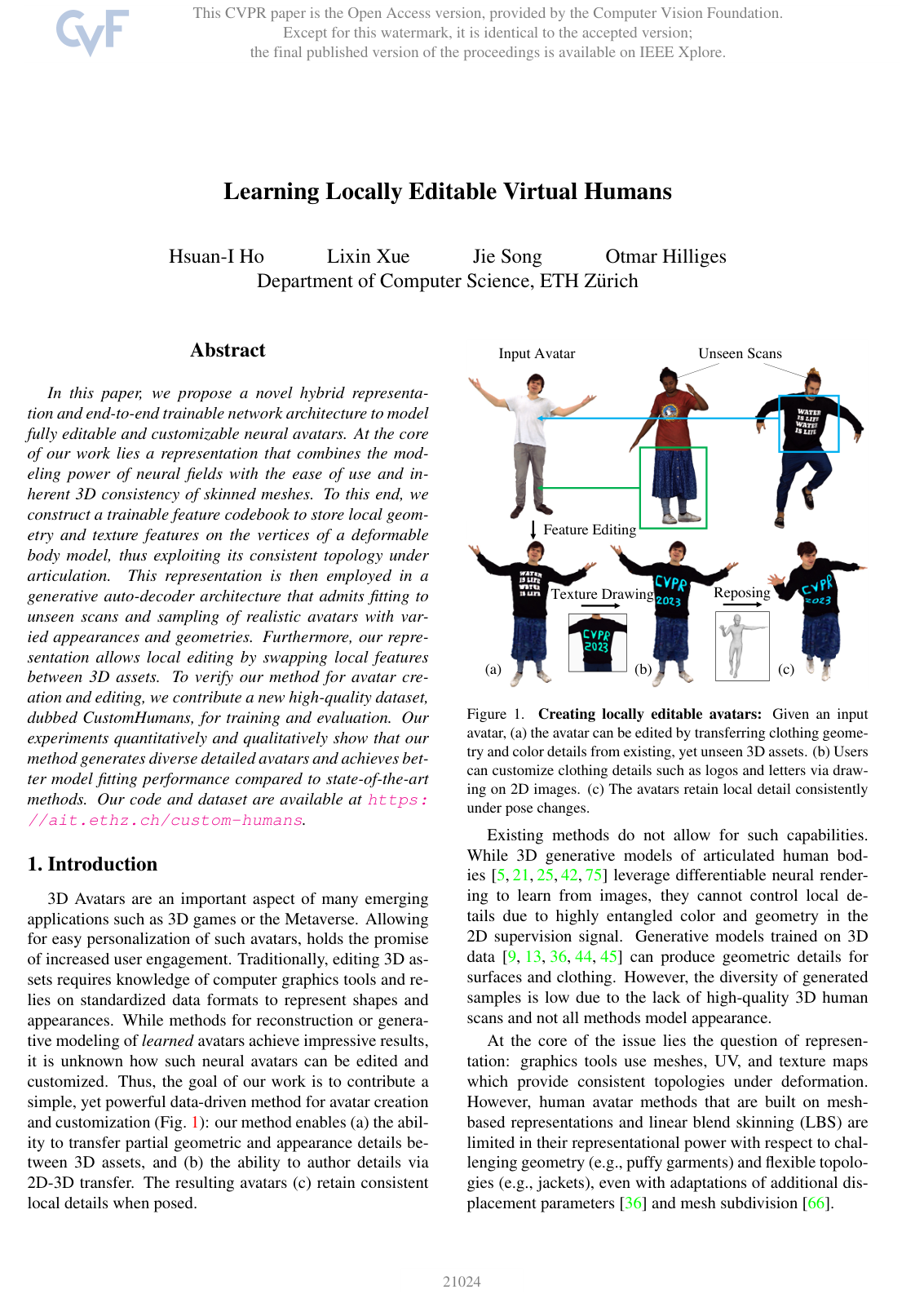
Learning Locally Editable Virtual Humans
Hsuan-I Ho, Lixin Xue, Jie Song, Otmar Hilliges
Why you should read this
Proposes a hybrid neural representation anchored to skinned mesh vertices that enables fine-grained local editing, texture painting, and generative modeling of articulate 3D human avatars.
In this paper, we propose a novel hybrid representation and end-to-end trainable network architecture to model fully editable and customizable neural avatars. At the core of our work lies a representation that combines the modeling power of neural fields with the ease of use and inherent 3D consistency of skinned meshes. To this end, we construct a trainable feature codebook to store local geometry and texture features on the vertices of a deformable body model, thus exploiting its consistent topology under articulation. This representation is then employed in a generative auto-decoder architecture that admits fitting to unseen scans and sampling of realistic avatars with varied appearances and geometries. Furthermore, our representation allows local editing by swapping local features between 3D assets. To verify our method for avatar creation and editing, we contribute a new high-quality dataset, dubbed CustomHumans, for training and evaluation. Our experiments quantitatively and qualitatively show that our method generates diverse detailed avatars and achieves better model fitting performance compared to state-of-the-art methods. Our code and dataset are available at https://ait.ethz.ch/custom-humans.
Added
2026-09-26
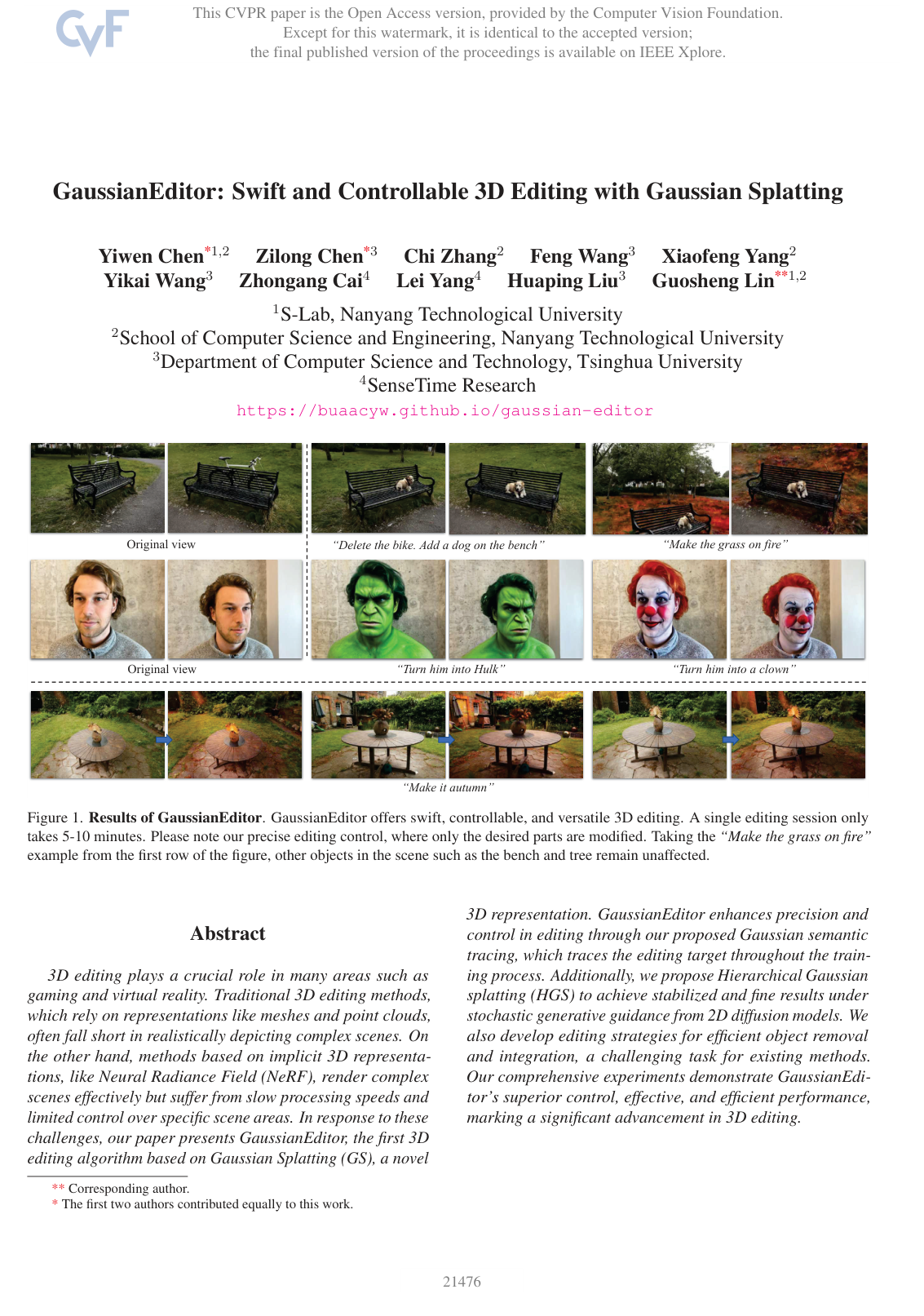
GaussianEditor: Swift and Controllable 3D Editing with Gaussian Splatting
Yiwen Chen, Zilong Chen, Chi Zhang, Feng Wang, Xiaofeng Yang, Yikai Wang, Zhongang Cai, Lei Yang, Huaping Liu, Guosheng Lin
Why you should read this
Proposes GaussianEditor, the first 3D editing framework built on Gaussian Splatting that uses semantic tracing and hierarchical constraints to enable fast, highly localized object insertion, removal, and text-guided scene modification within minutes.
3D editing plays a crucial role in many areas such as gaming and virtual reality. Traditional 3D editing methods, which rely on representations like meshes and point clouds, often fall short in realistically depicting complex scenes. On the other hand, methods based on implicit 3D representations, like Neural Radiance Field (NeRF), render complex scenes effectively but suffer from slow processing speeds and limited control over specific scene areas. In response to these challenges, our paper presents GaussianEditor, the first 3D editing algorithm based on Gaussian Splatting (GS), a novel 3D representation. GaussianEditor enhances precision and control in editing through our proposed Gaussian semantic tracing, which traces the editing target throughout the training process. Additionally, we propose Hierarchical Gaussian splatting (HGS) to achieve stabilized and fine results under stochastic generative guidance from 2D diffusion models. We also develop editing strategies for efficient object removal and integration, a challenging task for existing methods. Our comprehensive experiments demonstrate GaussianEditor's superior control, effective, and efficient performance, marking a significant advancement in 3D editing.
Added
2026-09-26