
keyword
network motifs
Network motifs are small, recurring subgraph patterns within a complex network that appear significantly more frequently than would be expected by chance in randomized reference networks. Often conceptualized as the elementary building blocks of complex systems, these higher-order connectivity patterns capture interactions beyond simple pairwise links and help explain how local arrangements organize to govern system-wide behavior. They are widely utilized across network science, computational biology, and graph machine learning to analyze information processing, function, and topology in biological, chemical, technological, and social systems.
4 items
Molecular Representation Learning via Heterogeneous Motif Graph Neural Networks
Zhaoning Yu, Hongyang Gao
Why you should read this
Proposes a heterogeneous motif graph neural network that captures cross-molecule structural patterns by linking shared motifs and whole molecules, enabling efficient multi-task representation learning and superior molecular property prediction on small datasets.
We consider feature representation learning problem of molecular graphs. Graph Neural Networks have been widely used in feature representation learning of molecular graphs. However, most existing methods deal with molecular graphs individually while neglecting their connections, such as motif-level relationships. We propose a novel molecular graph representation learning method by constructing a heterogeneous motif graph to address this issue. In particular, we build a heterogeneous motif graph that contains motif nodes and molecular nodes. Each motif node corresponds to a motif extracted from molecules. Then, we propose a Heterogeneous Motif Graph Neural Network (HM-GNN) to learn feature representations for each node in the heterogeneous motif graph. Our heterogeneous motif graph also enables effective multi-task learning, especially for small molecular datasets. To address the potential efficiency issue, we propose to use an edge sampler, which can significantly reduce computational resources usage. The experimental results show that our model consistently outperforms previous state-of-the-art models. Under multi-task settings, the promising performances of our methods on combined datasets shed light on a new learning paradigm for small molecular datasets. Finally, we show that our model achieves similar performances with significantly less computational resources by using our edge sampler.
Added
2026-09-26
Higher-order organization of complex networks
Austin R. Benson, David F. Gleich, Jure Leskovec
Why you should read this
Develops a scalable, mathematically rigorous framework for clustering complex networks based on higher-order subgraph patterns rather than simple edges, exposing functional modular structures in massive biological, neural, and transportation systems.
Networks are a fundamental tool for understanding and modeling complex systems in physics, biology, neuroscience, engineering, and social science. Many networks are known to exhibit rich, lower-order connectivity patterns that can be captured at the level of individual nodes and edges. However, higher-order organization of complex networks---at the level of small network subgraphs---remains largely unknown. Here we develop a generalized framework for clustering networks based on higher-order connectivity patterns. This framework provides mathematical guarantees on the optimality of obtained clusters and scales to networks with billions of edges. The framework reveals higher-order organization in a number of networks including information propagation units in neuronal networks and hub structure in transportation networks. Results show that networks exhibit rich higher-order organizational structures that are exposed by clustering based on higher-order connectivity patterns.
Added
2026-09-25
Networks beyond pairwise interactions: structure and dynamics
Federico Battiston, Giulia Cencetti, Iacopo Iacopini, Vito Latora, Maxime Lucas, Alice Patania, Jean-Gabriel Young, Giovanni Petri
Why you should read this
Unifies the mathematical frameworks, structural metrics, and dynamical models of higher-order networks to demonstrate how group interactions across hypergraphs and simplicial complexes fundamentally change processes such as diffusion, contagion, and synchronization.
The complexity of many biological, social and technological systems stems from the richness of the interactions among their units. Over the past decades, a great variety of complex systems has been successfully described as networks whose interacting pairs of nodes are connected by links. Yet, in face-to-face human communication, chemical reactions and ecological systems, interactions can occur in groups of three or more nodes and cannot be simply described just in terms of simple dyads. Until recently, little attention has been devoted to the higher-order architecture of real complex systems. However, a mounting body of evidence is showing that taking the higher-order structure of these systems into account can greatly enhance our modeling capacities and help us to understand and predict their emerging dynamical behaviors. Here, we present a complete overview of the emerging field of networks beyond pairwise interactions. We first discuss the methods to represent higher-order interactions and give a unified presentation of the different frameworks used to describe higher-order systems, highlighting the links between the existing concepts and representations. We review the measures designed to characterize the structure of these systems and the models proposed in the literature to generate synthetic structures, such as random and growing simplicial complexes, bipartite graphs and hypergraphs. We introduce and discuss the rapidly growing research on higher-order dynamical systems and on dynamical topology. We focus on novel emergent phenomena characterizing landmark dynamical processes, such as diffusion, spreading, synchronization and games, when extended beyond pairwise interactions. We elucidate the relations between higher-order topology and dynamical properties, and conclude with a summary of empirical applications, providing an outlook on current modeling and conceptual frontiers.
Added
2026-09-24
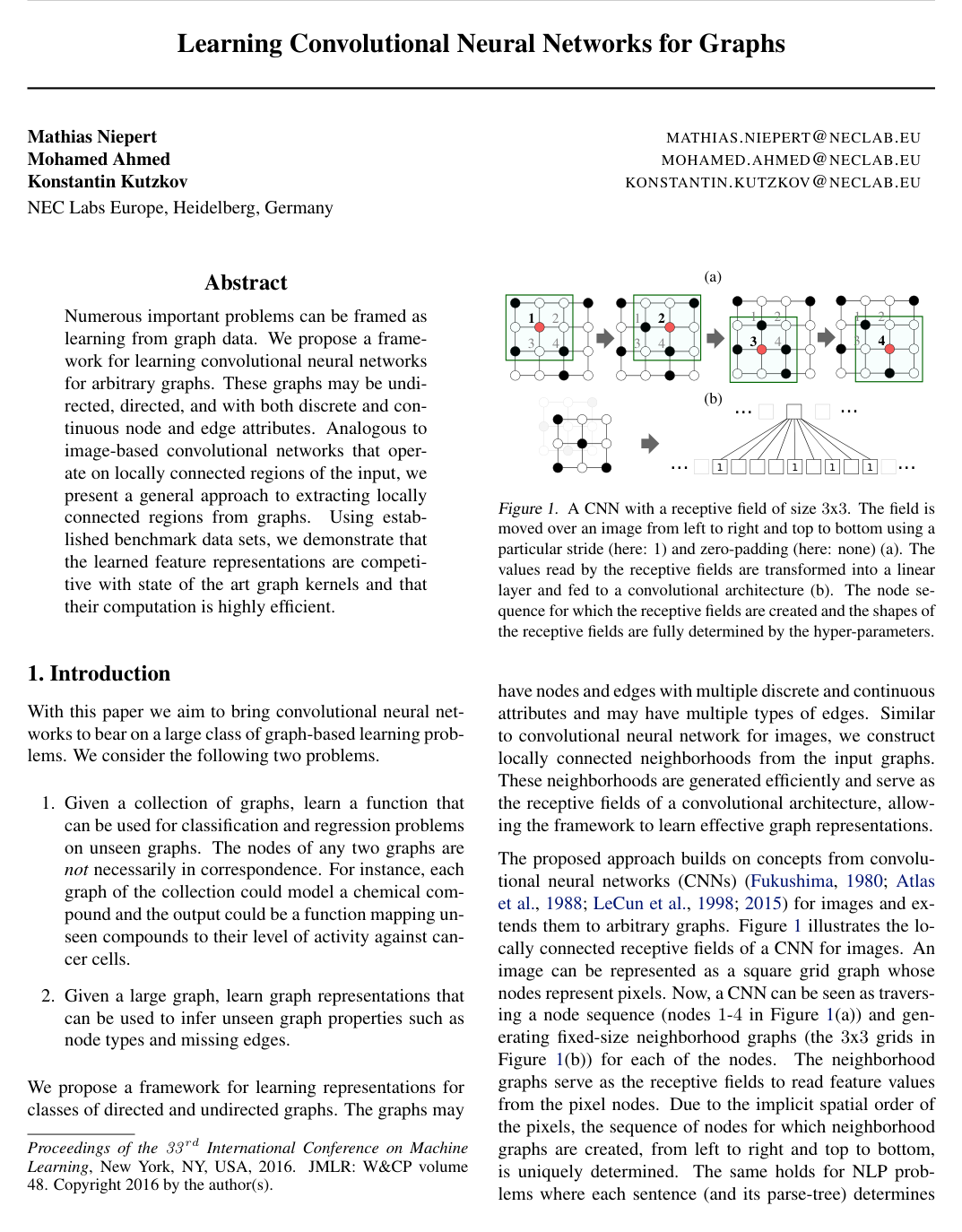
Learning Convolutional Neural Networks for Graphs
Mathias Niepert, Mohamed Ahmed, Konstantin Kutzkov
Why you should read this
Develops a general framework for applying convolutional neural networks directly to arbitrary graphs by extracting and ordering local neighborhood subgraphs, matching graph kernel classification performance with greater computational efficiency.
Numerous important problems can be framed as learning from graph data. We propose a framework for learning convolutional neural networks for arbitrary graphs. These graphs may be undirected, directed, and with both discrete and continuous node and edge attributes. Analogous to image-based convolutional networks that operate on locally connected regions of the input, we present a general approach to extracting locally connected regions from graphs. Using established benchmark data sets, we demonstrate that the learned feature representations are competitive with state of the art graph kernels and that their computation is highly efficient.
Added
2026-09-16