
keyword
multimodal reasoning
Multimodal reasoning is the computational or cognitive capability to combine, align, and jointly infer across information derived from two or more distinct data modalities, such as text, images, diagrams, video, and audio, to solve complex problems and draw coherent conclusions. Unlike unimodal processing or basic perceptual recognition, multimodal reasoning requires understanding the mutual relationships and dependencies between different representations, where the necessary context or logic is distributed across modalities rather than contained in a single medium. In artificial intelligence and machine learning, this involves integrating perceptual data with language models to execute structured, multi-step deductions, enabling systems to perform advanced tasks such as visual question answering, mathematical and spatial analysis, diagram interpretation, and cross-modal verification.
26 items
EXAMS-V: A Multi-Discipline Multilingual Multimodal Exam Benchmark for Evaluating Vision Language Models
Rocktim Jyoti Das, Simeon Emilov Hristov, Haonan Li, Dimitar Dimitrov, Ivan Koychev, Preslav Nakov
Why you should read this
Introduces EXAMS-V, a benchmark of over 20,000 real-world exam questions across 20 academic disciplines and 11 languages to evaluate how effectively vision-language models perform joint visual and textual reasoning on culturally diverse school subjects.
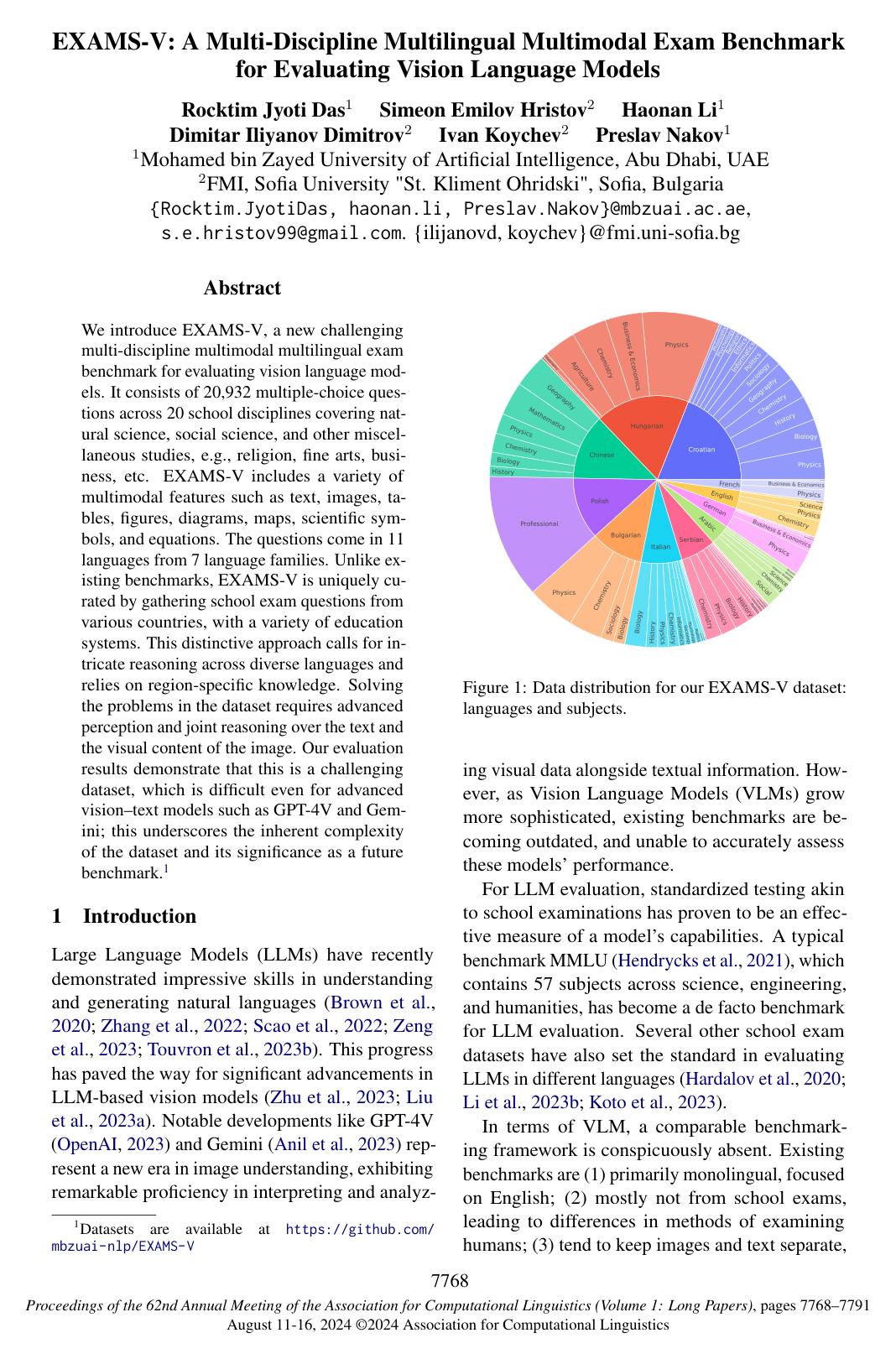
We introduce EXAMS-V, a new challenging multi-discipline multimodal multilingual exam benchmark for evaluating vision language models. It consists of 20,932 multiple-choice questions across 20 school disciplines covering natural science, social science, and other miscellaneous studies, e.g., religion, fine arts, business, etc. EXAMS-V includes a variety of multimodal features such as text, images, tables, figures, diagrams, maps, scientific symbols, and equations. The questions come in 11 languages from 7 language families. Unlike existing benchmarks, EXAMS-V is uniquely curated by gathering school exam questions from various countries, with a variety of education systems. This distinctive approach calls for intricate reasoning across diverse languages and relies on region-specific knowledge. Solving the problems in the dataset requires advanced perception and joint reasoning over the text and the visual content of the image. Our evaluation results demonstrate that this is a challenging dataset, which is difficult even for advanced vision–text models such as GPT-4V and Gemini; this underscores the inherent complexity of the dataset and its significance as a future benchmark.
Added
2026-10-03
Puzzle Solving using Reasoning of Large Language Models: A Survey
Panagiotis Giadikiaroglou, Maria Lymperaiou, Giorgos Filandrianos, Giorgos Stamou
Why you should read this
Categorizes puzzle-solving benchmarks into rule-based and rule-less domains to systematically evaluate large language models across prompting, neuro-symbolic, and fine-tuning strategies while identifying current gaps in automated logical reasoning.
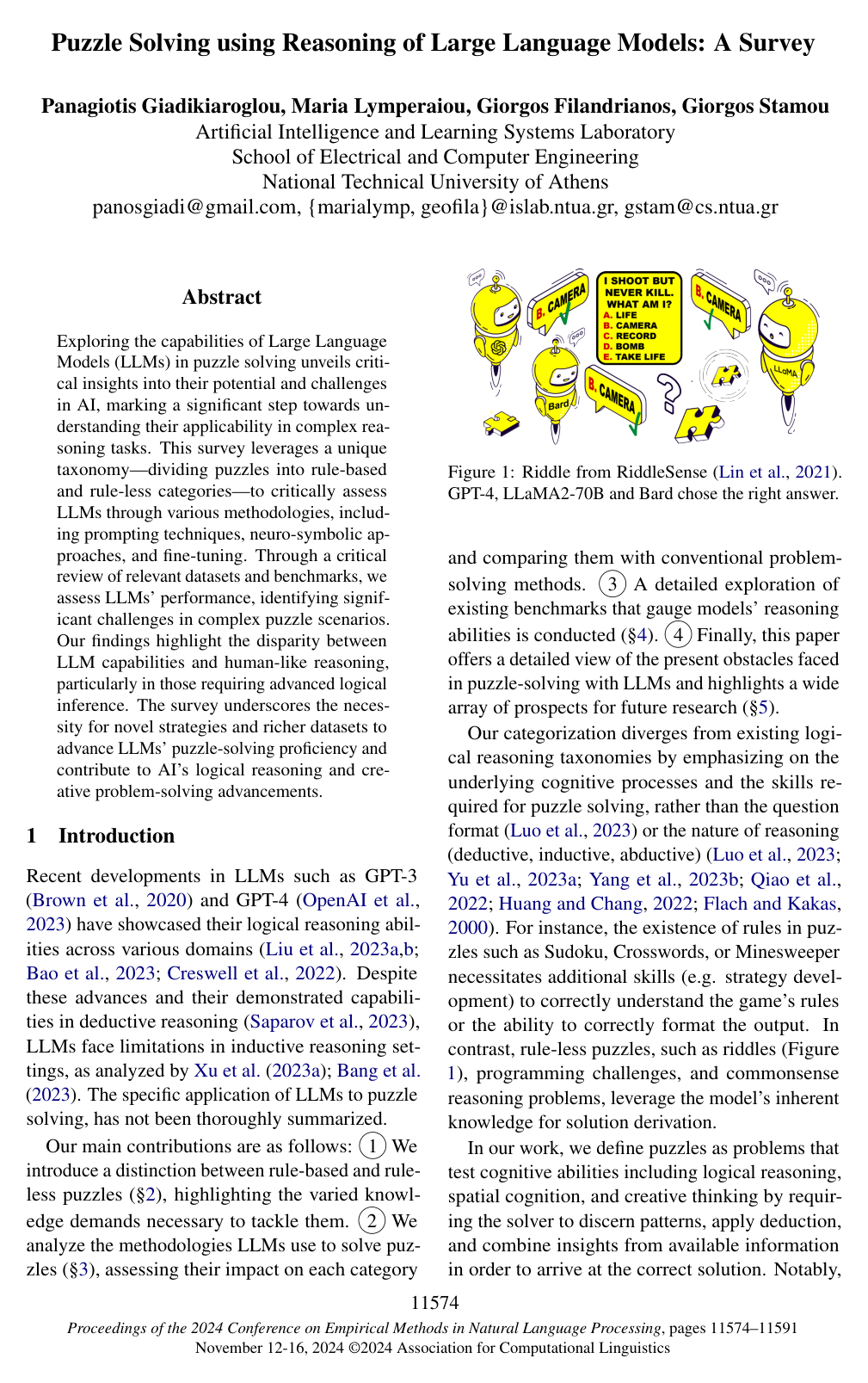
Exploring the capabilities of Large Language Models (LLMs) in puzzle solving unveils critical insights into their potential and challenges in AI, marking a significant step towards understanding their applicability in complex reasoning tasks. This survey leverages a unique taxonomy—dividing puzzles into rule-based and rule-less categories—to critically assess LLMs through various methodologies, including prompting techniques, neuro-symbolic approaches, and fine-tuning. Through a critical review of relevant datasets and benchmarks, we assess LLMs’ performance, identifying significant challenges in complex puzzle scenarios. Our findings highlight the disparity between LLM capabilities and human-like reasoning, particularly in those requiring advanced logical inference. The survey underscores the necessity for novel strategies and richer datasets to advance LLMs’ puzzle-solving proficiency and contribute to AI’s logical reasoning and creative problem-solving advancements.
Added
2026-10-03
MedCoT: Medical Chain of Thought via Hierarchical Expert
Jiaxiang Liu, Yuan Wang, Jiawei Du, Joey Zhou, Zuozhu Liu
Why you should read this
Proposes a hierarchical multi-expert chain-of-thought framework for medical visual question answering that validates step-by-step diagnostic rationales and outperforms models over twenty times its size without requiring manual rationale annotations.
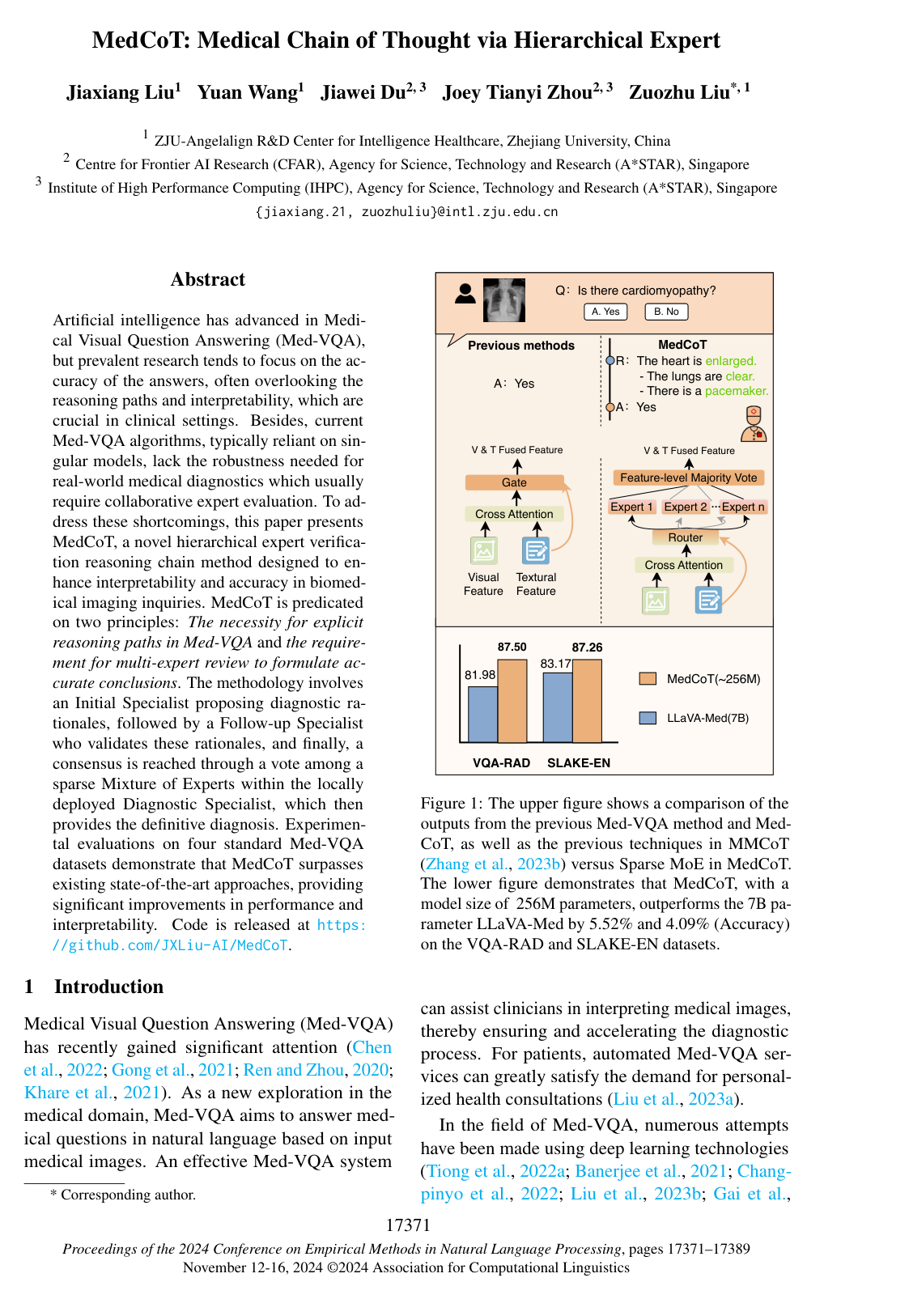
Artificial intelligence has advanced in Medical Visual Question Answering (Med-VQA), but prevalent research tends to focus on the accuracy of the answers, often overlooking the reasoning paths and interpretability, which are crucial in clinical settings. Besides, current Med-VQA algorithms, typically reliant on singular models, lack the robustness needed for real-world medical diagnostics which usually require collaborative expert evaluation. To address these shortcomings, this paper presents MedCoT, a novel hierarchical expert verification reasoning chain method designed to enhance interpretability and accuracy in biomedical imaging inquiries. MedCoT is predicated on two principles: The necessity for explicit reasoning paths in Med-VQA and the requirement for multi-expert review to formulate accurate conclusions. The methodology involves an Initial Specialist proposing diagnostic rationales, followed by a Follow-up Specialist who validates these rationales, and finally, a consensus is reached through a vote among a sparse Mixture of Experts within the locally deployed Diagnostic Specialist, which then provides the definitive diagnosis. Experimental evaluations on four standard Med-VQA datasets demonstrate that MedCoT surpasses existing state-of-the-art approaches, providing significant improvements in performance and interpretability. Code is released at https://github.com/JXLiu-AI/MedCoT.
Added
2026-10-03
MME-CoT: Benchmarking Chain-of-Thought in Large Multimodal Models for Reasoning Quality, Robustness, and Efficiency
Dongzhi Jiang, Renrui Zhang, Ziyu Guo, Yanwei Li, Yu Qi, Xinyan Chen, Liuhui Wang, Jianhan Jin, Claire Guo, Shen Yan, Bo Zhang, Chaoyou Fu, Peng Gao, Hongsheng Li
Why you should read this
Presents MME-CoT, a comprehensive benchmark and evaluation suite across six multimodal domains that reveals how chain-of-thought prompting can improve reasoning quality through reflection while paradoxically degrading model performance on perception-heavy tasks due to overthinking.
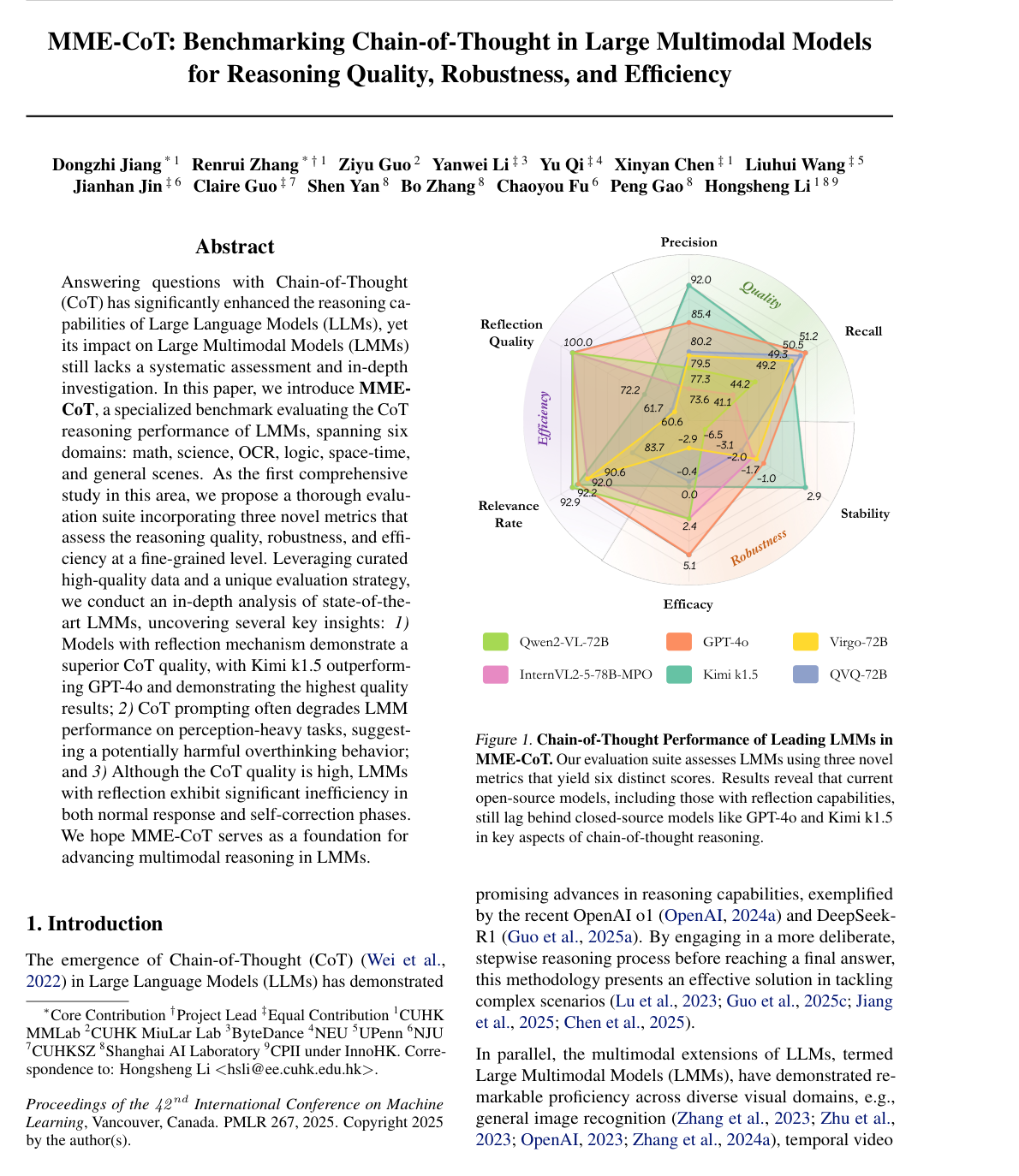
Answering questions with Chain-of-Thought (CoT) has significantly enhanced the reasoning capabilities of Large Language Models (LLMs), yet its impact on Large Multimodal Models (LMMs) still lacks a systematic assessment and in-depth investigation. In this paper, we introduce MME-CoT, a specialized benchmark evaluating the CoT reasoning performance of LMMs, spanning six domains: math, science, OCR, logic, space-time, and general scenes. As the first comprehensive study in this area, we propose a thorough evaluation suite incorporating three novel metrics that assess the reasoning quality, robustness, and efficiency at a fine-grained level. Leveraging curated high-quality data and a unique evaluation strategy, we conduct an in-depth analysis of state-of-the-art LMMs, uncovering several key insights: 1) Models with reflection mechanism demonstrate a superior CoT quality, with Kimi k1.5 outperforming GPT-4o and demonstrating the highest quality results; 2) CoT prompting often degrades LMM performance on perception-heavy tasks, suggesting a potentially harmful overthinking behavior; and 3) Although the CoT quality is high, LMMs with reflection exhibit significant inefficiency in both normal response and self-correction phases. We hope MME-CoT serves as a foundation for advancing multimodal reasoning in LMMs.
Added
2026-10-01
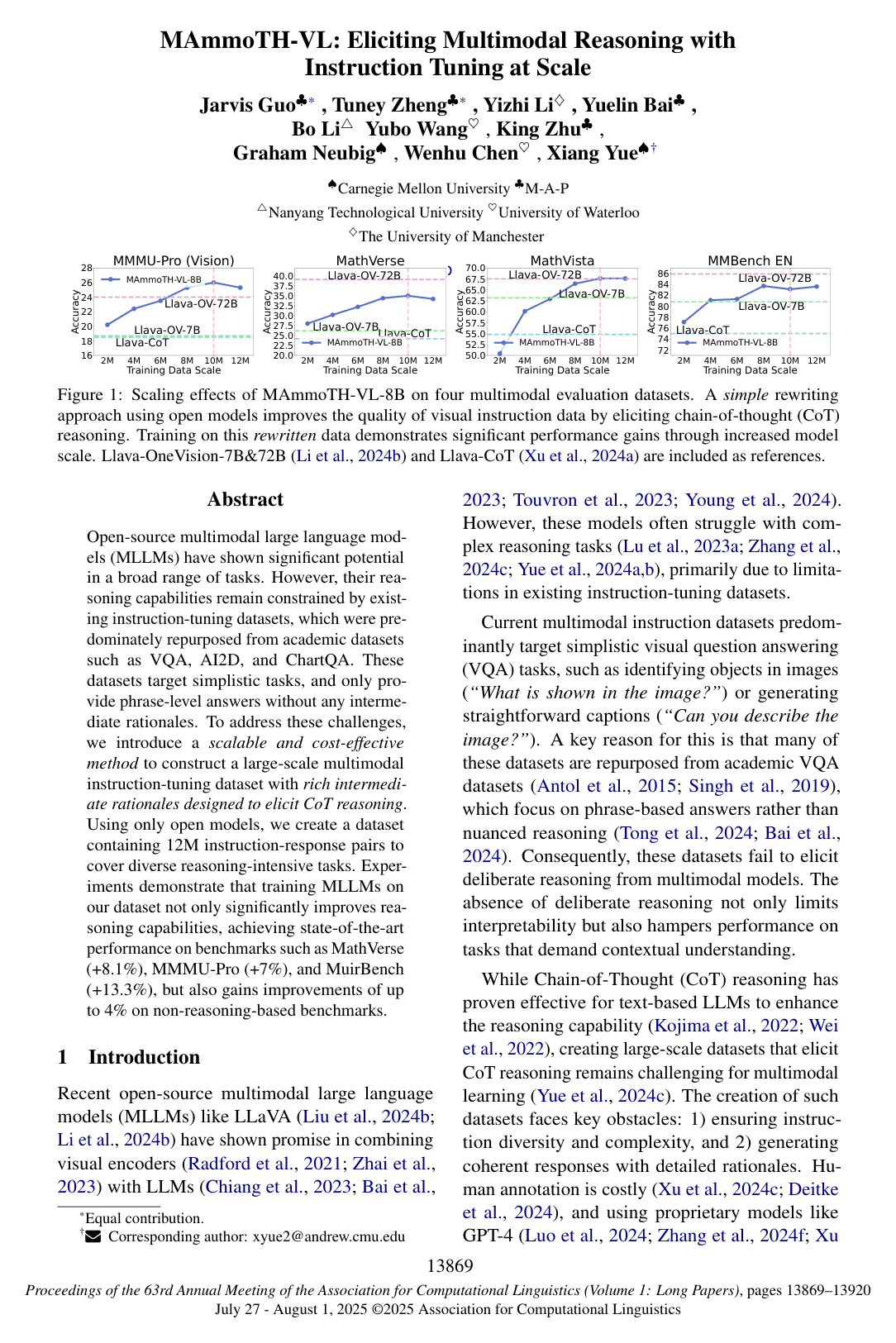
MAmmoTH-VL: Eliciting Multimodal Reasoning with Instruction Tuning at Scale
Jiawei Guo, Tianyu Zheng, Yizhi Li, Yuelin Bai, Bo Li, Yubo Wang, King Zhu, Graham Neubig, Wenhu Chen, Xiang Yue
Why you should read this
Presents a cost-effective data rewriting and filtering pipeline that uses only open-weight models to construct a 12-million-sample visual instruction dataset with chain-of-thought rationales, substantially boosting open-source multimodal model accuracy on complex reasoning benchmarks like MathVerse, MMMU-Pro, and MuirBench.
Open-source multimodal large language models (MLLMs) have shown significant potential in a broad range of tasks. However, their reasoning capabilities remain constrained by existing instruction-tuning datasets, which were predominately repurposed from academic datasets such as VQA, AI2D, and ChartQA. These datasets target simplistic tasks, and only provide phrase-level answers without any intermediate rationales. To address these challenges, we introduce a scalable and cost-effective method to construct a large-scale multimodal instruction-tuning dataset with rich intermediate rationales designed to elicit CoT reasoning. Using only open models, we create a dataset containing 12M instruction-response pairs to cover diverse reasoning-intensive tasks. Experiments demonstrate that training MLLMs on our dataset not only significantly improves reasoning capabilities, achieving state-of-the-art performance on benchmarks such as MathVerse (+8.1%), MMMU-Pro (+7%), and MuirBench (+13.3%), but also gains improvements of up to 4% on non-reasoning-based benchmarks.
Added
2026-10-01
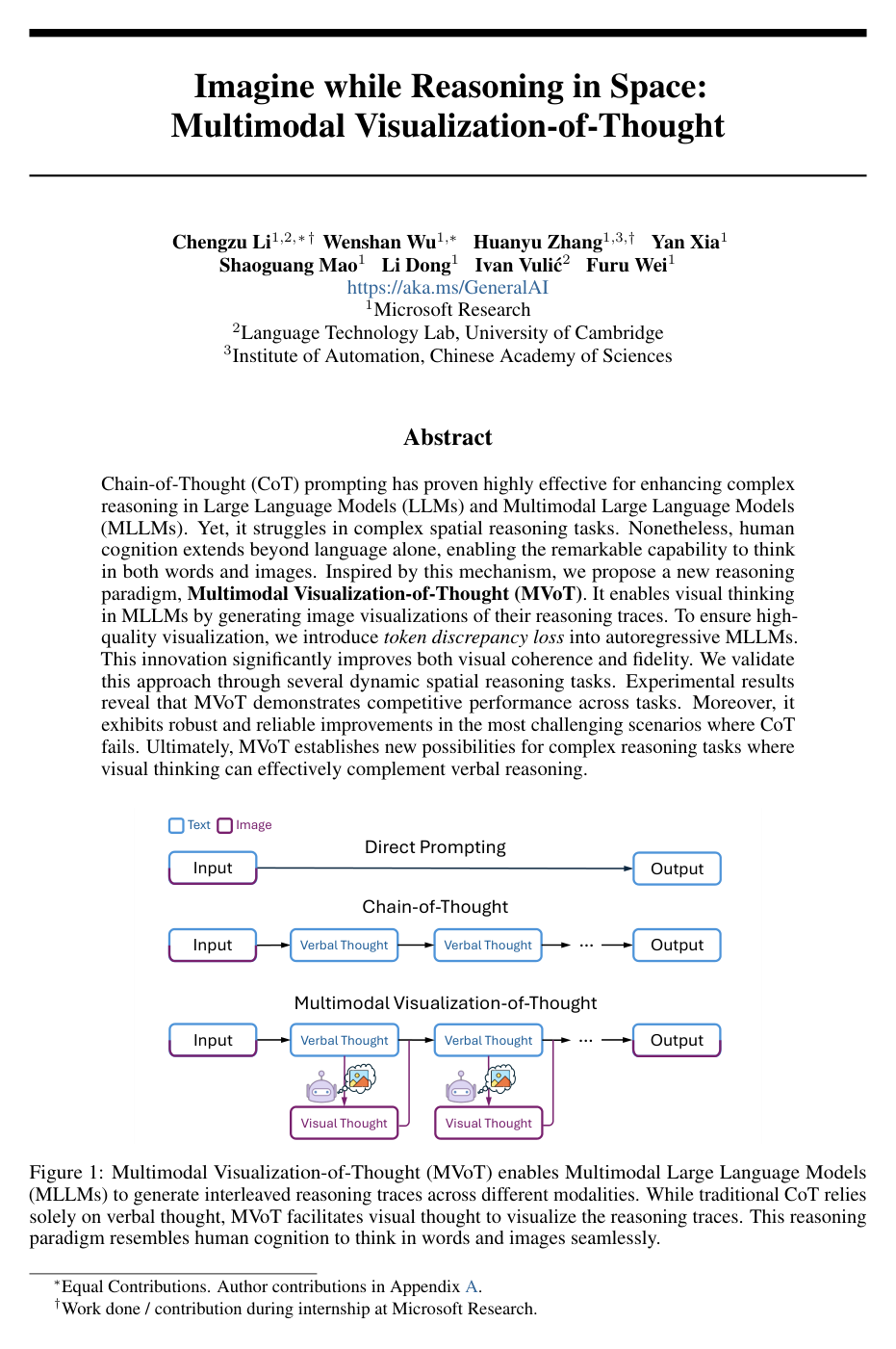
Imagine While Reasoning in Space: Multimodal Visualization-of-Thought
Chengzu Li, Wenshan Wu, Huanyu Zhang, Yan Xia, Shaoguang Mao, Li Dong, Ivan Vulic, Furu Wei
Why you should read this
Introduces Multimodal Visualization-of-Thought, a paradigm that enables multimodal models to generate intermediate visual traces using a token discrepancy loss, solving complex dynamic spatial reasoning tasks where traditional Chain-of-Thought fails.
Chain-of-Thought (CoT) prompting has proven highly effective for enhancing complex reasoning in Large Language Models (LLMs) and Multimodal Large Language Models (MLLMs). Yet, it struggles in complex spatial reasoning tasks. Nonetheless, human cognition extends beyond language alone, enabling the remarkable capability to think in both words and images. Inspired by this mechanism, we propose a new reasoning paradigm, Multimodal Visualization-of-Thought (MVoT). It enables visual thinking in MLLMs by generating image visualizations of their reasoning traces. To ensure high-quality visualization, we introduce token discrepancy loss into autoregressive MLLMs. This innovation significantly improves both visual coherence and fidelity. We validate this approach through several dynamic spatial reasoning tasks. Experimental results reveal that MVoT demonstrates competitive performance across tasks. Moreover, it exhibits robust and reliable improvements in the most challenging scenarios where CoT fails. Ultimately, MVoT establishes new possibilities for complex reasoning tasks where visual thinking can effectively complement verbal reasoning.
Added
2026-09-30
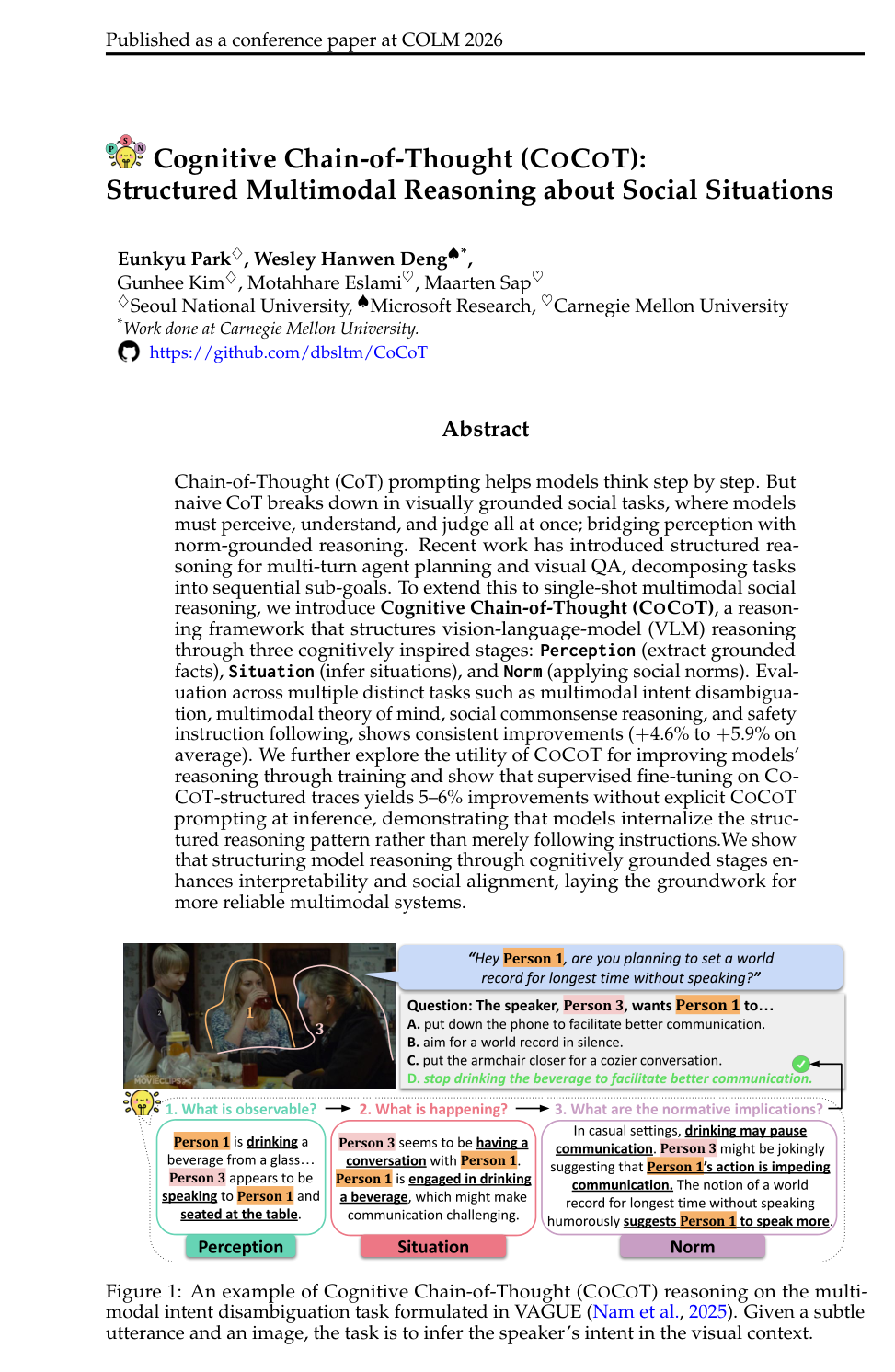
Cognitive Chain-of-Thought (CoCoT): Structured Multimodal Reasoning about Social Situations
Eunkyu Park, Wesley Deng, Gunhee Kim, Motahhare Eslami, Maarten Sap
Why you should read this
Proposes Cognitive Chain-of-Thought (CoCoT), a three-stage framework decomposing multimodal reasoning into perception, situation inference, and social norm application, which consistently improves vision-language models across social reasoning benchmarks and enables models to internalize structured reasoning through fine-tuning.
Chain-of-Thought (CoT) prompting helps models think step by step. But naive CoT breaks down in visually grounded social tasks, where models must perceive, understand, and judge all at once; bridging perception with norm-grounded reasoning. Recent work has introduced structured reasoning for multi-turn agent planning and visual QA, decomposing tasks into sequential sub-goals. To extend this to single-shot multimodal social reasoning, we introduce Cognitive Chain-of-Thought (CoCoT), a reasoning framework that structures vision-language-model (VLM) reasoning through three cognitively inspired stages: Perception (extract grounded facts), Situation (infer situations), and Norm (applying social norms). Evaluation across multiple distinct tasks such as multimodal intent disambiguation, multimodal theory of mind, social commonsense reasoning, and safety instruction following, shows consistent improvements (5.9% to 4.6% on average). We further explore the utility of CoCoT for improving models' reasoning through training and show that supervised fine-tuning on CoCoT-structured traces yields 5-6% improvements without explicit CoCoT prompting at inference, demonstrating that models internalize the structured reasoning pattern rather than merely following instructions. We show that structuring model reasoning through cognitively grounded stages enhances interpretability and social alignment, laying the groundwork for more reliable multimodal systems.
Added
2026-09-30
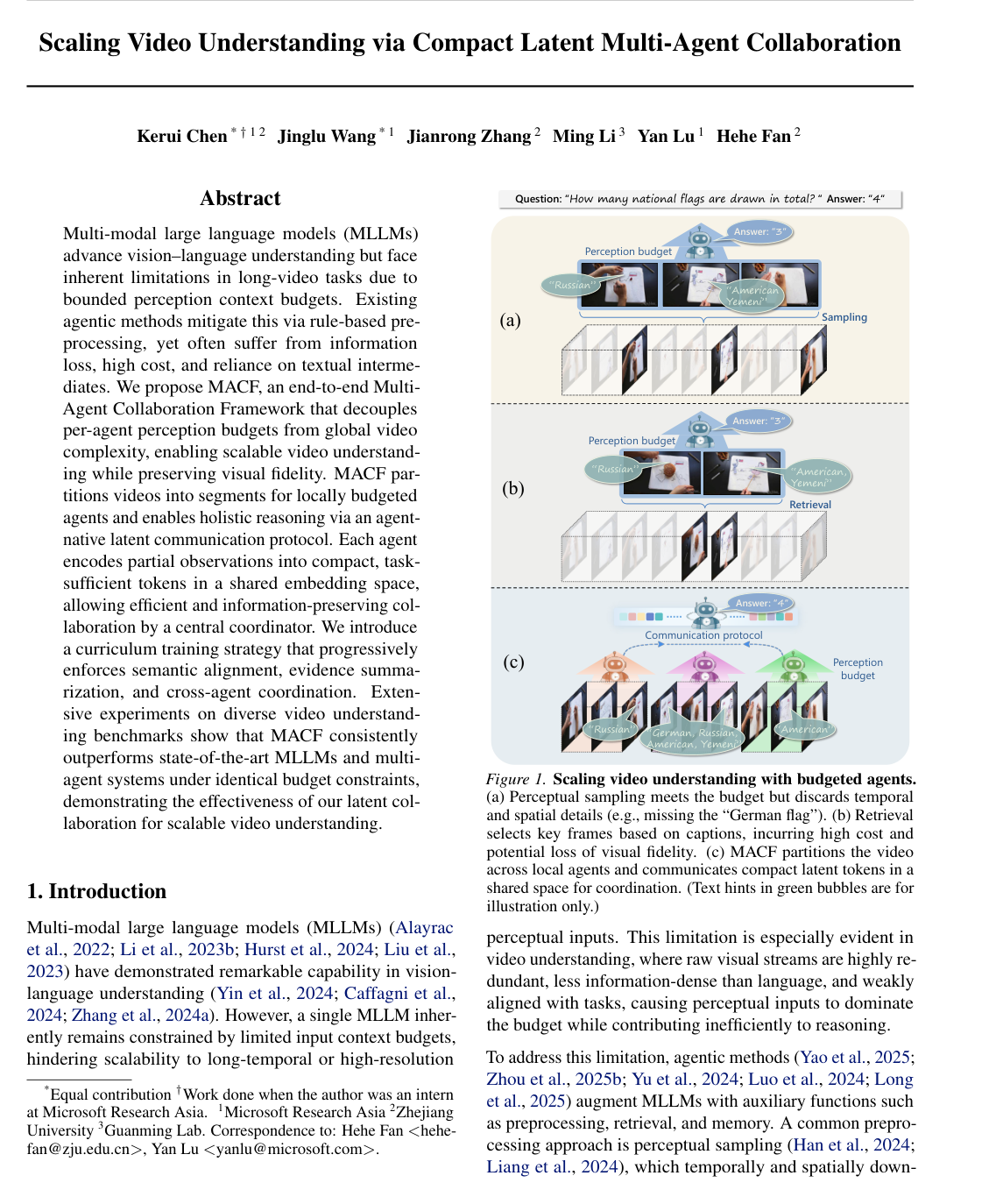
Scaling Video Understanding via Compact Latent Multi-Agent Collaboration
Kerui Chen, Jinglu Wang, Jianrong Zhang, Ming Li, Yang Lu, Hehe Fan
Why you should read this
Proposes a multi-agent framework that scales long-video understanding by coordinating video-segment agents through compact latent tokens rather than text summaries, outperforming existing vision-language models under tight context budgets.
Multi-modal large language models (MLLMs) advance vision language understanding but face inherent limitations in long-video tasks due to bounded perception context budgets. Existing agentic methods mitigate this via rule-based preprocessing, yet often suffer from information loss, high cost, and reliance on textual intermediates. We propose MACF, an end-to-end Multi-Agent Collaboration Framework that decouples per-agent perception budgets from global video complexity, enabling scalable video understanding while preserving visual fidelity. MACF partitions videos into segments for locally budgeted agents and enables holistic reasoning via an agent-native latent communication protocol. Each agent encodes partial observations into compact, task-sufficient tokens in a shared embedding space, allowing efficient and information-preserving collaboration by a central coordinator. We introduce a curriculum training strategy that progressively enforces semantic alignment, evidence summarization, and cross-agent coordination. Extensive experiments on diverse video understanding benchmarks show that MACF consistently outperforms state-of-the-art MLLMs and multi-agent systems under identical budget constraints, demonstrating the effectiveness of our latent collaboration for scalable video understanding.
Added
2026-09-29
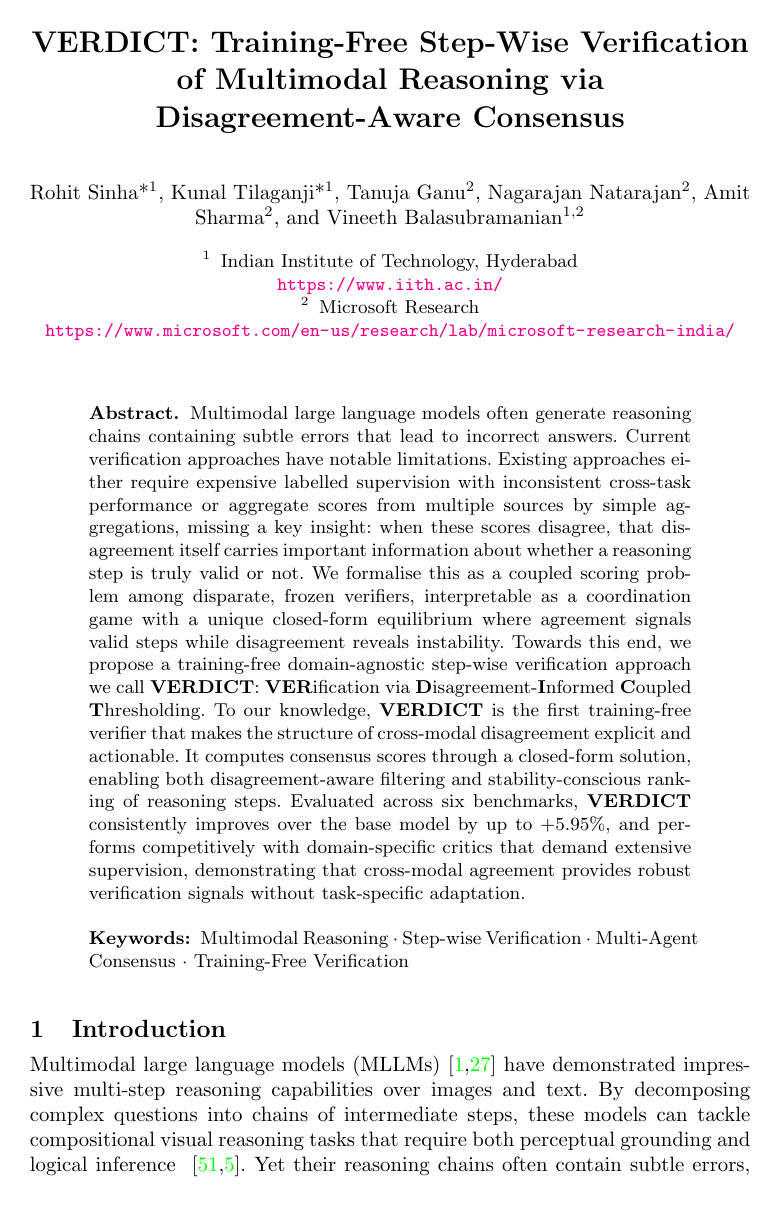
VERDICT: Training-Free Step-Wise Verification of Multimodal Reasoning via Disagreement-Aware Consensus
Rohit Sinha, Kunal Tilaganji, Tanuja Ganu, Nagarajan Natarajan, Amit Sharma, Vineeth N Balasubramanian
Why you should read this
Proposes VERDICT, a training-free verification framework that uses a closed-form coordination game equilibrium to exploit disagreement among frozen models, matching the performance of heavily supervised critics across six multimodal reasoning benchmarks.
Multimodal large language models often generate reasoning chains containing subtle errors that lead to incorrect answers. Current verification approaches have notable limitations. Existing approaches either require expensive labelled supervision with inconsistent cross-task performance or aggregate scores from multiple sources by simple aggregations, missing a key insight: when these scores disagree, that disagreement itself carries important information about whether a reasoning step is truly valid or not. We formalise this as a coupled scoring problem among disparate, frozen verifiers, interpretable as a coordination game with a unique closed-form equilibrium where agreement signals valid steps while disagreement reveals instability. Towards this end, we propose a training-free domain-agnostic step-wise verification approach we call VERDICT: VERification via Disagreement-Informed Coupled Thresholding. To our knowledge, VERDICT is the first training-free verifier that makes the structure of cross-modal disagreement explicit and actionable. It computes consensus scores through a closed-form solution, enabling both disagreement-aware filtering and stability-conscious ranking of reasoning steps. Evaluated across six benchmarks, \method consistently improves over the base model by up to +5.95%, and performs competitively with domain-specific critics that demand extensive supervision, demonstrating that cross-modal agreement provides robust verification signals without task-specific adaptation and Training-Free Verification
Added
2026-09-29
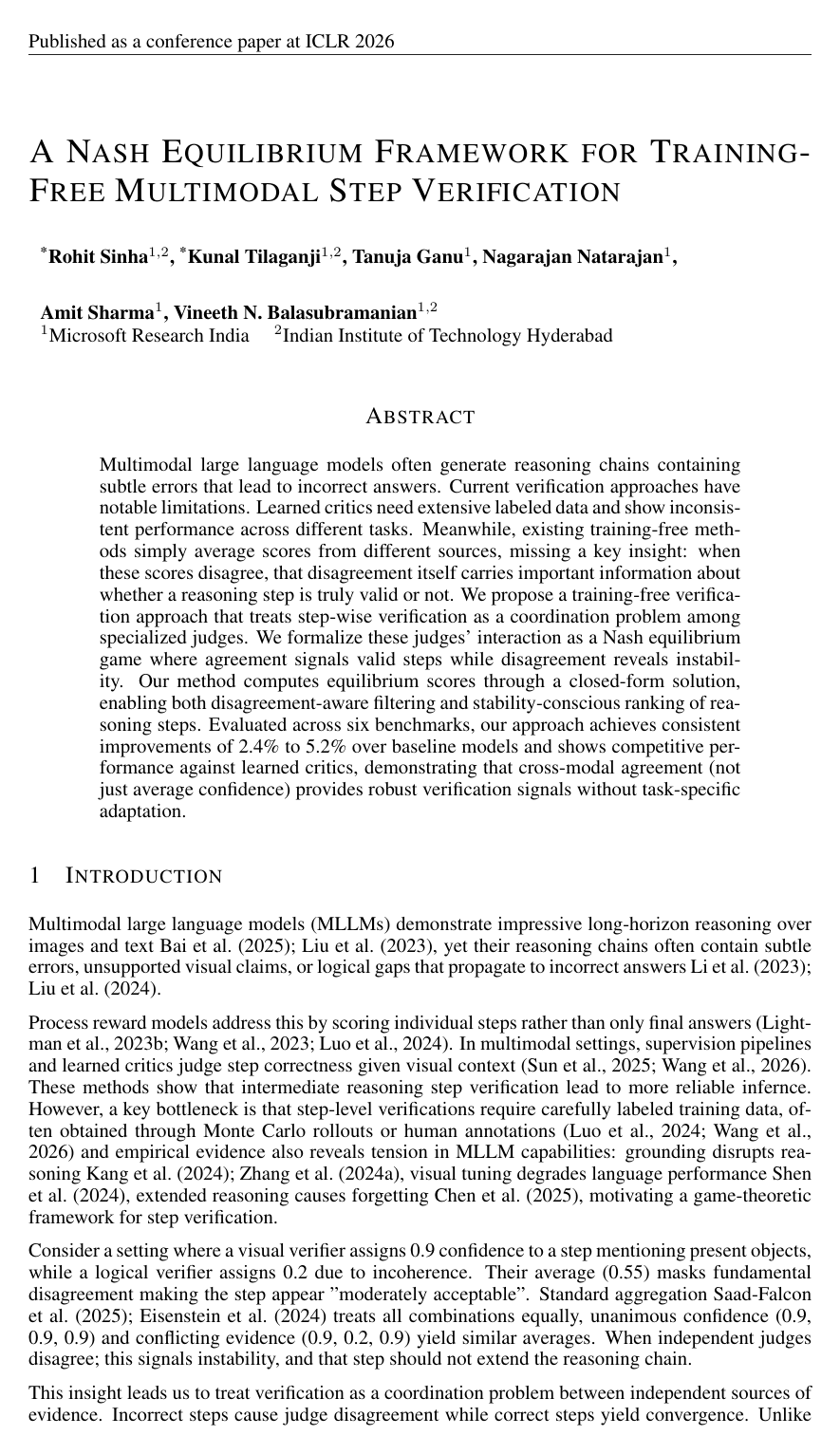
A Nash Equilibrium Framework For Training-Free Multimodal Step Verification
Rohit Sinha, Kunal Tilaganji, Tanuja Ganu, Nagarajan Natarajan, Amit Sharma, Vineeth N Balasubramanian
Why you should read this
Proposes a training-free framework that models multimodal reasoning step verification as a Nash equilibrium coordination game, using disagreement among specialized judges to catch subtle reasoning errors without requiring labeled training data.
Multimodal large language models often generate reasoning chains containing subtle errors that lead to incorrect answers. Current verification approaches have notable limitations. Learned critics need extensive labeled data and show inconsistent performance across different tasks. Meanwhile, existing training-free methods simply average scores from different sources, missing a key insight: when these scores disagree, that disagreement itself carries important information about whether a reasoning step is truly valid or not. We propose a training-free verification approach that treats step-wise verification as a coordination problem among specialized judges. We formalize these judges' interaction as a Nash equilibrium game where agreement signals valid steps while disagreement reveals instability. Our method computes equilibrium scores through a closed-form solution, enabling both disagreement-aware filtering and stability-conscious ranking of reasoning steps. Evaluated across six benchmarks, our approach achieves consistent improvements of 2.4% to 5.2% over baseline models and shows competitive performance against learned critics, demonstrating that cross-modal agreement (not just average confidence) provides robust verification signals without task-specific adaptation.
Added
2026-09-29
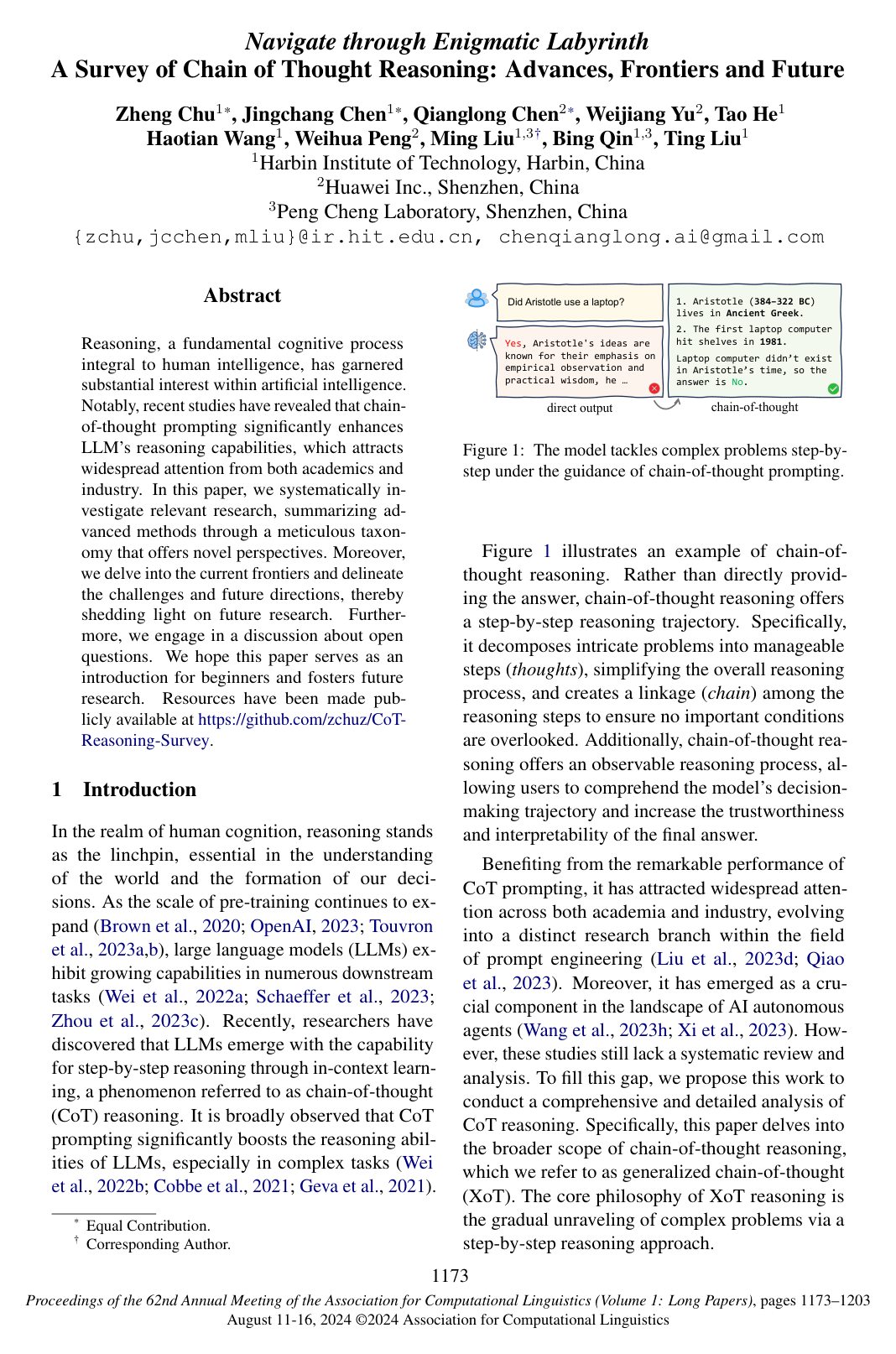
Navigate through Enigmatic Labyrinth A Survey of Chain of Thought Reasoning: Advances, Frontiers and Future
Zheng Chu, Jingchang Chen, Qianglong Chen, Weijiang Yu, Tao He, Haotian Wang, Weihua Peng, Ming Liu, Bing Qin, Ting Liu
Why you should read this
Presents a structured taxonomy of generalized chain-of-thought reasoning in large language models, categorizing prompt construction techniques, topological variants, and enhancement methods alongside core benchmarks and emerging frontiers.
Reasoning, a fundamental cognitive process integral to human intelligence, has garnered substantial interest within artificial intelligence. Notably, recent studies have revealed that chain-of-thought prompting significantly enhances LLM's reasoning capabilities, which attracts widespread attention from both academics and industry. In this paper, we systematically investigate relevant research, summarizing advanced methods through a meticulous taxonomy that offers novel perspectives. Moreover, we delve into the current frontiers and delineate the challenges and future directions, thereby shedding light on future research. Furthermore, we engage in a discussion about open questions. We hope this paper serves as an introduction for beginners and fosters future research. Resources have been made publicly available at https://github.com/zchuz/CoT-Reasoning-Survey.
Added
2026-09-28
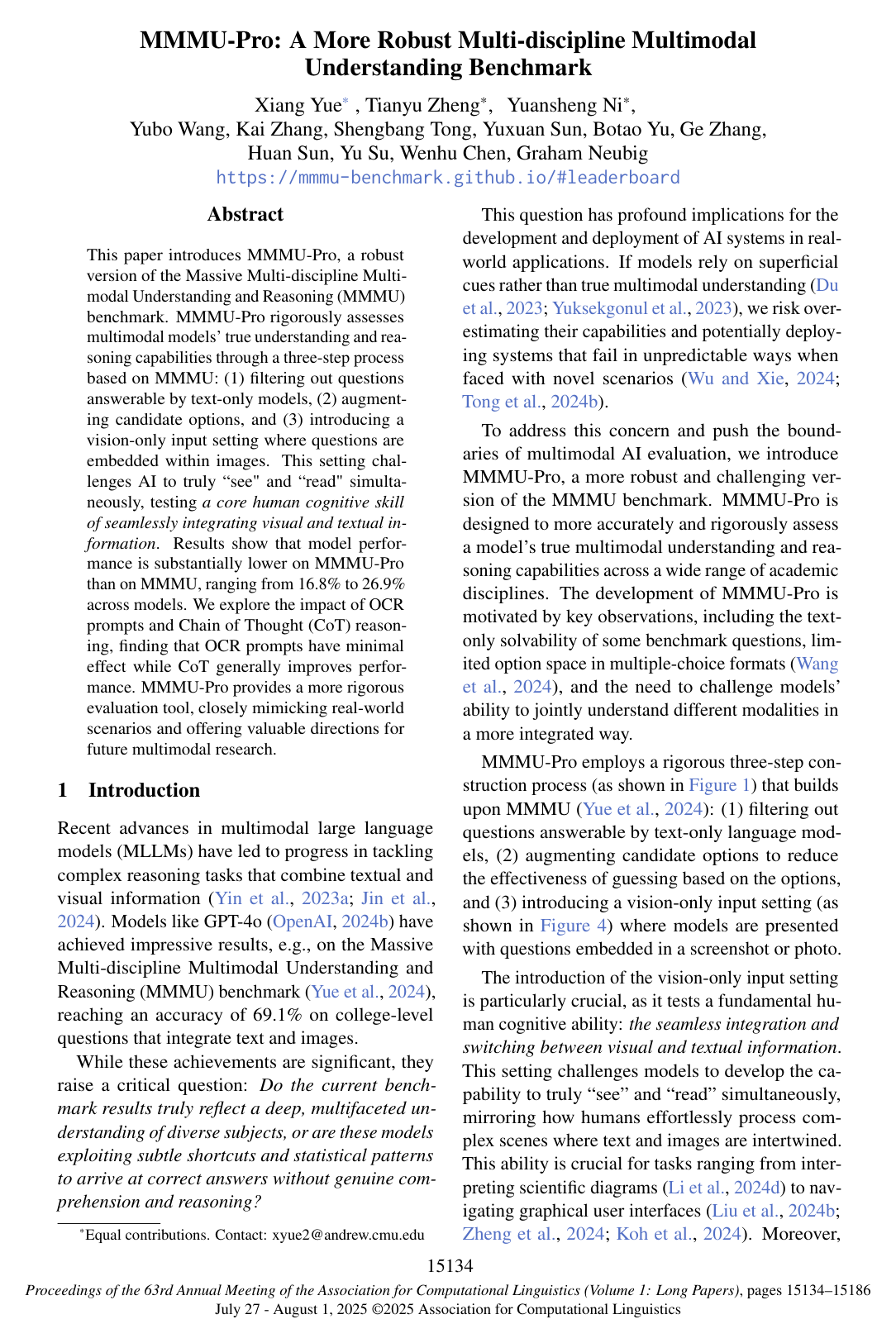
MMMU-Pro: A More Robust Multi-discipline Multimodal Understanding Benchmark
Xiang Yue, Tianyu Zheng, Yuansheng Ni, Yubo Wang, Kai Zhang, Shengbang Tong, Yuxuan Sun, Botao Yu, Ge Zhang, Huan Sun, Yu Su, Wenhu Chen, Graham Neubig
Why you should read this
Introduces MMMU-Pro, an advanced multimodal benchmark that eliminates text-only shortcuts, expands answer choices, and embeds text within images to expose severe performance drops in leading vision-language models.
This paper introduces MMMU-Pro, a robust version of the Massive Multi-discipline Multimodal Understanding and Reasoning (MMMU) benchmark. MMMU-Pro rigorously assesses multimodal models’ true understanding and reasoning capabilities through a three-step process based on MMMU: (1) filtering out questions answerable by text-only models, (2) augmenting candidate options, and (3) introducing a vision-only input setting where questions are embedded within images. This setting challenges AI to truly “see” and “read” simultaneously, testing a core human cognitive skill of seamlessly integrating visual and textual information. Results show that model performance is substantially lower on MMMU-Pro than on MMMU, ranging from 16.8% to 26.9% across models. We explore the impact of OCR prompts and Chain of Thought (CoT) reasoning, finding that OCR prompts have minimal effect while CoT generally improves performance. MMMU-Pro provides a more rigorous evaluation tool, closely mimicking real-world scenarios and offering valuable directions for future multimodal research.
Added
2026-09-28
ScreenQA: Large-Scale Question-Answer Pairs Over Mobile App Screenshots
Yu-Chung Hsiao, Fedir Zubach, Gilles Baechler, Srinivas Sunkara, Victor Carbune, Jason Lin, Maria Wang, Yun Zhu, Jindong Chen
Why you should read this
Presents ScreenQA, a large-scale benchmark of 86,000 question-answer pairs with bounding-box groundings over mobile screenshots to evaluate multimodal models on visual screen reading comprehension and interface-based automation.
We introduce ScreenQA, a novel benchmarking dataset designed to advance screen content understanding through question answering. The existing screen datasets are focused either on low-level structural and component understanding, or on a much higher-level composite task such as navigation and task completion for autonomous agents. ScreenQA attempts to bridge this gap. By annotating 86k question-answer pairs over the RICO dataset, we aim to benchmark the screen reading comprehension capacity, thereby laying the foundation for vision-based automation over screenshots. Our annotations encompass full answers, short answer phrases, and corresponding UI contents with bounding boxes, enabling four subtasks to address various application scenarios. We evaluate the dataset's efficacy using both open-weight and proprietary models in zero-shot, fine-tuned, and transfer learning settings. We further demonstrate positive transfer to web applications, highlighting its potential beyond mobile applications.
Added
2026-09-26
Generative Multimodal Models are In-Context Learners
Quan Sun, Yufeng Cui, Xiaosong Zhang, Fan Zhang, Qiying Yu, Yueze Wang, Yongming Rao, Jingjing Liu, Tiejun Huang, Xinlong Wang
Why you should read this
Introduces Emu2, a 37-billion-parameter generative multimodal model trained with a unified autoregressive objective that achieves state-of-the-art in-context learning and controllable generation across diverse visual-language tasks.
The human ability to easily solve multimodal tasks in context (i.e., with only a few demonstrations or simple instructions), is what current multimodal systems have largely struggled to imitate. In this work, we demonstrate that the task-agnostic in-context learning capabilities of large multimodal models can be significantly enhanced by effective scaling-up. We introduce Emu2, a generative multimodal model with 37 billion parameters, trained on large-scale multimodal sequences with a unified autoregressive objective. Emu2 exhibits strong multimodal in-context learning abilities, even emerging to solve tasks that require on-the-fly reasoning, such as visual prompting and object-grounded generation. The model sets a new record on multiple multimodal understanding tasks in few-shot settings. When instruction-tuned to follow specific instructions, Emu2 further achieves new state-of-the-art on challenging tasks such as question answering benchmarks for large multimodal models and open-ended subject-driven generation. These achievements demonstrate that Emu2 can serve as a base model and general-purpose interface for a wide range of multimodal tasks. Code and models are publicly available to facilitate future research.
Added
2026-09-26
Multimodal Reasoning with Multimodal Knowledge Graph
Junlin Lee, Yequan Wang, Jing Li, Min Zhang
Why you should read this
Presents a parameter-efficient framework that integrates multimodal knowledge graphs into large language models via relation graph attention networks and cross-modal alignment to curb hallucinations and improve multimodal reasoning.
Multimodal reasoning with large language models (LLMs) often suffers from hallucinations and the presence of deficient or outdated knowledge within LLMs. Some approaches have sought to mitigate these issues by employing textual knowledge graphs, but their singular modality of knowledge limits comprehensive cross-modal understanding. In this paper, we propose the Multimodal Reasoning with Multimodal Knowledge Graph (MR-MKG) method, which leverages multimodal knowledge graphs (MMKGs) to learn rich and semantic knowledge across modalities, significantly enhancing the multimodal reasoning capabilities of LLMs. In particular, a relation graph attention network is utilized for encoding MMKGs and a cross-modal alignment module is designed for optimizing image-text alignment. A MMKG-grounded dataset is constructed to equip LLMs with initial expertise in multimodal reasoning through pretraining. Remarkably, MR-MKG achieves superior performance while training on only a small fraction of parameters, approximately 2.25% of the LLM's parameter size. Experimental results on multimodal question answering and multimodal analogy reasoning tasks demonstrate that our MR-MKG method outperforms previous state-of-the-art models.
Added
2026-09-26
M³CoT: A Novel Benchmark for Multi-Domain Multi-step Multi-modal Chain-of-Thought
Qiguang Chen, Libo Qin, Jin Zhang, Zhi Chen, Xiao Xu, Wanxiang Che
Why you should read this
Introduces M³CoT, a comprehensive multi-domain benchmark that rigorously evaluates vision large language models on authentic multi-step multimodal reasoning and exposes significant performance gaps compared to human capabilities.
Multi-modal Chain-of-Thought (MCoT) requires models to leverage knowledge from both textual and visual modalities for step-by-step reasoning, which gains increasing attention. Nevertheless, the current MCoT benchmark still faces some challenges: (1) absence of visual modal reasoning, (2) single-step visual modal reasoning, and (3) Domain missing, thereby hindering the development of MCoT. Motivated by this, we introduce a novel benchmark (M³CoT) to address the above challenges, advancing the multi-domain, multi-step, and multi-modal CoT. Additionally, we conduct a thorough evaluation involving abundant MCoT approaches on Vision Large Language Models (VLLMs). In addition, we highlight that the current VLLMs still struggle to correctly reason in M³CoT and there remains a large gap between existing VLLMs and human performance in M³CoT, despite their superior results on previous MCoT benchmarks. To our knowledge, we take the first meaningful step toward the multi-domain, multi-step, and multi-modal scenario in MCoT. We hope that M³CoT can serve as a valuable resource, providing a pioneering foundation in multi-domain, multi-step, multi-modal chain-of-thought research.
Added
2026-09-26
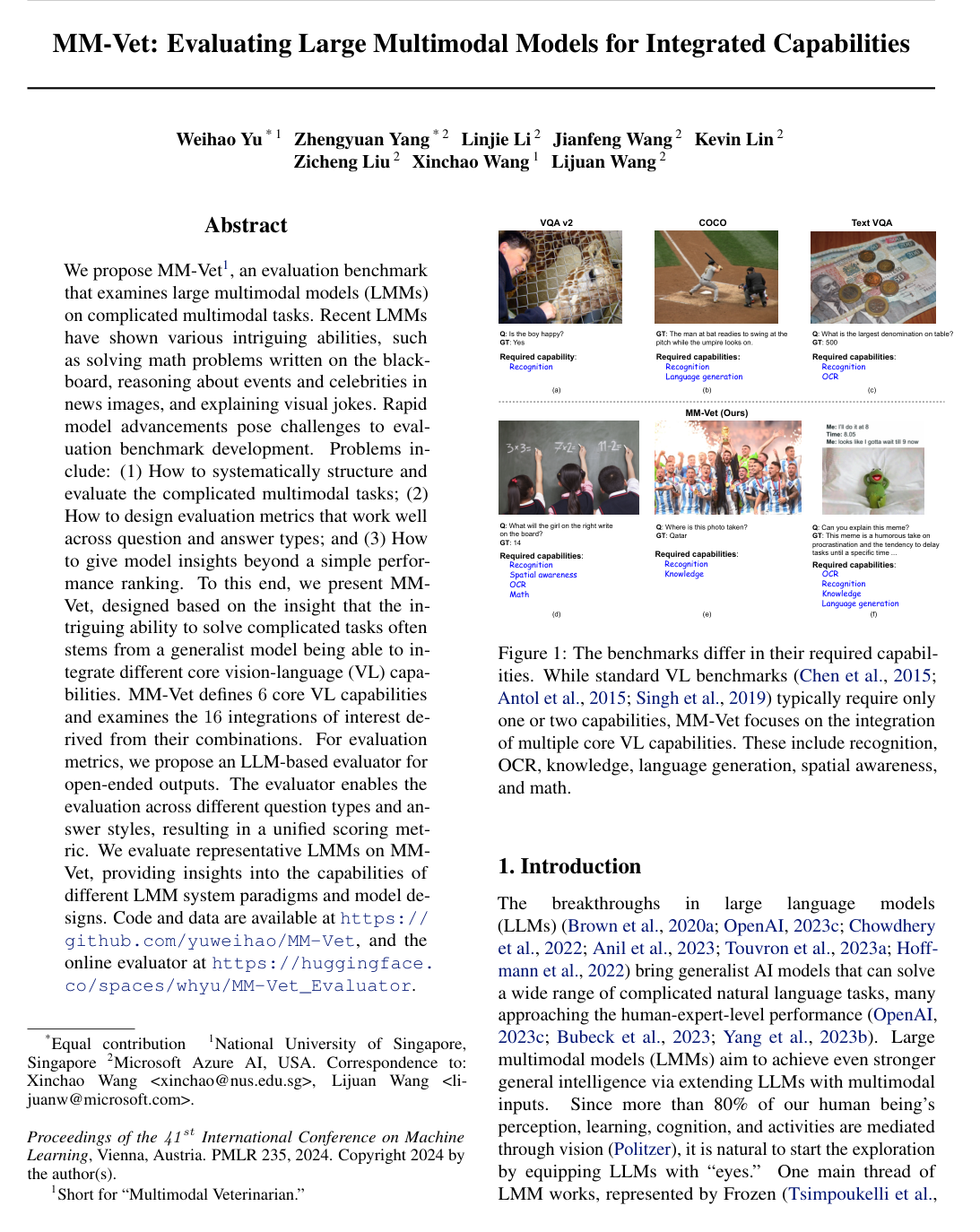
MM-Vet: Evaluating Large Multimodal Models for Integrated Capabilities
Weihao Yu, Zhengyuan Yang, Linjie Li, Jianfeng Wang, Kevin Lin, Zicheng Liu, Xinchao Wang, Lijuan Wang
Why you should read this
Proposes MM-Vet, an evaluation benchmark that measures how large multimodal models integrate six core vision-language capabilities across complex tasks using an LLM-based evaluator to deliver fine-grained diagnostic insights beyond standard rankings.
We propose MM-Vet, an evaluation benchmark that examines large multimodal models (LMMs) on complicated multimodal tasks. Recent LMMs have shown various intriguing abilities, such as solving math problems written on the blackboard, reasoning about events and celebrities in news images, and explaining visual jokes. Rapid model advancements pose challenges to evaluation benchmark development. Problems include: (1) How to systematically structure and evaluate the complicated multimodal tasks; (2) How to design evaluation metrics that work well across question and answer types; and (3) How to give model insights beyond a simple performance ranking. To this end, we present MM-Vet, designed based on the insight that the intriguing ability to solve complicated tasks is often achieved by a generalist model being able to integrate different core vision-language (VL) capabilities. MM-Vet defines 6 core VL capabilities and examines the 16 integrations of interest derived from the capability combination. For evaluation metrics, we propose an LLM-based evaluator for open-ended outputs. The evaluator enables the evaluation across different question types and answer styles, resulting in a unified scoring metric. We evaluate representative LMMs on MM-Vet, providing insights into the capabilities of different LMM system paradigms and models.
Added
2026-09-25
A survey on multimodal large language models
Shukang Yin, Chaoyou Fu, Sirui Zhao, Ke Li, Xing Sun, Tong Xu, Enhong Chen
Why you should read this
Synthesizes the rapid progress in Multimodal Large Language Models by structuring their core architectures, training strategies, and evaluation protocols while detailing critical advanced topics such as multimodal hallucination, chain-of-thought reasoning, and cross-modal extensions.
Recently, Multimodal Large Language Model (MLLM) represented by GPT-4V has been a new rising research hotspot, which uses powerful Large Language Models (LLMs) as a brain to perform multimodal tasks. The surprising emergent capabilities of MLLM, such as writing stories based on images and OCR-free math reasoning, are rare in traditional multimodal methods, suggesting a potential path to artificial general intelligence. To this end, both academia and industry have endeavored to develop MLLMs that can compete with or even better than GPT-4V, pushing the limit of research at a surprising speed. In this paper, we aim to trace and summarize the recent progress of MLLMs. First of all, we present the basic formulation of MLLM and delineate its related concepts, including architecture, training strategy and data, as well as evaluation. Then, we introduce research topics about how MLLMs can be extended to support more granularity, modalities, languages, and scenarios. We continue with multimodal hallucination and extended techniques, including Multimodal ICL (M-ICL), Multimodal CoT (M-CoT), and LLM-Aided Visual Reasoning (LAVR). To conclude the paper, we discuss existing challenges and point out promising research directions. In light of the fact that the era of MLLM has only just begun, we will keep updating this survey and hope it can inspire more research. An associated GitHub link collecting the latest papers is available at this https URL.
Added
2026-09-24
Expanding Performance Boundaries of Open-Source Multimodal Models with Model, Data, and Test-Time Scaling
Zhe Chen, Weiyun Wang, Yue Cao, Yang-Zhou Liu, Zhangwei Gao, Erfei Cui, Jinguo Zhu, Shenglong Ye, Hao Tian, Zhaoyang Liu, Lixin Gu, Xue-Hui Wang, Qing-Yun Li, Yi-Ming Ren, Zixuan Chen, Jia-Peng Luo, Jiahao Wang, Tan Jiang, Bo Wang, Conghui He, Botian Shi, Xingcheng Zhang, Han Lv, Yi Wang, Wenqi Shao, Pei Chu, Zhongying Tu, Tong He, Zhiyong Wu, Hui Deng, Jiaye Ge, Kaiming Chen, Min Dou, Lewei Lu, Xizhou Zhu, Tong Lu, Da-Hu Lin, Yunfeng Qiao, Jifeng Dai, Wenhai Wang
Why you should read this
Introduces InternVL 2.5, an open-source multimodal model series that rivals proprietary systems like GPT-4o and becomes the first open-source model to exceed 70% on the MMMU benchmark through model, data, and test-time scaling strategies.
We introduce InternVL 2.5, an advanced multimodal large language model (MLLM) series that builds upon InternVL 2.0, maintaining its core model architecture while introducing significant enhancements in training and testing strategies as well as data quality. In this work, we delve into the relationship between model scaling and performance, systematically exploring the performance trends in vision encoders, language models, dataset sizes, and test-time configurations. Through extensive evaluations on a wide range of benchmarks, including multi-discipline reasoning, document understanding, multi-image / video understanding, real-world comprehension, multimodal hallucination detection, visual grounding, multilingual capabilities, and pure language processing, InternVL 2.5 exhibits competitive performance, rivaling leading commercial models such as GPT-4o and Claude-3.5-Sonnet. Notably, our model is the first open-source MLLMs to surpass 70% on the MMMU benchmark, achieving a 3.7-point improvement through Chain-of-Thought (CoT) reasoning and showcasing strong potential for test-time scaling. We hope this model contributes to the open-source community by setting new standards for developing and applying multimodal AI systems. HuggingFace demo see this https URL
Added
2026-09-24
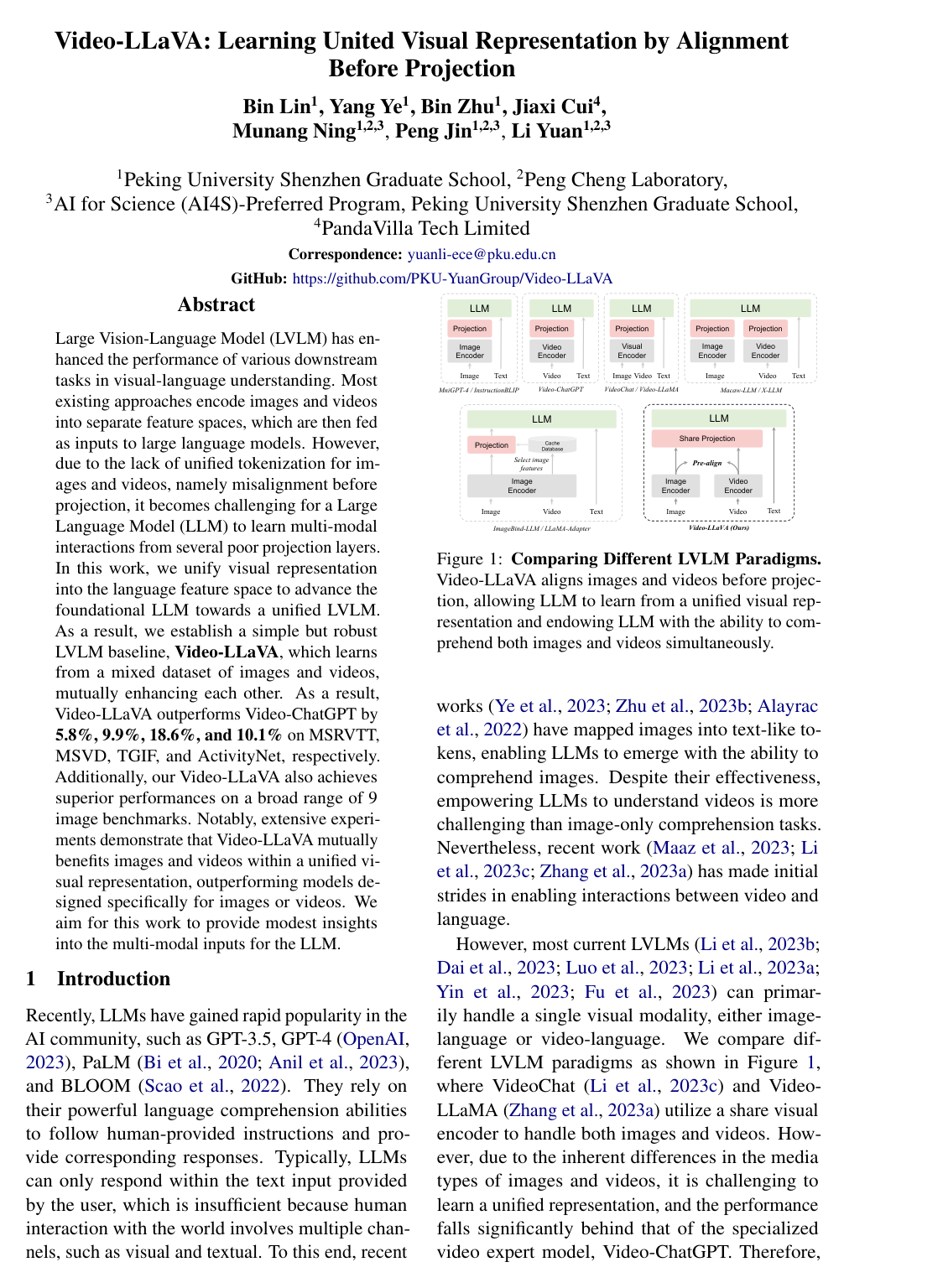
Video-LLaVA: Learning United Visual Representation by Alignment Before Projection
Bin Lin, Yang Ye, Bin Zhu, Jiaxi Cui, Munan Ning, Peng Jin, Li Yuan
Why you should read this
Introduces Video-LLaVA, a vision-language model that aligns image and video features into a single representation before projecting them to a large language model, demonstrating that joint multimodal training outperforms specialized single-modality systems across major image and video benchmarks.
The Large Vision-Language Model (LVLM) has enhanced the performance of various downstream tasks in visual-language understanding. Most existing approaches encode images and videos into separate feature spaces, which are then fed as inputs to large language models. However, due to the lack of unified tokenization for images and videos, namely misalignment before projection, it becomes challenging for a Large Language Model (LLM) to learn multi-modal interactions from several poor projection layers. In this work, we unify visual representation into the language feature space to advance the foundational LLM towards a unified LVLM. As a result, we establish a simple but robust LVLM baseline, Video-LLaVA, which learns from a mixed dataset of images and videos, mutually enhancing each other. Video-LLaVA achieves superior performances on a broad range of 9 image benchmarks across 5 image question-answering datasets and 4 image benchmark toolkits. Additionally, our Video-LLaVA also outperforms Video-ChatGPT by 5.8%, 9.9%, 18.6%, and 10.1% on MSRVTT, MSVD, TGIF, and ActivityNet, respectively. Notably, extensive experiments demonstrate that Video-LLaVA mutually benefits images and videos within a unified visual representation, outperforming models designed specifically for images or videos. We aim for this work to provide modest insights into the multi-modal inputs for the LLM. Code address: \href{this https URL}
Added
2026-09-24