Navigate through Enigmatic Labyrinth A Survey of Chain of Thought Reasoning: Advances, Frontiers and Future

Zheng ChuJingchang ChenQianglong ChenWeijiang YuTao HeHaotian WangWeihua PengMing LiuBing QinTing Liu

article2024ACL279 citations

Presents a structured taxonomy of generalized chain-of-thought reasoning in large language models, categorizing prompt construction techniques, topological variants, and enhancement methods alongside core benchmarks and emerging frontiers.

Listen

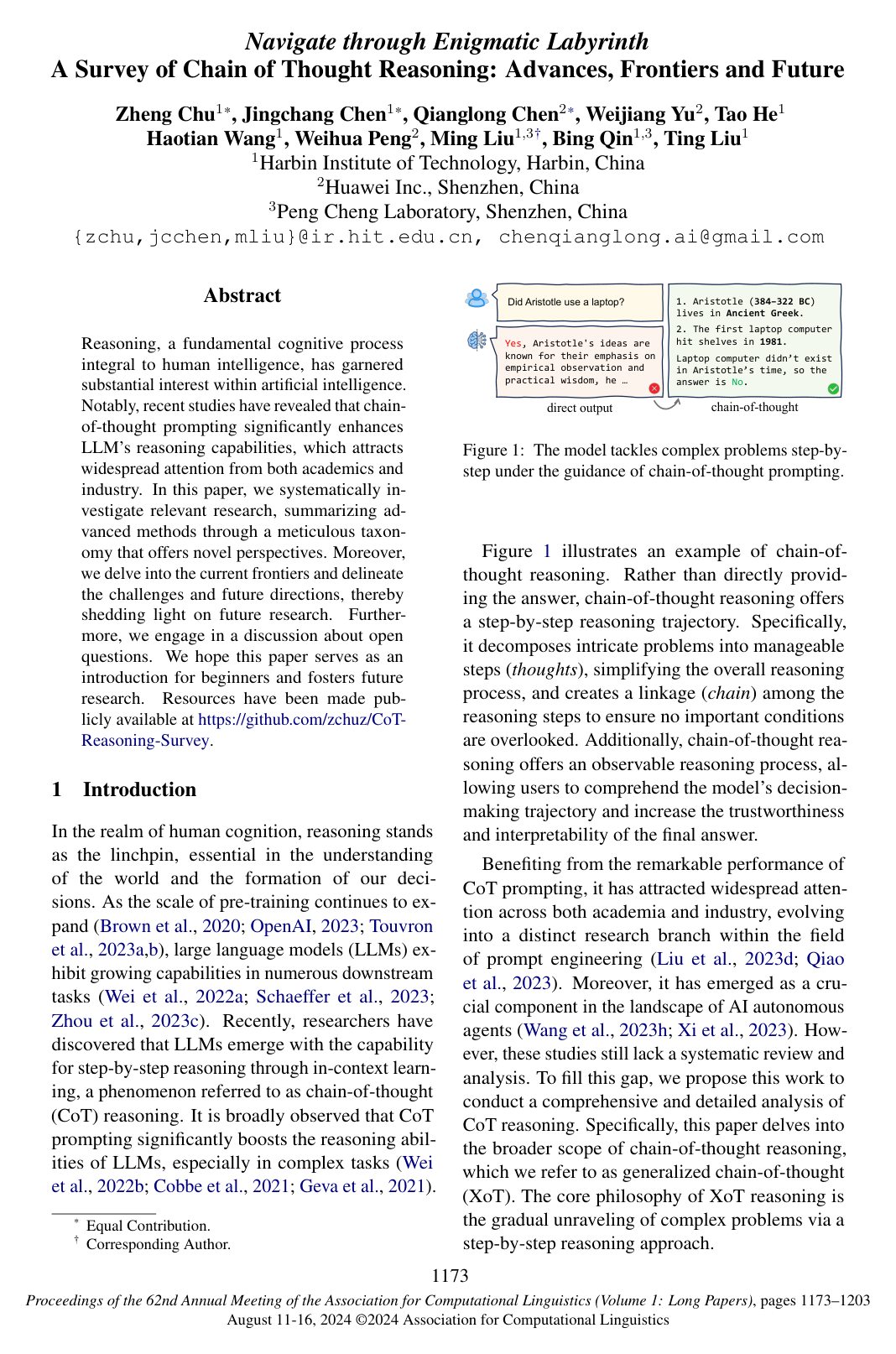
As large language models become central to artificial intelligence, standard prompting often fails when addressing complex tasks requiring multi-step deduction, factual consistency, and explainability. Directly requesting answers can lead to incorrect reasoning steps and untrustworthy outputs. To address this challenge, researchers have advanced chain-of-thought prompting—a paradigm where models break problems into intermediate steps before reaching a final answer.

The article provides a systematic overview and taxonomy of generalized chain-of-thought methods, synthesizing advancements in prompt design, structural variations, optimization strategies, and emerging applications. The authors analyze a wide collection of studies across mathematical, logical, commonsense, symbolic, and multi-modal benchmarks, assessing empirical performance trends and implementation trade-offs across leading language models.

The primary finding is that step-by-step reasoning significantly improves model accuracy and interpretability across intricate domains compared to standard input-output prompting. For instance, few-shot chain-of-thought prompting on benchmark tasks such as standard grade-school math improves accuracy from baseline levels under 20% to over 60–80% depending on the model version. Second, representing intermediate rationales in structured formats—such as code or formal logic executed by external engines—substantially reduces execution inconsistencies. Third, advanced structures like tree- and graph-based reasoning allow models to explore multiple solution paths and backtrack, offering stronger problem-solving capabilities than linear chains at the cost of narrower task generalization. Finally, techniques such as self-consistency voting and question decomposition consistently lift performance, while distillation successfully transfers multi-step reasoning capabilities from larger foundation models to smaller, cost-effective models.

These findings indicate that generalized chain-of-thought reasoning is foundational for deploying reliable AI systems and autonomous agents capable of dynamic planning, tool use, and external knowledge integration. However, organizations face clear operational trade-offs: complex search strategies and sampling ensembles yield higher accuracy but multiply computational latency and inference costs. Additionally, relying solely on a model's internal self-feedback often fails to catch subtle hallucinations, creating operational risks if deployed without external verification.

Organizations should adopt semi-automated prompting or hybrid neuro-symbolic approaches that blend human supervision, programmatic execution, and external retrieval to balance cost, accuracy, and domain flexibility. For resource-constrained deployments, teams should leverage knowledge distillation from larger models rather than running computationally intensive multi-path reasoning in production. Future work must prioritize establishing robust intermediate verification frameworks, improving vision-text integration for multi-modal reasoning, and advancing the theoretical understanding of emergent reasoning capabilities.

Confidence in the broad utility of chain-of-thought reasoning is high, but readers should exercise caution when comparing reported benchmark numbers directly, as experimental configurations and model checkpoints vary across individual studies. Furthermore, significant uncertainty remains regarding how reliably models can detect and correct their own internal reasoning errors without external ground truth.

Cover for Navigate through Enigmatic Labyrinth A Survey of Chain of Thought Reasoning: Advances, Frontiers and Future

Abstract

Reasoning, a fundamental cognitive process integral to human intelligence, has garnered substantial interest within artificial intelligence. Notably, recent studies have revealed that chain-of-thought prompting significantly enhances LLM's reasoning capabilities, which attracts widespread attention from both academics and industry. In this paper, we systematically investigate relevant research, summarizing advanced methods through a meticulous taxonomy that offers novel perspectives. Moreover, we delve into the current frontiers and delineate the challenges and future directions, thereby shedding light on future research. Furthermore, we engage in a discussion about open questions. We hope this paper serves as an introduction for beginners and fosters future research. Resources have been made publicly available at https://github.com/zchuz/CoT-Reasoning-Survey.

Table of Contents

  • 1 Introduction
  • 2 Background and Preliminary
  • 2.1 Background
  • 2.2 Preliminary
  • 2.3 Advantages of CoT Reasoning
  • 3 Benchmarks
  • 4 Advanced Methods
  • 4.1 XoT Prompt Construction
  • 4.1.1 Manual Prompting
  • 4.1.2 Automatic Prompting
  • 4.1.3 Semi-automatic Prompting
  • 4.1.4 Pros and Cons of Three Approaches
  • 4.2 XoT Topological Variants
  • 4.3 XoT Enhancement Methods
  • 4.3.1 Verify and Refine
  • 4.3.2 Question Decomposition
  • 4.3.3 Knowledge Enhancement
  • 4.3.4 Self-Ensemble
  • 4.3.5 Efficient Reasoning
  • 5 Frontiers of Research
  • 5.1 Tool Use
  • 5.2 Planning
  • 5.3 Distillation of Reasoning Capabilities
  • 6 Future Directions
  • 6.1 Multi-modal Reasoning
  • 6.2 Faithful Reasoning
  • 6.3 Theoretical Perspective
  • 7 Discussion
  • 8 Conclusion
  • Limitations
  • Acknowledgements
  • References
  • A Appendix
  • A.1 Related Survey
  • A.2 Further Discussion
  • A.3 Early Attempts and Efforts in Specific Domains
  • A.4 Empirical Results
  • B Details of Benchmarks
  • B.1 Mathematical Reasoning
  • B.2 Commonsense Reasoning
  • B.3 Symbolic Reasoning
  • B.4 Logical Reasoning
  • B.5 Multi-modal Reasoning
  • B.6 Comprehensive Benchmarks

Knowls

  1. Knowl 1 — Probabilistic Formulation of Standard and Chain-of-Thought Prompting

    equation

    In standard few-shot prompting, the prompt TSPT_{SP} contains an instruction II and nn input-output demonstration pairs (x1,y1),…,(xn,yn)(x_1, y_1), \dots, (x_n, y_n):

    TSP={I,(x1,y1),…,(xn,yn)}T_{SP} = \{I, (x_1, y_1), \dots, (x_n, y_n)\}

    Given question QQ and prompt TSPT_{SP}, a probabilistic language model pLMp_{LM} autoregressively predicts the answer sequence A=(a1,…,a∣A∣)A = (a_1, \dots, a_{|A|}) without explicit intermediate steps:

    p(A∣TSP,Q)=∏i=1∣A∣pLM(ai∣TSP,Q,a<i)p(A \mid T_{SP}, Q) = \prod_{i=1}^{|A|} p_{LM}(a_i \mid T_{SP}, Q, a_{<i})

    In few-shot chain-of-thought (CoT) prompting, the prompt TCoTT_{CoT} augments each demonstration with an intermediate reasoning rationale eie_i:

    TCoT={I,(x1,e1,y1),…,(xn,en,yn)}T_{CoT} = \{I, (x_1, e_1, y_1), \dots, (x_n, e_n, y_n)\}

    The model generates an intermediate reasoning trajectory R=(r1,…,r∣R∣)R = (r_1, \dots, r_{|R|}) before producing the final answer AA. The joint probability factorizes as:

    p(A,R∣TCoT,Q)=p(A∣TCoT,Q,R)⋅p(R∣TCoT,Q)p(A, R \mid T_{CoT}, Q) = p(A \mid T_{CoT}, Q, R) \cdot p(R \mid T_{CoT}, Q)

    where the trajectory and answer tokens are modeled by:

    p(R∣TCoT,Q)=∏i=1∣R∣pLM(ri∣TCoT,Q,r<i)p(R \mid T_{CoT}, Q) = \prod_{i=1}^{|R|} p_{LM}(r_i \mid T_{CoT}, Q, r_{<i})

    p(A∣TCoT,Q,R)=∏j=1∣A∣pLM(aj∣TCoT,Q,R,a<j)p(A \mid T_{CoT}, Q, R) = \prod_{j=1}^{|A|} p_{LM}(a_j \mid T_{CoT}, Q, R, a_{<j})

  2. Knowl 2 — Taxonomy of Generalized Chain-of-Thought Reasoning

    model/method

    Generalized Chain-of-Thought (XoT) organizes step-by-step problem-solving methods along three principal dimensions:

    1. Advanced Methods:

      • Prompt Construction: Manual Prompting (human-annotated rationales or program formulations), Automatic Prompting (zero-shot trigger instructions, automatic demonstration clustering and sampling), and Semi-automatic Prompting (bootstrapping, synthetic demonstration generation, policy-guided demonstration selection).
      • Topological Variants: Chain Structures (sequential natural language, code, or formal logic), Tree Structures (branching search via BFS, DFS, and Monte Carlo tree evaluation with backtracking), and Graph Structures (cyclic connections, NN-to-11 aggregation, and network-based premise dependencies).
      • Enhancement Methods: Verify and Refine (iterative feedback, critic models, deductive filtering), Question Decomposition (hierarchical top-down sub-question solving and bottom-up aggregation), Knowledge Enhancement (internal parametric recall and external retrieval augmentation), Self-Ensemble (majority voting, complexity-weighted aggregation, multi-agent debate), and Efficient Reasoning (parallel sub-problem decoding, speculative draft verification, adaptive sample budgeting).
    2. Frontiers of Research:

      • Tool Use: Integrating external APIs, calculators, search engines, and python interpreters to execute actions beyond pure language modeling.
      • Planning: Utilizing formal description languages (e.g., PDDL) and search algorithms (DFS, MCTS, A*) for goal decomposition and environment state tracking.
      • Distillation: Transferring teacher-generated step-by-step rationales into compact models via self-distillation, multi-chain training, and process reward optimization.
    3. Future Directions & Challenges:

      • Multimodal and video reasoning, faithful error detection and correction, and uncovering theoretical mechanisms governing emergence and computational expressivity.
  3. Knowl 3 — Trade-Offs in XoT Prompt Construction Paradigms

    model/method

    Prompt construction approaches for Generalized Chain-of-Thought fall into three paradigms with distinct operational trade-offs:

    • Manual Prompting: Employs human annotators to write explicit reasoning chains in natural language (e.g., Few-shot CoT) or code/logic (e.g., Program-aided Language models, Program of Thoughts). While it achieves strong task accuracy by providing clear reasoning demonstrations, it incurs substantial manual labor costs and exhibits poor cross-domain transferability.
    • Automatic Prompting: Generates reasoning steps without human annotation using zero-shot triggers (e.g., appending "Let's think step by step") or by clustering model-generated rationales (e.g., Auto-CoT, RePrompting). It eliminates labor costs and enables cross-domain adaptation, but suffers from instability and error cascading due to the absence of supervised guidance.
    • Semi-automatic Prompting: Combines a minimal seed set of human annotations with automated bootstrapping, iterative expansion, or reinforcement learning/policy gradient optimization (e.g., AutoMate CoT, Synthetic Prompting). This paradigm strikes a practical balance by maintaining competitive reasoning accuracy while minimizing human annotation requirements.
  4. Knowl 4 — Topological Reasoning Variants Across Chain, Tree, and Graph Structures

    model/method

    Generalized Chain-of-Thought (XoT) extends sequential reasoning across three primary topological structures:

    • Chain Structures: Linear step-by-step generation. Beyond natural language, reasoning steps can be formalized in programming languages (e.g., Program of Thoughts / PoT, Program-Aided Language models / PAL) or declarative logic (e.g., LINC, SatLM). Decoupling intermediate reasoning from execution via deterministic external interpreters eliminates arithmetic and logical calculation errors. However, linear chains cannot explore alternative reasoning branches or backtrack.
    • Tree Structures: Organize reasoning into branching decision trees where models explore multiple intermediate paths using search algorithms such as breadth-first search, depth-first search, or Monte Carlo Tree Search (e.g., Tree-of-Thoughts / ToT, ProbTree). Tree structures allow global exploration and backtracking to resolve dead ends, but require explicit state definitions and problem-specific decomposition rules, limiting generalizability.
    • Graph Structures: Introduce multi-parent links, cycles, and NN-to-11 aggregation nodes (e.g., Graph of Thoughts / GoT, ResPrompt). Graphs permit merging multiple intermediate findings and performing self-verification over complex relational dependencies, but introduce complex control flow overhead and depend heavily on custom state representations.
  5. Knowl 5 — Reasoning Enhancement Paradigms for Generalized Chain-of-Thought

    model/method

    Five primary enhancement paradigms improve reasoning fidelity, efficiency, and robustness in Generalized Chain-of-Thought:

    • Verify and Refine: Employs self-critique, secondary critic models, backward (abductive) verification, or deductive filtering (e.g., Natural Program, Deductive Beam Search) to detect intermediate inconsistencies and iteratively refine flawed reasoning chains.
    • Question Decomposition: Divides complex queries into a sequence of simpler sub-questions via top-down hierarchical splitting (e.g., Least-to-Most prompting, Decomposed Prompting) or bottom-up prerequisite aggregation (e.g., Socratic Questioning), passing resolved sub-answers to downstream reasoning steps.
    • Knowledge Enhancement: Mitigates factual hallucinations by prompting the model for introspective parametric recall or integrating non-parametric external retrieval (retriever modules, web search, knowledge graphs), interleaving retrieval queries directly within reasoning steps.
    • Self-Ensemble: Leverages generation stochasticity by sampling multiple reasoning paths and aggregating final answers via majority voting (Self-Consistency), complexity weighting, step-level filtering, multi-prompt ensembling, or multi-agent debate (MAD).
    • Efficient Reasoning: Reduces latency and computational cost through parallel sub-problem execution (Skeleton-of-Thought), draft-model speculative decoding, dynamic sampling frequency adaptation, and uncertainty-based selective annotation.
  6. Knowl 6 — Distillation of Step-by-Step Reasoning Capabilities into Smaller Language Models

    model/method

    While chain-of-thought capabilities emerge primarily in large-scale language models (typically ≥100B\ge 100\text{B} parameters), step-by-step reasoning can be distilled into compact models using specialized training paradigms:

    • Multi-Chain Distillation: Sampling diverse reasoning trajectories per instance from teacher LLMs and filtering them via self-consistency to train student models on step-by-step rationales (e.g., Distilling Step-by-Step, Symbolic CoT Distillation).
    • Counterfactual and Contrastive Objectives: Employing contrastive decoding or counterfactual reasoning objectives during student supervision to prevent small models from memorizing superficial rationale shortcuts (e.g., SCOTT).
    • Trajectory Preference Optimization: Optimizing student reasoning paths using Proximal Policy Optimization (PPO) or Direct Preference Optimization (DPO) guided by step-level process reward models or Monte Carlo tree search evaluations (e.g., DialCoT, Math-Shepherd).
    • Hybrid Natural Language and Code Supervision: Distilling reasoning rationales across both textual explanations and executable code representations.
    • Specialization Trade-off: Fine-tuning compact models on domain-specific reasoning chains can improve task-specific accuracy but risks degrading general out-of-domain conversational and zero-shot capabilities.
  7. Knowl 7 — Benchmark Landscape for Evaluating Multi-Domain LLM Reasoning

    data/table

    Evaluation benchmarks for LLM reasoning are structured into five key reasoning domains, spanning distinct input modalities, output formalisms, and reasoning types:

    Domain Representative Datasets Formats Reasoning Focus
    Mathematical GSM8K, SVAMP, MATH, Text, Tables →\to Multi-step arithmetic, programmatic
    MultiArith, FinQA, DROP Numbers, Equations calculation, financial tabular reasoning
    Commonsense CommonsenseQA, ARC, Questions, Scenarios →\to Physical intuition, multi-hop world
    PIQA, StrategyQA Options, Yes/No knowledge, counterfactual commonsense
    Symbolic Last Letter Concat, Lists, Strings →\to Rule-based operations, coin flip,
    Coin Flip, BIG-bench Transformed Tokens algorithmic state simulation
    Logical LogiQA, ReClor, FOLIO, Premises, Rules →\to Deductive entailment proofs,
    ProofWriter, DEER Proofs, Classifications first-order logic, inductive rules
    Multimodal ScienceQA, VisualCOMET, Images/Videos + Text →\to Visual QA with rationales, video
    CLEVRER, STAR, NExT-QA Text, Event Predictions causal and temporal reasoning

    These benchmarks test capabilities ranging from exact symbolic execution and theorem-driven deductions to multi-hop contextual reasoning over text, tabular data, and video streams.

  8. Knowl 8 — Empirical Performance of XoT Reasoning Variants Across Foundation LLM Backbones

    data/table

    Empirical evaluations of generalized chain-of-thought methods across mathematical, commonsense, and symbolic benchmarks illustrate the impact of step-by-step decomposition, code rationales, and ensemble verification:

    Method Setting Backbone GSM8K SVAMP CSQA LastLetterConcat
    Standard I-O Prompting Few-shot text-davinci-002 19.7 69.9 79.5 5.8
    Few-shot CoT Few-shot text-davinci-002 63.1 76.4 73.5 77.5
    Program of Thoughts (PoT) Few-shot text-davinci-002 80.0 89.1 - -
    Few-shot CoT Few-shot text-davinci-003 66.8 69.1 - -
    Self-Consistency (SC) Few-shot text-davinci-003 67.9 83.1 - -
    Progressive-Hint (PHP) Few-shot text-davinci-003 79.0 84.7 - -
    FOBAR Few-shot text-davinci-003 79.5 86.0 - -
    Few-shot CoT Few-shot code-davinci-002 60.1 75.8 79.0 70.4
    Self-Consistency (SC) Few-shot code-davinci-002 78.0 86.8 81.5 73.4
    Program-Aided LM (PAL) Few-shot code-davinci-002 72.0 79.4 - -
    DIVERSE Few-shot code-davinci-002 82.3 87.0 79.9 -
    Least-to-Most Few-shot code-davinci-002 68.0 - - 94.0
    Few-shot CoT Few-shot gpt-3.5-turbo 76.5 81.9 78.0 73.2
    Self-Consistency (SC) Few-shot gpt-3.5-turbo 81.9 86.4 - -
    Verify CoT Few-shot gpt-3.5-turbo 86.0 - - 92.6
    RCoT Few-shot gpt-3.5-turbo 84.6 84.9 - -
    Zero-shot CoT Zero-shot text-davinci-002 40.5 63.7 64.0 57.6
    Auto-CoT Zero-shot text-davinci-002 47.9 69.5 74.4 59.7
    Plan-and-Solve Zero-shot text-davinci-003 58.2 72.0 65.2 64.8
    RCoT Zero-shot gpt-3.5-turbo 82.0 79.6 - -

    Key takeaways from these results:

    1. Standard few-shot input-output (I-O) prompting fails on multi-step arithmetic (GSM8K: 19.7%) and symbolic manipulation (LastLetterConcat: 5.8%), while natural language Few-shot CoT achieves massive gains (63.1% and 77.5%, respectively).
    2. Programmatic rationales executed via external interpreters (PoT, PAL) outperform standard text rationales on mathematical tasks by offloading calculation.
    3. Search, verification, and ensemble aggregation methods (Self-Consistency, DIVERSE, Verify CoT, RCoT) substantially improve accuracy over single-pass greedy generation across backbones.
  9. Knowl 9 — Hypotheses on the Code-Data Origin and Emergence Mechanism of CoT Reasoning

    theoretical result

    The origin of chain-of-thought capabilities in large language models remains an active theoretical and empirical investigation centered on the following findings:

    • Impact of Code Pre-training: Early large language models trained predominantly on natural language text (e.g., original GPT-3 davinci, OPT) generally fail to perform effective multi-step chain-of-thought reasoning. Conversely, models pre-trained with substantial dedicated code corpora (e.g., GPT-3.5, LLaMA-2 with ~8% code) natively exhibit strong CoT reasoning capabilities. Pre-training on structured code enhances general reasoning and variable tracking, whereas incorporating code during instruction fine-tuning primarily provides task-specific reasoning improvements.
    • Theoretical Expressive Capacity: Incorporating intermediate reasoning tokens expands the computational expressivity of transformer architectures, allowing fixed-depth networks to solve problems outside the complexity classes computable in a single constant-depth forward pass.
    • Emergence Dynamics: Open questions persist regarding whether chain-of-thought reasoning represents a discontinuous emergent ability arising at critical parameter scales or an apparent artifact of non-linear multi-step evaluation metrics.
  10. Knowl 10 — Limitations of Self-Correction and Intermediate Reasoning Feedback in LLMs

    limitation

    Current Generalized Chain-of-Thought systems face core limitations in self-correction and feedback reliability:

    • Inability to Self-Correct Without External Grounding: When models evaluate their own intermediate steps without external execution or oracle feedback, they frequently fail to detect logical errors or reinforce invalid initial premises due to self-hallucination and confirmation bias within their capability boundaries.
    • Error Cascading: Reasoning steps in linear or deep branching structures depend sequentially on antecedent outputs. A single undetected factual or deductive error in an early step leads to irrecoverable cascading errors throughout downstream sub-problems.
    • Constraint of Rule-Based Verification: While external tools (deductive verifiers, code interpreters, task-specific critics) prevent calculation errors, defining comprehensive, generalizable verification rules for open-ended, multi-domain, and non-symbolic tasks remains an open challenge.

Coverage note — None was omitted; all major contributions including the XoT taxonomy, mathematical formulations, prompt construction trade-offs, topological variants, enhancement paradigms, distillation methods, benchmark classifications, empirical data, theoretical code-origin hypotheses, and self-correction limitations are fully covered.

References

  1. 1.Pranjal Aggarwal, Aman Madaan, Yiming Yang, and Mausam. 2023. Let’s sample step by step: Adaptive-consistency for efficient reasoning with llms. ArXiv preprint, abs/2305.11860.
  2. 2.Jean-Baptiste Alayrac, Jeff Donahue, Pauline Luc, Antoine Miech, Iain Barr, Yana Hasson, Karel Lenc, Arthur Mensch, Katherine Millican, Malcolm Reynolds, Roman Ring, Eliza Rutherford, Serkan Cabi, Tengda Han, Zhitao Gong, Sina Samangooei, Marianne Monteiro, Jacob L. Menick, Sebastian Borgeaud, Andy Brock, Aida Nematzadeh, Sahand Sharifzadeh, Mikolaj Binkowski, Ricardo Barreira, Oriol Vinyals, Andrew Zisserman, and Karén Simonyan. 2022. Flamingo: a visual language model for few-shot learning. In NeurIPS.
  3. 3.Aida Amini, Saadia Gabriel, Shanchuan Lin, Rik Koncel-Kedziorski, Yejin Choi, and Hannaneh Hajishirzi. 2019. MathQA: Towards interpretable math word problem solving with operation-based formalisms. In Proceedings of the 2019 Conference of the North American Chapter of the Association for Computational Linguistics: Human Language Technologies, Volume 1 (Long and Short Papers), pages 2357–2367, Minneapolis, Minnesota. Association for Computational Linguistics.
  4. 4.Simran Arora, Avanika Narayan, Mayee F Chen, Laurel Orr, Neel Guha, Kush Bhatia, Ines Chami, and Christopher Re. 2023. Ask me anything: A simple strategy for prompting language models. In The Eleventh International Conference on Learning Representations, ICLR 2023, Kigali, Rwanda, May 1-5, 2023. OpenReview.net.
  5. 5.Maciej Besta, Nils Blach, Ales Kubicek, Robert Gerstenberger, Lukas Gianinazzi, Joanna Gajda, Tomasz Lehmann, Michal Podstawski, Hubert Niewiadomski, Piotr Nyczyk, and Torsten Hoefler. 2023. Graph of thoughts: Solving elaborate problems with large language models. ArXiv preprint, abs/2308.09687.
  6. 6.Sumithra Bhakthavatsalam, Daniel Khashabi, Tushar Khot, Bhavana Dalvi Mishra, Kyle Richardson, Ashish Sabharwal, Carissa Schoenick, Oyvind Tafjord, and Peter Clark. 2021. Think you have solved direct-answer question answering? try arc-da, the direct-answer AI2 reasoning challenge. ArXiv preprint, abs/2102.03315.
  7. 7.Yonatan Bisk, Rowan Zellers, Ronan LeBras, Jianfeng Gao, and Yejin Choi. 2020. PIQA: reasoning about physical commonsense in natural language. In The Thirty-Fourth AAAI Conference on Artificial Intelligence, AAAI 2020, The Thirty-Second Innovative Applications of Artificial Intelligence Conference, IAAI 2020, The Tenth AAAI Symposium on Educational Advances in Artificial Intelligence, EAAI 2020, New York, NY, USA, February 7-12, 2020, pages 7432–7439. AAAI Press.
  8. 8.Tom B. Brown, Benjamin Mann, Nick Ryder, Melanie Subbiah, Jared Kaplan, Prafulla Dhariwal, Arvind Neelakantan, Pranav Shyam, Girish Sastry, Amanda Askell, Sandhini Agarwal, Ariel Herbert-Voss, Gretchen Krueger, Tom Henighan, Rewon Child, Aditya Ramesh, Daniel M. Ziegler, Jeffrey Wu, Clemens Winter, Christopher Hesse, Mark Chen, Eric Sigler, Mateusz Litwin, Scott Gray, Benjamin Chess, Jack Clark, Christopher Berner, Sam McCandlish, Alec Radford, Ilya Sutskever, and Dario Amodei. 2020. Language models are few-shot learners. In Advances in Neural Information Processing Systems 33: Annual Conference on Neural Information Processing Systems 2020, NeurIPS 2020, December 6-12, 2020, virtual.
  9. 9.Sébastien Bubeck, Varun Chandrasekaran, Ronen Eldan, Johannes Gehrke, Eric Horvitz, Ece Kamar, Peter Lee, Yin Tat Lee, Yuanzhi Li, Scott M. Lundberg, Harsha Nori, Hamid Palangi, Marco Túlio Ribeiro, and Yi Zhang. 2023. Sparks of artificial general intelligence: Early experiments with GPT-4. ArXiv preprint, abs/2303.12712.
  10. 10.Tianle Cai, Xuezhi Wang, Tengyu Ma, Xinyun Chen, and Denny Zhou. 2024. Large language models as tool makers. In The Twelfth International Conference on Learning Representations, ICLR 2024, Vienna Austria, May 7-11, 2024. OpenReview.net.
  11. 11.Shulin Cao, Jiajie Zhang, Jiaxin Shi, Xin Lv, Zijun Yao, Qi Tian, Lei Hou, and Juanzi Li. 2023. Probabilistic tree-of-thought reasoning for answering knowledge-intensive complex questions. In Findings of the Association for Computational Linguistics: EMNLP 2023, pages 12541–12560, Singapore. Association for Computational Linguistics.
  12. 12.Charlie Chen, Sebastian Borgeaud, Geoffrey Irving, Jean-Baptiste Lespiau, Laurent Sifre, and John Jumper. 2023a. Accelerating large language model decoding with speculative sampling. CoRR, abs/2302.01318.
  13. 13.Sijia Chen, Baochun Li, and Di Niu. 2024. Boosting of thoughts: Trial-and-error problem solving with large language models. CoRR, abs/2402.11140.
  14. 14.Wenhu Chen. 2023. Large language models are few(1)-shot table reasoners. In Findings of the Association for Computational Linguistics: EACL 2023, pages 1120–1130, Dubrovnik, Croatia. Association for Computational Linguistics.
  15. 15.Wenhu Chen, Xueguang Ma, Xinyi Wang, and William W. Cohen. 2022a. Program of thoughts prompting: Disentangling computation from reasoning for numerical reasoning tasks. ArXiv preprint, abs/2211.12588.
  16. 16.Wenhu Chen, Ming Yin, Max Ku, Pan Lu, Yixin Wan, Xueguang Ma, Jianyu Xu, Xinyi Wang, and Tony Xia. 2023b. TheoremQA: A theorem-driven question answering dataset. In Proceedings of the 2023 Conference on Empirical Methods in Natural Language Processing, pages 7889–7901, Singapore. Association for Computational Linguistics.
  17. 17.Yangyi Chen, Karan Sikka, Michael Cogswell, Heng Ji, and Ajay Divakaran. 2023c. Measuring and improving chain-of-thought reasoning in vision-language models. ArXiv preprint, abs/2309.04461.
  18. 18.Zhipeng Chen, Kun Zhou, Beichen Zhang, Zheng Gong, Xin Zhao, and Ji-Rong Wen. 2023d. ChatCoT: Tool-augmented chain-of-thought reasoning on chat-based large language models. In Findings of the Association for Computational Linguistics: EMNLP 2023, pages 14777–14790, Singapore. Association for Computational Linguistics.
  19. 19.Zhiyu Chen, Wenhu Chen, Charese Smiley, Sameena Shah, Iana Borova, Dylan Langdon, Reema Moussa, Matt Beane, Ting-Hao Huang, Bryan Routledge, and William Yang Wang. 2021. FinQA: A dataset of numerical reasoning over financial data. In Proceedings of the 2021 Conference on Empirical Methods in Natural Language Processing, pages 3697–3711, Online and Punta Cana, Dominican Republic. Association for Computational Linguistics.
  20. 20.Zhiyu Chen, Shiyang Li, Charese Smiley, Zhiqiang Ma, Sameena Shah, and William Yang Wang. 2022b. ConvFinQA: Exploring the chain of numerical reasoning in conversational finance question answering. In Proceedings of the 2022 Conference on Empirical Methods in Natural Language Processing, pages 6279–6292, Abu Dhabi, United Arab Emirates. Association for Computational Linguistics.
  21. 21.Zhoujun Cheng, Tianbao Xie, Peng Shi, Chengzu Li, Rahul Nadkarni, Yushi Hu, Caiming Xiong, Dragomir Radev, Mari Ostendorf, Luke Zettlemoyer, Noah A. Smith, and Tao Yu. 2023. Binding language models in symbolic languages. In The Eleventh International Conference on Learning Representations, ICLR 2023, Kigali, Rwanda, May 1-5, 2023. OpenReview.net.
  22. 22.Zheng Chu, Jingchang Chen, Qianglong Chen, Weijiang Yu, Haotian Wang, Ming Liu, and Bing Qin. 2023. Timebench: A comprehensive evaluation of temporal reasoning abilities in large language models. ArXiv preprint, abs/2311.17667.
  23. 23.Karl Cobbe, Vineet Kosaraju, Mohammad Bavarian, Mark Chen, Heewoo Jun, Lukasz Kaiser, Matthias Plappert, Jerry Tworek, Jacob Hilton, Reiichiro Nakano, Christopher Hesse, and John Schulman. 2021. Training verifiers to solve math word problems. ArXiv preprint, abs/2110.14168.
  24. 24.Nicholas Crispino, Kyle Montgomery, Fankun Zeng, Dawn Song, and Chenguang Wang. 2023. Agent instructs large language models to be general zero-shot reasoners. Preprint, arXiv:2310.03710.
  25. 25.Gautier Dagan, Frank Keller, and Alex Lascarides. 2023. Dynamic planning with a llm. ArXiv preprint, abs/2308.06391.
  26. 26.Yuntian Deng, Kiran Prasad, Roland Fernandez, Paul Smolensky, Vishrav Chaudhary, and Stuart Shieber. 2023. Implicit chain of thought reasoning via knowledge distillation. Preprint, arXiv:2311.01460.
  27. 27.Jacob Devlin, Ming-Wei Chang, Kenton Lee, and Kristina Toutanova. 2019. BERT: Pre-training of deep bidirectional transformers for language understanding. In Proceedings of the 2019 Conference of the North American Chapter of the Association for Computational Linguistics: Human Language Technologies, Volume 1 (Long and Short Papers), pages 4171–4186, Minneapolis, Minnesota. Association for Computational Linguistics.
  28. 28.Shehzaad Dhuliawala, Mojtaba Komeili, Jing Xu, Roberta Raileanu, Xian Li, Asli Celikyilmaz, and Jason Weston. 2023. Chain-of-verification reduces hallucination in large language models. ArXiv preprint, abs/2309.11495.
  29. 29.Shizhe Diao, Pengcheng Wang, Yong Lin, and Tong Zhang. 2023. Active prompting with chain-of-thought for large language models. ArXiv preprint, abs/2302.12246.
  30. 30.David Dohan, Winnie Xu, Aitor Lewkowycz, Jacob Austin, David Bieber, Raphael Gontijo Lopes, Yuhuai Wu, Henryk Michalewski, Rif A. Saurous, Jascha Sohl-Dickstein, Kevin Murphy, and Charles Sutton. 2022. Language model cascades. ArXiv preprint, abs/2207.10342.
  31. 31.Qingxiu Dong, Lei Li, Damai Dai, Ce Zheng, Zhiyong Wu, Baobao Chang, Xu Sun, Jingjing Xu, Lei Li, and Zhifang Sui. 2023. A survey for in-context learning. ArXiv preprint, abs/2301.00234.
  32. 32.Qingxiu Dong, Ziwei Qin, Heming Xia, Tian Feng, Shoujie Tong, Haoran Meng, Lin Xu, Zhongyu Wei, Weidong Zhan, Baobao Chang, Sujian Li, Tianyu Liu, and Zhifang Sui. 2022. Premise-based multimodal reasoning: Conditional inference on joint textual and visual clues. In Proceedings of the 60th Annual Meeting of the Association for Computational Linguistics (Volume 1: Long Papers), pages 932–946, Dublin, Ireland. Association for Computational Linguistics.
  33. 33.Alexey Dosovitskiy, Lucas Beyer, Alexander Kolesnikov, Dirk Weissenborn, Xiaohua Zhai, Thomas Unterthiner, Mostafa Dehghani, Matthias Minderer, Georg Heigold, Sylvain Gelly, Jakob Uszkoreit, and Neil Houlsby. 2021. An image is worth 16x16 words: Transformers for image recognition at scale. In 9th International Conference on Learning Representations, ICLR 2021, Virtual Event, Austria, May 3-7, 2021. OpenReview.net.
  34. 34.Yilun Du, Shuang Li, Antonio Torralba, Joshua B. Tenenbaum, and Igor Mordatch. 2023. Improving factuality and reasoning in language models through multiagent debate. ArXiv preprint, abs/2305.14325.
  35. 35.Dheeru Dua, Shivanshu Gupta, Sameer Singh, and Matt Gardner. 2022. Successive prompting for decomposing complex questions. In Proceedings of the 2022 Conference on Empirical Methods in Natural Language Processing, pages 1251–1265, Abu Dhabi, United Arab Emirates. Association for Computational Linguistics.
  36. 36.Dheeru Dua, Sameer Singh, and Matt Gardner. 2020. Benefits of intermediate annotations in reading comprehension. In Proceedings of the 58th Annual Meeting of the Association for Computational Linguistics, pages 5627–5634, Online. Association for Computational Linguistics.
  37. 37.Dheeru Dua, Yizhong Wang, Pradeep Dasigi, Gabriel Stanovsky, Sameer Singh, and Matt Gardner. 2019. DROP: A reading comprehension benchmark requiring discrete reasoning over paragraphs. In Proceedings of the 2019 Conference of the North American Chapter of the Association for Computational Linguistics: Human Language Technologies, Volume 1 (Long and Short Papers), pages 2368–2378, Minneapolis, Minnesota. Association for Computational Linguistics.
  38. 38.Hao Fei, Bobo Li, Qian Liu, Lidong Bing, Fei Li, and Tat-Seng Chua. 2023. Reasoning implicit sentiment with chain-of-thought prompting. In Proceedings of the 61st Annual Meeting of the Association for Computational Linguistics (Volume 2: Short Papers), pages 1171–1182, Toronto, Canada. Association for Computational Linguistics.
  39. 39.Guhao Feng, Bohang Zhang, Yuntian Gu, Haotian Ye, Di He, and Liwei Wang. 2023. Towards revealing the mystery behind chain of thought: A theoretical perspective. In Thirty-seventh Conference on Neural Information Processing Systems, NeurIPS 2023.
  40. 40.Yunlong Feng, Yang Xu, Libo Qin, Yasheng Wang, and Wanxiang Che. 2024. Improving language model reasoning with self-motivated learning. In Proceedings of the 2024 Joint International Conference on Computational Linguistics, Language Resources and Evaluation, LREC/COLING 2024, 20-25 May, 2024, Torino, Italy, pages 8840–8852. ELRA and ICCL.
  41. 41.Hao Fu, Yao; Peng and Tushar Khot. 2022. How does gpt obtain its ability? tracing emergent abilities of language models to their sources. Yao Fu’s Notion.
  42. 42.Yao Fu, Hao Peng, Ashish Sabharwal, Peter Clark, and Tushar Khot. 2023a. Complexity-based prompting for multi-step reasoning. In The Eleventh International Conference on Learning Representations, ICLR 2023, Kigali, Rwanda, May 1-5, 2023. OpenReview.net.
  43. 43.Yao Fu, Hao-Chun Peng, Litu Ou, Ashish Sabharwal, and Tushar Khot. 2023b. Specializing smaller language models towards multi-step reasoning. In International Conference on Machine Learning.
  44. 44.Luyu Gao, Aman Madaan, Shuyan Zhou, Uri Alon, Pengfei Liu, Yiming Yang, Jamie Callan, and Graham Neubig. 2023. PAL: Program-aided language models. In Proceedings of the 40th International Conference on Machine Learning, volume 202 of Proceedings of Machine Learning Research, pages 10764–10799. PMLR.
  45. 45.Alfonso Emilio Gerevini. 2020. An introduction to the planning domain definition language (PDDL): book review. Artif. Intell., 280:103221.
  46. 46.Mor Geva, Daniel Khashabi, Elad Segal, Tushar Khot, Dan Roth, and Jonathan Berant. 2021. Did aristotle use a laptop? a question answering benchmark with implicit reasoning strategies. Transactions of the Association for Computational Linguistics, 9:346–361.
  47. 47.Zhibin Gou, Zhihong Shao, Yeyun Gong, yelong shen, Yujiu Yang, Nan Duan, and Weizhu Chen. 2024a. CRITIC: Large language models can self-correct with tool-interactive critiquing. In The Twelfth International Conference on Learning Representations, ICLR 2024, Vienna Austria, May 7-11, 2024. OpenReview.net.
  48. 48.Zhibin Gou, Zhihong Shao, Yeyun Gong, yelong shen, Yujiu Yang, Minlie Huang, Nan Duan, and Weizhu Chen. 2024b. ToRA: A tool-integrated reasoning agent for mathematical problem solving. In The Twelfth International Conference on Learning Representations, ICLR 2024, Vienna Austria, May 7-11, 2024. OpenReview.net.
  49. 49.Zishan Guo, Renren Jin, Chuang Liu, Yufei Huang, Dan Shi, Linhao Yu, Yan Liu, Jiaxuan Li, Bojian Xiong, Deyi Xiong, et al. 2023. Evaluating large language models: A comprehensive survey. ArXiv preprint, abs/2310.19736.
  50. 50.Pranay Gupta and Manish Gupta. 2022. Newskvqa: Knowledge-aware news video question answering. In Advances in Knowledge Discovery and Data Mining - 26th Pacific-Asia Conference, PAKDD 2022, Chengdu, China, May 16-19, 2022, Proceedings, Part III, volume 13282 of Lecture Notes in Computer Science, pages 3–15. Springer.
  51. 51.Chengcheng Han, Xiaowei Du, Che Zhang, Yixin Lian, Xiang Li, Ming Gao, and Baoyuan Wang. 2023. DialCoT meets PPO: Decomposing and exploring reasoning paths in smaller language models. In Proceedings of the 2023 Conference on Empirical Methods in Natural Language Processing, pages 8055–8068, Singapore. Association for Computational Linguistics.
  52. 52.Simeng Han, Hailey Schoelkopf, Yilun Zhao, Zhenting Qi, Martin Riddell, Luke Benson, Lucy Sun, Ekaterina Zubova, Yujie Qiao, Matthew Burtell, David Peng, Jonathan Fan, Yixin Liu, Brian Wong, Malcolm Sailor, Ansong Ni, Linyong Nan, Jungo Kasai, Tao Yu, Rui Zhang, Shafiq R. Joty, Alexander R. Fabbri, Wojciech Kryscinski, Xi Victoria Lin, Caiming Xiong, and Dragomir Radev. 2022. FOLIO: natural language reasoning with first-order logic. ArXiv preprint, abs/2209.00840.
  53. 53.Shibo Hao, Yi Gu, Haodi Ma, Joshua Hong, Zhen Wang, Daisy Wang, and Zhiting Hu. 2023a. Reasoning with language model is planning with world model. In Proceedings of the 2023 Conference on Empirical Methods in Natural Language Processing, pages 8154–8173, Singapore. Association for Computational Linguistics.
  54. 54.Shibo Hao, Tianyang Liu, Zhen Wang, and Zhiting Hu. 2023b. ToolkenGPT: Augmenting frozen language models with massive tools via tool embeddings. In Thirty-seventh Conference on Neural Information Processing Systems, NeurIPS 2023.
  55. 55.Hangfeng He, Hongming Zhang, and Dan Roth. 2023a. Rethinking with retrieval: Faithful large language model inference. ArXiv preprint, abs/2301.00303.
  56. 56.Zhiwei He, Tian Liang, Wenxiang Jiao, Zhuosheng Zhang, Yujiu Yang, Rui Wang, Zhaopeng Tu, Shuming Shi, and Xing Wang. 2023b. Exploring human-like translation strategy with large language models. ArXiv preprint, abs/2305.04118.
  57. 57.Dan Hendrycks, Collin Burns, Steven Basart, Andy Zou, Mantas Mazeika, Dawn Song, and Jacob Steinhardt. 2021a. Measuring massive multitask language understanding. In 9th International Conference on Learning Representations, ICLR 2021, Virtual Event, Austria, May 3-7, 2021. OpenReview.net.
  58. 58.Dan Hendrycks, Collin Burns, Saurav Kadavath, Akul Arora, Steven Basart, Eric Tang, Dawn Song, and Jacob Steinhardt. 2021b. Measuring mathematical problem solving with the MATH dataset. In Proceedings of the Neural Information Processing Systems Track on Datasets and Benchmarks 1, NeurIPS Datasets and Benchmarks 2021, December 2021, virtual.
  59. 59.Namgyu Ho, Laura Schmid, and Se-Young Yun. 2023. Large language models are reasoning teachers. In Proceedings of the 61st Annual Meeting of the Association for Computational Linguistics (Volume 1: Long Papers), pages 14852–14882, Toronto, Canada. Association for Computational Linguistics.
  60. 60.Ruixin Hong, Hongming Zhang, Xinyu Pang, Dong Yu, and Changshui Zhang. 2023. A closer look at the self-verification abilities of large language models in logical reasoning. CoRR, abs/2311.07954.
  61. 61.Mohammad Javad Hosseini, Hannaneh Hajishirzi, Oren Etzioni, and Nate Kushman. 2014. Learning to solve arithmetic word problems with verb categorization. In Proceedings of the 2014 Conference on Empirical Methods in Natural Language Processing (EMNLP), pages 523–533, Doha, Qatar. Association for Computational Linguistics.
  62. 62.Yifan Hou, Jiaoda Li, Yu Fei, Alessandro Stolfo, Wangchunshu Zhou, Guangtao Zeng, Antoine Bosselut, and Mrinmaya Sachan. 2023. Towards a mechanistic interpretation of multi-step reasoning capabilities of language models. In Proceedings of the 2023 Conference on Empirical Methods in Natural Language Processing, pages 4902–4919, Singapore. Association for Computational Linguistics.
  63. 63.Cheng-Yu Hsieh, Si-An Chen, Chun-Liang Li, Yasuhisa Fujii, Alexander Ratner, Chen-Yu Lee, Ranjay Krishna, and Tomas Pfister. 2023a. Tool documentation enables zero-shot tool-usage with large language models. ArXiv preprint, abs/2308.00675.
  64. 64.Cheng-Yu Hsieh, Chun-Liang Li, Chih-kuan Yeh, Hootan Nakhost, Yasuhisa Fujii, Alex Ratner, Ranjay Krishna, Chen-Yu Lee, and Tomas Pfister. 2023b. Distilling step-by-step! outperforming larger language models with less training data and smaller model sizes. In Findings of the Association for Computational Linguistics: ACL 2023, pages 8003–8017, Toronto, Canada. Association for Computational Linguistics.
  65. 65.Chi Hu, Yuan Ge, Xiangnan Ma, Hang Cao, Qiang Li, Yonghua Yang, Tong Xiao, and Jingbo Zhu. 2024a. Rankprompt: Step-by-step comparisons make language models better reasoners. In Proceedings of the 2024 Joint International Conference on Computational Linguistics, Language Resources and Evaluation, LREC/COLING 2024, 20-25 May, 2024, Torino, Italy, pages 13524–13536. ELRA and ICCL.
  66. 66.Hanxu Hu, Hongyuan Lu, Huajian Zhang, Wai Lam, and Yue Zhang. 2023a. Chain-of-symbol prompting elicits planning in large langauge models. ArXiv preprint, abs/2305.10276.
  67. 67.Mengkang Hu, Yao Mu, Xinmiao Chelsey Yu, Mingyu Ding, Shiguang Wu, Wenqi Shao, Qiguang Chen, Bin Wang, Yu Qiao, and Ping Luo. 2024b. Tree-planner: Efficient close-loop task planning with large language models. In The Twelfth International Conference on Learning Representations, ICLR 2024, Vienna Austria, May 7-11, 2024. OpenReview.net.
  68. 68.Pengbo Hu, Ji Qi, Xingyu Li, Hong Li, Xinqi Wang, Bing Quan, Ruiyu Wang, and Yi Zhou. 2023b. Tree-of-mixed-thought: Combining fast and slow thinking for multi-hop visual reasoning. ArXiv preprint, abs/2308.09658.
  69. 69.Jiaxin Huang, Shixiang Gu, Le Hou, Yuexin Wu, Xuezhi Wang, Hongkun Yu, and Jiawei Han. 2023a. Large language models can self-improve. In Proceedings of the 2023 Conference on Empirical Methods in Natural Language Processing, pages 1051–1068, Singapore. Association for Computational Linguistics.
  70. 70.Jie Huang and Kevin Chen-Chuan Chang. 2023. Towards reasoning in large language models: A survey. In Findings of the Association for Computational Linguistics: ACL 2023, Toronto, Canada, July 9-14, 2023, pages 1049–1065. Association for Computational Linguistics.
  71. 71.Jie Huang, Xinyun Chen, Swaroop Mishra, Huaixiu Steven Zheng, Adams Wei Yu, Xinying Song, and Denny Zhou. 2024a. Large language models cannot self-correct reasoning yet. In The Twelfth International Conference on Learning Representations, ICLR 2024, Vienna Austria, May 7-11, 2024. OpenReview.net.
  72. 72.Jinfeng Huang, Qiaoqiao She, Wenbin Jiang, Hua Wu, Yang Hao, Tong Xu, and Feng Wu. 2024b. Qdmr-based planning-and-solving prompting for complex reasoning tasks. In Proceedings of the 2024 Joint International Conference on Computational Linguistics, Language Resources and Evaluation, LREC/COLING 2024, 20-25 May, 2024, Torino, Italy, pages 13395–13406. ELRA and ICCL.
  73. 73.Lei Huang, Weijiang Yu, Weitao Ma, Weihong Zhong, Zhangyin Feng, Haotian Wang, Qianglong Chen, Weihua Peng, Xiaocheng Feng, Bing Qin, and Ting Liu. 2023b. A survey on hallucination in large language models: Principles, taxonomy, challenges, and open questions. Preprint, arXiv:2311.05232.
  74. 74.Lifu Huang, Ronan Le Bras, Chandra Bhagavatula, and Yejin Choi. 2019. Cosmos QA: Machine reading comprehension with contextual commonsense reasoning. In Proceedings of the 2019 Conference on Empirical Methods in Natural Language Processing and the 9th International Joint Conference on Natural Language Processing (EMNLP-IJCNLP), pages 2391–2401, Hong Kong, China. Association for Computational Linguistics.
  75. 75.Yue Huang, Jiawen Shi, Yuan Li, Chenrui Fan, Siyuan Wu, Qihui Zhang, Yixin Liu, Pan Zhou, Yao Wan, Neil Zhenqiang Gong, and Lichao Sun. 2023c. Meta-tool benchmark: Deciding whether to use tools and which to use. Preprint, arXiv:2310.03128.
  76. 76.Yuzhen Huang, Yuzhuo Bai, Zhihao Zhu, Junlei Zhang, Jinghan Zhang, Tangjun Su, Junteng Liu, Chuancheng Lv, Yikai Zhang, Jiayi Lei, Yao Fu, Maosong Sun, and Junxian He. 2023d. C-eval: A multi-level multi-discipline chinese evaluation suite for foundation models. ArXiv preprint, abs/2305.08322.
  77. 77.Shima Imani, Liang Du, and Harsh Shrivastava. 2023. MathPrompter: Mathematical reasoning using large language models. In Proceedings of the 61st Annual Meeting of the Association for Computational Linguistics (Volume 5: Industry Track), pages 37–42, Toronto, Canada. Association for Computational Linguistics.
  78. 78.Raer Jack. 2023. Compression for agi. Stanford MLSys.
  79. 79.Ziwei Ji, Tiezheng Yu, Yan Xu, Nayeon Lee, Etsuko Ishii, and Pascale Fung. 2023. Towards mitigating hallucination in large language models via self-reflection. ArXiv preprint, abs/2310.06271.
  80. 80.Dongwei Jiang, Jingyu Zhang, Orion Weller, Nathaniel Weir, Benjamin Van Durme, and Daniel Khashabi. 2024. SELF-[IN]CORRECT: llms struggle with refining self-generated responses. CoRR, abs/2404.04298.
  81. 81.Song Jiang, Zahra Shakeri, Aaron Chan, Maziar Sanjabi, Hamed Firooz, Yinglong Xia, Bugra Akyildiz, Yizhou Sun, Jinchao Li, Qifan Wang, et al. 2023a. Resprompt: Residual connection prompting advances multi-step reasoning in large language models. ArXiv preprint, abs/2310.04743.
  82. 82.Weisen Jiang, Han Shi, Longhui Yu, Zhengying Liu, Yu Zhang, Zhenguo Li, and James T. Kwok. 2023b. Forward-backward reasoning in large language models for verification. ArXiv preprint, abs/2308.07758.
  83. 83.Yan Junbing, Chengyu Wang, Taolin Zhang, Xiaofeng He, Jun Huang, and Wei Zhang. 2023. From complex to simple: Unraveling the cognitive tree for reasoning with small language models. In Findings of the Association for Computational Linguistics: EMNLP 2023, pages 12413–12425, Singapore. Association for Computational Linguistics.
  84. 84.Saurav Kadavath, Tom Conerly, Amanda Askell, Tom Henighan, Dawn Drain, Ethan Perez, Nicholas Schiefer, Zac Hatfield-Dodds, Nova DasSarma, Eli Tran-Johnson, Scott Johnston, Sheer El Showk, Andy Jones, Nelson Elhage, Tristan Hume, Anna Chen, Yuntao Bai, Sam Bowman, Stanislav Fort, Deep Ganguli, Danny Hernandez, Josh Jacobson, Jackson Kernion, Shauna Kravec, Liane Lovitt, Kamal Ndousse, Catherine Olsson, Sam Ringer, Dario Amodei, Tom Brown, Jack Clark, Nicholas Joseph, Ben Mann, Sam McCandlish, Chris Olah, and Jared Kaplan. 2022. Language models (mostly) know what they know. ArXiv preprint, abs/2207.05221.
  85. 85.Ehud D. Karpas, Omri Abend, Yonatan Belinkov, Barak Lenz, Opher Lieber, Nir Ratner, Yoav Shoham, Hofit Bata, Yoav Levine, Kevin Leyton-Brown, Dor Muhlgay, Noam Rozen, Erez Schwartz, Gal Shachaf, Shai Shalev-Shwartz, Amnon Shashua, and Moshe Tenenholtz. 2022. Mrkl systems: A modular, neuro-symbolic architecture that combines large language models, external knowledge sources and discrete reasoning. ArXiv preprint, abs/2205.00445.
  86. 86.Uri Katz, Mor Geva, and Jonathan Berant. 2022. Inferring implicit relations in complex questions with language models. In Findings of the Association for Computational Linguistics: EMNLP 2022, pages 2548–2566, Abu Dhabi, United Arab Emirates. Association for Computational Linguistics.
  87. 87.Muhammad Khalifa, Lajanugen Logeswaran, Moontae Lee, Honglak Lee, and Lu Wang. 2023. Discriminator-guided multi-step reasoning with language models. ArXiv preprint, abs/2305.14934.
  88. 88.Tushar Khot, Harsh Trivedi, Matthew Finlayson, Yao Fu, Kyle Richardson, Peter Clark, and Ashish Sabharwal. 2023. Decomposed prompting: A modular approach for solving complex tasks. In The Eleventh International Conference on Learning Representations, ICLR 2023, Kigali, Rwanda, May 1-5, 2023. OpenReview.net.
  89. 89.Seungone Kim, Se Joo, Doyoung Kim, Joel Jang, Seonghyeon Ye, Jamin Shin, and Minjoon Seo. 2023. The CoT collection: Improving zero-shot and few-shot learning of language models via chain-of-thought fine-tuning. In Proceedings of the 2023 Conference on Empirical Methods in Natural Language Processing, pages 12685–12708, Singapore. Association for Computational Linguistics.
  90. 90.Takeshi Kojima, Shixiang Shane Gu, Machel Reid, Yutaka Matsuo, and Yusuke Iwasawa. 2022. Large language models are zero-shot reasoners. In NeurIPS.
  91. 91.Rik Koncel-Kedziorski, Hannaneh Hajishirzi, Ashish Sabharwal, Oren Etzioni, and Siena Dumas Ang. 2015. Parsing algebraic word problems into equations. Transactions of the Association for Computational Linguistics, 3:585–597.
  92. 92.Rik Koncel-Kedziorski, Subhro Roy, Aida Amini, Nate Kushman, and Hannaneh Hajishirzi. 2016. MAWPS: A math word problem repository. In Proceedings of the 2016 Conference of the North American Chapter of the Association for Computational Linguistics: Human Language Technologies, pages 1152–1157, San Diego, California. Association for Computational Linguistics.
  93. 93.Aobo Kong, Shiwan Zhao, Hao Chen, Qicheng Li, Yong Qin, Ruiqi Sun, and Xin Zhou. 2023a. Better zero-shot reasoning with role-play prompting. CoRR, abs/2308.07702.
  94. 94.Yilun Kong, Jingqing Ruan, Yihong Chen, Bin Zhang, Tianpeng Bao, Shiwei Shi, Guoqing Du, Xiaoru Hu, Hangyu Mao, Ziyue Li, Xingyu Zeng, and Rui Zhao. 2023b. Tptu-v2: Boosting task planning and tool usage of large language model-based agents in real-world systems. Preprint, arXiv:2311.11315.
  95. 95.Andrew Lampinen, Ishita Dasgupta, Stephanie Chan, Kory Mathewson, Mh Tessler, Antonia Creswell, James McClelland, Jane Wang, and Felix Hill. 2022. Can language models learn from explanations in context? In Findings of the Association for Computational Linguistics: EMNLP 2022, pages 537–563, Abu Dhabi, United Arab Emirates. Association for Computational Linguistics.
  96. 96.Tamera Lanham, Anna Chen, Ansh Radhakrishnan, Benoit Steiner, Carson Denison, Danny Hernandez, Dustin Li, Esin Durmus, Evan Hubinger, Jackson Kernion, Kamile Lukosiute, Karina Nguyen, Newton Cheng, Nicholas Joseph, Nicholas Schiefer, Oliver Rausch, Robin Larson, Sam McCandlish, Sandipan Kundu, Saurav Kadavath, Shannon Yang, Thomas Henighan, Timothy Maxwell, Timothy Telleen-Lawton, Tristan Hume, Zac Hatfield-Dodds, Jared Kaplan, Jan Brauner, Samuel R. Bowman, and Ethan Perez. 2023. Measuring faithfulness in chain-of-thought reasoning. ArXiv preprint, abs/2307.13702.
  97. 97.Soochan Lee and Gunhee Kim. 2023. Recursion of thought: A divide-and-conquer approach to multi-context reasoning with language models. In Findings of the Association for Computational Linguistics: ACL 2023, pages 623–658, Toronto, Canada. Association for Computational Linguistics.
  98. 98.Bin Lei, Pei-Hung Lin, Chunhua Liao, and Caiwen Ding. 2023a. Boosting logical reasoning in large language models through a new framework: The graph of thought. ArXiv preprint, abs/2308.08614.
  99. 99.Deren Lei, Yaxi Li, Mingyu Wang, Vincent Yun, Emily Ching, Eslam Kamal, et al. 2023b. Chain of natural language inference for reducing large language model ungrounded hallucinations. ArXiv preprint, abs/2310.03951.
  100. 100.Jie Lei, Licheng Yu, Tamara Berg, and Mohit Bansal. 2020. What is more likely to happen next? video-and-language future event prediction. In Proceedings of the 2020 Conference on Empirical Methods in Natural Language Processing (EMNLP), pages 8769–8784, Online. Association for Computational Linguistics.
  101. 101.Yaniv Leviathan, Matan Kalman, and Yossi Matias. 2023. Fast inference from transformers via speculative decoding. In International Conference on Machine Learning, ICML 2023, 23-29 July 2023, Honolulu, Hawaii, USA, volume 202 of Proceedings of Machine Learning Research, pages 19274–19286. PMLR.
  102. 102.Aitor Lewkowycz, Anders Andreassen, David Dohan, Ethan Dyer, Henryk Michalewski, Vinay V. Ramasesh, Ambrose Slone, Cem Anil, Imanol Schlag, Theo Gutman-Solo, Yuhuai Wu, Behnam Neyshabur, Guy Gur-Ari, and Vedant Misra. 2022. Solving quantitative reasoning problems with language models. In NeurIPS.
  103. 103.Chenglin Li, Qianglong Chen, Caiyu Wang, and Yin Zhang. 2023a. Mixed distillation helps smaller language model better reasoning. CoRR, abs/2312.10730.
  104. 104.Jiangtong Li, Li Niu, and Liqing Zhang. 2022. From representation to reasoning: Towards both evidence and commonsense reasoning for video question-answering. In IEEE/CVF Conference on Computer Vision and Pattern Recognition, CVPR 2022, New Orleans, LA, USA, June 18-24, 2022, pages 21241–21250. IEEE.
  105. 105.Junnan Li, Dongxu Li, Silvio Savarese, and Steven C. H. Hoi. 2023b. BLIP-2: bootstrapping language-image pre-training with frozen image encoders and large language models. In International Conference on Machine Learning, ICML 2023, 23-29 July 2023, Honolulu, Hawaii, USA, volume 202 of Proceedings of Machine Learning Research, pages 19730–19742. PMLR.
  106. 106.Liunian Harold Li, Jack Hessel, Youngjae Yu, Xiang Ren, Kai-Wei Chang, and Yejin Choi. 2023c. Symbolic chain-of-thought distillation: Small models can also “think” step-by-step. In Proceedings of the 61st Annual Meeting of the Association for Computational Linguistics (Volume 1: Long Papers), pages 2665–2679, Toronto, Canada. Association for Computational Linguistics.
  107. 107.Minghao Li, Feifan Song, Bowen Yu, Haiyang Yu, Zhoujun Li, Fei Huang, and Yongbin Li. 2023d. Api-bank: A benchmark for tool-augmented llms. ArXiv preprint, abs/2304.08244.
  108. 108.Xiang Li, Shizhu He, Jiayu Wu, Zhao Yang, Yao Xu, Yang jun Jun, Haifeng Liu, Kang Liu, and Jun Zhao. 2024. Mode-cotd: Chain-of-thought distillation for complex reasoning tasks with mixture of de-coupled lora-experts. In Proceedings of the 2024 Joint International Conference on Computational Linguistics, Language Resources and Evaluation, LREC/COLING 2024, 20-25 May, 2024, Torino, Italy, pages 11475–11485. ELRA and ICCL.
  109. 109.Xiang Lisa Li, Ari Holtzman, Daniel Fried, Percy Liang, Jason Eisner, Tatsunori Hashimoto, Luke Zettlemoyer, and Mike Lewis. 2023e. Contrastive decoding: Open-ended text generation as optimization. In Proceedings of the 61st Annual Meeting of the Association for Computational Linguistics (Volume 1: Long Papers), pages 12286–12312, Toronto, Canada. Association for Computational Linguistics.
  110. 110.Xiaonan Li and Xipeng Qiu. 2023. Mot: Pre-thinking and recalling enable chatgpt to self-improve with memory-of-thoughts. ArXiv preprint, abs/2305.05181.
  111. 111.Xingxuan Li, Ruochen Zhao, Yew Ken Chia, Bosheng Ding, Lidong Bing, Shafiq R. Joty, and Soujanya Poria. 2023f. Chain of knowledge: A framework for grounding large language models with structured knowledge bases. ArXiv preprint, abs/2305.13269.
  112. 112.Yifei Li, Zeqi Lin, Shizhuo Zhang, Qiang Fu, Bei Chen, Jian-Guang Lou, and Weizhu Chen. 2023g. Making language models better reasoners with step-aware verifier. In Proceedings of the 61st Annual Meeting of the Association for Computational Linguistics (Volume 1: Long Papers), pages 5315–5333, Toronto, Canada. Association for Computational Linguistics.
  113. 113.Yingcong Li, Kartik Sreenivasan, Angeliki Giannou, Dimitris S. Papailiopoulos, and Samet Oymak. 2023h. Dissecting chain-of-thought: A study on compositional in-context learning of mlps. ArXiv preprint, abs/2305.18869.
  114. 114.Percy Liang, Rishi Bommasani, Tony Lee, Dimitris Tsipras, Dilara Soylu, Michihiro Yasunaga, Yian Zhang, Deepak Narayanan, Yuhuai Wu, Ananya Kumar, Benjamin Newman, Binhang Yuan, Bobby Yan, Ce Zhang, Christian Cosgrove, Christopher D. Manning, Christopher Ré, Diana Acosta-Navas, Drew A. Hudson, Eric Zelikman, Esin Durmus, Faisal Ladhak, Frieda Rong, Hongyu Ren, Huaxiu Yao, Jue Wang, Keshav Santhanam, Laurel J. Orr, Lucia Zheng, Mert Yüksekgönül, Mirac Suzgun, Nathan Kim, Neel Guha, Niladri S. Chatterji, Omar Khattab, Peter Henderson, Qian Huang, Ryan Chi, Sang Michael Xie, Shibani Santurkar, Surya Ganguli, Tatsunori Hashimoto, Thomas Icard, Tianyi Zhang, Vishrav Chaudhary, William Wang, Xuechen Li, Yifan Mai, Yuhui Zhang, and Yuta Koreeda. 2022. Holistic evaluation of language models. ArXiv preprint, abs/2211.09110.
  115. 115.Tian Liang, Zhiwei He, Wenxiang Jiao, Xing Wang, Yan Wang, Rui Wang, Yujiu Yang, Zhaopeng Tu, and Shuming Shi. 2023. Encouraging divergent thinking in large language models through multi-agent debate. ArXiv preprint, abs/2305.19118.
  116. 116.Hunter Lightman, Vineet Kosaraju, Yuri Burda, Harrison Edwards, Bowen Baker, Teddy Lee, Jan Leike, John Schulman, Ilya Sutskever, and Karl Cobbe. 2024. Let’s verify step by step. In The Twelfth International Conference on Learning Representations, ICLR 2024, Vienna Austria, May 7-11, 2024. OpenReview.net.
  117. 117.Wang Ling, Dani Yogatama, Chris Dyer, and Phil Blunsom. 2017. Program induction by rationale generation: Learning to solve and explain algebraic word problems. In Proceedings of the 55th Annual Meeting of the Association for Computational Linguistics (Volume 1: Long Papers), pages 158–167, Vancouver, Canada. Association for Computational Linguistics.
  118. 118.Zhan Ling, Yunhao Fang, Xuanlin Li, Zhiao Huang, Mingu Lee, Roland Memisevic, and Hao Su. 2023. Deductive verification of chain-of-thought reasoning. In Thirty-seventh Conference on Neural Information Processing Systems, NeurIPS 2023.
  119. 119.Bo Liu, Yuqian Jiang, Xiaohan Zhang, Qiang Liu, Shiqi Zhang, Joydeep Biswas, and Peter Stone. 2023a. Llm+p: Empowering large language models with optimal planning proficiency. Preprint, arXiv:2304.11477.
  120. 120.Hanmeng Liu, Zhiyang Teng, Ruoxi Ning, Jian Liu, Qiji Zhou, and Yue Zhang. 2023b. Glore: Evaluating logical reasoning of large language models. ArXiv preprint, abs/2310.09107.
  121. 121.Jiacheng Liu, Ramakanth Pasunuru, Hannaneh Hajishirzi, Yejin Choi, and Asli Celikyilmaz. 2023c. Crystal: Introspective reasoners reinforced with self-feedback. In Proceedings of the 2023 Conference on Empirical Methods in Natural Language Processing, pages 11557–11572, Singapore. Association for Computational Linguistics.
  122. 122.Jian Liu, Leyang Cui, Hanmeng Liu, Dandan Huang, Yile Wang, and Yue Zhang. 2020. Logiqa: A challenge dataset for machine reading comprehension with logical reasoning. In Proceedings of the Twenty-Ninth International Joint Conference on Artificial Intelligence, IJCAI 2020, pages 3622–3628. ijcai.org.
  123. 123.Pengfei Liu, Weizhe Yuan, Jinlan Fu, Zhengbao Jiang, Hiroaki Hayashi, and Graham Neubig. 2023d. Pre-train, prompt, and predict: A systematic survey of prompting methods in natural language processing. ACM Comput. Surv., 55(9):195:1–195:35.
  124. 124.Tengxiao Liu, Qipeng Guo, Yuqing Yang, Xiangkun Hu, Yue Zhang, Xipeng Qiu, and Zheng Zhang. 2023e. Plan, verify and switch: Integrated reasoning with diverse X-of-thoughts. In Proceedings of the 2023 Conference on Empirical Methods in Natural Language Processing, pages 2807–2822, Singapore. Association for Computational Linguistics.
  125. 125.Tengxiao Liu, Qipeng Guo, Yuqing Yang, Xiangkun Hu, Yue Zhang, Xipeng Qiu, and Zheng Zhang. 2023f. Plan, verify and switch: Integrated reasoning with diverse X-of-thoughts. In Proceedings of the 2023 Conference on Empirical Methods in Natural Language Processing, pages 2807–2822, Singapore. Association for Computational Linguistics.
  126. 126.Jieyi Long. 2023. Large language model guided tree-of-thought. ArXiv preprint, abs/2305.08291.
  127. 127.Hongyuan Lu, Haoyang Huang, Dongdong Zhang, Haoran Yang, Wai Lam, and Furu Wei. 2023a. Chain-of-dictionary prompting elicits translation in large language models. ArXiv preprint, abs/2305.06575.
  128. 128.Pan Lu, Swaroop Mishra, Tanglin Xia, Liang Qiu, Kai-Wei Chang, Song-Chun Zhu, Oyvind Tafjord, Peter Clark, and Ashwin Kalyan. 2022. Learn to explain: Multimodal reasoning via thought chains for science question answering. In NeurIPS.
  129. 129.Pan Lu, Liang Qiu, Kai-Wei Chang, Ying Nian Wu, Song-Chun Zhu, Tanmay Rajpurohit, Peter Clark, and Ashwin Kalyan. 2023b. Dynamic prompt learning via policy gradient for semi-structured mathematical reasoning. In The Eleventh International Conference on Learning Representations, ICLR 2023, Kigali, Rwanda, May 1-5, 2023. OpenReview.net.
  130. 130.Pan Lu, Liang Qiu, Wenhao Yu, Sean Welleck, and Kai-Wei Chang. 2023c. A survey of deep learning for mathematical reasoning. In Proceedings of the 61st Annual Meeting of the Association for Computational Linguistics (Volume 1: Long Papers), pages 14605–14631, Toronto, Canada. Association for Computational Linguistics.
  131. 131.Yining Lu, Haoping Yu, and Daniel Khashabi. 2024. GEAR: Augmenting language models with generalizable and efficient tool resolution. In Proceedings of the 18th Conference of the European Chapter of the Association for Computational Linguistics (Volume 1: Long Papers), pages 112–138, St. Julian’s, Malta. Association for Computational Linguistics.
  132. 132.Man Luo, Shrinidhi Kumbhar, Ming shen, Mihir Parmar, Neeraj Varshney, Pratyay Banerjee, Somak Aditya, and Chitta Baral. 2023. Towards logiglue: A brief survey and a benchmark for analyzing logical reasoning capabilities of language models. Preprint, arXiv:2310.00836.
  133. 133.Qianli Ma, Haotian Zhou, Tingkai Liu, Jianbo Yuan, Pengfei Liu, Yang You, and Hongxia Yang. 2023. Let’s reward step by step: Step-level reward model as the navigators for reasoning. Preprint, arXiv:2310.10080.
  134. 134.Yingwei Ma, Yue Liu, Yue Yu, Yuanliang Zhang, Yu Jiang, Changjian Wang, and Shanshan Li. 2024. At which training stage does code data help LLMs reasoning? In The Twelfth International Conference on Learning Representations, ICLR 2024, Vienna Austria, May 7-11, 2024. OpenReview.net.
  135. 135.Aman Madaan, Niket Tandon, Prakhar Gupta, Skyler Hallinan, Luyu Gao, Sarah Wiegreffe, Uri Alon, Nouha Dziri, Shrimai Prabhumoye, Yiming Yang, Shashank Gupta, Bodhisattwa Prasad Majumder, Katherine Hermann, Sean Welleck, Amir Yazdanbakhsh, and Peter Clark. 2023. Self-refine: Iterative refinement with self-feedback. In Thirty-seventh Conference on Neural Information Processing Systems, NeurIPS 2023.
  136. 136.Aman Madaan and Amir Yazdanbakhsh. 2022. Text and patterns: For effective chain of thought, it takes two to tango. ArXiv preprint, abs/2209.07686.
  137. 137.Lucie Charlotte Magister, Jonathan Mallinson, Jakub Adamek, Eric Malmi, and Aliaksei Severyn. 2023. Teaching small language models to reason. In Proceedings of the 61st Annual Meeting of the Association for Computational Linguistics (Volume 2: Short Papers), pages 1773–1781, Toronto, Canada. Association for Computational Linguistics.
  138. 138.Ana Marasovic, Iz Beltagy, Doug Downey, and Matthew Peters. 2022. Few-shot self-rationalization with natural language prompts. In Findings of the Association for Computational Linguistics: NAACL 2022, pages 410–424, Seattle, United States. Association for Computational Linguistics.
  139. 139.William Merrill and Ashish Sabharwal. 2023. The expresssive power of transformers with chain of thought. Preprint, arXiv:2310.07923.
  140. 140.Ning Miao, Yee Whye Teh, and Tom Rainforth. 2024. Selfcheck: Using LLMs to zero-shot check their own step-by-step reasoning. In The Twelfth International Conference on Learning Representations, ICLR 2024, Vienna Austria, May 7-11, 2024. OpenReview.net.
  141. 141.Shen-yun Miao, Chao-Chun Liang, and Keh-Yih Su. 2020. A diverse corpus for evaluating and developing English math word problem solvers. In Proceedings of the 58th Annual Meeting of the Association for Computational Linguistics, pages 975–984, Online. Association for Computational Linguistics.
  142. 142.Todor Mihaylov, Peter Clark, Tushar Khot, and Ashish Sabharwal. 2018. Can a suit of armor conduct electricity? a new dataset for open book question answering. In Proceedings of the 2018 Conference on Empirical Methods in Natural Language Processing, pages 2381–2391, Brussels, Belgium. Association for Computational Linguistics.
  143. 143.Swaroop Mishra, Matthew Finlayson, Pan Lu, Leonard Tang, Sean Welleck, Chitta Baral, Tanmay Rajpurohit, Oyvind Tafjord, Ashish Sabharwal, Peter Clark, and Ashwin Kalyan. 2022a. LILA: A unified benchmark for mathematical reasoning. In Proceedings of the 2022 Conference on Empirical Methods in Natural Language Processing, pages 5807–5832, Abu Dhabi, United Arab Emirates. Association for Computational Linguistics.
  144. 144.Swaroop Mishra, Arindam Mitra, Neeraj Varshney, Bhavdeep Sachdeva, Peter Clark, Chitta Baral, and Ashwin Kalyan. 2022b. NumGLUE: A suite of fundamental yet challenging mathematical reasoning tasks. In Proceedings of the 60th Annual Meeting of the Association for Computational Linguistics (Volume 1: Long Papers), pages 3505–3523, Dublin, Ireland. Association for Computational Linguistics.
  145. 145.Shentong Mo and Miao Xin. 2023. Tree of uncertain thoughts reasoning for large language models. ArXiv preprint, abs/2309.07694.
  146. 146.Md Mahadi Hasan Nahid and Davood Rafiei. 2024. Tabsqlify: Enhancing reasoning capabilities of llms through table decomposition. CoRR, abs/2404.10150.
  147. 147.Ranjita Naik, Varun Chandrasekaran, Mert Yuksekgonul, Hamid Palangi, and Besmira Nushi. 2023. Diversity of thought improves reasoning abilities of large language models. ArXiv preprint, abs/2310.07088.
  148. 148.Deepak Nathani, David Wang, Liangming Pan, and William Wang. 2023. MAF: Multi-aspect feedback for improving reasoning in large language models. In Proceedings of the 2023 Conference on Empirical Methods in Natural Language Processing, pages 6591–6616, Singapore. Association for Computational Linguistics.
  149. 149.Xuefei Ning, Zinan Lin, Zixuan Zhou, Huazhong Yang, and Yu Wang. 2023. Skeleton-of-thought: Large language models can do parallel decoding. ArXiv preprint, abs/2307.15337.
  150. 150.Sean O’Brien and Mike Lewis. 2023. Contrastive decoding improves reasoning in large language models. ArXiv preprint, abs/2309.09117.
  151. 151.Theo Olausson, Alex Gu, Ben Lipkin, Cedegao Zhang, Armando Solar-Lezama, Joshua Tenenbaum, and Roger Levy. 2023. LINC: A neurosymbolic approach for logical reasoning by combining language models with first-order logic provers. In Proceedings of the 2023 Conference on Empirical Methods in Natural Language Processing, pages 5153–5176, Singapore. Association for Computational Linguistics.
  152. 152.OpenAI. 2023. GPT-4 technical report. ArXiv preprint, abs/2303.08774.
  153. 153.Liangming Pan, Alon Albalak, Xinyi Wang, and William Wang. 2023. Logic-LM: Empowering large language models with symbolic solvers for faithful logical reasoning. In Findings of the Association for Computational Linguistics: EMNLP 2023, pages 3806–3824, Singapore. Association for Computational Linguistics.
  154. 154.Bhargavi Paranjape, Scott Lundberg, Sameer Singh, Hannaneh Hajishirzi, Luke Zettlemoyer, and Marco Tulio Ribeiro. 2023. Art: Automatic multi-step reasoning and tool-use for large language models. Preprint, arXiv:2303.09014.
  155. 155.Aaron Parisi, Yao Zhao, and Noah Fiedel. 2022. Talm: Tool augmented language models. ArXiv preprint, abs/2205.12255.
  156. 156.Jae Sung Park, Chandra Bhagavatula, Roozbeh Mottaghi, Ali Farhadi, and Yejin Choi. 2020. Visualcomet: Reasoning about the dynamic context of a still image. In Computer Vision - ECCV 2020 - 16th European Conference, Glasgow, UK, August 23-28, 2020, Proceedings, Part V, volume 12350 of Lecture Notes in Computer Science, pages 508–524. Springer.
  157. 157.Arkil Patel, Satwik Bhattamishra, and Navin Goyal. 2021. Are NLP models really able to solve simple math word problems? In Proceedings of the 2021 Conference of the North American Chapter of the Association for Computational Linguistics: Human Language Technologies, pages 2080–2094, Online. Association for Computational Linguistics.
  158. 158.Debjit Paul, Mete Ismayilzada, Maxime Peyrard, Beatriz Borges, Antoine Bosselut, Robert West, and Boi Faltings. 2024a. REFINER: Reasoning feedback on intermediate representations. In Proceedings of the 18th Conference of the European Chapter of the Association for Computational Linguistics (Volume 1: Long Papers), pages 1100–1126, St. Julian’s, Malta. Association for Computational Linguistics.
  159. 159.Debjit Paul, Robert West, Antoine Bosselut, and Boi Faltings. 2024b. Making reasoning matter: Measuring and improving faithfulness of chain-of-thought reasoning. CoRR, abs/2402.13950.
  160. 160.Zhiliang Peng, Wenhui Wang, Li Dong, Yaru Hao, Shaohan Huang, Shuming Ma, and Furu Wei. 2023. Kosmos-2: Grounding multimodal large language models to the world. ArXiv preprint, abs/2306.14824.
  161. 161.Silviu Pitis, Michael R. Zhang, Andrew Wang, and Jimmy Ba. 2023. Boosted prompt ensembles for large language models. ArXiv preprint, abs/2304.05970.
  162. 162.Ofir Press, Muru Zhang, Sewon Min, Ludwig Schmidt, Noah Smith, and Mike Lewis. 2023. Measuring and narrowing the compositionality gap in language models. In Findings of the Association for Computational Linguistics: EMNLP 2023, pages 5687–5711, Singapore. Association for Computational Linguistics.
  163. 163.Ben Prystawski, Michael Li, and Noah D. Goodman. 2023. Why think step by step? reasoning emerges from the locality of experience. In Advances in Neural Information Processing Systems 36: Annual Conference on Neural Information Processing Systems 2023, NeurIPS 2023, New Orleans, LA, USA, December 10 - 16, 2023.
  164. 164.Jingyuan Qi, Zhiyang Xu, Ying Shen, Minqian Liu, Di Jin, Qifan Wang, and Lifu Huang. 2023. The art of SOCRATIC QUESTIONING: Recursive thinking with large language models. In Proceedings of the 2023 Conference on Empirical Methods in Natural Language Processing, pages 4177–4199, Singapore. Association for Computational Linguistics.
  165. 165.Shuofei Qiao, Yixin Ou, Ningyu Zhang, Xiang Chen, Yunzhi Yao, Shumin Deng, Chuanqi Tan, Fei Huang, and Huajun Chen. 2023. Reasoning with language model prompting: A survey. In Proceedings of the 61st Annual Meeting of the Association for Computational Linguistics (Volume 1: Long Papers), pages 5368–5393, Toronto, Canada. Association for Computational Linguistics.
  166. 166.Libo Qin, Qiguang Chen, Fuxuan Wei, Shijue Huang, and Wanxiang Che. 2023. Cross-lingual prompting: Improving zero-shot chain-of-thought reasoning across languages. In Proceedings of the 2023 Conference on Empirical Methods in Natural Language Processing, pages 2695–2709, Singapore. Association for Computational Linguistics.
  167. 167.Yujia Qin, Shihao Liang, Yining Ye, Kunlun Zhu, Lan Yan, Yaxi Lu, Yankai Lin, Xin Cong, Xiangru Tang, Bill Qian, Sihan Zhao, Lauren Hong, Runchu Tian, Ruobing Xie, Jie Zhou, Mark Gerstein, dahai li, Zhiyuan Liu, and Maosong Sun. 2024. ToolLLM: Facilitating large language models to master 16000+ real-world APIs. In The Twelfth International Conference on Learning Representations, ICLR 2024, Vienna Austria, May 7-11, 2024. OpenReview.net.
  168. 168.Xipeng Qiu, Tianxiang Sun, Yige Xu, Yunfan Shao, Ning Dai, and Xuanjing Huang. 2020. Pre-trained models for natural language processing: A survey. ArXiv preprint, abs/2003.08271.
  169. 169.Ansh Radhakrishnan, Karina Nguyen, Anna Chen, Carol Chen, Carson Denison, Danny Hernandez, Esin Durmus, Evan Hubinger, Jackson Kernion, Kamile Lukosiute, Newton Cheng, Nicholas Joseph, Nicholas Schiefer, Oliver Rausch, Sam McCandlish, Sheer El Showk, Tamera Lanham, Tim Maxwell, Venkatesa Chandrasekaran, Zac Hatfield-Dodds, Jared Kaplan, Jan Brauner, Samuel R. Bowman, and Ethan Perez. 2023. Question decomposition improves the faithfulness of model-generated reasoning. ArXiv preprint, abs/2307.11768.
  170. 170.Nazneen Fatema Rajani, Bryan McCann, Caiming Xiong, and Richard Socher. 2019a. Explain yourself! leveraging language models for commonsense reasoning. In Proceedings of the 57th Annual Meeting of the Association for Computational Linguistics, pages 4932–4942, Florence, Italy. Association for Computational Linguistics.
  171. 171.Nazneen Fatema Rajani, Bryan McCann, Caiming Xiong, and Richard Socher. 2019b. Explain yourself! leveraging language models for commonsense reasoning. In Proceedings of the 57th Annual Meeting of the Association for Computational Linguistics, pages 4932–4942, Florence, Italy. Association for Computational Linguistics.
  172. 172.Hannah Rashkin, Maarten Sap, Emily Allaway, Noah A. Smith, and Yejin Choi. 2018. Event2Mind: Commonsense inference on events, intents, and reactions. In Proceedings of the 56th Annual Meeting of the Association for Computational Linguistics (Volume 1: Long Papers), pages 463–473, Melbourne, Australia. Association for Computational Linguistics.
  173. 173.Subhro Roy and Dan Roth. 2015. Solving general arithmetic word problems. In Proceedings of the 2015 Conference on Empirical Methods in Natural Language Processing, pages 1743–1752, Lisbon, Portugal. Association for Computational Linguistics.
  174. 174.Jingqing Ruan, Yihong Chen, Bin Zhang, Zhiwei Xu, Tianpeng Bao, Guoqing Du, Shiwei Shi, Hangyu Mao, Xingyu Zeng, and Rui Zhao. 2023. Tptu: Task planning and tool usage of large language model-based ai agents. Preprint, arXiv:2308.03427.
  175. 175.Abulhair Saparov and He He. 2023. Language models are greedy reasoners: A systematic formal analysis of chain-of-thought. In The Eleventh International Conference on Learning Representations, ICLR 2023, Kigali, Rwanda, May 1-5, 2023. OpenReview.net.
  176. 176.Teven Le Scao, Angela Fan, Christopher Akiki, Ellie Pavlick, Suzana Ilic, Daniel Hesslow, Roman Castagné, Alexandra Sasha Luccioni, François Yvon, Matthias Gallé, Jonathan Tow, Alexander M. Rush, Stella Biderman, Albert Webson, Pawan Sasanka Ammanamanchi, Thomas Wang, Benoît Sagot, Niklas Muennighoff, Albert Villanova del Moral, Olatunji Ruwase, Rachel Bawden, Stas Bekman, Angelina McMillan-Major, Iz Beltagy, Huu Nguyen, Lucile Saulnier, Samson Tan, Pedro Ortiz Suarez, Victor Sanh, Hugo Laurençon, Yacine Jernite, Julien Launay, Margaret Mitchell, Colin Raffel, Aaron Gokaslan, Adi Simhi, Aitor Soroa, Alham Fikri Aji, Amit Alfassy, Anna Rogers, Ariel Kreisberg Nitzav, Canwen Xu, Chenghao Mou, Chris Emezue, Christopher Klamm, Colin Leong, Daniel van Strien, David Ifeoluwa Adelani, and et al. 2022. BLOOM: A 176b-parameter open-access multilingual language model. ArXiv preprint, abs/2211.05100.
  177. 177.Rylan Schaeffer, Brando Miranda, and Sanmi Koyejo. 2023. Are emergent abilities of large language models a mirage? In Thirty-seventh Conference on Neural Information Processing Systems, NeurIPS 2023.
  178. 178.Timo Schick, Jane Dwivedi-Yu, Roberto Dessì, Roberta Raileanu, Maria Lomeli, Eric Hambro, Luke Zettlemoyer, Nicola Cancedda, and Thomas Scialom. 2023. Toolformer: Language models can teach themselves to use tools. In Thirty-seventh Conference on Neural Information Processing Systems, NeurIPS 2023.
  179. 179.Bilgehan Sel, Ahmad Al-Tawaha, Vanshaj Khattar, Lu Wang, Ruoxi Jia, and Ming Jin. 2023. Algorithm of thoughts: Enhancing exploration of ideas in large language models. ArXiv preprint, abs/2308.10379.
  180. 180.Zhihong Shao, Yeyun Gong, Yelong Shen, Minlie Huang, Nan Duan, and Weizhu Chen. 2023a. Enhancing retrieval-augmented large language models with iterative retrieval-generation synergy. In Findings of the Association for Computational Linguistics: EMNLP 2023, pages 9248–9274, Singapore. Association for Computational Linguistics.
  181. 181.Zhihong Shao, Yeyun Gong, Yelong Shen, Minlie Huang, Nan Duan, and Weizhu Chen. 2023b. Synthetic prompting: Generating chain-of-thought demonstrations for large language models. ArXiv preprint, abs/2302.00618.
  182. 182.Yongliang Shen, Kaitao Song, Xu Tan, Dongsheng Li, Weiming Lu, and Yueting Zhuang. 2023a. HuggingGPT: Solving AI tasks with chatGPT and its friends in hugging face. In Thirty-seventh Conference on Neural Information Processing Systems, NeurIPS 2023.
  183. 183.Yongliang Shen, Kaitao Song, Xu Tan, Wenqi Zhang, Kan Ren, Siyu Yuan, Weiming Lu, Dongsheng Li, and Yueting Zhuang. 2023b. Taskbench: Benchmarking large language models for task automation. Preprint, arXiv:2311.18760.
  184. 184.Freda Shi, Mirac Suzgun, Markus Freitag, Xuezhi Wang, Suraj Srivats, Soroush Vosoughi, Hyung Won Chung, Yi Tay, Sebastian Ruder, Denny Zhou, Dipanjan Das, and Jason Wei. 2023. Language models are multilingual chain-of-thought reasoners. In The Eleventh International Conference on Learning Representations, ICLR 2023, Kigali, Rwanda, May 1-5, 2023. OpenReview.net.
  185. 185.Noah Shinn, Federico Cassano, Ashwin Gopinath, Karthik R Narasimhan, and Shunyu Yao. 2023. Reflexion: language agents with verbal reinforcement learning. In Thirty-seventh Conference on Neural Information Processing Systems, NeurIPS 2023.
  186. 186.Kumar Shridhar, Harsh Jhamtani, Hao Fang, Benjamin Van Durme, Jason Eisner, and Patrick Xia. 2023. Screws: A modular framework for reasoning with revisions. ArXiv preprint, abs/2309.13075.
  187. 187.Kashun Shum, Shizhe Diao, and Tong Zhang. 2023. Automatic prompt augmentation and selection with chain-of-thought from labeled data. In Findings of the Association for Computational Linguistics: EMNLP 2023, pages 12113–12139, Singapore. Association for Computational Linguistics.
  188. 188.Aarohi Srivastava, Abhinav Rastogi, Abhishek Rao, Abu Awal Md Shoeb, Abubakar Abid, Adam Fisch, Adam R. Brown, Adam Santoro, Aditya Gupta, Adrià Garriga-Alonso, Agnieszka Kluska, Aitor Lewkowycz, Akshat Agarwal, Alethea Power, Alex Ray, Alex Warstadt, Alexander W. Kocurek, Ali Safaya, Ali Tazarv, Alice Xiang, Alicia Parrish, Allen Nie, Aman Hussain, Amanda Askell, Amanda Dsouza, Ameet Rahane, Anantharaman S. Iyer, Anders Andreassen, Andrea Santilli, Andreas Stuhlmüller, Andrew M. Dai, Andrew La, Andrew K. Lampinen, Andy Zou, Angela Jiang, Angelica Chen, Anh Vuong, Animesh Gupta, Anna Gottardi, Antonio Norelli, Anu Venkatesh, Arash Gholamidavoodi, Arfa Tabassum, Arul Menezes, Arun Kirubarajan, Asher Mullokandov, Ashish Sabharwal, Austin Herrick, Avia Efrat, Aykut Erdem, Ayla Karakas, and et al. 2022. Beyond the imitation game: Quantifying and extrapolating the capabilities of language models. ArXiv preprint, abs/2206.04615.
  189. 189.Haotian Sun, Yuchen Zhuang, Lingkai Kong, Bo Dai, and Chao Zhang. 2023. Adaplanner: Adaptive planning from feedback with language models. In Thirty-seventh Conference on Neural Information Processing Systems, NeurIPS 2023.
  190. 190.Mirac Suzgun, Nathan Scales, Nathanael Schärli, Sebastian Gehrmann, Yi Tay, Hyung Won Chung, Aakanksha Chowdhery, Quoc Le, Ed Chi, Denny Zhou, and Jason Wei. 2023. Challenging BIG-bench tasks and whether chain-of-thought can solve them. In Findings of the Association for Computational Linguistics: ACL 2023, pages 13003–13051, Toronto, Canada. Association for Computational Linguistics.
  191. 191.Oyvind Tafjord, Bhavana Dalvi, and Peter Clark. 2021. ProofWriter: Generating implications, proofs, and abductive statements over natural language. In Findings of the Association for Computational Linguistics: ACL-IJCNLP 2021, pages 3621–3634, Online. Association for Computational Linguistics.
  192. 192.Alon Talmor, Jonathan Herzig, Nicholas Lourie, and Jonathan Berant. 2019. CommonsenseQA: A question answering challenge targeting commonsense knowledge. In Proceedings of the 2019 Conference of the North American Chapter of the Association for Computational Linguistics: Human Language Technologies, Volume 1 (Long and Short Papers), pages 4149–4158, Minneapolis, Minnesota. Association for Computational Linguistics.
  193. 193.Alon Talmor, Ori Yoran, Ronan Le Bras, Chandra Bhagavatula, Yoav Goldberg, Yejin Choi, and Jonathan Berant. 2021. Commonsenseqa 2.0: Exposing the limits of AI through gamification. In Proceedings of the Neural Information Processing Systems Track on Datasets and Benchmarks 1, NeurIPS Datasets and Benchmarks 2021, December 2021, virtual.
  194. 194.Xiaojuan Tang, Zilong Zheng, Jiaqi Li, Fanxu Meng, Song-Chun Zhu, Yitao Liang, and Muhan Zhang. 2023. Large language models are in-context semantic reasoners rather than symbolic reasoners. ArXiv preprint, abs/2305.14825.
  195. 195.Qingyuan Tian, Hanlun Zhu, Lei Wang, Yang Li, and Yunshi Lan. 2023. R^3 prompting: Review, rephrase and resolve for chain-of-thought reasoning in large language models under noisy context. In Findings of the Association for Computational Linguistics: EMNLP 2023, pages 1670–1685, Singapore. Association for Computational Linguistics.
  196. 196.Hugo Touvron, Thibaut Lavril, Gautier Izacard, Xavier Martinet, Marie-Anne Lachaux, Timothée Lacroix, Baptiste Rozière, Naman Goyal, Eric Hambro, Faisal Azhar, Aurélien Rodriguez, Armand Joulin, Edouard Grave, and Guillaume Lample. 2023a. Llama: Open and efficient foundation language models. ArXiv preprint, abs/2302.13971.
  197. 197.Hugo Touvron, Louis Martin, Kevin Stone, Peter Albert, Amjad Almahairi, Yasmine Babaei, Nikolay Bashlykov, Soumya Batra, Prajjwal Bhargava, Shruti Bhosale, Dan Bikel, Lukas Blecher, Cristian Canton-Ferrer, Moya Chen, Guillem Cucurull, David Esiobu, Jude Fernandes, Jeremy Fu, Wenyin Fu, Brian Fuller, Cynthia Gao, Vedanuj Goswami, Naman Goyal, Anthony Hartshorn, Saghar Hosseini, Rui Hou, Hakan Inan, Marcin Kardas, Viktor Kerkez, Madian Khabsa, Isabel Kloumann, Artem Korenev, Punit Singh Koura, Marie-Anne Lachaux, Thibaut Lavril, Jenya Lee, Diana Liskovich, Yinghai Lu, Yuning Mao, Xavier Martinet, Todor Mihaylov, Pushkar Mishra, Igor Molybog, Yixin Nie, Andrew Poulton, Jeremy Reizenstein, Rashi Rungta, Kalyan Saladi, Alan Schelten, Ruan Silva, Eric Michael Smith, Ranjan Subramanian, Xiaoqing Ellen Tan, Binh Tang, Ross Taylor, Adina Williams, Jian Xiang Kuan, Puxin Xu, Zheng Yan, Iliyan Zarov, Yuchen Zhang, Angela Fan, Melanie Kambadur, Sharan Narang, Aurélien Rodriguez, Robert Stojnic, Sergey Edunov, and Thomas Scialom. 2023b. Llama 2: Open foundation and fine-tuned chat models. ArXiv preprint, abs/2307.09288.
  198. 198.Harsh Trivedi, Niranjan Balasubramanian, Tushar Khot, and Ashish Sabharwal. 2023. Interleaving retrieval with chain-of-thought reasoning for knowledge-intensive multi-step questions. In Proceedings of the 61st Annual Meeting of the Association for Computational Linguistics (Volume 1: Long Papers), pages 10014–10037, Toronto, Canada. Association for Computational Linguistics.
  199. 199.Rasul Tutunov, Antoine Grosnit, Juliusz Ziomek, Jun Wang, and Haitham Bou-Ammar. 2023. Why can large language models generate correct chain-of-thoughts? ArXiv preprint, abs/2310.13571.
  200. 200.Jonathan Uesato, Nate Kushman, Ramana Kumar, H. Francis Song, Noah Y. Siegel, Lisa Wang, Antonia Creswell, Geoffrey Irving, and Irina Higgins. 2022. Solving math word problems with process-and outcome-based feedback. ArXiv preprint, abs/2211.14275.
  201. 201.Xingchen Wan, Ruoxi Sun, Hanjun Dai, Sercan Arik, and Tomas Pfister. 2023. Better zero-shot reasoning with self-adaptive prompting. In Findings of the Association for Computational Linguistics: ACL 2023, pages 3493–3514, Toronto, Canada. Association for Computational Linguistics.
  202. 202.Boshi Wang, Xiang Deng, and Huan Sun. 2022. Iteratively prompt pre-trained language models for chain of thought. In Proceedings of the 2022 Conference on Empirical Methods in Natural Language Processing, pages 2714–2730, Abu Dhabi, United Arab Emirates. Association for Computational Linguistics.
  203. 203.Boshi Wang, Sewon Min, Xiang Deng, Jiaming Shen, You Wu, Luke Zettlemoyer, and Huan Sun. 2023a. Towards understanding chain-of-thought prompting: An empirical study of what matters. In Proceedings of the 61st Annual Meeting of the Association for Computational Linguistics (Volume 1: Long Papers), pages 2717–2739, Toronto, Canada. Association for Computational Linguistics.
  204. 204.Cunxiang Wang, Shuailong Liang, Yue Zhang, Xiaonan Li, and Tian Gao. 2019. Does it make sense? and why? a pilot study for sense making and explanation. In Proceedings of the 57th Annual Meeting of the Association for Computational Linguistics, pages 4020–4026, Florence, Italy. Association for Computational Linguistics.
  205. 205.Haotian Wang, Xiyuan Du, Weijiang Yu, Qianglong Chen, Kun Zhu, Zheng Chu, Lian Yan, and Yi Guan. 2023b. Apollo’s oracle: Retrieval-augmented reasoning in multi-agent debates. Preprint, arXiv:2312.04854.
  206. 206.Jianing Wang, Qiushi Sun, Nuo Chen, Xiang Li, and Ming Gao. 2023c. Boosting language models reasoning with chain-of-knowledge prompting. ArXiv preprint, abs/2306.06427.
  207. 207.Jinyuan Wang, Junlong Li, and Hai Zhao. 2023d. Self-prompted chain-of-thought on large language models for open-domain multi-hop reasoning. In Findings of the Association for Computational Linguistics: EMNLP 2023, pages 2717–2731, Singapore. Association for Computational Linguistics.
  208. 208.Keheng Wang, Feiyu Duan, Sirui Wang, Peiguang Li, Yunsen Xian, Chuantao Yin, Wenge Rong, and Zhang Xiong. 2023e. Knowledge-driven cot: Exploring faithful reasoning in llms for knowledge-intensive question answering. Preprint, arXiv:2308.13259.
  209. 209.Lean Wang, Lei Li, Damai Dai, Deli Chen, Hao Zhou, Fandong Meng, Jie Zhou, and Xu Sun. 2023f. Label words are anchors: An information flow perspective for understanding in-context learning. In Proceedings of the 2023 Conference on Empirical Methods in Natural Language Processing, pages 9840–9855, Singapore. Association for Computational Linguistics.
  210. 210.Lei Wang, Yi Hu, Jiabang He, Xing Xu, Ning Liu, Hui Liu, and Heng Tao Shen. 2023g. T-sciq: Teaching multimodal chain-of-thought reasoning via large language model signals for science question answering. ArXiv preprint, abs/2305.03453.
  211. 211.Lei Wang, Chen Ma, Xueyang Feng, Zeyu Zhang, Hao Yang, Jingsen Zhang, Zhiyuan Chen, Jiakai Tang, Xu Chen, Yankai Lin, Wayne Xin Zhao, Zhewei Wei, and Ji-Rong Wen. 2023h. A survey on large language model based autonomous agents. ArXiv preprint, abs/2308.11432.
  212. 212.Lei Wang, Wanyu Xu, Yihuai Lan, Zhiqiang Hu, Yunshi Lan, Roy Ka-Wei Lee, and Ee-Peng Lim. 2023i. Plan-and-solve prompting: Improving zero-shot chain-of-thought reasoning by large language models. In Proceedings of the 61st Annual Meeting of the Association for Computational Linguistics (Volume 1: Long Papers), pages 2609–2634, Toronto, Canada. Association for Computational Linguistics.
  213. 213.Peifeng Wang, Zhengyang Wang, Zheng Li, Yifan Gao, Bing Yin, and Xiang Ren. 2023j. SCOTT: Self-consistent chain-of-thought distillation. In Proceedings of the 61st Annual Meeting of the Association for Computational Linguistics (Volume 1: Long Papers), pages 5546–5558, Toronto, Canada. Association for Computational Linguistics.
  214. 214.Peiyi Wang, Lei Li, Zhihong Shao, R. X. Xu, Damai Dai, Yifei Li, Deli Chen, Y. Wu, and Zhifang Sui. 2023k. Math-shepherd: Verify and reinforce llms step-by-step without human annotations. CoRR, abs/2312.08935.
  215. 215.Xingyao Wang, Zihan Wang, Jiateng Liu, Yangyi Chen, Lifan Yuan, Hao Peng, and Heng Ji. 2024. MINT: Evaluating LLMs in multi-turn interaction with tools and language feedback. In The Twelfth International Conference on Learning Representations, ICLR 2024, Vienna Austria, May 7-11, 2024. OpenReview.net.
  216. 216.Xinyi Wang, Lucas Caccia, Oleksiy Ostapenko, Xingdi Yuan, and Alessandro Sordoni. 2023l. Guiding language model reasoning with planning tokens. Preprint, arXiv:2310.05707.
  217. 217.Xuezhi Wang, Jason Wei, Dale Schuurmans, Quoc V Le, Ed H. Chi, Sharan Narang, Aakanksha Chowdhery, and Denny Zhou. 2023m. Self-consistency improves chain of thought reasoning in language models. In The Eleventh International Conference on Learning Representations, ICLR 2023, Kigali, Rwanda, May 1-5, 2023. OpenReview.net.
  218. 218.Yiming Wang, Zhuosheng Zhang, and Rui Wang. 2023n. Element-aware summarization with large language models: Expert-aligned evaluation and chain-of-thought method. In Proceedings of the 61st Annual Meeting of the Association for Computational Linguistics (Volume 1: Long Papers), pages 8640–8665, Toronto, Canada. Association for Computational Linguistics.
  219. 219.Yuqing Wang and Yun Zhao. 2023. TRAM: benchmarking temporal reasoning for large language models. ArXiv preprint, abs/2310.00835.
  220. 220.Zhaoyang Wang, Shaohan Huang, Yuxuan Liu, Jiahai Wang, Minghui Song, Zihan Zhang, Haizhen Huang, Furu Wei, Weiwei Deng, Feng Sun, and Qi Zhang. 2023o. Democratizing reasoning ability: Tailored learning from large language model. In Proceedings of the 2023 Conference on Empirical Methods in Natural Language Processing, pages 1948–1966, Singapore. Association for Computational Linguistics.
  221. 221.Jason Wei, Yi Tay, Rishi Bommasani, Colin Raffel, Barret Zoph, Sebastian Borgeaud, Dani Yogatama, Maarten Bosma, Denny Zhou, Donald Metzler, Ed H. Chi, Tatsunori Hashimoto, Oriol Vinyals, Percy Liang, Jeff Dean, and William Fedus. 2022a. Emergent abilities of large language models. Trans. Mach. Learn. Res., 2022.
  222. 222.Jason Wei, Xuezhi Wang, Dale Schuurmans, Maarten Bosma, Brian Ichter, Fei Xia, Ed H. Chi, Quoc V. Le, and Denny Zhou. 2022b. Chain-of-thought prompting elicits reasoning in large language models. In NeurIPS.
  223. 223.Yixuan Weng, Minjun Zhu, Shizhu He, Kang Liu, and Jun Zhao. 2022. Large language models are reasoners with self-verification. ArXiv preprint, abs/2212.09561.
  224. 224.Bo Wu, Shoubin Yu, Zhenfang Chen, Josh Tenenbaum, and Chuang Gan. 2021. STAR: A benchmark for situated reasoning in real-world videos. In Proceedings of the Neural Information Processing Systems Track on Datasets and Benchmarks 1, NeurIPS Datasets and Benchmarks 2021, December 2021, virtual.
  225. 225.Haoyi Wu, Wenyang Hui, Yezeng Chen, Weiqi Wu, Kewei Tu, and Yi Zhou. 2023a. Conic10K: A challenging math problem understanding and reasoning dataset. In Findings of the Association for Computational Linguistics: EMNLP 2023, pages 6444–6458, Singapore. Association for Computational Linguistics.
  226. 226.Skyler Wu, Eric Meng Shen, Charumathi Badrinath, Jiaqi Ma, and Himabindu Lakkaraju. 2023b. Analyzing chain-of-thought prompting in large language models via gradient-based feature attributions. ArXiv preprint, abs/2307.13339.
  227. 227.Yexin Wu, Zhuosheng Zhang, and Hai Zhao. 2024. Mitigating misleading chain-of-thought reasoning with selective filtering. In Proceedings of the 2024 Joint International Conference on Computational Linguistics, Language Resources and Evaluation, LREC/COLING 2024, 20-25 May, 2024, Torino, Italy, pages 11325–11340. ELRA and ICCL.
  228. 228.Zhiheng Xi, Wenxiang Chen, Xin Guo, Wei He, Yiwen Ding, Boyang Hong, Ming Zhang, Junzhe Wang, Senjie Jin, Enyu Zhou, Rui Zheng, Xiaoran Fan, Xiao Wang, Limao Xiong, Yuhao Zhou, Weiran Wang, Changhao Jiang, Yicheng Zou, Xiangyang Liu, Zhangyue Yin, Shihan Dou, Rongxiang Weng, Wensen Cheng, Qi Zhang, Wenjuan Qin, Yongyan Zheng, Xipeng Qiu, Xuanjing Huan, and Tao Gui. 2023. The rise and potential of large language model based agents: A survey. ArXiv preprint, abs/2309.07864.
  229. 229.Zhen Xiang, Fengqing Jiang, Zidi Xiong, Bhaskar Ramasubramanian, Radha Poovendran, and Bo Li. 2024. Badchain: Backdoor chain-of-thought prompting for large language models. CoRR, abs/2401.12242.
  230. 230.Junbin Xiao, Xindi Shang, Angela Yao, and Tat-Seng Chua. 2021. Next-qa: Next phase of question-answering to explaining temporal actions. In IEEE Conference on Computer Vision and Pattern Recognition, CVPR 2021, virtual, June 19-25, 2021, pages 9777–9786. Computer Vision Foundation / IEEE.
  231. 231.Yuxi Xie, Anirudh Goyal, Wenyue Zheng, Min-Yen Kan, Timothy P. Lillicrap, Kenji Kawaguchi, and Michael Shieh. 2024. Monte carlo tree search boosts reasoning via iterative preference learning. CoRR.
  232. 232.Yuxi Xie, Kenji Kawaguchi, Yiran Zhao, James Xu Zhao, Min-Yen Kan, Junxian He, and Michael Qizhe Xie. 2023. Self-evaluation guided beam search for reasoning. In Advances in Neural Information Processing Systems 36: Annual Conference on Neural Information Processing Systems 2023, NeurIPS 2023, New Orleans, LA, USA, December 10 - 16, 2023.
  233. 233.Weijia Xu, Andrzej Banburski-Fahey, and Nebojsa Jojic. 2023. Reprompting: Automated chain-of-thought prompt inference through gibbs sampling. Preprint, arXiv:2305.09993.
  234. 234.Tianci Xue, Ziqi Wang, Zhenhailong Wang, Chi Han, Pengfei Yu, and Heng Ji. 2023. RCOT: detecting and rectifying factual inconsistency in reasoning by reversing chain-of-thought. ArXiv preprint, abs/2305.11499.
  235. 235.Bohao Yang, Chen Tang, Kun Zhao, Chenghao Xiao, and Chenghua Lin. 2024a. Effective distillation of table-based reasoning ability from llms. In Proceedings of the 2024 Joint International Conference on Computational Linguistics, Language Resources and Evaluation, LREC/COLING 2024, 20-25 May, 2024, Torino, Italy, pages 5538–5550. ELRA and ICCL.
  236. 236.Hui Yang, Sifu Yue, and Yunzhong He. 2023a. Auto-gpt for online decision making: Benchmarks and additional opinions. ArXiv preprint, abs/2306.02224.
  237. 237.Zhengyuan Yang, Linjie Li, Jianfeng Wang, Kevin Lin, Ehsan Azarnasab, Faisal Ahmed, Zicheng Liu, Ce Liu, Michael Zeng, and Lijuan Wang. 2023b. MM-REACT: prompting chatgpt for multimodal reasoning and action. ArXiv preprint, abs/2303.11381.
  238. 238.Zonglin Yang, Li Dong, Xinya Du, Hao Cheng, Erik Cambria, Xiaodong Liu, Jianfeng Gao, and Furu Wei. 2024b. Language models as inductive reasoners. In Proceedings of the 18th Conference of the European Chapter of the Association for Computational Linguistics (Volume 1: Long Papers), pages 209–225, St. Julian’s, Malta. Association for Computational Linguistics.
  239. 239.Zonglin Yang, Xinya Du, Rui Mao, Jinjie Ni, and Erik Cambria. 2023c. Logical reasoning over natural language as knowledge representation: A survey. ArXiv preprint, abs/2303.12023.
  240. 240.Fanglong Yao, Changyuan Tian, Jintao Liu, Zequn Zhang, Qing Liu, Li Jin, Shuchao Li, Xiaoyu Li, and Xian Sun. 2023a. Thinking like an expert:multimodal hypergraph-of-thought (hot) reasoning to boost foundation modals. Preprint, arXiv:2308.06207.
  241. 241.Shunyu Yao, Dian Yu, Jeffrey Zhao, Izhak Shafran, Thomas L. Griffiths, Yuan Cao, and Karthik R Narasimhan. 2023b. Tree of thoughts: Deliberate problem solving with large language models. In Thirty-seventh Conference on Neural Information Processing Systems, NeurIPS 2023.
  242. 242.Shunyu Yao, Jeffrey Zhao, Dian Yu, Nan Du, Izhak Shafran, Karthik R Narasimhan, and Yuan Cao. 2023c. React: Synergizing reasoning and acting in language models. In The Eleventh International Conference on Learning Representations, ICLR 2023, Kigali, Rwanda, May 1-5, 2023. OpenReview.net.
  243. 243.Yao Yao, Zuchao Li, and Hai Zhao. 2023d. Beyond chain-of-thought, effective graph-of-thought reasoning in large language models. ArXiv preprint, abs/2305.16582.
  244. 244.Xi Ye, Qiaochu Chen, Isil Dillig, and Greg Durrett. 2023a. SatLM: Satisfiability-aided language models using declarative prompting. In Thirty-seventh Conference on Neural Information Processing Systems, NeurIPS 2023.
  245. 245.Xi Ye and Greg Durrett. 2022. The unreliability of explanations in few-shot in-context learning. ArXiv preprint, abs/2205.03401.
  246. 246.Xi Ye and Greg Durrett. 2023. Explanation selection using unlabeled data for in-context learning. ArXiv preprint, abs/2302.04813.
  247. 247.Yunhu Ye, Binyuan Hui, Min Yang, Binhua Li, Fei Huang, and Yongbin Li. 2023b. Large language models are versatile decomposers: Decomposing evidence and questions for table-based reasoning. In Proceedings of the 46th International ACM SIGIR Conference on Research and Development in Information Retrieval, SIGIR 2023, Taipei, Taiwan, July 23-27, 2023, pages 174–184. ACM.
  248. 248.Kexin Yi, Chuang Gan, Yunzhu Li, Pushmeet Kohli, Jiajun Wu, Antonio Torralba, and Joshua B. Tenenbaum. 2020. CLEVRER: collision events for video representation and reasoning. In 8th International Conference on Learning Representations, ICLR 2020, Addis Ababa, Ethiopia, April 26-30, 2020. OpenReview.net.
  249. 249.Zhangyue Yin, Qiushi Sun, Qipeng Guo, Jiawen Wu, Xipeng Qiu, and Xuanjing Huang. 2023. Do large language models know what they don’t know? In Findings of the Association for Computational Linguistics: ACL 2023, pages 8653–8665, Toronto, Canada. Association for Computational Linguistics.
  250. 250.Zhangyue Yin, Qiushi Sun, Qipeng Guo, Zhiyuan Zeng, Xiaonan Li, Tianxiang Sun, Cheng Chang, Qinyuan Cheng, Ding Wang, Xiaofeng Mou, Xipeng Qiu, and Xuanjing Huang. 2024. Aggregation of reasoning: A hierarchical framework for enhancing answer selection in large language models. In Proceedings of the 2024 Joint International Conference on Computational Linguistics, Language Resources and Evaluation, LREC/COLING 2024, 20-25 May, 2024, Torino, Italy, pages 609–625. ELRA and ICCL.
  251. 251.Ori Yoran, Tomer Wolfson, Ben Bogin, Uri Katz, Daniel Deutch, and Jonathan Berant. 2023. Answering questions by meta-reasoning over multiple chains of thought. In Proceedings of the 2023 Conference on Empirical Methods in Natural Language Processing, pages 5942–5966, Singapore. Association for Computational Linguistics.
  252. 252.Fei Yu, Hongbo Zhang, and Benyou Wang. 2023a. Nature language reasoning, A survey. ArXiv preprint, abs/2303.14725.
  253. 253.Junchi Yu, Ran He, and Zhitao Ying. 2024. THOUGHT PROPAGATION: AN ANALOGICAL APPROACH TO COMPLEX REASONING WITH LARGE LANGUAGE MODELS. In The Twelfth International Conference on Learning Representations, ICLR 2024, Vienna Austria, May 7-11, 2024. OpenReview.net.
  254. 254.Weihao Yu, Zihang Jiang, Yanfei Dong, and Jiashi Feng. 2020. Reclor: A reading comprehension dataset requiring logical reasoning. In 8th International Conference on Learning Representations, ICLR 2020, Addis Ababa, Ethiopia, April 26-30, 2020. OpenReview.net.
  255. 255.Xiao Yu, Baolin Peng, Michel Galley, Jianfeng Gao, and Zhou Yu. 2023b. Teaching language models to self-improve through interactive demonstrations. Preprint, arXiv:2310.13522.
  256. 256.Zihan Yu, Liang He, Zhen Wu, Xinyu Dai, and Jiajun Chen. 2023c. Towards better chain-of-thought prompting strategies: A survey. Preprint, arXiv:2310.04959.
  257. 257.Eric Zelikman, Yuhuai Wu, Jesse Mu, and Noah D. Goodman. 2022. Star: Bootstrapping reasoning with reasoning. In NeurIPS.
  258. 258.Rowan Zellers, Yonatan Bisk, Ali Farhadi, and Yejin Choi. 2019. From recognition to cognition: Visual commonsense reasoning. In IEEE Conference on Computer Vision and Pattern Recognition, CVPR 2019, Long Beach, CA, USA, June 16-20, 2019, pages 6720–6731. Computer Vision Foundation / IEEE.
  259. 259.Bowen Zhang, Kehua Chang, and Chunping Li. 2023a. Cot-bert: Enhancing unsupervised sentence representation through chain-of-thought. ArXiv preprint, abs/2309.11143.
  260. 260.Hugh Zhang and David C. Parkes. 2023. Chain-of-thought reasoning is a policy improvement operator. Preprint, arXiv:2309.08589.
  261. 261.Jun Zhang, Jue Wang, Huan Li, Lidan Shou, Ke Chen, Gang Chen, and Sharad Mehrotra. 2023b. Draft & verify: Lossless large language model acceleration via self-speculative decoding. ArXiv preprint, abs/2309.08168.
  262. 262.Muru Zhang, Ofir Press, William Merrill, Alisa Liu, and Noah A. Smith. 2023c. How language model hallucinations can snowball. ArXiv preprint, abs/2305.13534.
  263. 263.Sarah J. Zhang, Reece Shuttleworth, Derek Austin, Yann Hicke, Leonard Tang, Sathwik Karnik, Darnell Granberry, and Iddo Drori. 2022a. A dataset and benchmark for automatically answering and generating machine learning final exams. ArXiv preprint, abs/2206.05442.
  264. 264.Susan Zhang, Stephen Roller, Naman Goyal, Mikel Artetxe, Moya Chen, Shuohui Chen, Christopher Dewan, Mona T. Diab, Xian Li, Xi Victoria Lin, Todor Mihaylov, Myle Ott, Sam Shleifer, Kurt Shuster, Daniel Simig, Punit Singh Koura, Anjali Sridhar, Tianlu Wang, and Luke Zettlemoyer. 2022b. OPT: open pre-trained transformer language models. ArXiv preprint, abs/2205.01068.
  265. 265.Tianhua Zhang, Jiaxin Ge, Hongyin Luo, Yung-Sung Chuang, Mingye Gao, Yuan Gong, Xixin Wu, Yoon Kim, Helen Meng, and James Glass. 2023d. Natural language embedded programs for hybrid language symbolic reasoning. ArXiv preprint, abs/2309.10814.
  266. 266.Yifan Zhang, Jingqin Yang, Yang Yuan, and Andrew Chi-Chih Yao. 2024. Cumulative reasoning with large language models. In ICLR 2024 Workshop on Bridging the Gap Between Practice and Theory in Deep Learning.
  267. 267.Yue Zhang, Yafu Li, Leyang Cui, Deng Cai, Lemao Liu, Tingchen Fu, Xinting Huang, Enbo Zhao, Yu Zhang, Yulong Chen, Longyue Wang, Anh Tuan Luu, Wei Bi, Freda Shi, and Shuming Shi. 2023e. Siren’s song in the AI ocean: A survey on hallucination in large language models. ArXiv preprint, abs/2309.01219.
  268. 268.Zhebin Zhang, Xinyu Zhang, Yuanhang Ren, Saijiang Shi, Meng Han, Yongkang Wu, Ruofei Lai, and Zhao Cao. 2023f. IAG: Induction-augmented generation framework for answering reasoning questions. In Proceedings of the 2023 Conference on Empirical Methods in Natural Language Processing, pages 1–14, Singapore. Association for Computational Linguistics.
  269. 269.Zhuosheng Zhang, Yao Yao, Aston Zhang, Xiangru Tang, Xinbei Ma, Zhiwei He, Yiming Wang, Mark Gerstein, Rui Wang, Gongshen Liu, and Hai Zhao. 2023g. Igniting language intelligence: The hitchhiker’s guide from chain-of-thought reasoning to language agents. CoRR, abs/2311.11797.
  270. 270.Zhuosheng Zhang and Aston Zhang. 2023. You only look at screens: Multimodal chain-of-action agents. Preprint, arXiv:2309.11436.
  271. 271.Zhuosheng Zhang, Aston Zhang, Mu Li, and Alex Smola. 2023h. Automatic chain of thought prompting in large language models. In The Eleventh International Conference on Learning Representations, ICLR 2023, Kigali, Rwanda, May 1-5, 2023. OpenReview.net.
  272. 272.Zhuosheng Zhang, Aston Zhang, Mu Li, Hai Zhao, George Karypis, and Alex Smola. 2023i. Multimodal chain-of-thought reasoning in language models. ArXiv preprint, abs/2302.00923.
  273. 273.Ruochen Zhao, Xingxuan Li, Shafiq Joty, Chengwei Qin, and Lidong Bing. 2023a. Verify-and-edit: A knowledge-enhanced chain-of-thought framework. In Proceedings of the 61st Annual Meeting of the Association for Computational Linguistics (Volume 1: Long Papers), pages 5823–5840, Toronto, Canada. Association for Computational Linguistics.
  274. 274.Wayne Xin Zhao, Kun Zhou, Zheng Gong, Beichen Zhang, Yuanhang Zhou, Jing Sha, Zhigang Chen, Shijin Wang, Cong Liu, and Ji-Rong Wen. 2022. Jiuzhang: A chinese pre-trained language model for mathematical problem understanding. In KDD ’22: The 28th ACM SIGKDD Conference on Knowledge Discovery and Data Mining, Washington, DC, USA, August 14 - 18, 2022, pages 4571–4581. ACM.
  275. 275.Wayne Xin Zhao, Kun Zhou, Junyi Li, Tianyi Tang, Xiaolei Wang, Yupeng Hou, Yingqian Min, Beichen Zhang, Junjie Zhang, Zican Dong, Yifan Du, Chen Yang, Yushuo Chen, Zhipeng Chen, Jinhao Jiang, Ruiyang Ren, Yifan Li, Xinyu Tang, Zikang Liu, Peiyu Liu, Jian-Yun Nie, and Ji-Rong Wen. 2023b. A survey of large language models. ArXiv preprint, abs/2303.18223.
  276. 276.Xufeng Zhao, Mengdi Li, Wenhao Lu, Cornelius Weber, Jae Hee Lee, Kun Chu, and Stefan Wermter. 2024a. Enhancing zero-shot chain-of-thought reasoning in large language models through logic. In Proceedings of the 2024 Joint International Conference on Computational Linguistics, Language Resources and Evaluation (LREC-COLING 2024), pages 6144–6166, Torino, Italia. ELRA and ICCL.
  277. 277.Yichun Zhao, Shuheng Zhou, and Huijia Zhu. 2024b. Probe then retrieve and reason: Distilling probing and reasoning capabilities into smaller language models. In Proceedings of the 2024 Joint International Conference on Computational Linguistics, Language Resources and Evaluation, LREC/COLING 2024, 20-25 May, 2024, Torino, Italy, pages 13026–13032. ELRA and ICCL.
  278. 278.Chuanyang Zheng, Zhengying Liu, Enze Xie, Zhenguo Li, and Yu Li. 2023a. Progressive-hint prompting improves reasoning in large language models. ArXiv preprint, abs/2304.09797.
  279. 279.Ge Zheng, Bin Yang, Jiajin Tang, Hong-Yu Zhou, and Sibei Yang. 2023b. DDCot: Duty-distinct chain-of-thought prompting for multimodal reasoning in language models. In Thirty-seventh Conference on Neural Information Processing Systems, NeurIPS 2023.
  280. 280.Huaixiu Steven Zheng, Swaroop Mishra, Xinyun Chen, Heng-Tze Cheng, Ed H. Chi, Quoc V Le, and Denny Zhou. 2024. Take a step back: Evoking reasoning via abstraction in large language models. In The Twelfth International Conference on Learning Representations, ICLR 2024, Vienna Austria, May 7-11, 2024. OpenReview.net.
  281. 281.Andy Zhou, Kai Yan, Michal Shlapentokh-Rothman, Haohan Wang, and Yu-Xiong Wang. 2023a. Language agent tree search unifies reasoning acting and planning in language models. Preprint, arXiv:2310.04406.
  282. 282.Ben Zhou, Daniel Khashabi, Qiang Ning, and Dan Roth. 2019. “going on a vacation” takes longer than “going for a walk”: A study of temporal commonsense understanding. In Proceedings of the 2019 Conference on Empirical Methods in Natural Language Processing and the 9th International Joint Conference on Natural Language Processing (EMNLP-IJCNLP), pages 3363–3369, Hong Kong, China. Association for Computational Linguistics.
  283. 283.Denny Zhou, Nathanael Schärli, Le Hou, Jason Wei, Nathan Scales, Xuezhi Wang, Dale Schuurmans, Claire Cui, Olivier Bousquet, Quoc V Le, and Ed H. Chi. 2023b. Least-to-most prompting enables complex reasoning in large language models. In The Eleventh International Conference on Learning Representations, ICLR 2023, Kigali, Rwanda, May 1-5, 2023. OpenReview.net.
  284. 284.Yuxiang Zhou, Jiazheng Li, Yanzheng Xiang, Hanqi Yan, Lin Gui, and Yulan He. 2023c. The mystery and fascination of llms: A comprehensive survey on the interpretation and analysis of emergent abilities. ArXiv preprint, abs/2311.00237.
  285. 285.Zhehua Zhou, Jiayang Song, Kunpeng Yao, Zhan Shu, and Lei Ma. 2023d. Isr-llm: Iterative self-refined large language model for long-horizon sequential task planning. Preprint, arXiv:2308.13724.
  286. 286.Fengbin Zhu, Wenqiang Lei, Youcheng Huang, Chao Wang, Shuo Zhang, Jiancheng Lv, Fuli Feng, and Tat-Seng Chua. 2021. TAT-QA: A question answering benchmark on a hybrid of tabular and textual content in finance. In Proceedings of the 59th Annual Meeting of the Association for Computational Linguistics and the 11th International Joint Conference on Natural Language Processing (Volume 1: Long Papers), pages 3277–3287, Online. Association for Computational Linguistics.
  287. 287.Tinghui Zhu, Kai Zhang, Jian Xie, and Yu Su. 2024a. Deductive beam search: Decoding deducible rationale for chain-of-thought reasoning. CoRR, abs/2401.17686.
  288. 288.Xuekai Zhu, Biqing Qi, Kaiyan Zhang, Xingwei Long, and Bowen Zhou. 2023. Pad: Program-aided distillation specializes large models in reasoning. CoRR, abs/2305.13888.
  289. 289.Xunyu Zhu, Jian Li, Yong Liu, Can Ma, and Weiping Wang. 2024b. Improving small language models’ mathematical reasoning via equation-of-thought distillation. CoRR, abs/2401.11864.
  290. 290.Yuchen Zhuang, Xiang Chen, Tong Yu, Saayan Mitra, Victor Bursztyn, Ryan A. Rossi, Somdeb Sarkhel, and Chao Zhang. 2024. Toolchain*: Efficient action space navigation in large language models with a* search. In The Twelfth International Conference on Learning Representations, ICLR 2024, Vienna Austria, May 7-11, 2024. OpenReview.net.
  291. 291.Jin Ziqi and Wei Lu. 2023. Tab-CoT: Zero-shot tabular chain of thought. In Findings of the Association for Computational Linguistics: ACL 2023, pages 10259–10277, Toronto, Canada. Association for Computational Linguistics.
  292. 292.Anni Zou, Zhuosheng Zhang, and Hai Zhao. 2024. Aurora: A one-for-all platform for augmented reasoning and refining with task-adaptive chain-of-thought prompting. In Proceedings of the 2024 Joint International Conference on Computational Linguistics, Language Resources and Evaluation, LREC/COLING 2024, 20-25 May, 2024, Torino, Italy, pages 1801–1807. ELRA and ICCL.
  293. 293.Anni Zou, Zhuosheng Zhang, Hai Zhao, and Xiangru Tang. 2023. Meta-cot: Generalizable chain-of-thought prompting in mixed-task scenarios with large language models. ArXiv preprint, abs/2310.06692.

Citation

MLA
Chu, Z., et al. “Navigate Through Enigmatic Labyrinth A Survey of Chain of Thought Reasoning: Advances, Frontiers and Future”. Proceedings of the 62nd Annual Meeting of the Association for Computational Linguistics (Volume 1: Long Papers), 2024, pp. 1173–203, https://doi.org/10.18653/v1/2024.acl-long.65.
APA
Chu, Z., Chen, J., Chen, Q., Yu, W., He, T., Wang, H., Peng, W., Liu, M., (秦兵), B. Q., & Liu, T. (2024). Navigate through Enigmatic Labyrinth A Survey of Chain of Thought Reasoning: Advances, Frontiers and Future. Proceedings of the 62nd Annual Meeting of the Association for Computational Linguistics (Volume 1: Long Papers), 1173–1203. https://doi.org/10.18653/v1/2024.acl-long.65
Chicago
Chu, Z., J. Chen, Q. Chen, et al. 2024. “Navigate Through Enigmatic Labyrinth A Survey of Chain of Thought Reasoning: Advances, Frontiers and Future”. Proceedings of the 62nd Annual Meeting of the Association for Computational Linguistics (Volume 1: Long Papers), 1173–1203. https://doi.org/10.18653/v1/2024.acl-long.65.
Harvard
Chu, Z. et al. (2024) “Navigate through Enigmatic Labyrinth A Survey of Chain of Thought Reasoning: Advances, Frontiers and Future”, Proceedings of the 62nd Annual Meeting of the Association for Computational Linguistics (Volume 1: Long Papers). Association for Computational Linguistics, pp. 1173–1203. Available at: https://doi.org/10.18653/v1/2024.acl-long.65.
Vancouver
1. Chu Z, Chen J, Chen Q, Yu W, He T, Wang H, Peng W, Liu M, (秦兵) BQ, Liu T (2024) Navigate through Enigmatic Labyrinth A Survey of Chain of Thought Reasoning: Advances, Frontiers and Future. In: Proceedings of the 62nd Annual Meeting of the Association for Computational Linguistics (Volume 1: Long Papers). Association for Computational Linguistics, pp 1173–1203

BibTeX

@inproceedings{chu-etal-2024-navigate,
    title = "Navigate through Enigmatic Labyrinth A Survey of Chain of Thought Reasoning: Advances, Frontiers and Future",
    author = "Chu, Zheng  and
      Chen, Jingchang  and
      Chen, Qianglong  and
      Yu, Weijiang  and
      He, Tao  and
      Wang, Haotian  and
      Peng, Weihua  and
      Liu, Ming  and
      Qin, Bing  and
      Liu, Ting",
    editor = "Ku, Lun-Wei  and
      Martins, Andre  and
      Srikumar, Vivek",
    booktitle = "Proceedings of the 62nd Annual Meeting of the Association for Computational Linguistics (Volume 1: Long Papers)",
    month = aug,
    year = "2024",
    address = "Bangkok, Thailand",
    publisher = "Association for Computational Linguistics",
    url = "https://aclanthology.org/2024.acl-long.65/",
    doi = "10.18653/v1/2024.acl-long.65",
    pages = "1173--1203"
}
Metadata:ACL Anthology

Source Code

This paper has an official code repository available. Click below to access the source code.

View Repository

Access the Paper

This paper is available from its original source. Click below to access the PDF.

Open PDF
License: https://creativecommons.org/licenses/by/4.0/