
keyword
multi-hop reasoning
Multi-hop reasoning is the process of answering a question by connecting multiple pieces of information through a sequence of linked steps, rather than relying on a single fact or inference. Each step uses information from the previous one to reach a conclusion, such as following several relationships in a knowledge graph or combining facts from multiple sources.
24 items
Fine-Tuning and Prompt Optimization: Two Great Steps that Work Better Together
Dilara Soylu, Christopher Potts, Omar Khattab
Why you should read this
Demonstrates that alternating between prompt optimization and model weight fine-tuning enables modular language model pipelines to teach themselves, substantially outperforming either approach used alone across complex reasoning and retrieval tasks.
Natural Language Processing (NLP) systems are increasingly taking the form of sophisticated modular pipelines, e.g., Retrieval Augmented Generation (RAG), where each module may involve a distinct Language Model (LM) and an associated prompt template. These compound systems often lack intermediate labels or gradient flow to optimize each module, making their end-to-end optimization challenging. Here we seek strategies to optimize both the module-level LM weights and the associated prompt templates of such systems to maximize a downstream task metric. We propose for the first time combining the weight and prompt optimization strategies to optimize a modular LM pipeline by alternating between the two to get the same LM to teach itself. In experiments with multi-hop QA, mathematical reasoning, and feature-based classification using mistral-7b, llama-2-7b, and llama-3-8b, these BetterTogether strategies optimizing the weights and prompts of a pipeline together outperform directly optimizing weights alone and prompts alone by up to 60% and 6%, respectively, on average across LMs and tasks. Our BetterTogether optimizer is released in DSPy at http://dspy.ai.
Added
2026-10-05
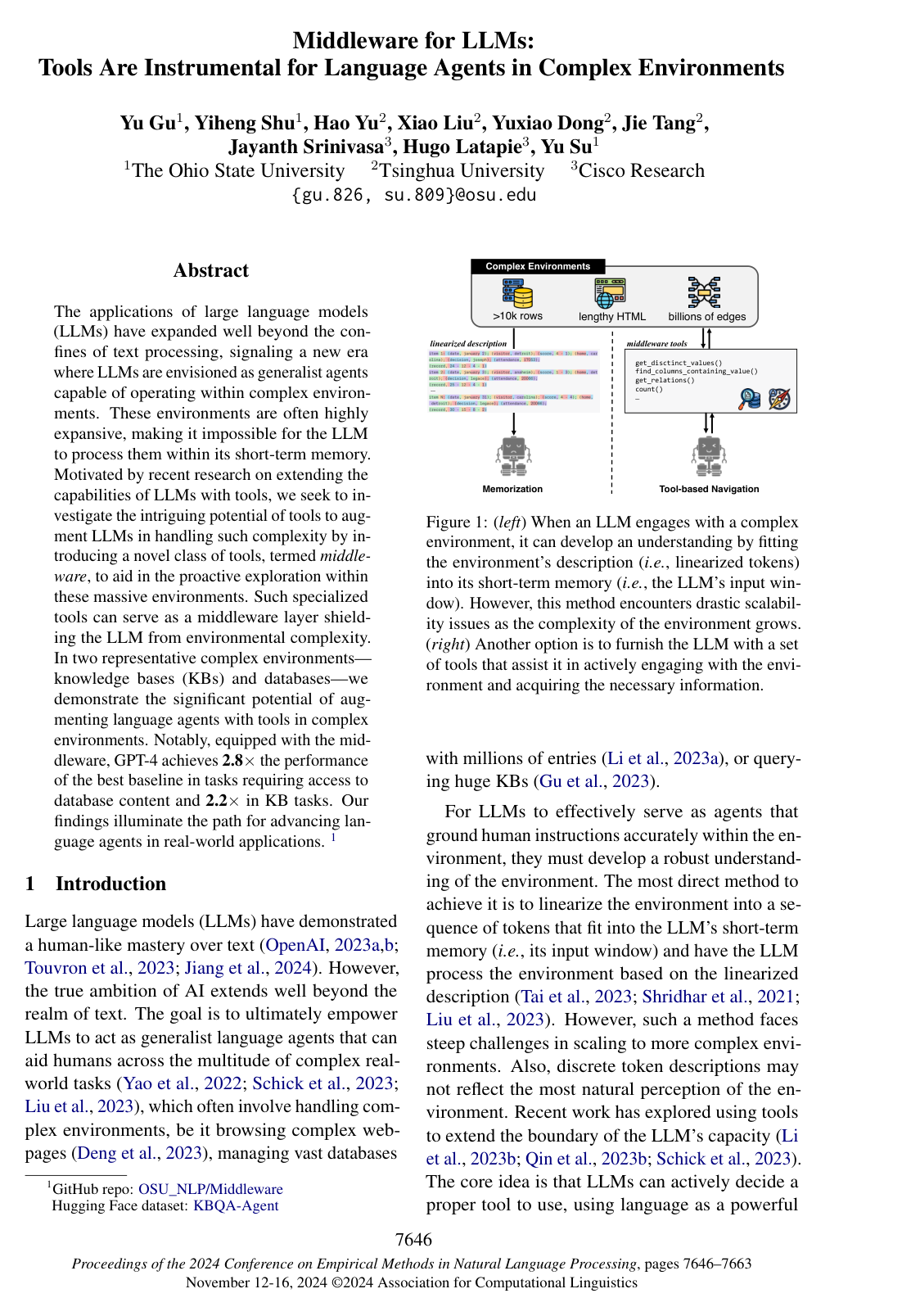
Middleware for LLMs: Tools Are Instrumental for Language Agents in Complex Environments
Yu Gu, Yiheng Shu, Hao Yu, Xiao Liu, Yuxiao Dong, Jie Tang, Jayanth Srinivasa, Hugo Latapie, Yu Su
Why you should read this
Presents a middleware tool framework that shields large language models from the overwhelming scale of complex databases and knowledge bases, more than doubling agent task accuracy through active environment exploration.
The applications of large language models (LLMs) have expanded well beyond the confines of text processing, signaling a new era where LLMs are envisioned as generalist agents capable of operating within complex environments. These environments are often highly expansive, making it impossible for the LLM to process them within its short-term memory. Motivated by recent research on extending the capabilities of LLMs with tools, we seek to investigate the intriguing potential of tools to augment LLMs in handling such complexity by introducing a novel class of tools, termed middleware, to aid in the proactive exploration within these massive environments. Such specialized tools can serve as a middleware layer shielding the LLM from environmental complexity. In two representative complex environments—knowledge bases (KBs) and databases—we demonstrate the significant potential of augmenting language agents with tools in complex environments. Notably, equipped with the middleware, GPT-4 achieves 2.8× the performance of the best baseline in tasks requiring access to database content and 2.2× in KB tasks. Our findings illuminate the path for advancing language agents in real-world applications.
Added
2026-10-04

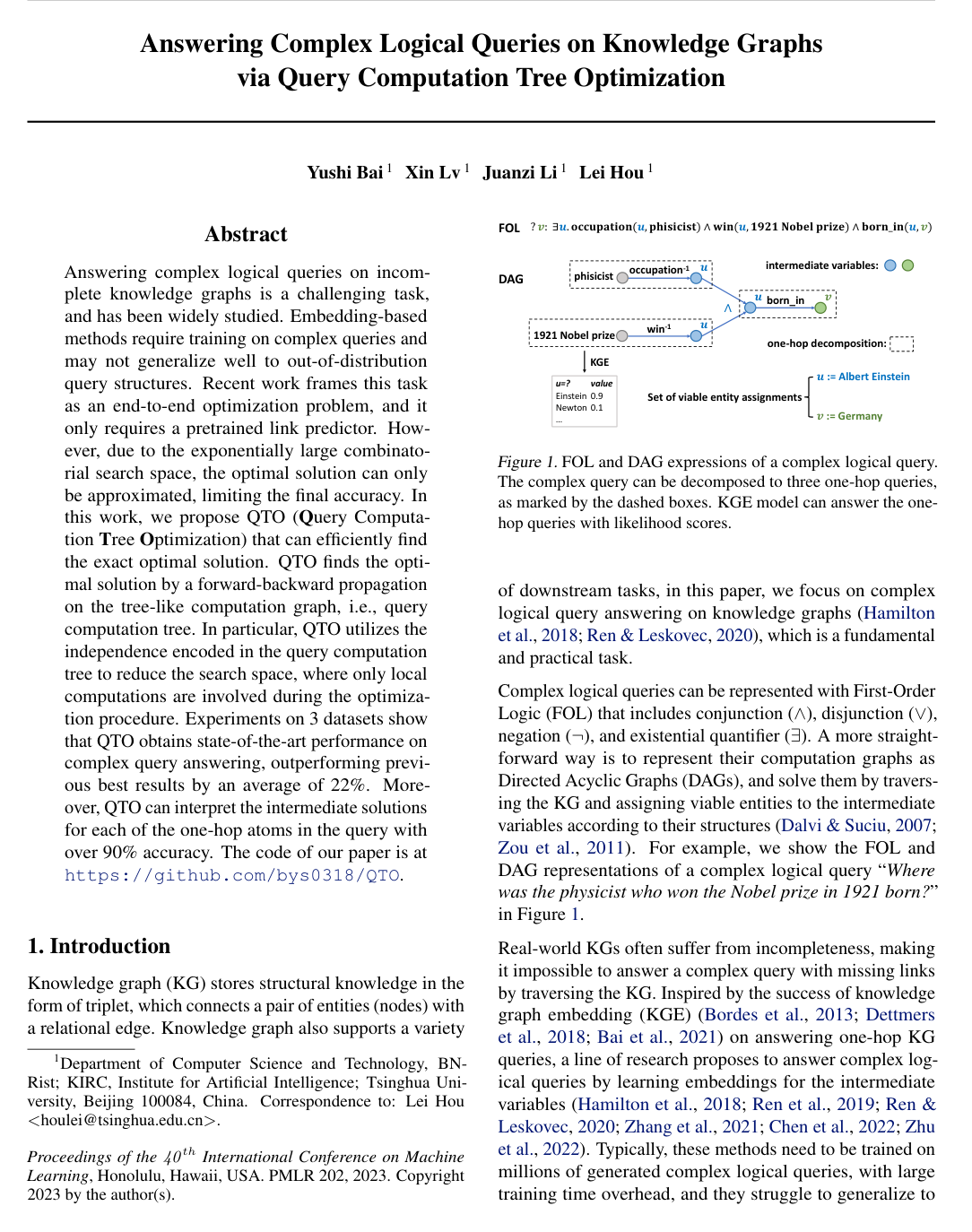
Answering Complex Logical Queries on Knowledge Graphs via Query Computation Tree Optimization
Yushi Bai, Xin Lv, Juanzi Li, Lei Hou
Why you should read this
Proposes a forward-backward propagation algorithm over query computation trees to efficiently find exact optimal entity assignments for complex logical queries on incomplete knowledge graphs without requiring complex query training.
Answering complex logical queries on incomplete knowledge graphs is a challenging task, and has been widely studied. Embedding-based methods require training on complex queries and may not generalize well to out-of-distribution query structures. Recent work frames this task as an end-to-end optimization problem, and it only requires a pretrained link predictor. However, due to the exponentially large combinatorial search space, the optimal solution can only be approximated, limiting the final accuracy. In this work, we propose QTO (Query Computation Tree Optimization) that can efficiently find the exact optimal solution. QTO finds the optimal solution by a forward-backward propagation on the tree-like computation graph, i.e., query computation tree. In particular, QTO utilizes the independence encoded in the query computation tree to reduce the search space, where only local computations are involved during the optimization procedure. Experiments on 3 datasets show that QTO obtains state-of-the-art performance on complex query answering, outperforming previous best results by an average of 22%. Moreover, QTO can interpret the intermediate solutions for each of the one-hop atoms in the query with over 90% accuracy. The code of our paper is at https://github.com/bys0318/QTO.
Added
2026-10-04
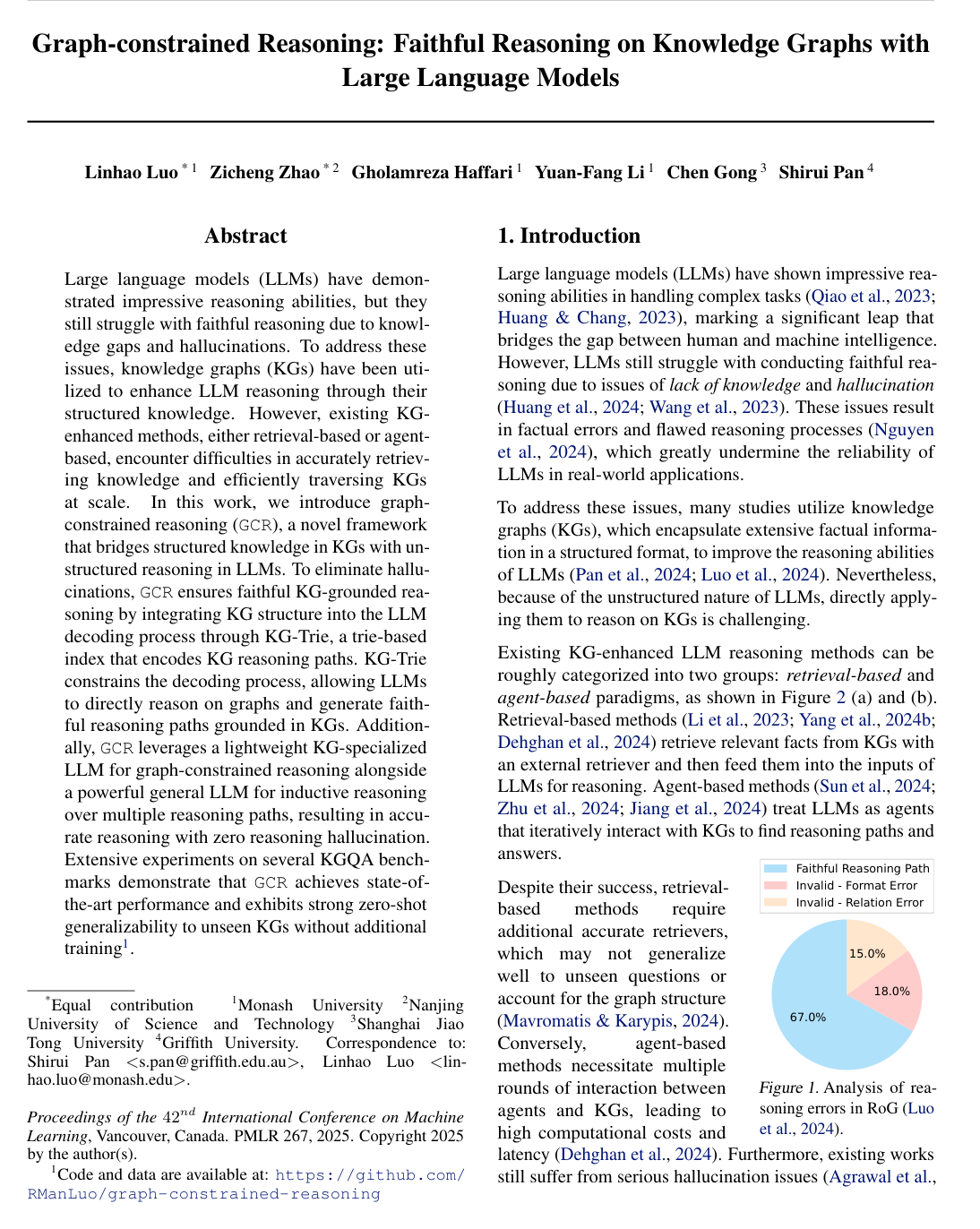
Graph-constrained Reasoning: Faithful Reasoning on Knowledge Graphs with Large Language Models
Linhao Luo, Zicheng Zhao, Gholamreza Haffari, Yuan-Fang Li, Chen Gong, Shirui Pan
Why you should read this
Proposes Graph-Constrained Reasoning, a framework that constrains language model decoding with a trie-based index of knowledge graph paths to eliminate reasoning hallucinations and achieve zero-shot generalization across question answering benchmarks.
Large language models (LLMs) have demonstrated impressive reasoning abilities, but they still struggle with faithful reasoning due to knowledge gaps and hallucinations. To address these issues, knowledge graphs (KGs) have been utilized to enhance LLM reasoning through their structured knowledge. However, existing KG-enhanced methods, either retrieval-based or agent-based, encounter difficulties in accurately retrieving knowledge and efficiently traversing KGs at scale. In this work, we introduce graph-constrained reasoning (GCR), a novel framework that bridges structured knowledge in KGs with unstructured reasoning in LLMs. To eliminate hallucinations, GCR ensures faithful KG-grounded reasoning by integrating KG structure into the LLM decoding process through KG-Trie, a trie-based index that encodes KG reasoning paths. KG-Trie constrains the decoding process, allowing LLMs to directly reason on graphs and generate faithful reasoning paths grounded in KGs. Additionally, GCR leverages a lightweight KG-specialized LLM for graph-constrained reasoning alongside a powerful general LLM for inductive reasoning over multiple reasoning paths, resulting in accurate reasoning with zero reasoning hallucination. Extensive experiments on several KGQA benchmarks demonstrate that GCR achieves state-of-the-art performance and exhibits strong zero-shot generalizability to unseen KGs without additional training¹.
Added
2026-10-04
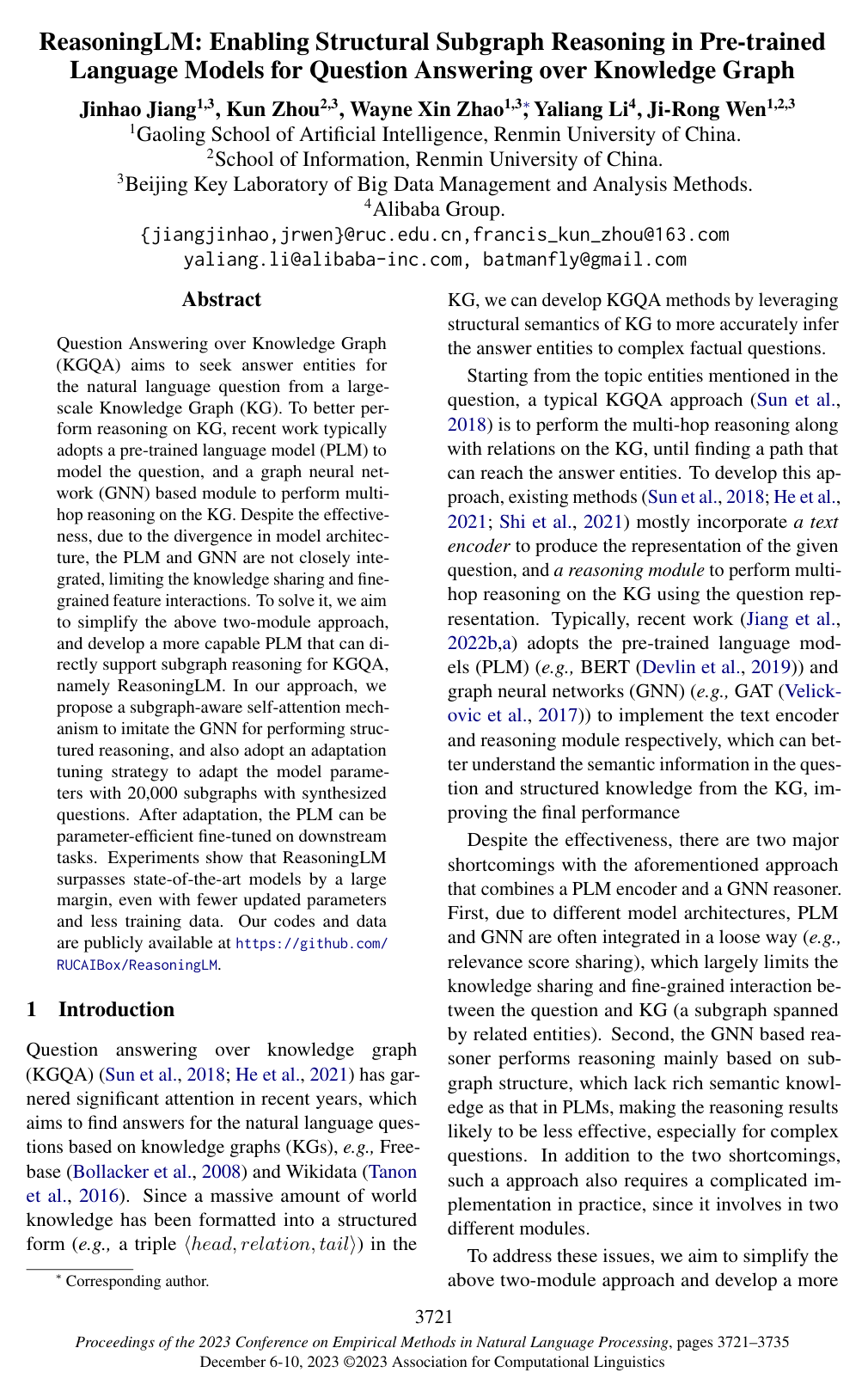
ReasoningLM: Enabling Structural Subgraph Reasoning in Pre-trained Language Models for Question Answering over Knowledge Graph
Jinhao Jiang, Kun Zhou, Wayne Xin Zhao, Yaliang Li, Ji-Rong Wen
Why you should read this
Proposes a unified pre-trained language model that performs structural subgraph reasoning directly via a specialized self-attention mechanism, outperforming traditional two-module graph neural network approaches for knowledge graph question answering while updating fewer parameters.
Question Answering over Knowledge Graph (KGQA) aims to seek answer entities for the natural language question from a large-scale Knowledge Graph (KG). To better perform reasoning on KG, recent work typically adopts a pre-trained language model (PLM) to model the question, and a graph neural network (GNN) based module to perform multi-hop reasoning on the KG. Despite the effectiveness, due to the divergence in model architecture, the PLM and GNN are not closely integrated, limiting the knowledge sharing and fine-grained feature interactions. To solve it, we aim to simplify the above two-module approach, and develop a more capable PLM that can directly support subgraph reasoning for KGQA, namely ReasoningLM. In our approach, we propose a subgraph-aware self-attention mechanism to imitate the GNN for performing structured reasoning, and also adopt an adaptation tuning strategy to adapt the model parameters with 20,000 subgraphs with synthesized questions. After adaptation, the PLM can be parameter-efficient fine-tuned on downstream tasks. Experiments show that ReasoningLM surpasses state-of-the-art models by a large margin, even with fewer updated parameters and less training data. Our codes and data are publicly available at https://github.com/RUCAIBox/ReasoningLM.
Added
2026-10-03
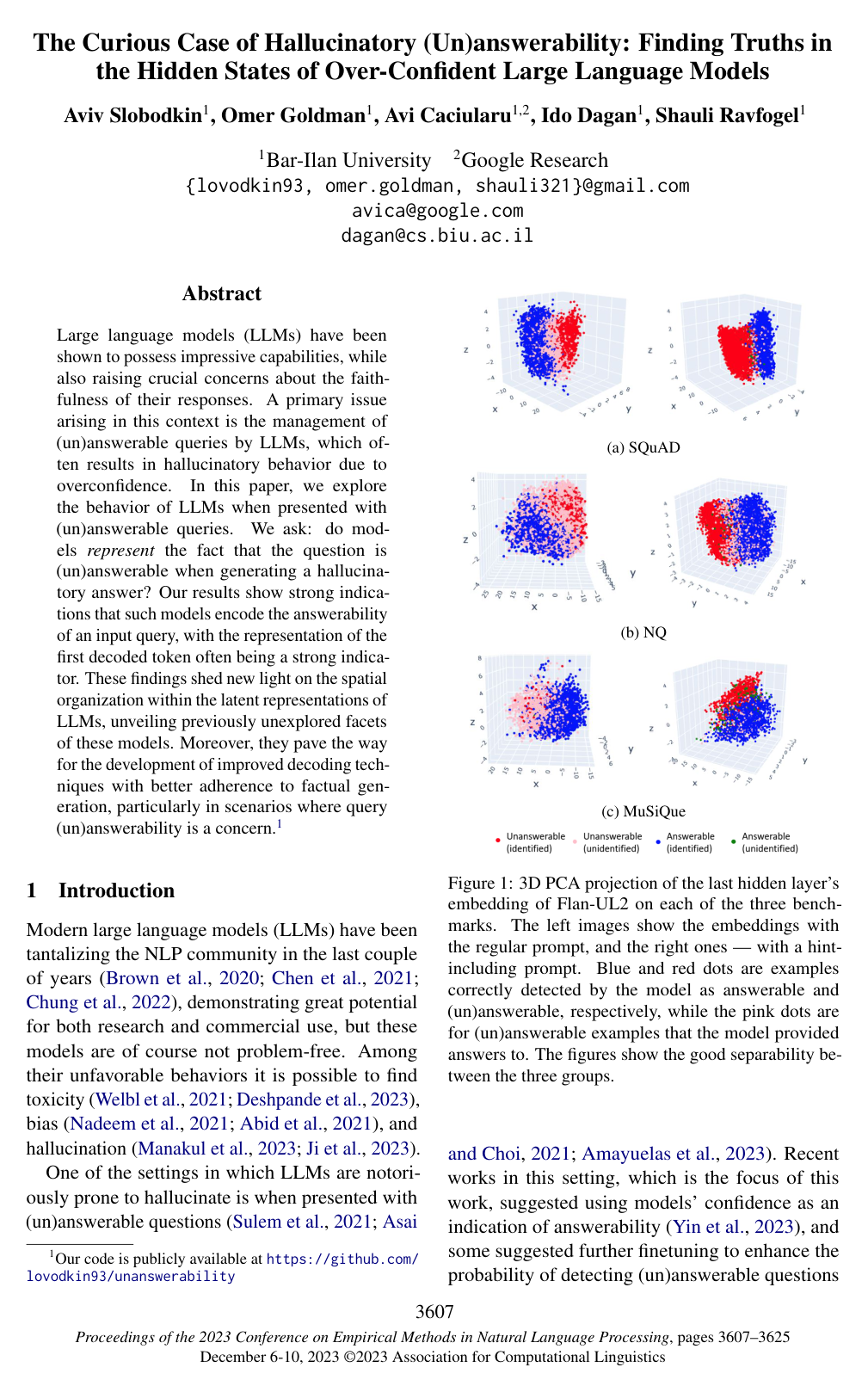
The Curious Case of Hallucinatory (Un)answerability: Finding Truths in the Hidden States of Over-Confident Large Language Models
Aviv Slobodkin, Omer Goldman, Avi Caciularu, Ido Dagan, Shauli Ravfogel
Why you should read this
Reveals that large language models internally encode whether a question is answerable in their hidden states even while generating hallucinatory answers, showing that this linearly separable answerability signal can be extracted to curb overconfident errors.
Large language models (LLMs) have been shown to possess impressive capabilities, while also raising crucial concerns about the faithfulness of their responses. A primary issue arising in this context is the management of (un)answerable queries by LLMs, which often results in hallucinatory behavior due to overconfidence. In this paper, we explore the behavior of LLMs when presented with (un)answerable queries. We ask: do models represent the fact that the question is (un)answerable when generating a hallucinatory answer? Our results show strong indications that such models encode the answerability of an input query, with the representation of the first decoded token often being a strong indicator. These findings shed new light on the spatial organization within the latent representations of LLMs, unveiling previously unexplored facets of these models. Moreover, they pave the way for the development of improved decoding techniques with better adherence to factual generation, particularly in scenarios where query (un)answerability is a concern.
Added
2026-10-03
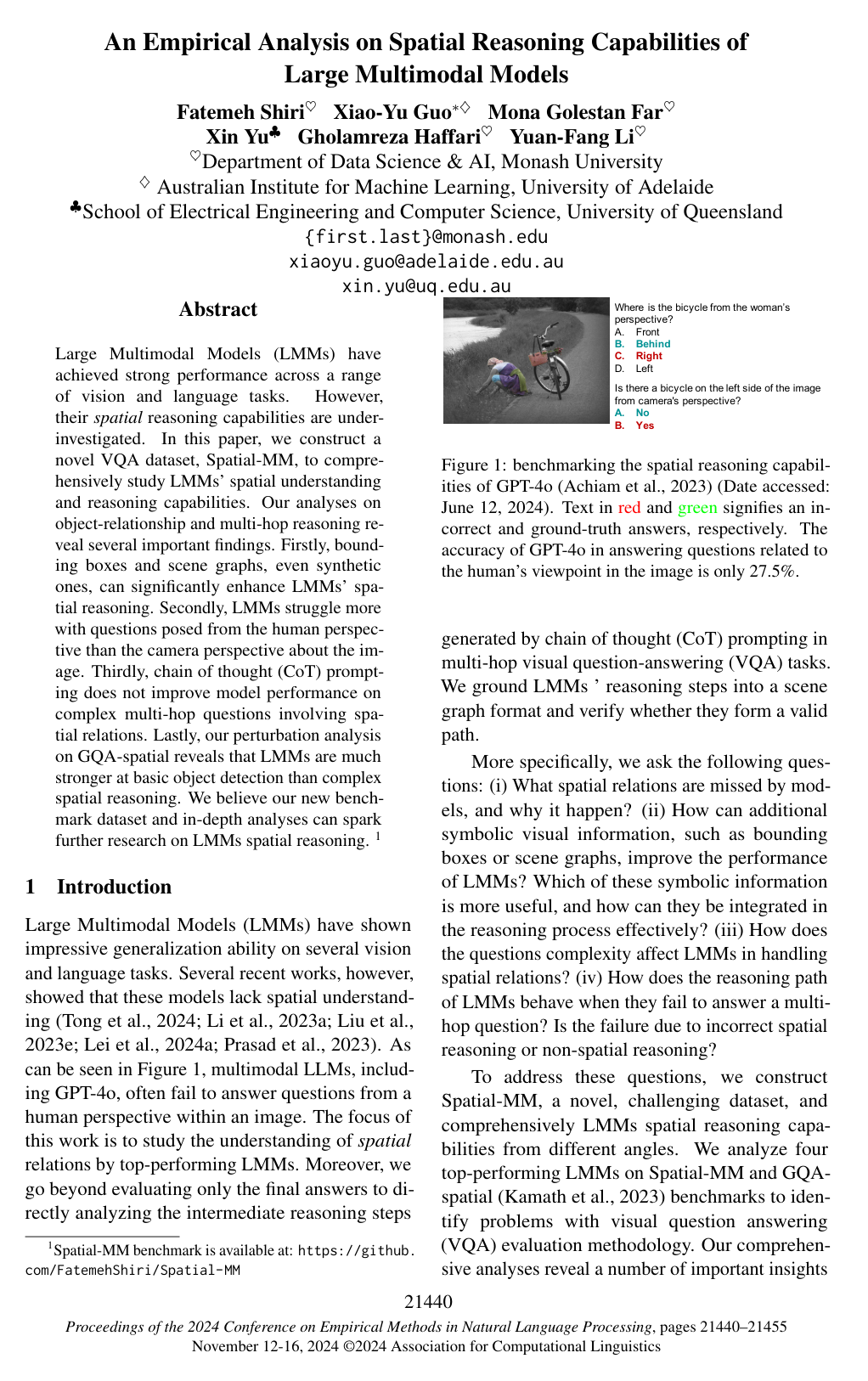
An Empirical Analysis on Spatial Reasoning Capabilities of Large Multimodal Models
Fatemeh Shiri, Xiao-Yu Guo, Mona Far, Xin Yu, Reza Haf, Yuan-Fang Li
Why you should read this
Presents the Spatial-MM benchmark to expose critical weaknesses in large multimodal models, showing that while symbolic aids like bounding boxes improve performance, models still fail on human-perspective viewpoints and gain no benefit from chain-of-thought prompting on complex spatial questions.
Large Multimodal Models (LMMs) have achieved strong performance across a range of vision and language tasks. However, their spatial reasoning capabilities are under-investigated. In this paper, we construct a novel VQA dataset, Spatial-MM, to comprehensively study LMMs' spatial understanding and reasoning capabilities. Our analyses on object-relationship and multi-hop reasoning reveal several important findings. Firstly, bounding boxes and scene graphs, even synthetic ones, can significantly enhance LMMs' spatial reasoning. Secondly, LMMs struggle more with questions posed from the human perspective than the camera perspective about the image. Thirdly, chain of thought (CoT) prompting does not improve model performance on complex multi-hop questions involving spatial relations. Lastly, our perturbation analysis on GQA-spatial reveals that LMMs are much stronger at basic object detection than complex spatial reasoning. We believe our new benchmark dataset and in-depth analyses can spark further research on LMMs spatial reasoning.
Added
2026-10-03
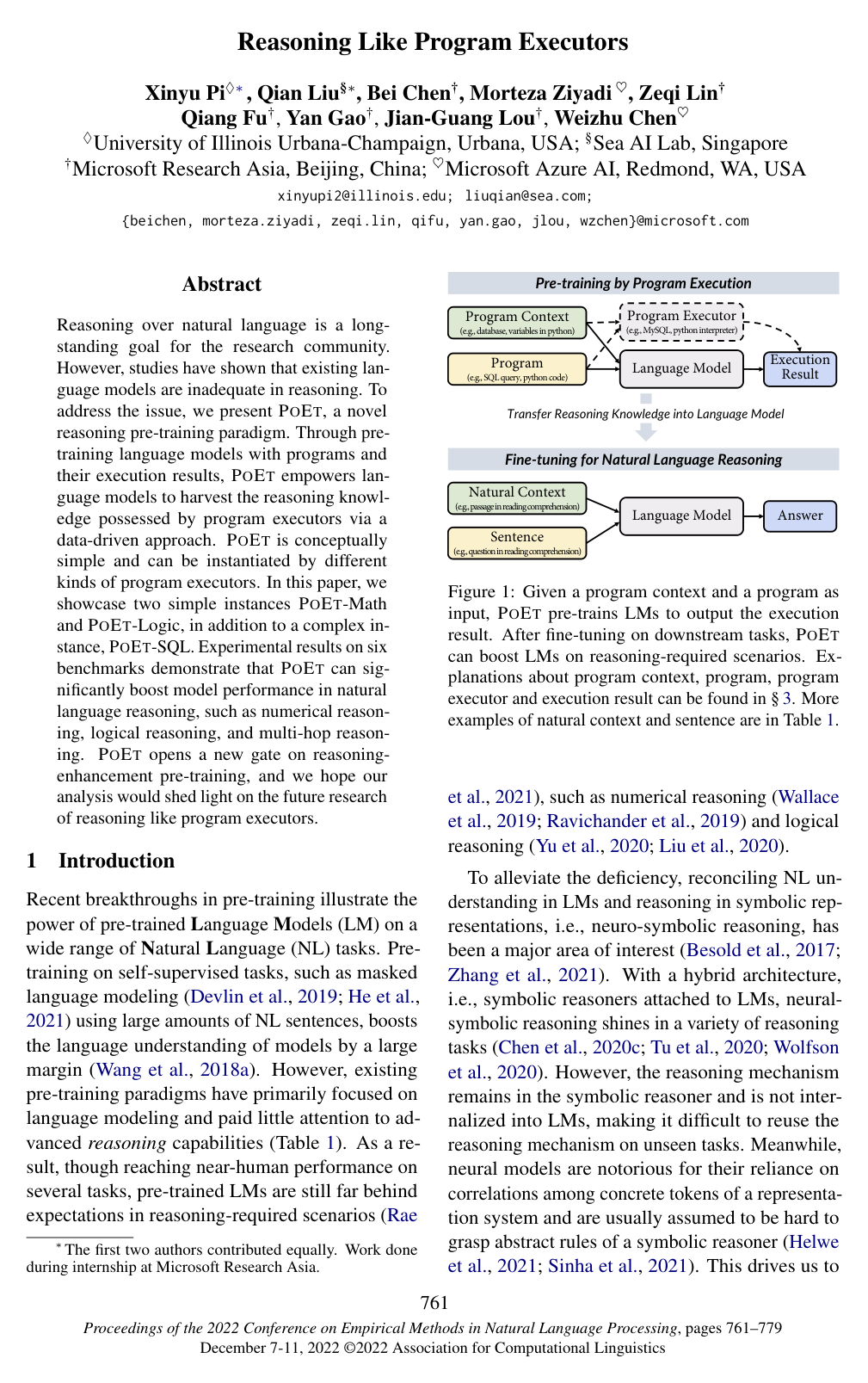
Reasoning Like Program Executors
Xinyu Pi, Qian Liu, Bei Chen, Morteza Ziyadi, Zeqi Lin, Qiang Fu, Yan Gao, Jian-Guang Lou, Weizhu Chen
Why you should read this
Proposes a pre-training paradigm that teaches language models to predict program execution outputs, transferring formal symbolic reasoning capabilities directly into neural models for downstream natural language tasks.
Reasoning over natural language is a long-standing goal for the research community. However, studies have shown that existing language models are inadequate in reasoning. To address the issue, we present PoET, a novel reasoning pre-training paradigm. Through pre-training language models with programs and their execution results, PoET empowers language models to harvest the reasoning knowledge possessed by program executors via a data-driven approach. PoET is conceptually simple and can be instantiated by different kinds of program executors. In this paper, we showcase two simple instances PoET-Math and PoET-Logic, in addition to a complex instance, PoET-SQL. Experimental results on six benchmarks demonstrate that PoET can significantly boost model performance in natural language reasoning, such as numerical reasoning, logical reasoning, and multi-hop reasoning. PoET opens a new gate on reasoning-enhancement pre-training, and we hope our analysis would shed light on the future research of reasoning like program executors.
Added
2026-10-03
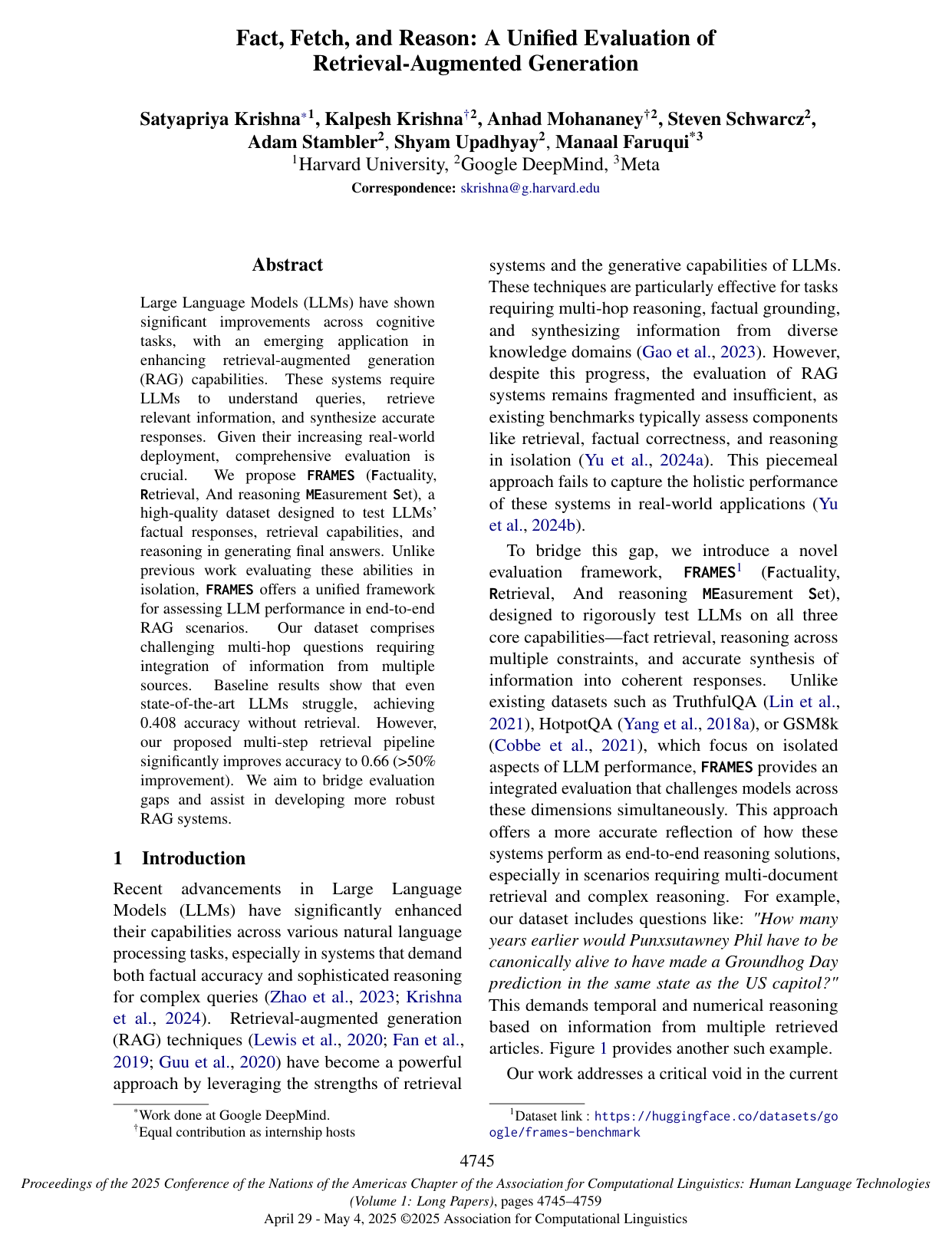
Fact, Fetch, and Reason: A Unified Evaluation of Retrieval-Augmented Generation
Satyapriya Krishna, Kalpesh Krishna, Anhad Mohananey, Steven Schwarcz, Adam Stambler, Shyam Upadhyay, Manaal Faruqui
Why you should read this
Introduces FRAMES, a benchmark of multi-hop questions requiring information synthesis across multiple documents to evaluate retrieval-augmented generation systems simultaneously on factuality, retrieval, and complex reasoning.
Large Language Models (LLMs) have shown significant improvements across cognitive tasks, with an emerging application in enhancing retrieval-augmented generation (RAG) capabilities. These systems require LLMs to understand queries, retrieve relevant information, and synthesize accurate responses. Given their increasing real-world deployment, comprehensive evaluation is crucial. We propose FRAMES (Factuality, Retrieval, And reasoning MEasurement Set), a high-quality dataset designed to test LLMs’ factual responses, retrieval capabilities, and reasoning in generating final answers. Unlike previous work evaluating these abilities in isolation, FRAMES offers a unified framework for assessing LLM performance in end-to-end RAG scenarios. Our dataset comprises challenging multi-hop questions requiring integration of information from multiple sources. Baseline results show that even state-of-the-art LLMs struggle, achieving 0.408 accuracy without retrieval. However, our proposed multi-step retrieval pipeline significantly improves accuracy to 0.66 (>50% improvement). We aim to bridge evaluation gaps and assist in developing more robust RAG systems.
Added
2026-10-01
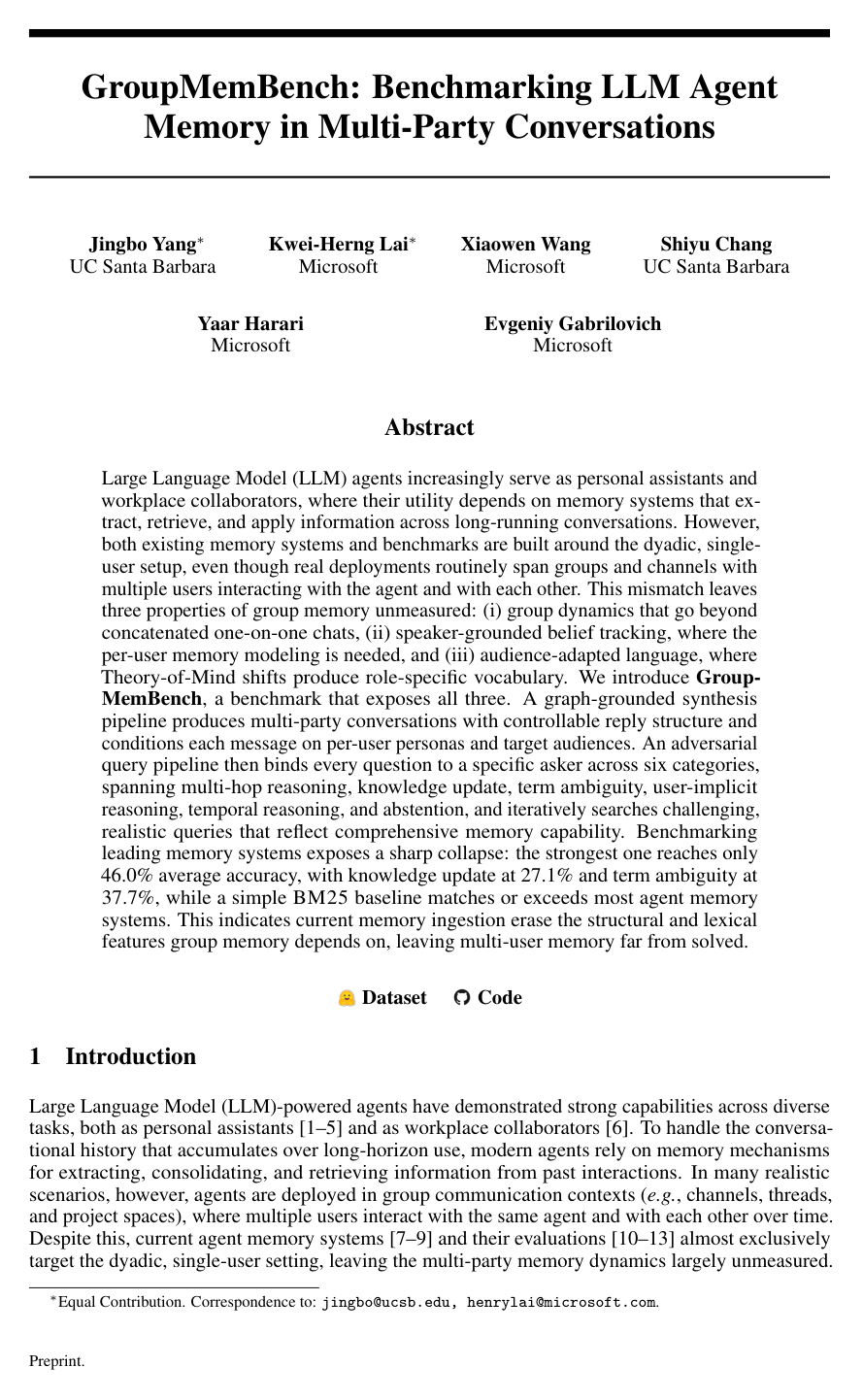
GroupMemBench: Benchmarking LLM Agent Memory in Multi-Party Conversations
Jingbo Yang, Kwei-Herng Lai, Xiaowen Wang, Shiyu Chang, Yaar Harari, Evgeniy Gabrilovich
Why you should read this
Introduces GroupMemBench, a benchmark for evaluating LLM agent memory in multi-party conversations, revealing that current memory systems struggle with speaker-grounded context and collapse to an average accuracy of only 46%.
Large Language Model (LLM) agents increasingly serve as personal assistants and workplace collaborators, where their utility depends on memory systems that extract, retrieve, and apply information across long-running conversations. However, both existing memory systems and benchmarks are built around the dyadic, single-user setup, even though real deployments routinely span groups and channels with multiple users interacting with the agent and with each other. This mismatch leaves three properties of group memory unmeasured: (i) group dynamics that go beyond concatenated one-on-one chats, (ii) speaker-grounded belief tracking, where the per-user memory modeling is needed, and (iii) audience-adapted language, where Theory-of-Mind shifts produce role-specific vocabulary. We introduce GroupMemBench, a benchmark that exposes all three. A graph-grounded synthesis pipeline produces multi-party conversations with controllable reply structure and conditions each message on per-user personas and target audiences. An adversarial query pipeline then binds every question to a specific asker across six categories, spanning multi-hop reasoning, knowledge update, term ambiguity, user-implicit reasoning, temporal reasoning, and abstention, and iteratively searches challenging, realistic queries that reflect comprehensive memory capability. Benchmarking leading memory systems exposes a sharp collapse: the strongest one reaches only 46.0% average accuracy, with knowledge update at 27.1% and term ambiguity at 37.7%, while a simple BM25 baseline matches or exceeds most agent memory systems. This indicates current memory ingestion erases the structural and lexical features group memory depends on, leaving multi-user memory far from solved.
Added
2026-09-30
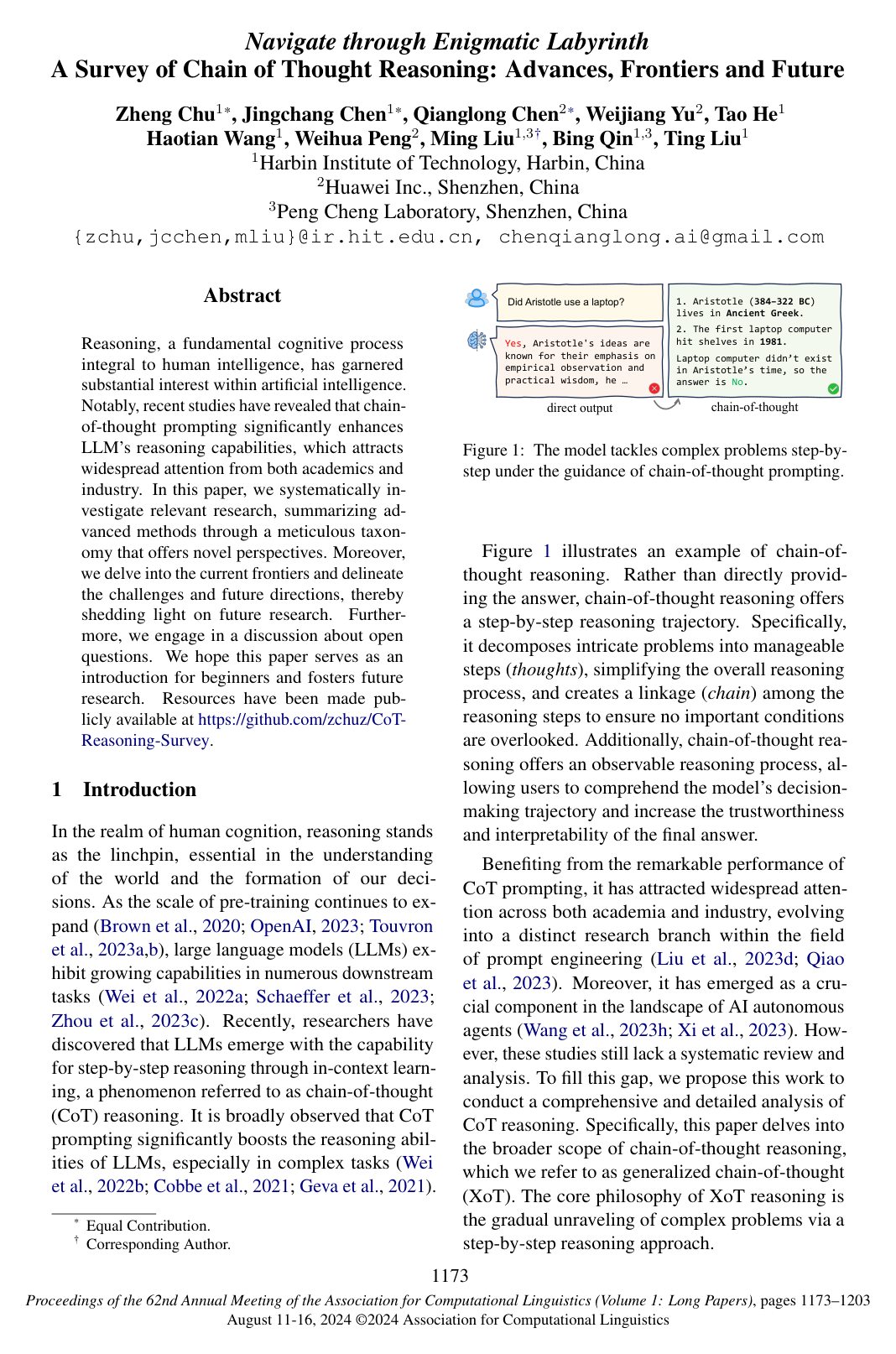
Navigate through Enigmatic Labyrinth A Survey of Chain of Thought Reasoning: Advances, Frontiers and Future
Zheng Chu, Jingchang Chen, Qianglong Chen, Weijiang Yu, Tao He, Haotian Wang, Weihua Peng, Ming Liu, Bing Qin, Ting Liu
Why you should read this
Presents a structured taxonomy of generalized chain-of-thought reasoning in large language models, categorizing prompt construction techniques, topological variants, and enhancement methods alongside core benchmarks and emerging frontiers.
Reasoning, a fundamental cognitive process integral to human intelligence, has garnered substantial interest within artificial intelligence. Notably, recent studies have revealed that chain-of-thought prompting significantly enhances LLM's reasoning capabilities, which attracts widespread attention from both academics and industry. In this paper, we systematically investigate relevant research, summarizing advanced methods through a meticulous taxonomy that offers novel perspectives. Moreover, we delve into the current frontiers and delineate the challenges and future directions, thereby shedding light on future research. Furthermore, we engage in a discussion about open questions. We hope this paper serves as an introduction for beginners and fosters future research. Resources have been made publicly available at https://github.com/zchuz/CoT-Reasoning-Survey.
Added
2026-09-28
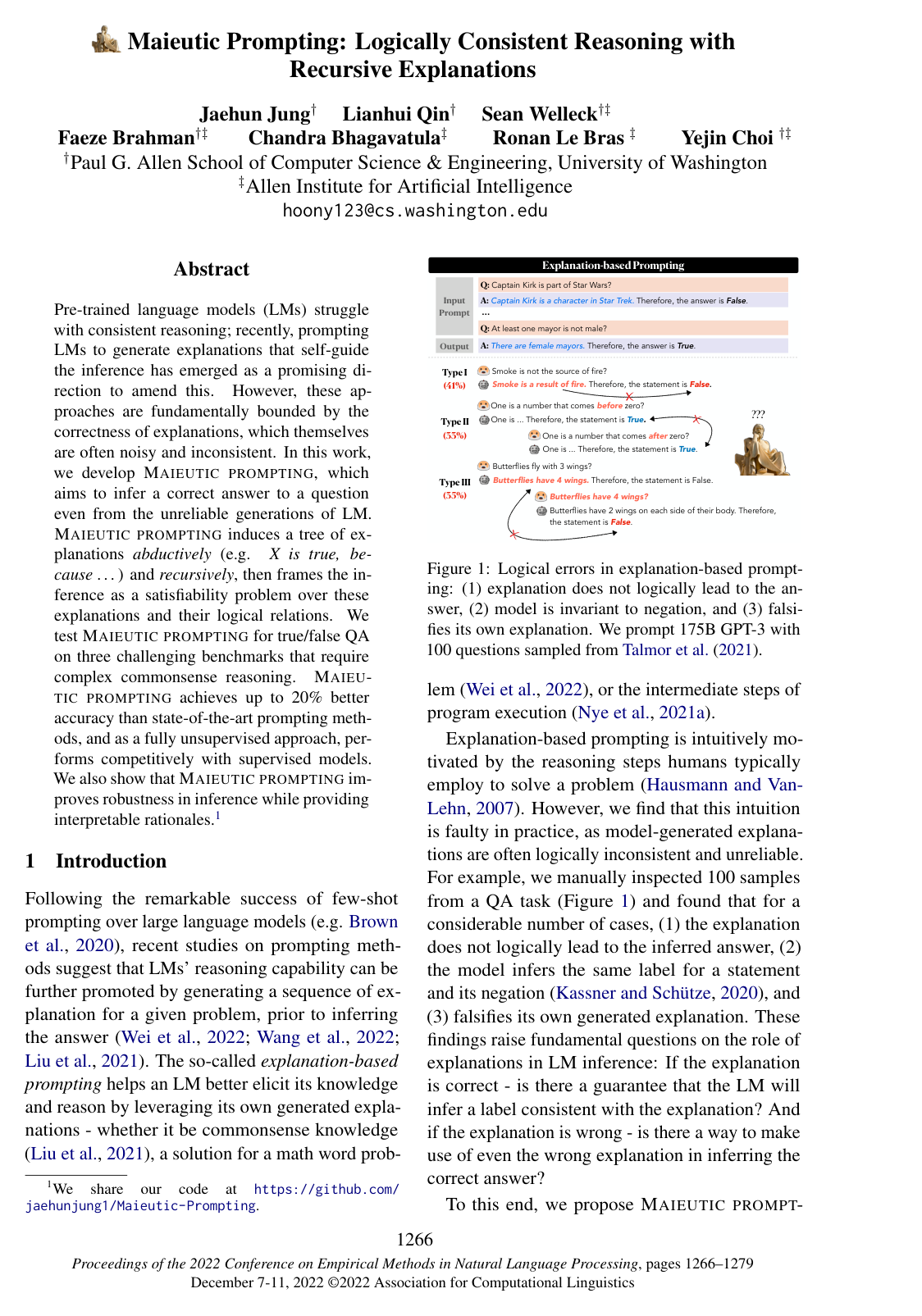
Maieutic Prompting: Logically Consistent Reasoning with Recursive Explanations
Jaehun Jung, Lianhui Qin, Sean Welleck, Faeze Brahman, Chandra Bhagavatula, Ronan Le Bras, Yejin Choi
Why you should read this
Proposes an unsupervised prompting method that recursively generates trees of abductive explanations and resolves their logical inconsistencies with a satisfiability solver, improving commonsense question-answering accuracy by up to 20% over standard prompting baselines.
Pre-trained language models (LMs) struggle with consistent reasoning; recently, prompting LMs to generate explanations that self-guide the inference has emerged as a promising direction to amend this. However, these approaches are fundamentally bounded by the correctness of explanations, which themselves are often noisy and inconsistent. In this work, we develop MAIEUTIC PROMPTING, which aims to infer a correct answer to a question even from the unreliable generations of LM. MAIEUTIC PROMPTING induces a tree of explanations abductively (e.g. X is true, because . . .) and recursively, then frames the inference as a satisfiability problem over these explanations and their logical relations. We test MAIEUTIC PROMPTING for true/false QA on three challenging benchmarks that require complex commonsense reasoning. MAIEUTIC PROMPTING achieves up to 20% better accuracy than state-of-the-art prompting methods, and as a fully unsupervised approach, performs competitively with supervised models. We also show that MAIEUTIC PROMPTING improves robustness in inference while providing interpretable rationales.
Added
2026-09-26
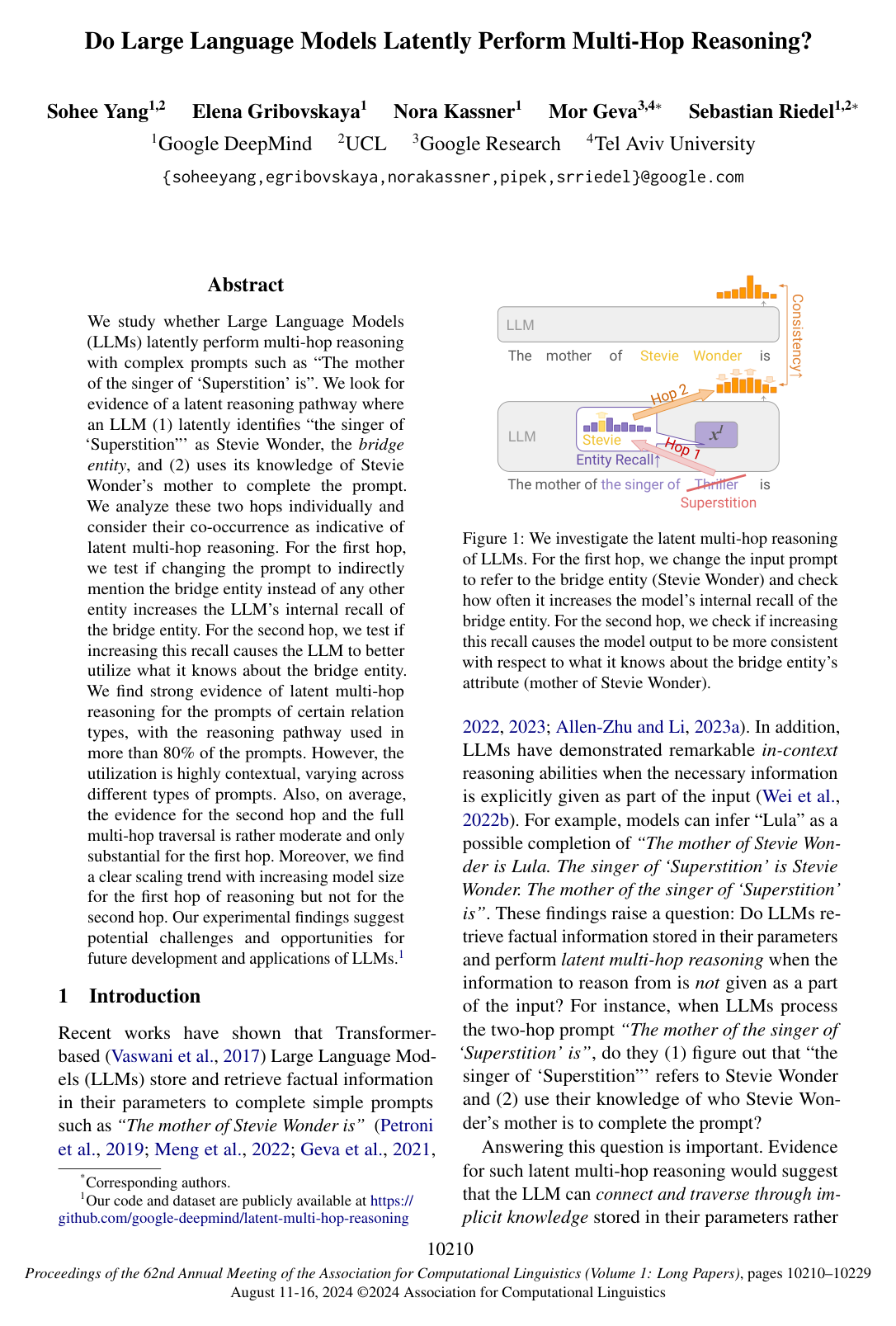
Do Large Language Models Latently Perform Multi-Hop Reasoning?
Sohee Yang, Elena Gribovskaya, Nora Kassner, Mor Geva, Sebastian Riedel
Why you should read this
Investigates whether large language models internally connect factual knowledge across multi-hop prompts, revealing that while models frequently recall intermediate bridge entities, their ability to utilize that recalled information for the final reasoning step remains context-dependent and fails to scale with model size.
We study whether Large Language Models (LLMs) latently perform multi-hop reasoning with complex prompts such as “The mother of the singer of ‘Superstition’ is”. We look for evidence of a latent reasoning pathway where an LLM (1) latently identifies “the singer of ‘Superstition’” as Stevie Wonder, the bridge entity, and (2) uses its knowledge of Stevie Wonder’s mother to complete the prompt. We analyze these two hops individually and consider their co-occurrence as indicative of latent multi-hop reasoning. For the first hop, we test if changing the prompt to indirectly mention the bridge entity instead of any other entity increases the LLM’s internal recall of the bridge entity. For the second hop, we test if increasing this recall causes the LLM to better utilize what it knows about the bridge entity. We find strong evidence of latent multi-hop reasoning for the prompts of certain relation types, with the reasoning pathway used in more than 80% of the prompts. However, the utilization is highly contextual, varying across different types of prompts. Also, on average, the evidence for the second hop and the full multi-hop traversal is rather moderate and only substantial for the first hop. Moreover, we find a clear scaling trend with increasing model size for the first hop of reasoning but not for the second hop. Our experimental findings suggest potential challenges and opportunities for future development and applications of LLMs.^1
Added
2026-09-26
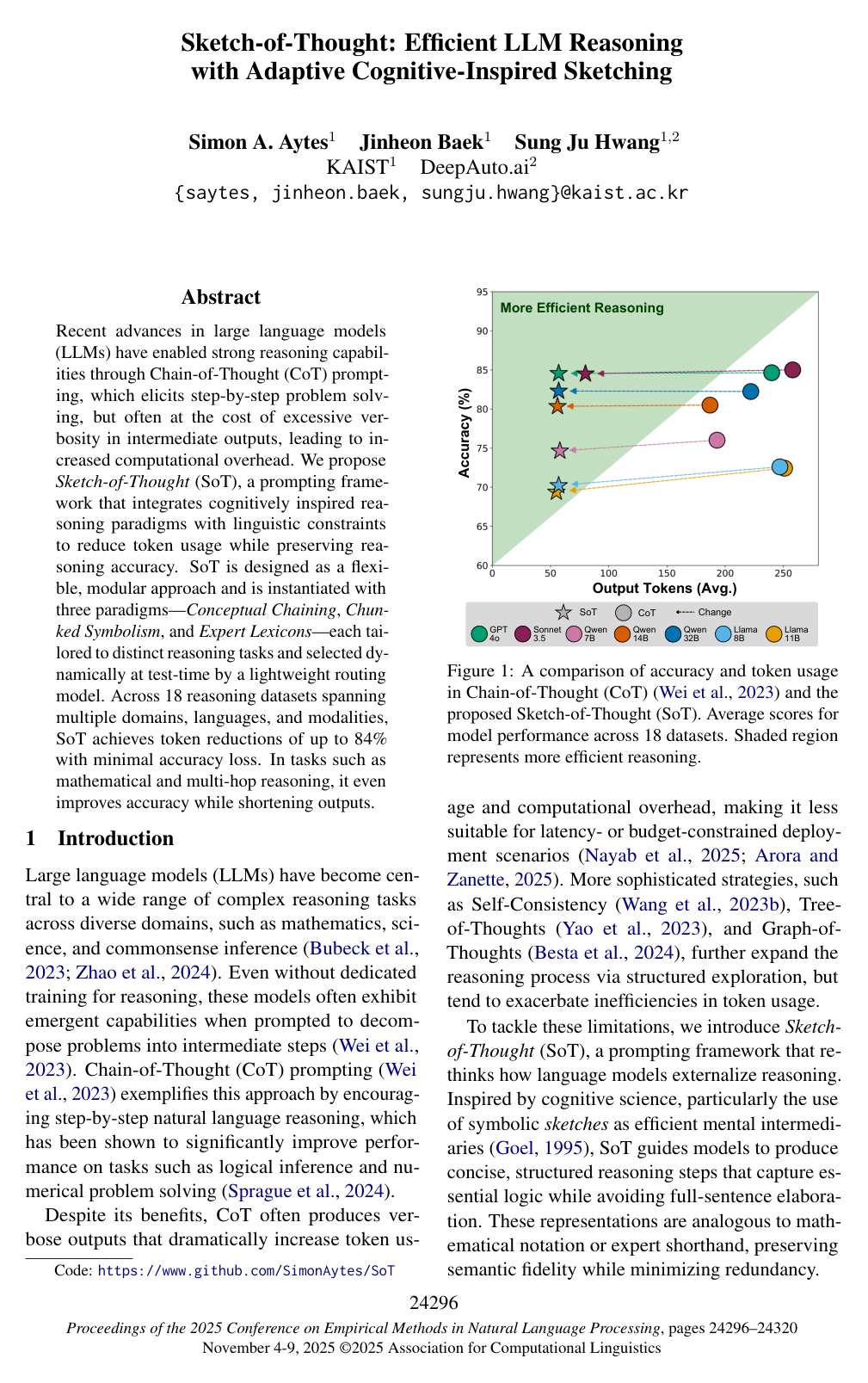
Sketch-of-Thought: Efficient LLM Reasoning with Adaptive Cognitive-Inspired Sketching
Simon A. Aytes, Jinheon Baek, Sung Ju Hwang
Why you should read this
Proposes Sketch-of-Thought, a prompting framework that dynamically selects cognitively inspired reasoning paradigms to cut language model token generation by up to 84% while maintaining task accuracy.
Recent advances in large language models (LLMs) have enabled strong reasoning capabilities through Chain-of-Thought (CoT) prompting, which elicits step-by-step problem solving, but often at the cost of excessive verbosity in intermediate outputs, leading to increased computational overhead. We propose Sketch-of-Thought (SoT), a prompting framework that integrates cognitively inspired reasoning paradigms with linguistic constraints to reduce token usage while preserving reasoning accuracy. SoT is designed as a flexible, modular approach and is instantiated with three paradigms—Conceptual Chaining, Chunked Symbolism, and Expert Lexicons—each tailored to distinct reasoning tasks and selected dynamically at test-time by a lightweight routing model. Across 18 reasoning datasets spanning multiple domains, languages, and modalities, SoT achieves token reductions of up to 84% with minimal accuracy loss. In tasks such as mathematical and multi-hop reasoning, it even improves accuracy while shortening outputs.
Added
2026-09-26
BoardgameQA: A Dataset for Natural Language Reasoning with Contradictory Information
Mehran Kazemi, Quan Yuan, Deepti Bhatia, Najoung Kim, Xin Xu, Vaiva Imbrasaite, Deepak Ramachandran
Why you should read this
Introduces BoardgameQA, a benchmark for evaluating language models on multi-hop defeasible reasoning with contradictory rules and missing background knowledge, revealing that state-of-the-art models struggle to resolve conflicting information even after fine-tuning.
Automated reasoning with unstructured natural text is a key requirement for many potential applications of NLP and for developing robust AI systems. Recently, Language Models (LMs) have demonstrated complex reasoning capacities even without any finetuning. However, existing evaluation for automated reasoning assumes access to a consistent and coherent set of information over which models reason. When reasoning in the real-world, the available information is frequently inconsistent or contradictory, and therefore models need to be equipped with a strategy to resolve such conflicts when they arise. One widely-applicable way of resolving conflicts is to impose preferences over information sources (e.g., based on source credibility or information recency) and adopt the source with higher preference. In this paper, we formulate the problem of reasoning with contradictory information guided by preferences over sources as the classical problem of defeasible reasoning, and develop a dataset called BoardgameQA for measuring the reasoning capacity of LMs in this setting. BoardgameQA also incorporates reasoning with implicit background knowledge, to better reflect reasoning problems in downstream applications. We benchmark various LMs on BoardgameQA and the results reveal a significant gap in the reasoning capacity of state-of-the-art LMs on this problem, showing that reasoning with conflicting information does not surface out-of-the-box in LMs. While performance can be improved with finetuning, it nevertheless remains poor.
Added
2026-09-26
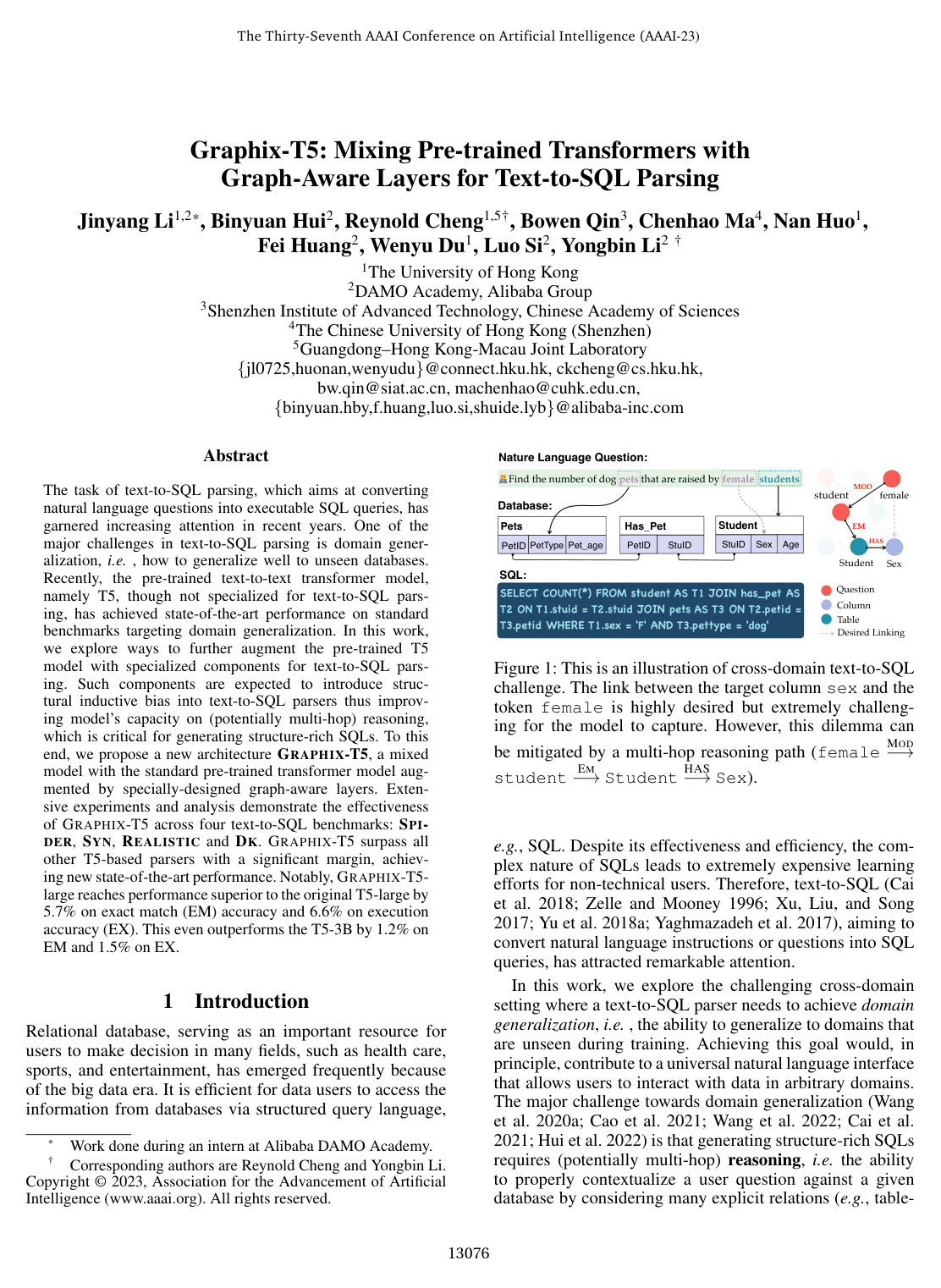
Graphix-T5: Mixing Pre-trained Transformers with Graph-Aware Layers for Text-to-SQL Parsing
Jinyang Li, Binyuan Hui, Reynold Cheng, Bowen Qin, Chenhao Ma, Nan Huo, Fei Huang, Wenyu Du, Luo Si, Yongbin Li
Why you should read this
Proposes Graphix-T5, a text-to-SQL architecture that integrates relational graph neural network layers directly into pre-trained T5 encoder blocks to improve multi-hop reasoning over database schemas, achieving state-of-the-art cross-domain parsing accuracy while outperforming much larger standard models.
The task of text-to-SQL parsing, which aims at converting natural language questions into executable SQL queries, has garnered increasing attention in recent years. One of the major challenges in text-to-SQL parsing is domain generalization, i.e., how to generalize well to unseen databases. Recently, the pre-trained text-to-text transformer model, namely T5, though not specialized for text-to-SQL parsing, has achieved state-of-the-art performance on standard benchmarks targeting domain generalization. In this work, we explore ways to further augment the pre-trained T5 model with specialized components for text-to-SQL parsing. Such components are expected to introduce structural inductive bias into text-to-SQL parsers thus improving model's capacity on (potentially multi-hop) reasoning, which is critical for generating structure-rich SQLs. To this end, we propose a new architecture GRAPHIX-T5, a mixed model with the standard pre-trained transformer model augmented by specially-designed graph-aware layers. Extensive experiments and analysis demonstrate the effectiveness of GRAPHIX-T5 across four text-to-SQL benchmarks: SPIDER, SYN, REALISTIC and DK. GRAPHIX-T5 surpass all other T5-based parsers with a significant margin, achieving new state-of-the-art performance. Notably, GRAPHIX-T5-large reaches performance superior to the original T5-large by 5.7% on exact match (EM) accuracy and 6.6% on execution accuracy (EX). This even outperforms the T5-3B by 1.2% on EM and 1.5% on EX.
Added
2026-09-26
Differentiable Neuro-Symbolic Reasoning on Large-Scale Knowledge Graphs
Shengyuan Chen, Yunfeng Cai, Huang Fang, Xiao Huang, Mingming Sun
Why you should read this
Proposes DiffLogic, an end-to-end differentiable neuro-symbolic framework that integrates continuous probabilistic soft logic with knowledge graph embeddings and an efficient rule-grounding mechanism to enable scalable, accurate reasoning on large-scale knowledge graphs.
Knowledge graph (KG) reasoning utilizes two primary techniques, i.e., rule-based and KG-embedding based. The former provides precise inferences, but inferring via concrete rules is not scalable. The latter enables efficient reasoning at the cost of ambiguous inference accuracy. Neuro-symbolic reasoning seeks to amalgamate the advantages of both techniques. The crux of this approach is replacing the predicted existence of all possible triples (i.e., truth scores inferred from rules) with a suitable approximation grounded in embedding representations. However, constructing an effective approximation of all possible triples’ truth scores is a challenging task, because it needs to balance the tradeoff between accuracy and efficiency, while compatible with both the rule-based and KG-embedding models. To this end, we proposed a differentiable framework - DiffLogic. Instead of directly approximating all possible triples, we design a tailored filter to adaptively select essential triples based on the dynamic rules and weights. The truth scores assessed by KG-embedding are continuous, so we employ a continuous Markov logic network named probabilistic soft logic (PSL). It employs the truth scores of essential triples to assess the overall agreement among rules, weights, and observed triples. PSL enables end-to-end differentiable optimization, so we can alternately update embedding and weighted rules. On benchmark datasets, we empirically show that DiffLogic surpasses baselines in both effectiveness and efficiency.
Added
2026-09-26
Learning to Walk with Dual Agents for Knowledge Graph Reasoning
Denghui Zhang, Zixuan Yuan, Hao Liu, Xiaodong Lin, Hui Xiong
Why you should read this
Proposes a collaborative dual-agent reinforcement learning framework that pairs coarse cluster-level searching with fine entity-level walking to improve multi-hop reasoning over long paths in incomplete knowledge graphs.
Graph walking based on reinforcement learning (RL) has shown great success in navigating an agent to automatically complete various reasoning tasks over an incomplete knowledge graph (KG) by exploring multi-hop relational paths. However, existing multi-hop reasoning approaches only work well on short reasoning paths and tend to miss the target entity with the increasing path length. This is undesirable for many reasoning tasks in real-world scenarios, where short paths connecting the source and target entities are not available in incomplete KGs, and thus the reasoning performances drop drastically unless the agent is able to seek out more clues from longer paths. To address the above challenge, in this paper, we propose a dual-agent reinforcement learning framework, which trains two agents (GIANT and DWARF) to walk over a KG jointly and search for the answer collaboratively. Our approach tackles the reasoning challenge in long paths by assigning one of the agents (GIANT) searching on cluster-level paths quickly and providing stage-wise hints for another agent (DWARF). Finally, experimental results on several KG reasoning benchmarks show that our approach can search answers more accurately and efficiently, and outperforms existing RL-based methods for long path queries by a large margin.
Added
2026-09-26
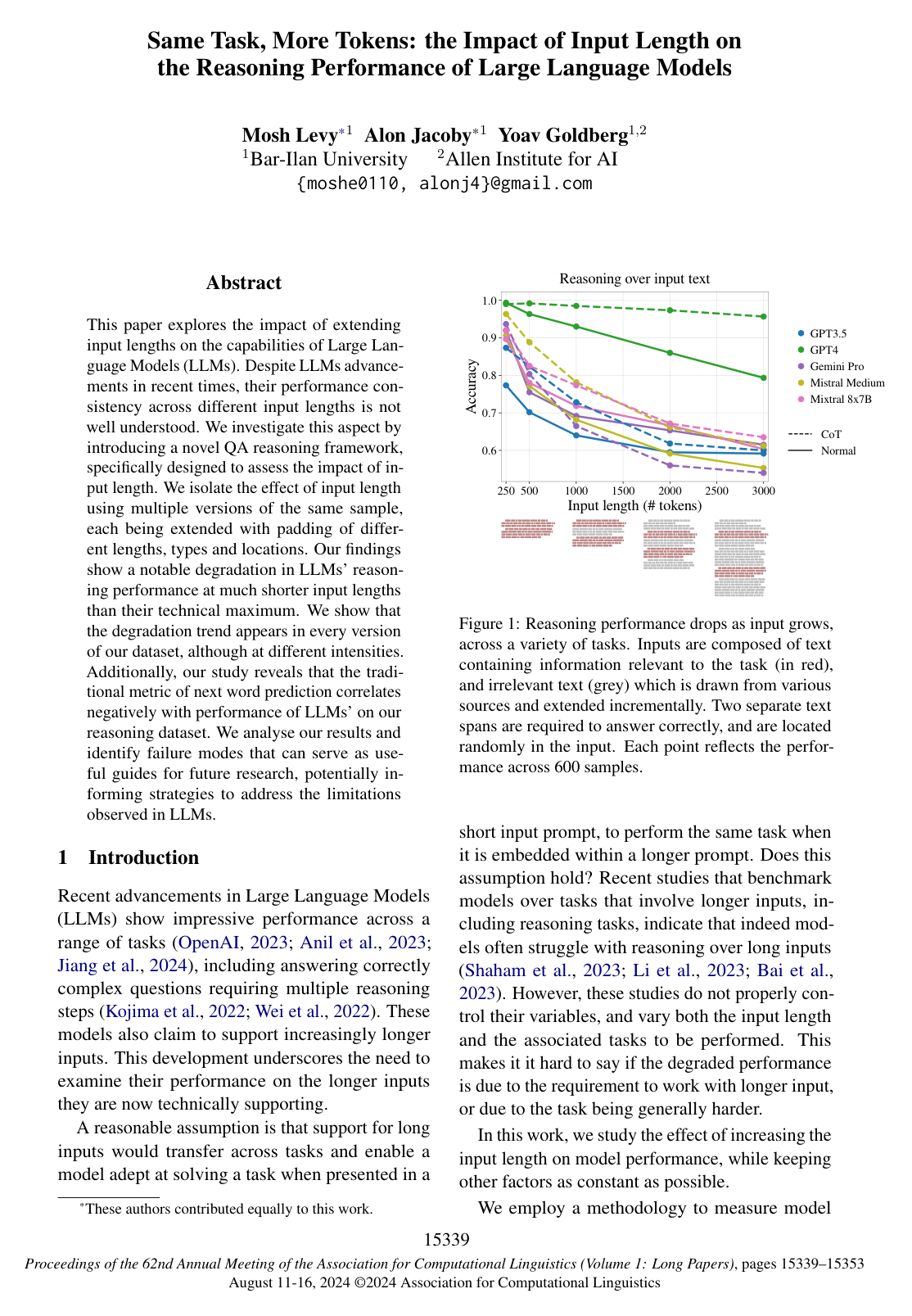
Same Task, More Tokens: the Impact of Input Length on the Reasoning Performance of Large Language Models
Mosh Levy, Alon Jacoby, Yoav Goldberg
Why you should read this
Demonstrates through a controlled question-answering framework that large language models experience sharp declines in multi-step reasoning performance as context length increases, failing well before reaching their technical context limits regardless of padding type or fact placement.
This paper explores the impact of extending input lengths on the capabilities of Large Language Models (LLMs). Despite LLMs advancements in recent times, their performance consistency across different input lengths is not well understood. We investigate this aspect by introducing a novel QA reasoning framework, specifically designed to assess the impact of input length. We isolate the effect of input length using multiple versions of the same sample, each being extended with padding of different lengths, types and locations. Our findings show a notable degradation in LLMs’ reasoning performance at much shorter input lengths than their technical maximum. We show that the degradation trend appears in every version of our dataset, although at different intensities. Additionally, our study reveals that the traditional metric of next word prediction correlates negatively with performance of LLMs’ on our reasoning dataset. We analyse our results and identify failure modes that can serve as useful guides for future research, potentially informing strategies to address the limitations observed in LLMs.
Added
2026-09-26
Neural-Symbolic Models for Logical Queries on Knowledge Graphs
Zhaocheng Zhu, Mikhail Galkin, Zuobai Zhang, Jian Tang
Why you should read this
Presents a neural-symbolic framework that executes complex first-order logic queries over incomplete knowledge graphs by combining graph neural networks with product fuzzy logic, providing interpretable intermediate steps and state-of-the-art reasoning accuracy.
Answering complex first-order logic (FOL) queries on knowledge graphs is a fundamental task for multi-hop reasoning. Traditional symbolic methods traverse a complete knowledge graph to extract the answers, which provides good interpretation for each step. Recent neural methods learn geometric embeddings for complex queries. These methods can generalize to incomplete knowledge graphs, but their reasoning process is hard to interpret. In this paper, we propose Graph Neural Network Query Executor (GNN-QE), a neural-symbolic model that enjoys the advantages of both worlds. GNN-QE decomposes a complex FOL query into relation projections and logical operations over fuzzy sets, which provides interpretability for intermediate variables. To reason about the missing links, GNN-QE adapts a graph neural network from knowledge graph completion to execute the relation projections, and models the logical operations with product fuzzy logic. Experiments on 3 datasets show that GNN-QE significantly improves over previous state-of-the-art models in answering FOL queries. Meanwhile, GNN-QE can predict the number of answers without explicit supervision, and provide visualizations for intermediate variables.
Added
2026-09-26