
keyword
magnetic resonance images
Magnetic resonance images are noninvasive medical visualizations produced by applying strong magnetic fields and radiofrequency pulses to generate detailed two-dimensional or three-dimensional views of internal anatomical structures and physiological processes. Unlike imaging techniques that use ionizing radiation, such as computed tomography or conventional radiography, magnetic resonance imaging measures the radio signals emitted by atomic nuclei, particularly hydrogen protons abundant in bodily water and lipids, as they realign with an applied magnetic field. Sophisticated computer algorithms reconstruct these signals into high-contrast cross-sectional representations that distinguish subtle differences between various soft tissues, facilitating clinical diagnosis, treatment monitoring, and computerized anatomical segmentation.
2 items
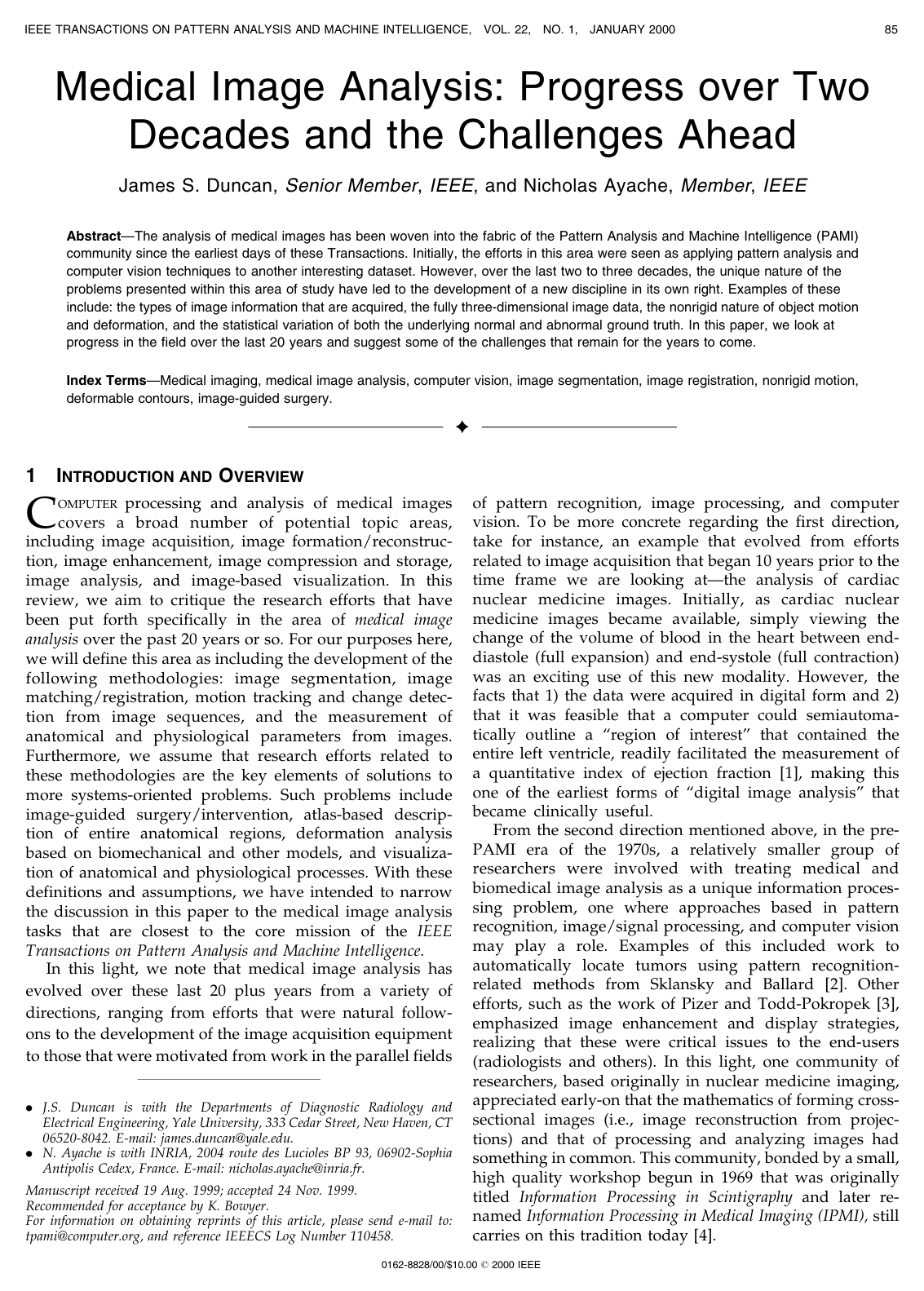
Medical Image Analysis: Progress over Two Decades and the Challenges Ahead
J. Duncan, N. Ayache
Why you should read this
Synthesizes twenty years of foundational advances in medical image analysis across segmentation, registration, motion tracking, and image-guided surgery while defining critical open problems for integrating biomechanical models and physiological data.
Added
2026-09-25
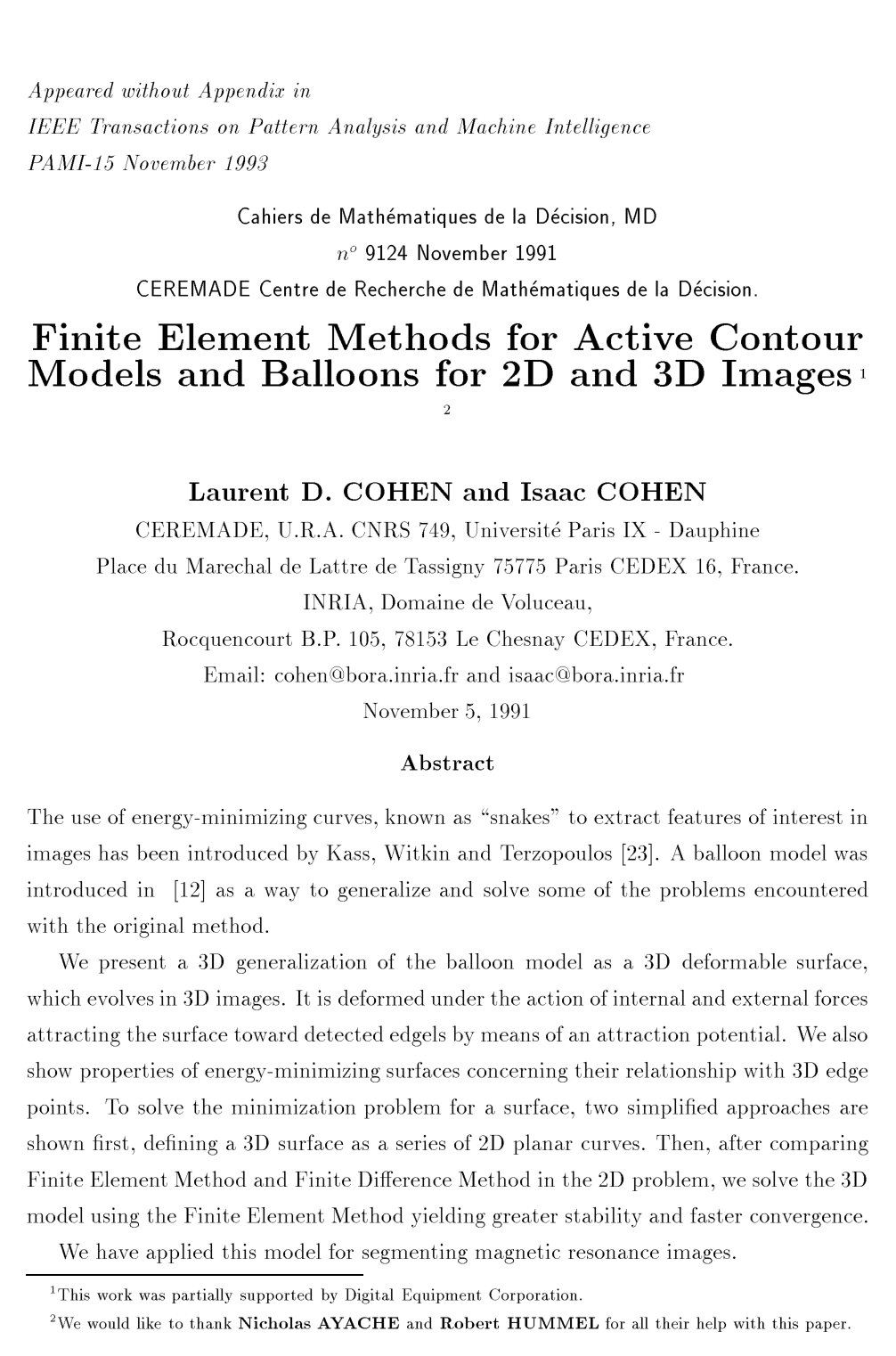
Finite-Element Methods for Active Contour Models and Balloons for 2-D and 3-D Images
L. Cohen, I. Cohen
Why you should read this
Presents a three-dimensional generalization of the balloon deformable surface model and implements a finite element framework that achieves faster convergence and superior numerical stability for volumetric medical image segmentation.
The use of energy-minimizing curves, known as "snakes" to extract features of interest in images has been introduced by Kass, Witkin and Terzopoulos [23]. A balloon model was introduced in [12] as a way to generalize and solve some of the problems encountered with the original method. We present a 3D generalization of the balloon model as a 3D deformable surface, which evolves in 3D images. It is deformed under the action of internal and external forces attracting the surface toward detected edgels by means of an attraction potential. We also show properties of energy-minimizing surfaces concerning their relationship with 3D edge points. To solve the minimization problem for a surface, two simplified approaches are shown first, defining a 3D surface as a series of 2D planar curves. Then, after comparing Finite Element Method and Finite Difference Method in the 2D problem, we solve the 3D model using the Finite Element Method yielding greater stability and faster convergence. We have applied this model for segmenting magnetic resonance images.
Added
2026-09-24