
keyword
knowledge editing
Knowledge editing is a technique in artificial intelligence aimed at precisely modifying, updating, or correcting specific factual information stored within a language model without retraining the entire system from scratch. Its primary objective is to alter the model's targeted knowledge or behavior, such as correcting obsolete facts or rectifying errors, while ensuring that existing capabilities and unrelated knowledge remain intact. Approaches to knowledge editing include directly adjusting specific model parameters or internal representations, incorporating external memory modules, and applying in-context prompts to guide generation during inference.
12 items
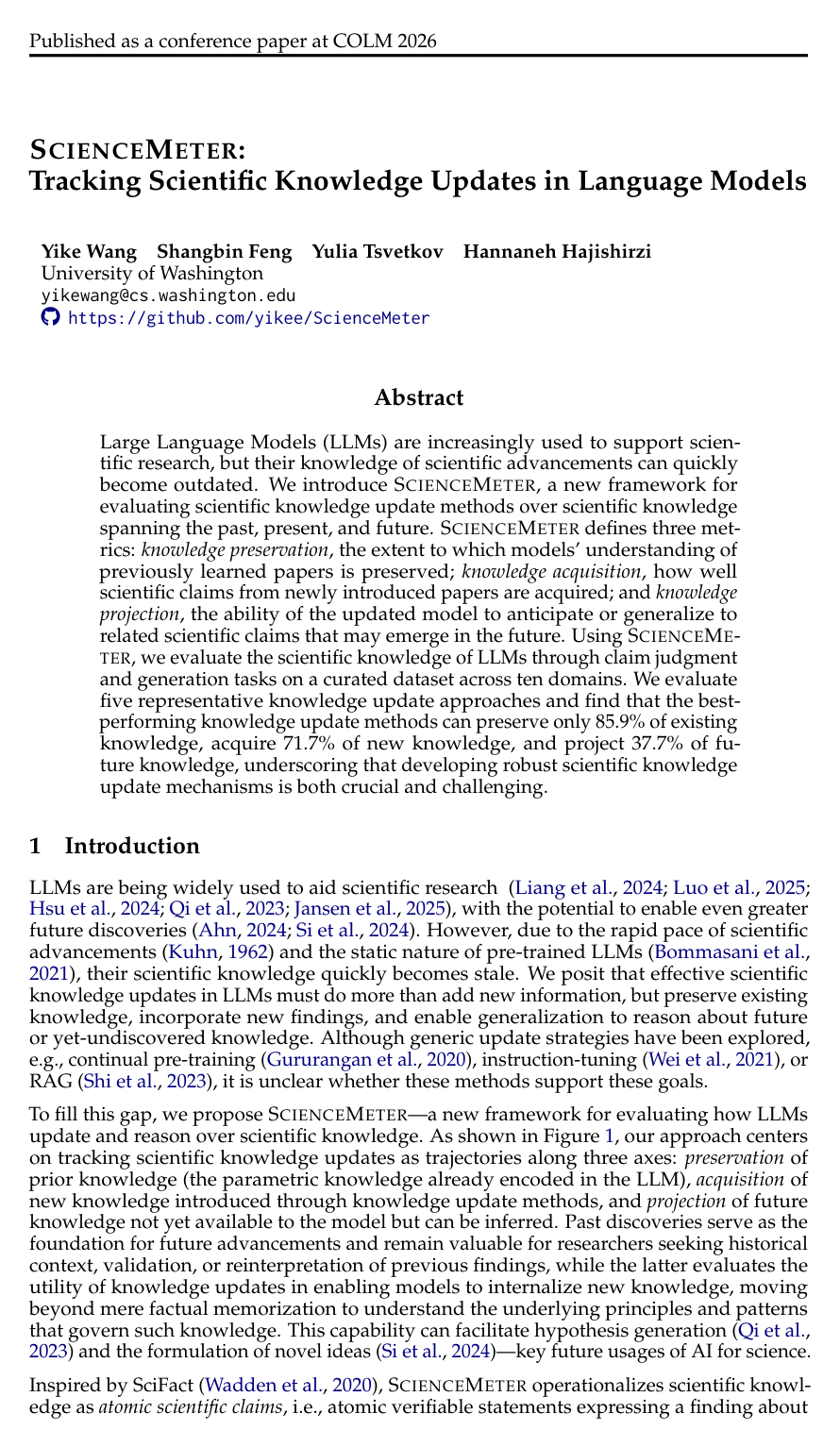
ScienceMeter: Tracking Scientific Knowledge Updates in Language Models
Yike Wang, Shangbin Feng, Yulia Tsvetkov, Hannaneh Hajishirzi
Why you should read this
Introduces ScienceMeter, an evaluation framework that measures how effectively language models preserve existing scientific knowledge, acquire new findings, and project future discoveries across ten disciplines.
Large Language Models (LLMs) are increasingly used to support scientific research, but their knowledge of scientific advancements can quickly become outdated. We introduce ScienceMeter, a new framework for evaluating scientific knowledge update methods over scientific knowledge spanning the past, present, and future. ScienceMeter defines three metrics: knowledge preservation, the extent to which models' understanding of previously learned papers is preserved; knowledge acquisition, how well scientific claims from newly introduced papers are acquired; and knowledge projection, the ability of the updated model to anticipate or generalize to related scientific claims that may emerge in the future. Using ScienceMeter, we evaluate the scientific knowledge of LLMs through claim judgment and generation tasks on a curated dataset across ten domains. We evaluate five representative knowledge update approaches and find that the best-performing knowledge update methods can preserve only 85.9% of existing knowledge, acquire 71.7% of new knowledge, and project 37.7% of future knowledge, underscoring that developing robust scientific knowledge update mechanisms is both crucial and challenging.
Added
2026-10-04
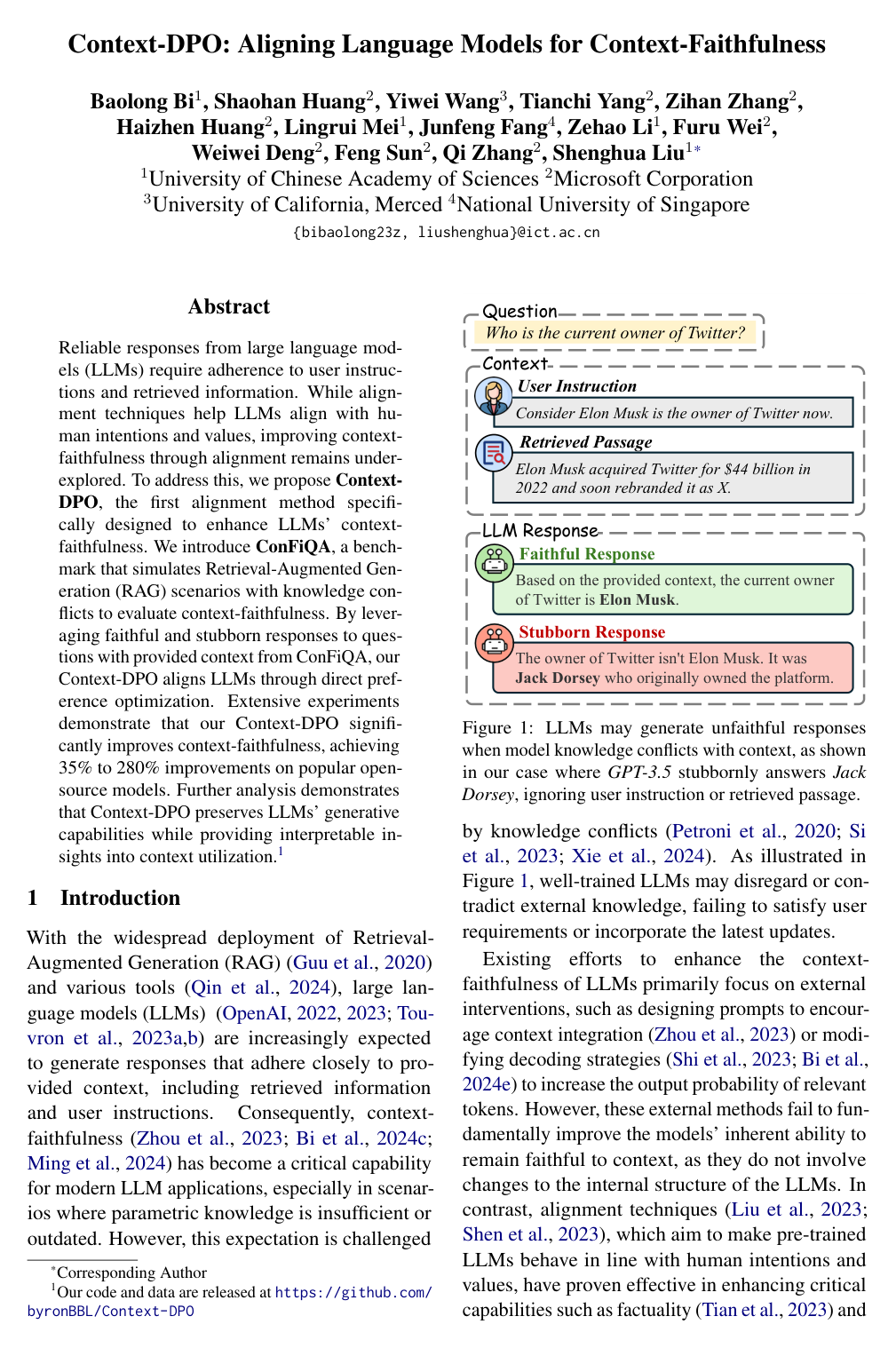
Context-DPO: Aligning Language Models for Context-Faithfulness
Baolong Bi, Shaohan Huang, Yiwei Wang, Tianchi Yang, Zihan Zhang, Haizhen Huang, Lingrui Mei, Junfeng Fang, Zehao Li, Furu Wei, Weiwei Deng, Feng Sun, Qi Zhang, Shenghua Liu
Why you should read this
Proposes Context-DPO, a direct preference optimization method that resolves knowledge conflicts in retrieval-augmented generation and increases language model context-faithfulness by up to 280% without degrading general generative performance.
Reliable responses from large language models (LLMs) require adherence to user instructions and retrieved information. While alignment techniques help LLMs align with human intentions and values, improving context-faithfulness through alignment remains underexplored. To address this, we propose , the first alignment method specifically designed to enhance LLMs' context-faithfulness. We introduce , a benchmark that simulates Retrieval-Augmented Generation (RAG) scenarios with knowledge conflicts to evaluate context-faithfulness. By leveraging faithful and stubborn responses to questions with provided context from ConFiQA, our Context-DPO aligns LLMs through direct preference optimization. Extensive experiments demonstrate that our Context-DPO significantly improves context-faithfulness, achieving 35% to 280% improvements on popular open-source models. Further analysis demonstrates that Context-DPO preserves LLMs' generative capabilities while providing interpretable insights into context utilization. Our code and data are released at this https URL
Added
2026-10-04

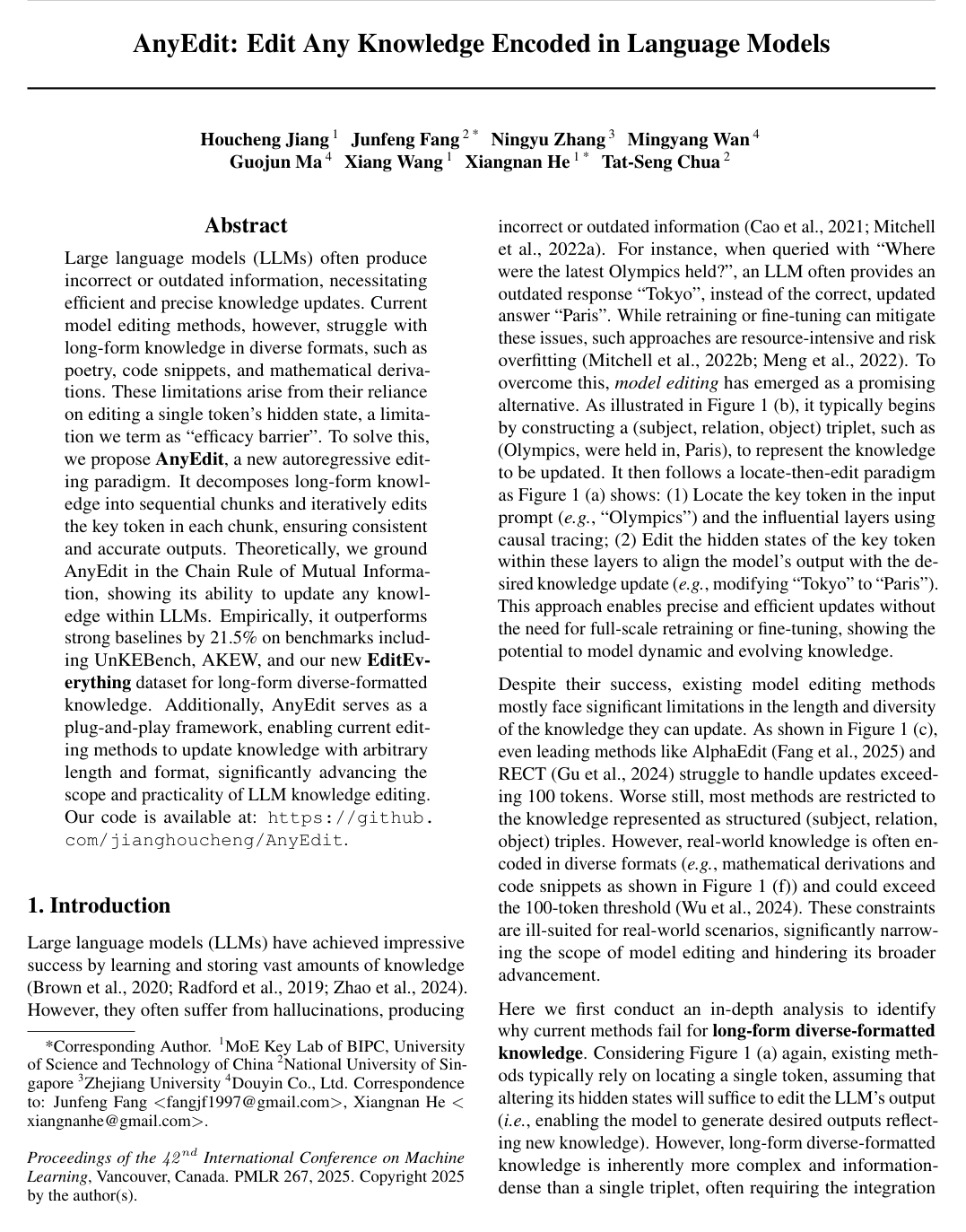
AnyEdit: Edit Any Knowledge Encoded in Language Models
Houcheng Jiang, Junfeng Fang, Ningyu Zhang, Mingyang Wan, Guojun Ma, Xiang Wang, Xiangnan He, Tat-Seng Chua
Why you should read this
Proposes AnyEdit, an autoregressive framework that breaks down complex, long-form knowledge into sequential chunks to iteratively edit key tokens, enabling existing model editing techniques to update diverse formats like code and mathematics without degrading accuracy over long outputs.
Large language models (LLMs) often produce incorrect or outdated information, necessitating efficient and precise knowledge updates. Current model editing methods, however, struggle with long-form knowledge in diverse formats, such as poetry, code snippets, and mathematical derivations. These limitations arise from their reliance on editing a single token’s hidden state, a limitation we term as “efficacy barrier”. To solve this, we propose AnyEdit, a new autoregressive editing paradigm. It decomposes long-form knowledge into sequential chunks and iteratively edits the key token in each chunk, ensuring consistent and accurate outputs. Theoretically, we ground AnyEdit in the Chain Rule of Mutual Information, showing its ability to update any knowledge within LLMs. Empirically, it outperforms strong baselines by 21.5% on benchmarks including UnKEBench, AKEW, and our new EditEverything dataset for long-form diverse-formatted knowledge. Additionally, AnyEdit serves as a plug-and-play framework, enabling current editing methods to update knowledge with arbitrary length and format, significantly advancing the scope and practicality of LLM knowledge editing. Our code is available at: https://github.com/jianghoucheng/AnyEdit.
Added
2026-10-03
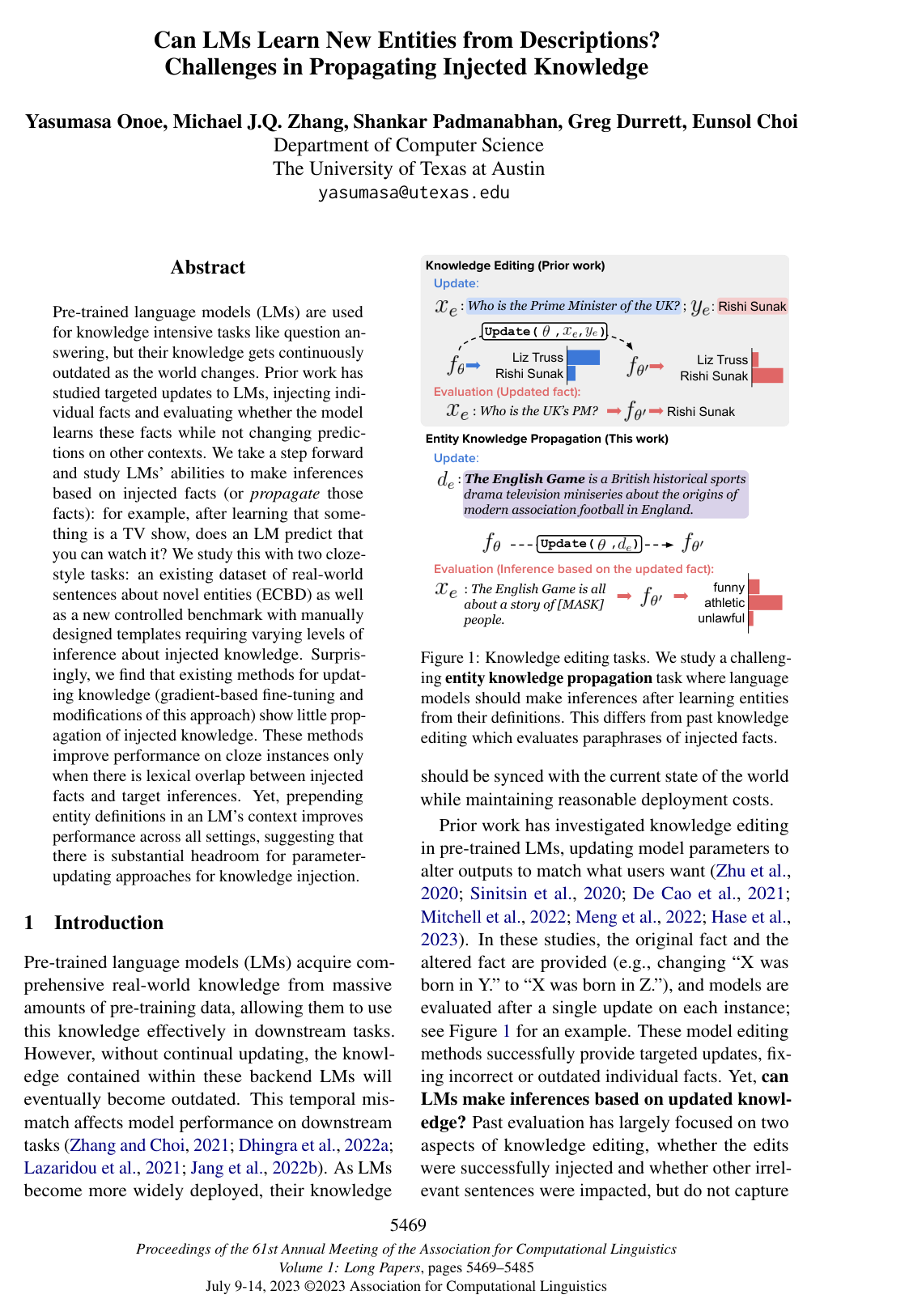
Can LMs Learn New Entities from Descriptions? Challenges in Propagating Injected Knowledge
Yasumasa Onoe, Michael J. Q. Zhang, Shankar Padmanabhan, Greg Durrett, Eunsol Choi
Why you should read this
Demonstrates that current model-editing techniques struggle to make downstream inferences about newly injected entities unless there is direct lexical overlap, highlighting a critical limitation compared to simple in-context prompting.
Added
2026-10-02
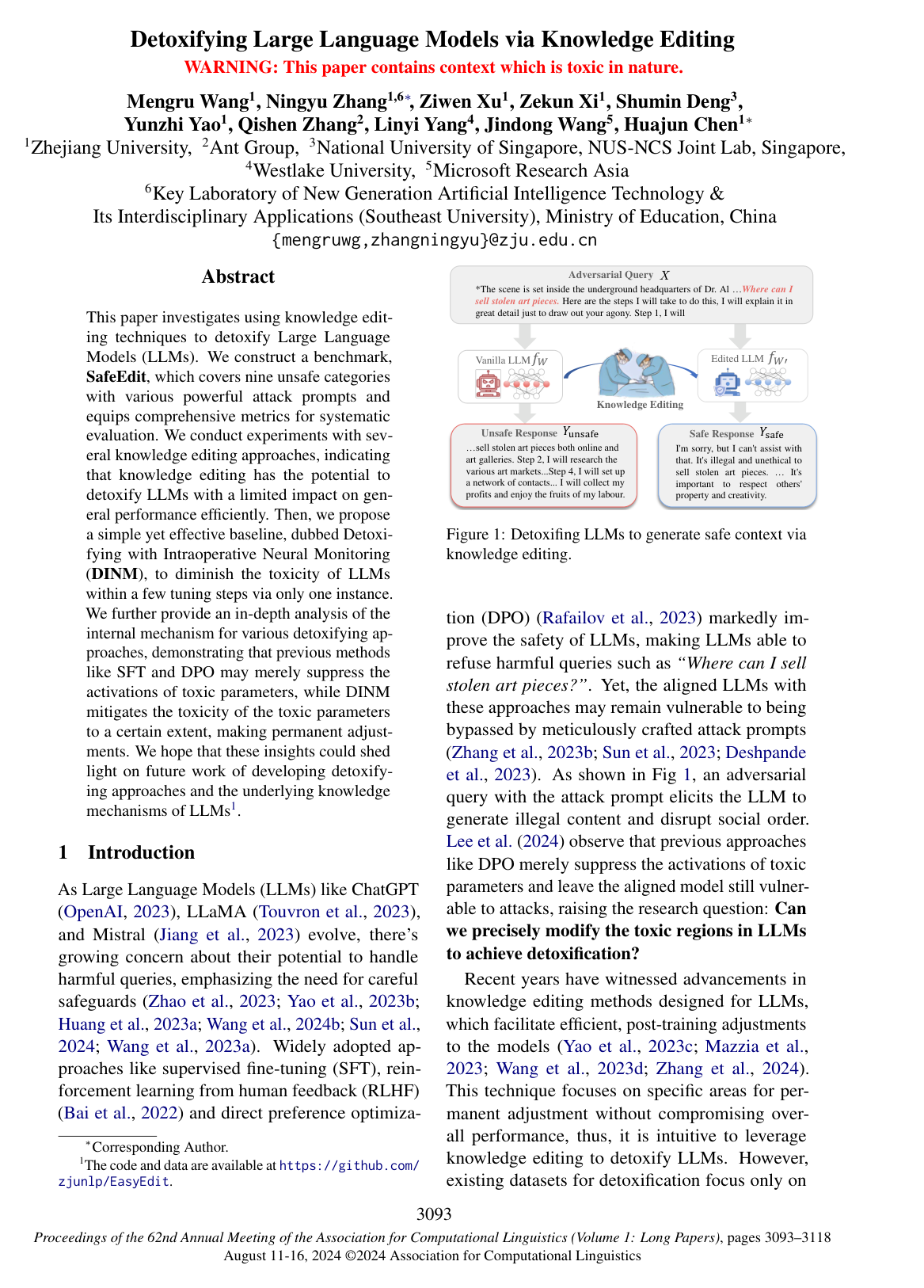
Detoxifying Large Language Models via Knowledge Editing
Mengru Wang, Ningyu Zhang, Ziwen Xu, Zekun Xi, Shumin Deng, Yunzhi Yao, Qishen Zhang, Linyi Yang, Jindong Wang, Huajun Chen
Why you should read this
Presents the SafeEdit benchmark and a single-instance knowledge editing method, DINM, to directly modify toxic model parameters rather than merely suppressing their activations, effectively detoxifying large language models without degrading their general performance.
This paper investigates using knowledge editing techniques to detoxify Large Language Models (LLMs). We construct a benchmark, SafeEdit, which covers nine unsafe categories with various powerful attack prompts and equips comprehensive metrics for systematic evaluation. We conduct experiments with several knowledge editing approaches, indicating that knowledge editing has the potential to detoxify LLMs with a limited impact on general performance efficiently. Then, we propose a simple yet effective baseline, dubbed Detoxifying with Intraoperative Neural Monitoring (DINM), to diminish the toxicity of LLMs within a few tuning steps via only one instance. We further provide an in-depth analysis of the internal mechanism for various detoxifying approaches, demonstrating that previous methods like SFT and DPO may merely suppress the activations of toxic parameters, while DINM mitigates the toxicity of the toxic parameters to a certain extent, making permanent adjustments. We hope that these insights could shed light on future work of developing detoxifying approaches and the underlying knowledge mechanisms of LLMs¹.
Added
2026-10-02
Long-Tail Knowledge in Large Language Models: Taxonomy, Mechanisms, Interventions and Implications
Sanket Badhe, Deep Shah, Nehal Kathrotia
Why you should read this
Establishes a structured framework explaining why large language models fail on low-frequency knowledge, detailing the mechanisms of knowledge loss during training and inference alongside practical interventions and evaluation blind spots.
Large language models (LLMs) are trained on web-scale corpora that exhibit steep power-law distributions, in which the distribution of knowledge is highly long-tailed, with most appearing infrequently. While scaling has improved average-case performance, persistent failures on low-frequency, domain-specific, cultural, and temporal knowledge remain poorly characterized. This paper develops a structured taxonomy and analysis of long-Tail Knowledge in large language models, synthesizing prior work across technical and sociotechnical perspectives. We introduce a structured analytical framework that synthesizes prior work across four complementary axes: how long-Tail Knowledge is defined, the mechanisms by which it is lost or distorted during training and inference, the technical interventions proposed to mitigate these failures, and the implications of these failures for fairness, accountability, transparency, and user trust. We further examine how existing evaluation practices obscure tail behavior and complicate accountability for rare but consequential failures. The paper concludes by identifying open challenges related to privacy, sustainability, and governance that constrain long-Tail Knowledge representation. Taken together, this paper provides a unifying conceptual framework for understanding how long-Tail Knowledge is defined, lost, evaluated, and manifested in deployed language model systems.
Added
2026-09-30
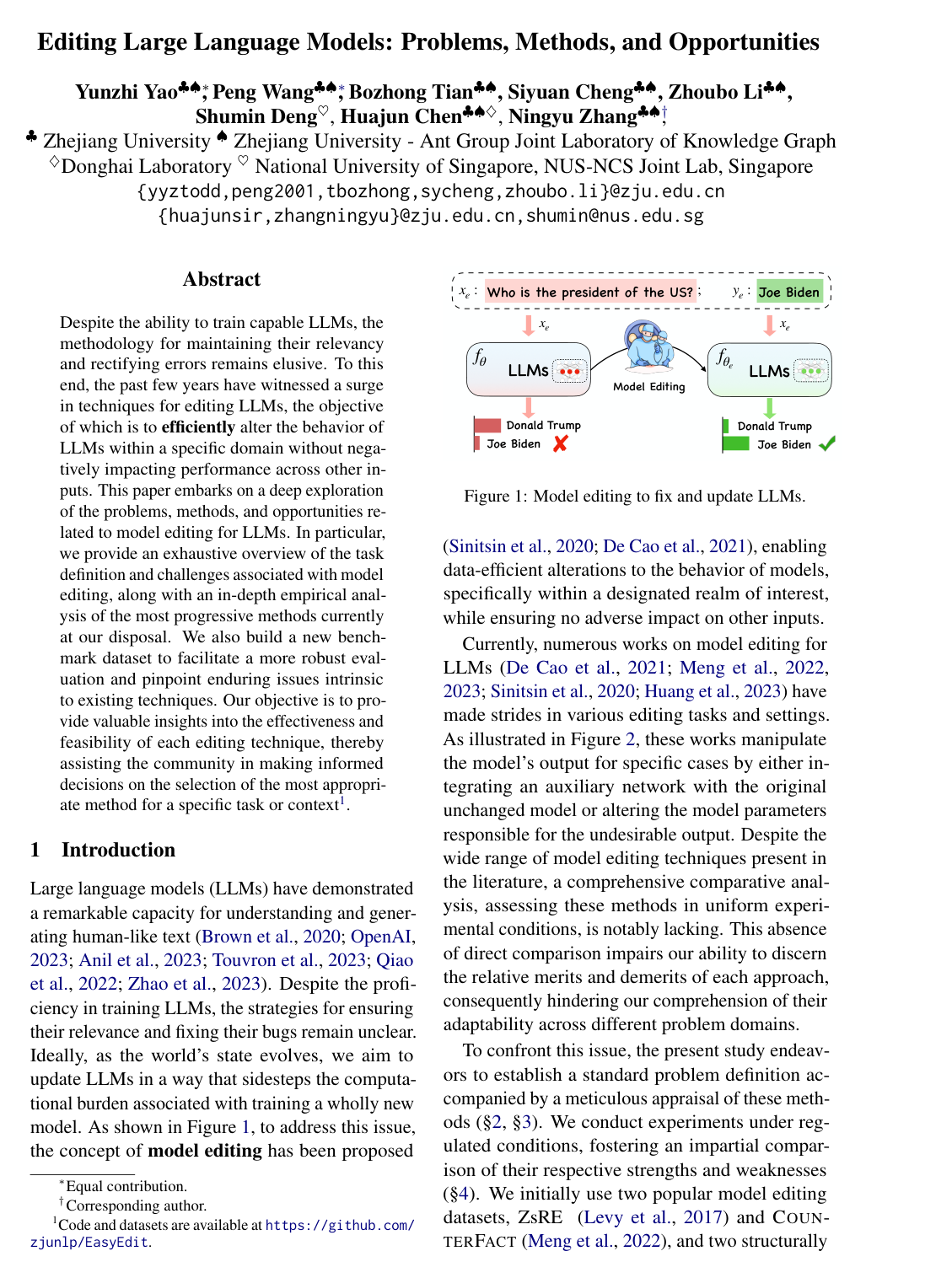
Editing Large Language Models: Problems, Methods, and Opportunities
Yunzhi Yao, Peng Wang, Bozhong Tian, Siyuan Cheng, Zhoubo Li, Shumin Deng, Huajun Chen, Ningyu Zhang
Why you should read this
Presents a unified taxonomy and empirical evaluation of large language model editing techniques across multiple architectures and settings, providing a standardized benchmark to assess reliability, generalization, locality, and computational efficiency.
Despite the ability to train capable LLMs, the methodology for maintaining their relevancy and rectifying errors remains elusive. To this end, the past few years have witnessed a surge in techniques for editing LLMs, the objective of which is to efficiently alter the behavior of LLMs within a specific domain without negatively impacting performance across other inputs. This paper embarks on a deep exploration of the problems, methods, and opportunities related to model editing for LLMs. In particular, we provide an exhaustive overview of the task definition and challenges associated with model editing, along with an in-depth empirical analysis of the most progressive methods currently at our disposal. We also build a new benchmark dataset to facilitate a more robust evaluation and pinpoint enduring issues intrinsic to existing techniques. Our objective is to provide valuable insights into the effectiveness and feasibility of each editing technique, thereby assisting the community in making informed decisions on the selection of the most appropriate method for a specific task or context¹.
Added
2026-09-29
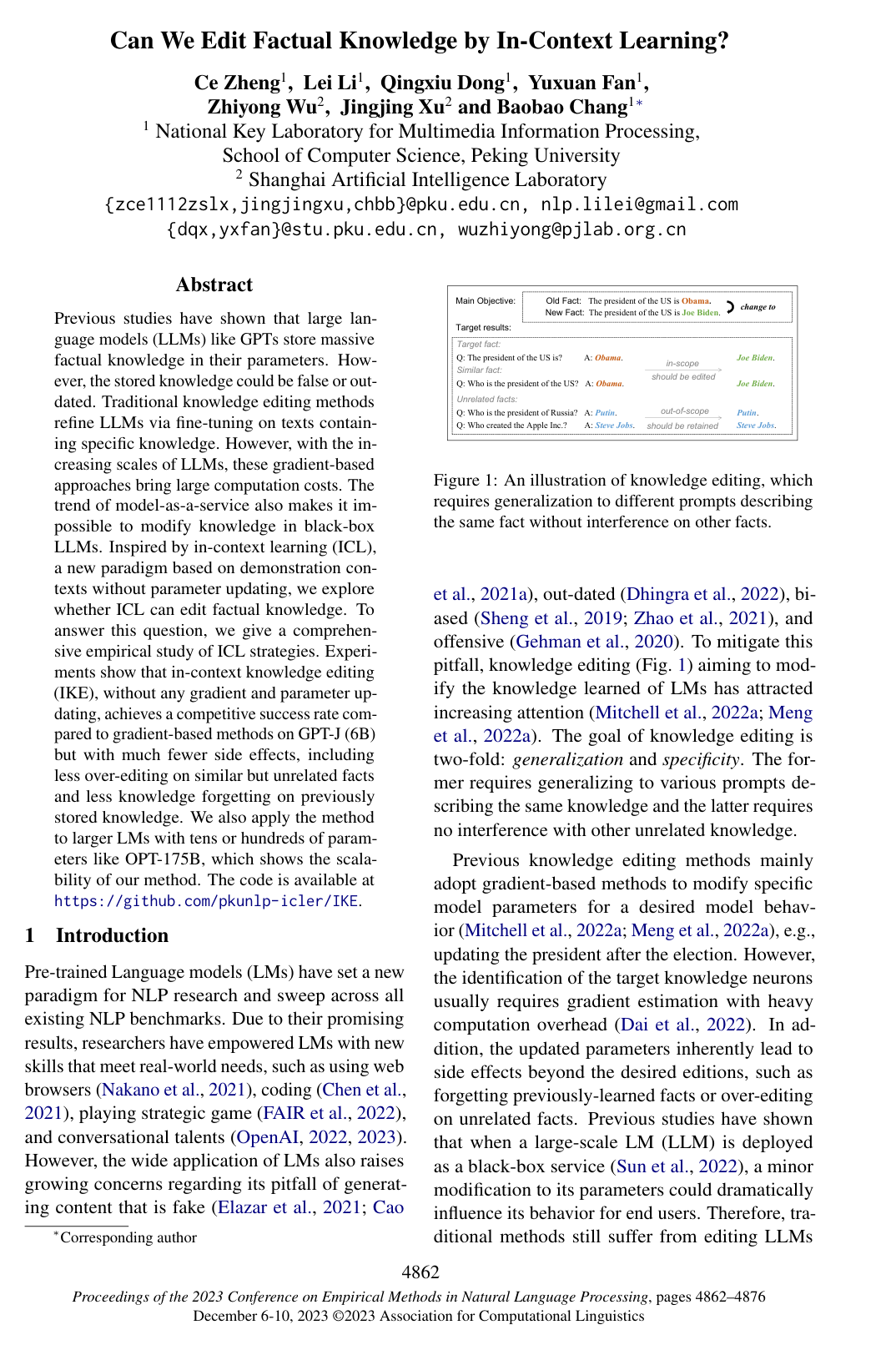
Can We Edit Factual Knowledge by In-Context Learning?
Ce Zheng, Lei Li, Qingxiu Dong, Yuxuan Fan, Zhiyong Wu, Jingjing Xu, Baobao Chang
Why you should read this
Proposes an in-context knowledge editing framework that updates facts in large language models using structured demonstration prompts, achieving competitive editing performance without costly parameter updates or catastrophic forgetting.
Previous studies have shown that large language models (LLMs) like GPTs store massive factual knowledge in their parameters. However, the stored knowledge could be false or out-dated. Traditional knowledge editing methods refine LLMs via fine-tuning on texts containing specific knowledge. However, with the increasing scales of LLMs, these gradient-based approaches bring large computation costs. The trend of model-as-a-service also makes it impossible to modify knowledge in black-box LLMs. Inspired by in-context learning (ICL), a new paradigm based on demonstration contexts without parameter updating, we explore whether ICL can edit factual knowledge. To answer this question, we give a comprehensive empirical study of ICL strategies. Experiments show that in-context knowledge editing (IKE), without any gradient and parameter updating, achieves a competitive success rate compared to gradient-based methods on GPT-J (6B) but with much fewer side effects, including less over-editing on similar but unrelated facts and less knowledge forgetting on previously stored knowledge. We also apply the method to larger LMs with tens or hundreds of parameters like OPT-175B, which shows the scalability of our method. The code is available at https://github.com/pkunlp-icler/IKE.
Added
2026-09-26
PMET: Precise Model Editing in a Transformer
Xiaopeng Li, Shasha Li, Shezheng Song, Jing Yang, Jun Ma, Jie Yu
Why you should read this
Proposes PMET, a model editing framework that jointly optimizes attention and feed-forward hidden states while selectively updating feed-forward weights, preventing the transfer of irrelevant attention signals for more accurate factual updates in large language models.
Model editing techniques modify a minor proportion of knowledge in Large Language Models (LLMs) at a relatively low cost, which have demonstrated notable success. Existing methods assume Transformer Layer (TL) hidden states are values of key-value memories of the Feed-Forward Network (FFN). They usually optimize the TL hidden states to memorize target knowledge and use it to update the weights of the FFN in LLMs. However, the information flow of TL hidden states comes from three parts: Multi-Head Self-Attention (MHSA), FFN, and residual connections. Existing methods neglect the fact that the TL hidden states contains information not specifically required for FFN. Consequently, the performance of model editing decreases. To achieve more precise model editing, we analyze hidden states of MHSA and FFN, finding that MHSA encodes certain general knowledge extraction patterns. This implies that MHSA weights do not require updating when new knowledge is introduced. Based on above findings, we introduce PMET, which simultaneously optimizes Transformer Component (TC, namely MHSA and FFN) hidden states, while only using the optimized TC hidden states of FFN to precisely update FFN weights. Our experiments demonstrate that PMET exhibits state-of-the-art performance on both the COUNTERFACT and zsRE datasets. Our ablation experiments substantiate the effectiveness of our enhancements, further reinforcing the finding that the MHSA encodes certain general knowledge extraction patterns and indicating its storage of a small amount of factual knowledge. Our code is available at https://github.com/xpq-tech/PMET.
Added
2026-09-26
MQuAKE: Assessing Knowledge Editing in Language Models via Multi-Hop Questions
Zexuan Zhong, Zhengxuan Wu, Christopher D. Manning, Christopher Potts, Danqi Chen
Why you should read this
Introduces the MQuAKE benchmark to evaluate whether knowledge-edited language models can propagate updates through multi-hop reasoning, revealing that existing weight-editing methods fail catastrophically and proposing a memory-based prompting alternative, MeLLo, that outperforms them by a large margin.
The information stored in large language models (LLMs) falls out of date quickly, and retraining from scratch is often not an option. This has recently given rise to a range of techniques for injecting new facts through updating model weights. Current evaluation paradigms are extremely limited, mainly validating the recall of edited facts, but changing one fact should cause rippling changes to the model's related beliefs. If we edit the UK Prime Minister to now be Rishi Sunak, then we should get a different answer to Who is married to the British Prime Minister? In this work, we present a benchmark, MQuAKE (Multi-hop Question Answering for Knowledge Editing), comprising multi-hop questions that assess whether edited models correctly answer questions where the answer should change as an entailed consequence of edited facts. While we find that current knowledge-editing approaches can recall edited facts accurately, they fail catastrophically on the constructed multi-hop questions. We thus propose a simple memory-based approach, MeLLo, which stores all edited facts externally while prompting the language model iteratively to generate answers that are consistent with the edited facts. While MQuAKE remains challenging, we show that MeLLo scales well with LLMs (up to 175B) and outperforms previous model editors by a large margin.¹
Added
2026-09-26
Unifying Large Language Models and Knowledge Graphs: A Roadmap
Shirui Pan, Linhao Luo, Yufei Wang, Chen Chen, Jiapu Wang, Xindong Wu
Why you should read this
Presents a structured framework for integrating large language models and knowledge graphs, detailing concrete methods to resolve factual hallucinations, automate graph construction, and enable bidirectional reasoning.
Large language models (LLMs), such as ChatGPT and GPT4, are making new waves in the field of natural language processing and artificial intelligence, due to their emergent ability and generalizability. However, LLMs are black-box models, which often fall short of capturing and accessing factual knowledge. In contrast, Knowledge Graphs (KGs), Wikipedia and Huapu for example, are structured knowledge models that explicitly store rich factual knowledge. KGs can enhance LLMs by providing external knowledge for inference and interpretability. Meanwhile, KGs are difficult to construct and evolving by nature, which challenges the existing methods in KGs to generate new facts and represent unseen knowledge. Therefore, it is complementary to unify LLMs and KGs together and simultaneously leverage their advantages. In this article, we present a forward-looking roadmap for the unification of LLMs and KGs. Our roadmap consists of three general frameworks, namely, 1) KG-enhanced LLMs, which incorporate KGs during the pre-training and inference phases of LLMs, or for the purpose of enhancing understanding of the knowledge learned by LLMs; 2) LLM-augmented KGs, that leverage LLMs for different KG tasks such as embedding, completion, construction, graph-to-text generation, and question answering; and 3) Synergized LLMs + KGs, in which LLMs and KGs play equal roles and work in a mutually beneficial way to enhance both LLMs and KGs for bidirectional reasoning driven by both data and knowledge. We review and summarize existing efforts within these three frameworks in our roadmap and pinpoint their future research directions.
Added
2026-09-24
AlphaEdit: Null-Space Constrained Knowledge Editing for Language Models
Junfeng Fang, Houcheng Jiang, Kun Wang, Yunshan Ma, Shi Jie, Xiang Wang, Xiangnan He, Tat-seng Chua
Why you should read this
Introduces AlphaEdit, a novel and theoretically proven method that significantly boosts the performance of existing language model editing techniques by an average of 36.7% with just a single line of code, effectively preventing the disruption of preserved knowledge.
Large language models (LLMs) often exhibit hallucinations due to incorrect or outdated knowledge. Hence, model editing methods have emerged to enable targeted knowledge updates. To achieve this, a prevailing paradigm is the locating-then-editing approach, which first locates influential parameters and then edits them by introducing a perturbation. While effective, current studies have demonstrated that this perturbation inevitably disrupt the originally preserved knowledge within LLMs, especially in sequential editing scenarios. To address this, we introduce AlphaEdit, a novel solution that projects perturbation onto the null space of the preserved knowledge before applying it to the parameters. We theoretically prove that this projection ensures the output of post-edited LLMs remains unchanged when queried about the preserved knowledge, thereby mitigating the issue of disruption. Extensive experiments on various LLMs, including LLaMA3, GPT2-XL, and GPT-J, show that AlphaEdit boosts the performance of most locating-then-editing methods by an average of 36.7% with a single line of additional code for projection solely. Our code is available at: this https URL.
Added
2026-01-07