Can LMs Learn New Entities from Descriptions? Challenges in Propagating Injected Knowledge

Yasumasa OnoeMichael J. Q. ZhangShankar PadmanabhanGreg DurrettEunsol Choi

article2023ACL88 citations

Demonstrates that current model-editing techniques struggle to make downstream inferences about newly injected entities unless there is direct lexical overlap, highlighting a critical limitation compared to simple in-context prompting.

Listen

Pre-trained language models quickly become outdated as real-world information changes, which degrades their performance on downstream knowledge tasks. While existing model-editing techniques can update isolated facts, deployed systems require models to perform reasoning and draw valid inferences about newly introduced entities rather than merely memorizing updated statements.

The article evaluates whether current parameter-updating methods allow language models to effectively learn new entities from short definitions and propagate that knowledge to downstream inferences. To test this, the authors benchmarked several model-editing and fine-tuning approaches across three base language models using real-world Wikipedia data from the Entity Cloze By Date dataset and a new controlled evaluation set containing explicit and commonsense implicit reasoning probes.

The investigation produced four central findings. First, parameter-updating techniques struggle significantly on real-world inference tasks: on the standard Entity Cloze By Date benchmark, fine-tuning and specialized editing methods failed to improve perplexity over base models. Second, existing methods succeeded only when target answers directly overlapped verbatim with the injected definition sentences, reducing perplexity by 8.5 to 9.0 points in simpler, high-overlap subsets. Third, while full-model fine-tuning improved accuracy by 21 to 32 percentage points on the controlled inference dataset, it degraded model specificity on unrelated facts by up to 16 points. Fourth, simply prepending the entity definition directly into the model context consistently outperformed all parameter-updating methods, improving accuracy by 25 to 31 points and cutting perplexity substantially without harming specificity.

These findings indicate that current parameter-editing techniques are largely restricted to shallow factual recall rather than true knowledge propagation and reasoning. For organizational decision-makers, relying on parameter-editing methods to maintain up-to-date language models introduces operational risks of incorrect inferences and unintended model degradation on unrelated tasks. Although input augmentation via in-context prompt updates carries higher inference-time computational costs, it remains far more dependable than model weight updates for incorporating novel knowledge.

Organizations should treat in-context knowledge injection and retrieval-augmented methods as the primary production strategy for emerging entities until more robust model-editing architectures are developed. Future research should prioritize designing parameter-updating algorithms capable of integrating complex, multi-hop reasoning without sacrificing specificity. Decision-makers should exercise caution when reviewing these results, as the study focused exclusively on English-language models up to 1.5 billion parameters and examined single-run updates for newly emerging entities rather than modifications to existing entities.

Cover for Can LMs Learn New Entities from Descriptions? Challenges in Propagating Injected Knowledge

Table of Contents

  • 1 Introduction
  • 2 Entity Knowledge Propagation
  • 2.1 Task Definition
  • 3 Constructing benchmarks for EKP
  • 3.1 ECBD
  • 3.2 ENTITY INFERENCES
  • 4 Experimental Setup
  • 4.1 Base Language Models
  • 4.2 Parameter Updating Methods
  • 4.3 Input Augmentation
  • 4.4 Computational Cost
  • 5 Results
  • 5.1 ENTITY INFERENCES
  • 5.2 ECBD
  • 5.3 ECBD-EASY
  • 6 Analysis
  • 6.1 Targeted Update / Specificity Tradeoff
  • 6.2 Information Overlap
  • 7 Related Work
  • Content Transfer and Knowledge Acquisition
  • 8 Conclusion
  • Limitations
  • Acknowledgments
  • References
  • A Appendix
  • A.1 Licensing
  • A.2 Harmful Data Instances
  • A.3 Modeling Details
  • A.4 More Similarity Scores
  • A.5 Analysis of ROME
  • A.5.1 Comparison of datasets
  • A.5.2 ROMETest Generation
  • ACL 2023 Responsible NLP Checklist

Knowls

  1. Knowl 1 — Entity knowledge propagation task and evaluation criteria

    definition

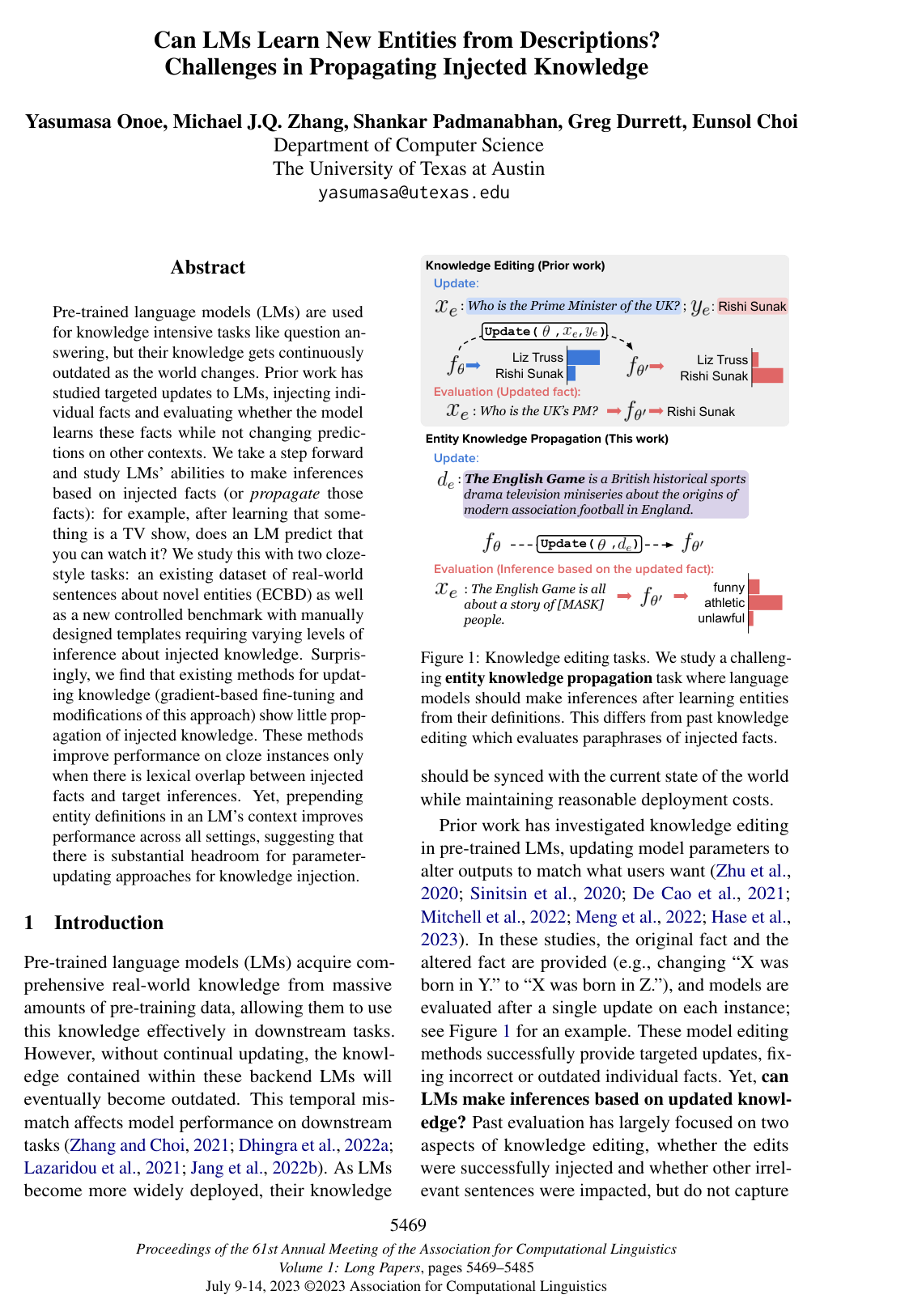
    Entity knowledge propagation (EKP) evaluates whether a language model can use a definition of a previously unseen entity to answer related questions or complete probe sentences. An example is a tuple (e,de,xe,ye)(e,d_e,x_e,y_e), where ee is the emerging entity, ded_e is its definition, xex_e is a probe containing an explicit reference to ee, and yey_e is the desired completion expressing an inference about ee. An update method changes model parameters from θ\theta to θ′\theta' using ee and ded_e, with the goal of raising the model’s probability for appropriate completions on later probes. Update success is measured by per-token perplexity on open-span completion tasks (lower is better) or accuracy on multiple-choice tasks (higher is better). Specificity measures the effect of the update on examples about other entities: for perplexity it is the post-update minus pre-update perplexity, ideally near zero; for accuracy the desirable direction is the reverse. Thus EKP tests both learning from the definition and avoiding collateral changes to unrelated entity predictions.

  2. Knowl 2 — Benchmarks for measuring entity knowledge propagation

    experimental setup

    The study evaluates EKP with two complementary benchmarks. Entity Cloze By Date (ECBD) uses Wikipedia entities originating from 2020/01 through 2021/09, their article-opening definition sentences, and probe sentences with masked spans drawn from the articles; it contains 1,000 examples for 208 entities, and only 29 examples have a gold span appearing in the definition. ECBD-EASY is the subset in which the gold span occurs verbatim in the definition: 152 examples for 74 entities, with overlap in all 152. The authors also create ENTITY INFERENCES, a controlled multiple-choice benchmark with manually written probes about TV shows, natural disasters, and fabricated people. Its probes test explicit facts stated in definitions and implicit commonsense inferences, such as what people do with a TV show. It contains 170 examples for 85 entities; 92 examples have a gold answer span included in the definition. ENTITY INFERENCES provides 6–12 answer choices per example, averaging 10. ECBD tests propagation in varied real-world text, while ENTITY INFERENCES makes the desired inference and answer alternatives more controlled.

  3. Knowl 3 — Model-update methods and experimental protocol

    model/method

    The experiments use GPT-Neo 1.3B and GPT2-XL 1.5B as left-to-right language models and T5-large 770M as a sequence-to-sequence model. Fine-tuning starts from the original checkpoint separately for each entity and trains on its definition; the authors compare updating all parameters with updating only the final transformer layer. GPT-style models use next-token prediction over the definition, while T5 is trained to fill a randomly selected span of length 1–5 that does not overlap the entity mention. MEND is a learned editor that transforms a fine-tuning gradient into a parameter update; its editors are trained using WikiText-103. ROME is evaluated with GPT2-XL by formatting definitions as subject–relation–object facts and applying a rank-one MLP update. As a non-parameter-updating comparison, Definition prepends the entity definition to the probe at inference time; Random Def. prepends a different entity’s definition. Main fine-tuning runs use batch size 1, 5 epochs and learning rate 3×10−63\times10^{-6} for ECBD, and 10 epochs and learning rate 5×10−45\times10^{-4} for ENTITY INFERENCES. Results are single runs. Prepending definitions increases inference context length, whereas parameter updates incur update-time computation but do not lengthen inference inputs.

  4. Knowl 4 — Parameter updates improve controlled multiple-choice inference, with specificity costs

    empirical result

    On ENTITY INFERENCES, full-model fine-tuning substantially improves accuracy over each model’s base score, but can reduce accuracy on probes about other entities. GPT-Neo rises from 34.1% to 57.7% with full fine-tuning (specificity score 34.1% to 18.3%); final-layer fine-tuning reaches 48.8% (specificity 16.4%). T5-large rises from 42.9% to 64.7% with full fine-tuning (specificity 38.2%), while final-layer fine-tuning reaches 52.9% (specificity 43.9%). GPT2-XL rises from 32.9% to 64.7% with full fine-tuning (specificity 25.2%); final-layer fine-tuning reaches 46.5% (specificity 35.4%). ROME on GPT2-XL reaches 54.3% accuracy with specificity 29.9%. MEND has little effect on T5-large and GPT-Neo, reaching 43.5% and 41.8%, respectively, but gives a small specificity increase for GPT-Neo (34.4% versus 34.1%). Prepending the definition yields 60.0% for GPT-Neo, 73.5% for T5-large, and 64.1% for GPT2-XL, without parameter changes; prepending a random definition instead yields 27.7%, 42.4%, and 26.5%. The controlled task is therefore learnable to a meaningful extent by parameter updates, but the strongest update results can alter predictions about other entities, and definition context performs better than every tested update method.

  5. Knowl 5 — Editing methods largely fail on real-world ECBD probes

    empirical result

    On ECBD, where most target spans do not occur in the entity definition, parameter editing does not consistently propagate useful information to probe completions. Per-token perplexity for GPT-Neo is 38.8 before updating, 36.8 after full fine-tuning, 38.7 after final-layer fine-tuning, and 48.6 after MEND; prepending the definition lowers it to 22.5. T5-large starts at 17.0: full and final-layer fine-tuning leave it at 17.0, MEND raises it to 17.3, and prepending the definition lowers it to 12.4. GPT2-XL starts at 42.8: full fine-tuning reaches 39.4, final-layer fine-tuning remains at 42.8, and prepending the definition reaches 26.6. Specificity scores for these updates are generally nearly unchanged, so the small perplexity shifts do not constitute robust propagation. Random definitions worsen ECBD perplexity for GPT-Neo (55.1 versus 38.8) and GPT2-XL (56.3 versus 42.8). ROME was not formally reported on ECBD: forcing the general definitions into its subject–relation–object format produced perplexities above 100 on both ECBD sets, and the format was considered poorly suited to general definitional knowledge.

  6. Knowl 6 — Verbatim answer overlap makes ECBD-EASY substantially more learnable

    empirical result

    When the gold span is guaranteed to occur verbatim in the definition, several parameter updates improve ECBD-EASY perplexity, especially for GPT-Neo and GPT2-XL. GPT-Neo’s baseline is 21.1; full fine-tuning lowers perplexity to 12.1 and MEND to 12.6, while prepending the definition lowers it further to 3.2. GPT2-XL’s baseline is 31.0; full fine-tuning lowers it to 16.8, while prepending the definition reaches 3.5. T5-large changes little: from a baseline of 14.3, full fine-tuning remains at 14.3, MEND reaches 14.0, and definition prepending reaches 13.6. The contrast with the broader ECBD results indicates that updates are more effective when improving the target can be achieved by reproducing answer material directly present in the injected definition; it does not establish comparable success on less overlapping inferences.

  7. Knowl 7 — Train-on-test analysis separates learning the answer from propagating knowledge

    empirical result

    To estimate a fine-tuning performance reference, the authors use a Train-on-Test condition in which the definition and probe sentences are made identical, then fine-tune GPT-Neo for 1–8 epochs. This condition is not a deployable update setting; it indicates how well fine-tuning can fit the evaluation material itself. On ECBD, ordinary fine-tuning moves toward worse specificity while also failing to improve perplexity usefully, whereas Train-on-Test can fit the probes; prepending the definition remains effective. On ECBD-EASY, fine-tuning and MEND can approach the Train-on-Test performance with substantial perplexity gains and relatively mild specificity degradation. On ENTITY INFERENCES, fine-tuning improves accuracy and quickly approaches its own plateau, but remains substantially short of the gold setting. The results show that failure on ECBD is not simply evidence that the model cannot fit these probe spans: transferring information from a separate definition to a probe is the harder part.

  8. Knowl 8 — Definition–probe overlap predicts gains on ENTITY INFERENCES more clearly than on ECBD

    empirical result

    An instance-level analysis on GPT-Neo relates update performance to lexical overlap between an entity definition and a probe. For examples whose gold answer span is included verbatim in the definition, fine-tuning improves performance on average in both ENTITY INFERENCES and ECBD-EASY; input augmentation shows an even stronger included-versus-not-included contrast on ECBD. Most ECBD probes fall into the not-included group, where input augmentation and fine-tuning usually produce little or no substantial perplexity improvement. When overlap is measured continuously with Jaccard similarity, higher similarity is associated with more favorable gold-answer rank changes on ENTITY INFERENCES. ECBD does not show a perceptible corresponding relationship between Jaccard similarity and perplexity change. Thus direct answer overlap helps, but the paper’s analyses do not support a general claim that lexical similarity alone explains ECBD difficulty.

  9. Knowl 9 — ROME struggles when both the subject and answer are unfamiliar

    limitation

    ROME represents an editable association as a subject key and an object value in an MLP, then modifies the MLP weights to rewrite that association. In the authors’ diagnostic examples, ROME can generate reasonable text after an update when either the subject or the answer label is familiar to the model, but fails when both are unfamiliar. This behavior is consistent with difficulty locating or retrieving a useful key–value association for a novel entity and novel value, and with the method’s limited ability to use the rest of a definition as contextual evidence. It helps explain why forcing broad descriptions into ROME’s expected fact format is unsuitable for some emerging-entity examples; it is a diagnostic of this method and setup, not a general result about every possible ROME configuration.

  10. Knowl 10 — Scope and deployment limitations

    limitation

    The experiments focus on new entities assumed to be unseen during pretraining, not changes to already known entities, which the authors exclude because such changes may affect many related entities. The evaluation uses English models only, including models no larger than 1.5B parameters, and all reported experiments are single runs; the authors therefore identify broader model and multilingual evaluation as open needs. Definition prepending gives strong results but is not treated as a scalable solution for continually adding many entities because it lengthens every inference input. Parameter editing avoids that inference-time context increase, but its propagation results are weak on the more realistic ECBD task.

Coverage note — Related work, licensing and ethics checklist material, and illustrative appendix examples were omitted because they do not add distinct contributed findings; the benchmark construction, update methods, main results, analyses, and stated limitations are represented.

References

  1. 1.Sid Black, Leo Gao, Phil Wang, Connor Leahy, and Stella Biderman. 2021. GPT-Neo: Large Scale Autoregressive Language Modeling with Mesh-Tensorflow.
  2. 2.Eunbi Choi, Yongrae Jo, Joel Jang, and Minjoon Seo. 2022. Prompt Injection: Parameterization of Fixed Inputs. arXiv, abs/2206.11349.
  3. 3.Damai Dai, Li Dong, Yaru Hao, Zhifang Sui, and Furu Wei. 2021. Knowledge Neurons in Pretrained Transformers. arXiv, abs/2104.08696.
  4. 4.Nicola De Cao, Wilker Aziz, and Ivan Titov. 2021. Editing Factual Knowledge in Language Models. In Proceedings of the 2021 Conference on Empirical Methods in Natural Language Processing, pages 6491–6506, Online and Punta Cana, Dominican Republic. Association for Computational Linguistics.
  5. 5.Bhuwan Dhingra, Jeremy R. Cole, Julian Martin Eisenschlos, Daniel Gillick, Jacob Eisenstein, and William W. Cohen. 2022a. Time-Aware Language Models as Temporal Knowledge Bases. volume 10, pages 257–273, Cambridge, MA. MIT Press.
  6. 6.Bhuwan Dhingra, Jeremy R. Cole, Julian Martin Eisenschlos, Daniel Gillick, Jacob Eisenstein, and William W. Cohen. 2022b. Time-aware language models as temporal knowledge bases. Transactions of the Association for Computational Linguistics, 10:257–273.
  7. 7.Leo Gao, Stella Biderman, Sid Black, Laurence Golding, Travis Hoppe, Charles Foster, Jason Phang, Horace He, Anish Thite, Noa Nabeshima, Shawn Presser, and Connor Leahy. 2020. The Pile: An 800gb dataset of diverse text for language modeling. arXiv preprint arXiv:2101.00027.
  8. 8.Mor Geva, Roei Schuster, Jonathan Berant, and Omer Levy. 2021. Transformer Feed-Forward Layers Are Key-Value Memories. In Proceedings of the 2021 Conference on Empirical Methods in Natural Language Processing, pages 5484–5495, Online and Punta Cana, Dominican Republic. Association for Computational Linguistics.
  9. 9.Suchin Gururangan, Ana Marasovic, Swabha Swayamdipta, Kyle Lo, Iz Beltagy, Doug Downey, and Noah A. Smith. 2020. Don’t stop pretraining: Adapt language models to domains and tasks. In Proceedings of the 58th Annual Meeting of the Association for Computational Linguistics, pages 8342–8360, Online. Association for Computational Linguistics.
  10. 10.Peter Hase, Mona T. Diab, Asli Celikyilmaz, Xian Li, Zornitsa Kozareva, Veselin Stoyanov, Mohit Bansal, and Srinivasan Iyer. 2023. Methods for Measuring, Updating, and Visualizing Factual Beliefs in Language Models. In Proceedings of the Conference of the European Chapter of the Association for Computational Linguistics (EACL).
  11. 11.Joel Jang, Seonghyeon Ye, Changho Lee, Sohee Yang, Joongbo Shin, Janghoon Han, Gyeonghun Kim, and Minjoon Seo. 2022a. TemporalWiki: A Lifelong Benchmark for Training and Evaluating Ever-Evolving Language Models. In Proceedings of the 2022 Conference on Empirical Methods in Natural Language Processing.
  12. 12.Joel Jang, Seonghyeon Ye, Sohee Yang, Joongbo Shin, Janghoon Han, Gyeonghun Kim, Stanley Jungkyu Choi, and Minjoon Seo. 2022b. Towards Continual Knowledge Learning of Language Models. In Proceedings of the International Conference on Learning Representations (ICLR).
  13. 13.Yunah Jang, Dongryeol Lee, Hyung Joo Park, Taegwan Kang, Hwanhee Lee, Hyunkyung Bae, and Kyomin Jung. 2022c. Improving multiple documents grounded goal-oriented dialog systems via diverse knowledge enhanced pretrained language model. In Proceedings of the Second DialDoc Workshop on Document-grounded Dialogue and Conversational Question Answering, pages 136–141, Dublin, Ireland. Association for Computational Linguistics.
  14. 14.Xisen Jin, Dejiao Zhang, Henghui Zhu, Wei Xiao, Shang-Wen Li, Xiaokai Wei, Andrew Arnold, and Xiang Ren. 2022. Lifelong pretraining: Continually adapting language models to emerging corpora. In Proceedings of the 2022 Conference of the North American Chapter of the Association for Computational Linguistics: Human Language Technologies, pages 4764–4780, Seattle, United States. Association for Computational Linguistics.
  15. 15.Nikhil Kandpal, Haikang Deng, Adam Roberts, Eric Wallace, and Colin Raffel. 2022. Large language models struggle to learn long-tail knowledge. arXiv preprint arXiv:2211.08411.
  16. 16.Angeliki Lazaridou, Adhiguna Kuncoro, Elena Gribovskaya, Devang Agrawal, Adam Liska, Tayfun Terzi, Mai Gimenez, Cyprien de Masson d’Autume, Tomas Kocisky, Sebastian Ruder, Dani Yogatama, Kris Cao, Susannah Young, and Phil Blunsom. 2021. Mind the Gap: Assessing Temporal Generalization in Neural Language Models. In Advances in Neural Information Processing Systems (NeurIPS).
  17. 17.Kevin Meng, David Bau, Alex Andonian, and Yonatan Belinkov. 2022. Locating and Editing Factual Associations in GPT. In Advances in Neural Information Processing Systems (NeurIPS).
  18. 18.Eric Mitchell, Charles Lin, Antoine Bosselut, Chelsea Finn, and Christopher D Manning. 2022. Fast Model Editing at Scale. In International Conference on Learning Representations (ICLR).
  19. 19.Yasumasa Onoe, Michael Zhang, Eunsol Choi, and Greg Durrett. 2022. Entity cloze by date: What LMs know about unseen entities. In Findings of the Association for Computational Linguistics: NAACL 2022, pages 693–702, Seattle, United States. Association for Computational Linguistics.
  20. 20.Alec Radford, Jeff Wu, Rewon Child, David Luan, Dario Amodei, and Ilya Sutskever. 2019. Language Models are Unsupervised Multitask Learners.
  21. 21.Colin Raffel, Noam Shazeer, Adam Roberts, Katherine Lee, Sharan Narang, Michael Matena, Yanqi Zhou, Wei Li, and Peter J. Liu. 2020. Exploring the Limits of Transfer Learning with a Unified Text-to-Text Transformer. Journal of Machine Learning Research, 21(140):1–67.
  22. 22.Anton Sinitsin, Vsevolod Plokhotnyuk, Dmitriy Pyrkin, Sergei Popov, and Artem Babenko. 2020. Editable Neural Networks. In International Conference on Learning Representations (ICLR).
  23. 23.Peter West, Chris Quirk, Michel Galley, and Yejin Choi. 2022. Probing Factually Grounded Content Transfer with Factual Ablation. In Findings of the Association for Computational Linguistics: ACL 2022, pages 3732–3746, Dublin, Ireland. Association for Computational Linguistics.
  24. 24.Thomas Wolf, Lysandre Debut, Victor Sanh, Julien Chaumond, Clement Delangue, Anthony Moi, Pierric Cistac, Tim Rault, Remi Louf, Morgan Funtowicz, Joe Davison, Sam Shleifer, Patrick von Platen, Clara Ma, Yacine Jernite, Julien Plu, Canwen Xu, Teven Le Scao, Sylvain Gugger, Mariama Drame, Quentin Lhoest, and Alexander Rush. 2020. Transformers: State-of-the-art natural language processing. In Proceedings of the 2020 Conference on Empirical Methods in Natural Language Processing: System Demonstrations, pages 38–45, Online. Association for Computational Linguistics.
  25. 25.Michael Zhang and Eunsol Choi. 2021. SituatedQA: Incorporating extra-linguistic contexts into QA. In Proceedings of the 2021 Conference on Empirical Methods in Natural Language Processing, pages 7371–7387, Online and Punta Cana, Dominican Republic. Association for Computational Linguistics.
  26. 26.Tianyi Zhang, Varsha Kishore, Felix Wu, Kilian Q. Weinberger, and Yoav Artzi. 2020. BERTScore: Evaluating Text Generation with BERT. In International Conference on Learning Representations (ICLR).
  27. 27.Chen Zhu, Ankit Singh Rawat, Manzil Zaheer, Srinadh Bhojanapalli, Daliang Li, Felix Yu, and Sanjiv Kumar. 2020. Modifying memories in transformer models. arXiv, abs/2012.00363.

Citation

MLA
Onoe, Y., et al. “Can LMs Learn New Entities from Descriptions? Challenges in Propagating Injected Knowledge”. Proceedings of the 61st Annual Meeting of the Association for Computational Linguistics (Volume 1: Long Papers), 2023, pp. 5469–85, https://doi.org/10.18653/v1/2023.acl-long.300.
APA
Onoe, Y., Zhang, M., Padmanabhan, S., Durrett, G., & Choi, E. (2023). Can LMs Learn New Entities from Descriptions? Challenges in Propagating Injected Knowledge. Proceedings of the 61st Annual Meeting of the Association for Computational Linguistics (Volume 1: Long Papers), 5469–5485. https://doi.org/10.18653/v1/2023.acl-long.300
Chicago
Onoe, Y., M. Zhang, S. Padmanabhan, G. Durrett, and E. Choi. 2023. “Can LMs Learn New Entities from Descriptions? Challenges in Propagating Injected Knowledge”. Proceedings of the 61st Annual Meeting of the Association for Computational Linguistics (Volume 1: Long Papers), 5469–85. https://doi.org/10.18653/v1/2023.acl-long.300.
Harvard
Onoe, Y. et al. (2023) “Can LMs Learn New Entities from Descriptions? Challenges in Propagating Injected Knowledge”, Proceedings of the 61st Annual Meeting of the Association for Computational Linguistics (Volume 1: Long Papers). Association for Computational Linguistics, pp. 5469–5485. Available at: https://doi.org/10.18653/v1/2023.acl-long.300.
Vancouver
1. Onoe Y, Zhang M, Padmanabhan S, Durrett G, Choi E (2023) Can LMs Learn New Entities from Descriptions? Challenges in Propagating Injected Knowledge. In: Proceedings of the 61st Annual Meeting of the Association for Computational Linguistics (Volume 1: Long Papers). Association for Computational Linguistics, pp 5469–5485

BibTeX

@inproceedings{onoe-etal-2023-lms,
    title = "Can {LM}s Learn New Entities from Descriptions? Challenges in Propagating Injected Knowledge",
    author = "Onoe, Yasumasa  and
      Zhang, Michael  and
      Padmanabhan, Shankar  and
      Durrett, Greg  and
      Choi, Eunsol",
    editor = "Rogers, Anna  and
      Boyd-Graber, Jordan  and
      Okazaki, Naoaki",
    booktitle = "Proceedings of the 61st Annual Meeting of the Association for Computational Linguistics (Volume 1: Long Papers)",
    month = jul,
    year = "2023",
    address = "Toronto, Canada",
    publisher = "Association for Computational Linguistics",
    url = "https://aclanthology.org/2023.acl-long.300/",
    doi = "10.18653/v1/2023.acl-long.300",
    pages = "5469--5485"
}
Metadata:ACL Anthology

Source Code

This paper has an official code repository available. Click below to access the source code.

View Repository

Access the Paper

This paper is available from its original source. Click below to access the PDF.

Open PDF
License: https://creativecommons.org/licenses/by/4.0/