
keyword
kernel methods
Kernel methods are a class of algorithms for pattern analysis and machine learning that enable linear models to solve non-linear problems by implicitly mapping input data into a higher-dimensional feature space. Instead of explicitly computing the coordinates of data points in this transformed space, these algorithms rely on a kernel function to compute the inner product or similarity between pairs of inputs directly, an approach known as the kernel trick. By formulating learning algorithms entirely through these pairwise evaluations in a reproducing kernel Hilbert space, kernel methods allow techniques such as support vector machines, kernel ridge regression, and kernel principal component analysis to discover non-linear relationships across diverse data types, including numerical vectors, text strings, and structured sequences, without incurring the computational burden of high-dimensional feature evaluation.
9 items
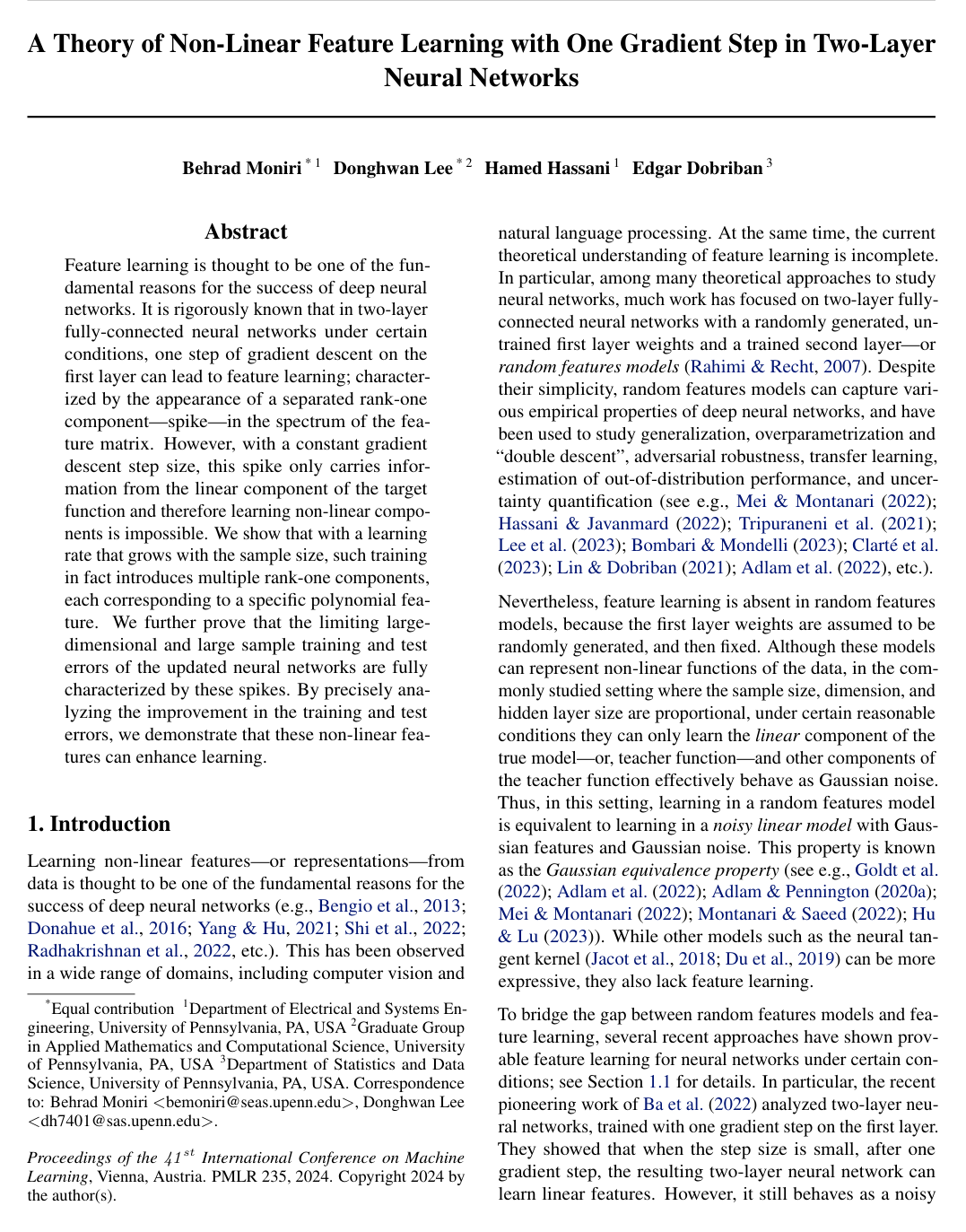
A Theory of Non-Linear Feature Learning with One Gradient Step in Two-Layer Neural Networks
Behrad Moniri, Donghwan Lee, Hamed Hassani, Edgar Dobriban
Feature learning is thought to be one of the fundamental reasons for the success of deep neural networks. It is rigorously known that in two-layer fully-connected neural networks under certain conditions, one step of gradient descent on the first layer can lead to feature learning; characterized by the appearance of a separated rank-one component—spike—in the spectrum of the feature matrix. However, with a constant gradient descent step size, this spike only carries information from the linear component of the target function and therefore learning non-linear components is impossible. We show that with a learning rate that grows with the sample size, such training in fact introduces multiple rank-one components, each corresponding to a specific polynomial feature. We further prove that the limiting large-dimensional and large sample training and test errors of the updated neural networks are fully characterized by these spikes. By precisely analyzing the improvement in the training and test errors, we demonstrate that these non-linear features can enhance learning.
Added
2026-10-05
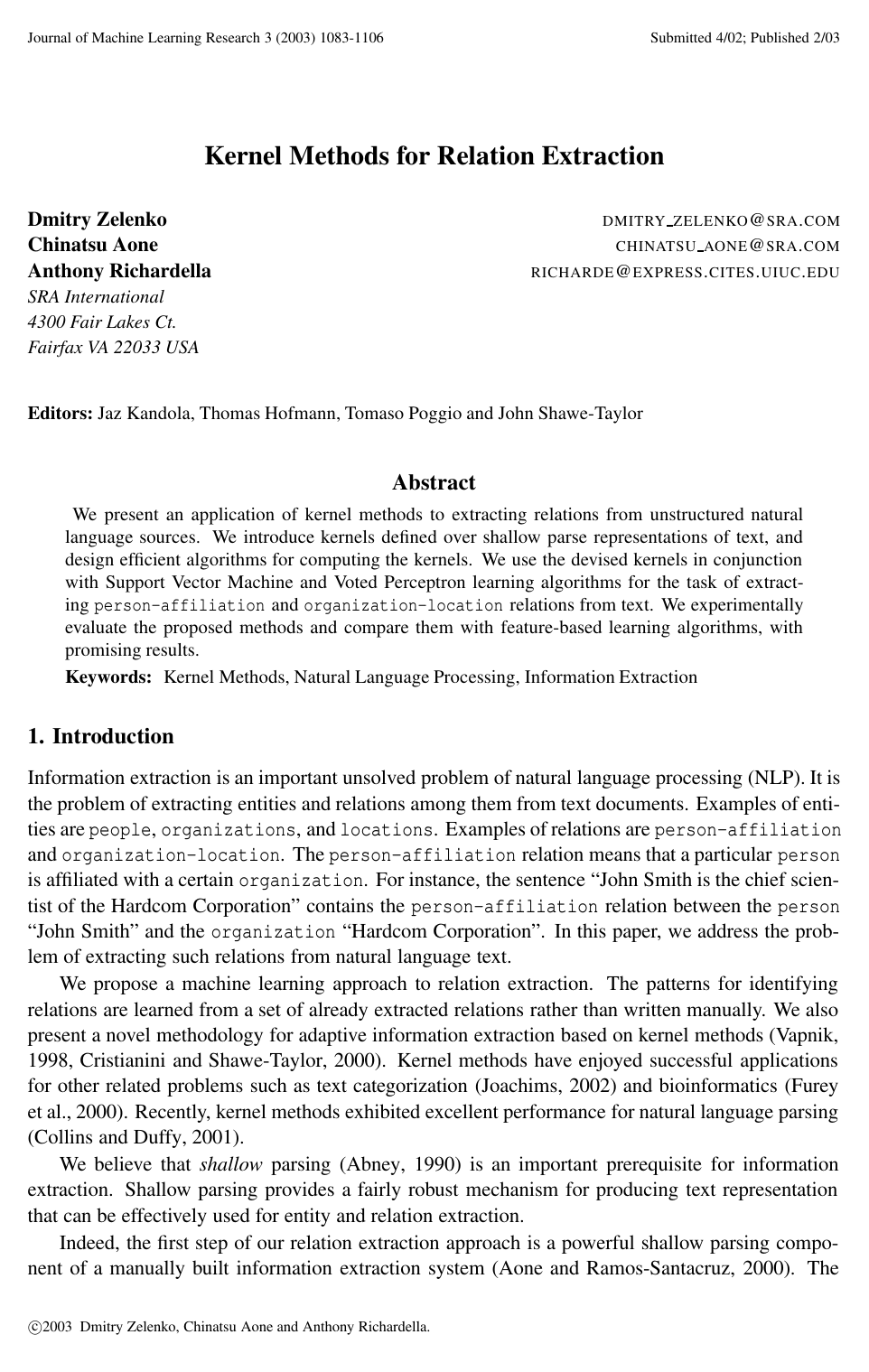
Kernel Methods for Relation Extraction
Dmitry Zelenko, Chinatsu Aone, Anthony Richardella
Why you should read this
Develops tree kernels defined over shallow parse representations along with efficient computation algorithms, enabling Support Vector Machines and Voted Perceptrons to accurately extract semantic relations without manual feature engineering.
We present an application of kernel methods to extracting relations from unstructured natural language sources. We introduce kernels defined over shallow parse representations of text, and design efficient algorithms for computing the kernels. We use the devised kernels in conjunction with Support Vector Machine and Voted Perceptron learning algorithms for the task of extracting person-affiliation and organization-location relations from text. We experimentally evaluate the proposed methods and compare them with feature-based learning algorithms, with promising results.
Added
2026-09-26

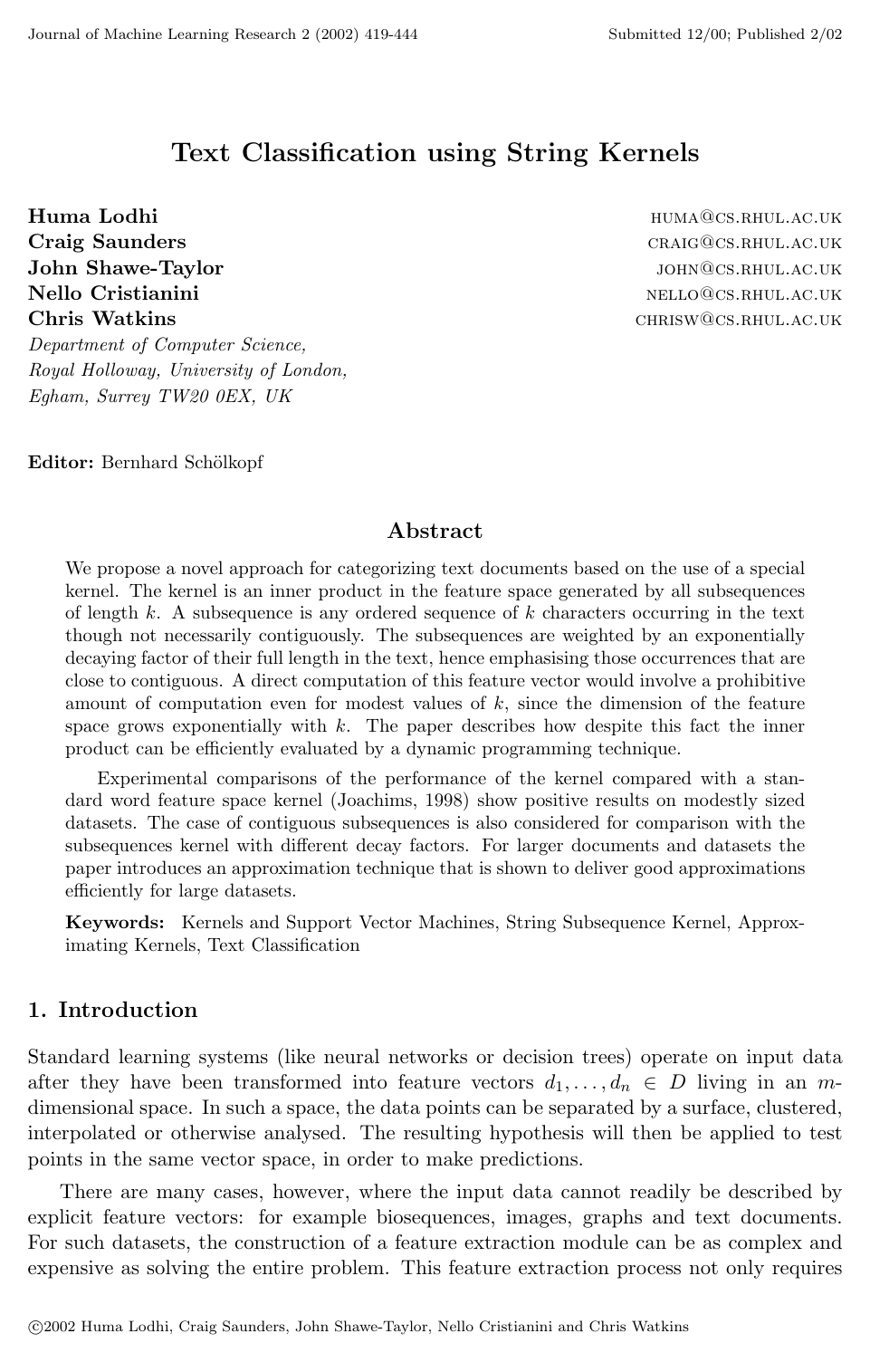
Text Classification using String Kernels
H. Lodhi, C. Saunders, J. Shawe-Taylor, N. Cristianini, Christopher J. C. H. Watkins
Why you should read this
Proposes a string subsequence kernel for text categorization that captures non-contiguous character sequences via dynamic programming and outperforms traditional bag-of-words representations on benchmark corpora.
We propose a novel approach for categorizing text documents based on the use of a special kernel. The kernel is an inner product in the feature space generated by all subsequences of length k. A subsequence is any ordered sequence of k characters occurring in the text though not necessarily contiguously. The subsequences are weighted by an exponentially decaying factor of their full length in the text, hence emphasising those occurrences that are close to contiguous. A direct computation of this feature vector would involve a prohibitive amount of computation even for modest values of k, since the dimension of the feature space grows exponentially with k. The paper describes how despite this fact the inner product can be efficiently evaluated by a dynamic programming technique. Experimental comparisons of the performance of the kernel compared with a standard word feature space kernel (Joachims, 1998) show positive results on modestly sized datasets. The case of contiguous subsequences is also considered for comparison with the subsequences kernel with different decay factors. For larger documents and datasets the paper introduces an approximation technique that is shown to deliver good approximations efficiently for large datasets.
Added
2026-09-25
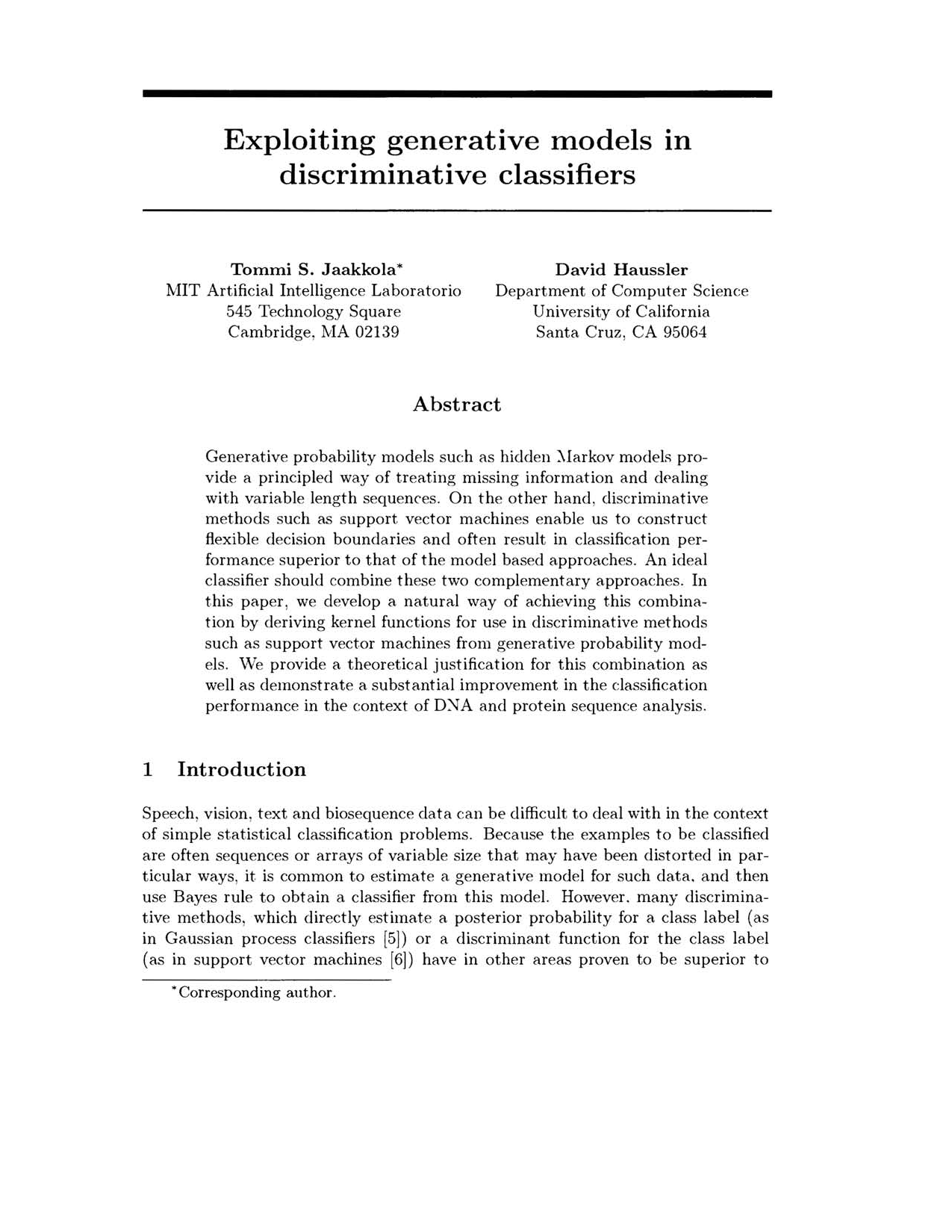
Exploiting Generative Models in Discriminative Classifiers
T. Jaakkola, D. Haussler
Why you should read this
Proposes a general framework for deriving kernel functions directly from generative probability models, enabling discriminative classifiers such as support vector machines to effectively process complex, variable-length biological sequences.
Generative probability models such as hidden Markov models provide a principled way of treating missing information and dealing with variable length sequences. On the other hand, discriminative methods such as support vector machines enable us to construct flexible decision boundaries and often result in classification performance superior to that of the model based approaches. An ideal classifier should combine these two complementary approaches. In this paper, we develop a natural way of achieving this combination by deriving kernel functions for use in discriminative methods such as support vector machines from generative probability models. We provide a theoretical justification for this combination as well as demonstrate a substantial improvement in the classification performance in the context of DNA and protein sequence analysis.
Added
2026-09-24
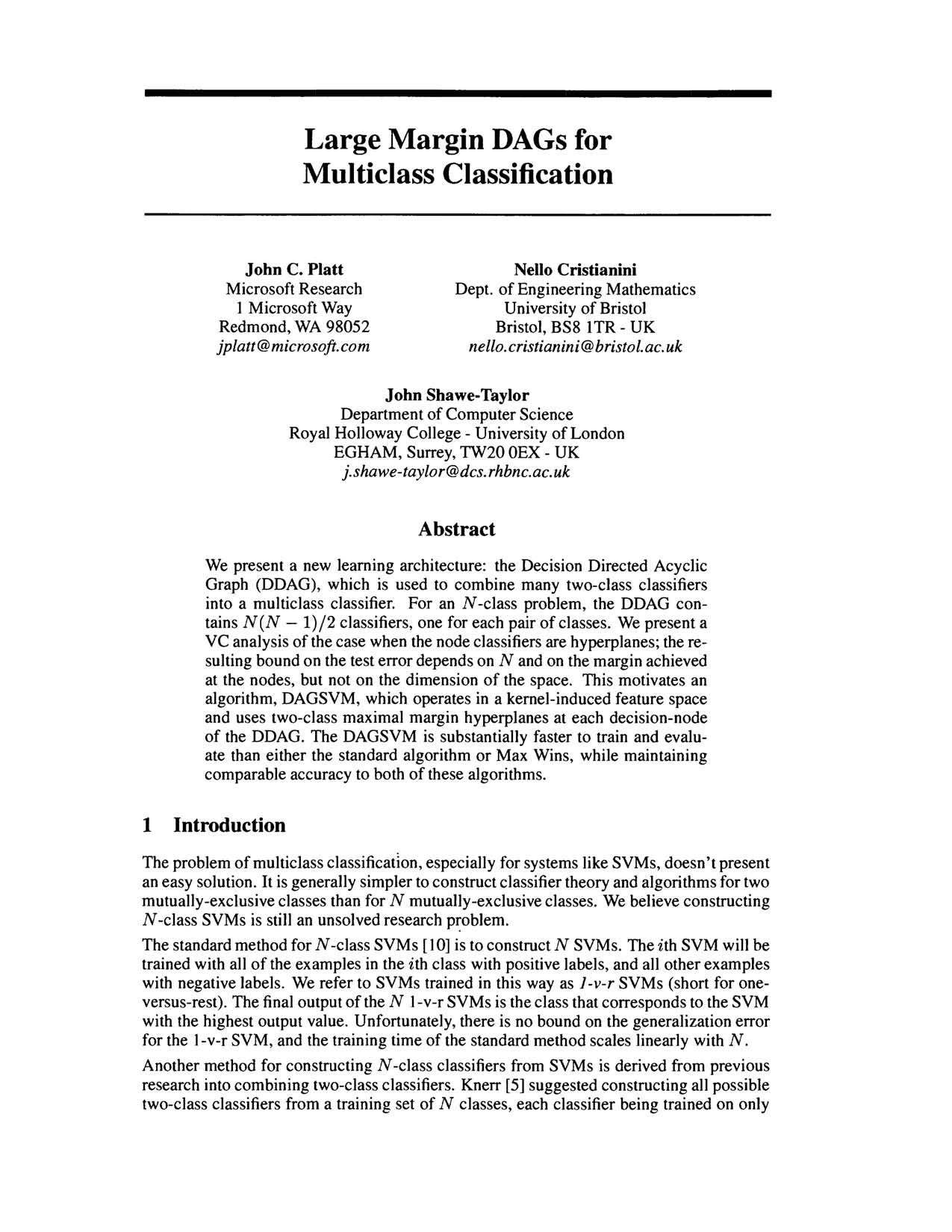
Large Margin DAGs for Multiclass Classification
John C. Platt, N. Cristianini, J. Shawe-Taylor
Why you should read this
Introduces the Decision Directed Acyclic Graph architecture and the DAGSVM algorithm, providing dimension-independent generalization error bounds and substantially faster multiclass SVM evaluation by requiring only linear-time path traversals without sacrificing accuracy.
We present a new learning architecture: the Decision Directed Acyclic Graph (DDAG), which is used to combine many two-class classifiers into a multiclass classifier. For an N-class problem, the DDAG contains N(N − 1)/2 classifiers, one for each pair of classes. We present a VC analysis of the case when the node classifiers are hyperplanes; the resulting bound on the test error depends on N and on the margin achieved at the nodes, but not on the dimension of the space. This motivates an algorithm, DAGSVM, which operates in a kernel-induced feature space and uses two-class maximal margin hyperplanes at each decision-node of the DDAG. The DAGSVM is substantially faster to train and evaluate than either the standard algorithm or Max Wins, while maintaining comparable accuracy to both of these algorithms.
Added
2026-09-18
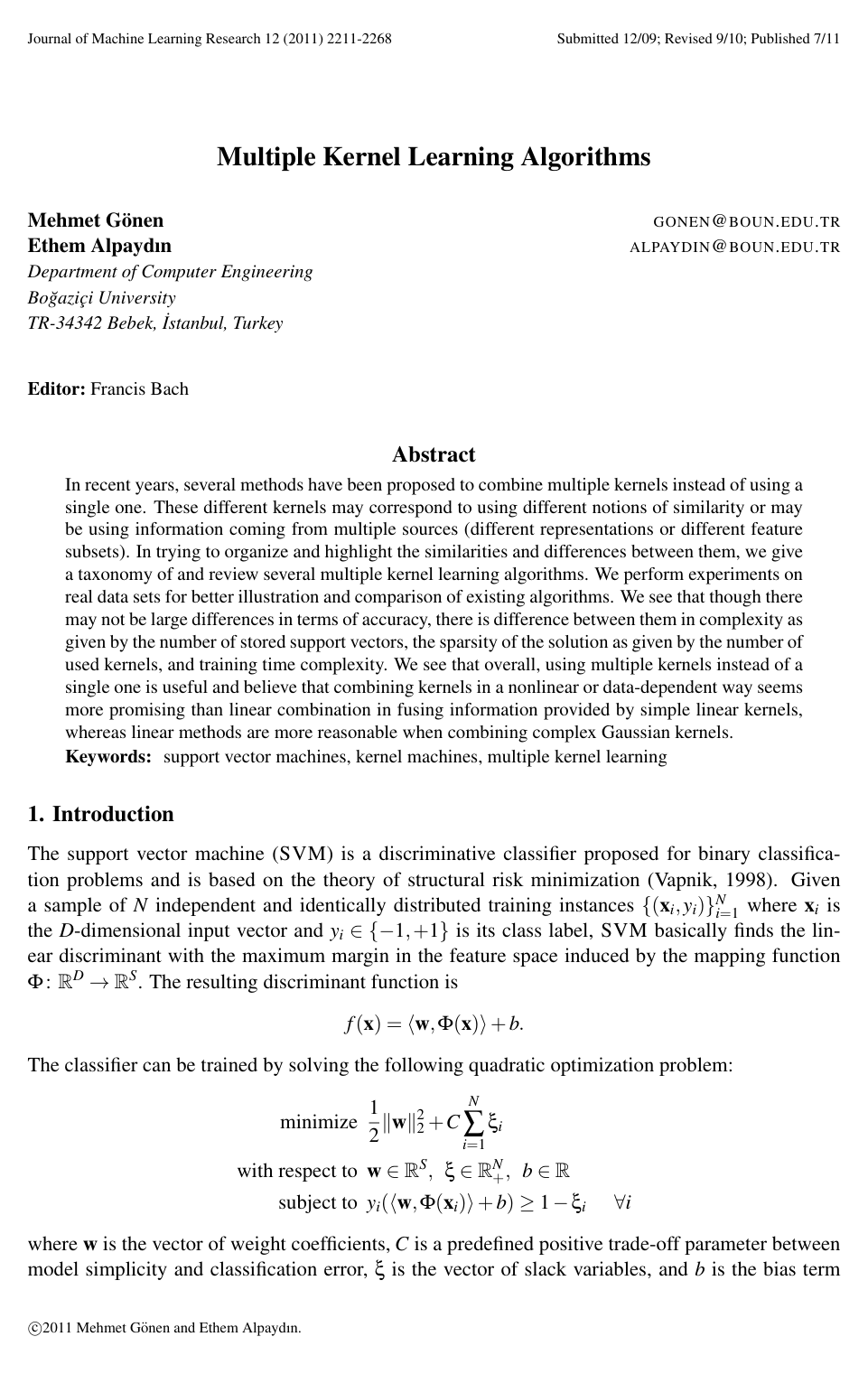
Multiple Kernel Learning Algorithms
Mehmet Gönen, Ethem Alpaydin
Why you should read this
Presents a comprehensive taxonomy and empirical comparison of multiple kernel learning algorithms across six key dimensions to guide the selection of combination methods based on computational complexity, solution sparsity, and kernel types.
In recent years, several methods have been proposed to combine multiple kernels instead of using a single one. These different kernels may correspond to using different notions of similarity or may be using information coming from multiple sources (different representations or different feature subsets). In trying to organize and highlight the similarities and differences between them, we give a taxonomy of and review several multiple kernel learning algorithms. We perform experiments on real data sets for better illustration and comparison of existing algorithms. We see that though there may not be large differences in terms of accuracy, there is difference between them in complexity as given by the number of stored support vectors, the sparsity of the solution as given by the number of used kernels, and training time complexity. We see that overall, using multiple kernels instead of a single one is useful and believe that combining kernels in a nonlinear or data-dependent way seems more promising than linear combination in fusing information provided by simple linear kernels, whereas linear methods are more reasonable when combining complex Gaussian kernels.
Added
2026-09-17
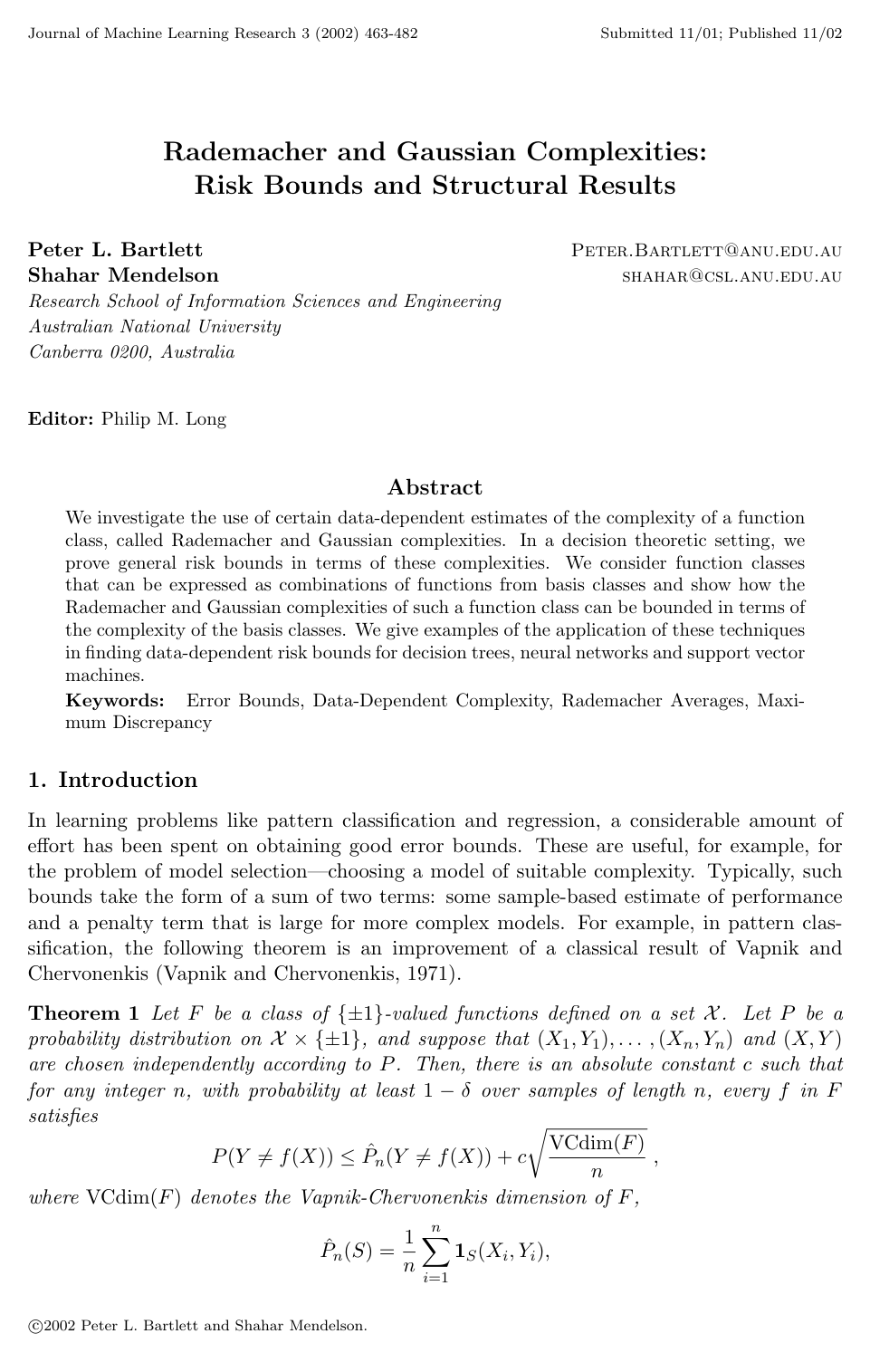
Rademacher and Gaussian Complexities: Risk Bounds and Structural Results
Peter L. Bartlett, Shahar Mendelson
Why you should read this
Establishes data-dependent generalization bounds using Rademacher and Gaussian complexities alongside structural composition rules that yield practical error guarantees for neural networks, kernel methods, and decision trees.
We investigate the use of certain data-dependent estimates of the complexity of a function class, called Rademacher and Gaussian complexities. In a decision theoretic setting, we prove general risk bounds in terms of these complexities. We consider function classes that can be expressed as combinations of functions from basis classes and show how the Rademacher and Gaussian complexities of such a function class can be bounded in terms of the complexity of the basis classes. We give examples of the application of these techniques in finding data-dependent risk bounds for decision trees, neural networks and support vector machines.
Added
2026-09-11
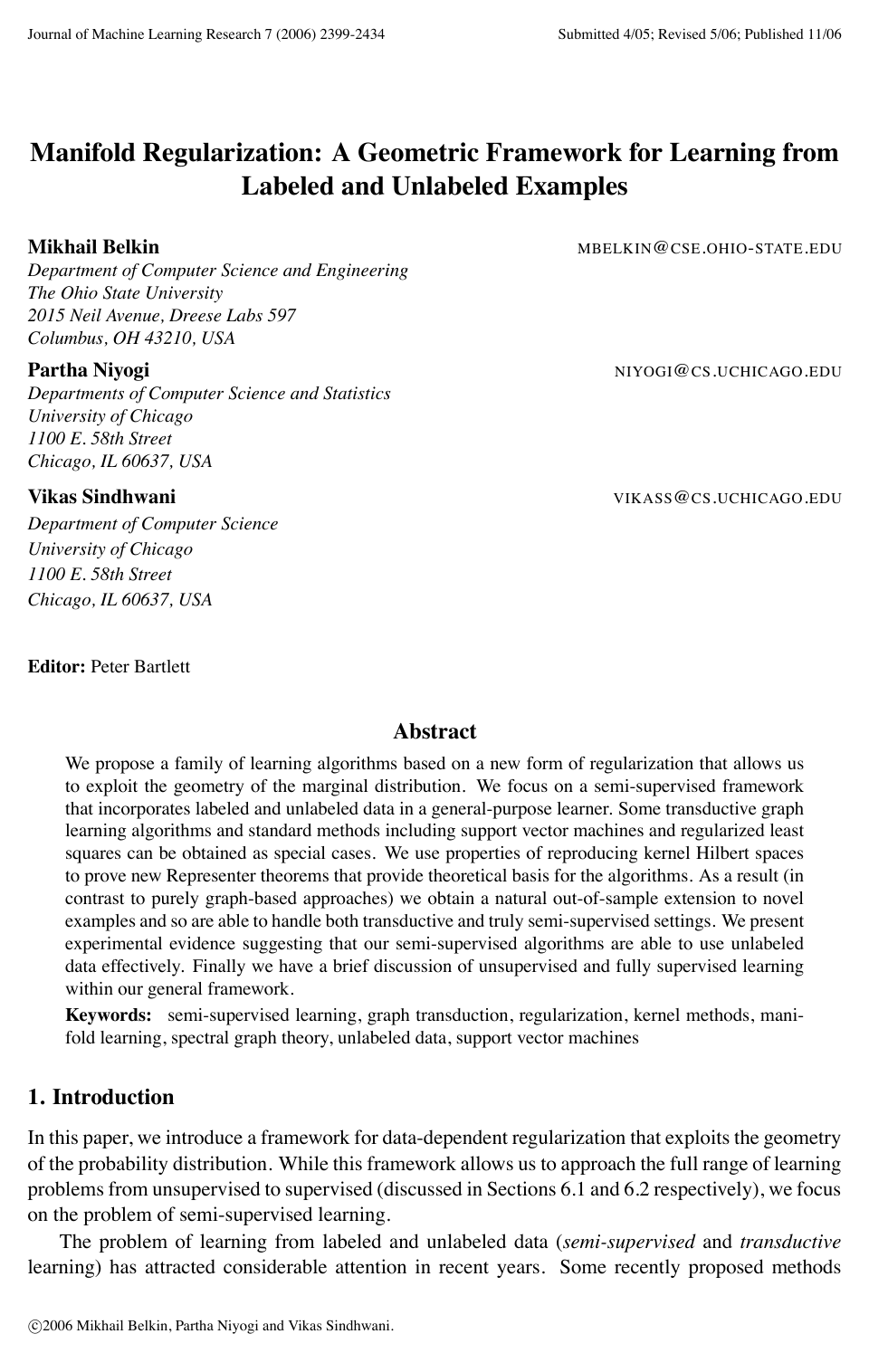
Manifold Regularization: A Geometric Framework for Learning from Labeled and Unlabeled Examples
Mikhail Belkin, Partha Niyogi, Vikas Sindhwani
Why you should read this
Develops a geometric regularization framework that combines reproducing kernel Hilbert spaces with graph Laplacians to extend algorithms like support vector machines and regularized least squares to semi-supervised learning with out-of-sample generalization.
We propose a family of learning algorithms based on a new form of regularization that allows us to exploit the geometry of the marginal distribution. We focus on a semi-supervised framework that incorporates labeled and unlabeled data in a general-purpose learner. Some transductive graph learning algorithms and standard methods including support vector machines and regularized least squares can be obtained as special cases. We use properties of reproducing kernel Hilbert spaces to prove new Representer theorems that provide theoretical basis for the algorithms. As a result (in contrast to purely graph-based approaches) we obtain a natural out-of-sample extension to novel examples and so are able to handle both transductive and truly semi-supervised settings. We present experimental evidence suggesting that our semi-supervised algorithms are able to use unlabeled data effectively. Finally we have a brief discussion of unsupervised and fully supervised learning within our general framework.
Added
2026-09-11
Neural Tangent Kernel: Convergence and Generalization in Neural Networks
Arthur Jacot, Franck Gabriel, Clément Hongler
Why you should read this
Establishes the Neural Tangent Kernel framework to prove that infinite-width neural networks follow linear dynamics during gradient descent, enabling an exact theoretical analysis of training convergence and generalization in function space.
At initialization, artificial neural networks (ANNs) are equivalent to Gaussian processes in the infinite-width limit, thus connecting them to kernel methods. We prove that the evolution of an ANN during training can also be described by a kernel: during gradient descent on the parameters of an ANN, the network function (which maps input vectors to output vectors) follows the kernel gradient of the functional cost (which is convex, in contrast to the parameter cost) w.r.t. a new kernel: the Neural Tangent Kernel (NTK). This kernel is central to describe the generalization features of ANNs. While the NTK is random at initialization and varies during training, in the infinite-width limit it converges to an explicit limiting kernel and it stays constant during training. This makes it possible to study the training of ANNs in function space instead of parameter space. Convergence of the training can then be related to the positive-definiteness of the limiting NTK. We prove the positive-definiteness of the limiting NTK when the data is supported on the sphere and the non-linearity is non-polynomial. We then focus on the setting of least-squares regression and show that in the infinite-width limit, the network function follows a linear differential equation during training. The convergence is fastest along the largest kernel principal components of the input data with respect to the NTK, hence suggesting a theoretical motivation for early stopping. Finally we study the NTK numerically, observe its behavior for wide networks, and compare it to the infinite-width limit.
Added
2026-09-11