
keyword
implicit feedback datasets
Implicit feedback datasets are collections of user interaction records that capture indirect behavioral signals, such as purchase history, browsing activity, clicks, listening logs, and viewing patterns, rather than explicit ratings or direct user reviews. Widely used in recommender systems and collaborative filtering, these datasets passively track user actions to infer personal preferences without requiring active user evaluation. Unlike explicit feedback datasets that contain direct positive and negative judgments, implicit feedback datasets inherently lack explicit negative feedback, as unobserved interactions can indicate either a lack of interest or simple unawareness of an item. Consequently, data points in implicit feedback datasets are typically modeled as indications of preference accompanied by varying levels of confidence based on the frequency, intensity, or duration of the observed behaviors.
4 items

Ups and Downs: Modeling the Visual Evolution of Fashion Trends with One-Class Collaborative Filtering
Ruining He, Julian McAuley
Why you should read this
Introduces a visual collaborative filtering framework that integrates deep convolutional image features with temporal dynamics to model evolving fashion trends and deliver superior personalized product recommendations.
Building a successful recommender system depends on understanding both the dimensions of people's preferences as well as their dynamics. In certain domains, such as fashion, modeling such preferences can be incredibly difficult, due to the need to simultaneously model the visual appearance of products as well as their evolution over time. The subtle semantics and non-linear dynamics of fashion evolution raise unique challenges especially considering the sparsity and large scale of the underlying datasets. In this paper we build novel models for the One-Class Collaborative Filtering setting, where our goal is to estimate users' fashion-aware personalized ranking functions based on their past feedback. To uncover the complex and evolving visual factors that people consider when evaluating products, our method combines high-level visual features extracted from a deep convolutional neural network, users' past feedback, as well as evolving trends within the community. Experimentally we evaluate our method on two large real-world datasets from this http URL, where we show it to outperform state-of-the-art personalized ranking measures, and also use it to visualize the high-level fashion trends across the 11-year span of our dataset.
Added
2026-09-14
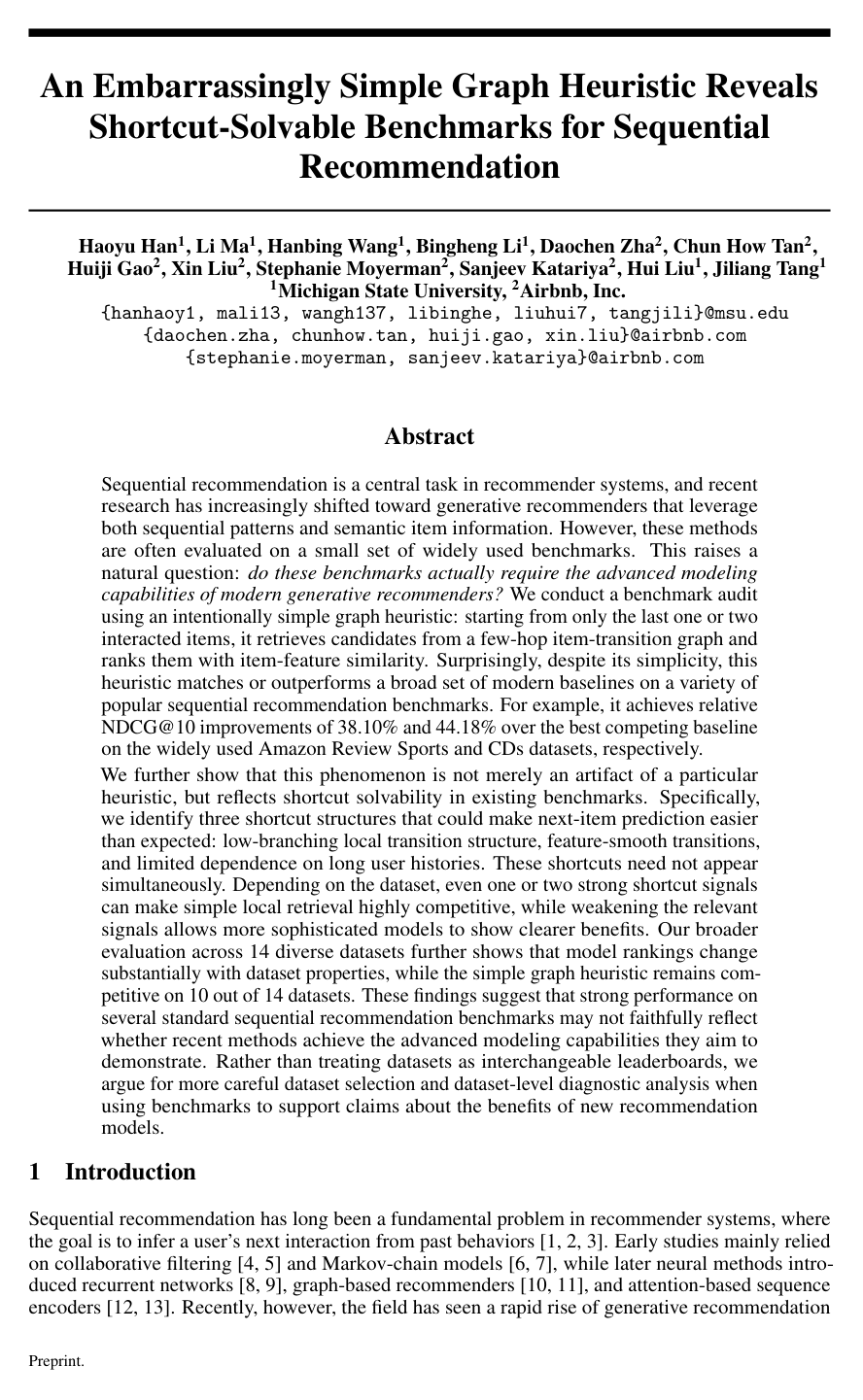
An Embarrassingly Simple Graph Heuristic Reveals Shortcut-Solvable Benchmarks for Sequential Recommendation
Haoyu Han, Li Ma, Hanbing Wang, Bingheng Li, Daochen Zha, Chun How Tan, Huiji Gao, Xin Liu, Stephanie Moyerman, Sanjeev Katariya, Hui Liu, Jiliang Tang
Why you should read this
Reveals that many sequential recommendation benchmarks are "shortcut-solvable" by a simple graph heuristic, challenging the perceived necessity of complex generative models and advocating for more rigorous benchmark analysis.
Sequential recommendation has increasingly shifted toward generative recommenders that combine sequential patterns with semantic item information. Yet these methods are often evaluated on a small set of widely used benchmarks, raising a key question: do these benchmarks actually require the advanced modeling capabilities that modern generative recommenders claim to provide? We conduct a benchmark audit with an intentionally simple graph heuristic. Starting from only the last one or two interacted items, it retrieves candidates from a few-hop item-transition graph and ranks them by item-feature similarity. Despite using no sequence encoder, generative objective, or training, this heuristic matches or outperforms many modern baselines, with relative NDCG@10 improvements of 38.10% and 44.18% over the best competing baseline on Amazon Review Sports and CDs. We show that this behavior reflects shortcut solvability rather than an artifact of one heuristic. We identify three shortcut structures that can make next-item prediction easier than expected: low-branching local transitions, feature-smooth transitions, and limited dependence on long user histories. These shortcuts need not appear together; even one or two strong signals can make simple local retrieval highly competitive, while weakening them makes the benefits of more sophisticated models clearer. Across 14 datasets, model rankings vary substantially with dataset properties, yet the heuristic remains competitive on 10 of them. Our findings suggest that strong performance on standard benchmarks does not always demonstrate advanced sequential, semantic, or generative modeling ability. We call for more careful dataset selection and dataset-level diagnostic analysis when using benchmarks to support claims about new recommendation models.
Added
2026-05-11

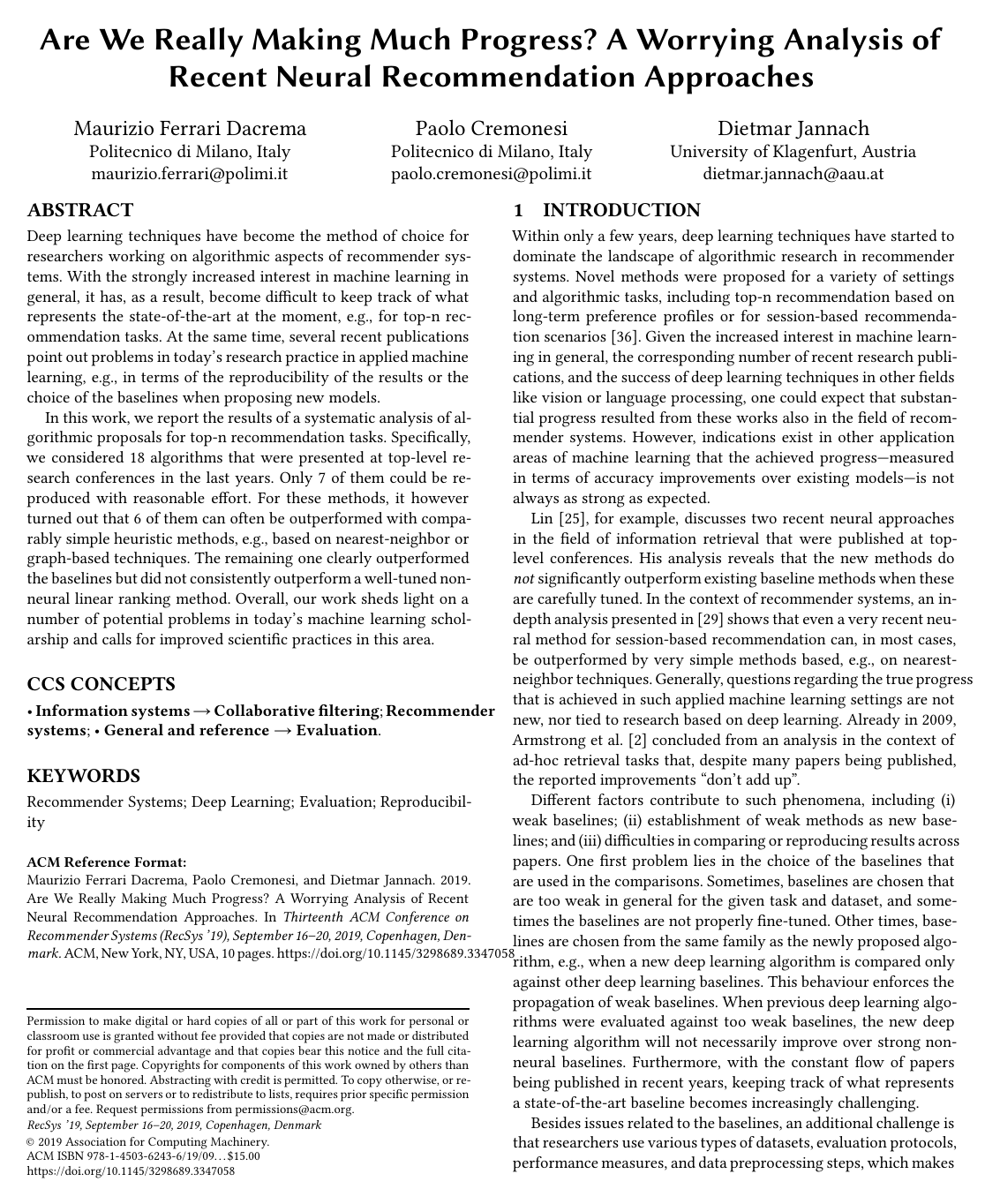
Are we really making much progress? A worrying analysis of recent neural recommendation approaches
Maurizio Ferrari Dacrema, Paolo Cremonesi, Dietmar Jannach
Why you should read this
Exposes severe systemic methodological flaws plaguing broader AI recommendation research systematically unmasking the fact that dozens of elite neural architectures frequently fail completely to beat properly tuned simple heuristics.
Deep learning techniques have become the method of choice for researchers working on algorithmic aspects of recommender systems. With the strongly increased interest in machine learning in general, it has, as a result, become difficult to keep track of what represents the state-of-the-art at the moment, e.g., for top-n recommendation tasks. At the same time, several recent publications point out problems in today's research practice in applied machine learning, e.g., in terms of the reproducibility of the results or the choice of the baselines when proposing new models.
Added
2026-01-25
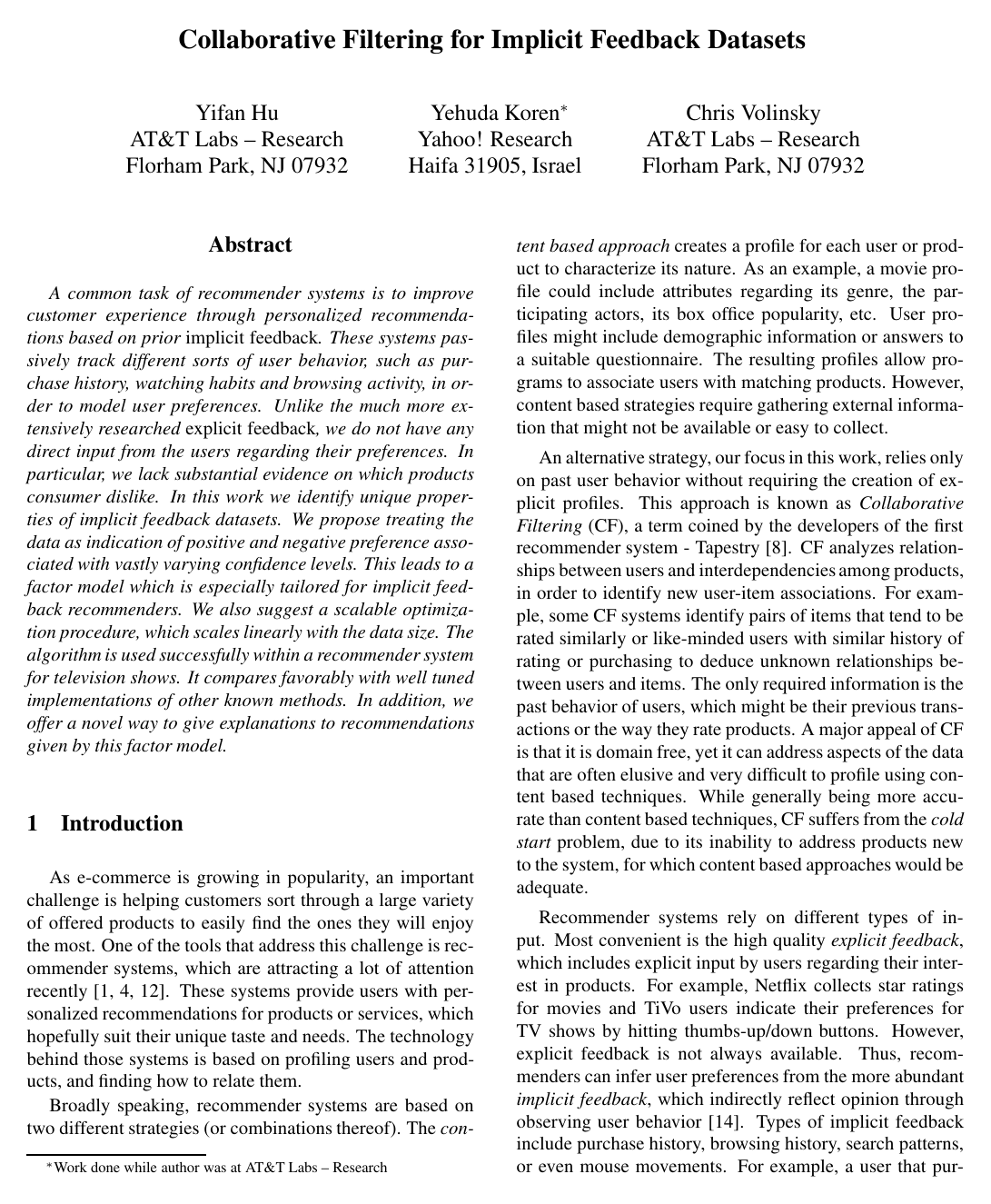
Collaborative Filtering for Implicit Feedback Datasets
Yifan Hu, Yehuda Koren, Chris Volinsky
Why you should read this
Solves the critical problem of learning user preferences from binary signals (clicks/views) using a weighted alternating least squares algorithm.
A common task of recommender systems is to improve customer experience through personalized recommendations based on prior implicit feedback. These systems passively track different sorts of user behavior, such as purchase history, watching habits and browsing activity, in order to model user preferences. Unlike the much more extensively researched explicit feedback, we do not have any direct input from the users regarding their preferences. In particular, we lack substantial evidence on which products consumer dislike. In this work we identify unique properties of implicit feedback datasets. We propose treating the data as indication of positive and negative preference associated with vastly varying confidence levels. This leads to a factor model which is especially tailored for implicit feedback recommenders. We also suggest a scalable optimization procedure, which scales linearly with the data size. The algorithm is used successfully within a recommender system for television shows. It compares favorably with well tuned implementations of other known methods. In addition, we offer a novel way to give explanations to recommendations given by this factor model.
Added
2026-01-25