
keyword
image extrapolation
Image extrapolation is the process of extending an image beyond its original boundaries by generating plausible visual content that continues the scene, often using visible context to keep the added areas coherent with the original.
3 items
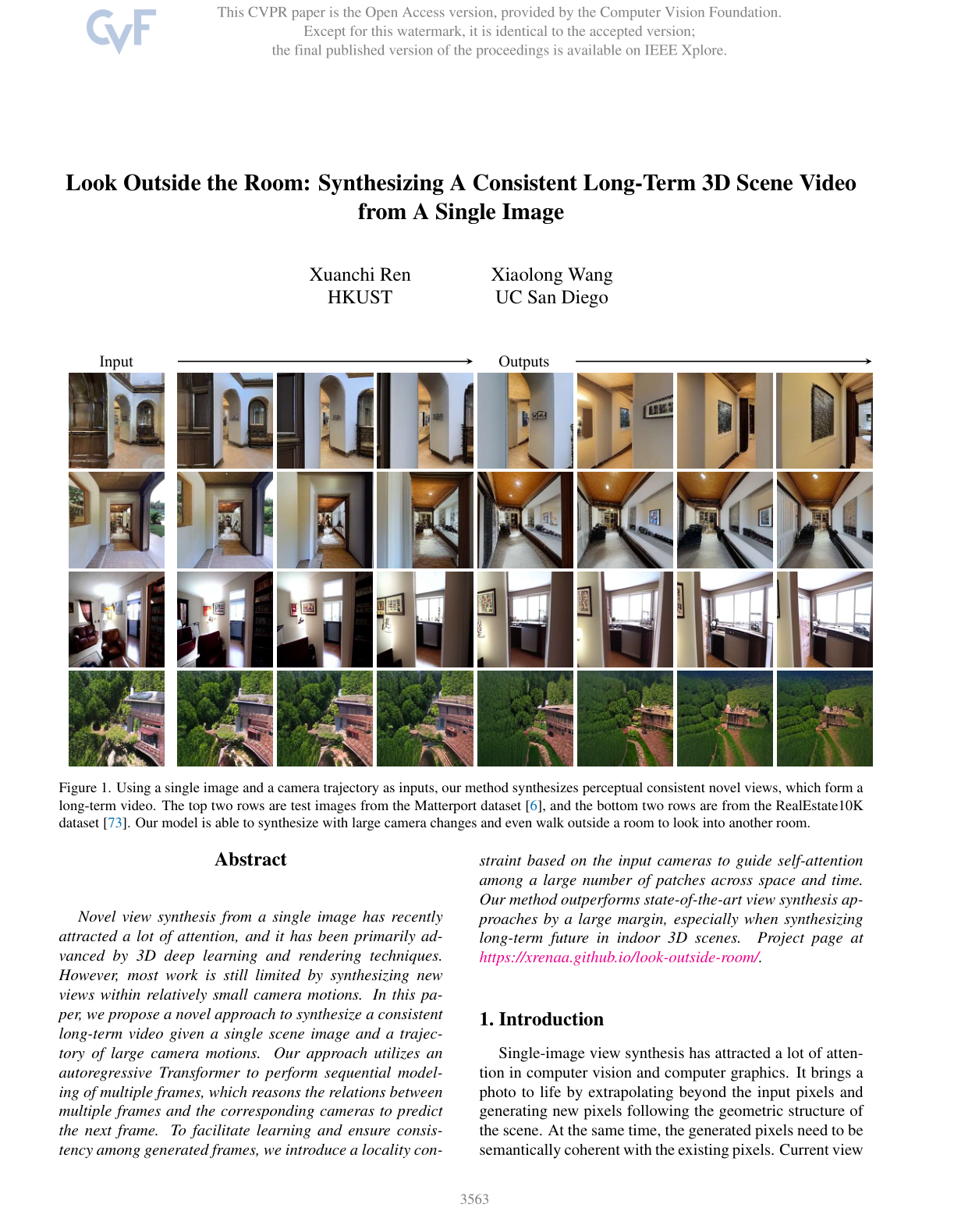
Look Outside the Room: Synthesizing A Consistent Long-Term 3D Scene Video from A Single Image
Xuanchi Ren, Xiaolong Wang
Why you should read this
Develops an autoregressive Transformer framework that generates geometrically consistent long-term 3D scene videos from a single input image and a large camera trajectory by using a camera-aware bias to guide space-time attention.
Novel view synthesis from a single image has recently attracted a lot of attention, and it has been primarily advanced by 3D deep learning and rendering techniques. However, most work is still limited by synthesizing new views within relatively small camera motions. In this paper, we propose a novel approach to synthesize a consistent long-term video given a single scene image and a trajectory of large camera motions. Our approach utilizes an autoregressive Transformer to perform sequential modeling of multiple frames, which reasons the relations between multiple frames and the corresponding cameras to predict the next frame. To facilitate learning and ensure consistency among generated frames, we introduce a locality constraint based on the input cameras to guide self-attention among a large number of patches across space and time. Our method outperforms state-of-the-art view synthesis approaches by a large margin, especially when synthesizing long-term future in indoor 3D scenes. Project page at https://xrenaa.github.io/look-outside-room/.
Added
2026-09-26
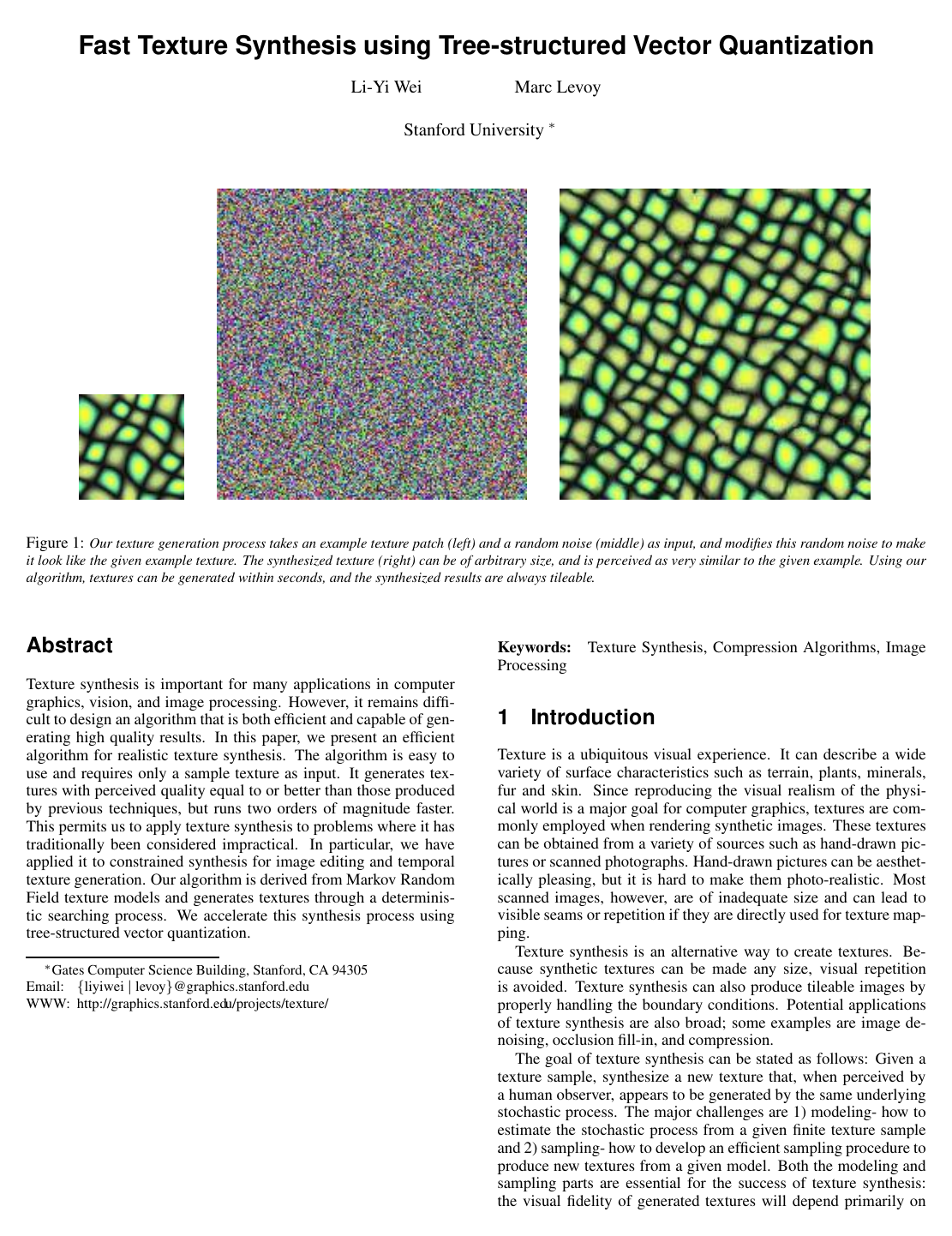
Fast texture synthesis using tree-structured vector quantization
Li-Yi Wei, Marc Levoy
Why you should read this
Accelerates Markov Random Field-based texture synthesis by two orders of magnitude using tree-structured vector quantization, enabling high-quality, real-time texture generation and image editing from a single exemplar.
Texture synthesis is important for many applications in computer graphics, vision, and image processing. However, it remains difficult to design an algorithm that is both efficient and capable of generating high quality results. In this paper, we present an efficient algorithm for realistic texture synthesis. The algorithm is easy to use and requires only a sample texture as input. It generates textures with perceived quality equal to or better than those produced by previous techniques, but runs two orders of magnitude faster. This permits us to apply texture synthesis to problems where it has traditionally been considered impractical. In particular, we have applied it to constrained synthesis for image editing and temporal texture generation. Our algorithm is derived from Markov Random Field texture models and generates textures through a deterministic searching process. We accelerate this synthesis process using tree-structured vector quantization.
Added
2026-09-24
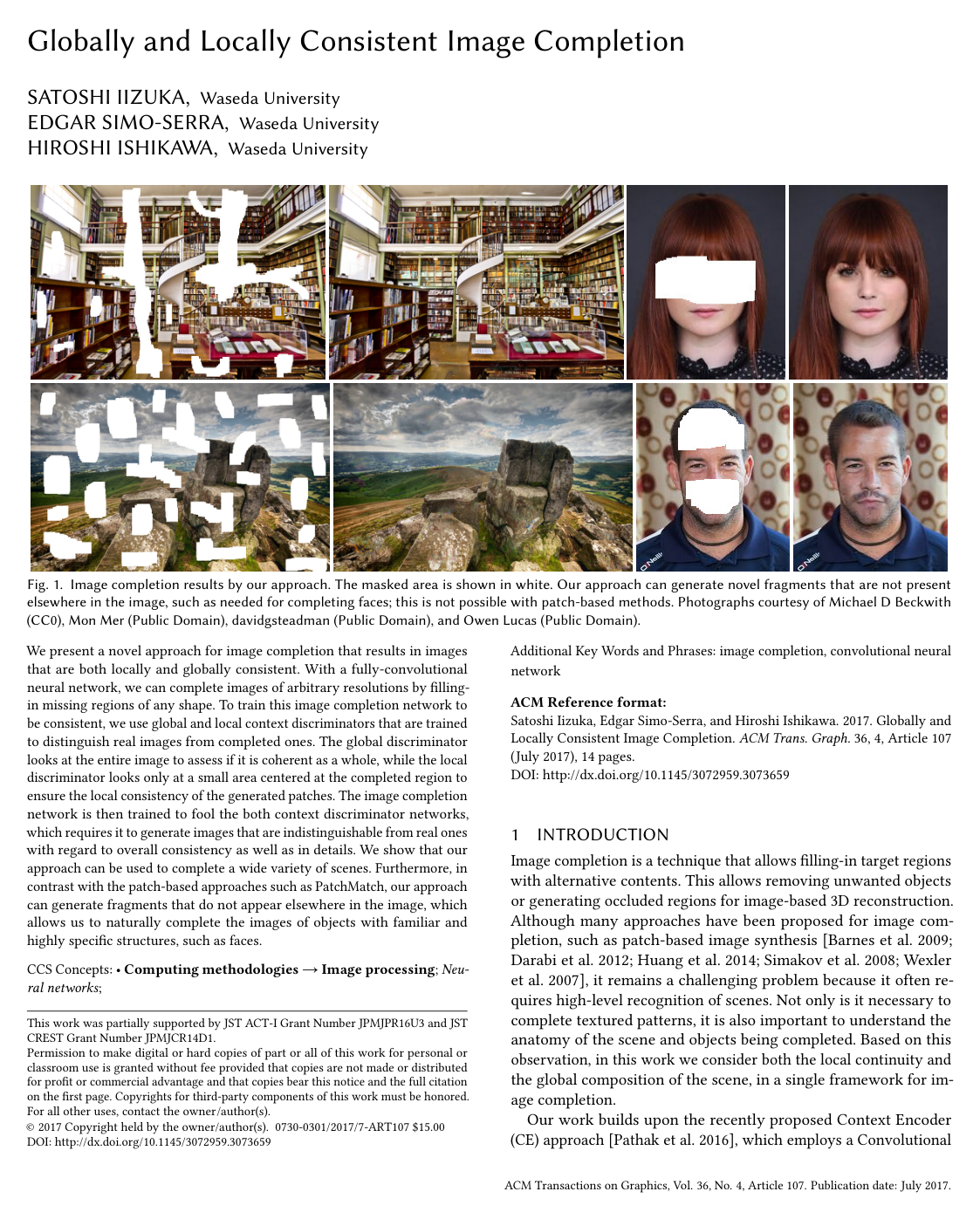
Globally and locally consistent image completion
SATOSHI IIZUKA, EDGAR SIMO-SERRA, HIROSHI ISHIKAWA
Why you should read this
Proposes a fully convolutional image completion framework trained with dual global and local context discriminators, enabling realistic synthesis of arbitrary-shaped missing regions while preserving both fine local details and overall semantic coherence across diverse scenes.
We present a novel approach for image completion that results in images that are both locally and globally consistent. With a fully-convolutional neural network, we can complete images of arbitrary resolutions by filling-in missing regions of any shape. To train this image completion network to be consistent, we use global and local context discriminators that are trained to distinguish real images from completed ones. The global discriminator looks at the entire image to assess if it is coherent as a whole, while the local discriminator looks only at a small area centered at the completed region to ensure the local consistency of the generated patches. The image completion network is then trained to fool the both context discriminator networks, which requires it to generate images that are indistinguishable from real ones with regard to overall consistency as well as in details. We show that our approach can be used to complete a wide variety of scenes. Furthermore, in contrast with the patch-based approaches such as PatchMatch, our approach can generate fragments that do not appear elsewhere in the image, which allows us to naturally complete the images of objects with familiar and highly specific structures, such as faces.
Added
2026-09-16