Fast texture synthesis using tree-structured vector quantization
Li-Yi WeiMarc Levoy
Accelerates Markov Random Field-based texture synthesis by two orders of magnitude using tree-structured vector quantization, enabling high-quality, real-time texture generation and image editing from a single exemplar.
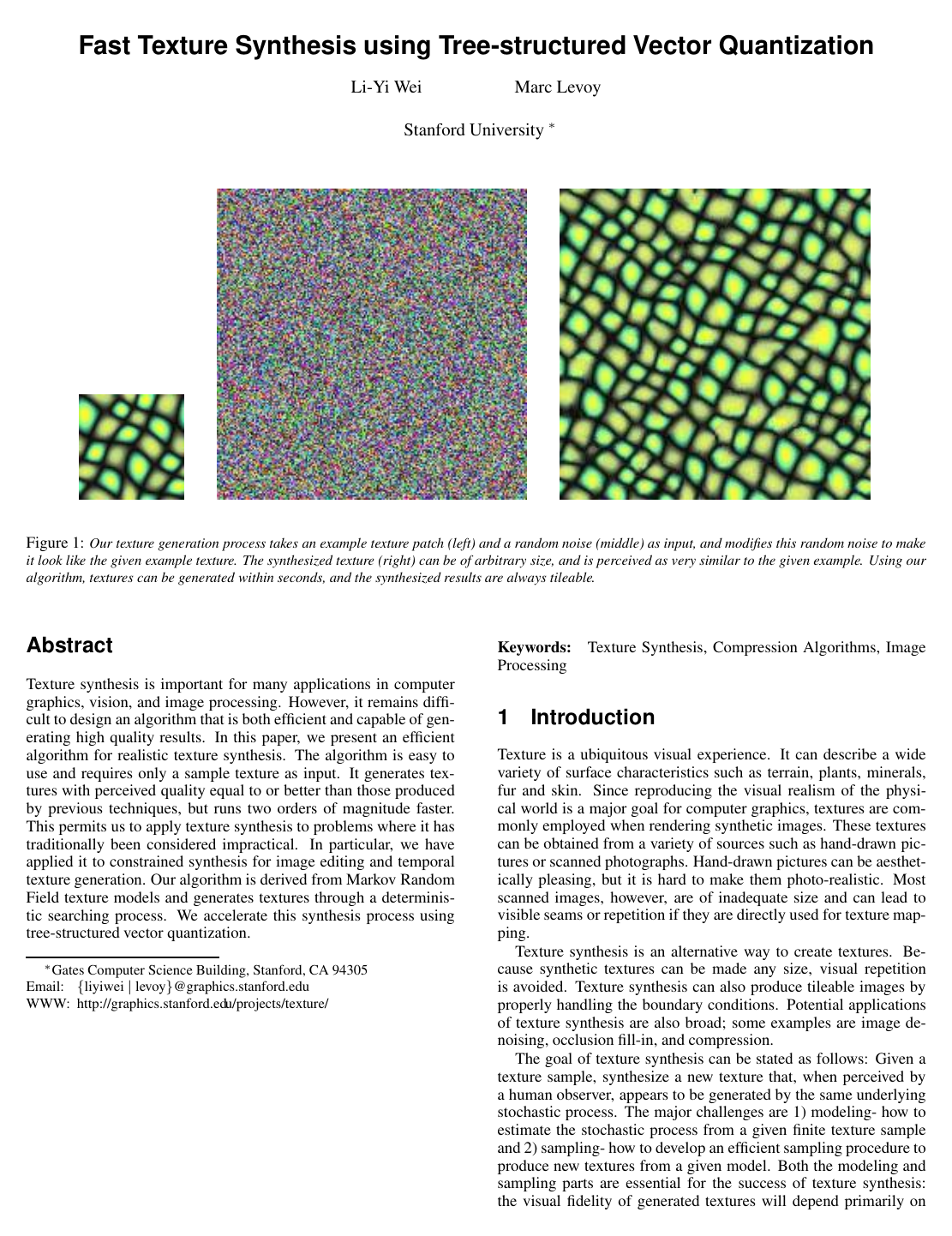
Texture synthesis is critical across computer graphics, image processing, and visual effects for generating seamless, repeatable surface imagery from small input samples. However, conventional techniques face a difficult trade-off: statistical feature-matching methods are fast but often distort complex structural patterns, while probabilistic Markov Random Field methods produce realistic, high-quality textures but require heavy computation that often takes hours to generate small patches. The article evaluates and demonstrates a fast, deterministic texture synthesis algorithm that combines multi-resolution image pyramids with tree-structured vector quantization to generate high-fidelity, seamlessly tileable textures.
The evaluated approach models textures under locality and stationarity assumptions, synthesizing an output image pixel by pixel from coarse to fine resolution levels. Instead of performing slow probabilistic sampling, the method treats pixel neighborhood matching as a nearest-point search in high-dimensional space and accelerates it using tree-structured vector quantization codebooks. To validate the method, the authors tested it across diverse standard texture datasets (such as the MIT VisTex collection) and applied it to advanced image editing, image hole filling, and three-dimensional motion sequences including fire, smoke, and ocean waves.
The key findings demonstrate significant performance gains and broad versatility. First, the accelerated algorithm runs roughly two orders of magnitude faster than comparable high-quality sampling methods; for example, it synthesized a sample image in 24 seconds (12 seconds of training and 12 seconds of synthesis) compared to 1,941 seconds required by an existing state-of-the-art method. Second, visual fidelity matches or exceeds prior techniques while naturally enforcing seamless tiling at image boundaries. Third, tree-structured vector quantization codebooks reduced memory demands effectively, with codebooks containing under 10 percent of the original input vectors producing visual quality comparable to exhaustive search. Fourth, extending the method with two-pass spiral processing and three-dimensional temporal neighborhoods successfully enabled artifact-free image hole filling and realistic motion texture synthesis at approximately 20 seconds per frame.
These findings mean that realistic texture synthesis can transition from an expensive offline computation into a fast, practical tool for interactive digital workflows. For organizations in graphics production, digital restoration, and simulation, this approach substantially reduces computational overhead and project timelines without sacrificing visual quality. Because the algorithm requires only a single sample image and minimal parameter tuning, it also streamlines production pipelines and expands capabilities into temporal video textures.
Organizations should consider adopting tree-structured vector quantization-based texture synthesis for graphics asset creation, hole filling in image editing, and background dynamic effects. When implementing the method, teams should tune codebook sizes and tree-traversal backtracking parameters to balance memory footprint against image sharpness. Further work is recommended to explore real-time decompression architectures, enable direct synthesis on irregular three-dimensional surface meshes, and incorporate explicit user controls over dynamic animations.
The primary limitation of this method is its fundamental reliance on the stationarity and locality assumptions of Markov Random Fields; consequently, it cannot capture non-repeating global structures, three-dimensional depth, explicit lighting changes, or complex articulated motions such as human movement. Within its intended domain of stationary two-dimensional and three-dimensional textures, the reported results demonstrate high reliability and consistent performance across diverse test cases.
- Paper: Texture Features for Browsing and Retrieval of Image Data, B.S. Manjunath et al. (1996). This paper establishes foundational multiresolution and tree-structured wavelet representations for analyzing texture features that motivated hierarchical texture modeling.
- Paper: Image quilting for texture synthesis and transfer, Alexei A. Efros et al. (2001). This work advances beyond pixel-by-pixel Markov random field synthesis to patch-based quilting, dramatically improving local structural coherence and synthesis speed.
- Paper: Image Analogies, Aaron Hertzmann et al. (2001). This paper extends example-based multiscale texture synthesis and approximate nearest-neighbor search into a general framework for learning visual image analogies and artistic styles.
- Paper: PatchMatch: a randomized correspondence algorithm for structural image editing, Connelly Barnes et al. (2009). This work introduces a highly efficient randomized nearest-neighbor correspondence algorithm that revolutionizes fast patch-based texture and structural image synthesis.
- Paper: Super-resolution from a single image, Daniel Glasner et al. (2009). This research applies the principle of recurring internal texture patches across multiscale image pyramids to perform single-image super-resolution without external training sets.
- Paper: Image inpainting, Marcelo Bertalmio et al. (2000). This paper introduces automated image inpainting for seamless region filling, providing an alternative partial-differential-equation approach to the constrained texture synthesis applications proposed by the source.