Image Analogies
Aaron HertzmannCharles E. JacobsNuria OliverBrian CurlessDavid H. Salesin
Introduces a multi-scale autoregressive framework that learns visual transformations from an exemplary image pair to automatically synthesize complex effects—such as artistic style transfer, texture synthesis, and super-resolution—on novel target images without explicit filter programming.
Digital image processing and artistic rendering typically require custom-engineered algorithms or complex manual adjustments for each specific visual style. This creates high development costs and limits creative flexibility when digital artists or designers want to reproduce distinctive visual effects, such as watercolor, oil painting, or realistic texture composition.
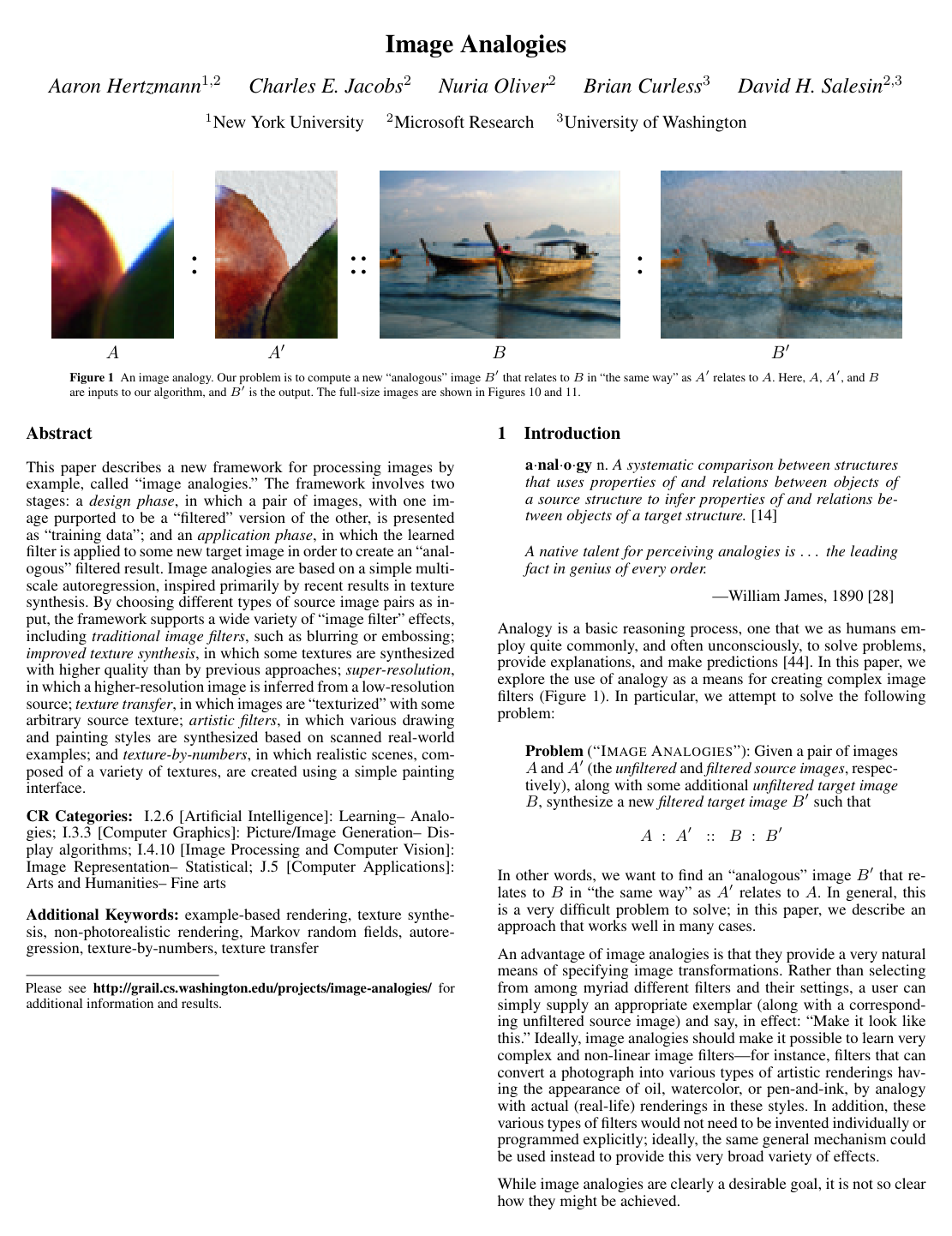
The article demonstrates a unified, example-based framework called "image analogies." The primary objective is to evaluate whether a system can learn an arbitrary image filter from an unfiltered and filtered training pair (A and A') and automatically apply that learned transformation to a new target image (B) to synthesize a corresponding filtered result (B').
The authors implemented a multiscale autoregression framework that synthesizes the output image from coarse to fine resolutions. To select output pixels, the algorithm combines an approximate nearest-neighbor search across multiscale neighborhoods with a coherence-guided search that favors copying continuous patches from the source. The framework was evaluated across multiple experimental scenarios, including traditional filters, super-resolution, texture synthesis, texture transfer, non-photorealistic artistic rendering, and "texture-by-numbers" scene generation.
The findings show that a single underlying mechanism successfully captures a diverse array of complex image transformations without needing style-specific hand coding. Combining approximate search with coherence matching produces higher-quality, seamless textures compared to prior methods that exhibited boundary tearing or blurring. In artistic rendering, the framework successfully transfers hand-painted oil, watercolor, and line art styles onto target photographs, especially when matching is performed in luminance space and assisted by oriented derivative filters. Additionally, the approach supports an interactive, two-threaded painting tool that enables rapid scene generation by prioritizing coherence updates before performing full multiscale refinement.
These results indicate that example-based rendering can replace dedicated algorithmic pipelines with exemplar image pairs, significantly lowering technical barriers and production timelines for digital content creation. The ability to generalize multiple tasks under one model reduces software complexity and enables non-technical users to generate rich visual effects by providing simple examples.
For practical adoption, organizations should establish libraries of pre-aligned exemplar pairs and explore GPU or code optimization, as the authors estimate that implementation tuning can yield roughly a fivefold speed improvement. Future technical efforts should focus on integrating automatic image registration, supporting full three-dimensional spatial data (such as depth and surface normals), and developing methods to capture broader semantic features like coherent long-range brush strokes.
Confidence in the core image synthesis capabilities is high, as demonstrated across numerous visual tasks. However, users should remain aware of key limitations: processing times can range from minutes to hours on complex high-resolution renderings, the model relies on low-level statistical matching rather than high-level structural understanding, and the training pairs must be accurately aligned to avoid synthesis artifacts.
- Paper: Image quilting for texture synthesis and transfer, Alexei A. Efros et al. (2001). This paper introduces patch-based texture synthesis and texture transfer, establishing the foundational non-parametric sampling principles that Image Analogies generalizes to multi-scale paired image relationships.
- Paper: The Design and Use of Steerable Filters, W. Freeman et al. (1991). This work establishes steerable pyramids and oriented multiscale feature representations essential for constructing the multi-scale autoregressive feature vectors used to match image neighborhoods.
- Paper: A Parametric Texture Model Based on Joint Statistics of Complex Wavelet Coefficients, Javier Portilla et al. (2000). This study develops statistical modeling of visual textures across multi-scale wavelet subbands, providing key theoretical groundwork for multi-scale texture matching and transfer.
- Paper: PatchMatch: a randomized correspondence algorithm for structural image editing, Connelly Barnes et al. (2009). This paper develops PatchMatch, a randomized correspondence algorithm that drastically accelerates the dense nearest-neighbor patch search foundational to non-parametric exemplar-based synthesis methods.
- Paper: Image-to-Image Translation with Conditional Adversarial Networks, Phillip Isola et al. (2017). This work introduces the conditional GAN framework (pix2pix), formulating paired image-to-image translation as a deep learning problem that directly succeeds example-based filtering paradigms like Image Analogies.
- Paper: A Neural Algorithm of Artistic Style, Leon A. Gatys et al. (2015). This landmark paper introduces neural style transfer, replacing pixel-neighborhood autoregression with deep convolutional feature correlations to transfer artistic styles onto photographs.
- Paper: Poisson image editing, P. Pérez et al. (2003). This paper introduces gradient-domain Poisson image editing, providing an alternative partial differential equation formulation for seamless texture replacement and local filtering.
- Paper: Super-resolution from a single image, Daniel Glasner et al. (2009). This work extends example-based super-resolution by exploiting cross-scale and within-scale patch redundancies found directly within a single image.
- Paper: Unpaired Image-to-Image Translation Using Cycle-Consistent Adversarial Networks, Jun-Yan Zhu et al. (2017). This paper introduces CycleGAN, removing the strict paired-data requirement of traditional analogy frameworks to learn cross-domain image translations from unpaired datasets.