
keyword
image diffusion models
Image diffusion models are a class of deep generative models designed to create, edit, and manipulate visual imagery by learning to reverse a gradual noise-addition process. In the forward process of these models, random Gaussian noise is incrementally added to image data over a series of steps until the original visual content degrades into pure noise. A neural network, typically utilizing a U-Net or transformer architecture, is trained on the reverse process to estimate and remove this noise step by step, reconstructing clean images from corrupted inputs. During inference, the model generates novel, high-fidelity images by iteratively denoising random noise samples, operating either directly in pixel space or within lower-dimensional latent spaces. These models frequently integrate multimodal conditioning signals, such as text prompts, spatial layouts, or reference images, enabling diverse visual tasks including text-to-image synthesis, localized image editing, object compositing, and guidance for three-dimensional asset generation.
10 items
One-2-3-45: Any Single Image to 3D Mesh in 45 Seconds without Per-Shape Optimization
Minghua Liu, Chao Xu, Haian Jin, Linghao Chen, Mukund Varma T., Zexiang Xu, Hao Su
Why you should read this
Develops a feed-forward approach that reconstructs consistent 360-degree textured 3D meshes from a single image in 45 seconds, bypassing costly per-shape optimization by integrating view-conditioned 2D diffusion with generalizable neural surface reconstruction.
Single image 3D reconstruction is an important but challenging task that requires extensive knowledge of our natural world. Many existing methods solve this problem by optimizing a neural radiance field under the guidance of 2D diffusion models but suffer from lengthy optimization time, 3D inconsistency results, and poor geometry. In this work, we propose a novel method that takes a single image of any object as input and generates a full 360-degree 3D textured mesh in a single feed-forward pass. Given a single image, we first use a view-conditioned 2D diffusion model, Zero123, to generate multi-view images for the input view, and then aim to lift them up to 3D space. Since traditional reconstruction methods struggle with inconsistent multi-view predictions, we build our 3D reconstruction module upon an SDF-based generalizable neural surface reconstruction method and propose several critical training strategies to enable the reconstruction of 360-degree meshes. Without costly optimizations, our method reconstructs 3D shapes in significantly less time than existing methods. Moreover, our method favors better geometry, generates more 3D consistent results, and adheres more closely to the input image. We evaluate our approach on both synthetic data and in-the-wild images and demonstrate its superiority in terms of both mesh quality and runtime. In addition, our approach can seamlessly support the text-to-3D task by integrating with off-the-shelf text-to-image diffusion models.
Added
2026-10-05
Kosmos-G: Generating Images in Context with Multimodal Large Language Models
Xichen Pan, Li Dong, Shaohan Huang, Zhiliang Peng, Wenhu Chen, Furu Wei
Why you should read this
Presents Kosmos-G, a framework that aligns multimodal large language models with CLIP to achieve zero-shot subject-driven image generation from interleaved text and image inputs without requiring test-time tuning or image decoder modifications.
Recent advancements in subject-driven image generation have made significant strides. However, current methods still fall short in diverse application scenarios, as they require test-time tuning and cannot accept interleaved multi-image and text input. These limitations keep them far from the ultimate goal of "image as a foreign language in image generation." This paper presents Kosmos-G, a model that leverages the advanced multimodal perception capabilities of Multimodal Large Language Models (MLLMs) to tackle the aforementioned challenge. Our approach aligns the output space of MLLM with CLIP using the textual modality as an anchor and performs compositional instruction tuning on curated data. Kosmos-G demonstrates an impressive capability of zero-shot subject-driven generation with interleaved multi-image and text input. Notably, the score distillation instruction tuning requires no modifications to the image decoder. This allows for a seamless substitution of CLIP and effortless integration with a myriad of U-Net techniques ranging from fine-grained controls to personalized image decoder variants. We posit Kosmos-G as an initial attempt towards the goal of "image as a foreign language in image generation." The code can be found at this https URL
Added
2026-09-26
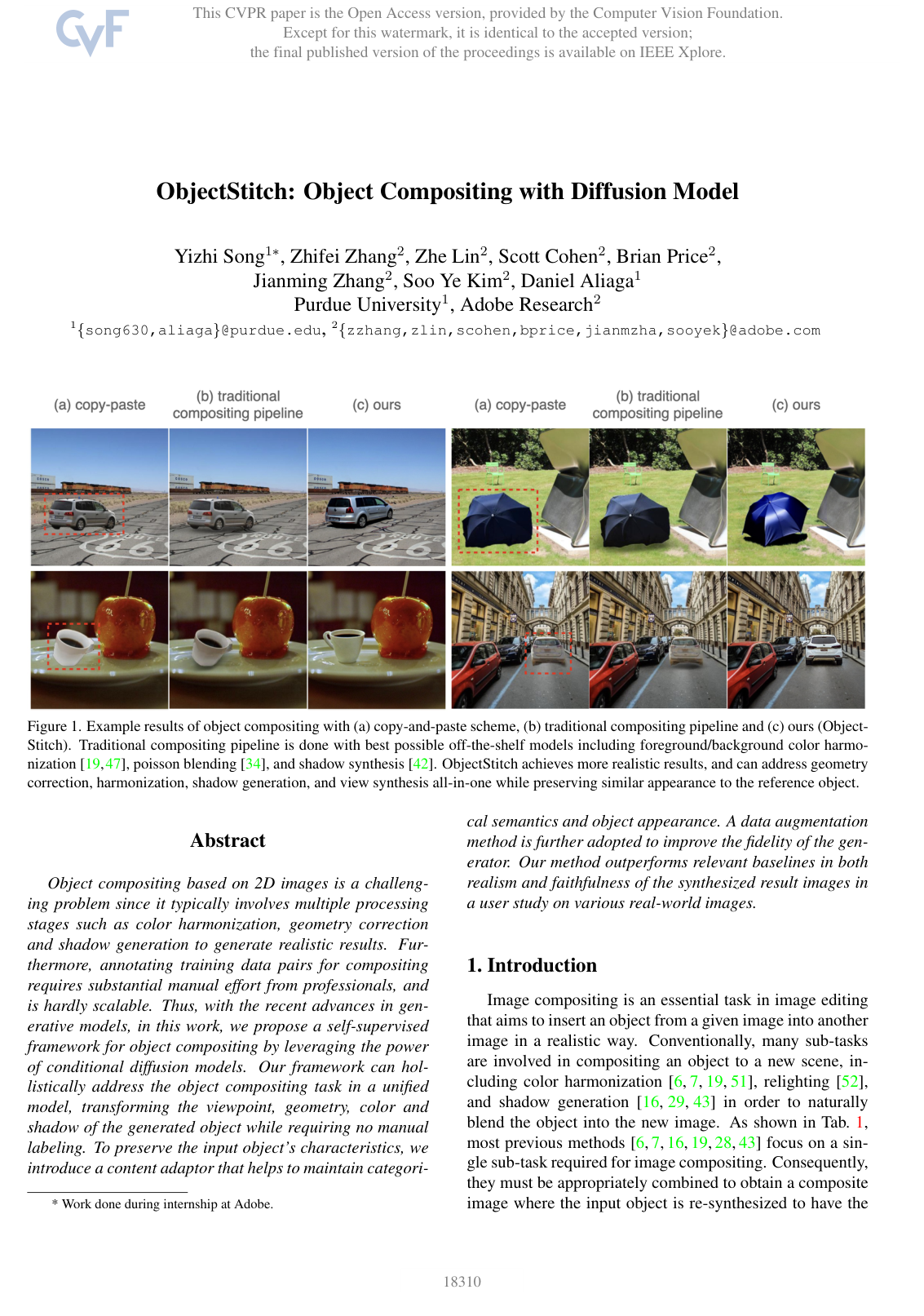
ObjectStitch: Object Compositing with Diffusion Model
Yizhi Song, Zhifei Zhang, Zhe Lin, Scott Cohen, Brian L. Price, Jianming Zhang, Soo Ye Kim, Daniel G. Aliaga
Why you should read this
Proposes a self-supervised generative framework based on conditional diffusion models that unifies color harmonization, viewpoint adjustment, geometry correction, and shadow generation into a single pipeline to insert objects realistically into background scenes.
Object compositing based on 2D images is a challenging problem since it typically involves multiple processing stages such as color harmonization, geometry correction and shadow generation to generate realistic results. Furthermore, annotating training data pairs for compositing requires substantial manual effort from professionals, and is hardly scalable. Thus, with the recent advances in generative models, in this work, we propose a self-supervised framework for object compositing by leveraging the power of conditional diffusion models. Our framework can holistically address the object compositing task in a unified model, transforming the viewpoint, geometry, color and shadow of the generated object while requiring no manual labeling. To preserve the input object’s characteristics, we introduce a content adaptor that helps to maintain categorical semantics and object appearance. A data augmentation method is further adopted to improve the fidelity of the generator. Our method outperforms relevant baselines in both realism and faithfulness of the synthesized result images in a user study on various real-world images.
Added
2026-09-26
SVGDreamer: Text Guided SVG Generation with Diffusion Model
Ximing Xing, Haitao Zhou, Chuang Wang, Jing Zhang, Dong Xu, Qian Yu
Why you should read this
Proposes a text-guided vector graphics generation framework that decomposes visual elements into editable foreground and background layers and uses particle-based score distillation to produce diverse, high-quality SVGs across multiple artistic styles.
Recently, text-guided scalable vector graphics (SVGs) synthesis has shown promise in domains such as iconography and sketch. However, existing text-to-SVG generation methods lack editability and struggle with visual quality and result diversity. To address these limitations, we propose a novel text-guided vector graphics synthesis method called SVGDreamer. SVGDreamer incorporates a semantic-driven image vectorization (SIVE) process that enables the decomposition of synthesis into foreground objects and background, thereby enhancing editability. Specifically, the SIVE process introduces attention-based primitive control and an attention-mask loss function for effective control and manipulation of individual elements. Additionally, we propose a Vectorized Particle-based Score Distillation (VPSD) approach to address issues of shape over-smoothing, color over-saturation, limited diversity, and slow convergence of the existing text-to-SVG generation methods by modeling SVGs as distributions of control points and colors. Furthermore, VPSD leverages a reward model to re-weight vector particles, which improves aesthetic appeal and accelerates convergence. Extensive experiments are conducted to validate the effectiveness of SVGDreamer, demonstrating its superiority over baseline methods in terms of editability, visual quality, and diversity. Project page: https://ximing.github.io/SVGDreamer-project/
Added
2026-09-26
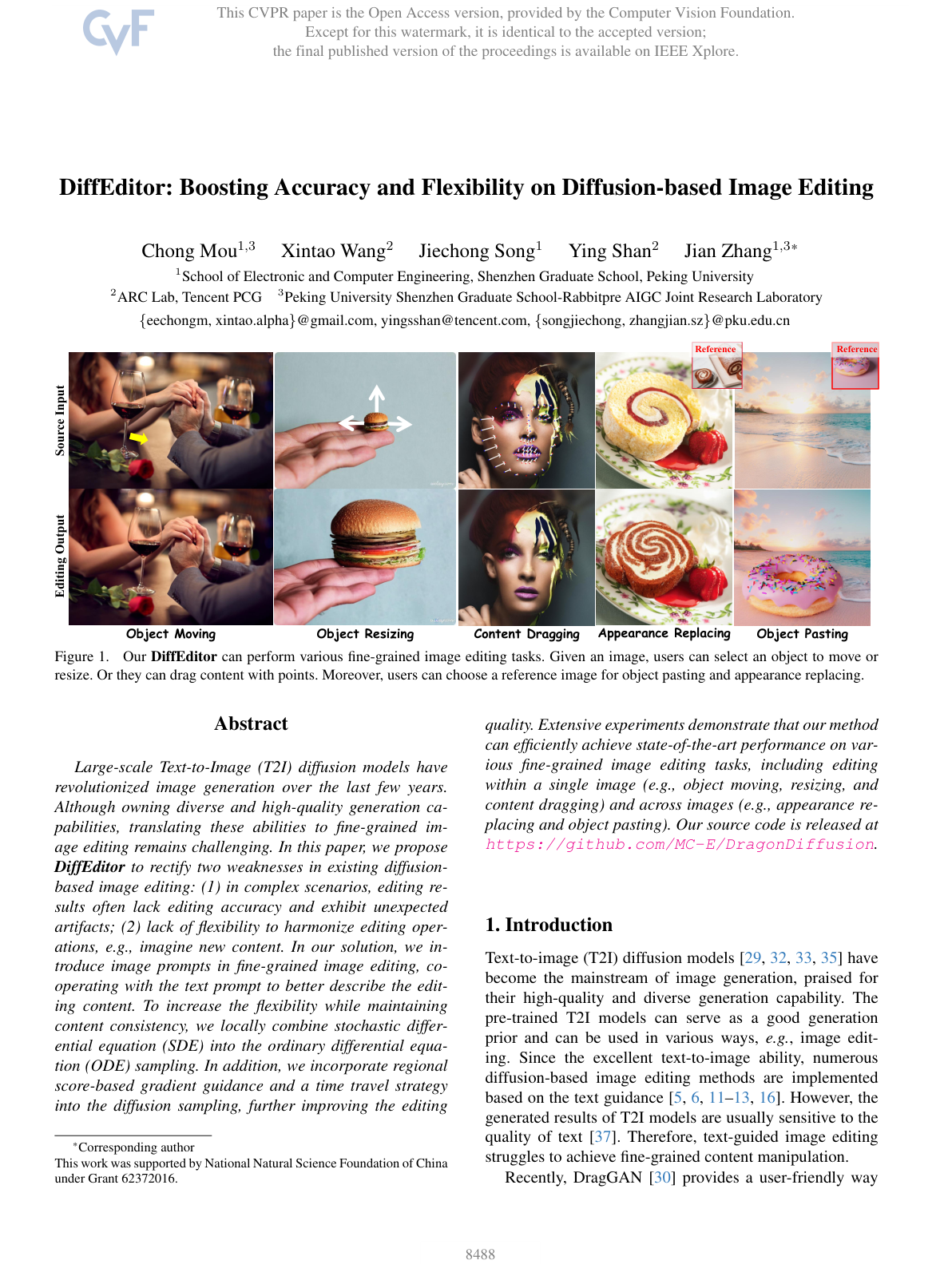
DiffEditor: Boosting Accuracy and Flexibility on Diffusion-Based Image Editing
Chong Mou, Xintao Wang, Jiechong Song, Ying Shan, Jian Zhang
Large-scale Text-to-Image (T2I) diffusion models have revolutionized image generation over the last few years. Although owning diverse and high-quality generation capabilities, translating these abilities to fine-grained image editing remains challenging. In this paper, we propose DiffEditor to rectify two weaknesses in existing diffusion-based image editing: (1) in complex scenarios, editing results often lack editing accuracy and exhibit unexpected artifacts; (2) lack of flexibility to harmonize editing operations, e.g., imagine new content. In our solution, we introduce image prompts in fine-grained image editing, cooperating with the text prompt to better describe the editing content. To increase the flexibility while maintaining content consistency, we locally combine stochastic differential equation (SDE) into the ordinary differential equation (ODE) sampling. In addition, we incorporate regional score-based gradient guidance and a time travel strategy into the diffusion sampling, further improving the editing quality. Extensive experiments demonstrate that our method can efficiently achieve state-of-the-art performance on various fine-grained image editing tasks, including editing within a single image (e.g., object moving, resizing, and content dragging) and across images (e.g., appearance replacing and object pasting). Our source code is released at https://github.com/MC-E/DragonDiffusion.
Added
2026-09-26
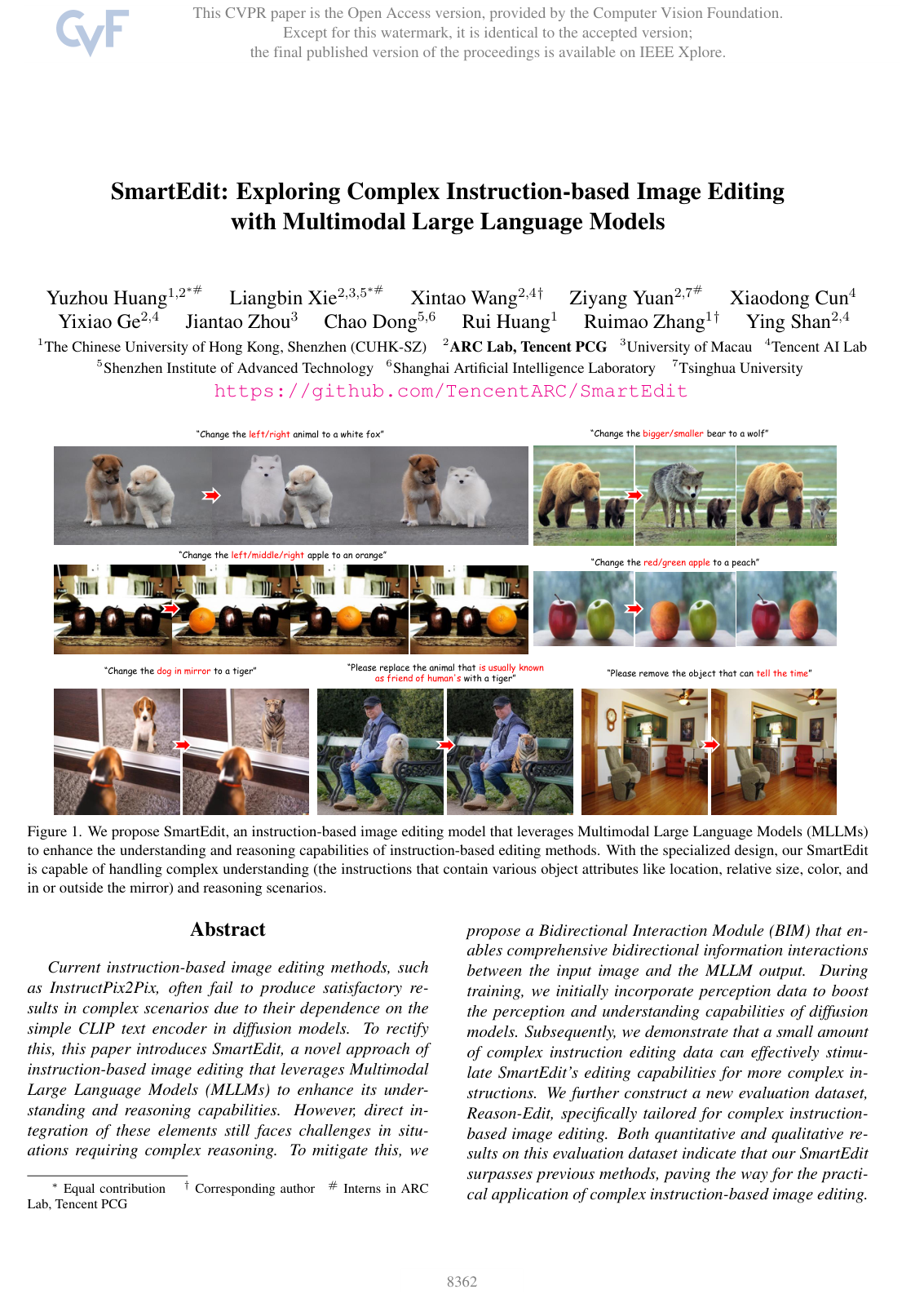
SmartEdit: Exploring Complex Instruction-Based Image Editing with Multimodal Large Language Models
Yuzhou Huang, Liangbin Xie, Xintao Wang, Ziyang Yuan, Xiaodong Cun, Yixiao Ge, Jiantao Zhou, Chao Dong, Rui Huang, Ruimao Zhang, Ying Shan
Why you should read this
Develops SmartEdit, a framework integrating multimodal large language models with diffusion models via a bidirectional interaction module and targeted perception training to execute image editing instructions requiring multi-object reasoning and world knowledge.
Current instruction-based image editing methods, such as InstructPix2Pix, often fail to produce satisfactory results in complex scenarios due to their dependence on the simple CLIP text encoder in diffusion models. To rectify this, this paper introduces SmartEdit, a novel approach of instruction-based image editing that leverages Multimodal Large Language Models (MLLMs) to enhance its understanding and reasoning capabilities. However, direct integration of these elements still faces challenges in situations requiring complex reasoning. To mitigate this, we propose a Bidirectional Interaction Module (BIM) that enables comprehensive bidirectional information interactions between the input image and the MLLM output. During training, we initially incorporate perception data to boost the perception and understanding capabilities of diffusion models. Subsequently, we demonstrate that a small amount of complex instruction editing data can effectively stimulate SmartEdit's editing capabilities for more complex instructions. We further construct a new evaluation dataset, Reason-Edit, specifically tailored for complex instruction-based image editing. Both quantitative and qualitative results on this evaluation dataset indicate that our SmartEdit surpasses previous methods, paving the way for the practical application of complex instruction-based image editing.
Added
2026-09-26
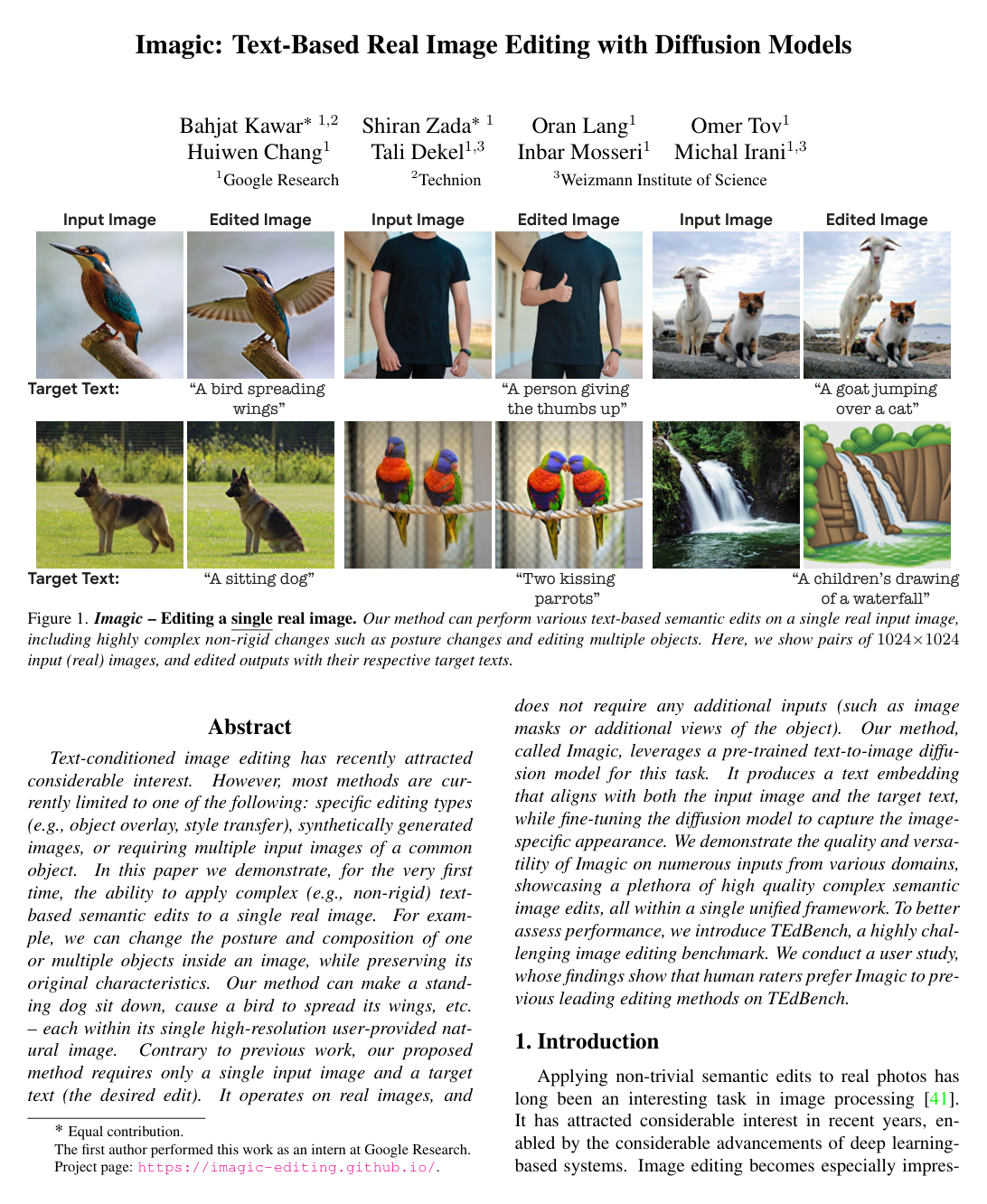
Imagic: Text-Based Real Image Editing with Diffusion Models
Bahjat Kawar, Shiran Zada, Oran Lang, Omer Tov, Huiwen Chang, Tali Dekel, Inbar Mosseri, Michal Irani
Why you should read this
Introduces Imagic, a method that uses pre-trained diffusion models to perform complex, non-rigid semantic edits on a single real image using only a text prompt without requiring masks or multi-view data.
Text-conditioned image editing has recently attracted considerable interest. However, most methods are currently either limited to specific editing types (e.g., object overlay, style transfer), or apply to synthetically generated images, or require multiple input images of a common object. In this paper we demonstrate, for the very first time, the ability to apply complex (e.g., non-rigid) text-guided semantic edits to a single real image. For example, we can change the posture and composition of one or multiple objects inside an image, while preserving its original characteristics. Our method can make a standing dog sit down or jump, cause a bird to spread its wings, etc. -- each within its single high-resolution natural image provided by the user. Contrary to previous work, our proposed method requires only a single input image and a target text (the desired edit). It operates on real images, and does not require any additional inputs (such as image masks or additional views of the object). Our method, which we call "Imagic", leverages a pre-trained text-to-image diffusion model for this task. It produces a text embedding that aligns with both the input image and the target text, while fine-tuning the diffusion model to capture the image-specific appearance. We demonstrate the quality and versatility of our method on numerous inputs from various domains, showcasing a plethora of high quality complex semantic image edits, all within a single unified framework.
Added
2026-09-24
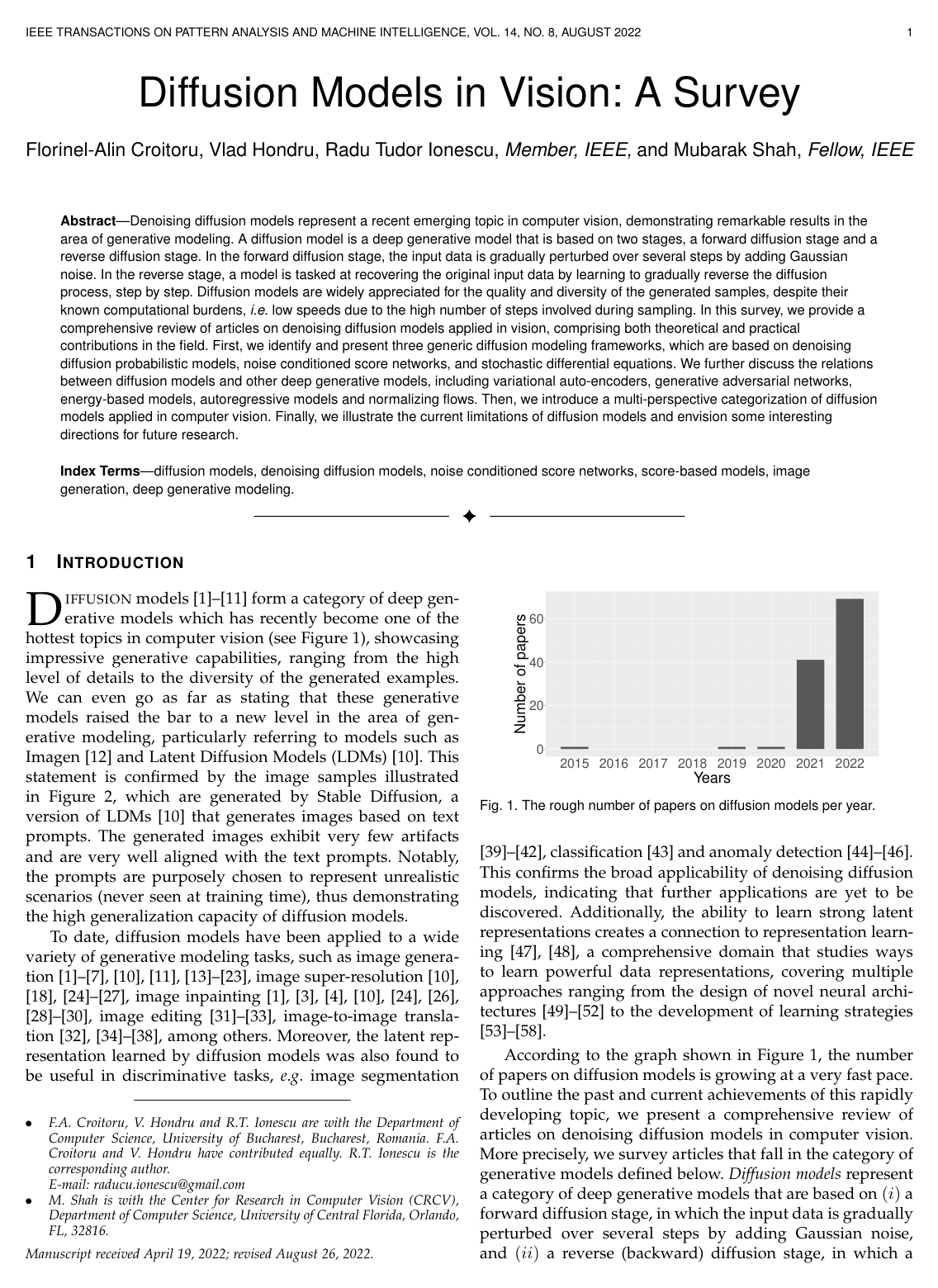
Diffusion Models in Vision: A Survey
Florinel-Alin Croitoru, Vlad Hondru, Radu Tudor Ionescu, Mubarak Shah
Why you should read this
Systematizes the theoretical foundations of diffusion models across probabilistic, score-based, and stochastic differential equation frameworks while analyzing their vision applications, generative trade-offs, and computational bottlenecks.
Denoising diffusion models represent a recent emerging topic in computer vision, demonstrating remarkable results in the area of generative modeling. A diffusion model is a deep generative model that is based on two stages, a forward diffusion stage and a reverse diffusion stage. In the forward diffusion stage, the input data is gradually perturbed over several steps by adding Gaussian noise. In the reverse stage, a model is tasked at recovering the original input data by learning to gradually reverse the diffusion process, step by step. Diffusion models are widely appreciated for the quality and diversity of the generated samples, despite their known computational burdens, i.e. low speeds due to the high number of steps involved during sampling. In this survey, we provide a comprehensive review of articles on denoising diffusion models applied in vision, comprising both theoretical and practical contributions in the field. First, we identify and present three generic diffusion modeling frameworks, which are based on denoising diffusion probabilistic models, noise conditioned score networks, and stochastic differential equations. We further discuss the relations between diffusion models and other deep generative models, including variational auto-encoders, generative adversarial networks, energy-based models, autoregressive models and normalizing flows. Then, we introduce a multi-perspective categorization of diffusion models applied in computer vision. Finally, we illustrate the current limitations of diffusion models and envision some interesting directions for future research.
Added
2026-09-16
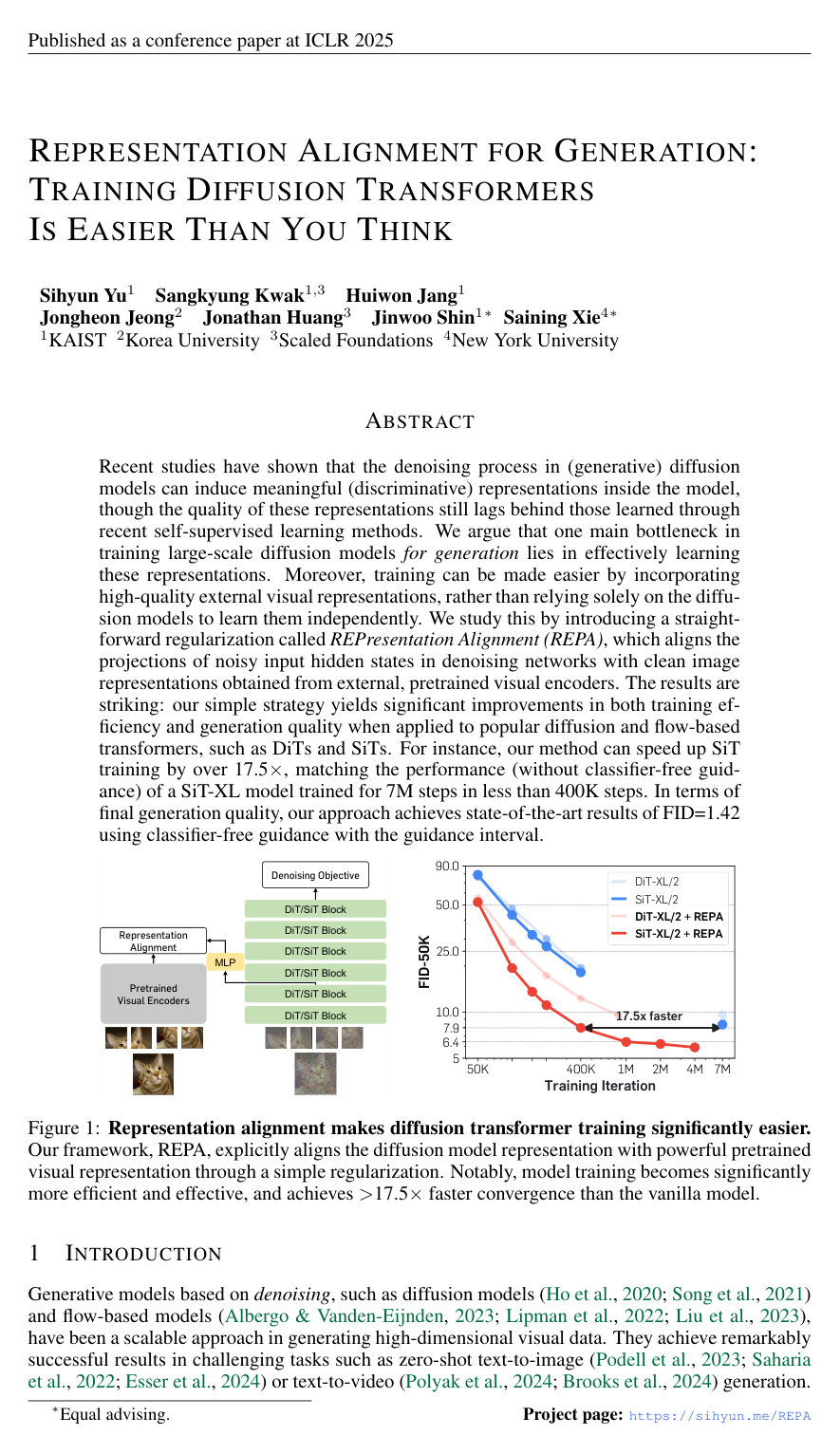
Representation Alignment for Generation: Training Diffusion Transformers Is Easier Than You Think
Sihyun Yu, Sangkyung Kwak, Huiwon Jang, Jongheon Jeong, Jonathan Huang, Jinwoo Shin, Saining Xie
Why you should read this
Introduces REPA, a simple regularization framework that achieves over 17.5x faster training convergence and state-of-the-art image generation quality by aligning diffusion transformer representations with those from pretrained self-supervised visual encoders.
Recent studies have shown that the denoising process in (generative) diffusion models can induce meaningful (discriminative) representations inside the model, though the quality of these representations still lags behind those learned through recent self-supervised learning methods. We argue that one main bottleneck in training large-scale diffusion models for generation lies in effectively learning these representations. Moreover, training can be made easier by incorporating high-quality external visual representations, rather than relying solely on the diffusion models to learn them independently. We study this by introducing a straightforward regularization called REPresentation Alignment (REPA), which aligns the projections of noisy input hidden states in denoising networks with clean image representations obtained from external, pretrained visual encoders. The results are striking: our simple strategy yields significant improvements in both training efficiency and generation quality when applied to popular diffusion and flow-based transformers, such as DiTs and SiTs. For instance, our method can speed up SiT training by over 17.5, matching the performance (without classifier-free guidance) of a SiT-XL model trained for 7M steps in less than 400K steps. In terms of final generation quality, our approach achieves state-of-the-art results of FID=1.42 using classifier-free guidance with the guidance interval.
Added
2026-05-18
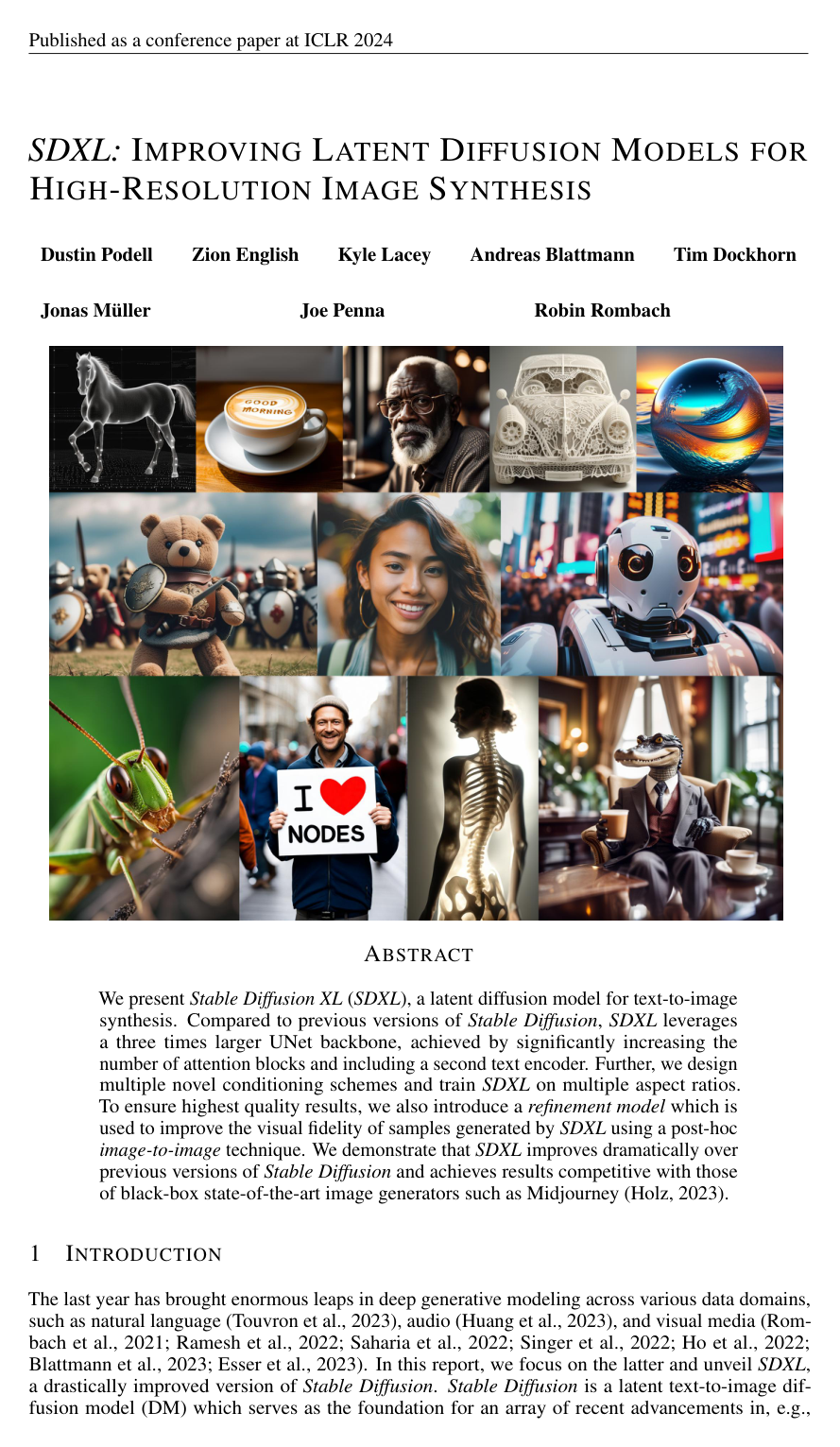
SDXL: Improving Latent Diffusion Models for High-Resolution Image Synthesis
Dustin Podell, Zion English, Kyle Lacey, Andreas Blattmann, Tim Dockhorn, Jonas Müller, Joe Penna, Robin Rombach
Why you should read this
Introduces the architectural enhancements and micro-conditioning strategies that enable SDXL to produce high-resolution, photorealistic images competitive with leading proprietary models through a scaled-up UNet backbone and a specialized two-stage refinement process.
We present SDXL, a latent diffusion model for text-to-image synthesis. Compared to previous versions of Stable Diffusion, SDXL leverages a three times larger UNet backbone: The increase of model parameters is mainly due to more attention blocks and a larger cross-attention context as SDXL uses a second text encoder. We design multiple novel conditioning schemes and train SDXL on multiple aspect ratios. We also introduce a refinement model which is used to improve the visual fidelity of samples generated by SDXL using a post-hoc image-to-image technique. We demonstrate that SDXL shows drastically improved performance compared the previous versions of Stable Diffusion and achieves results competitive with those of black-box state-of-the-art image generators. In the spirit of promoting open research and fostering transparency in large model training and evaluation, we provide access to code and model weights at https://github.com/Stability-AI/generative-models
Added
2026-05-12