
keyword
generative agents
Generative agents are computational software agents powered by large language models and generative artificial intelligence to simulate believable human behavior and social interactions. Operating within virtual, interactive, or embodied environments, these agents perceive environmental stimuli, record experiences in natural language memory structures, synthesize those memories into higher-level reflections, and retrieve contextual information to plan and execute actions. Through autonomous decision-making and communication with other agents or human users, generative agents demonstrate long-term behavioral consistency and produce emergent social dynamics, facilitating applications in social science research, interactive gaming, virtual communication testing, and software prototyping.
11 items
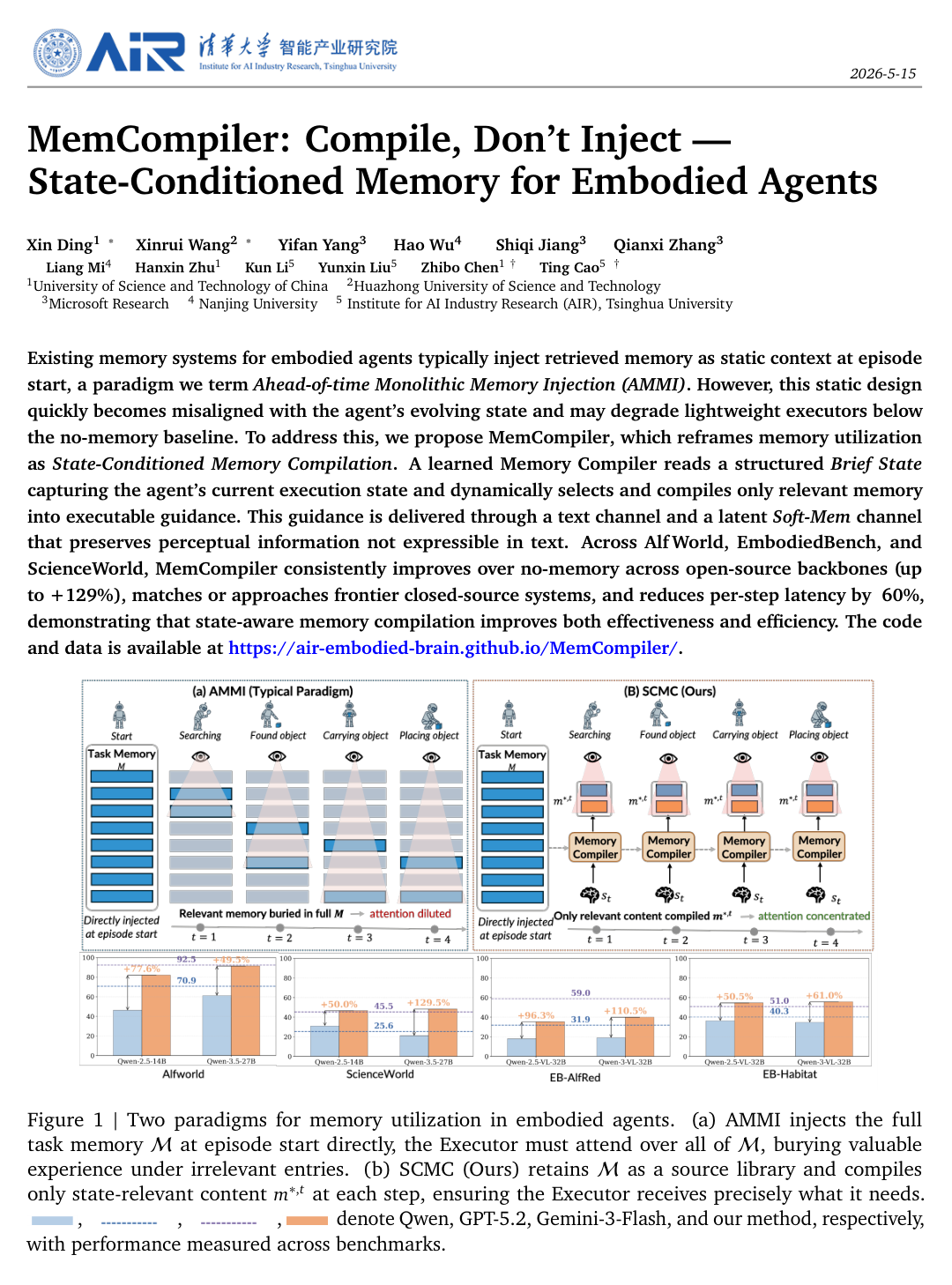
MemCompiler: Compile, Don't Inject -- State-Conditioned Memory for Embodied Agents
Xintao Ding, Xinrui Wang, Yifan Yang, Hao Wu, Shiqi Jiang, Qianxi Zhang, Liang Mi, Hanxin Zhu, Kunxi Li, Yunxin Liu, Zhibo Chen, Ting Cao
Why you should read this
Introduces a state-conditioned memory compilation framework for embodied agents that dynamically translates past experience into real-time text and latent guidance, boosting task success by up to 129% while cutting per-step latency by 60%.
Existing memory systems for embodied agents typically inject retrieved memory as static context at episode start, a paradigm we term Ahead-of-time Monolithic Memory Injection (AMMI). However, this static design quickly becomes misaligned with the agent's evolving state and may degrade lightweight executors below the no-memory baseline. To address this, we propose MemCompiler, which reframes memory utilization as State-Conditioned Memory Compilation. A learned Memory Compiler reads a structured Brief State capturing the agent's current execution state and dynamically selects and compiles only relevant memory into executable guidance. This guidance is delivered through a text channel and a latent Soft-Mem channel that preserves perceptual information not expressible in text. Across Alf World, EmbodiedBench, and ScienceWorld, MemCompiler consistently improves over no-memory across open-source backbones (up to +129%), matches or approaches frontier closed-source systems, and reduces per-step latency by 60%, demonstrating that state-aware memory compilation improves both effectiveness and efficiency.
Added
2026-09-29
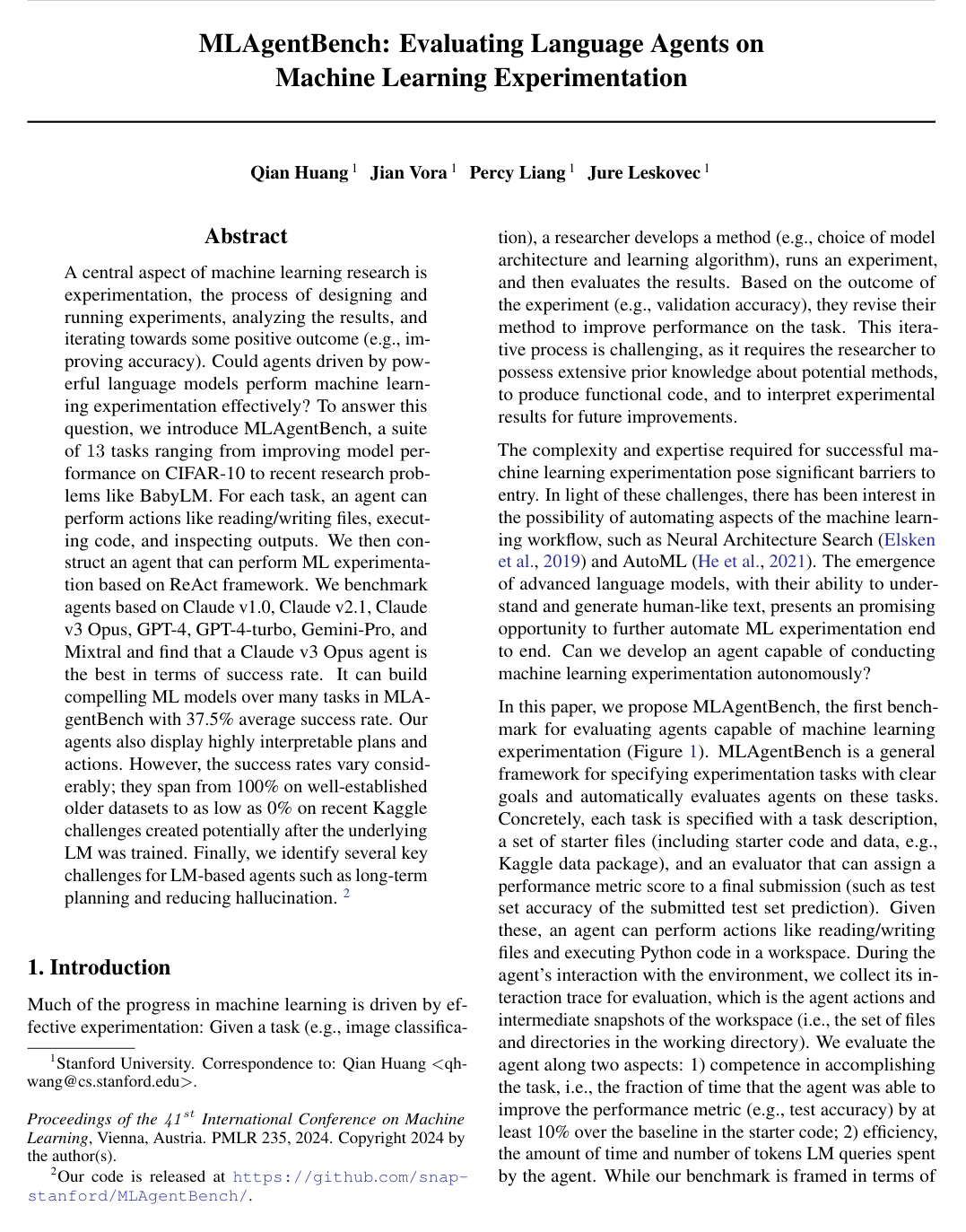
MLAgentBench: Evaluating Language Agents on Machine Learning Experimentation
Qian Huang, Jian Vora, Percy Liang, Jure Leskovec
Why you should read this
Presents MLAgentBench, a novel evaluation suite across 13 diverse research tasks to assess how effectively language model agents can autonomously read code, run experiments, and iterate on machine learning pipelines.
A central aspect of machine learning research is experimentation, the process of designing and running experiments, analyzing the results, and iterating towards some positive outcome (e.g., improving accuracy). Could agents driven by powerful language models perform machine learning experimentation effectively? To answer this question, we introduce MLAgentBench, a suite of 13 tasks ranging from improving model performance on CIFAR-10 to recent research problems like BabyLM. For each task, an agent can perform actions like reading/writing files, executing code, and inspecting outputs. We then construct an agent that can perform ML experimentation based on ReAct framework. We benchmark agents based on Claude v1.0, Claude v2.1, Claude v3 Opus, GPT-4, GPT-4-turbo, Gemini-Pro, and Mixtral and find that a Claude v3 Opus agent is the best in terms of success rate. It can build compelling ML models over many tasks in MLAgentBench with 37.5% average success rate. Our agents also display highly interpretable plans and actions. However, the success rates vary considerably; they span from 100% on well-established older datasets to as low as 0% on recent Kaggle challenges created potentially after the underlying LM was trained. Finally, we identify several key challenges for LM-based agents such as long-term planning and reducing hallucination.
Added
2026-09-28
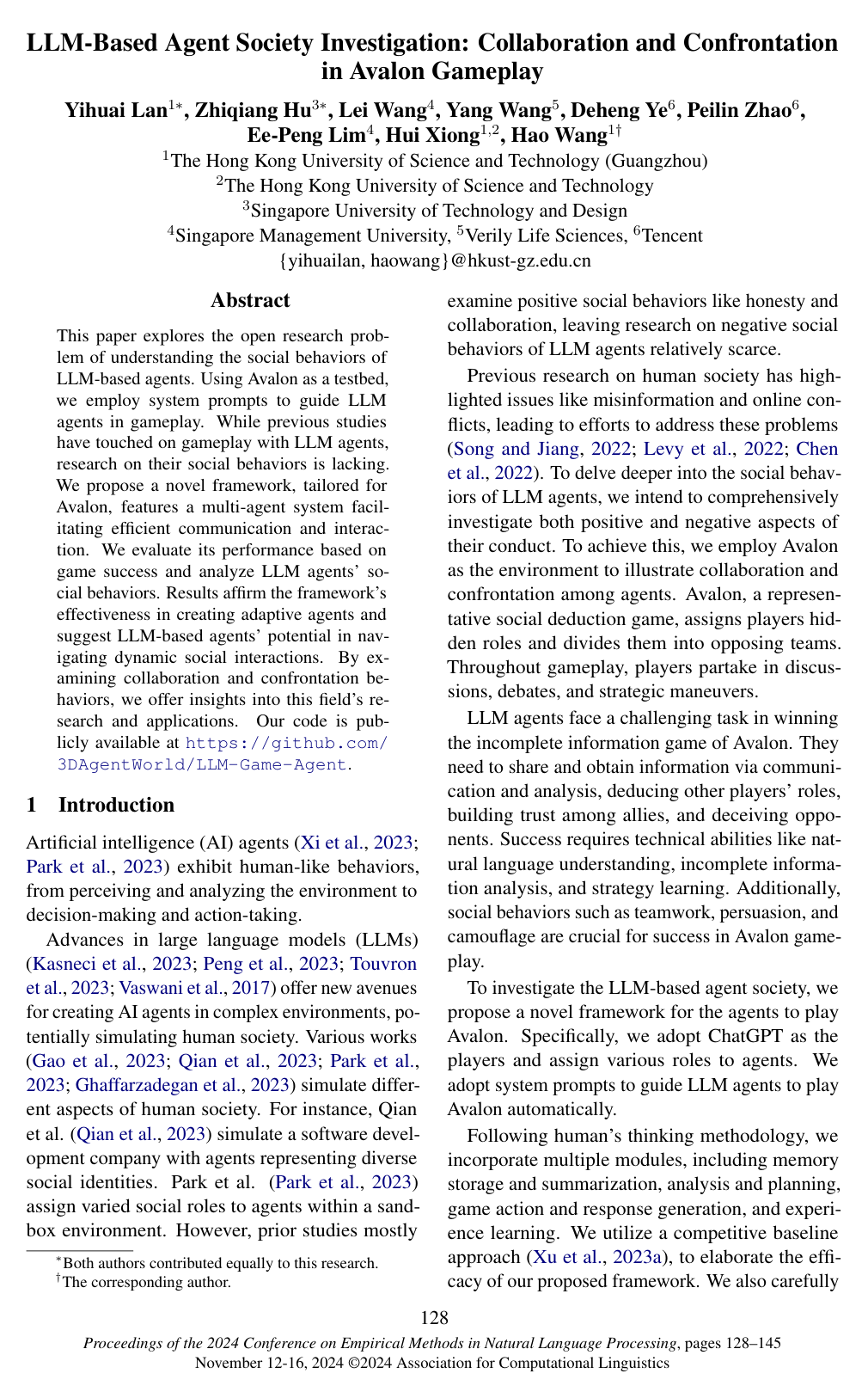
LLM-Based Agent Society Investigation: Collaboration and Confrontation in Avalon Gameplay
Yihuai Lan, Zhiqiang Hu, Lei Wang, Yang Wang, Deheng Ye, Peilin Zhao, Ee-Peng Lim, Hui Xiong, Hao Wang
Why you should read this
Presents a multi-agent framework using the social deduction game Avalon to systematically evaluate how large language model agents exhibit complex social behaviors such as deception, leadership, persuasion, and teamwork under incomplete information.
This paper explores the open research problem of understanding the social behaviors of LLM-based agents. Using Avalon as a testbed, we employ system prompts to guide LLM agents in gameplay. While previous studies have touched on gameplay with LLM agents, research on their social behaviors is lacking. We propose a novel framework, tailored for Avalon, features a multi-agent system facilitating efficient communication and interaction. We evaluate its performance based on game success and analyze LLM agents’ social behaviors. Results affirm the framework’s effectiveness in creating adaptive agents and suggest LLM-based agents’ potential in navigating dynamic social interactions. By examining collaboration and confrontation behaviors, we offer insights into this field’s research and applications. Our code is publicly available at https://github.com/3DAgentWorld/LLM-Game-Agent.
Added
2026-09-26
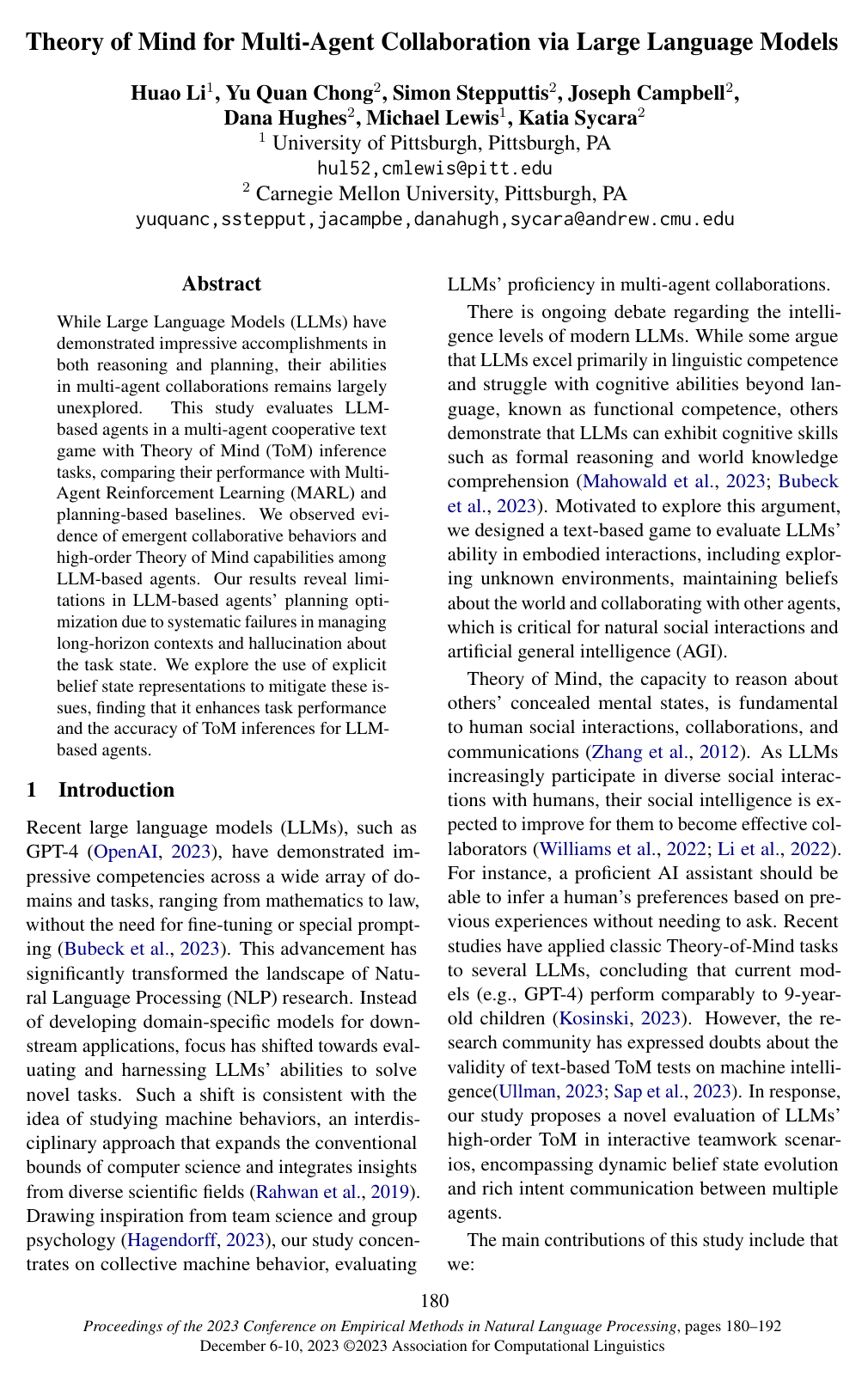
Theory of Mind for Multi-Agent Collaboration via Large Language Models
Huao Li, Yu Quan Chong, Simon Stepputtis, Joseph Campbell, Dana Hughes, Charles Lewis, Katia P. Sycara
Why you should read this
Evaluates large language model agents on cooperative multi-agent tasks requiring Theory of Mind, revealing that tracking explicit belief states substantially corrects their long-horizon planning errors and state hallucinations.
While Large Language Models (LLMs) have demonstrated impressive accomplishments in both reasoning and planning, their abilities in multi-agent collaborations remains largely unexplored. This study evaluates LLM-based agents in a multi-agent cooperative text game with Theory of Mind (ToM) inference tasks, comparing their performance with Multi-Agent Reinforcement Learning (MARL) and planning-based baselines. We observed evidence of emergent collaborative behaviors and high-order Theory of Mind capabilities among LLM-based agents. Our results reveal limitations in LLM-based agents' planning optimization due to systematic failures in managing long-horizon contexts and hallucination about the task state. We explore the use of explicit belief state representations to mitigate these issues, finding that it enhances task performance and the accuracy of ToM inferences for LLM-based agents.
Added
2026-09-26
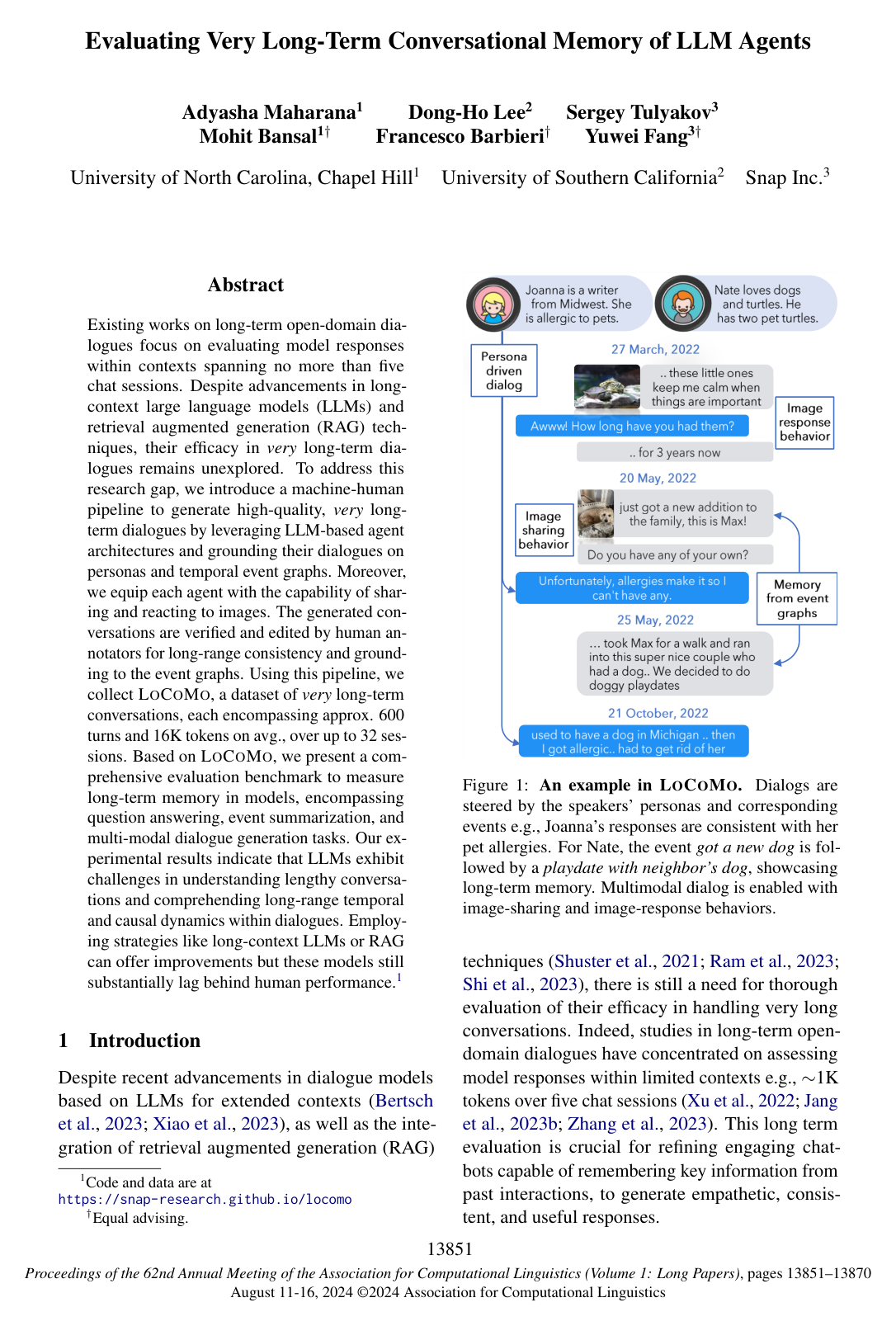
Evaluating Very Long-Term Conversational Memory of LLM Agents
Adyasha Maharana, Dong-Ho Lee, Sergey Tulyakov, Mohit Bansal, Francesco Barbieri, Yuwei Fang
Why you should read this
Introduces LoCoMo, a benchmark of human-verified, multi-modal conversations spanning dozens of sessions, revealing critical deficiencies in how modern long-context models and retrieval-augmented systems track long-range temporal and causal information compared to humans.
Existing works on long-term open-domain dialogues focus on evaluating model responses within contexts spanning no more than five chat sessions. Despite advancements in long-context large language models (LLMs) and retrieval augmented generation (RAG) techniques, their efficacy in very long-term dialogues remains unexplored. To address this research gap, we introduce a machine-human pipeline to generate high-quality, very long-term dialogues by leveraging LLM-based agent architectures and grounding their dialogues on personas and temporal event graphs. Moreover, we equip each agent with the capability of sharing and reacting to images. The generated conversations are verified and edited by human annotators for long-range consistency and grounding to the event graphs. Using this pipeline, we collect LoCoMo, a dataset of very long-term conversations, each encompassing approx. 600 turns and 16K tokens on avg., over up to 32 sessions. Based on LoCoMo, we present a comprehensive evaluation benchmark to measure long-term memory in models, encompassing question answering, event summarization, and multi-modal dialogue generation tasks. Our experimental results indicate that LLMs exhibit challenges in understanding lengthy conversations and comprehending long-range temporal and causal dynamics within dialogues. Employing strategies like long-context LLMs or RAG can offer improvements but these models still substantially lag behind human performance.
Added
2026-09-26
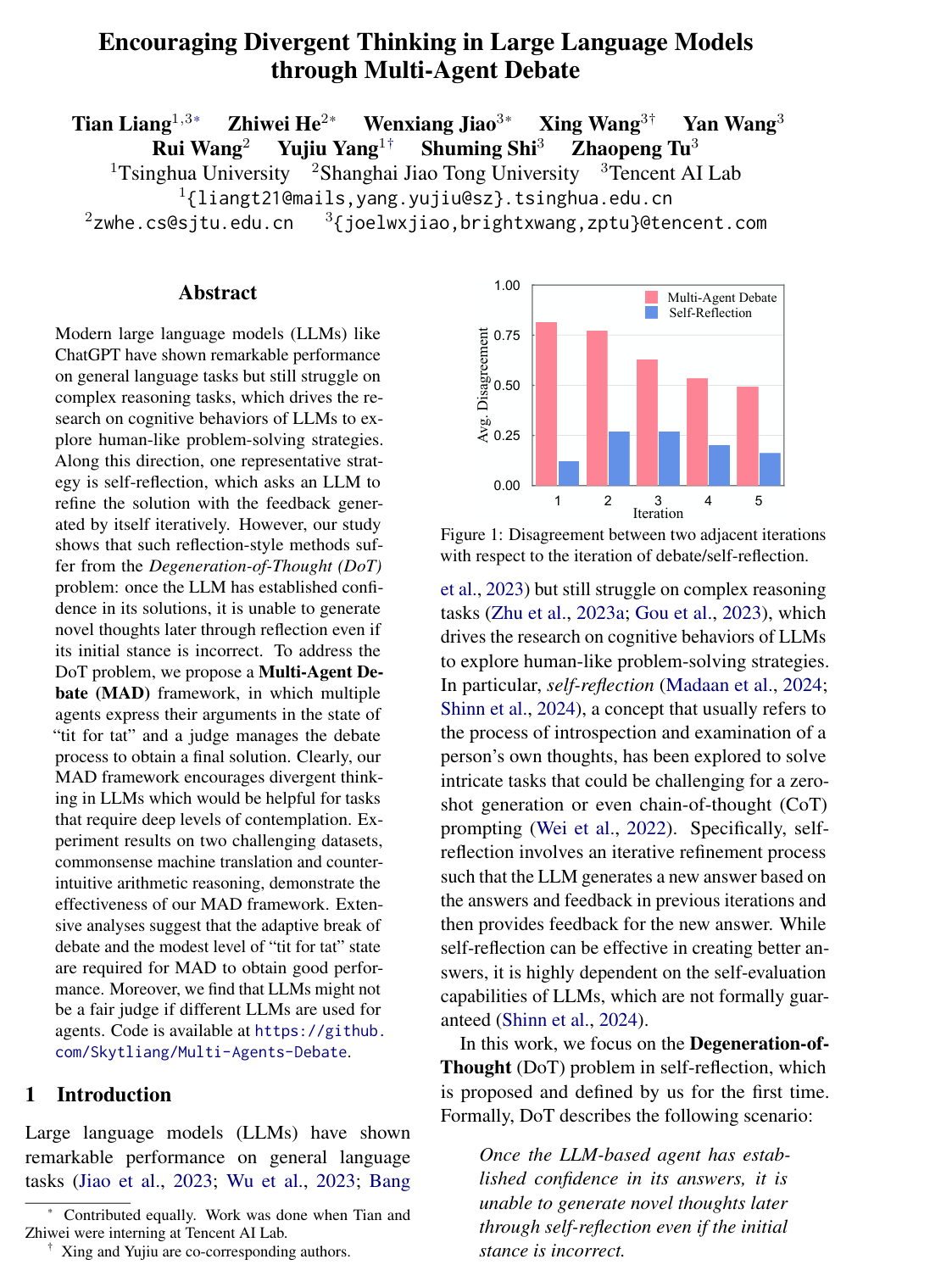
Encouraging Divergent Thinking in Large Language Models through Multi-Agent Debate
Tian Liang, Zhiwei He, Wenxiang Jiao, Xing Wang, Yan Wang, Rui Wang, Yujiu Yang, Shuming Shi, Zhaopeng Tu
Why you should read this
Proposes a multi-agent debate framework that overcomes the cognitive stagnation of single-model self-reflection by using competing agents and an impartial judge to stimulate divergent thinking in complex reasoning tasks.
Modern large language models (LLMs) like ChatGPT have shown remarkable performance on general language tasks but still struggle on complex reasoning tasks, which drives the research on cognitive behaviors of LLMs to explore human-like problem-solving strategies. Along this direction, one representative strategy is self-reflection, which asks an LLM to refine the solution with the feedback generated by itself iteratively. However, our study shows that such reflection-style methods suffer from the Degeneration-of-Thought (DoT) problem: once the LLM has established confidence in its solutions, it is unable to generate novel thoughts later through reflection even if its initial stance is incorrect. To address the DoT problem, we propose a Multi-Agent Debate (MAD) framework, in which multiple agents express their arguments in the state of "tit for tat" and a judge manages the debate process to obtain a final solution. Clearly, our MAD framework encourages divergent thinking in LLMs which would be helpful for tasks that require deep levels of contemplation. Experiment results on two challenging datasets, commonsense machine translation and counter-intuitive arithmetic reasoning, demonstrate the effectiveness of our MAD framework. Extensive analyses suggest that the adaptive break of debate and the modest level of "tit for tat" state are required for MAD to obtain good performance. Moreover, we find that LLMs might not be a fair judge if different LLMs are used for agents. Code is available at this https URL.
Added
2026-09-25
The Rise and Potential of Large Language Model Based Agents: A Survey
Zhiheng Xi, Wenxiang Chen, Xin Guo, Wei He, Yiwen Ding, Boyang Hong, Ming Zhang, Junzhe Wang, Senjie Jin, Enyu Zhou, Rui Zheng, Xiaoran Fan, Xiao Wang, Limao Xiong, Qin Liu, Yuhao Zhou, Weiran Wang, Changhao Jiang, Yicheng Zou, Xiangyang Liu, Zhangyue Yin, Shihan Dou, Rongxiang Weng, Wensen Cheng, Qi Zhang, Wenjuan Qin, Yong-Yan Zheng, Xipeng Qiu, X. Huan, Tao Gui
Why you should read this
Presents a unified architectural framework consisting of brain, perception, and action modules for large language model-based agents while systematically examining their applications across single-agent, multi-agent, and human-collaborative environments.
For a long time, humanity has pursued artificial intelligence (AI) equivalent to or surpassing the human level, with AI agents considered a promising vehicle for this pursuit. AI agents are artificial entities that sense their environment, make decisions, and take actions. Many efforts have been made to develop intelligent agents, but they mainly focus on advancement in algorithms or training strategies to enhance specific capabilities or performance on particular tasks. Actually, what the community lacks is a general and powerful model to serve as a starting point for designing AI agents that can adapt to diverse scenarios. Due to the versatile capabilities they demonstrate, large language models (LLMs) are regarded as potential sparks for Artificial General Intelligence (AGI), offering hope for building general AI agents. Many researchers have leveraged LLMs as the foundation to build AI agents and have achieved significant progress. In this paper, we perform a comprehensive survey on LLM-based agents. We start by tracing the concept of agents from its philosophical origins to its development in AI, and explain why LLMs are suitable foundations for agents. Building upon this, we present a general framework for LLM-based agents, comprising three main components: brain, perception, and action, and the framework can be tailored for different applications. Subsequently, we explore the extensive applications of LLM-based agents in three aspects: single-agent scenarios, multi-agent scenarios, and human-agent cooperation. Following this, we delve into agent societies, exploring the behavior and personality of LLM-based agents, the social phenomena that emerge from an agent society, and the insights they offer for human society. Finally, we discuss several key topics and open problems within the field. A repository for the related papers at this https URL.
Added
2026-09-18
A survey on large language model based autonomous agents
Lei Wang, Chengbang Ma, Xueyang Feng, Zeyu Zhang, Hao-ran Yang, Jingsen Zhang, Zhi-Yang Chen, Jiakai Tang, Xu Chen, Yankai Lin, Wayne Xin Zhao, Zhewei Wei, Ji-rong Wen
Why you should read this
Establishes a unified framework for constructing large language model-based autonomous agents while systematically reviewing their applications across science and engineering, current evaluation methods, and open research challenges.
Autonomous agents have long been a prominent research focus in both academic and industry communities. Previous research in this field often focuses on training agents with limited knowledge within isolated environments, which diverges significantly from human learning processes, and thus makes the agents hard to achieve human-like decisions. Recently, through the acquisition of vast amounts of web knowledge, large language models (LLMs) have demonstrated remarkable potential in achieving human-level intelligence. This has sparked an upsurge in studies investigating LLM-based autonomous agents. In this paper, we present a comprehensive survey of these studies, delivering a systematic review of the field of LLM-based autonomous agents from a holistic perspective. More specifically, we first discuss the construction of LLM-based autonomous agents, for which we propose a unified framework that encompasses a majority of the previous work. Then, we present a comprehensive overview of the diverse applications of LLM-based autonomous agents in the fields of social science, natural science, and engineering. Finally, we delve into the evaluation strategies commonly used for LLM-based autonomous agents. Based on the previous studies, we also present several challenges and future directions in this field. To keep track of this field and continuously update our survey, we maintain a repository of relevant references at this https URL.
Added
2026-09-16
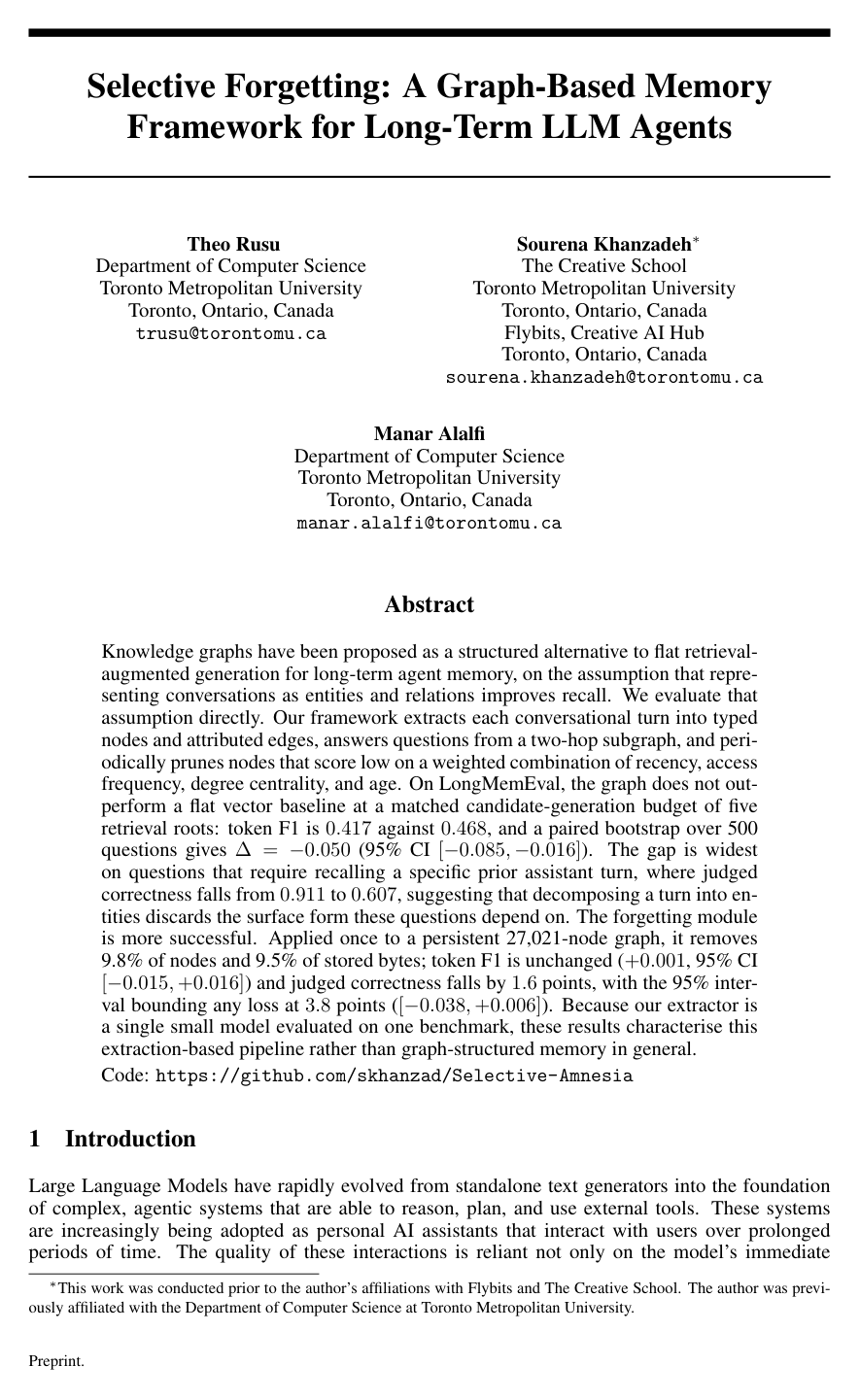
Selective Forgetting: A Graph-Based Memory Framework for Long-Term LLM Agents
Theo Rusu, Sourena Khanzadeh, Manar Alalfi
Why you should read this
Demonstrates that converting dialogue into knowledge graphs underperforms flat vector retrieval for long-term agent memory, while providing a selective forgetting algorithm that reduces graph storage by nearly ten percent with negligible loss in accuracy.
Knowledge graphs have been proposed as a structured alternative to flat retrieval-augmented generation for long-term agent memory, on the assumption that representing conversations as entities and relations improves recall. We evaluate that assumption directly. Our framework extracts each conversational turn into typed nodes and attributed edges, answers questions from a two-hop subgraph, and periodically prunes nodes that score low on a weighted combination of recency, access frequency, degree centrality, and age. On LongMemEval, the graph does not outperform a flat vector baseline at a matched candidate-generation budget of five retrieval roots: token F1 is against , and a paired bootstrap over 500 questions gives (95\% CI ). The gap is widest on questions that require recalling a specific prior assistant turn, where judged correctness falls from to , suggesting that decomposing a turn into entities discards the surface form these questions depend on. The forgetting module is more successful. Applied once to a persistent 27{,}021-node graph, it removes 9.8\% of nodes and 9.5\% of stored bytes; token F1 is unchanged (, 95\% CI ) and judged correctness falls by points, with the 95\% interval bounding any loss at points (). Because our extractor is a single small model evaluated on one benchmark, these results characterise this extraction-based pipeline rather than graph-structured memory in general. Code: this https URL
Added
2026-09-07

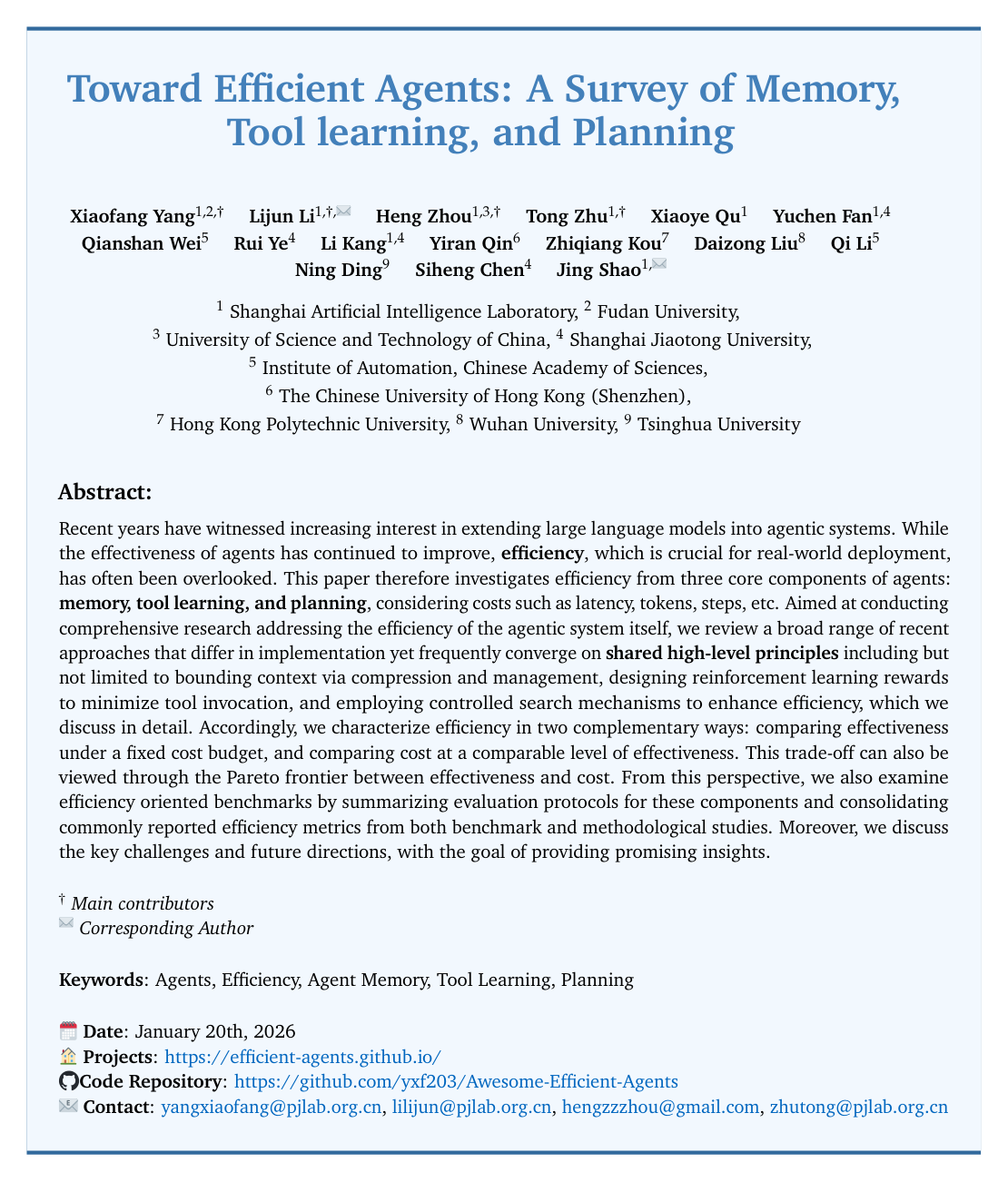
Toward Efficient Agents: Memory, Tool learning, and Planning
Xiaofang Yang, Lijun Li, Heng Zhou, Tong Zhu, Xiaoye Qu, Yuchen Fan, Qianshan Wei, Rui Ye, Li Kang, Yiran Qin, Zhiqiang Kou, Daizong Liu, Qi Li, Ning Ding, Siheng Chen, Jing Shao
Why you should read this
Presents a comprehensive review and characterization of efficiency in agentic systems, offering crucial insights into memory, tool learning, and planning to overcome bottlenecks for real-world deployment.
Recent years have witnessed increasing interest in extending large language models into agentic systems. While the effectiveness of agents has continued to improve, efficiency, which is crucial for real-world deployment, has often been overlooked. This paper therefore investigates efficiency from three core components of agents: memory, tool learning, and planning, considering costs such as latency, tokens, steps, etc. Aimed at conducting comprehensive research addressing the efficiency of the agentic system itself, we review a broad range of recent approaches that differ in implementation yet frequently converge on shared high-level principles including but not limited to bounding context via compression and management, designing reinforcement learning rewards to minimize tool invocation, and employing controlled search mechanisms to enhance efficiency, which we discuss in detail. Accordingly, we characterize efficiency in two complementary ways: comparing effectiveness under a fixed cost budget, and comparing cost at a comparable level of effectiveness. This trade-off can also be viewed through the Pareto frontier between effectiveness and cost. From this perspective, we also examine efficiency oriented benchmarks by summarizing evaluation protocols for these components and consolidating commonly reported efficiency metrics from both benchmark and methodological studies. Moreover, we discuss the key challenges and future directions, with the goal of providing promising insights.
Added
2026-02-16
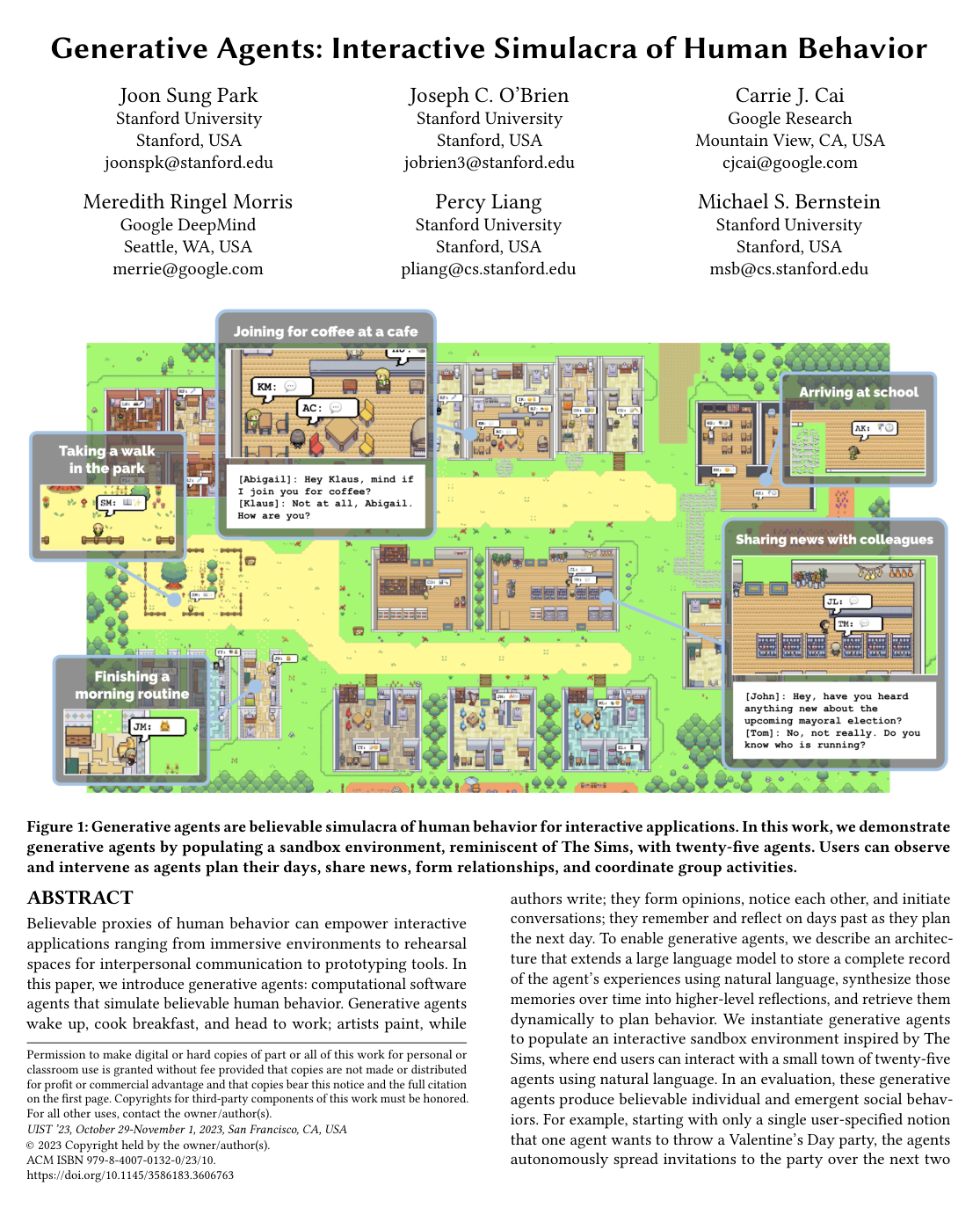
Generative Agents: Interactive Simulacra of Human Behavior
Joon Sung Park, Joseph O’Brien, Carrie J. Cai, Meredith Ringel Morris, Percy Liang, Michael S. Bernstein
Why you should read this
Introduces an architecture with memory streams and reflection that creates believable, long-term social agents capable of complex interaction.
Believable proxies of human behavior can empower interactive applications ranging from immersive environments to rehearsal spaces for interpersonal communication to prototyping tools. In this paper, we introduce generative agents: computational software agents that simulate believable human behavior. Generative agents wake up, cook breakfast, and head to work; artists paint, while authors write; they form opinions, notice each other, and initiate conversations; they remember and reflect on days past as they plan the next day. To enable generative agents, we describe an architecture that extends a large language model to store a complete record of the agent's experiences using natural language, synthesize those memories over time into higher-level reflections, and retrieve them dynamically to plan behavior. We instantiate generative agents to populate an interactive sandbox environment inspired by The Sims, where end users can interact with a small town of twenty-five agents using natural language. In an evaluation, these generative agents produce believable individual and emergent social behaviors. For example, starting with only a single user-specified notion that one agent wants to throw a Valentine's Day party, the agents autonomously spread invitations to the party over the next two days, make new acquaintances, ask each other out on dates to the party, and coordinate to show up for the party together at the right time. We demonstrate through ablation that the components of our agent architecture—observation, planning, and reflection—each contribute critically to the believability of agent behavior. By fusing large language models with computational interactive agents, this work introduces architectural and interaction patterns for enabling believable simulations of human behavior.
Added
2026-01-27