
keyword
empirical risk minimization
Empirical risk minimization is a foundational principle in machine learning and statistical learning theory where a predictive model is chosen by minimizing the average error, or loss, over a known set of training data. Because the true probability distribution generating the data is unknown in practice, the true risk—the expected loss across all possible unseen instances—cannot be directly computed. Empirical risk minimization uses the empirical risk, calculated as the average loss measured on the observed training sample, as a practical surrogate for the true risk. Under the assumption that the training examples are representative of future data, minimizing this sample average guides the model toward parameters that generalize well, though explicit regularization or model capacity constraints are frequently added to mitigate the risk of overfitting to the specific training points.
26 items
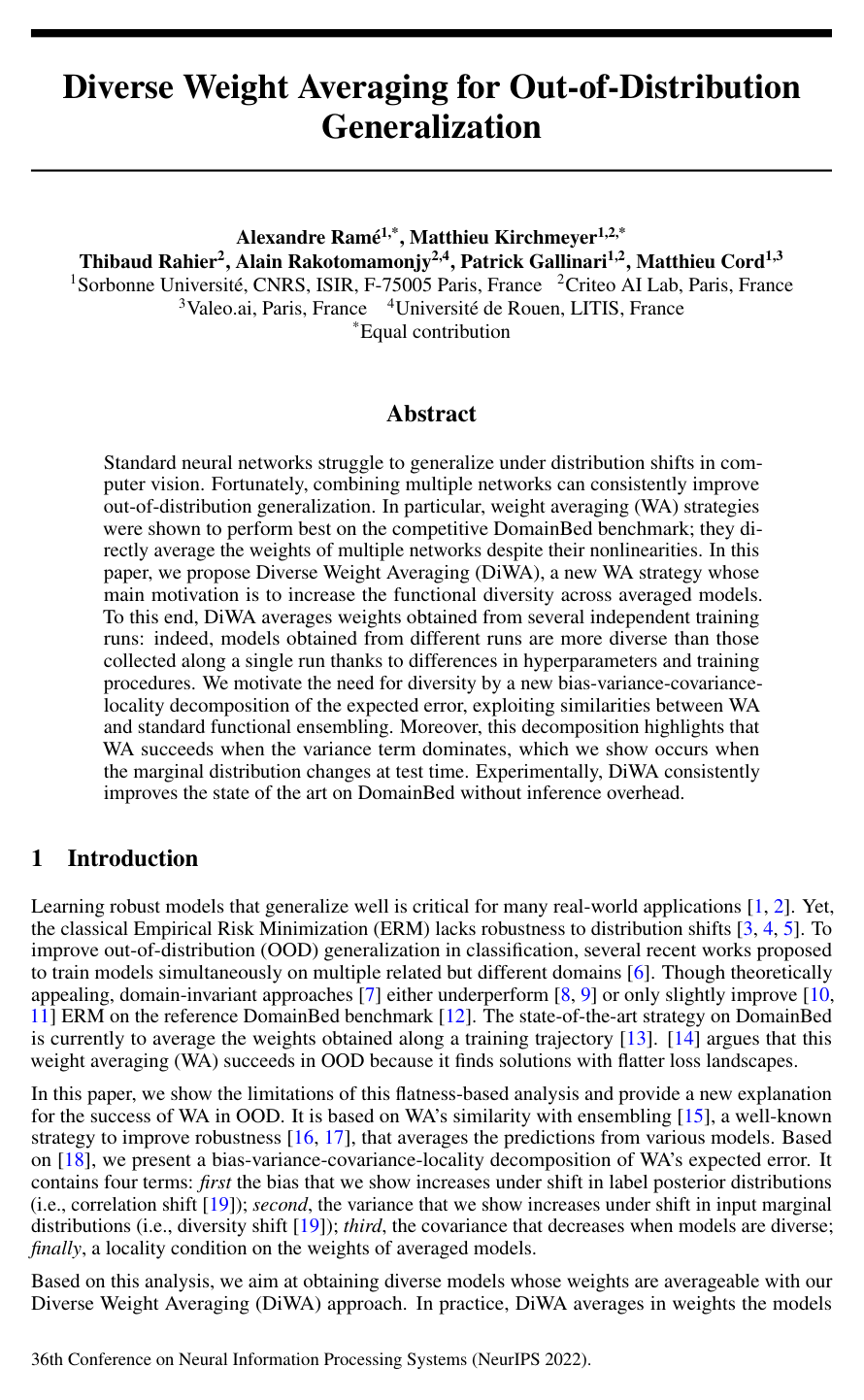
Diverse Weight Averaging for Out-of-Distribution Generalization
Alexandre Ramé, Matthieu Kirchmeyer, Thibaud Rahier, Alain Rakotomamonjy, Patrick Gallinari, Matthieu Cord
Why you should read this
Presents Diverse Weight Averaging (DiWA), a method that averages weights from independent training runs to boost functional diversity, supported by a novel bias-variance-covariance error decomposition that explains when weight averaging improves out-of-distribution generalization without increasing inference costs.
Standard neural networks struggle to generalize under distribution shifts in computer vision. Fortunately, combining multiple networks can consistently improve out-of-distribution generalization. In particular, weight averaging (WA) strategies were shown to perform best on the competitive DomainBed benchmark; they directly average the weights of multiple networks despite their nonlinearities. In this paper, we propose Diverse Weight Averaging (DiWA), a new WA strategy whose main motivation is to increase the functional diversity across averaged models. To this end, DiWA averages weights obtained from several independent training runs: indeed, models obtained from different runs are more diverse than those collected along a single run thanks to differences in hyperparameters and training procedures. We motivate the need for diversity by a new bias-variance-covariance-locality decomposition of the expected error, exploiting similarities between WA and standard functional ensembling. Moreover, this decomposition highlights that WA succeeds when the variance term dominates, which we show occurs when the marginal distribution changes at test time. Experimentally, DiWA consistently improves the state of the art on DomainBed without inference overhead.
Added
2026-10-05
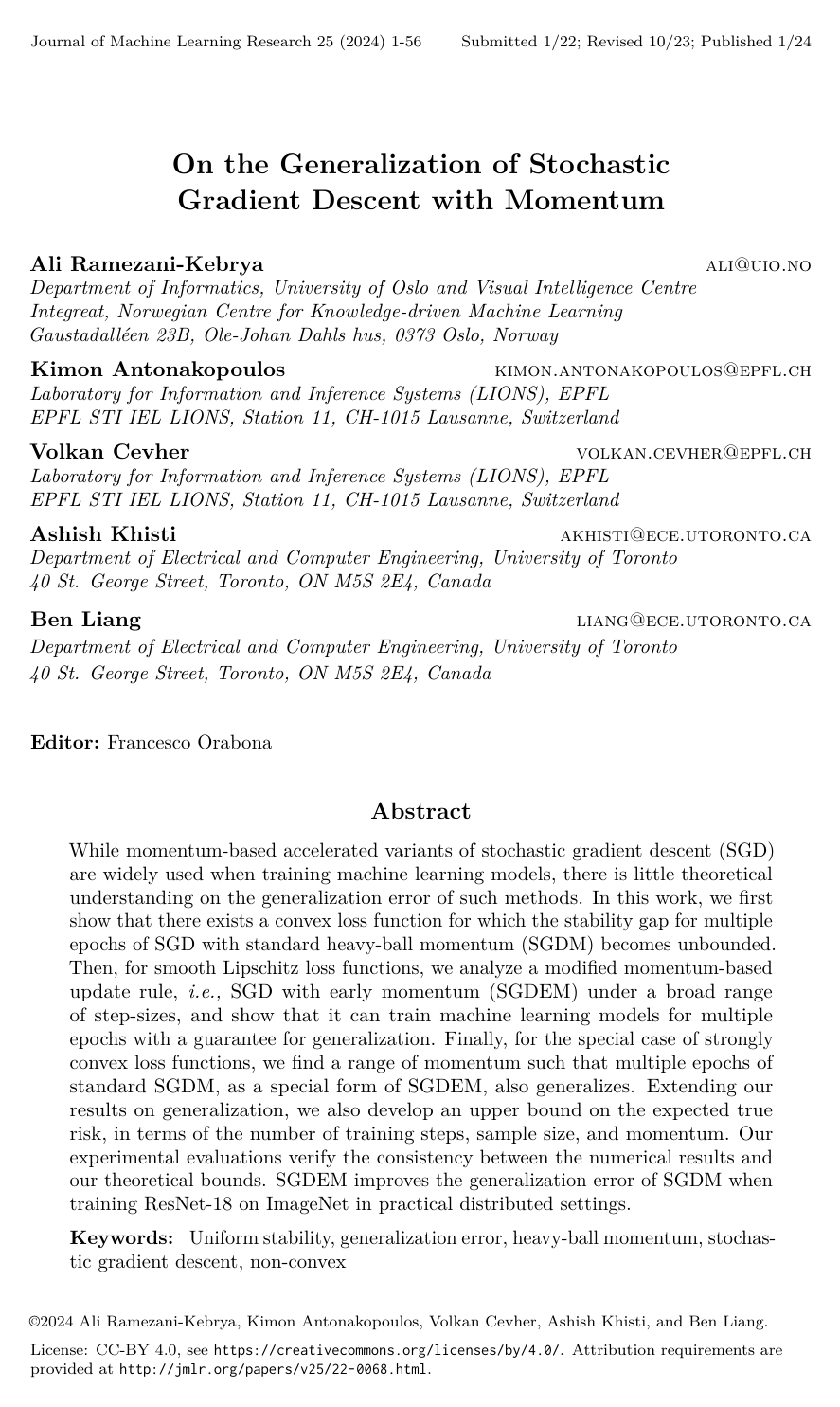
On the Generalization of Stochastic Gradient Descent with Momentum
Ali Ramezani-Kebrya, Kimon Antonakopoulos, Volkan Cevher, Ashish Khisti, Ben Liang
Why you should read this
Establishes theoretical generalization bounds for momentum-based stochastic gradient descent by introducing an early momentum variant that prevents unbounded stability gaps across multiple training epochs while improving real-world performance on ImageNet.
While momentum-based accelerated variants of stochastic gradient descent (SGD) are widely used when training machine learning models, there is little theoretical understanding on the generalization error of such methods. In this work, we first show that there exists a convex loss function for which the stability gap for multiple epochs of SGD with standard heavy-ball momentum (SGDM) becomes unbounded. Then, for smooth Lipschitz loss functions, we analyze a modified momentum-based update rule, i.e., SGDM with early momentum (SGDEM) under a broad range of step-sizes, and show that it can train machine learning models for multiple epochs with a guarantee for generalization. Finally, for the special case of strongly convex loss functions, we find a range of momentum such that multiple epochs of standard SGDM, as a special form of SGDEM, also generalizes. Extending our results on generalization, we also develop an upper bound on the expected true risk, in terms of the number of training steps, sample size, and momentum. Our experimental evaluations verify the consistency between the numerical results and our theoretical bounds. SGDEM improves the generalization error of SGDM when training ResNet-18 on ImageNet in practical distributed settings.
Added
2026-10-05
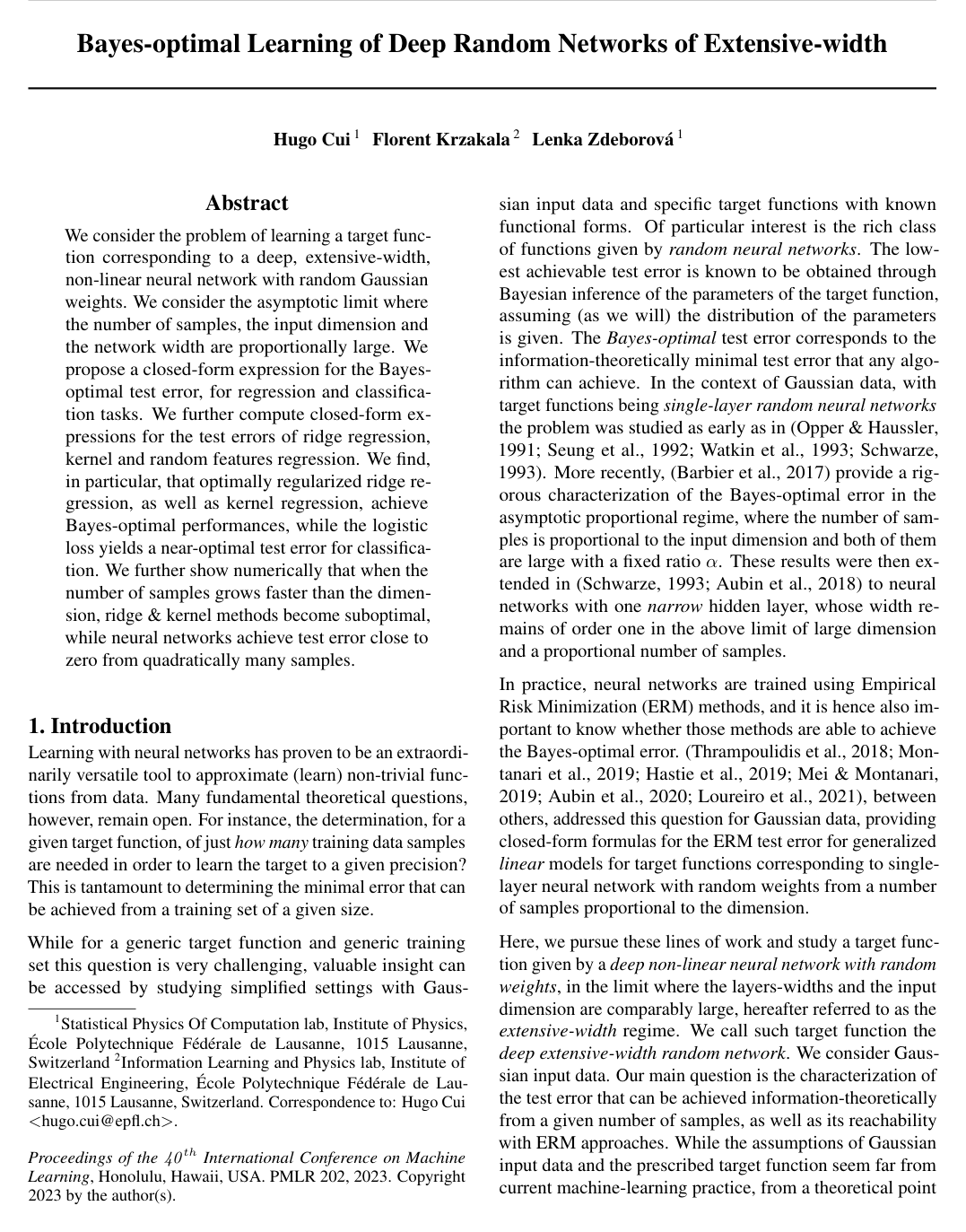
Bayes-optimal Learning of Deep Random Networks of Extensive-width
Hugo Cui, Florent Krzakala, Lenka Zdeborová
Why you should read this
Establishes closed-form theoretical bounds on Bayes-optimal test errors for learning deep extensive-width random neural networks, revealing that simple kernel and ridge methods match optimal Bayesian performance when sample size scales linearly with input dimension but fail when sample size grows quadratically.
We consider the problem of learning a target function corresponding to a deep, extensive-width, non-linear neural network with random Gaussian weights. We consider the asymptotic limit where the number of samples, the input dimension and the network width are proportionally large. We propose a closed-form expression for the Bayes-optimal test error, for regression and classification tasks. We further compute closed-form expressions for the test errors of ridge regression, kernel and random features regression. We find, in particular, that optimally regularized ridge regression, as well as kernel regression, achieve Bayes-optimal performances, while the logistic loss yields a near-optimal test error for classification. We further show numerically that when the number of samples grows faster than the dimension, ridge & kernel methods become suboptimal, while neural networks achieve test error close to zero from quadratically many samples.
Added
2026-10-03
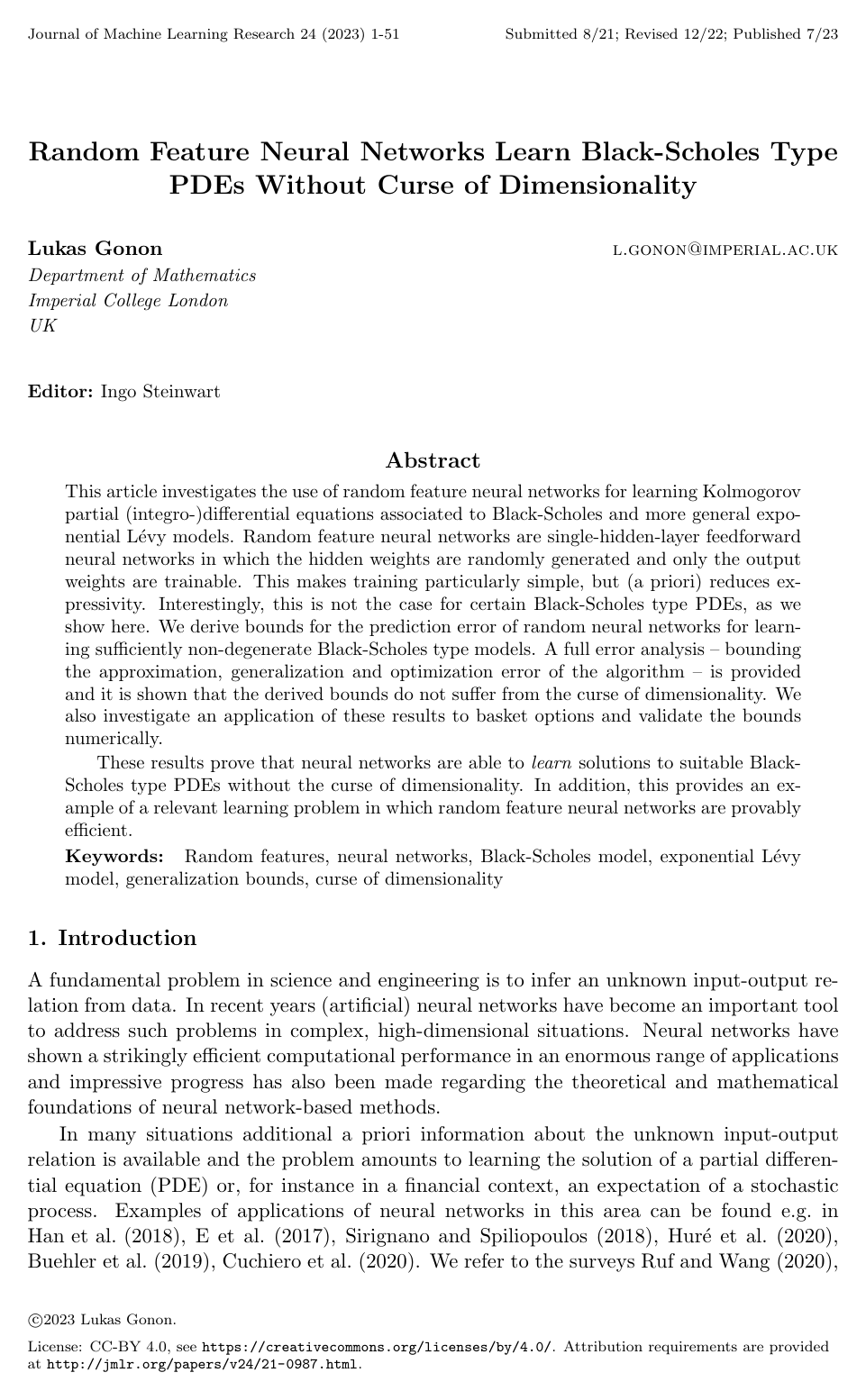
Random Feature Neural Networks Learn Black-Scholes Type PDEs Without Curse of Dimensionality
Lukas Gonon
Why you should read this
Proves that single-hidden-layer random feature neural networks overcome the curse of dimensionality when learning solutions to Black-Scholes and exponential Lévy partial differential equations by providing a complete error analysis covering approximation, generalization, and optimization.
This article investigates the use of random feature neural networks for learning Kolmogorov partial (integro-)differential equations associated to Black-Scholes and more general exponential Lévy models. Random feature neural networks are single-hidden-layer feedforward neural networks in which the hidden weights are randomly generated and only the output weights are trainable. This makes training particularly simple, but (a priori) reduces expressivity. Interestingly, this is not the case for certain Black-Scholes type PDEs, as we show here. We derive bounds for the prediction error of random neural networks for learning sufficiently non-degenerate Black-Scholes type models. A full error analysis – bounding the approximation, generalization and optimization error of the algorithm – is provided and it is shown that the derived bounds do not suffer from the curse of dimensionality. We also investigate an application of these results to basket options and validate the bounds numerically. These results prove that neural networks are able to learn solutions to suitable Black-Scholes type PDEs without the curse of dimensionality. In addition, this provides an example of a relevant learning problem in which random feature neural networks are provably efficient.
Added
2026-10-03
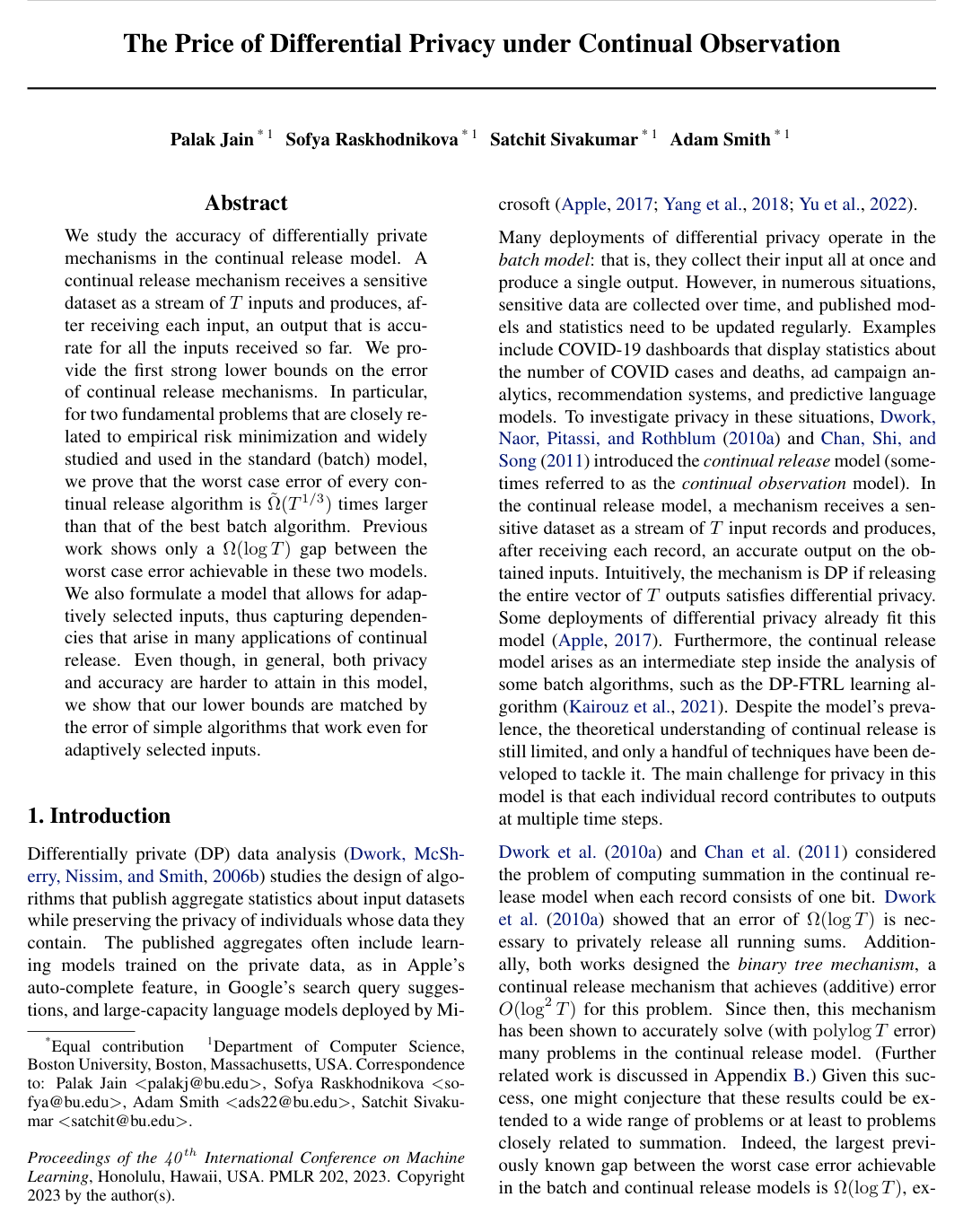
The Price of Differential Privacy under Continual Observation
Palak Jain, Sofya Raskhodnikova, Satchit Sivakumar, Adam D. Smith
Why you should read this
Proves that fundamental tasks like MaxSum and SumSelect require polynomial error in the stream length under continual observation, establishing tight lower and upper bounds that reveal an exponential separation between continual release and standard batch differential privacy.
We study the accuracy of differentially private mechanisms in the continual release model. A continual release mechanism receives a sequence of T inputs and must output a sequence of T outputs, one for each input, that approximates some function of the inputs while maintaining differential privacy for the entire sequence, even for inputs that arrive later. The standard approach to achieving differential privacy in the continual release model is to use the binary tree mechanism of Chan, Shi, and Song (2010) and Dwork, Naor, Pitassi, and Roth (2010), which gives an additive error of O(log T) for counting queries. We show that the binary tree mechanism is optimal for counting queries in the continual release model, up to constant factors in the error, by proving a lower bound of Ω(log T). Our lower bound is the first to show that the binary tree mechanism is optimal for any class of queries in the continual release model. Our techniques also yield lower bounds for the related problems of differentially private streaming and pan-private algorithms for counting queries. Our lower bound for the continual release model is based on a new method for analyzing the privacy of mechanisms that use correlated randomness, which may be of independent interest.
Added
2026-10-03
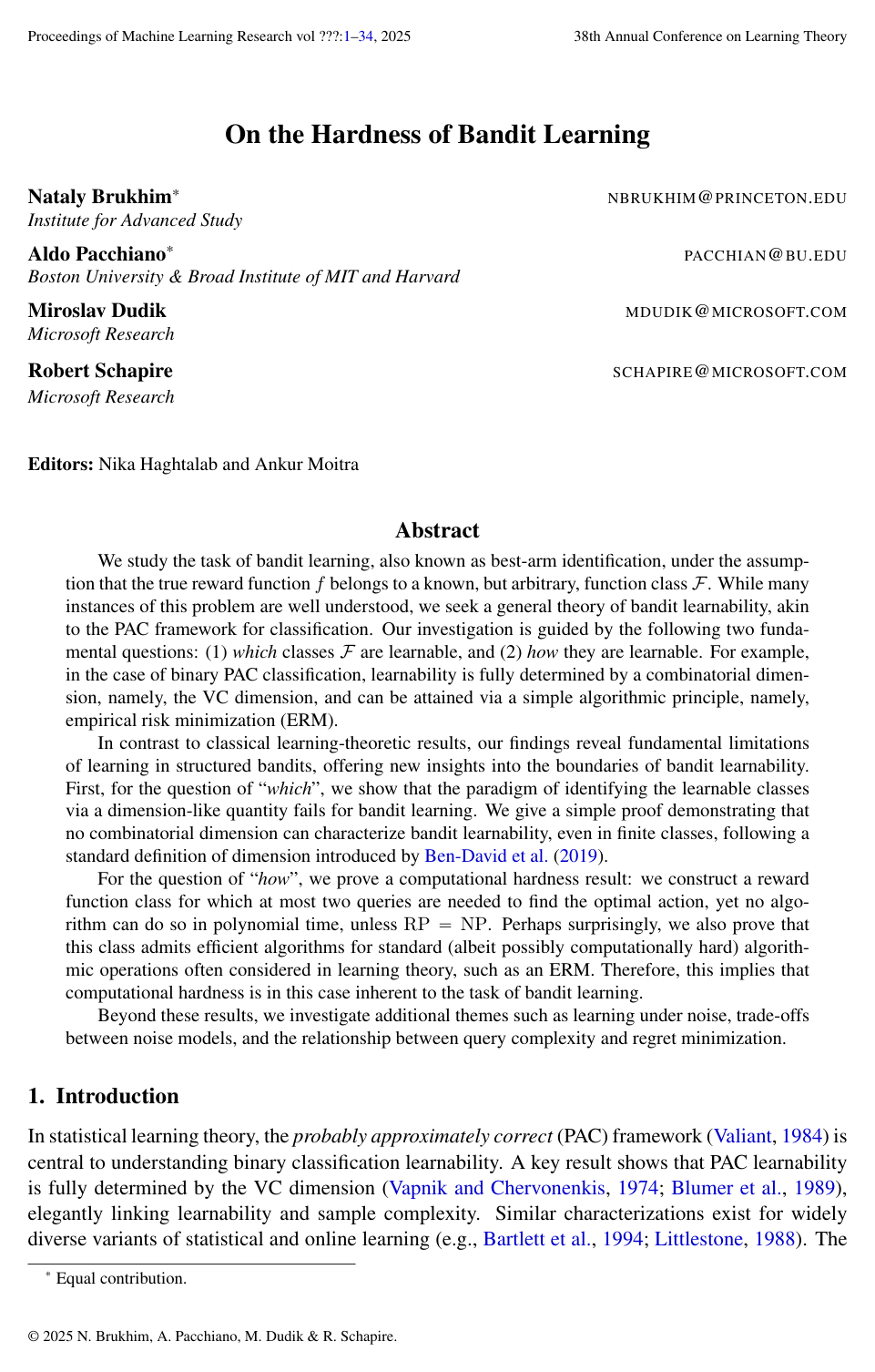
On the Hardness of Bandit Learning
Nataly Brukhim, Aldo Pacchiano, Miro Dudík, Robert E. Schapire
Why you should read this
Establishes fundamental theoretical limits of structured bandit learning by proving that no combinatorial dimension can characterize learnability and demonstrating that finding optimal actions can be computationally intractable even when sample complexity is minimal and standard empirical risk minimization is efficient.
We study the task of bandit learning, also known as best-arm identification, under the assumption that the true reward function f belongs to a known, but arbitrary, function class F. We seek a general theory of bandit learnability, akin to the PAC framework for classification. Our investigation is guided by the following two questions: (1) which classes F are learnable, and (2) how they are learnable. For example, in the case of binary PAC classification, learnability is fully determined by a combinatorial dimension - the VC dimension- and can be attained via a simple algorithmic principle, namely, empirical risk minimization (ERM). In contrast to classical learning-theoretic results, our findings reveal limitations of learning in structured bandits, offering insights into the boundaries of bandit learnability. First, for the question of "which", we show that the paradigm of identifying the learnable classes via a dimension-like quantity fails for bandit learning. We give a simple proof demonstrating that no combinatorial dimension can characterize bandit learnability, even in finite classes, following a standard definition of dimension introduced by Ben-David et al. (2019). For the question of "how", we prove a computational hardness result: we construct a reward function class for which at most two queries are needed to find the optimal action, yet no algorithm can do so in polynomial time unless RP=NP. We also prove that this class admits efficient algorithms for standard algorithmic operations often considered in learning theory, such as an ERM. This implies that computational hardness is in this case inherent to the task of bandit learning. Beyond these results, we investigate additional themes such as learning under noise, trade-offs between noise models, and the relationship between query complexity and regret minimization.
Added
2026-09-29
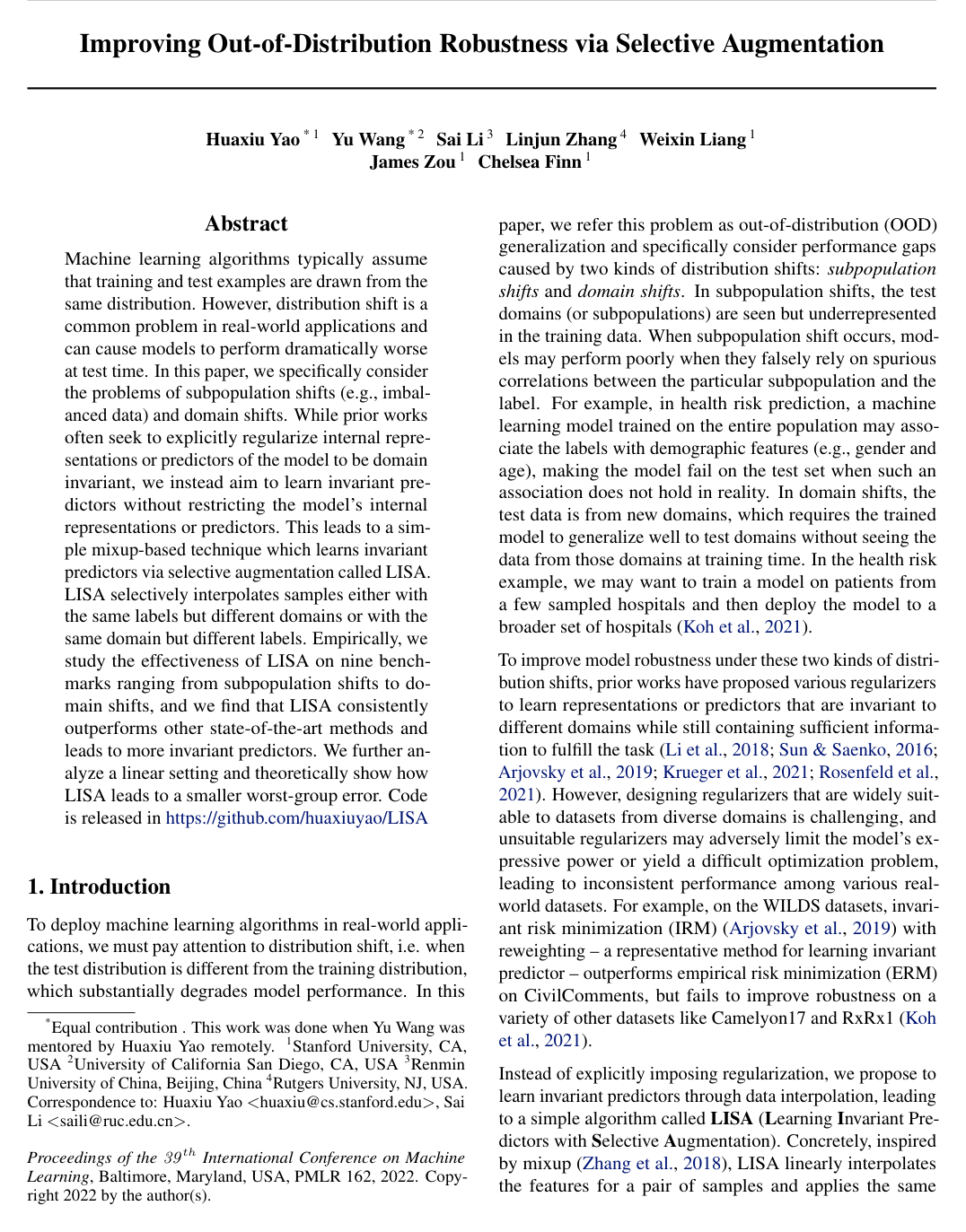
Improving Out-of-Distribution Robustness via Selective Augmentation
Huaxiu Yao, Yu Wang, Sai Li, Linjun Zhang, Weixin Liang, James Zou, Chelsea Finn
Why you should read this
Develops LISA, a selective data interpolation method that pairs samples sharing labels across different domains or domains across different labels, achieving superior out-of-distribution generalization and theoretically reduced worst-group error across diverse shift benchmarks.
Machine learning algorithms typically assume that training and test examples are drawn from the same distribution. However, distribution shift is a common problem in real-world applications and can cause models to perform dramatically worse at test time. In this paper, we specifically consider the problems of subpopulation shifts (e.g., imbalanced data) and domain shifts. While prior works often seek to explicitly regularize internal representations or predictors of the model to be domain invariant, we instead aim to learn invariant predictors without restricting the model's internal representations or predictors. This leads to a simple mixup-based technique which learns invariant predictors via selective augmentation called LISA. LISA selectively interpolates samples either with the same labels but different domains or with the same domain but different labels. Empirically, we study the effectiveness of LISA on nine benchmarks ranging from subpopulation shifts to domain shifts, and we find that LISA consistently outperforms other state-of-the-art methods and leads to more invariant predictors. We further analyze a linear setting and theoretically show how LISA leads to a smaller worst-group error.
Added
2026-09-28
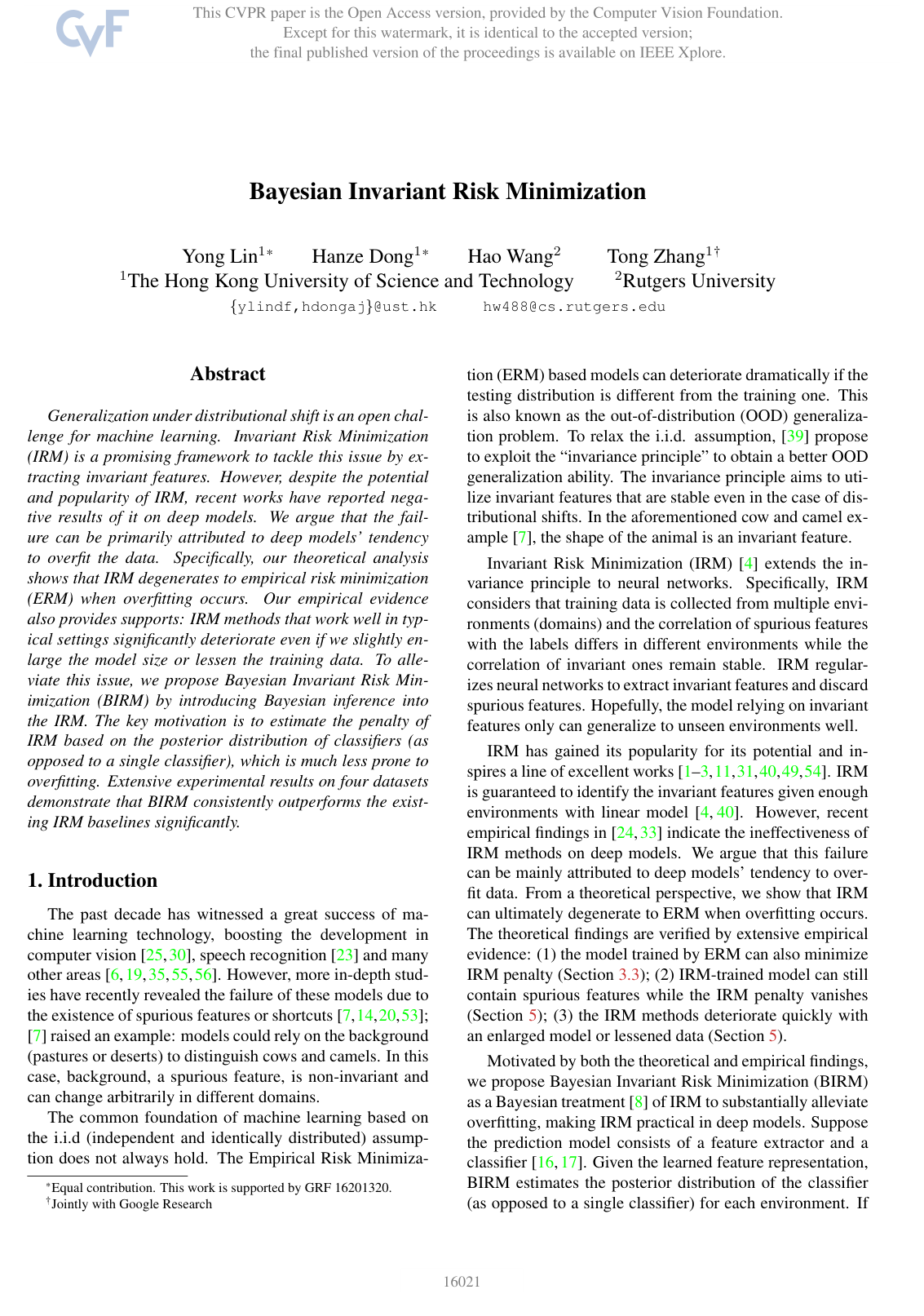
Bayesian Invariant Risk Minimization
Yong Lin, Hanze Dong, Hao Wang, Tong Zhang
Why you should read this
Reveals that Invariant Risk Minimization fails in deep networks because overfitting causes it to degenerate into empirical risk minimization, and resolves this failure mode by incorporating Bayesian inference over classifier posteriors to consistently improve out-of-distribution generalization.
Generalization under distributional shift is an open challenge for machine learning. Invariant Risk Minimization (IRM) is a promising framework to tackle this issue by extracting invariant features. However, despite the potential and popularity of IRM, recent works have reported negative results of it on deep models. We argue that the failure can be primarily attributed to deep models’ tendency to overfit the data. Specifically, our theoretical analysis shows that IRM degenerates to empirical risk minimization (ERM) when overfitting occurs. Our empirical evidence also provides supports: IRM methods that work well in typical settings significantly deteriorate even if we slightly enlarge the model size or lessen the training data. To alleviate this issue, we propose Bayesian Invariant Risk Minimization (BIRM) by introducing Bayesian inference into the IRM. The key motivation is to estimate the penalty of IRM based on the posterior distribution of classifiers (as opposed to a single classifier), which is much less prone to overfitting. Extensive experimental results on four datasets demonstrate that BIRM consistently outperforms the existing IRM baselines significantly.
Added
2026-09-26
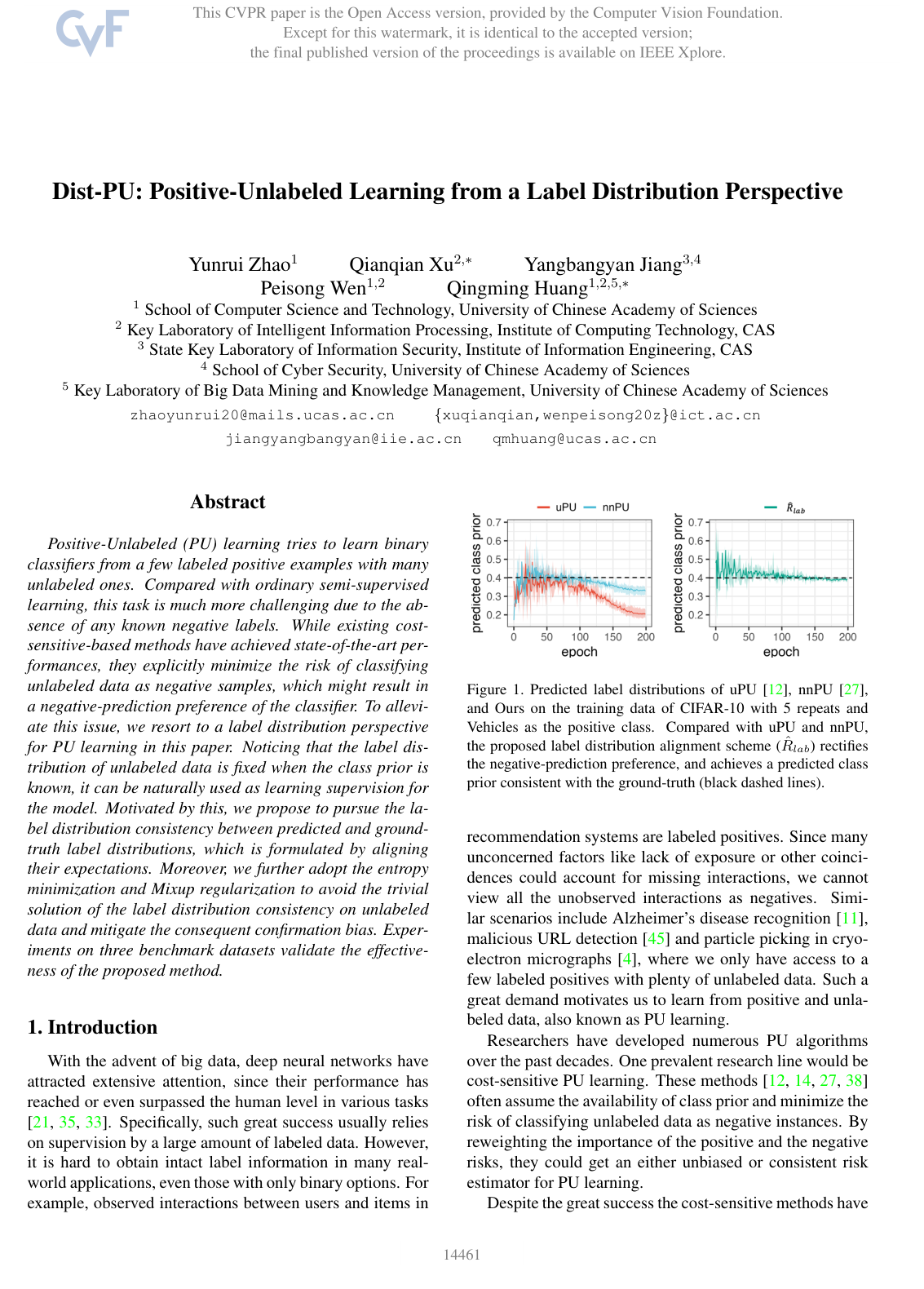
Dist-PU: Positive-Unlabeled Learning from a Label Distribution Perspective
Yunrui Zhao, Qianqian Xu, Yangbangyan Jiang, Peisong Wen, Qingming Huang
Why you should read this
Proposes Dist-PU, a positive-unlabeled learning framework that aligns predicted and ground-truth label distributions while utilizing entropy minimization and Mixup regularization to eliminate negative-prediction bias in deep classifiers.
Positive-Unlabeled (PU) learning tries to learn binary classifiers from a few labeled positive examples with many unlabeled ones. Compared with ordinary semi-supervised learning, this task is much more challenging due to the absence of any known negative labels. While existing cost-sensitive-based methods have achieved state-of-the-art performances, they explicitly minimize the risk of classifying unlabeled data as negative samples, which might result in a negative-prediction preference of the classifier. To alleviate this issue, we resort to a label distribution perspective for PU learning in this paper. Noticing that the label distribution of unlabeled data is fixed when the class prior is known, it can be naturally used as learning supervision for the model. Motivated by this, we propose to pursue the label distribution consistency between predicted and ground-truth label distributions, which is formulated by aligning their expectations. Moreover, we further adopt the entropy minimization and Mixup regularization to avoid the trivial solution of the label distribution consistency on unlabeled data and mitigate the consequent confirmation bias. Experiments on three benchmark datasets validate the effectiveness of the proposed method.
Added
2026-09-26
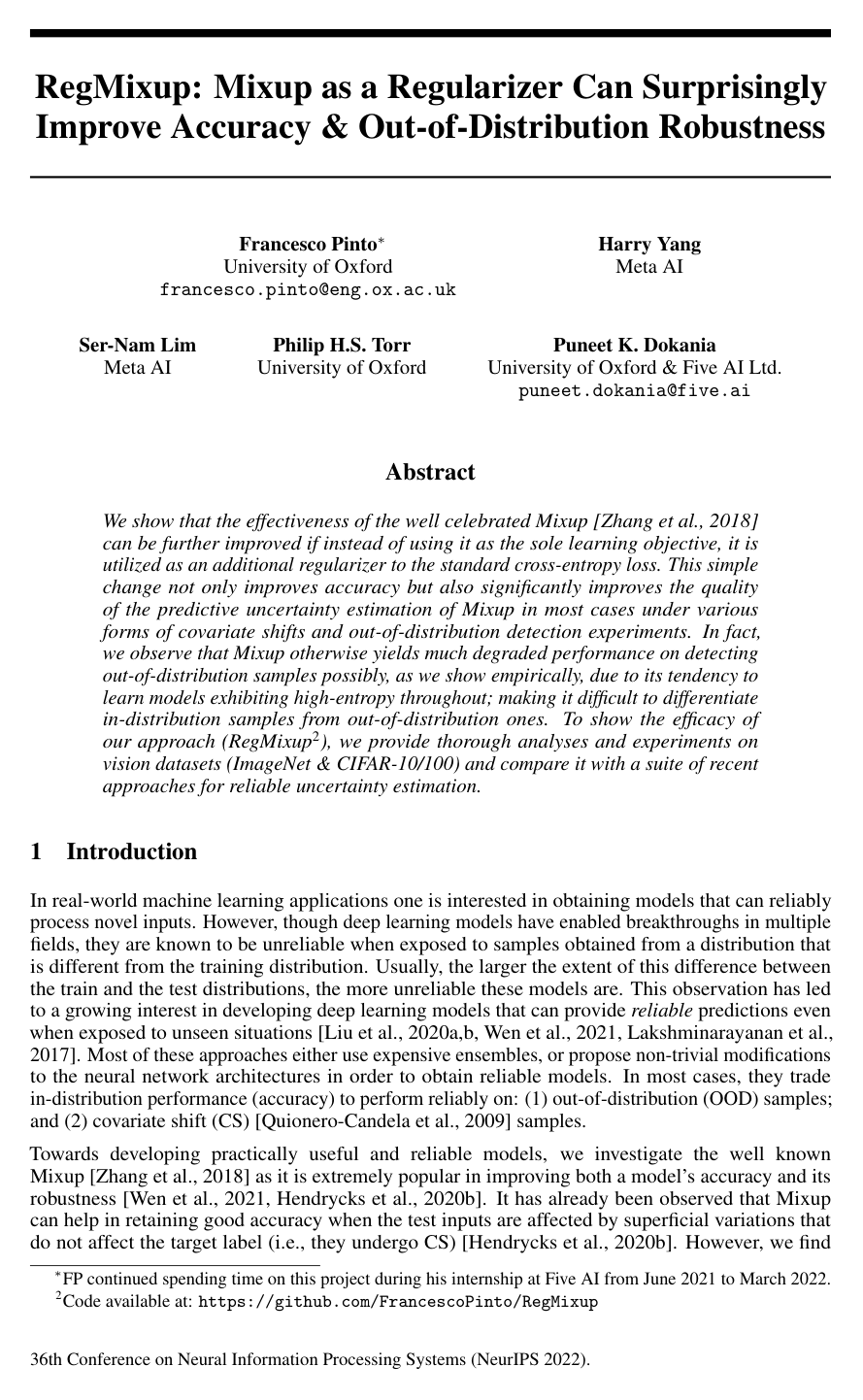
Using Mixup as a Regularizer Can Surprisingly Improve Accuracy & Out-of-Distribution Robustness
Francesco Pinto, Harry Yang, Ser Nam Lim, Philip H. S. Torr, Puneet K. Dokania
Why you should read this
Proposes RegMixup, a simple modification that applies Mixup as an auxiliary regularizer alongside standard cross-entropy loss rather than as a standalone objective, substantially improving classification accuracy and out-of-distribution detection without requiring architectural changes or costly ensembles.
We show that the effectiveness of the well celebrated Mixup [Zhang et al., 2018] can be further improved if instead of using it as the sole learning objective, it is utilized as an additional regularizer to the standard cross-entropy loss. This simple change not only improves accuracy but also significantly improves the quality of the predictive uncertainty estimation of Mixup in most cases under various forms of covariate shifts and out-of-distribution detection experiments. In fact, we observe that Mixup otherwise yields much degraded performance on detecting out-of-distribution samples possibly, as we show empirically, due to its tendency to learn models exhibiting high-entropy throughout; making it difficult to differentiate in-distribution samples from out-of-distribution ones. To show the efficacy of our approach (RegMixup²), we provide thorough analyses and experiments on vision datasets (ImageNet & CIFAR-10/100) and compare it with a suite of recent approaches for reliable uncertainty estimation.
Added
2026-09-26
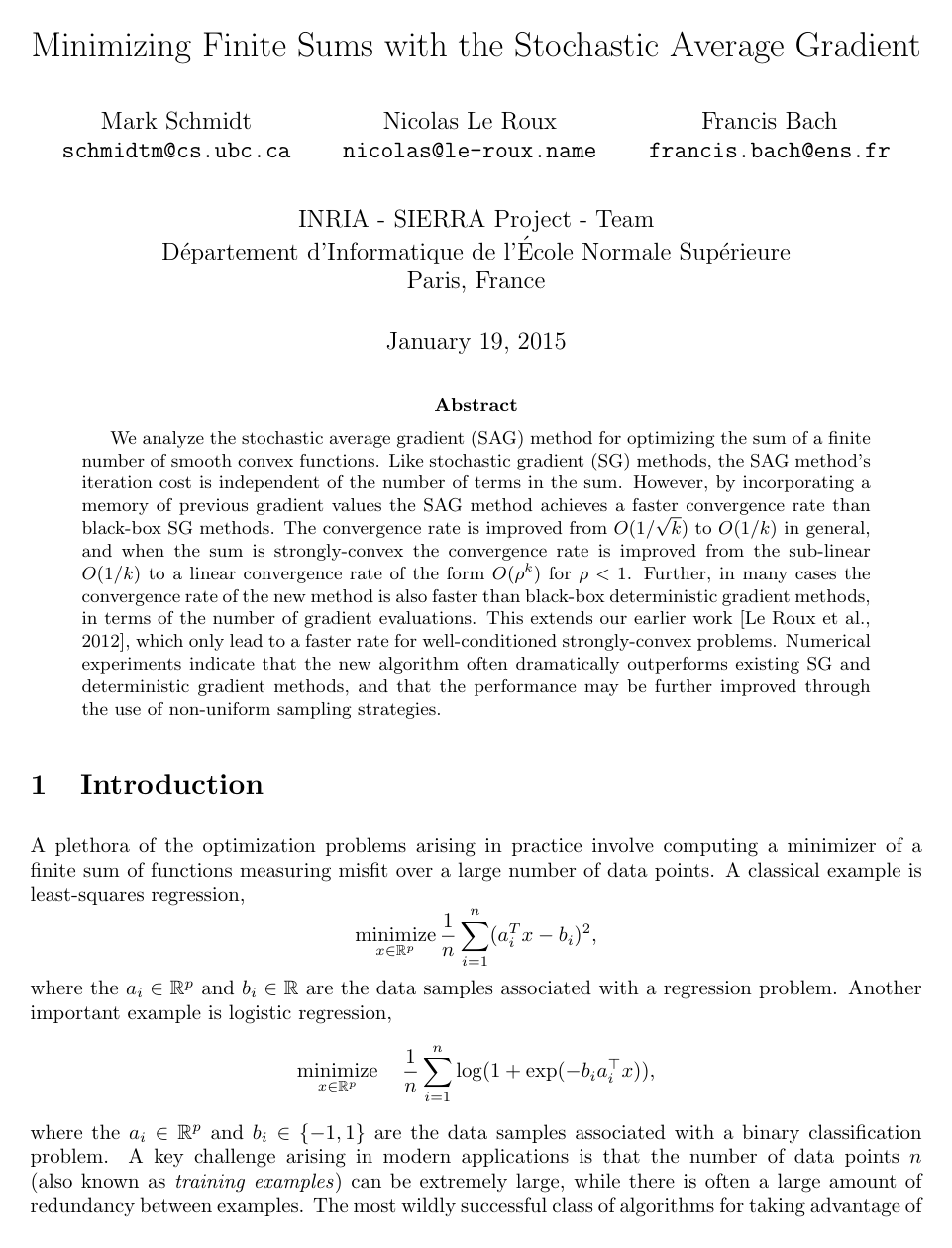
Minimizing finite sums with the stochastic average gradient
Mark Schmidt, Nicolas Le Roux, Francis Bach
Why you should read this
Introduces the stochastic average gradient method, which stores past gradient evaluations to achieve the fast linear convergence of full-batch gradient descent while maintaining the cheap per-iteration cost of stochastic methods for finite-sum convex optimization.
We propose the stochastic average gradient (SAG) method for optimizing the sum of a finite number of smooth convex functions. Like stochastic gradient (SG) methods, the SAG method's iteration cost is independent of the number of terms in the sum. However, by incorporating a memory of previous gradient values the SAG method achieves a faster convergence rate than black-box SG methods. The convergence rate is improved from O(1/k^{1/2}) to O(1/k) in general, and when the sum is strongly-convex the convergence rate is improved from the sub-linear O(1/k) to a linear convergence rate of the form O(p^k) for p \textless{} 1. Further, in many cases the convergence rate of the new method is also faster than black-box deterministic gradient methods, in terms of the number of gradient evaluations. Numerical experiments indicate that the new algorithm often dramatically outperforms existing SG and deterministic gradient methods, and that the performance may be further improved through the use of non-uniform sampling strategies.
Added
2026-09-25
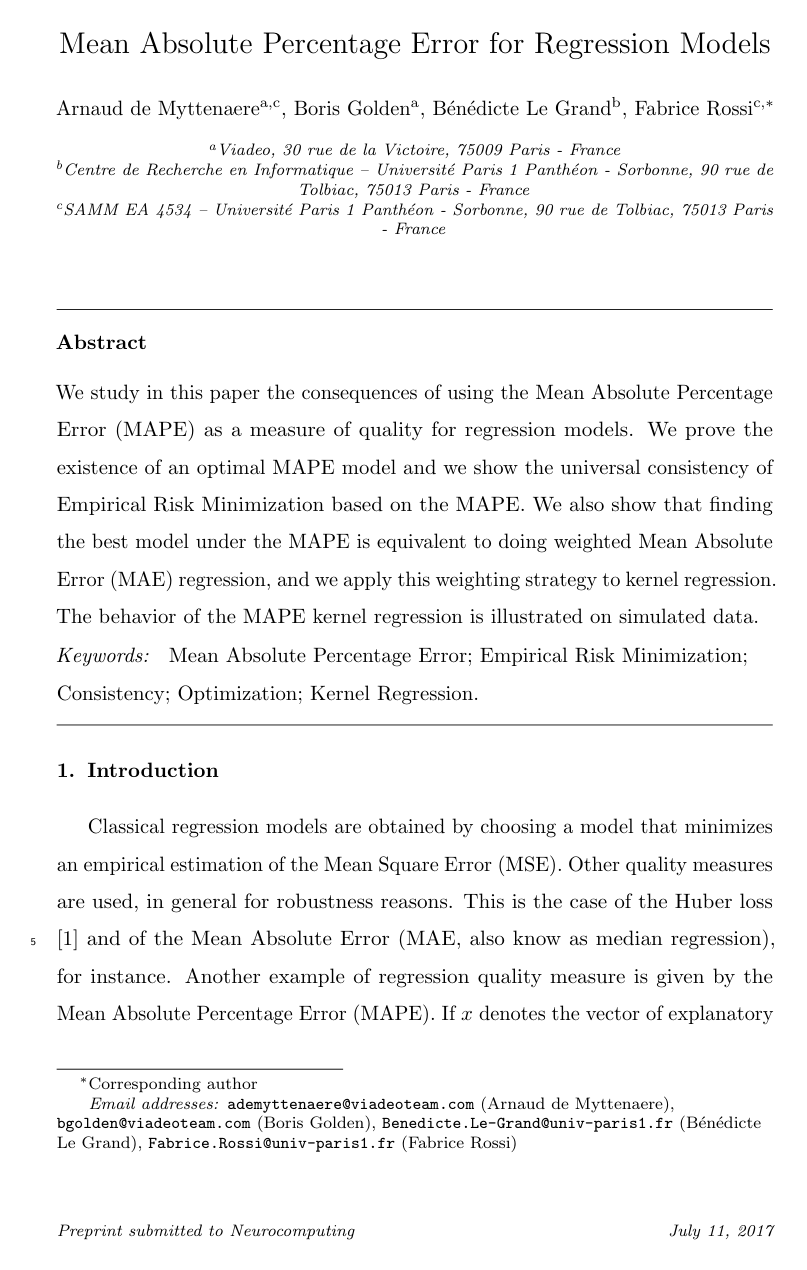
Mean Absolute Percentage Error for regression models
Arnaud de Myttenaere, Boris Golden, Bénédicte Le Grand, Fabrice Rossi
Why you should read this
Establishes theoretical foundations for Mean Absolute Percentage Error regression by proving the universal consistency of empirical risk minimization and demonstrating that training optimal MAPE models is equivalent to weighted Mean Absolute Error regression.
We study in this paper the consequences of using the Mean Absolute Percentage Error (MAPE) as a measure of quality for regression models. We prove the existence of an optimal MAPE model and we show the universal consistency of Empirical Risk Minimization based on the MAPE. We also show that finding the best model under the MAPE is equivalent to doing weighted Mean Absolute Error (MAE) regression, and we apply this weighting strategy to kernel regression. The behavior of the MAPE kernel regression is illustrated on simulated data.
Added
2026-09-25
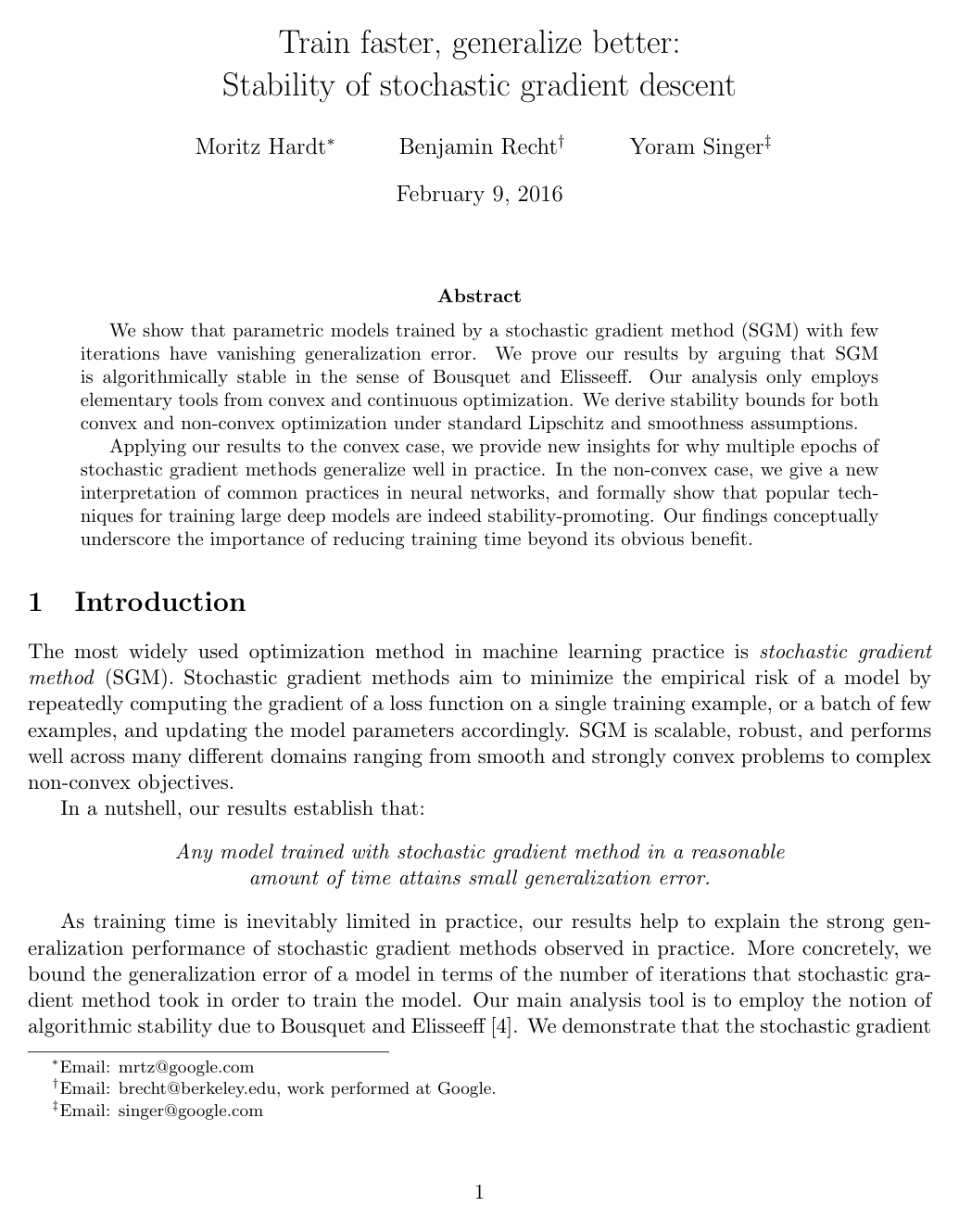
Train faster, generalize better: Stability of stochastic gradient descent
Moritz Hardt, Benjamin Recht, Yoram Singer
Why you should read this
Proves that stochastic gradient descent is algorithmically stable, providing theoretical bounds that explain why faster training and fewer iterations prevent overfitting in both convex optimization and deep neural networks.
We show that parametric models trained by a stochastic gradient method (SGM) with few iterations have vanishing generalization error. We prove our results by arguing that SGM is algorithmically stable in the sense of Bousquet and Elisseeff. Our analysis only employs elementary tools from convex and continuous optimization. We derive stability bounds for both convex and non-convex optimization under standard Lipschitz and smoothness assumptions. Applying our results to the convex case, we provide new insights for why multiple epochs of stochastic gradient methods generalize well in practice. In the non-convex case, we give a new interpretation of common practices in neural networks, and formally show that popular techniques for training large deep models are indeed stability-promoting. Our findings conceptually underscore the importance of reducing training time beyond its obvious benefit.
Added
2026-09-25
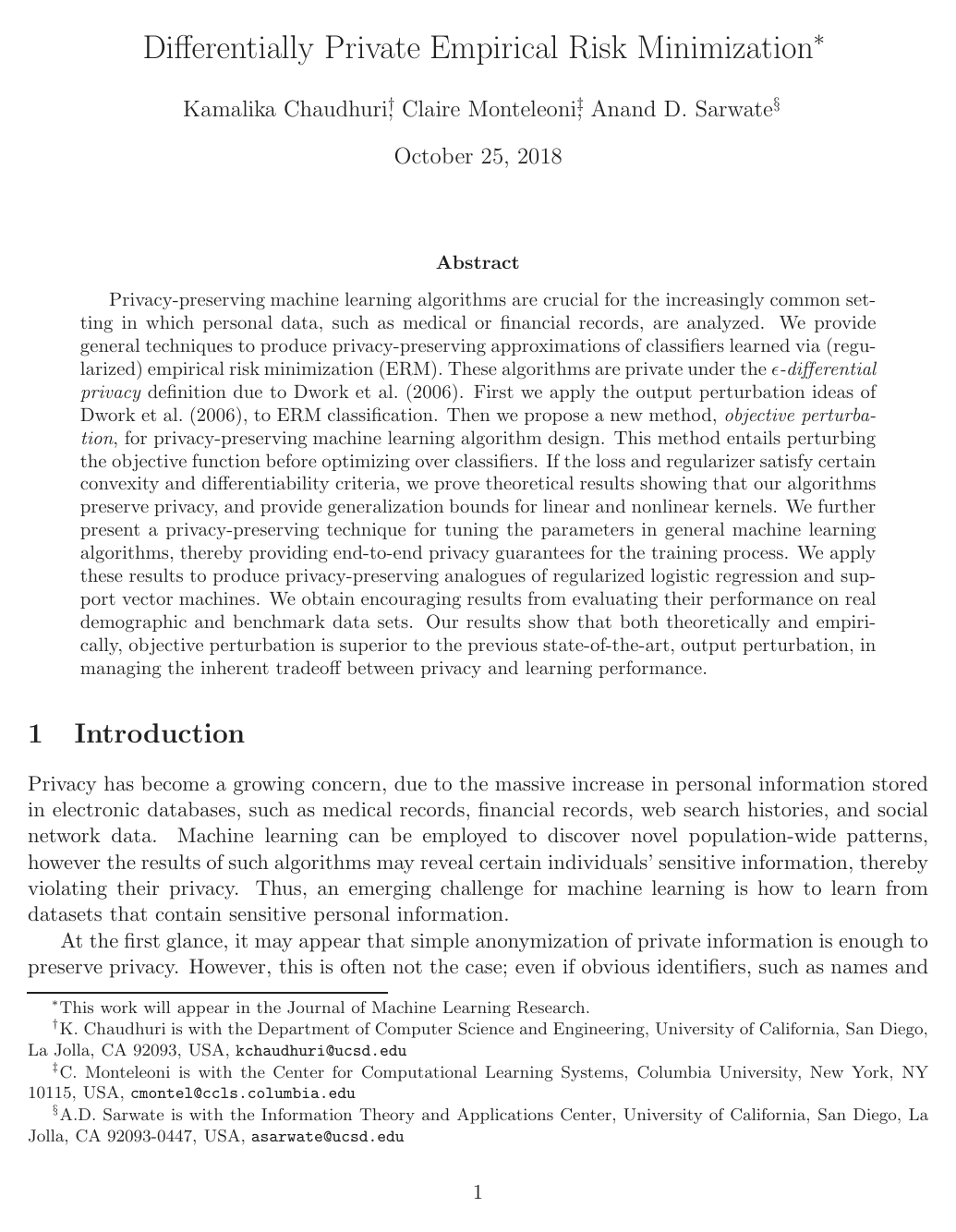
Differentially Private Empirical Risk Minimization
Kamalika Chaudhuri, Claire Monteleoni, Anand D. Sarwate
Why you should read this
Introduces the objective perturbation technique for differentially private empirical risk minimization, proving that perturbing optimization objectives achieves superior privacy-utility trade-offs and theoretical generalization bounds over traditional output perturbation in models like logistic regression and support vector machines.
Privacy-preserving machine learning algorithms are crucial for the increasingly common setting in which personal data, such as medical or financial records, are analyzed. We provide general techniques to produce privacy-preserving approximations of classifiers learned via (regularized) empirical risk minimization (ERM). These algorithms are private under the -differential privacy definition due to Dwork et al. (2006). First we apply the output perturbation ideas of Dwork et al. (2006), to ERM classification. Then we propose a new method, objective perturbation, for privacy-preserving machine learning algorithm design. This method entails perturbing the objective function before optimizing over classifiers. If the loss and regularizer satisfy certain convexity and differentiability criteria, we prove theoretical results showing that our algorithms preserve privacy, and provide generalization bounds for linear and nonlinear kernels. We further present a privacy-preserving technique for tuning the parameters in general machine learning algorithms, thereby providing end-to-end privacy guarantees for the training process. We apply these results to produce privacy-preserving analogues of regularized logistic regression and support vector machines. We obtain encouraging results from evaluating their performance on real demographic and benchmark data sets. Our results show that both theoretically and empirically, objective perturbation is superior to the previous state-of-the-art, output perturbation, in managing the inherent tradeoff between privacy and learning performance.
Added
2026-09-24

Introduction to Machine Learning
Laurent Younes
Why you should read this
Establishes a rigorous mathematical foundation for core machine learning methods by directly connecting optimization theory, reproducing kernel Hilbert spaces, and concentration inequalities to supervised, generative, and unsupervised algorithms.
This book introduces the mathematical foundations and techniques that lead to the development and analysis of many of the algorithms that are used in machine learning. It starts with an introductory chapter that describes notation used throughout the book and serve at a reminder of basic concepts in calculus, linear algebra and probability and also introduces some measure theoretic terminology, which can be used as a reading guide for the sections that use these tools. The introductory chapters also provide background material on matrix analysis and optimization. The latter chapter provides theoretical support to many algorithms that are used in the book, including stochastic gradient descent, proximal methods, etc. After discussing basic concepts for statistical prediction, the book includes an introduction to reproducing kernel theory and Hilbert space techniques, which are used in many places, before addressing the description of various algorithms for supervised statistical learning, including linear methods, support vector machines, decision trees, boosting, or neural networks. The subject then switches to generative methods, starting with a chapter that presents sampling methods and an introduction to the theory of Markov chains. The following chapter describe the theory of graphical models, an introduction to variational methods for models with latent variables, and to deep-learning based generative models. The next chapters focus on unsupervised learning methods, for clustering, factor analysis and manifold learning. The final chapter of the book is theory-oriented and discusses concentration inequalities and generalization bounds.
Added
2026-09-19

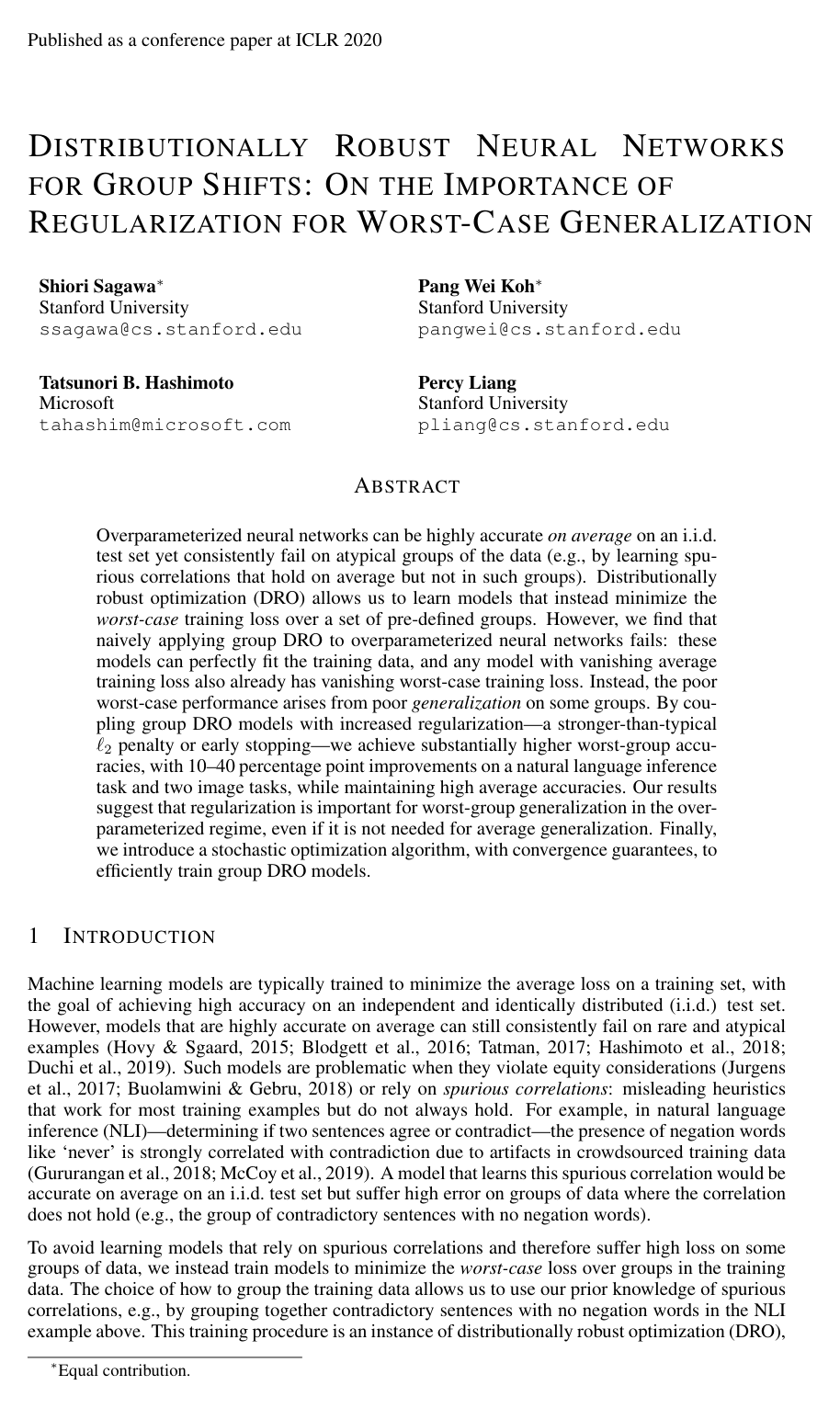
Distributionally Robust Neural Networks for Group Shifts: On the Importance of Regularization for Worst-Case Generalization
Shiori Sagawa, Pang Wei Koh, Tatsunori B. Hashimoto, Percy Liang
Why you should read this
Demonstrates that pairing group DRO with strong regularization solves worst-case generalization failures in overparameterized neural networks, improving minority group test accuracy by 10 to 40 percentage points on language and vision benchmarks.
Overparameterized neural networks can be highly accurate on average on an i.i.d. test set yet consistently fail on atypical groups of the data (e.g., by learning spurious correlations that hold on average but not in such groups). Distributionally robust optimization (DRO) allows us to learn models that instead minimize the worst-case training loss over a set of pre-defined groups. However, we find that naively applying group DRO to overparameterized neural networks fails: these models can perfectly fit the training data, and any model with vanishing average training loss also already has vanishing worst-case training loss. Instead, the poor worst-case performance arises from poor generalization on some groups. By coupling group DRO models with increased regularization---a stronger-than-typical L2 penalty or early stopping---we achieve substantially higher worst-group accuracies, with 10-40 percentage point improvements on a natural language inference task and two image tasks, while maintaining high average accuracies. Our results suggest that regularization is important for worst-group generalization in the overparameterized regime, even if it is not needed for average generalization. Finally, we introduce a stochastic optimization algorithm, with convergence guarantees, to efficiently train group DRO models.
Added
2026-09-18
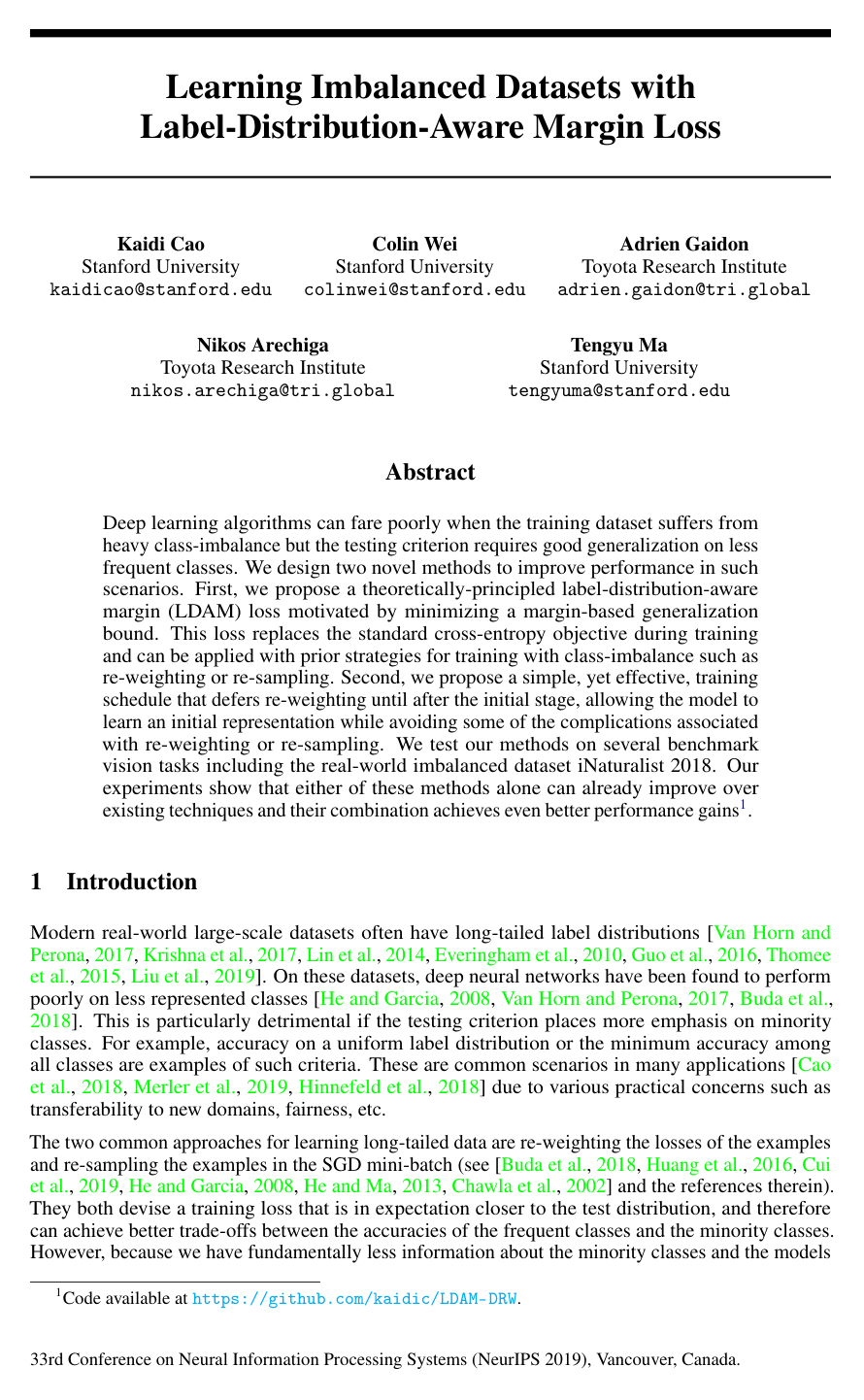
Learning Imbalanced Datasets with Label-Distribution-Aware Margin Loss
Kaidi Cao, Colin Wei, Adrien Gaidon, Nikos Aréchiga, Tengyu Ma
Why you should read this
Proposes a theoretically grounded label-distribution-aware margin loss paired with a deferred re-weighting training schedule to substantially improve deep learning generalization on minority classes in heavily imbalanced datasets.
Deep learning algorithms can fare poorly when the training dataset suffers from heavy class-imbalance but the testing criterion requires good generalization on less frequent classes. We design two novel methods to improve performance in such scenarios. First, we propose a theoretically-principled label-distribution-aware margin (LDAM) loss motivated by minimizing a margin-based generalization bound. This loss replaces the standard cross-entropy objective during training and can be applied with prior strategies for training with class-imbalance such as re-weighting or re-sampling. Second, we propose a simple, yet effective, training schedule that defers re-weighting until after the initial stage, allowing the model to learn an initial representation while avoiding some of the complications associated with re-weighting or re-sampling. We test our methods on several benchmark vision tasks including the real-world imbalanced dataset iNaturalist 2018. Our experiments show that either of these methods alone can already improve over existing techniques and their combination achieves even better performance gains.
Added
2026-09-16
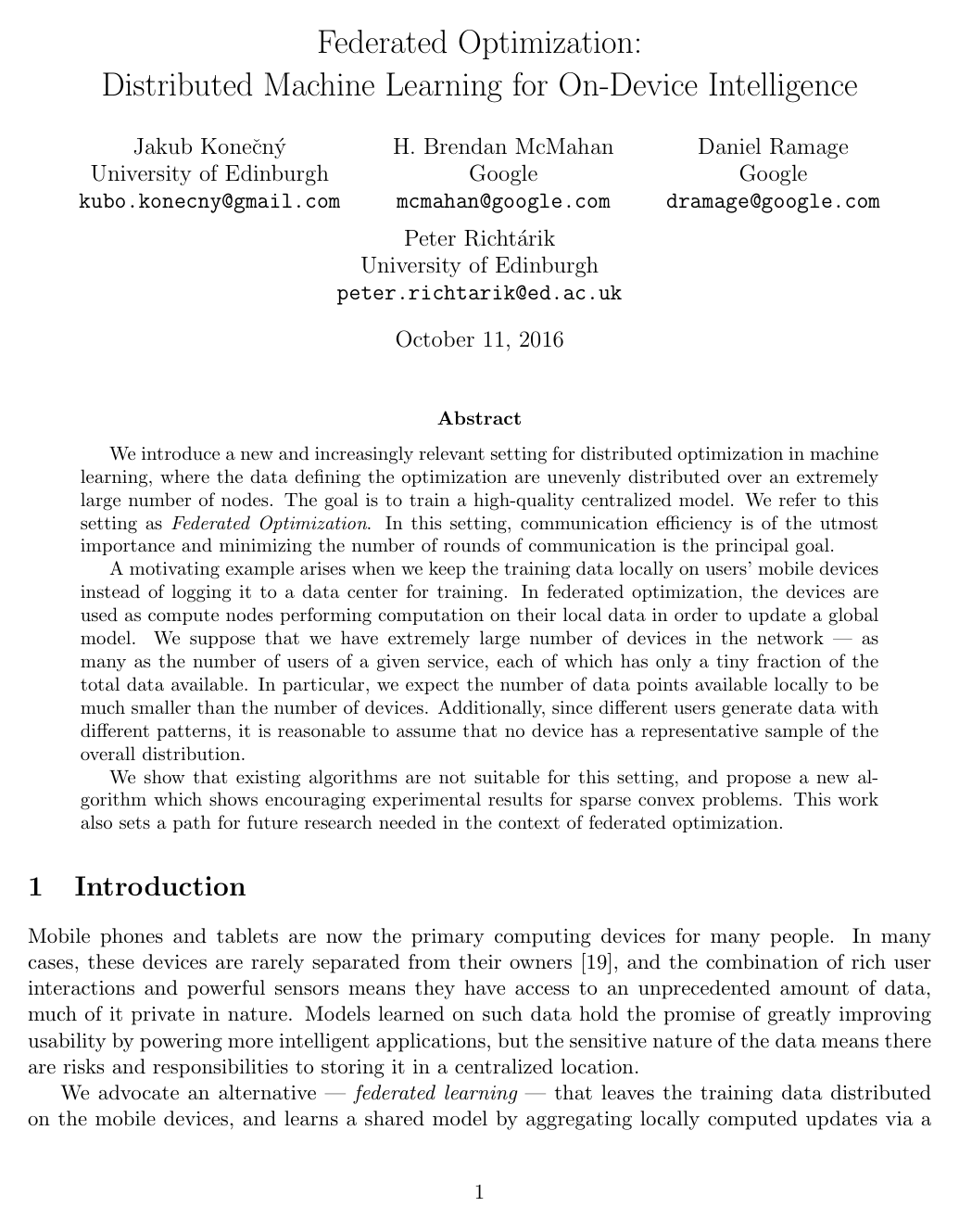
Federated Optimization: Distributed Machine Learning for On-Device Intelligence
Jakub Konečný, H. Brendan McMahan, Daniel Ramage, Peter Richtárik
Why you should read this
Introduces the federated optimization framework to train centralized machine learning models across millions of decentralized edge devices holding heterogeneous data while minimizing communication rounds.
We introduce a new and increasingly relevant setting for distributed optimization in machine learning, where the data defining the optimization are unevenly distributed over an extremely large number of nodes. The goal is to train a high-quality centralized model. We refer to this setting as Federated Optimization. In this setting, communication efficiency is of the utmost importance and minimizing the number of rounds of communication is the principal goal. A motivating example arises when we keep the training data locally on users' mobile devices instead of logging it to a data center for training. In federated optimziation, the devices are used as compute nodes performing computation on their local data in order to update a global model. We suppose that we have extremely large number of devices in the network --- as many as the number of users of a given service, each of which has only a tiny fraction of the total data available. In particular, we expect the number of data points available locally to be much smaller than the number of devices. Additionally, since different users generate data with different patterns, it is reasonable to assume that no device has a representative sample of the overall distribution. We show that existing algorithms are not suitable for this setting, and propose a new algorithm which shows encouraging experimental results for sparse convex problems. This work also sets a path for future research needed in the context of \federated optimization.
Added
2026-09-16
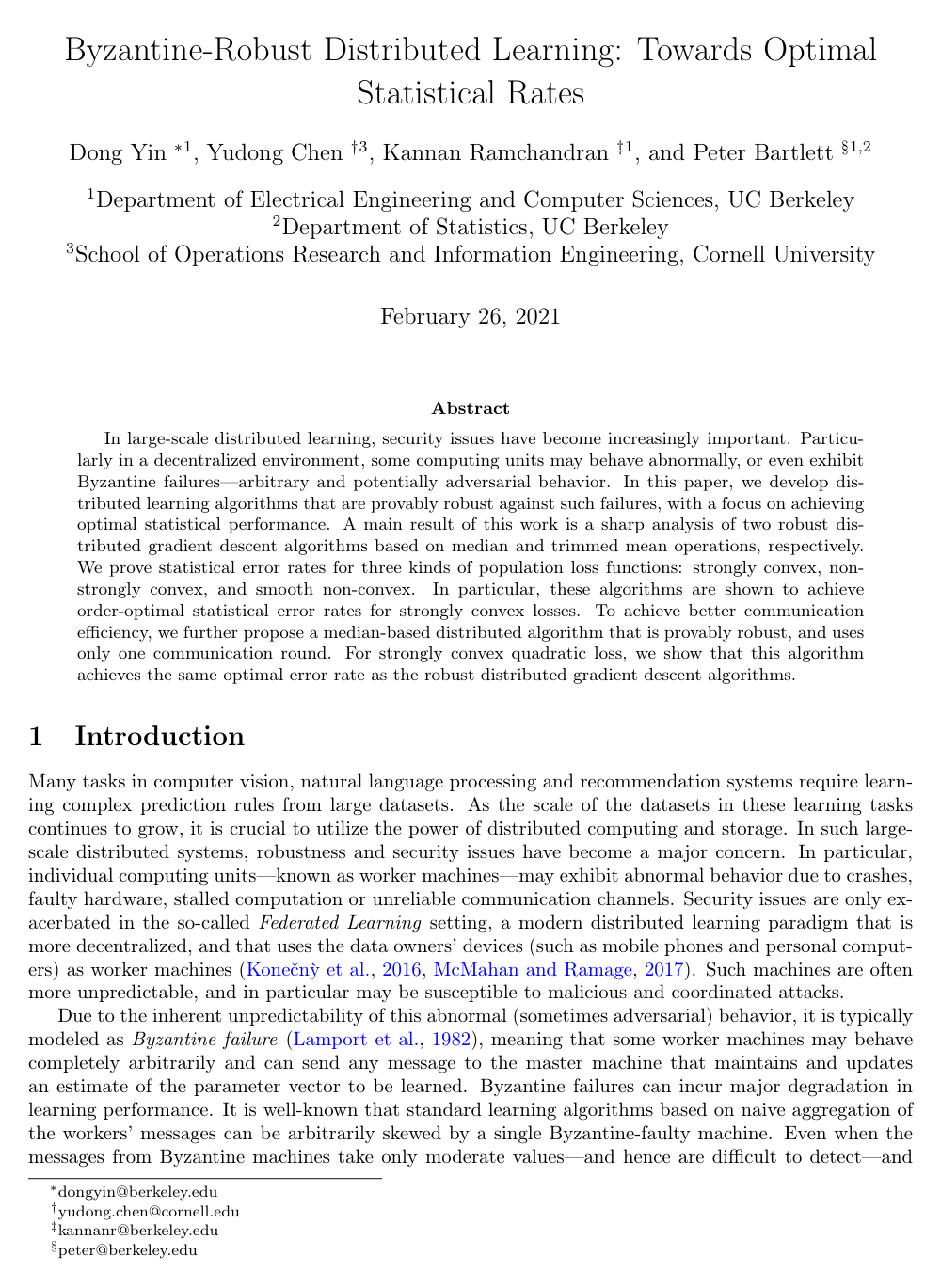
Byzantine-Robust Distributed Learning: Towards Optimal Statistical Rates
Dong Yin, Yudong Chen, Kannan Ramchandran, Peter Bartlett
Why you should read this
Establishes optimal statistical error rates for distributed gradient descent under Byzantine adversarial failures across convex and non-convex losses using median and trimmed-mean aggregations, while introducing a communication-efficient one-round algorithm that matches these guarantees.
In large-scale distributed learning, security issues have become increasingly important. Particularly in a decentralized environment, some computing units may behave abnormally, or even exhibit Byzantine failures -- arbitrary and potentially adversarial behavior. In this paper, we develop distributed learning algorithms that are provably robust against such failures, with a focus on achieving optimal statistical performance. A main result of this work is a sharp analysis of two robust distributed gradient descent algorithms based on median and trimmed mean operations, respectively. We prove statistical error rates for three kinds of population loss functions: strongly convex, non-strongly convex, and smooth non-convex. In particular, these algorithms are shown to achieve order-optimal statistical error rates for strongly convex losses. To achieve better communication efficiency, we further propose a median-based distributed algorithm that is provably robust, and uses only one communication round. For strongly convex quadratic loss, we show that this algorithm achieves the same optimal error rate as the robust distributed gradient descent algorithms.
Added
2026-09-14
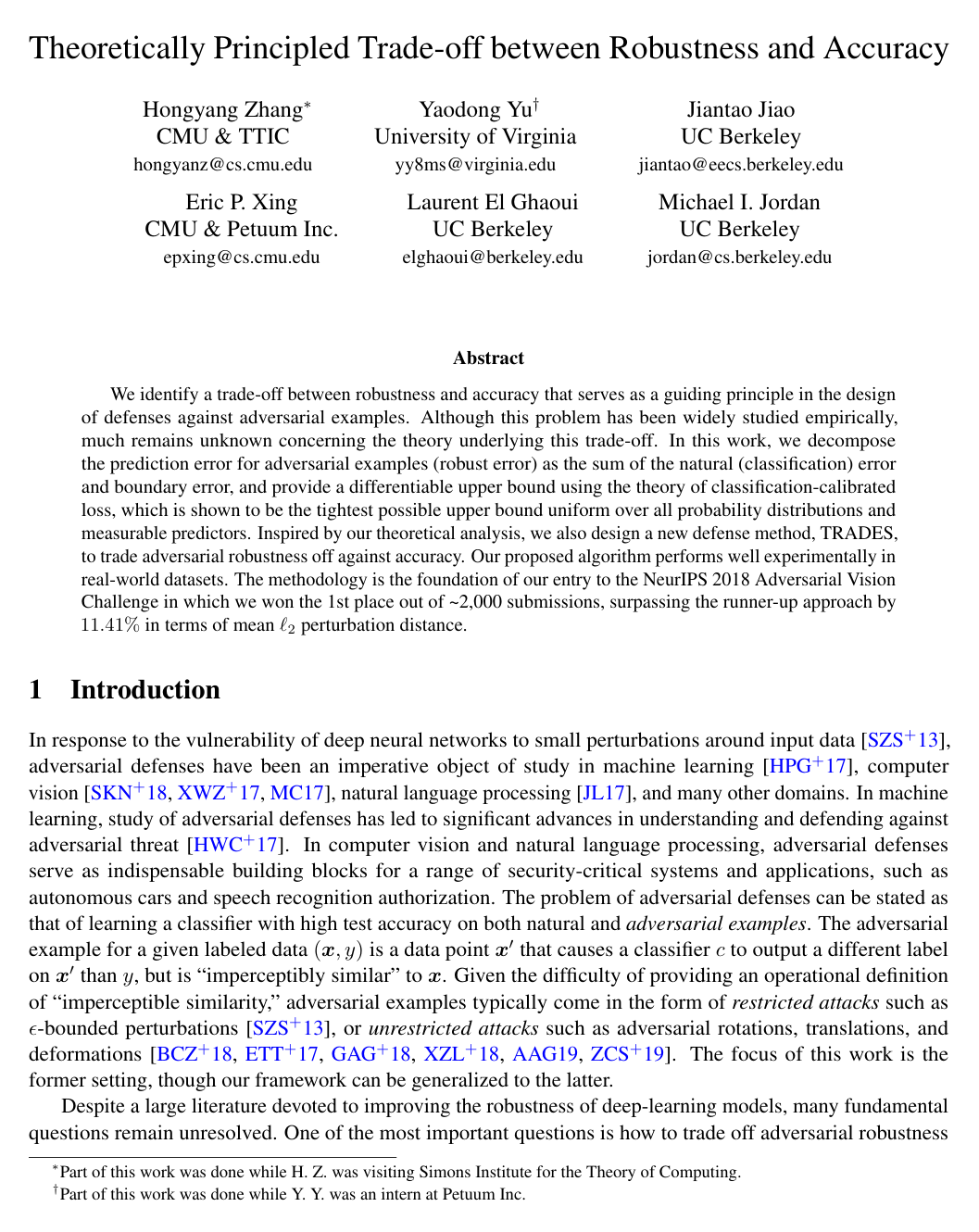
Theoretically Principled Trade-off between Robustness and Accuracy
Hongyang Zhang, Yaodong Yu, Jiantao Jiao, Eric P. Xing, Laurent El Ghaoui, Michael I. Jordan
Why you should read this
Introduces TRADES, a defense algorithm derived from a tight theoretical bound that decomposes prediction error into classification and boundary terms to systematically balance clean accuracy against adversarial attacks.
We identify a trade-off between robustness and accuracy that serves as a guiding principle in the design of defenses against adversarial examples. Although this problem has been widely studied empirically, much remains unknown concerning the theory underlying this trade-off. In this work, we decompose the prediction error for adversarial examples (robust error) as the sum of the natural (classification) error and boundary error, and provide a differentiable upper bound using the theory of classification-calibrated loss, which is shown to be the tightest possible upper bound uniform over all probability distributions and measurable predictors. Inspired by our theoretical analysis, we also design a new defense method, TRADES, to trade adversarial robustness off against accuracy. Our proposed algorithm performs well experimentally in real-world datasets. The methodology is the foundation of our entry to the NeurIPS 2018 Adversarial Vision Challenge in which we won the 1st place out of ~2,000 submissions, surpassing the runner-up approach by in terms of mean perturbation distance.
Added
2026-09-12