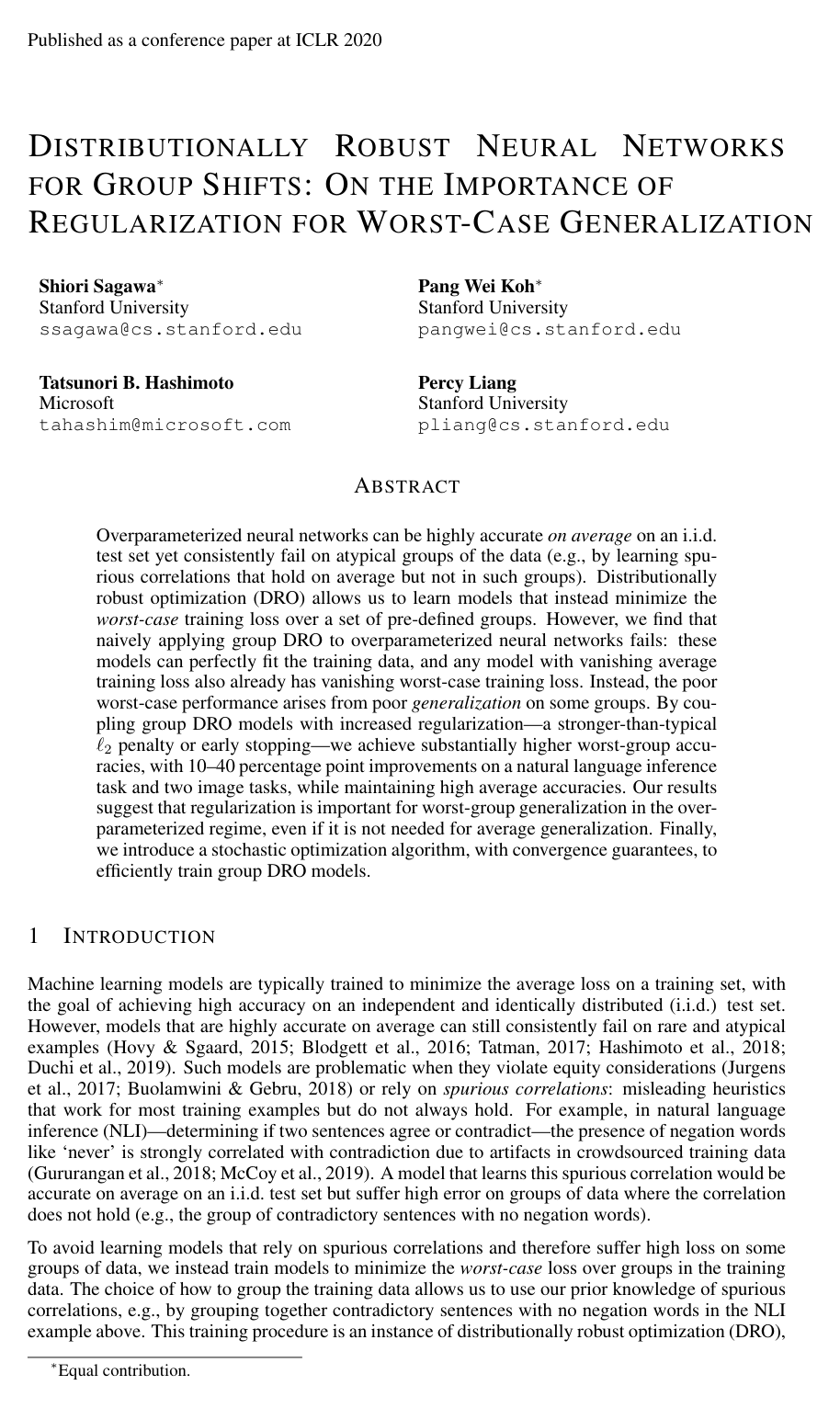
Distributionally Robust Neural Networks for Group Shifts: On the Importance of Regularization for Worst-Case Generalization

Shiori SagawaPang Wei KohTatsunori B. HashimotoPercy Liang

article2019arXiv1,781 citations

Demonstrates that pairing group DRO with strong regularization solves worst-case generalization failures in overparameterized neural networks, improving minority group test accuracy by 10 to 40 percentage points on language and vision benchmarks.

Listen

Modern deep learning systems routinely achieve exceptional average accuracy on standard test sets but frequently fail when deployed in real-world settings where spurious correlations break down. These models learn misleading shortcuts—such as associating water backgrounds with waterbirds, gender with hair color, or negation words with sentence contradictions—leading to severe drops in performance on minority groups. This failure poses serious operational, safety, and fairness risks in critical domains such as clinical diagnosis and automated text analysis.

The article evaluates why standard robust training techniques fail to protect complex, overparameterized neural networks against these group shifts and demonstrates how pairing distributionally robust optimization with deliberate regularization enables models to maintain high accuracy across all subgroups.

The researchers conducted an empirical and theoretical investigation using standard deep architectures, specifically fine-tuning ResNet-50 image models on bird classification (Waterbirds) and facial attribute recognition (CelebA), as well as a BERT language model on natural language inference (MultiNLI). They compared standard empirical risk minimization against group-based distributionally robust optimization—an approach that minimizes the worst-case loss across predefined subgroups. Additionally, the authors developed a scalable online stochastic optimization algorithm that adaptively updates model weights alongside a probability distribution over the data groups.

The investigation produced three critical findings. First, when models are trained to near-zero training error without strong regularization, robust optimization fails completely: both standard and robustly trained models achieve near-perfect training scores but suffer catastrophic test errors on minority groups (e.g., yielding worst-group test accuracies of only 41.1% to 65.7%). Second, applying strong regularization—such as increasing weight decay penalties by multiple orders of magnitude or halting training early—enables robust optimization to dramatically outperform standard approaches, improving worst-group test accuracy by 10 to 40 percentage points while maintaining average accuracy. Third, introducing group adjustments that penalize smaller groups more heavily to account for their higher risk of overfitting provides further performance gains, outperforming common heuristic techniques like standard importance upweighting, which can destabilize non-convex neural network training.

These findings demonstrate that overparameterized neural networks suffer from uneven generalization gaps across different subgroups rather than an inability to learn minority patterns. Consequently, conventional wisdom—which holds that large neural networks do not need strong regularization to achieve high average accuracy—does not apply when worst-case robustness is required. For decision-makers, this highlights that high average performance benchmarks can conceal severe vulnerabilities in rare scenarios, and mitigating these risks requires explicitly constraining model capacity during training.

Organizations developing or deploying neural networks where minority group accuracy is critical should adopt group-based robust optimization paired with elevated regularization and size-based group adjustments. Standard sample upweighting should be avoided as a standalone fix in complex models due to its theoretical and empirical shortcomings. Before deployment, engineering teams must define known confounding variables to form subgroups and evaluate performance on a group-by-group basis rather than relying exclusively on aggregate test metrics.

These conclusions are supported by strong empirical results and theoretical convergence proofs, though important boundaries remain. The proposed approach currently relies on knowing the relevant confounding attributes in advance to specify subgroups, and hyperparameter tuning requires access to balanced validation data. While supplemental experiments suggest the method remains effective under noisy group definitions, further research is required to automatically identify unmodeled subgroup shifts where prior attribute labels are entirely unavailable.

arXiv: 1911.08731kohpangwei/group_DRO
Cover for Distributionally Robust Neural Networks for Group Shifts: On the Importance of Regularization for Worst-Case Generalization

Abstract

Overparameterized neural networks can be highly accurate on average on an i.i.d. test set yet consistently fail on atypical groups of the data (e.g., by learning spurious correlations that hold on average but not in such groups). Distributionally robust optimization (DRO) allows us to learn models that instead minimize the worst-case training loss over a set of pre-defined groups. However, we find that naively applying group DRO to overparameterized neural networks fails: these models can perfectly fit the training data, and any model with vanishing average training loss also already has vanishing worst-case training loss. Instead, the poor worst-case performance arises from poor generalization on some groups. By coupling group DRO models with increased regularization---a stronger-than-typical L2 penalty or early stopping---we achieve substantially higher worst-group accuracies, with 10-40 percentage point improvements on a natural language inference task and two image tasks, while maintaining high average accuracies. Our results suggest that regularization is important for worst-group generalization in the overparameterized regime, even if it is not needed for average generalization. Finally, we introduce a stochastic optimization algorithm, with convergence guarantees, to efficiently train group DRO models.

Table of Contents

  • 1 Introduction
  • 2 Setup
  • 2.1 Applications
  • 3 Comparison between group DRO and ERM
  • 3.1 ERM and DRO have poor worst-group accuracy in the overparameterized regime
  • 3.2 DRO improves worst-group accuracy under appropriate regularization
  • 3.3 Accounting for generalization through group adjustments improves DRO
  • 4 Comparison between DRO and importance weighting
  • 5 Algorithm
  • 6 Related work
  • 7 Discussion
  • References
  • A Proofs
  • A.1 Equivalence of DRO and importance weighting in the convex setting
  • A.2 Convergence rate of Algorithm
  • B Supplementary experiments
  • C Experimental details
  • C.1 Datasets
  • C.2 Models

Knowls

  1. Knowl 1 — Group Distributionally Robust Optimization Formulation for Group Shifts

    model/method

    To build models robust to subpopulation distribution shifts and spurious correlations, the data distribution is modeled as a mixture of mm predefined groups indexed by G={1,…,m}\mathcal{G} = \{1, \dots, m\}, where each group has distribution PgP_g. The uncertainty set Q\mathcal{Q} is defined as the set of all probability mixtures over these groups:

    Q:={∑g=1mqgPg:q∈Δm}\mathcal{Q} := \left\{ \sum_{g=1}^m q_g P_g : q \in \Delta_m \right\}

    where Δm={q∈Rm:∑g=1mqg=1,qg≥0}\Delta_m = \{q \in \mathbb{R}^m : \sum_{g=1}^m q_g = 1, q_g \ge 0\} is the (m−1)(m-1)-dimensional probability simplex.

    For a parameter space Θ\Theta, inputs x∈Xx \in \mathcal{X}, labels y∈Yy \in \mathcal{Y}, and a non-negative loss function ℓ:Θ×(X×Y)→R+\ell: \Theta \times (\mathcal{X} \times \mathcal{Y}) \to \mathbb{R}_+, the worst-case expected loss over Q\mathcal{Q} reduces to the maximum expected loss across groups:

    R(θ):=sup⁡Q∈QE(x,y)∼Q[ℓ(θ;(x,y))]=max⁡g∈GE(x,y)∼Pg[ℓ(θ;(x,y))]R(\theta) := \sup_{Q \in \mathcal{Q}} \mathbb{E}_{(x,y)\sim Q}[\ell(\theta; (x, y))] = \max_{g \in \mathcal{G}} \mathbb{E}_{(x,y)\sim P_g}[\ell(\theta; (x, y))]

    Given training samples split into empirical group distributions P^g\hat{P}_g over ngn_g samples from group gg, the Group Distributionally Robust Optimization (Group DRO) objective minimizes the empirical worst-group risk:

    θ^DRO:=arg⁡min⁡θ∈Θ{R^(θ):=max⁡g∈GE(x,y)∼P^g[ℓ(θ;(x,y))]}\hat{\theta}_{\text{DRO}} := \arg\min_{\theta \in \Theta} \left\{ \hat{R}(\theta) := \max_{g \in \mathcal{G}} \mathbb{E}_{(x,y)\sim \hat{P}_g}[\ell(\theta; (x, y))] \right\}

  2. Knowl 2 — Online Stochastic Minimax Optimization Algorithm for Group DRO

    algorithm

    The Group DRO empirical objective min⁡θ∈Θmax⁡q∈Δm∑g=1mqgE(x,y)∼Pg[ℓ(θ;(x,y))]\min_{\theta \in \Theta} \max_{q \in \Delta_m} \sum_{g=1}^m q_g \mathbb{E}_{(x,y)\sim P_g}[\ell(\theta; (x,y))] can be solved efficiently via a stochastic online minimax procedure that alternates between gradient descent updates on model parameters θ\theta and exponentiated gradient ascent updates on the group probability distribution q∈Δmq \in \Delta_m.

    Input: Step sizes ηq>0\eta_q > 0, ηθ>0\eta_\theta > 0; group data distributions PgP_g for each g∈{1,…,m}g \in \{1, \dots, m\}; total iterations TT
    Initialize θ(0)∈Θ\theta^{(0)} \in \Theta and q(0)=(1/m,…,1/m)∈Δmq^{(0)} = (1/m, \dots, 1/m) \in \Delta_m
    for t=1,…,Tt = 1, \dots, T do
        Sample group index g∼Uniform(1,…,m)g \sim \text{Uniform}(1, \dots, m)
        Sample training point (x,y)∼Pg(x, y) \sim P_g
        q′←q(t−1)q' \leftarrow q^{(t-1)}
        qg′←qg(t−1)exp⁡(ηqℓ(θ(t−1);(x,y)))q'_g \leftarrow q^{(t-1)}_g \exp(\eta_q \ell(\theta^{(t-1)}; (x, y)))
        q(t)←q′/∑g′=1mqg′′q^{(t)} \leftarrow q' / \sum_{g'=1}^m q'_{g'}
        θ(t)←θ(t−1)−ηθqg(t)∇θℓ(θ(t−1);(x,y))\theta^{(t)} \leftarrow \theta^{(t-1)} - \eta_\theta q^{(t)}_g \nabla_\theta \ell(\theta^{(t-1)}; (x, y))
    end
    Output: Final parameters θ(T)\theta^{(T)} or iterate average θˉ(1:T)=1T∑t=1Tθ(t)\bar{\theta}^{(1:T)} = \frac{1}{T}\sum_{t=1}^T \theta^{(t)}

    In practice, stochastic gradient updates on θ\theta are computed over minibatches with momentum, and the per-epoch compute time is within 5% of standard Empirical Risk Minimization SGD.

  3. Knowl 3 — Group-Adjusted DRO for Disparate Group Sample Sizes

    model/method

    Because groups in imbalanced datasets differ substantially in sample size ngn_g, the generalization gap δg:=EPg[ℓ(θ;(x,y))]−EP^g[ℓ(θ;(x,y))]\delta_g := \mathbb{E}_{P_g}[\ell(\theta; (x, y))] - \mathbb{E}_{\hat{P}_g}[\ell(\theta; (x, y))] varies widely across groups, causing smaller groups to overfit more severely. To optimize an upper bound on worst-group test loss, the Group-Adjusted DRO estimator adds a group-size-dependent surrogate penalty δ^g=C/ng\hat{\delta}_g = C / \sqrt{n_g} to the empirical training risk of each group:

    θ^adj:=arg⁡min⁡θ∈Θmax⁡g∈G{E(x,y)∼P^g[ℓ(θ;(x,y))]+Cng}\hat{\theta}_{\text{adj}} := \arg\min_{\theta \in \Theta} \max_{g \in \mathcal{G}} \left\{ \mathbb{E}_{(x,y)\sim \hat{P}_g}[\ell(\theta; (x, y))] + \frac{C}{\sqrt{n_g}} \right\}

    where C≥0C \ge 0 is a capacity-dependent tuning constant treated as a hyperparameter and ngn_g is the number of training points in group gg. This penalty forces the optimization to prioritize achieving lower training loss on smaller groups to compensate for their larger anticipated generalization gaps.

  4. Knowl 4 — Failure of Unregularized Group DRO in Overparameterized Neural Networks

    empirical result

    In the overparameterized regime, neural networks trained to convergence with default regularization (e.g., standard small ℓ2\ell_2 penalty λ=10−4\lambda = 10^{-4} and batch normalization) achieve near 100% training accuracy and vanishing training loss across all training groups. Under vanishing training loss, the worst-group empirical risk R^(θ)=max⁡gEP^g[ℓ(θ;(x,y))]\hat{R}(\theta) = \max_g \mathbb{E}_{\hat{P}_g}[\ell(\theta; (x, y))] is zero, which renders the empirical DRO objective mathematically identical to the empirical risk minimization (ERM) objective.

    As a consequence, unregularized Group DRO performs identically to ERM on test data:

    • On Waterbirds, ERM achieves 60.0% worst-group test accuracy and DRO achieves 76.9% worst-group test accuracy (with identical 100% worst-group training accuracy).
    • On CelebA, ERM achieves 41.1% worst-group test accuracy and DRO achieves 41.1% worst-group test accuracy (with 99.9% and 100% worst-group training accuracy, respectively).
    • On MultiNLI, ERM achieves 65.7% worst-group test accuracy and DRO achieves 66.4% worst-group test accuracy (both reaching ≥99.0%\ge 99.0\% worst-group training accuracy).

    The poor worst-case test performance in overparameterized models stems from large worst-group generalization gaps rather than optimization failure on training loss.

  5. Knowl 5 — Necessity of Strong Regularization for Group DRO Generalization

    empirical result

    Applying strong explicit regularization (substantially larger ℓ2\ell_2 penalty) or implicit regularization (early stopping) prevents overparameterized neural networks from reaching zero training loss, which allows Group DRO to trade off group training errors and generalize well to worst-case groups.

    1. Strong ℓ2\ell_2 Regularization: Increasing the ℓ2\ell_2 penalty coefficient to λ=1.0\lambda = 1.0 for ResNet-50 on Waterbirds and λ=0.1\lambda = 0.1 on CelebA reduces group generalization gaps:

      • Waterbirds worst-group test accuracy: ERM drops to 21.3% (train worst-group 35.7%), whereas Group DRO achieves 84.6% (train worst-group 97.5%).
      • CelebA worst-group test accuracy: ERM drops to 37.8% (train worst-group 40.4%), whereas Group DRO achieves 86.7% (train worst-group 93.4%).
    2. Early Stopping: Curtailing training to 1 epoch for ResNet-50 on Waterbirds/CelebA and 3 epochs for BERT on MultiNLI yields:

      • Waterbirds worst-group test accuracy: ERM 6.7% vs. Group DRO 86.0%.
      • CelebA worst-group test accuracy: ERM 25.0% vs. Group DRO 88.3%.
      • MultiNLI worst-group test accuracy: ERM 66.0% vs. Group DRO 77.7%.

    While strong regularization is not necessary for high average test accuracy in overparameterized models, it is essential for worst-group generalization.

  6. Knowl 6 — Convergence Rate of Stochastic Online Group DRO in Convex Settings

    theoretical result

    Let the parameter set Θ⊆Rd\Theta \subseteq \mathbb{R}^d be convex and compact with ∥θ∥2≤BΘ\|\theta\|_2 \le B_\Theta for all θ∈Θ\theta \in \Theta. Assume the loss function ℓ(⋅;(x,y))\ell(\cdot; (x, y)) is non-negative, convex, bounded by BℓB_\ell for all (x,y)∈X×Y(x, y) \in \mathcal{X} \times \mathcal{Y}, and B∇B_\nabla-Lipschitz continuous (meaning ∥∇θℓ(θ;(x,y))∥2≤B∇\|\nabla_\theta \ell(\theta; (x, y))\|_2 \le B_\nabla).

    For the saddle-point objective L(θ,q):=∑g=1mqgE(x,y)∼Pg[ℓ(θ;(x,y))]L(\theta, q) := \sum_{g=1}^m q_g \mathbb{E}_{(x,y)\sim P_g}[\ell(\theta; (x, y))], the error of the iterate average θˉ(1:T)=1T∑t=1Tθ(t)\bar{\theta}^{(1:T)} = \frac{1}{T}\sum_{t=1}^T \theta^{(t)} produced by the stochastic online Group DRO algorithm after TT steps is defined as:

    εT:=max⁡q∈ΔmL(θˉ(1:T),q)−min⁡θ∈Θmax⁡q∈ΔmL(θ,q)\varepsilon_T := \max_{q \in \Delta_m} L(\bar{\theta}^{(1:T)}, q) - \min_{\theta \in \Theta} \max_{q \in \Delta_m} L(\theta, q)

    The expected error is bounded by:

    E[εT]≤2m10(BΘ2B∇2+Bℓ2log⁡m)T\mathbb{E}[\varepsilon_T] \le 2m \sqrt{\frac{10(B_\Theta^2 B_\nabla^2 + B_\ell^2 \log m)}{T}}

    where the expectation is taken over the stochastic sampling of groups and data points.

  7. Knowl 7 — Convex Equivalence and Non-Convex Inequivalence of Group DRO and Importance Weighting

    theoretical result

    For an uncertainty set Q\mathcal{Q} over distributions on Z=X×Y\mathcal{Z} = \mathcal{X} \times \mathcal{Y} and a parameter space Θ⊆Rd\Theta \subseteq \mathbb{R}^d:

    1. Convex Equivalence: If the loss ℓ(⋅;z)\ell(\cdot; z) is continuous and convex for all z∈Zz \in \mathcal{Z}, and both Q\mathcal{Q} and Θ\Theta are compact and convex, then for any worst-group minimizer θ∗∈arg⁡min⁡θ∈Θsup⁡Q∈QEz∼Q[ℓ(θ;z)]\theta^* \in \arg\min_{\theta \in \Theta} \sup_{Q \in \mathcal{Q}} \mathbb{E}_{z \sim Q}[\ell(\theta; z)], there exists a fixed distribution Q∗∈QQ^* \in \mathcal{Q} such that:

    θ∗∈arg⁡min⁡θ∈ΘEz∼Q∗[ℓ(θ;z)]\theta^* \in \arg\min_{\theta \in \Theta} \mathbb{E}_{z \sim Q^*}[\ell(\theta; z)]

    Thus, in convex settings, DRO is equivalent to static importance weighting under some target distribution Q∗Q^*.

    1. Non-Convex Inequivalence: When ℓ(⋅;z)\ell(\cdot; z) is non-convex, this equivalence fails. There exist finite datasets where no fixed importance weights w∈Δmw \in \Delta_m can recover the robust minimax parameter θ∗\theta^*. Even when stationary points match, the global minimizers of the importance-weighted risk do not coincide with the minimax DRO optimal solution θ∗\theta^*.
  8. Knowl 8 — Benchmark Accuracy Comparison of ERM, Upweighting, and Group DRO

    data/table

    Performance across benchmark tasks under full hyperparameter grid search (optimizing over ℓ2\ell_2 penalty strength, training epochs, and group adjustments C∈{0,1,2,3,4,5}C \in \{0, 1, 2, 3, 4, 5\} on validation worst-group accuracy). Accuracies are reported as percentages with binomial standard deviations in parentheses:

    Average Accuracy (%) Worst-Group Accuracy (%)
    Dataset ERM UW DRO ERM UW DRO
    Waterbirds 97.0 (0.2) 95.1 (0.3) 93.5 (0.3) 63.7 (1.9) 88.0 (1.3) 91.4 (1.1)
    CelebA 94.9 (0.2) 92.9 (0.2) 92.9 (0.2) 47.8 (3.7) 83.3 (2.8) 88.9 (2.3)
    MultiNLI 82.8 (0.1) 81.2 (0.1) 81.4 (0.1) 66.4 (1.6) 64.8 (1.6) 77.7 (1.4)

    Group DRO consistently outperforms standard Empirical Risk Minimization (ERM) on worst-group accuracy across all domains by 11.3 to 27.7 percentage points. It also outperforms standard inverse-frequency importance upweighting (UW), which fails on MultiNLI because static reweighting over-prioritizes minority groups at the expense of others when group losses are non-convex and unequally difficult to optimize.

  9. Knowl 9 — Spurious Correlation Benchmark Datasets: Waterbirds, CelebA, and MultiNLI

    experimental setup

    Three datasets evaluate robustness to group shifts where a spurious attribute a∈Aa \in \mathcal{A} correlates with label y∈Yy \in \mathcal{Y} during training (m=∣A∣×∣Y∣m = |\mathcal{A}| \times |\mathcal{Y}| groups):

    1. Waterbirds (m=4m = 4): Combines Caltech-UCSD Birds-200-2011 (CUB) foreground bird photographs cropped and pasted onto Places image backgrounds. Target y∈{waterbird,landbird}y \in \{\text{waterbird}, \text{landbird}\}, spurious background a∈{water,land}a \in \{\text{water}, \text{land}\}. In training (n=4795n = 4795), 95% of waterbirds appear on water and 95% of landbirds on land. The smallest training group (waterbirds on land) has 56 examples. Validation and test sets are balanced across groups.
    2. CelebA (m=4m = 4): Celebrity face image dataset with target label y∈{blond,dark}y \in \{\text{blond}, \text{dark}\} hair and spurious attribute a∈{male,female}a \in \{\text{male}, \text{female}\}. Training set contains n=162770n = 162770 examples, with the minority group (blond males) having 1387 examples.
    3. MultiNLI (m=6m = 6): Natural language inference classification with y∈{entailment,neutral,contradiction}y \in \{\text{entailment}, \text{neutral}, \text{contradiction}\} and spurious attribute a∈{negation word,no negation word}a \in \{\text{negation word}, \text{no negation word}\} (annotated by presence of 'nobody', 'no', 'never', or 'nothing' in the hypothesis). Training set contains n=206175n = 206175 examples with a 50-20-30 train-val-test split; the smallest group (entailment with negation) contains 1521 examples.

Coverage note — None was omitted; all key theoretical definitions, optimization algorithms, bounds, propositions, counterexamples, experimental setups, and empirical benchmark findings have been extracted into self-contained knowls.

References

  1. 1.M. Arjovsky, L. Bottou, I. Gulrajani, and D. Lopez-Paz. Invariant risk minimization. arXiv preprint arXiv:1907.02893, 2019.
  2. 2.M. A. Badgeley, J. R. Zech, L. Oakden-Rayner, B. S. Glicksberg, M. Liu, W. Gale, M. V. McConnell, B. Percha, T. M. Snyder, and J. T. Dudley. Deep learning predicts hip fracture using confounding patient and healthcare variables. npj Digital Medicine, 2, 2019.
  3. 3.S. Ben-David, J. Blitzer, K. Crammer, and F. Pereira. Analysis of representations for domain adaptation. In Advances in Neural Information Processing Systems (NeurIPS), pp. 137–144, 2006.
  4. 4.A. Ben-Tal, D. den Hertog, A. D. Waegenaere, B. Melenberg, and G. Rennen. Robust solutions of optimization problems affected by uncertain probabilities. Management Science, 59:341–357, 2013.
  5. 5.D. P. Bertsekas. Convex Optimization Theory. Athena Scientific Belmont, 2009.
  6. 6.D. Bertsimas, V. Gupta, and N. Kallus. Data-driven robust optimization. Mathematical Programming Series A, 167, 2018.
  7. 7.J. Blanchet and K. Murthy. Quantifying distributional model risk via optimal transport. Mathematics of Operations Research, 44(2):565–600, 2019.
  8. 8.S. L. Blodgett, L. Green, and B. O’Connor. Demographic dialectal variation in social media: A case study of African-American English. In Empirical Methods in Natural Language Processing (EMNLP), pp. 1119–1130, 2016.
  9. 9.S. Boyd and L. Vandenberghe. Convex Optimization. Cambridge University Press, 2004.
  10. 10.M. Buda, A. Maki, and M. A. Mazurowski. A systematic study of the class imbalance problem in convolutional neural networks. Neural Networks, 106:249–259, 2018.
  11. 11.P. Bôhlmann and N. Meinshausen. Magging: maximin aggregation for inhomogeneous large-scale data. In IEEE, 2016.
  12. 12.J. Buolamwini and T. Gebru. Gender shades: Intersectional accuracy disparities in commercial gender classification. In Conference on Fairness, Accountability and Transparency, pp. 77–91, 2018.
  13. 13.J. Byrd and Z. Lipton. What is the effect of importance weighting in deep learning? In International Conference on Machine Learning (ICML), pp. 872–881, 2019.
  14. 14.K. Cao, C. Wei, A. Gaidon, N. Arechiga, and T. Ma. Learning imbalanced datasets with label-distribution-aware margin loss. In Advances in Neural Information Processing Systems (NeurIPS), 2019.
  15. 15.Y. Cui, M. Jia, T. Lin, Y. Song, and S. Belongie. Class-balanced loss based on effective number of samples. In Computer Vision and Pattern Recognition (CVPR), pp. 9268–9277, 2019.
  16. 16.J. Devlin, M. Chang, K. Lee, and K. Toutanova. BERT: Pre-training of deep bidirectional transformers for language understanding. In Association for Computational Linguistics (ACL), pp. 4171–4186, 2019.
  17. 17.J. Duchi and H. Namkoong. Learning models with uniform performance via distributionally robust optimization. arXiv preprint arXiv:1810.08750, 2018.
  18. 18.J. Duchi, P. Glynn, and H. Namkoong. Statistics of robust optimization: A generalized empirical likelihood approach. arXiv, 2016.
  19. 19.J. Duchi, T. Hashimoto, and H. Namkoong. Distributionally robust losses against mixture covariate shifts. https://cs.stanford.edu/~thashim/assets/publications/condrisk.pdf, 2019.
  20. 20.C. Dwork, M. Hardt, T. Pitassi, O. Reingold, and R. Zemel. Fairness through awareness. In Innovations in Theoretical Computer Science (ITCS), pp. 214–226, 2012.
  21. 21.P. M. Esfahani and D. Kuhn. Data-driven distributionally robust optimization using the wasserstein metric: Performance guarantees and tractable reformulations. Mathematical Programming, 171 (1):115–166, 2018.
  22. 22.Y. Ganin and V. Lempitsky. Unsupervised domain adaptation by backpropagation. In International Conference on Machine Learning (ICML), pp. 1180–1189, 2015.
  23. 23.S. Gururangan, S. Swayamdipta, O. Levy, R. Schwartz, S. Bowman, and N. A. Smith. Annotation artifacts in natural language inference data. In Association for Computational Linguistics (ACL), pp. 107–112, 2018.
  24. 24.M. Hardt, E. Price, and N. Srebo. Equality of opportunity in supervised learning. In Advances in Neural Information Processing Systems (NeurIPS), pp. 3315–3323, 2016a.
  25. 25.M. Hardt, B. Recht, and Y. Singer. Train faster, generalize better: Stability of stochastic gradient descent. In International Conference on Machine Learning (ICML), pp. 1225–1234, 2016b.
  26. 26.T. B. Hashimoto, M. Srivastava, H. Namkoong, and P. Liang. Fairness without demographics in repeated loss minimization. In International Conference on Machine Learning (ICML), 2018.
  27. 27.K. He, X. Zhang, S. Ren, and J. Sun. Deep residual learning for image recognition. In Computer Vision and Pattern Recognition (CVPR), 2016.
  28. 28.C. Heinze-Deml and N. Meinshausen. Conditional variance penalties and domain shift robustness. arXiv preprint arXiv:1710.11469, 2017.
  29. 29.E. Hoffer, I. Hubara, and D. Soudry. Train longer, generalize better: closing the generalization gap in large batch training of neural networks. In Advances in Neural Information Processing Systems (NeurIPS), pp. 1731–1741, 2017.
  30. 30.D. Hovy and A. Sgaard. Tagging performance correlates with age. In Association for Computational Linguistics (ACL), pp. 483–488, 2015.
  31. 31.W. Hu, G. Niu, I. Sato, and M. Sugiyama. Does distributionally robust supervised learning give robust classifiers? In International Conference on Machine Learning (ICML), 2018.
  32. 32.S. Ioffe and C. Szegedy. Batch normalization: Accelerating deep network training by reducing internal covariate shift. In International Conference on Machine Learning (ICML), pp. 448–456, 2015.
  33. 33.D. Jurgens, Y. Tsvetkov, and D. Jurafsky. Incorporating dialectal variability for socially equitable language identification. In Association for Computational Linguistics (ACL), pp. 51–57, 2017.
  34. 34.J. Kleinberg, S. Mullainathan, and M. Raghavan. Inherent trade-offs in the fair determination of risk scores. In Innovations in Theoretical Computer Science (ITCS), 2017.
  35. 35.H. Lam and E. Zhou. Quantifying input uncertainty in stochastic optimization. In 2015 Winter Simulation Conference, 2015.
  36. 36.J. T. Leek, R. B. Scharpf, H. C. Bravo, D. Simcha, B. Langmead, W. E. Johnson, D. Geman, K. Baggerly, and R. A. Irizarry. Tackling the widespread and critical impact of batch effects in high-throughput data. Nature Reviews Genetics, 11(10), 2010.
  37. 37.Z. Liu, P. Luo, X. Wang, and X. Tang. Deep learning face attributes in the wild. In Proceedings of the IEEE International Conference on Computer Vision, pp. 3730–3738, 2015.
  38. 38.A. Maurer and M. Pontil. Empirical bernstein bounds and sample variance penalization. In Conference on Learning Theory (COLT), 2009.
  39. 39.R. T. McCoy, E. Pavlick, and T. Linzen. Right for the wrong reasons: Diagnosing syntactic heuristics in natural language inference. In Association for Computational Linguistics (ACL), 2019.
  40. 40.N. Meinshausen and P. Bôhlmann. Maximin effects in inhomogeneous large-scale data. Annals of Statistics, 43, 2015.
  41. 41.T. Miyato, S. Maeda, S. Ishii, and M. Koyama. Virtual adversarial training: a regularization method for supervised and semi-supervised learning. IEEE Transactions on Pattern Analysis and Machine Intelligence, 2018.
  42. 42.H. Namkoong and J. Duchi. Stochastic gradient methods for distributionally robust optimization with f-divergences. In Advances in Neural Information Processing Systems (NeurIPS), 2016.
  43. 43.H. Namkoong and J. Duchi. Variance regularization with convex objectives. In Advances in Neural Information Processing Systems (NeurIPS), 2017.
  44. 44.A. Nemirovski, A. Juditsky, G. Lan, and A. Shapiro. Robust stochastic approximation approach to stochastic programming. SIAM Journal on optimization, 19(4):1574–1609, 2009.
  45. 45.L. Oakden-Rayner, J. Dunnmon, G. Carneiro, and C. Ré. Hidden stratification causes clinically meaningful failures in machine learning for medical imaging. arXiv preprint arXiv:1909.12475, 2019.
  46. 46.Y. Oren, S. Sagawa, T. Hashimoto, and P. Liang. Distributionally robust language modeling. In Empirical Methods in Natural Language Processing (EMNLP), 2019.
  47. 47.J. Peters, P. Bôhlmann, and N. Meinshausen. Causal inference by using invariant prediction: identification and confidence intervals. Journal of the Royal Statistical Society. Series B (Methodological), 78, 2016.
  48. 48.A. Radford, J. Wu, R. Child, D. Luan, D. Amodei, and I. Sutskever. Language models are unsupervised multitask learners. OpenAI Blog, 1(8), 2019.
  49. 49.M. T. Ribeiro, S. Singh, and C. Guestrin. "why should I trust you?": Explaining the predictions of any classifier. In International Conference on Knowledge Discovery and Data Mining (KDD), 2016.
  50. 50.D. Rothenhäusler, P. Bôhlmann, N. Meinshausen, and J. Peters. Anchor regression: heterogeneous data meets causality. arXiv preprint arXiv:1801.06229, 2018.
  51. 51.S. Shafieezadeh-Abadeh, P. M. Esfahani, and D. Kuhn. Distributionally robust logistic regression. In Advances in Neural Information Processing Systems (NeurIPS), 2015.
  52. 52.L. Shen, Z. Lin, and Q. Huang. Relay backpropagation for effective learning of deep convolutional neural networks. In European Conference on Computer Vision, pp. 467–482, 2016.
  53. 53.H. Shimodaira. Improving predictive inference under covariate shift by weighting the log-likelihood function. Journal of Statistical Planning and Inference, 90:227–244, 2000.
  54. 54.A. Sinha, H. Namkoong, and J. Duchi. Certifiable distributional robustness with principled adversarial training. In International Conference on Learning Representations (ICLR), 2018.
  55. 55.N. Srivastava, G. Hinton, A. Krizhevsky, I. Sutskever, and R. Salakhutdinov. Dropout: A simple way to prevent neural networks from overfitting. Journal of Machine Learning Research (JMLR), 15(1):1929–1958, 2014.
  56. 56.C. Szegedy, V. Vanhoucke, S. Ioffe, J. Shlens, and Z. Wojna. Rethinking the Inception architecture for computer vision. In Computer Vision and Pattern Recognition (CVPR), pp. 2818–2826, 2016.
  57. 57.R. Tatman. Gender and dialect bias in youtubes automatic captions. In Workshop on Ethics in Natural Langauge Processing, volume 1, pp. 53–59, 2017.
  58. 58.V. Vapnik. Principles of risk minimization for learning theory. In Advances in Neural Information Processing Systems, pp. 831–838, 1992.
  59. 59.C. Wah, S. Branson, P. Welinder, P. Perona, and S. Belongie. The Caltech-UCSD Birds-200-2011 dataset. Technical report, California Institute of Technology, 2011.
  60. 60.J. Wen, C. Yu, and R. Greiner. Robust learning under uncertain test distributions: Relating covariate shift to model misspecification. In International Conference on Machine Learning (ICML), pp. 631–639, 2014.
  61. 61.A. Williams, N. Nangia, and S. Bowman. A broad-coverage challenge corpus for sentence understanding through inference. In Association for Computational Linguistics (ACL), pp. 1112–1122, 2018.
  62. 62.F. Yang, Z. Wang, and C. Heinze-Deml. Invariance-inducing regularization using worst-case transformations suffices to boost accuracy and spatial robustness. In Advances in Neural Information Processing Systems (NeurIPS), 2019.
  63. 63.C. Zhang, S. Bengio, M. Hardt, B. Recht, and O. Vinyals. Understanding deep learning requires rethinking generalization. In International Conference on Learning Representations (ICLR), 2017.
  64. 64.B. Zhou, A. Lapedriza, A. Khosla, A. Oliva, and A. Torralba. Places: A 10 million image database for scene recognition. IEEE Transactions on Pattern Analysis and Machine Intelligence, 40(6): 1452–1464, 2017.

Citation

MLA
Sagawa, S., et al. “Distributionally Robust Neural Networks for Group Shifts: On the Importance of Regularization for Worst-Case Generalization”. arXiv, 2019, http://arxiv.org/abs/1911.08731v2.
APA
Sagawa, S., Koh, P. W., Hashimoto, T. B., & Liang, P. (2019). Distributionally Robust Neural Networks for Group Shifts: On the Importance of Regularization for Worst-Case Generalization. arXiv. http://arxiv.org/abs/1911.08731v2
Chicago
Sagawa, S., P. W. Koh, T. B. Hashimoto, and P. Liang. 2019. “Distributionally Robust Neural Networks for Group Shifts: On the Importance of Regularization for Worst-Case Generalization”. arXiv. http://arxiv.org/abs/1911.08731v2.
Harvard
Sagawa, S. et al. (2019) “Distributionally Robust Neural Networks for Group Shifts: On the Importance of Regularization for Worst-Case Generalization”, arXiv [Preprint]. Available at: http://arxiv.org/abs/1911.08731v2.
Vancouver
1. Sagawa S, Koh PW, Hashimoto TB, Liang P (2019) Distributionally Robust Neural Networks for Group Shifts: On the Importance of Regularization for Worst-Case Generalization. arXiv

BibTeX

@article{sagawa2019distributionally,
  title = {Distributionally Robust Neural Networks for Group Shifts: On the Importance of Regularization for Worst-Case Generalization},
  author = {Sagawa, Shiori and Koh, Pang Wei and Hashimoto, Tatsunori B. and Liang, Percy},
  year = {2019},
  journal = {arXiv},
  url = {http://arxiv.org/abs/1911.08731v2},
  eprint = {1911.08731}
}
Metadata:arXiv

Source Code

This paper has an official code repository available. Click below to access the source code.

View Repository

Access the Paper

This paper is available from its original source. Click below to access the PDF.

Open PDF

License: Published with permission