
keyword
EM algorithm
The Expectation-Maximization algorithm is an iterative optimization method used in statistics and machine learning to find maximum likelihood or maximum a posteriori estimates of parameters in probabilistic models that involve unobserved latent variables or missing data. The procedure alternates between two steps: the Expectation step, which calculates the expected value of the complete-data log-likelihood with respect to the conditional distribution of the latent variables given the observed data and current parameter estimates, and the Maximization step, which updates the model parameters by maximizing this expected log-likelihood. By repeating these two steps until convergence, the algorithm guarantees that the likelihood of the observed data monotonically increases or remains constant at each iteration, making it a standard approach for tasks such as fitting Gaussian mixture models, estimating parameters in hidden Markov models, and performing soft clustering.
15 items
Convergence Rates for Gaussian Mixtures of Experts
Nhat Ho, Chiao-Yu Yang, Michael I. Jordan
Why you should read this
Establishes the convergence rates of maximum likelihood estimation for over-specified Gaussian mixtures of experts by connecting the algebraic independence of expert functions to partial differential equations and generalized optimal transport distances.
We provide a theoretical treatment of over-specified Gaussian mixtures of experts with covariate-free gating networks. We establish the convergence rates of the maximum likelihood estimation (MLE) for these models. Our proof technique is based on a novel notion of algebraic independence of the expert functions. Drawing on optimal transport, we establish a connection between the algebraic independence of the expert functions and a certain class of partial differential equations (PDEs) with respect to the parameters. Exploiting this connection allows us to derive convergence rates for parameter estimation.
Added
2026-10-03
Inducing Features of Random Fields
Stephen Della Pietra, Vincent J. Della Pietra, J. Lafferty
Why you should read this
Introduces a principled framework for incrementally inducing complex features in random fields via maximum entropy and introduces the Improved Iterative Scaling algorithm to train non-Markovian exponential models with thousands of parameters.
We present a technique for constructing random fields from a set of training samples. The learning paradigm builds increasingly complex fields by allowing potential functions, or features, that are supported by increasingly large subgraphs. Each feature has a weight that is trained by minimizing the Kullback-Leibler divergence between the model and the empirical distribution of the training data. A greedy algorithm determines how features are incrementally added to the field and an iterative scaling algorithm is used to estimate the optimal values of the weights. The random field models and techniques introduced in this paper differ from those common to much of the computer vision literature in that the underlying random fields are non-Markovian and have a large number of parameters that must be estimated. Relations to other learning approaches, including decision trees, are given. As a demonstration of the method, we describe its application to the problem of automatic word classification in natural language processing.
Added
2026-09-25
Convex and Semi-Nonnegative Matrix Factorizations
C. Ding, Tao Li, Michael I. Jordan
Why you should read this
Introduces Semi-NMF and Convex-NMF to enable nonnegative matrix factorization on mixed-sign data and kernel spaces while establishing theoretical and practical connections to K-means clustering.
We present several new variations on the theme of nonnegative matrix factorization (NMF). Considering factorizations of the form X = FG^T, we focus on algorithms in which G is restricted to contain nonnegative entries, but allow the data matrix X to have mixed signs, thus extending the applicable range of NMF methods. We also consider algorithms in which the basis vectors of F are constrained to be convex combinations of the data points. This is used for a kernel extension of NMF. We provide algorithms for computing these new factorizations and we provide supporting theoretical analysis. We also analyze the relationships between our algorithms and clustering algorithms, and consider the implications for sparseness of solutions. Finally, we present experimental results that explore the properties of these new methods.
Added
2026-09-25
Autoencoders, Minimum Description Length and Helmholtz Free Energy
Geoffrey E. Hinton, R. Zemel
Why you should read this
Establishes a theoretical framework connecting autoencoder training to Helmholtz free energy and Minimum Description Length, introducing the bits-back coding argument to efficiently learn non-linear, distributed factorial representations.
An autoencoder network uses a set of recognition weights to convert an input vector into a code vector. It then uses a set of generative weights to convert the code vector into an approximate reconstruction of the input vector. We derive an objective function for training autoencoders based on the Minimum Description Length (MDL) principle. The aim is to minimize the information required to describe both the code vector and the reconstruction error. We show that this information is minimized by choosing code vectors stochastically according to a Boltzmann distribution, where the generative weights define the energy of each possible code vector given the input vector. Unfortunately, if the code vectors use distributed representations, it is exponentially expensive to compute this Boltzmann distribution because it involves all possible code vectors. We show that the recognition weights of an autoencoder can be used to compute an approximation to the Boltzmann distribution and that this approximation gives an upper bound on the description length. Even when this bound is poor, it can be used as a Lyapunov function for learning both the generative and the recognition weights. We demonstrate that this approach can be used to learn factorial codes.
Added
2026-09-25
Learning From Crowds
V. Raykar, Shipeng Yu, Linda H. Zhao, Gerardo Hermosillo Valadez, Charles Florin, L. Bogoni, Linda Moy
Why you should read this
Presents an expectation-maximization framework that jointly estimates underlying ground-truth labels, measures individual annotator reliability, and trains predictive classifiers from noisy, crowdsourced multi-annotator data without requiring a gold standard.
For many supervised learning tasks it may be infeasible (or very expensive) to obtain objective and reliable labels. Instead, we can collect subjective (possibly noisy) labels from multiple experts or annotators. In practice, there is a substantial amount of disagreement among the annotators, and hence it is of great practical interest to address conventional supervised learning problems in this scenario. In this paper we describe a probabilistic approach for supervised learning when we have multiple annotators providing (possibly noisy) labels but no absolute gold standard. The proposed algorithm evaluates the different experts and also gives an estimate of the actual hidden labels. Experimental results indicate that the proposed method is superior to the commonly used majority voting baseline.
Added
2026-09-24
Self-Paced Learning for Latent Variable Models
M. P. Kumar, Ben Packer, D. Koller
Why you should read this
Introduces a self-paced learning framework that dynamically selects training samples from easiest to hardest to prevent latent variable models from getting trapped in poor local optima.
Latent variable models are a powerful tool for addressing several tasks in machine learning. However, the algorithms for learning the parameters of latent variable models are prone to getting stuck in a bad local optimum. To alleviate this problem, we build on the intuition that, rather than considering all samples simultaneously, the algorithm should be presented with the training data in a meaningful order that facilitates learning. The order of the samples is determined by how easy they are. The main challenge is that often we are not provided with a readily computable measure of the easiness of samples. We address this issue by proposing a novel, iterative self-paced learning algorithm where each iteration simultaneously selects easy samples and learns a new parameter vector. The number of samples selected is governed by a weight that is annealed until the entire training data has been considered. We empirically demonstrate that the self-paced learning algorithm outperforms the state of the art method for learning a latent structural SVM on four applications: object localization, noun phrase coreference, motif finding and handwritten digit recognition.
Added
2026-09-24
Clustering with Bregman Divergences
Arindam Banerjee, Srujana Merugu, Inderjit S. Dhillon, Joydeep Ghosh
Why you should read this
Unifies centroid-based hard and soft clustering methods across arbitrary Bregman divergences by establishing a fundamental bijection with regular exponential families and formulating clustering as an optimal quantization problem that minimizes information loss.
A wide variety of distortion functions, such as squared Euclidean distance, Mahalanobis distance, Itakura-Saito distance and relative entropy, have been used for clustering. In this paper, we propose and analyze parametric hard and soft clustering algorithms based on a large class of distortion functions known as Bregman divergences. The proposed algorithms unify centroid-based parametric clustering approaches, such as classical kmeans, the Linde-Buzo-Gray (LBG) algorithm and information-theoretic clustering, which arise by special choices of the Bregman divergence. The algorithms maintain the simplicity and scalability of the classical kmeans algorithm, while generalizing the method to a large class of clustering loss functions. This is achieved by first posing the hard clustering problem in terms of minimizing the loss in Bregman information, a quantity motivated by rate distortion theory, and then deriving an iterative algorithm that monotonically decreases this loss. In addition, we show that there is a bijection between regular exponential families and a large class of Bregman divergences, that we call regular Bregman divergences. This result enables the development of an alternative interpretation of an efficient EM scheme for learning mixtures of exponential family distributions, and leads to a simple soft clustering algorithm for regular Bregman divergences. Finally, we discuss the connection between rate distortion theory and Bregman clustering and present an information theoretic analysis of Bregman clustering algorithms in terms of a trade-off between compression and loss in Bregman information.
Added
2026-09-18
Region Competition: Unifying Snakes, Region Growing, and Bayes/MDL for Multiband Image Segmentation
Song-Chun Zhu, A. Yuille
Why you should read this
Unifies active contour models, region growing, and Bayesian criteria into a single variational framework that accurately segments multi-band images while accounting for shadows, intensity gradients, and textures.
We present a novel statistical and variational approach to image segmentation based on a new algorithm named region competition. This algorithm is derived by minimizing a generalized Bayes/MDL criterion using the variational principle. The algorithm is guaranteed to converge to a local minimum and combines aspects of snakes/balloons and region growing. Indeed the classic snakes/balloons and region growing algorithms can be directly derived from our approach. We provide theoretical analysis of region competition including accuracy of boundary location, criteria for initial conditions, and the relationship to edge detection using filters. It is straightforward to generalize the algorithm to multi-band segmentation and we demonstrate it on grey level images, color images and texture images. The novel color model allows us to eliminate intensity gradients and shadows, thereby obtaining segmentation based on the albedos of objects. It also helps detect highlight regions.
Added
2026-09-16
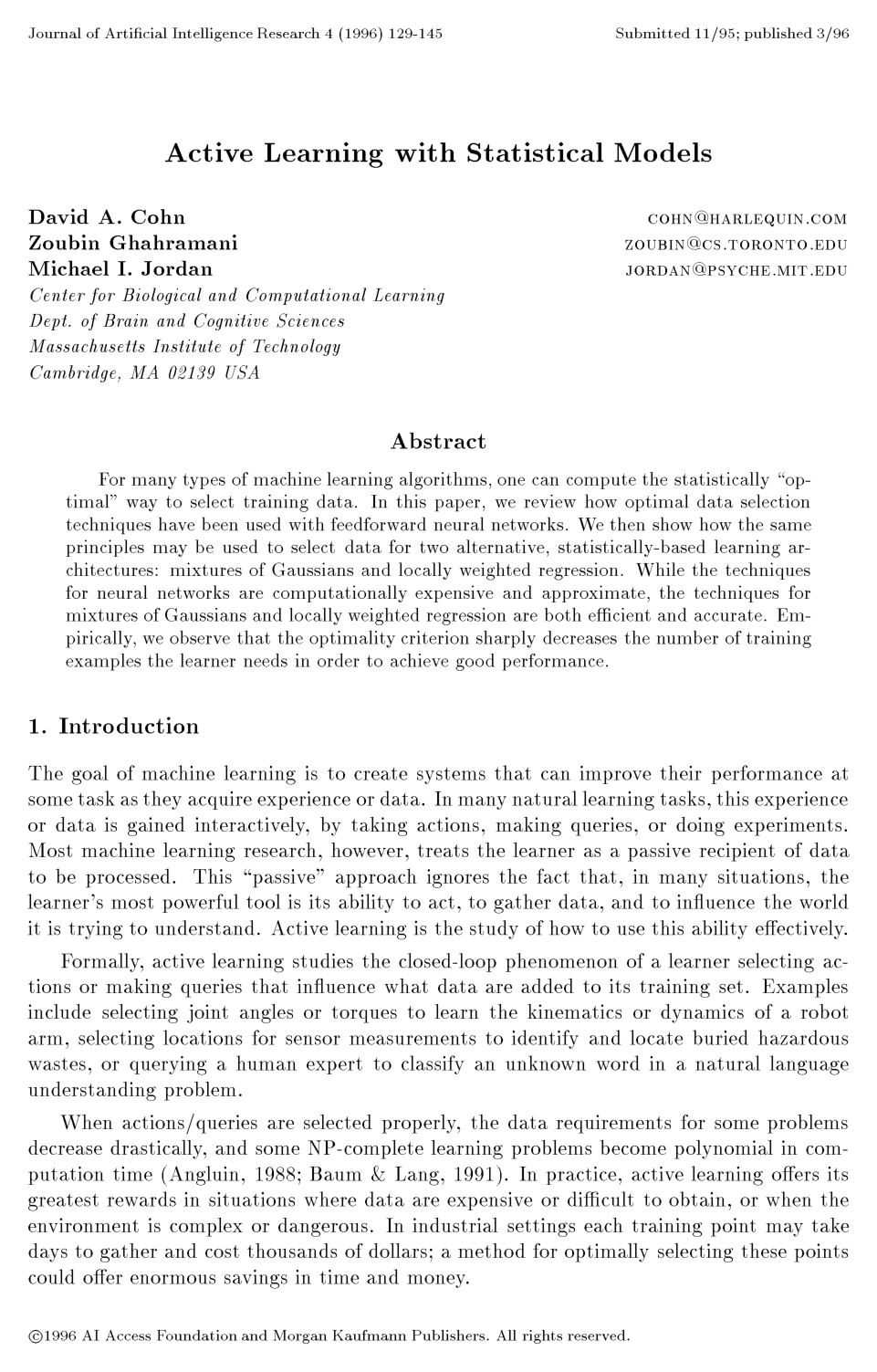
Active Learning with Statistical Models
D. Cohn, Zoubin Ghahramani, Michael I. Jordan
Why you should read this
Derives exact, closed-form criteria for active data selection through variance minimization in mixtures of Gaussians and locally weighted regression, enabling computationally efficient query selection that drastically reduces the training examples required for accurate regression.
For many types of machine learning algorithms, one can compute the statistically “optimal” way to select training data. In this paper, we review how optimal data selection techniques have been used with feedforward neural networks. We then show how the same principles may be used to select data for two alternative, statistically-based learning architectures: mixtures of Gaussians and locally weighted regression. While the techniques for neural networks are computationally expensive and approximate, the techniques for mixtures of Gaussians and locally weighted regression are both efficient and accurate. Empirically, we observe that the optimality criterion sharply decreases the number of training examples the learner needs in order to achieve good performance.
Added
2026-09-14
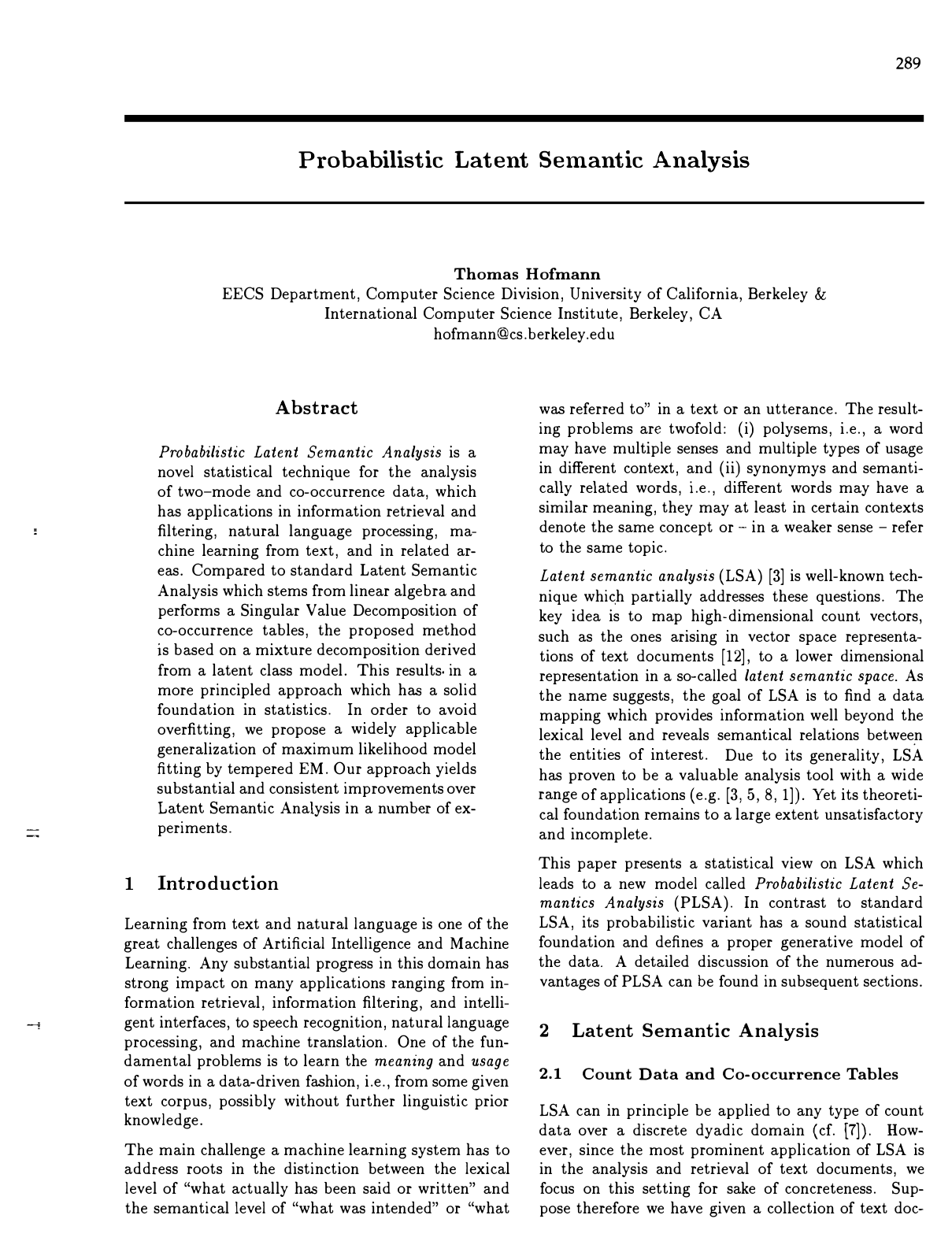
Probabilistic Latent Semantic Analysis
Thomas Hofmann
Why you should read this
Proposes Probabilistic Latent Semantic Analysis, replacing standard algebraic singular value decomposition with a statistical latent class mixture model fitted by tempered EM to substantially improve document modeling and information retrieval.
Probabilistic Latent Semantic Analysis is a novel statistical technique for the analysis of two-mode and co-occurrence data, which has applications in information retrieval and filtering, natural language processing, machine learning from text, and in related areas. Compared to standard Latent Semantic Analysis which stems from linear algebra and performs a Singular Value Decomposition of co-occurrence tables, the proposed method is based on a mixture decomposition derived from a latent class model. This results in a more principled approach which has a solid foundation in statistics. In order to avoid overfitting, we propose a widely applicable generalization of maximum likelihood model fitting by tempered EM. Our approach yields substantial and consistent improvements over Latent Semantic Analysis in a number of experiments.
Added
2026-09-14
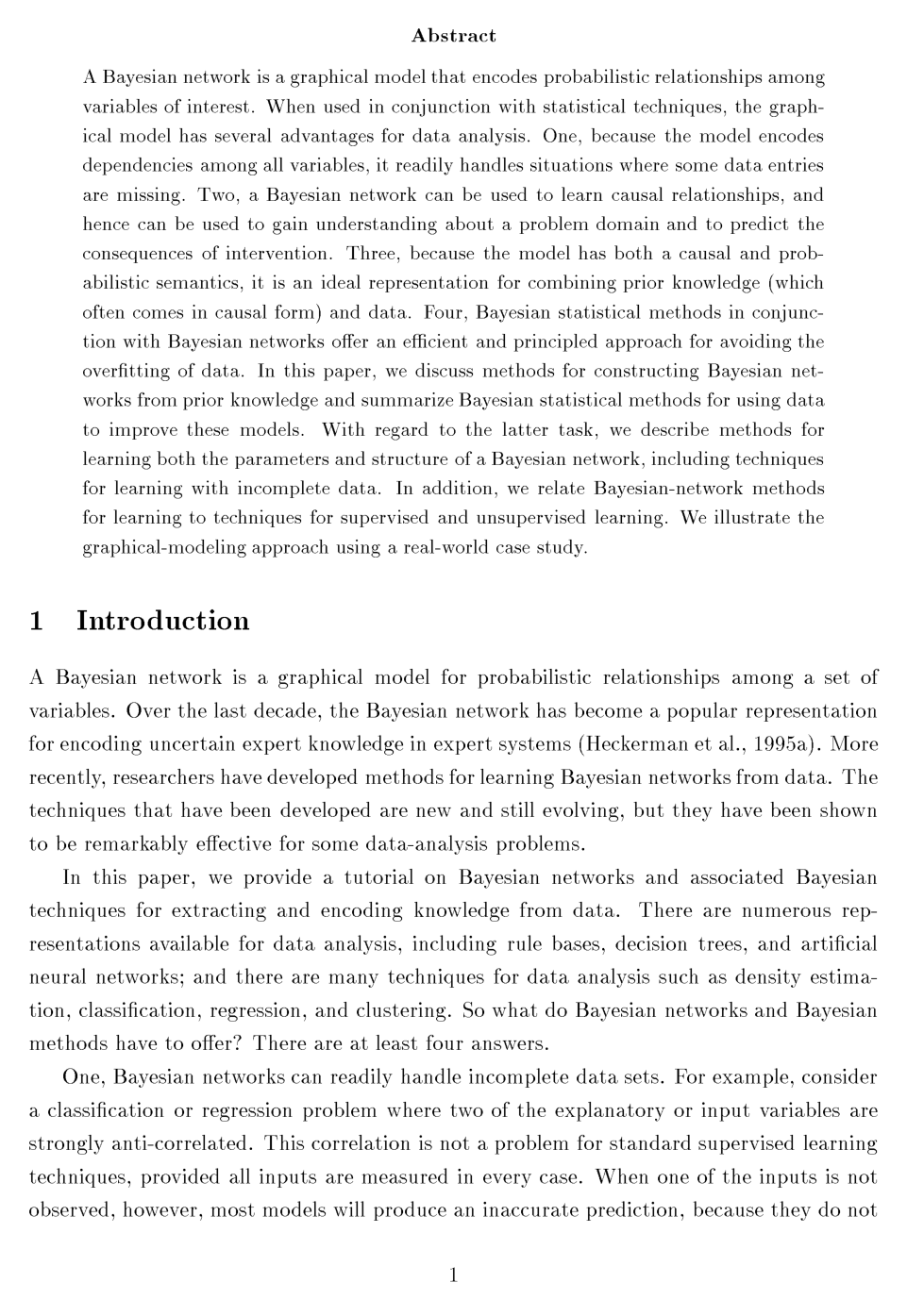
A Tutorial on Learning with Bayesian Networks
David Heckerman
Why you should read this
Explains the foundational principles and practical algorithms for learning both the structure and parameters of Bayesian networks from complete and incomplete data, bridging statistical inference, prior knowledge integration, and causal discovery.
A Bayesian network is a graphical model that encodes probabilistic relationships among variables of interest. When used in conjunction with statistical techniques, the graphical model has several advantages for data analysis. One, because the model encodes dependencies among all variables, it readily handles situations where some data entries are missing. Two, a Bayesian network can be used to learn causal relationships, and hence can be used to gain understanding about a problem domain and to predict the consequences of intervention. Three, because the model has both a causal and probabilistic semantics, it is an ideal representation for combining prior knowledge (which often comes in causal form) and data. Four, Bayesian statistical methods in conjunction with Bayesian networks offer an efficient and principled approach for avoiding the overfitting of data. In this paper, we discuss methods for constructing Bayesian networks from prior knowledge and summarize Bayesian statistical methods for using data to improve these models. With regard to the latter task, we describe methods for learning both the parameters and structure of a Bayesian network, including techniques for learning with incomplete data. In addition, we relate Bayesian-network methods for learning to techniques for supervised and unsupervised learning. We illustrate the graphical-modeling approach using a real-world case study.
Added
2026-09-13
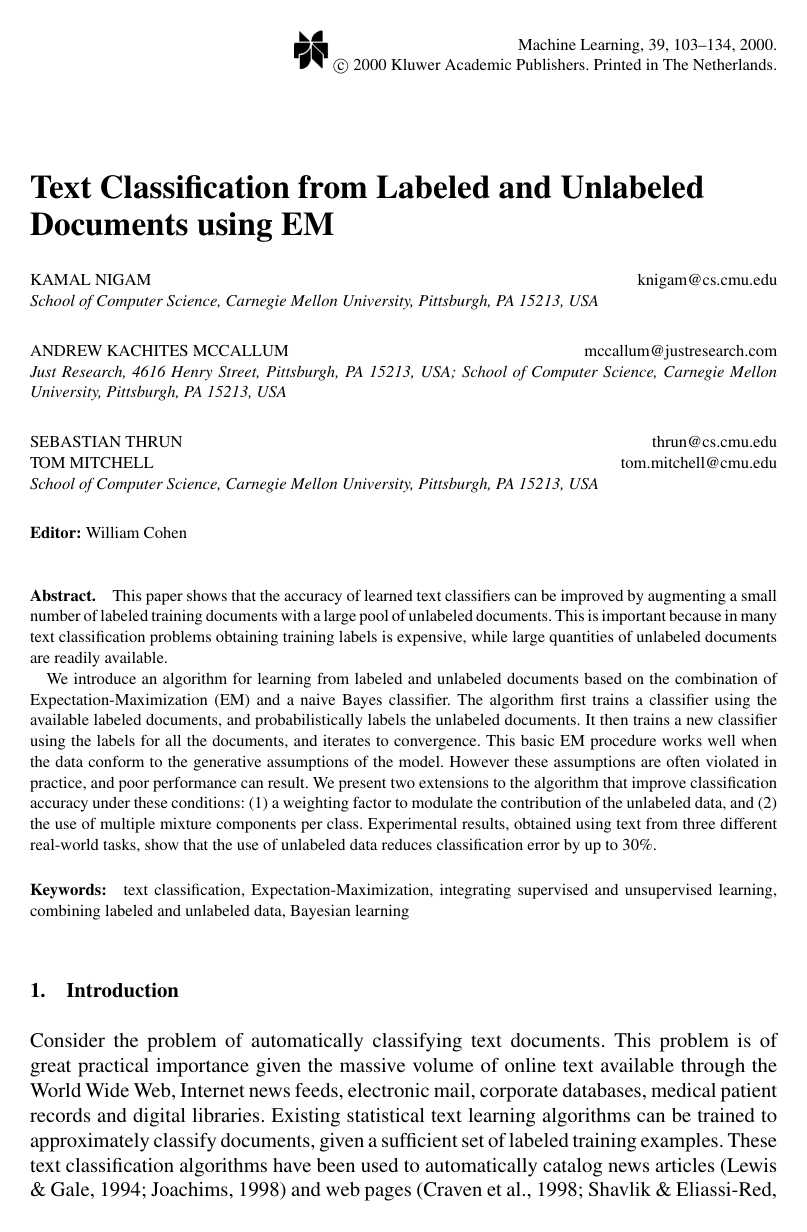
Text Classification from Labeled and Unlabeled Documents using EM
Kamal Nigam, Andrew Kachites Mccallum, Sebastian Thrun, Tom Mitchell
Why you should read this
Demonstrates how combining Expectation-Maximization with naive Bayes leverages abundant unlabeled text to significantly reduce classification error and labeled data requirements, while introducing practical extensions to address violated generative model assumptions.
This paper shows that the accuracy of learned text classifiers can be improved by augmenting a small number of labeled training documents with a large pool of unlabeled documents. This is important because in many text classification problems obtaining training labels is expensive, while large quantities of unlabeled documents are readily available. We introduce an algorithm for learning from labeled and unlabeled documents based on the combination of Expectation-Maximization (EM) and a naive Bayes classifier. The algorithm first trains a classifier using the available labeled documents, and probabilistically labels the unlabeled documents. It then trains a new classifier using the labels for all the documents, and iterates to convergence. This basic EM procedure works well when the data conform to the generative assumptions of the model. However these assumptions are often violated in practice, and poor performance can result. We present two extensions to the algorithm that improve classification accuracy under these conditions: (1) a weighting factor to modulate the contribution of the unlabeled data, and (2) the use of multiple mixture components per class. Experimental results, obtained using text from three different real-world tasks, show that the use of unlabeled data reduces classification error by up to 30%.
Added
2026-09-12
Probabilistic latent semantic indexing
Thomas Hofmann
Why you should read this
Introduces Probabilistic Latent Semantic Indexing (PLSI), a generative latent class approach fitted via tempered Expectation-Maximization that replaces heuristic singular value decomposition with a sound statistical foundation to handle synonymy and polysemy in information retrieval.
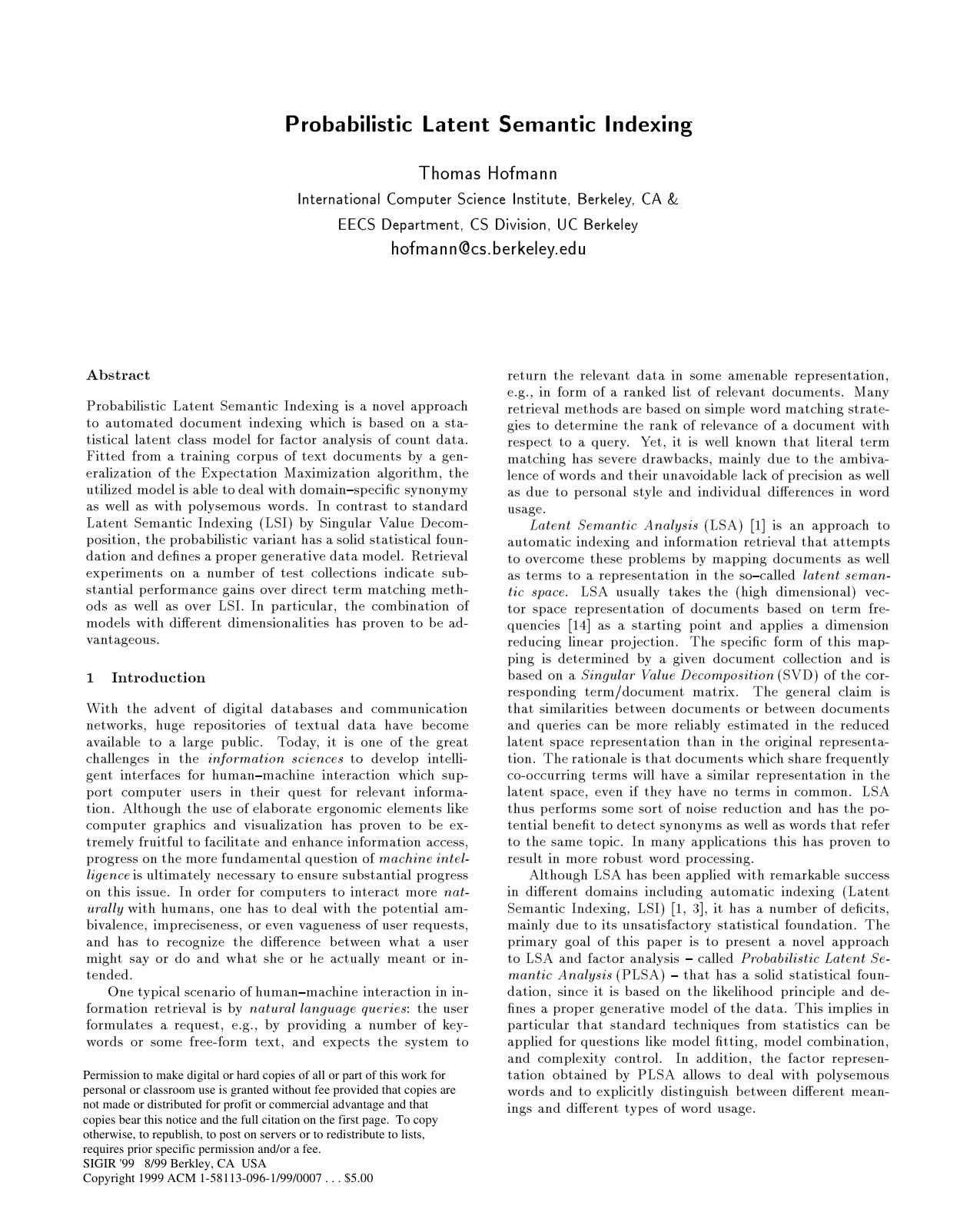
Probabilistic Latent Semantic Indexing is a novel approach to automated document indexing which is based on a statistical latent class model for factor analysis of count data. Fitted from a training corpus of text documents by a generalization of the Expectation Maximization algorithm, the utilized model is able to deal with domain-specific synonymy as well as with polysemous words. In contrast to standard Latent Semantic Indexing (LSI) by Singular Value Decomposition, the probabilistic variant has a solid statistical foundation and defines a proper generative data model. Retrieval experiments on a number of test collections indicate substantial performance gains over direct term matching methods as well as over LSI. In particular, the combination of models with different dimensionalities has proven to be advantageous.
Added
2026-09-11
Estimating Continuous Distributions in Bayesian Classifiers
George H. John, Pat Langley
Why you should read this
Demonstrates that replacing rigid normality assumptions with nonparametric kernel density estimation substantially reduces classification error in naive Bayesian classifiers handling continuous data.
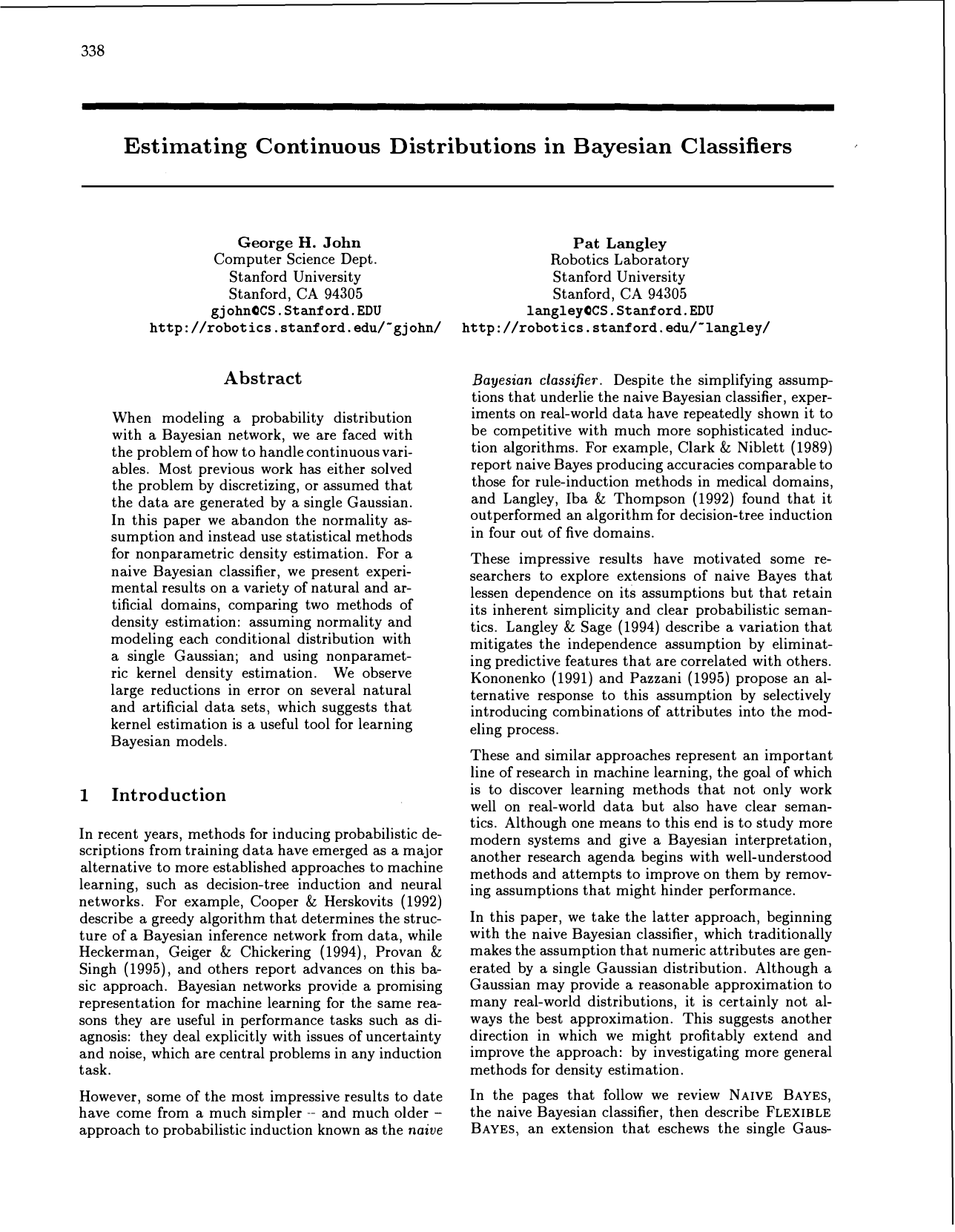
When modeling a probability distribution with a Bayesian network, we are faced with the problem of how to handle continuous variables. Most previous work has either solved the problem by discretizing, or assumed that the data are generated by a single Gaussian. In this paper we abandon the normality assumption and instead use statistical methods for nonparametric density estimation. For a naive Bayesian classifier, we present experimental results on a variety of natural and artificial domains, comparing two methods of density estimation: assuming normality and modeling each conditional distribution with a single Gaussian; and using nonparametric kernel density estimation. We observe large reductions in error on several natural and artificial data sets, which suggests that kernel estimation is a useful tool for learning Bayesian models.
Added
2026-09-11
Hierarchical Mixtures of Experts and the EM Algorithm
Michael I. Jordan, Robert A. Jacobs
Why you should read this
Establishes the recursive, tree-structured probabilistic framework for MoEs and sets forth the Expectation-Maximization algorithm for training them.
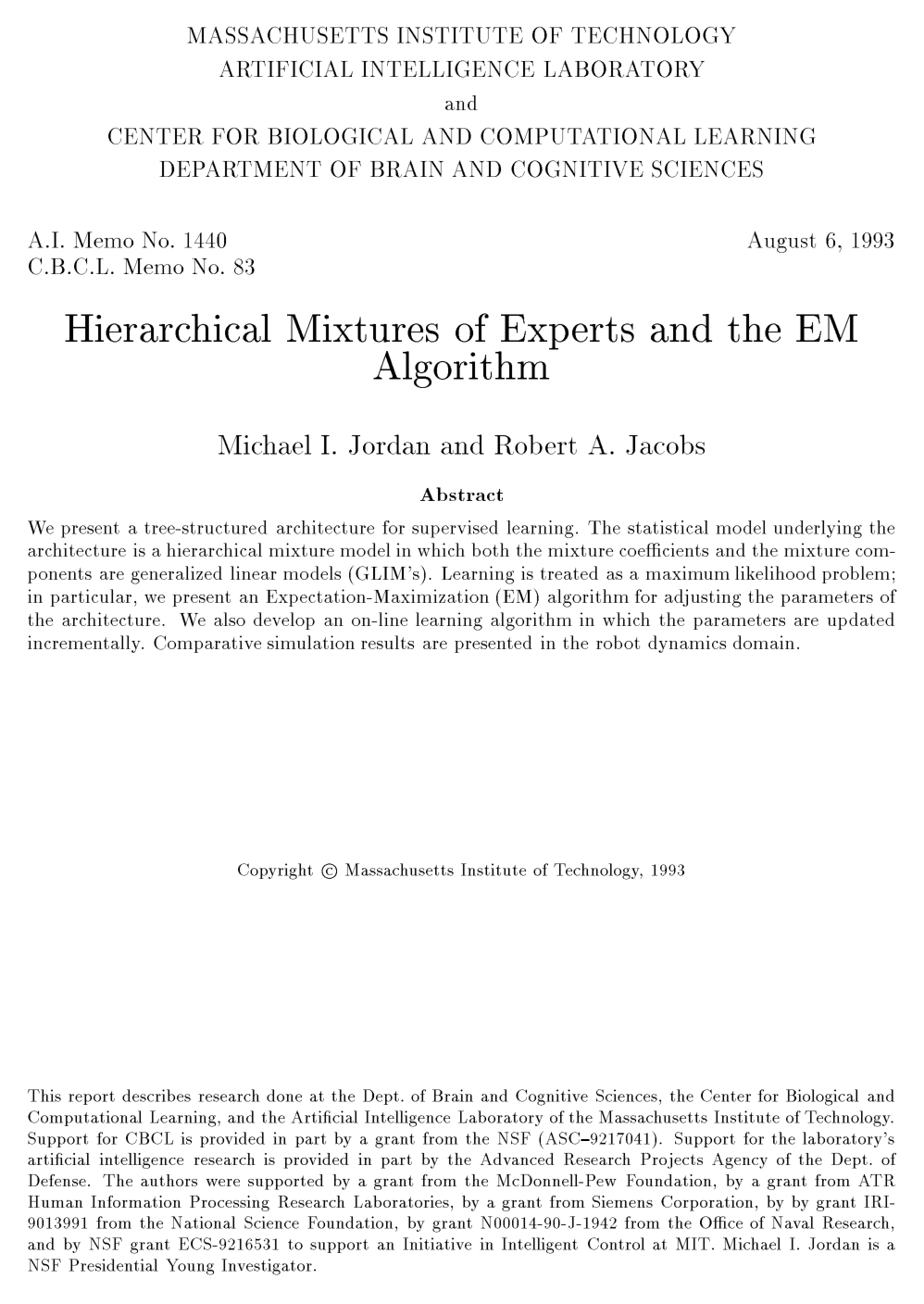
We present a tree-structured architecture for supervised learning. The statistical model underlying the architecture is a hierarchical mixture model in which both the mixture coefficients and the mixture components are generalized linear models (GLIM's). Learning is treated as a maximum likelihood problem; in particular, we present an Expectation-Maximization (EM) algorithm for adjusting the parameters of the architecture. We also develop an on-line learning algorithm in which the parameters are updated incrementally. Comparative simulation results are presented in the robot dynamics domain.
Added
2026-02-23