
keyword
domain randomization
Domain randomization is a machine learning and simulation technique designed to improve model generalization and bridge the reality gap when transferring models from simulated training environments to real-world or unseen domains. Rather than striving for photorealistic or perfectly calibrated simulations, this approach deliberately introduces wide statistical variability into the synthetic training environment by randomizing visual properties, such as textures, lighting, colors, and camera viewpoints, as well as physical parameters like friction, mass, and dynamics. By exposing the model to a diverse spectrum of randomized conditions during training, the real-world environment is treated as just another variation within the generated distribution, enabling the model to learn invariant, robust representations and perform tasks in physical settings without requiring extensive real-world training data.
8 items
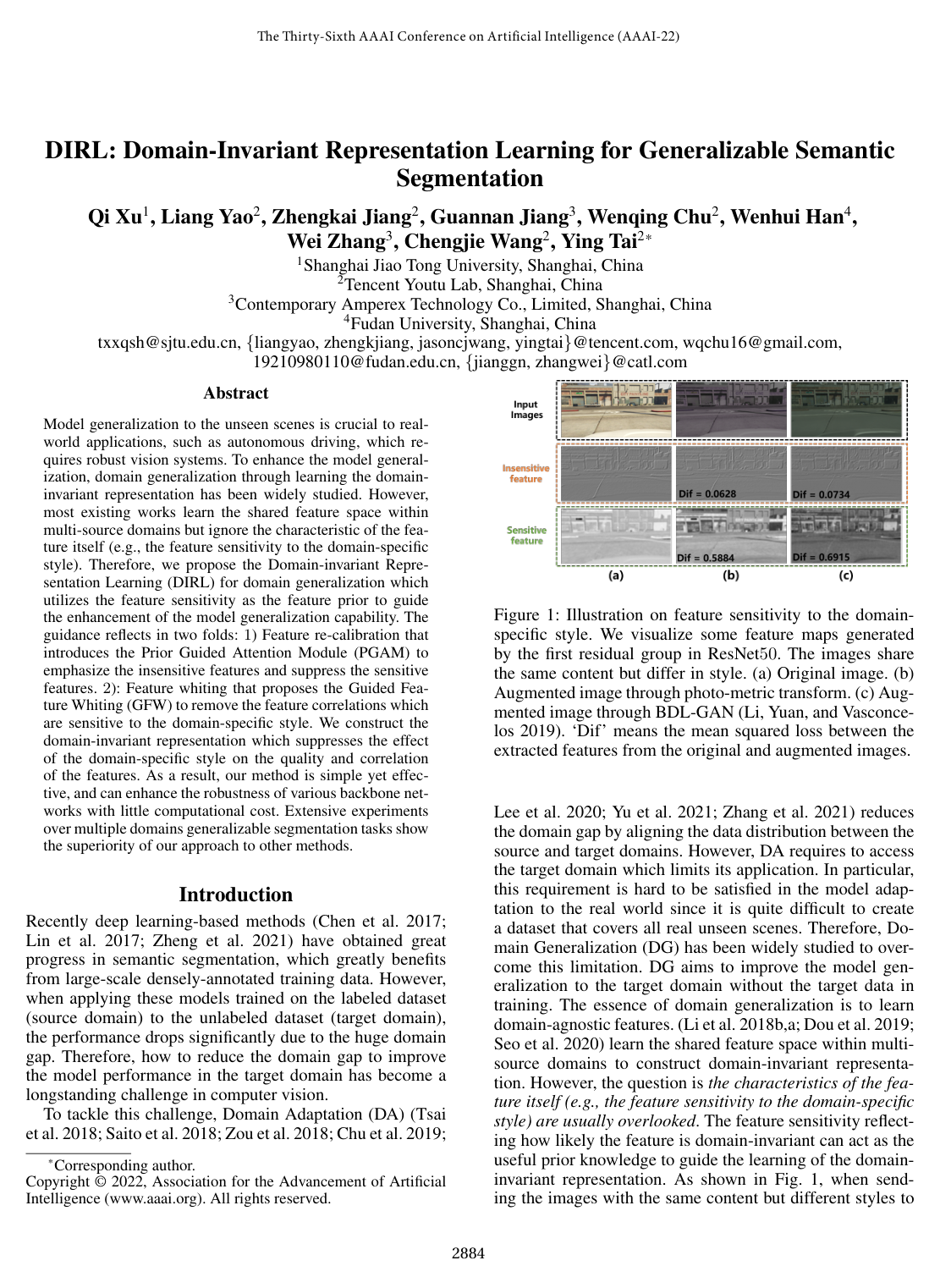
DIRL: Domain-Invariant Representation Learning for Generalizable Semantic Segmentation
Qi Xu, Liang Yao, Zhengkai Jiang, Guannan Jiang, Wenqing Chu, Wenhui Han, Wei Zhang, Chengjie Wang, Ying Tai
Why you should read this
Proposes a domain generalization framework for semantic segmentation that quantifies channel-level sensitivity to style shifts, using this prior knowledge to re-calibrate feature responses and selectively whiten domain-sensitive feature correlations.
Model generalization to the unseen scenes is crucial to real-world applications, such as autonomous driving, which requires robust vision systems. To enhance the model generalization, domain generalization through learning the domain-invariant representation has been widely studied. However, most existing works learn the shared feature space within multi-source domains but ignore the characteristic of the feature itself (e.g., the feature sensitivity to the domain-specific style). Therefore, we propose the Domain-invariant Representation Learning (DIRL) for domain generalization which utilizes the feature sensitivity as the feature prior to guide the enhancement of the model generalization capability. The guidance reflects in two folds: 1) Feature re-calibration that introduces the Prior Guided Attention Module (PGAM) to emphasize the insensitive features and suppress the sensitive features. 2) Feature whiting that proposes the Guided Feature Whiting (GFW) to remove the feature correlations which are sensitive to the domain-specific style. We construct the domain-invariant representation which suppresses the effect of the domain-specific style on the quality and correlation of the features. As a result, our method is simple yet effective, and can enhance the robustness of various backbone networks with little computational cost. Extensive experiments over multiple domains generalizable segmentation tasks show the superiority of our approach to other methods.
Added
2026-09-26
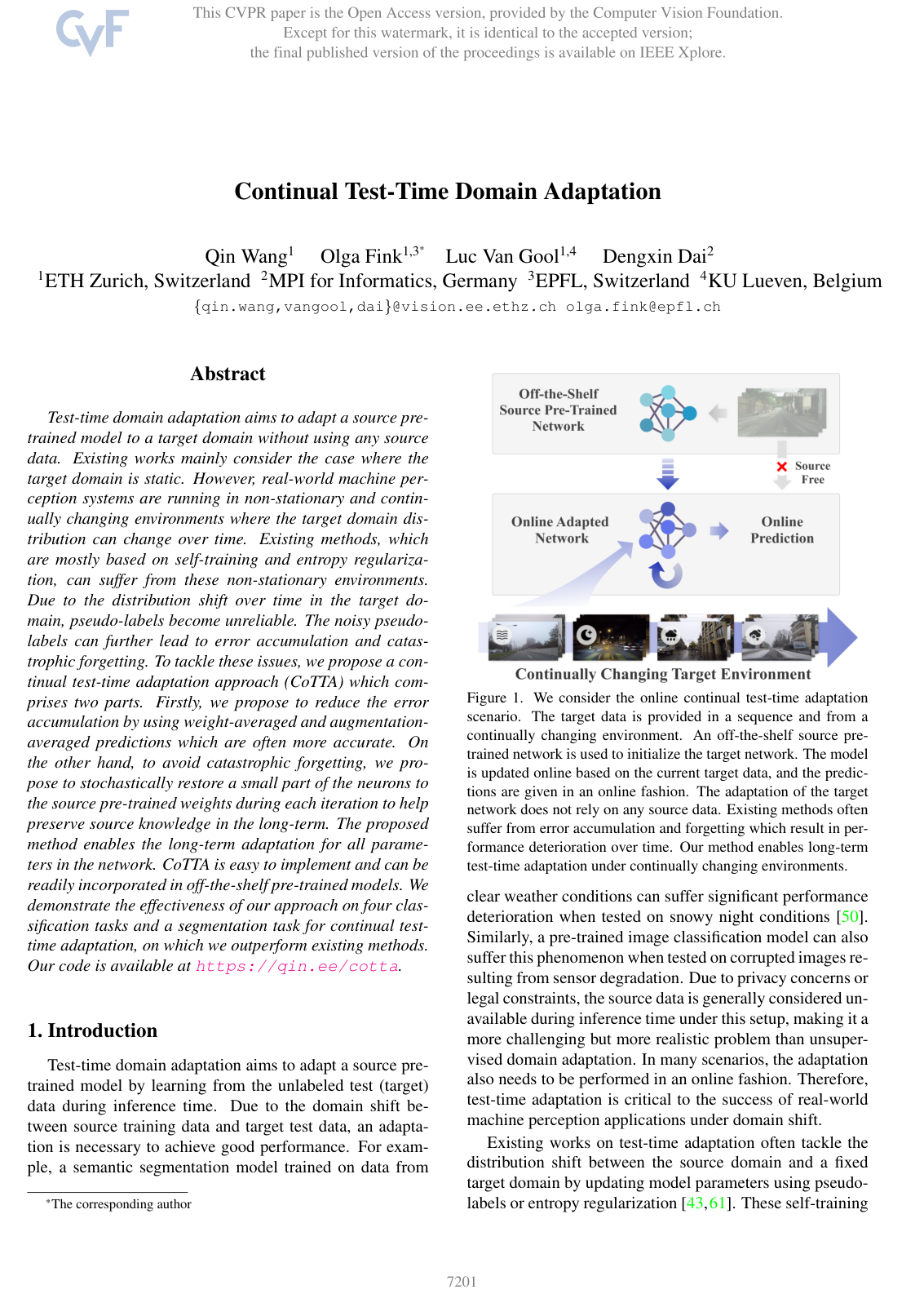
Continual Test-Time Domain Adaptation
Qin Wang, Olga Fink, Luc Van Gool, Dengxin Dai
Why you should read this
Introduces CoTTA, a continual test-time adaptation framework that prevents error accumulation and catastrophic forgetting in dynamically shifting target domains through averaged predictions and stochastic weight restoration.
Test-time domain adaptation aims to adapt a source pre-trained model to a target domain without using any source data. Existing works mainly consider the case where the target domain is static. However, real-world machine perception systems are running in non-stationary and continually changing environments where the target domain distribution can change over time. Existing methods, which are mostly based on self-training and entropy regularization, can suffer from these non-stationary environments. Due to the distribution shift over time in the target domain, pseudo-labels become unreliable. The noisy pseudo-labels can further lead to error accumulation and catastrophic forgetting. To tackle these issues, we propose a continual test-time adaptation approach~(CoTTA) which comprises two parts. Firstly, we propose to reduce the error accumulation by using weight-averaged and augmentation-averaged predictions which are often more accurate. On the other hand, to avoid catastrophic forgetting, we propose to stochastically restore a small part of the neurons to the source pre-trained weights during each iteration to help preserve source knowledge in the long-term. The proposed method enables the long-term adaptation for all parameters in the network. CoTTA is easy to implement and can be readily incorporated in off-the-shelf pre-trained models. We demonstrate the effectiveness of our approach on four classification tasks and a segmentation task for continual test-time adaptation, on which we outperform existing methods. Our code is available at \url{this https URL}.
Added
2026-09-26
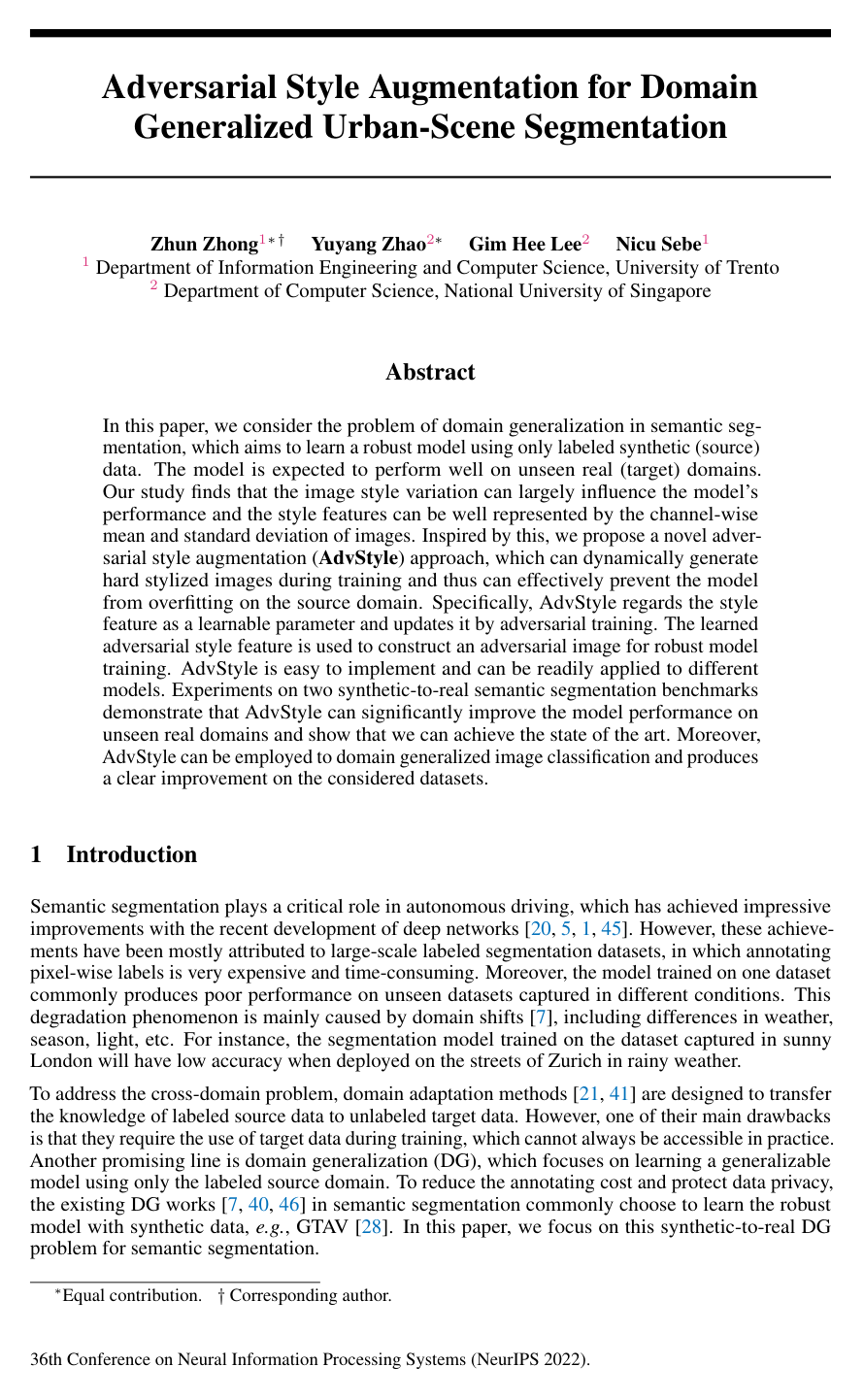
Adversarial Style Augmentation for Domain Generalized Urban-Scene Segmentation
Zhun Zhong, Yuyang Zhao, Gim Hee Lee, Nicu Sebe
Why you should read this
Proposes a dynamic data augmentation framework that optimizes channel-wise image statistics via adversarial training to synthesize challenging styles from synthetic data alone, substantially boosting cross-domain semantic segmentation performance on unseen real-world driving scenes.
In this paper, we consider the problem of domain generalization in semantic segmentation, which aims to learn a robust model using only labeled synthetic (source) data. The model is expected to perform well on unseen real (target) domains. Our study finds that the image style variation can largely influence the model's performance and the style features can be well represented by the channel-wise mean and standard deviation of images. Inspired by this, we propose a novel adversarial style augmentation (AdvStyle) approach, which can dynamically generate hard stylized images during training and thus can effectively prevent the model from overfitting on the source domain. Specifically, AdvStyle regards the style feature as a learnable parameter and updates it by adversarial training. The learned adversarial style feature is used to construct an adversarial image for robust model training. AdvStyle is easy to implement and can be readily applied to different models. Experiments on two synthetic-to-real semantic segmentation benchmarks demonstrate that AdvStyle can significantly improve the model performance on unseen real domains and show that we can achieve the state of the art. Moreover, AdvStyle can be employed to domain generalized image classification and produces a clear improvement on the considered datasets.
Added
2026-09-26
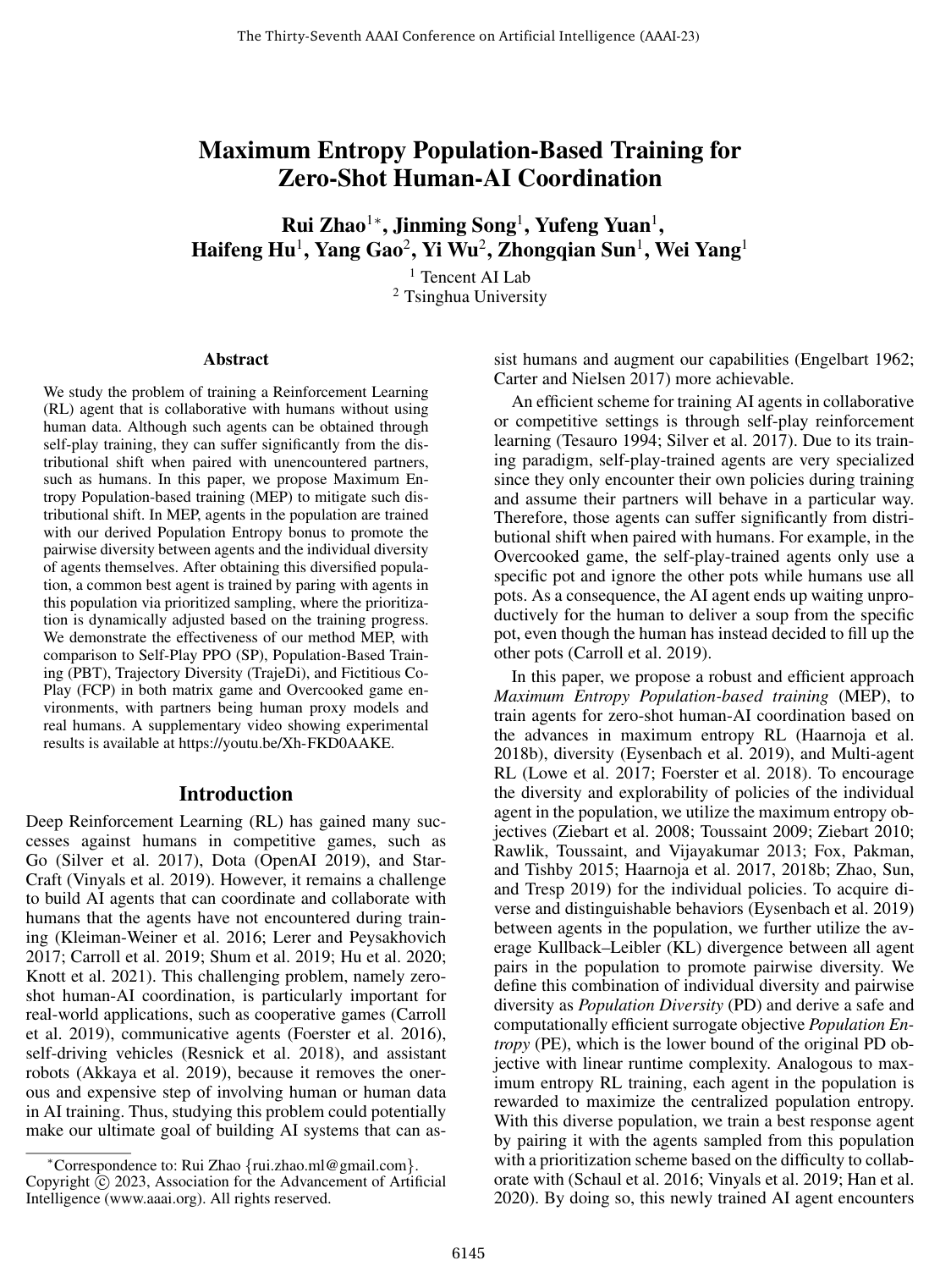
Maximum Entropy Population-Based Training for Zero-Shot Human-AI Coordination
Rui Zhao, Jinming Song, Yufeng Yuan, Haifeng Hu, Yang Gao, Yi Wu, Zhongqian Sun, Wei Yang
Why you should read this
Introduces Maximum Entropy Population-based training, a framework that generates a diverse partner population using a computationally efficient population entropy objective and trains a coordinator agent via prioritized sampling to enable zero-shot human-AI collaboration without requiring human data.
We study the problem of training a Reinforcement Learning (RL) agent that is collaborative with humans without using human data. Although such agents can be obtained through self-play training, they can suffer significantly from the distributional shift when paired with unencountered partners, such as humans. In this paper, we propose Maximum Entropy Population-based training (MEP) to mitigate such distributional shift. In MEP, agents in the population are trained with our derived Population Entropy bonus to promote the pairwise diversity between agents and the individual diversity of agents themselves. After obtaining this diversified population, a common best agent is trained by paring with agents in this population via prioritized sampling, where the prioritization is dynamically adjusted based on the training progress. We demonstrate the effectiveness of our method MEP, with comparison to Self-Play PPO (SP), Population-Based Training (PBT), Trajectory Diversity (TrajeDi), and Fictitious Co-Play (FCP) in both matrix game and Overcooked game environments, with partners being human proxy models and real humans. A supplementary video showing experimental results is available at https://youtu.be/Xh-FKD0AAKE.
Added
2026-09-26
Domain Generalization: A Survey
Kaiyang Zhou, Ziwei Liu, Yu Qiao, Tao Xiang, Chen Change Loy
Why you should read this
Systematizes a decade of domain generalization research by establishing a formal framework, categorizing diverse methodologies from meta-learning to data augmentation, and identifying key open challenges for training models that generalize to unseen distributions.
Generalization to out-of-distribution (OOD) data is a capability natural to humans yet challenging for machines to reproduce. This is because most learning algorithms strongly rely on the i.i.d.~assumption on source/target data, which is often violated in practice due to domain shift. Domain generalization (DG) aims to achieve OOD generalization by using only source data for model learning. Over the last ten years, research in DG has made great progress, leading to a broad spectrum of methodologies, e.g., those based on domain alignment, meta-learning, data augmentation, or ensemble learning, to name a few; DG has also been studied in various application areas including computer vision, speech recognition, natural language processing, medical imaging, and reinforcement learning. In this paper, for the first time a comprehensive literature review in DG is provided to summarize the developments over the past decade. Specifically, we first cover the background by formally defining DG and relating it to other relevant fields like domain adaptation and transfer learning. Then, we conduct a thorough review into existing methods and theories. Finally, we conclude this survey with insights and discussions on future research directions.
Added
2026-09-24
Sim-to-Real Transfer of Robotic Control with Dynamics Randomization
Xue Bin Peng, Marcin Andrychowicz, Wojciech Zaremba, Pieter Abbeel
Why you should read this
Demonstrates that randomizing physical dynamics during simulation training enables robotic control policies to transfer directly to physical hardware without requiring real-world data or exact model calibration.
Simulations are attractive environments for training agents as they provide an abundant source of data and alleviate certain safety concerns during the training process. But the behaviours developed by agents in simulation are often specific to the characteristics of the simulator. Due to modeling error, strategies that are successful in simulation may not transfer to their real world counterparts. In this paper, we demonstrate a simple method to bridge this "reality gap". By randomizing the dynamics of the simulator during training, we are able to develop policies that are capable of adapting to very different dynamics, including ones that differ significantly from the dynamics on which the policies were trained. This adaptivity enables the policies to generalize to the dynamics of the real world without any training on the physical system. Our approach is demonstrated on an object pushing task using a robotic arm. Despite being trained exclusively in simulation, our policies are able to maintain a similar level of performance when deployed on a real robot, reliably moving an object to a desired location from random initial configurations. We explore the impact of various design decisions and show that the resulting policies are robust to significant calibration error.
Added
2026-09-18
Generalizing to Unseen Domains: A Survey on Domain Generalization
Jindong Wang, Cuiling Lan, Chang Liu, Yidong Ouyang, Tao Qin
Why you should read this
Systematizes out-of-distribution machine learning by establishing theoretical foundations for domain generalization, classifying existing methods into a clear three-part taxonomy, and providing standardized benchmark datasets with an open-source codebase for fair evaluation.
Machine learning systems generally assume that the training and testing distributions are the same. To this end, a key requirement is to develop models that can generalize to unseen distributions. Domain generalization (DG), i.e., out-of-distribution generalization, has attracted increasing interests in recent years. Domain generalization deals with a challenging setting where one or several different but related domain(s) are given, and the goal is to learn a model that can generalize to an unseen test domain. Great progress has been made in the area of domain generalization for years. This paper presents the first review of recent advances in this area. First, we provide a formal definition of domain generalization and discuss several related fields. We then thoroughly review the theories related to domain generalization and carefully analyze the theory behind generalization. We categorize recent algorithms into three classes: data manipulation, representation learning, and learning strategy, and present several popular algorithms in detail for each category. Third, we introduce the commonly used datasets, applications, and our open-sourced codebase for fair evaluation. Finally, we summarize existing literature and present some potential research topics for the future.
Added
2026-09-18
Domain randomization for transferring deep neural networks from simulation to the real world
Josh Tobin, Rachel Fong, Alex Ray, Jonas Schneider, Wojciech Zaremba, Pieter Abbeel
Why you should read this
Proposes domain randomization to bridge the reality gap in robotics, proving that neural networks trained entirely on synthetic images with randomized rendering can achieve accurate real-world object localization and robotic grasping without any real training data.
Bridging the 'reality gap' that separates simulated robotics from experiments on hardware could accelerate robotic research through improved data availability. This paper explores domain randomization, a simple technique for training models on simulated images that transfer to real images by randomizing rendering in the simulator. With enough variability in the simulator, the real world may appear to the model as just another variation. We focus on the task of object localization, which is a stepping stone to general robotic manipulation skills. We find that it is possible to train a real-world object detector that is accurate to cm and robust to distractors and partial occlusions using only data from a simulator with non-realistic random textures. To demonstrate the capabilities of our detectors, we show they can be used to perform grasping in a cluttered environment. To our knowledge, this is the first successful transfer of a deep neural network trained only on simulated RGB images (without pre-training on real images) to the real world for the purpose of robotic control.
Added
2026-09-11