
keyword
diffusion transformer
A diffusion transformer is a class of generative artificial intelligence model that combines diffusion probabilistic modeling with a transformer neural network architecture as its core denoising engine. Unlike traditional diffusion models that rely primarily on convolutional U-Net backbones to remove noise from data, a diffusion transformer treats inputs as sequences of tokens, such as patches of images, video frames, or latent representations. By applying multi-head self-attention across these token sequences, the model effectively captures global spatial, temporal, and semantic relationships while conditioning on inputs such as text descriptions, class labels, or structural maps. This design improves computational scalability, supports flexible input resolutions and sequence lengths, and facilitates high-fidelity generation across diverse visual and multimodal tasks.
6 items
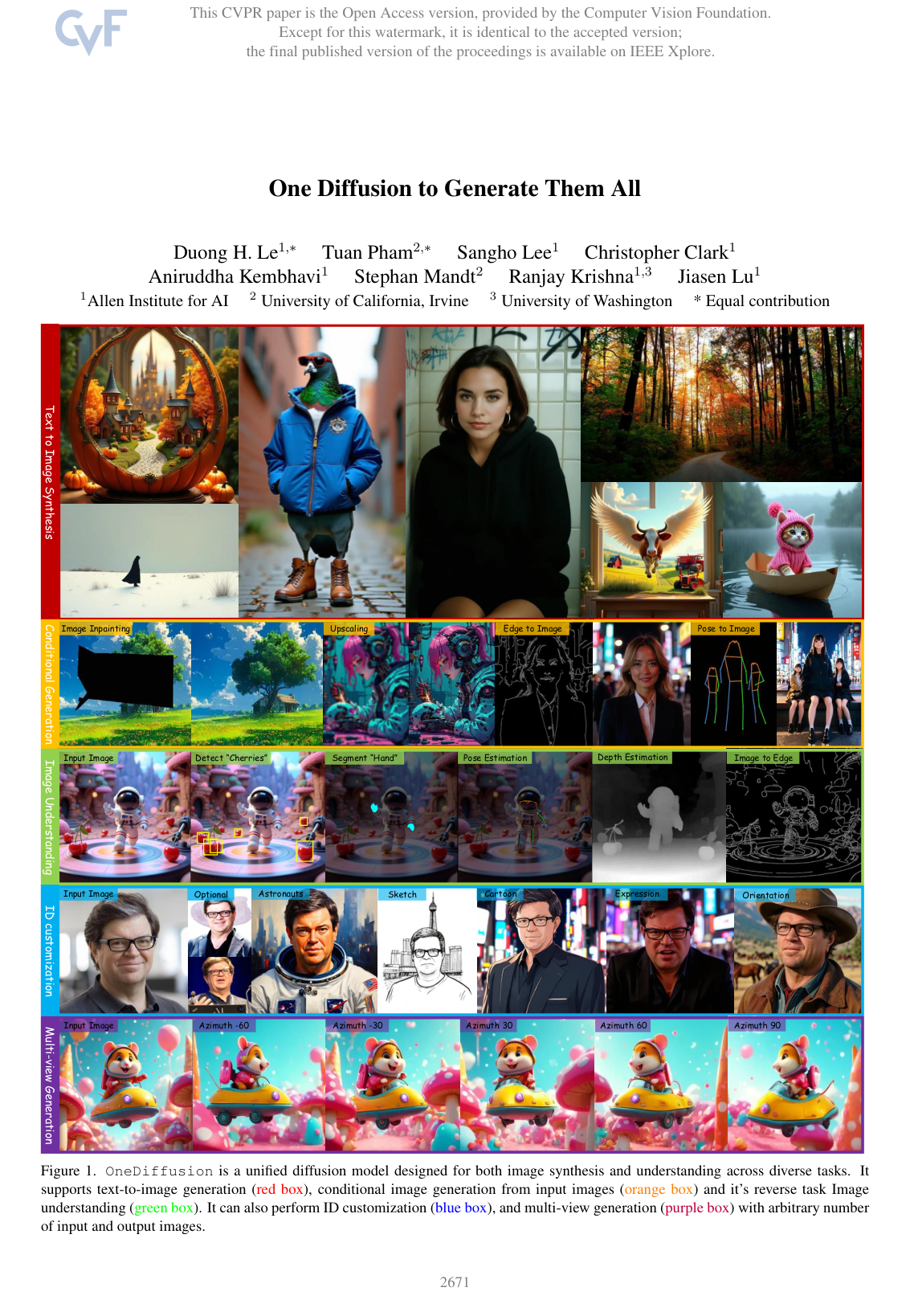
One Diffusion to Generate Them All
Duong H. Le, Tuan Pham, Sangho Lee, Christopher Clark, Aniruddha Kembhavi, Stephan Mandt, Ranjay Krishna, Jiasen Lu
Why you should read this
Presents OneDiffusion, a unified diffusion model that integrates bidirectional image synthesis and visual understanding into a single architecture by formulating diverse vision tasks as multi-frame sequences with variable noise scales.
We introduce OneDiffusion, a versatile, large-scale diffusion model that seamlessly supports bidirectional image synthesis and understanding across diverse tasks. It enables conditional generation from inputs such as text, depth, pose, layout, and semantic maps, while also handling tasks like image deblurring, upscaling, and reverse processes such as depth estimation and segmentation. Additionally, OneDiffusion allows for multi-view generation, camera pose estimation, and instant personalization using sequential image inputs. Our model takes a straightforward yet effective approach by treating all tasks as frame sequences with varying noise scales during training, allowing any frame to act as a conditioning image at inference time. Our unified training framework removes the need for specialized architectures, supports scalable multi-task training, and adapts smoothly to any resolution, enhancing both generalization and scalability. Experimental results demonstrate competitive performance across tasks in both generation and prediction such as text-to-image, multiview generation, ID preservation, depth estimation and camera pose estimation despite relatively small training dataset. Our code and checkpoint are freely available at this https URL
Added
2026-10-03
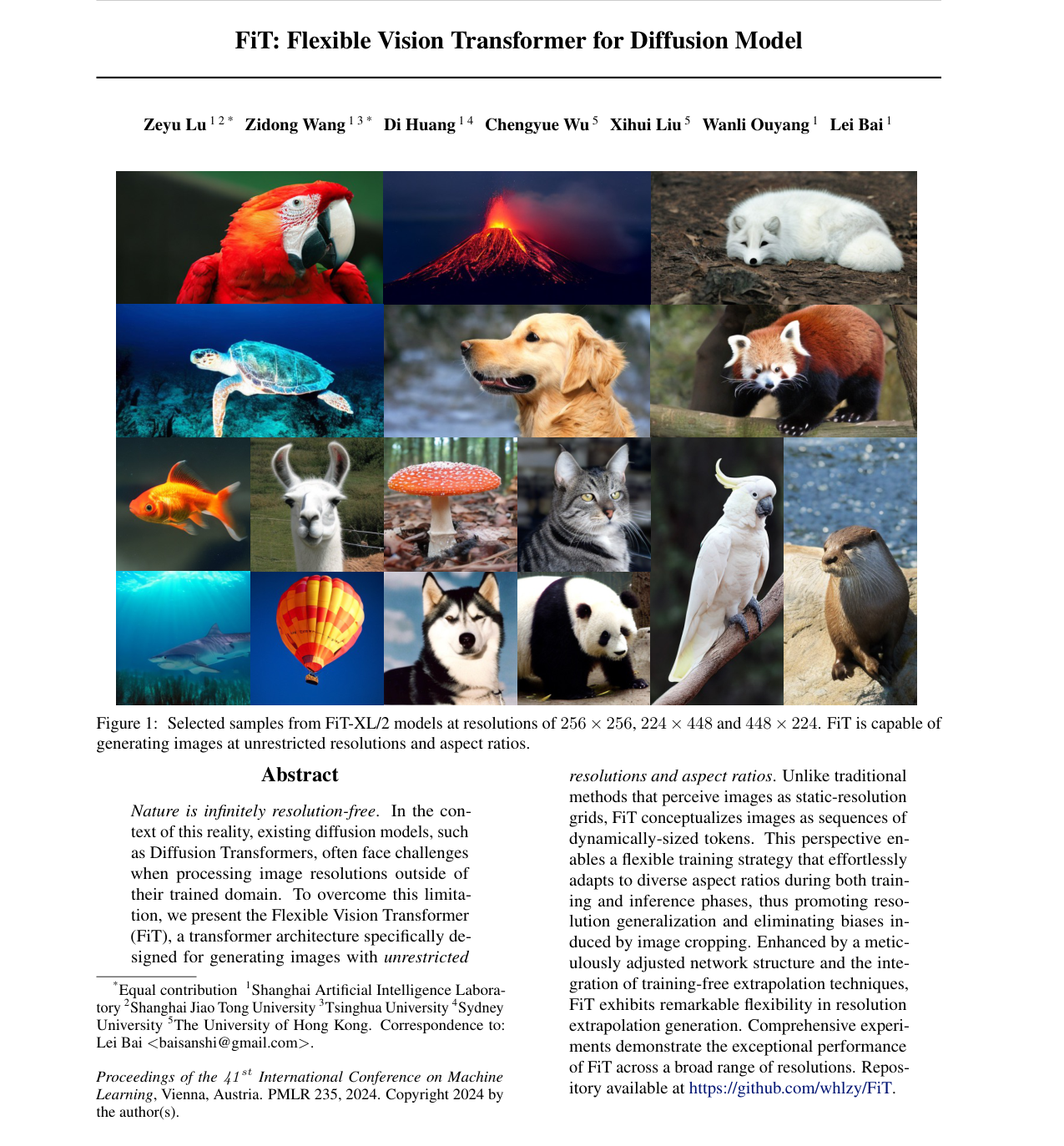
FiT: Flexible Vision Transformer for Diffusion Model
Zeyu Lu, Zidong Wang, Di Huang, Chengyue Wu, Xihui Liu, Wanli Ouyang, Lei Bai
Why you should read this
Proposes a flexible vision transformer architecture that treats images as variable-length token sequences using 2D rotary positional embeddings, enabling diffusion models to generate high-fidelity images across arbitrary resolutions and aspect ratios without cropping.
Nature is infinitely resolution-free. In the context of this reality, existing diffusion models, such as Diffusion Transformers, often face challenges when processing image resolutions outside of their trained domain. To overcome this limitation, we present the Flexible Vision Transformer (FiT), a transformer architecture specifically designed for generating images with unrestricted resolutions and aspect ratios. Unlike traditional methods that perceive images as static-resolution grids, FiT conceptualizes images as sequences of dynamically-sized tokens. This perspective enables a flexible training strategy that effortlessly adapts to diverse aspect ratios during both training and inference phases, thus promoting resolution generalization and eliminating biases induced by image cropping. Enhanced by a meticulously adjusted network structure and the integration of training-free extrapolation techniques, FiT exhibits remarkable flexibility in resolution extrapolation generation. Comprehensive experiments demonstrate the exceptional performance of FiT across a broad range of resolutions. Repository available at https://github.com/whlzy/FiT.
Added
2026-09-26
Looped Diffusion Language Models
Sanghyun Lee, Chunsan Hong, Seungryong Kim, Jonghyun Lee, Jongho Park, Dongmin Park
Why you should read this
Introduces LoopMDM, a novel transformer architecture for masked diffusion language models that significantly boosts training efficiency and performance on reasoning benchmarks by selectively looping early-middle layers, achieving depth-scaling effects without added parameters and enabling flexible inference-time compute scaling.
Masked diffusion models (MDMs) have emerged as a promising alternative to autoregressive models for language modeling, yet the effective design of transformer architectures for MDMs remains underexplored. In this paper, we show that selectively looping the early-middle transformer layers significantly improves both training efficiency and model performance in MDMs. We call this approach LoopMDM(Looped Masked Diffusion Model), which brings two key benefits: looping layers at training-time yields a depth-scaling effect without adding parameters, while varying the number of loops at inference-time enables flexible compute scaling. Despite the simplicity, the results are striking: across multiple pre-training corpora, LoopMDM matches the performance of same-size MDMs with up to 3.3 fewer training FLOPs, while its final performance outperforms them on various reasoning benchmarks, including up to 8.5 points on GSM8K. It even surpasses deeper non-looped MDMs trained with comparable per-step compute, indicating that selective looping is more effective than naive depth scaling. Furthermore, LoopMDM can scale inference-time compute by increasing the number of loops. Adaptively adjusting the number of loops throughout the sampling process further yields additional gains in compute efficiency while maintaining performance. Lastly, with attention analysis, we provide evidence that looping is effective in MDMs by promoting interactions among masked positions. Our code and weights will be publicly released.
Added
2026-07-31

DiffusionBlocks: Block-wise Neural Network Training via Diffusion Interpretation
Makoto Shing, Masanori Koyama, Takuya Akiba
Why you should read this
Presents DiffusionBlocks, a theoretically grounded framework that transforms transformer-based networks into independently trainable blocks using a diffusion interpretation, achieving competitive performance with end-to-end training while significantly reducing memory requirements across diverse generative tasks.
End-to-end backpropagation requires storing activations throughout all layers, creating memory bottlenecks that limit model scalability. Existing block-wise training methods offer means to alleviate this problem, but they rely on ad-hoc local objectives and remain largely unexplored beyond classification tasks. We propose , a principled framework for transforming transformer-based networks into genuinely independent trainable blocks that maintain competitive performance with end-to-end training. Our key insight leverages the fact that residual connections naturally correspond to updates in a dynamical system. With minimal modifications to this system, we can convert the updates to those of a denoising process, where each block can be learned independently by leveraging the score matching objective. This independence enables training with gradients for only one block at a time, thereby reducing memory requirements in proportion to the number of blocks. Our experiments on a range of transformer architectures (vision, diffusion, autoregressive, recurrent-depth, and masked diffusion) demonstrate that DiffusionBlocks training matches the performance of end-to-end training while enabling scalable block-wise training on practical tasks beyond small-scale classification. DiffusionBlocks provides a theoretically grounded approach that successfully scales to modern generative tasks across diverse architectures. Code is available at this https URL .
Added
2026-05-27
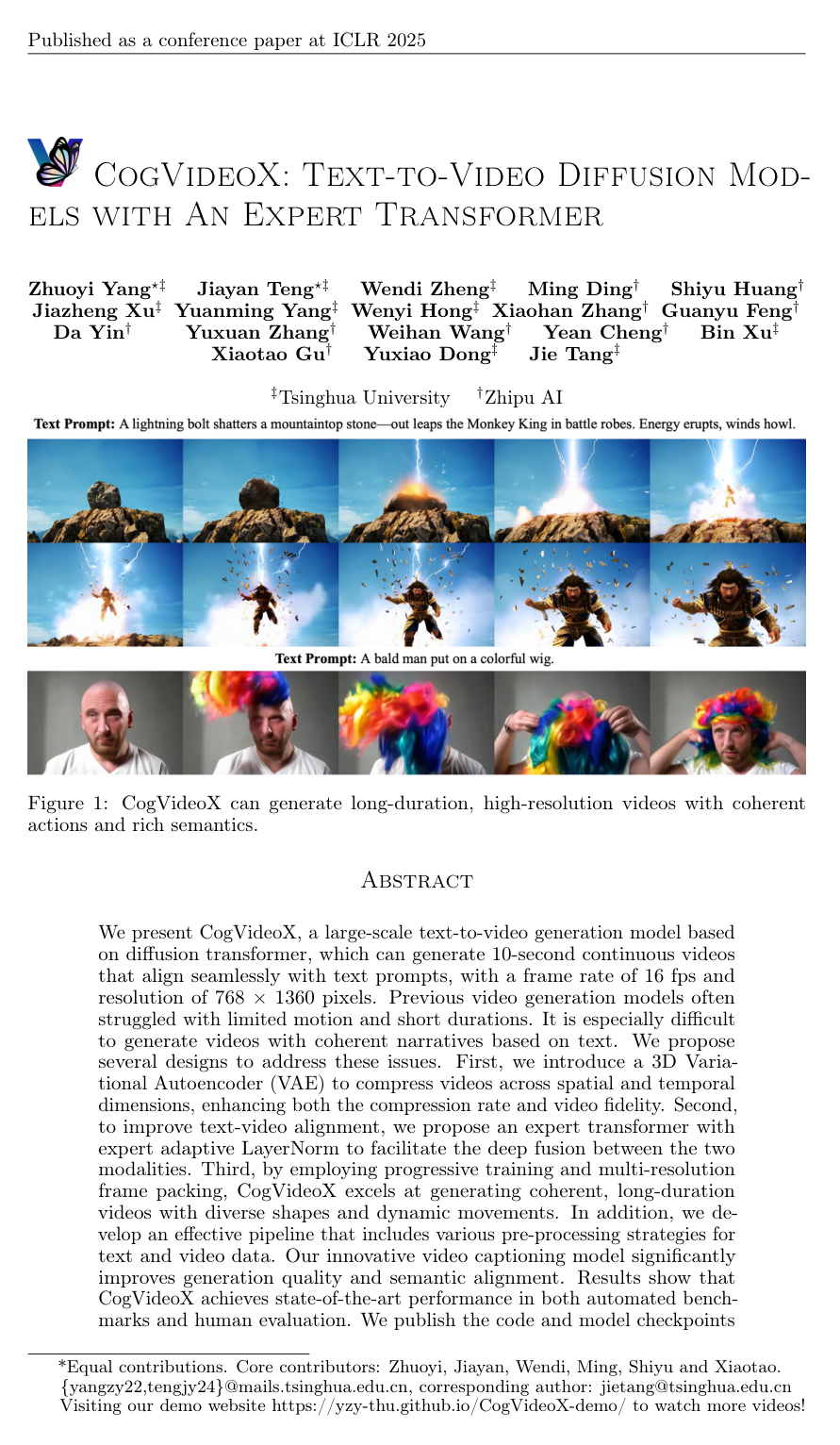
CogVideoX: Text-to-Video Diffusion Models with An Expert Transformer
Zhuoyi Yang, Jiayan Teng, Wendi Zheng, Ming Ding, Shiyu Huang, Jiazheng Xu, Yuanming Yang, Wenyi Hong, Xiaohan Zhang, Guanyu Feng, Da Yin, Yuxuan Zhang, Weihan Wang, Yean Cheng, Bin Xu, Xiaotao Gu, Yuxiao Dong, Jie Tang
Why you should read this
Develops CogVideoX, a text-to-video diffusion model that leverages an expert transformer, progressive training, and a novel 3D VAE to generate 10-second, high-resolution videos with complex motion and narrative coherence, addressing limitations of prior models.
We present CogVideoX, a large-scale text-to-video generation model based on diffusion transformer, which can generate 10-second continuous videos aligned with text prompt, with a frame rate of 16 fps and resolution of 768 * 1360 pixels. Previous video generation models often had limited movement and short durations, and is difficult to generate videos with coherent narratives based on text. We propose several designs to address these issues. First, we propose a 3D Variational Autoencoder (VAE) to compress videos along both spatial and temporal dimensions, to improve both compression rate and video fidelity. Second, to improve the text-video alignment, we propose an expert transformer with the expert adaptive LayerNorm to facilitate the deep fusion between the two modalities. Third, by employing a progressive training and multi-resolution frame pack technique, CogVideoX is adept at producing coherent, long-duration, different shape videos characterized by significant motions. In addition, we develop an effective text-video data processing pipeline that includes various data preprocessing strategies and a video captioning method, greatly contributing to the generation quality and semantic alignment. Results show that CogVideoX demonstrates state-of-the-art performance across both multiple machine metrics and human evaluations. The model weight of both 3D Causal VAE, Video caption model and CogVideoX are publicly available at https://github.com/THUDM/CogVideo.
Added
2026-05-13
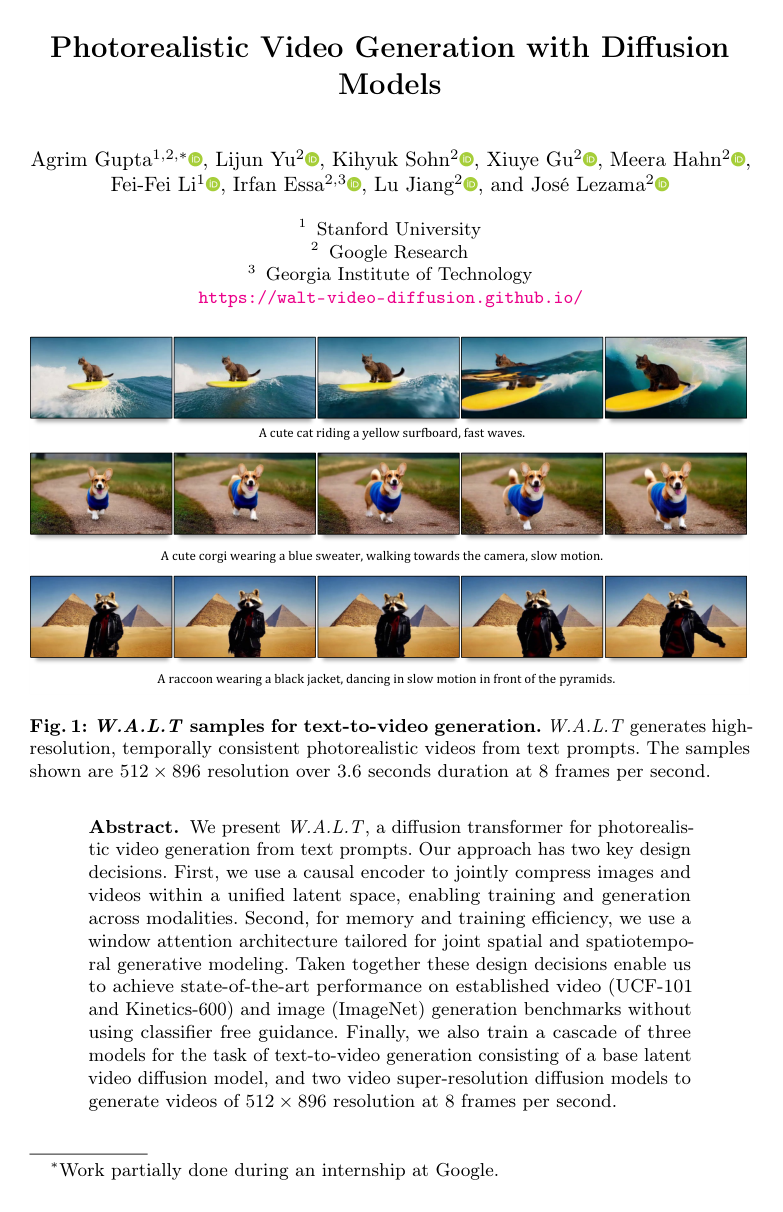
Photorealistic Video Generation with Diffusion Models
Agrim Gupta, Lijun Yu, Kihyuk Sohn, Xiuye Gu, Meera Hahn, Li Fei-Fei, Irfan Essa, Lu Jiang, José Lezama
Why you should read this
Employs a transformer-based backbone with windowed attention to process latent video patches, proving that scalable diffusion transformers can outperform traditional U-Nets for video.
We present W.A.L.T, a diffusion transformer for photorealistic video generation from text prompts. Our approach has two key design decisions. First, we use a causal encoder to jointly compress images and videos within a unified latent space, enabling training and generation across modalities. Second, for memory and training efficiency, we use a window attention architecture tailored for joint spatial and spatiotemporal generative modeling. Taken together these design decisions enable us to achieve state-of-the-art performance on established video (UCF-101 and Kinetics-600) and image (ImageNet) generation benchmarks without using classifier free guidance. Finally, we also train a cascade of three models for the task of text-to-video generation consisting of a base latent video diffusion model, and two video super-resolution diffusion models to generate videos of 512 × 896 resolution at 8 frames per second.
Added
2026-03-11