
keyword
depthwise convolution
Depthwise convolution is a specialized convolutional operation in neural networks where a spatial filter is applied independently to each individual input channel, rather than combining features across all channels simultaneously. Unlike standard convolutions that perform spatial filtering and channel mixing in a single step, depthwise convolution isolates the spatial processing of each channel without altering the channel depth. This per-channel approach significantly reduces the number of learnable parameters and floating-point operations required for computation. Depthwise convolutions are frequently paired with pointwise convolutions, which use one-by-one kernels to mix channels, together forming depthwise separable convolutions that serve as core building blocks in lightweight and efficient deep learning architectures.
11 items
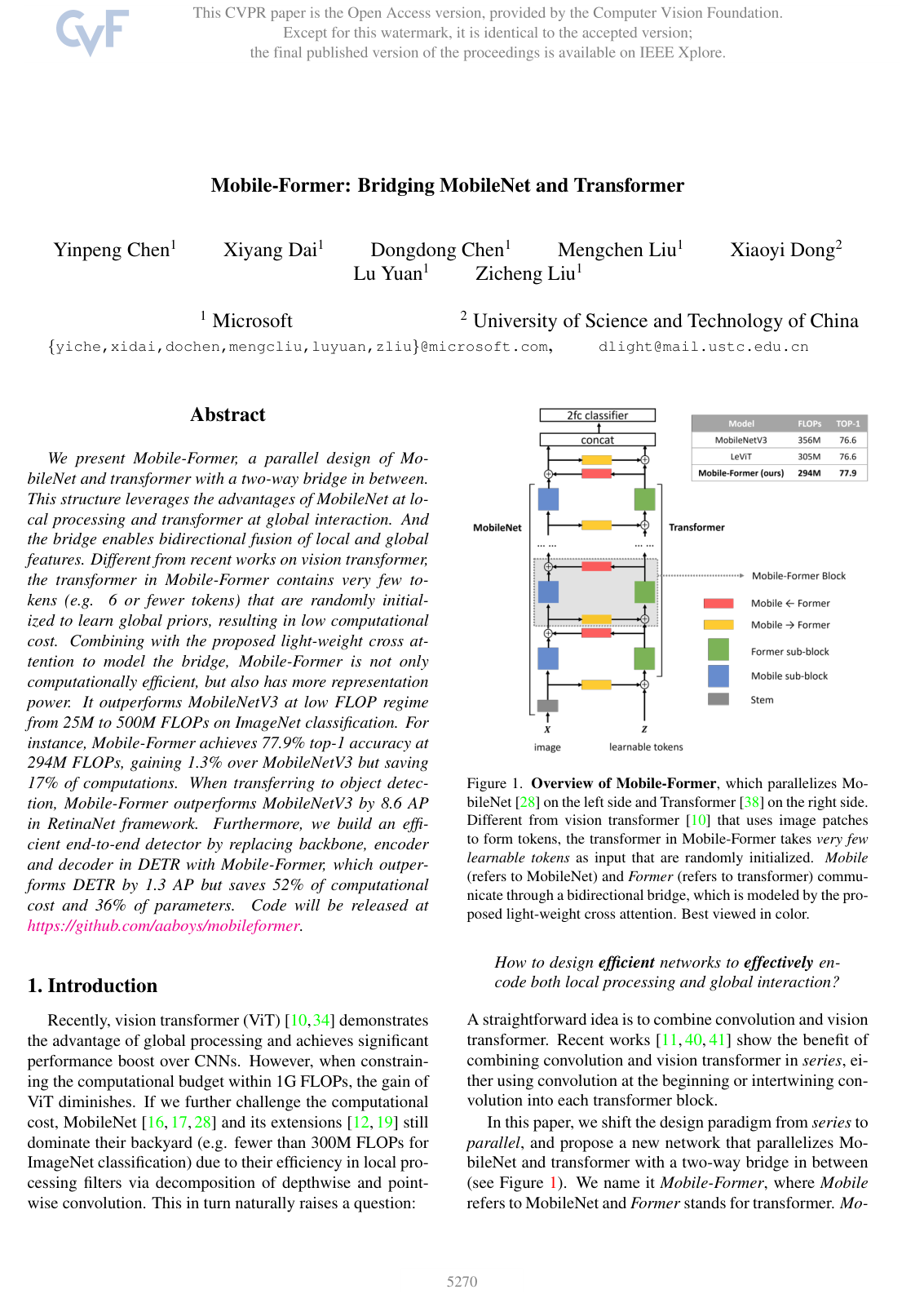
Mobile-Former: Bridging MobileNet and Transformer
Yinpeng Chen, Xiyang Dai, Dongdong Chen, Mengchen Liu, Xiaoyi Dong, Lu Yuan, Zicheng Liu
Why you should read this
Proposes a parallel architecture bridging MobileNet and a lightweight vision transformer with bidirectional cross-attention, significantly outperforming MobileNetV3 and DETR in image classification and object detection under strict computational budgets.
We present Mobile-Former, a parallel design of MobileNet and transformer with a two-way bridge in between. This structure leverages the advantages of MobileNet at local processing and transformer at global interaction. And the bridge enables bidirectional fusion of local and global features. Different from recent works on vision transformer, the transformer in Mobile-Former contains very few tokens (e.g. 6 or fewer tokens) that are randomly initialized to learn global priors, resulting in low computational cost. Combining with the proposed light-weight cross attention to model the bridge, Mobile-Former is not only computationally efficient, but also has more representation power. It outperforms MobileNetV3 at low FLOP regime from 25M to 500M FLOPs on ImageNet classification. For instance, Mobile-Former achieves 77.9% top-1 accuracy at 294M FLOPs, gaining 1.3% over MobileNetV3 but saving 17% of computations. When transferring to object detection, Mobile-Former outperforms MobileNetV3 by 8.6 AP in RetinaNet framework. Furthermore, we build an efficient end-to-end detector by replacing backbone, encoder and decoder in DETR with Mobile-Former, which outperforms DETR by 1.3 AP but saves 52% of computational cost and 36% of parameters. Code will be released at https://github.com/aaboys/mobileformer.
Added
2026-10-05
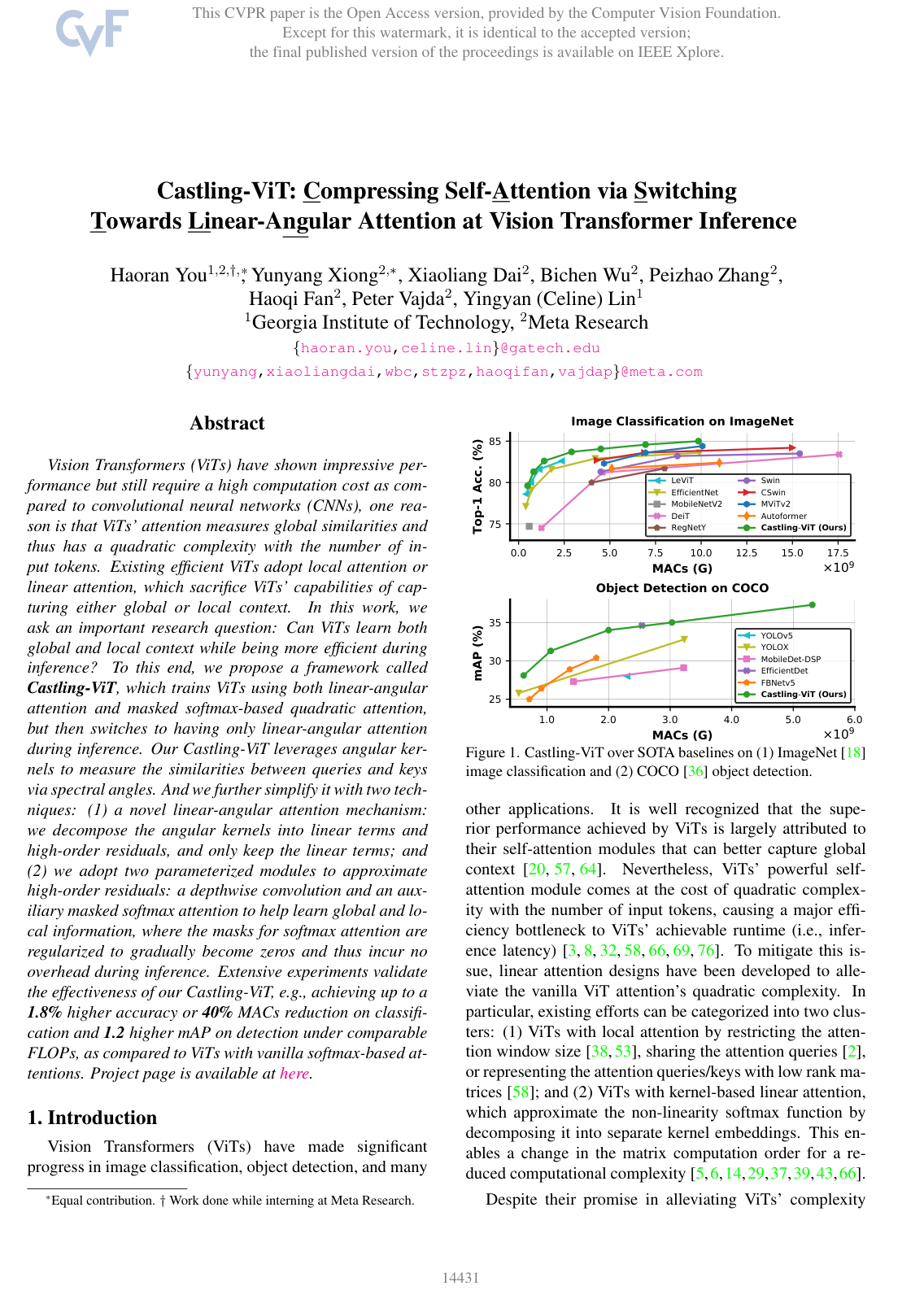
Castling-ViT: Compressing Self-Attention via Switching Towards Linear-Angular Attention at Vision Transformer Inference
Haoran You, Yunyang Xiong, Xiaoliang Dai, Bichen Wu, Peizhao Zhang, Haoqi Fan, Peter Vajda, Yingyan Celine Lin
Why you should read this
Proposes a training framework that pairs linear-angular attention with a decaying auxiliary softmax branch, enabling vision transformers to switch to efficient linear-complexity inference without sacrificing accuracy across classification and detection tasks.
Vision Transformers (ViTs) have shown impressive performance but still require a high computation cost as compared to convolutional neural networks (CNNs), one reason is that ViTs’ attention measures global similarities and thus has a quadratic complexity with the number of input tokens. Existing efficient ViTs adopt local attention or linear attention, which sacrifice ViTs’ capabilities of capturing either global or local context. In this work, we ask an important research question: Can ViTs learn both global and local context while being more efficient during inference? To this end, we propose a framework called Castling-ViT, which trains ViTs using both linear-angular attention and masked softmax-based quadratic attention, but then switches to having only linear-angular attention during inference. Our Castling-ViT leverages angular kernels to measure the similarities between queries and keys via spectral angles. And we further simplify it with two techniques: (1) a novel linear-angular attention mechanism: we decompose the angular kernels into linear terms and high-order residuals, and only keep the linear terms; and (2) we adopt two parameterized modules to approximate high-order residuals: a depthwise convolution and an auxiliary masked softmax attention to help learn global and local information, where the masks for softmax attention are regularized to gradually become zeros and thus incur no overhead during inference. Extensive experiments validate the effectiveness of our Castling-ViT, e.g., achieving up to a 1.8% higher accuracy or 40% MACs reduction on classification and 1.2 higher mAP on detection under comparable FLOPs, as compared to ViTs with vanilla softmax-based attentions. Project page is available at here.
Added
2026-09-26
Inception Transformer
Chenyang Si, Weihao Yu, Pan Zhou, Yichen Zhou, Xinchao Wang, Shuicheng Yan
Why you should read this
Proposes the Inception Transformer, a hybrid vision architecture that couples parallel frequency-specific mixers via channel splitting with a layer-wise frequency ramp to capture both fine local details and broad global context with superior parameter efficiency over standard vision transformers.
Recent studies show that Transformer has strong capability of building long-range dependencies, yet is incompetent in capturing high frequencies that predominantly convey local information. To tackle this issue, we present a novel and general-purpose Inception Transformer, or iFormer for short, that effectively learns comprehensive features with both high- and low-frequency information in visual data. Specifically, we design an Inception mixer to explicitly graft the advantages of convolution and max-pooling for capturing the high-frequency information to Transformers. Different from recent hybrid frameworks, the Inception mixer brings greater efficiency through a channel splitting mechanism to adopt parallel convolution/max-pooling path and self-attention path as high- and low-frequency mixers, while having the flexibility to model discriminative information scattered within a wide frequency range. Considering that bottom layers play more roles in capturing high-frequency details while top layers more in modeling low-frequency global information, we further introduce a frequency ramp structure, i.e., gradually decreasing the dimensions fed to the high-frequency mixer and increasing those to the low-frequency mixer, which can effectively trade-off high- and low-frequency components across different layers. We benchmark the iFormer on a series of vision tasks, and showcase that it achieves impressive performance on image classification, COCO detection and ADE20K segmentation. For example, our iFormer-S hits the top-1 accuracy of 83.4% on ImageNet-1K, much higher than DeiT-S by 3.6%, and even slightly better than much bigger model Swin-B (83.3%) with only 1/4 parameters and 1/3 FLOPs. Code and models are released at https://github.com/sail-sg/iFormer.
Added
2026-09-26
Fast, Accurate, and, Lightweight Super-Resolution with Cascading Residual Network
Namhyuk Ahn, Byungkon Kang, Kyung-ah Sohn
Why you should read this
Proposes a cascading residual network for single-image super-resolution that matches state-of-the-art accuracy while dramatically cutting parameters and computational cost to enable practical real-world deployment.
In recent years, deep learning methods have been successfully applied to single-image super-resolution tasks. Despite their great performances, deep learning methods cannot be easily applied to real-world applications due to the requirement of heavy computation. In this paper, we address this issue by proposing an accurate and lightweight deep network for image super-resolution. In detail, we design an architecture that implements a cascading mechanism upon a residual network. We also present variant models of the proposed cascading residual network to further improve efficiency. Our extensive experiments show that even with much fewer parameters and operations, our models achieve performance comparable to that of state-of-the-art methods.
Added
2026-09-25
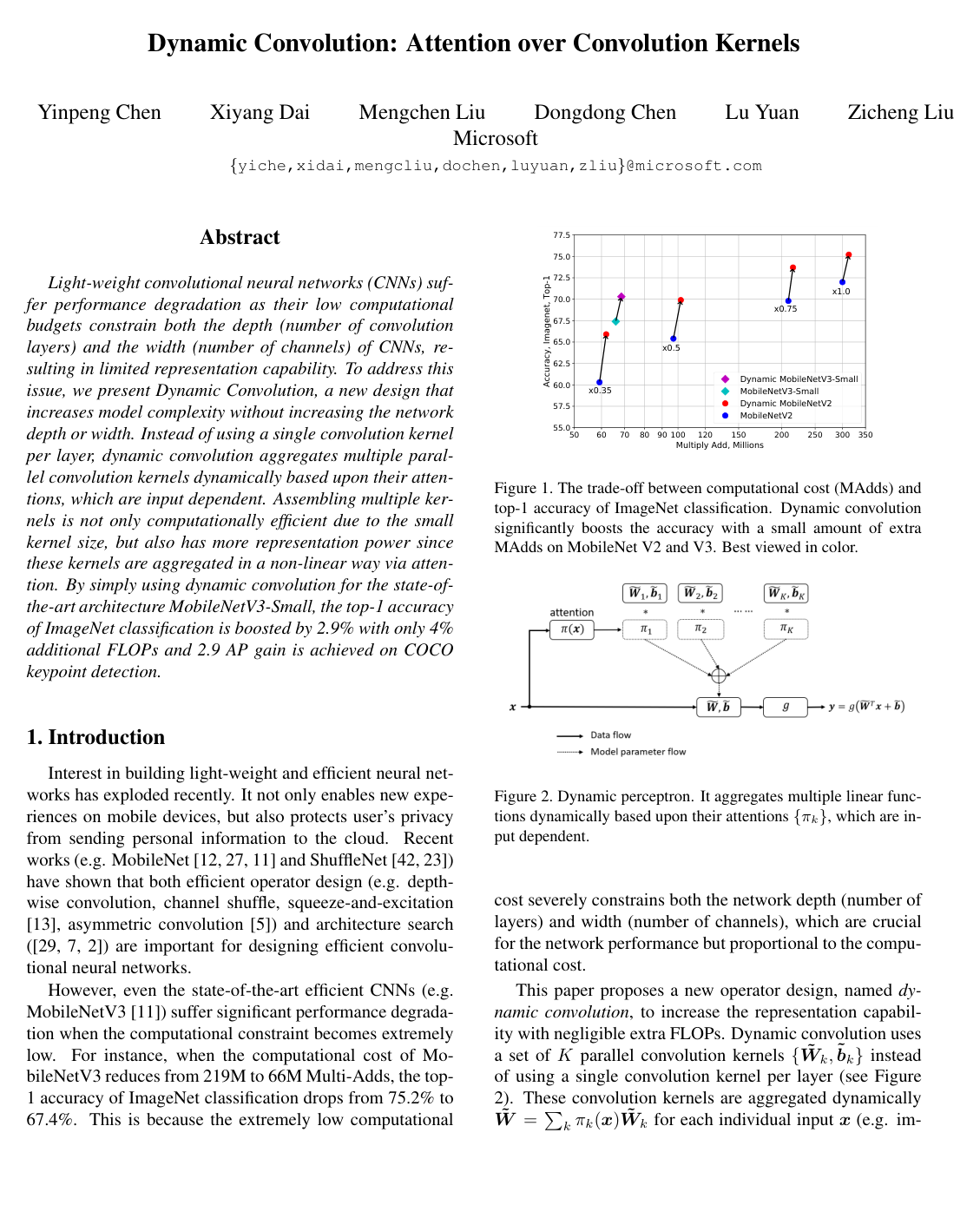
Dynamic Convolution: Attention Over Convolution Kernels
Yinpeng Chen, Xiyang Dai, Mengchen Liu, Dongdong Chen, Lu Yuan, Zicheng Liu
Why you should read this
Introduces Dynamic Convolution, an efficient approach that dynamically aggregates multiple parallel kernels via input-dependent attention to increase the representation capacity and accuracy of lightweight convolutional networks with minimal computational overhead.
Light-weight convolutional neural networks (CNNs) suffer performance degradation as their low computational budgets constrain both the depth (number of convolution layers) and the width (number of channels) of CNNs, resulting in limited representation capability. To address this issue, we present Dynamic Convolution, a new design that increases model complexity without increasing the network depth or width. Instead of using a single convolution kernel per layer, dynamic convolution aggregates multiple parallel convolution kernels dynamically based upon their attentions, which are input dependent. Assembling multiple kernels is not only computationally efficient due to the small kernel size, but also has more representation power since these kernels are aggregated in a non-linear way via attention. By simply using dynamic convolution for the state-of-the-art architecture MobileNetV3-Small, the top-1 accuracy of ImageNet classification is boosted by 2.9% with only 4% additional FLOPs and 2.9 AP gain is achieved on COCO keypoint detection.
Added
2026-09-25
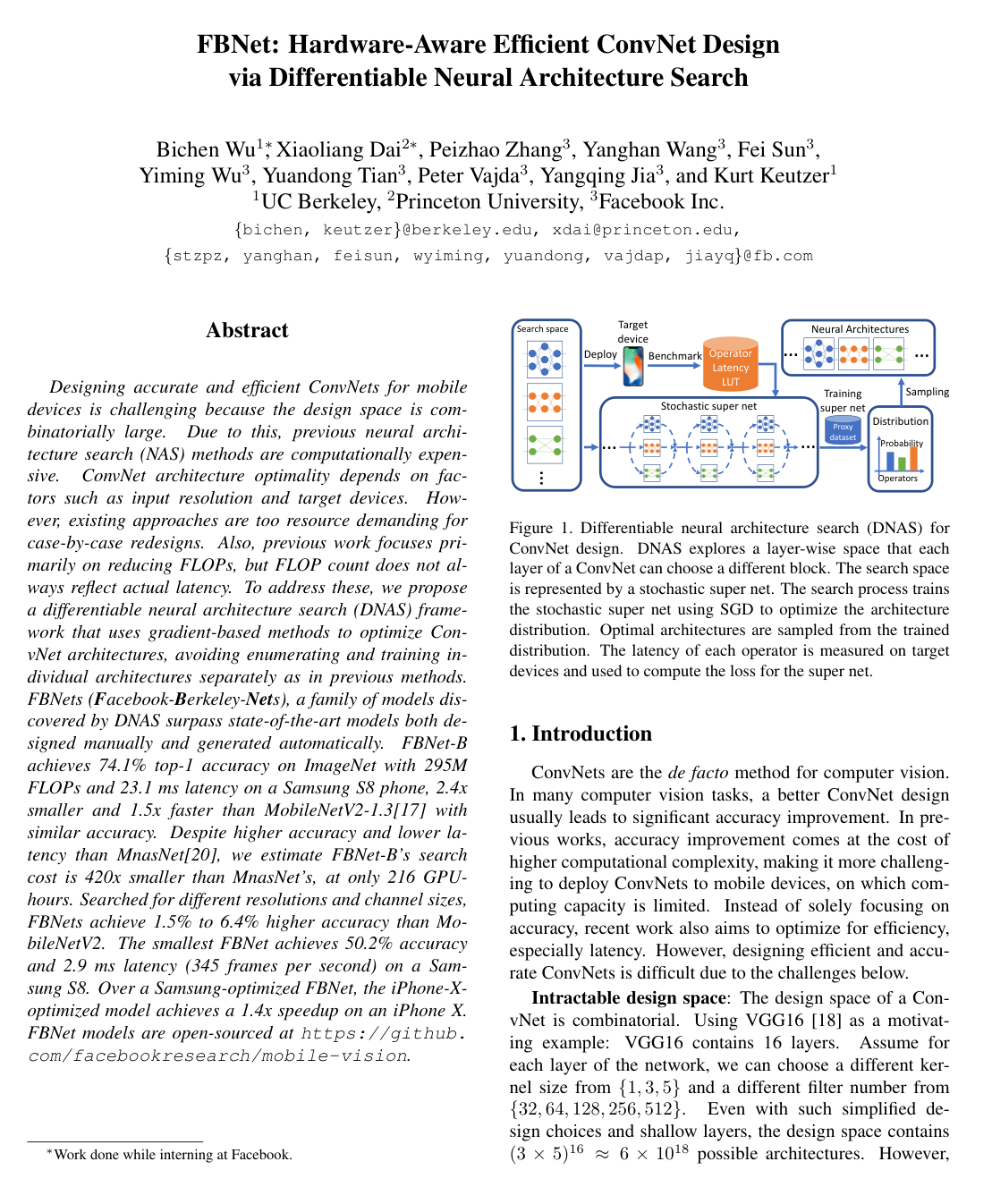
FBNet: Hardware-Aware Efficient ConvNet Design via Differentiable Neural Architecture Search
Bichen Wu, Xiaoliang Dai, Peizhao Zhang, Yanghan Wang, Fei Sun, Yiming Wu, Yuandong Tian, Peter Vajda, Yangqing Jia, Kurt Keutzer
Why you should read this
Introduces a hardware-aware differentiable neural architecture search framework that directly optimizes ConvNets for device-specific latency, cutting search costs by over 400 times compared to prior methods while achieving superior speed and accuracy on mobile devices.
Designing accurate and efficient ConvNets for mobile devices is challenging because the design space is combinatorially large. Due to this, previous neural architecture search (NAS) methods are computationally expensive. ConvNet architecture optimality depends on factors such as input resolution and target devices. However, existing approaches are too expensive for case-by-case redesigns. Also, previous work focuses primarily on reducing FLOPs, but FLOP count does not always reflect actual latency. To address these, we propose a differentiable neural architecture search (DNAS) framework that uses gradient-based methods to optimize ConvNet architectures, avoiding enumerating and training individual architectures separately as in previous methods. FBNets, a family of models discovered by DNAS surpass state-of-the-art models both designed manually and generated automatically. FBNet-B achieves 74.1% top-1 accuracy on ImageNet with 295M FLOPs and 23.1 ms latency on a Samsung S8 phone, 2.4x smaller and 1.5x faster than MobileNetV2-1.3 with similar accuracy. Despite higher accuracy and lower latency than MnasNet, we estimate FBNet-B's search cost is 420x smaller than MnasNet's, at only 216 GPU-hours. Searched for different resolutions and channel sizes, FBNets achieve 1.5% to 6.4% higher accuracy than MobileNetV2. The smallest FBNet achieves 50.2% accuracy and 2.9 ms latency (345 frames per second) on a Samsung S8. Over a Samsung-optimized FBNet, the iPhone-X-optimized model achieves a 1.4x speedup on an iPhone X.
Added
2026-09-25
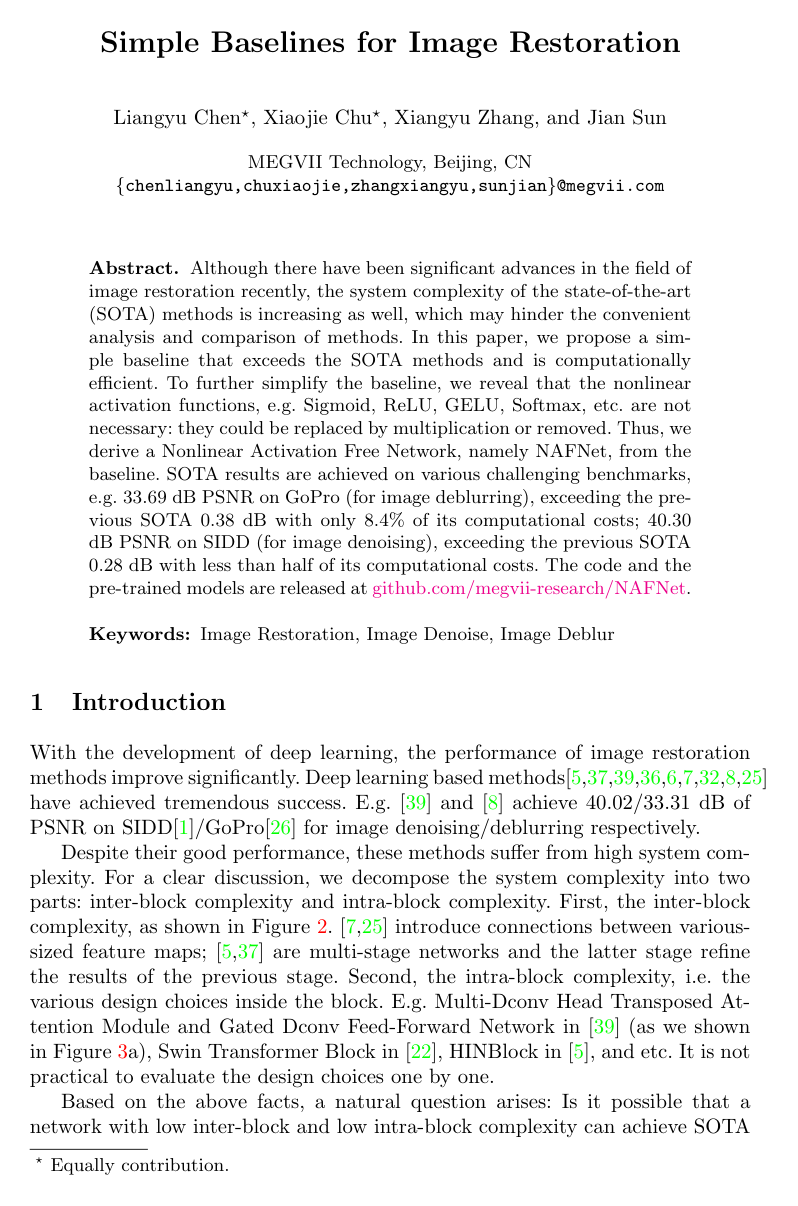
Simple Baselines for Image Restoration
Liangyu Chen, Xiaojie Chu, Xiangyu Zhang, Jian Sun
Why you should read this
Introduces NAFNet, an image restoration architecture that removes conventional nonlinear activation functions to achieve state-of-the-art deblurring and denoising performance at a fraction of the computational cost of existing methods.
Although there have been significant advances in the field of image restoration recently, the system complexity of the state-of-the-art (SOTA) methods is increasing as well, which may hinder the convenient analysis and comparison of methods. In this paper, we propose a simple baseline that exceeds the SOTA methods and is computationally efficient. To further simplify the baseline, we reveal that the nonlinear activation functions, e.g. Sigmoid, ReLU, GELU, Softmax, etc. are not necessary: they could be replaced by multiplication or removed. Thus, we derive a Nonlinear Activation Free Network, namely NAFNet, from the baseline. SOTA results are achieved on various challenging benchmarks, e.g. 33.69 dB PSNR on GoPro (for image deblurring), exceeding the previous SOTA 0.38 dB with only 8.4% of its computational costs; 40.30 dB PSNR on SIDD (for image denoising), exceeding the previous SOTA 0.28 dB with less than half of its computational costs. The code and the pre-trained models are released at this https URL.
Added
2026-09-24
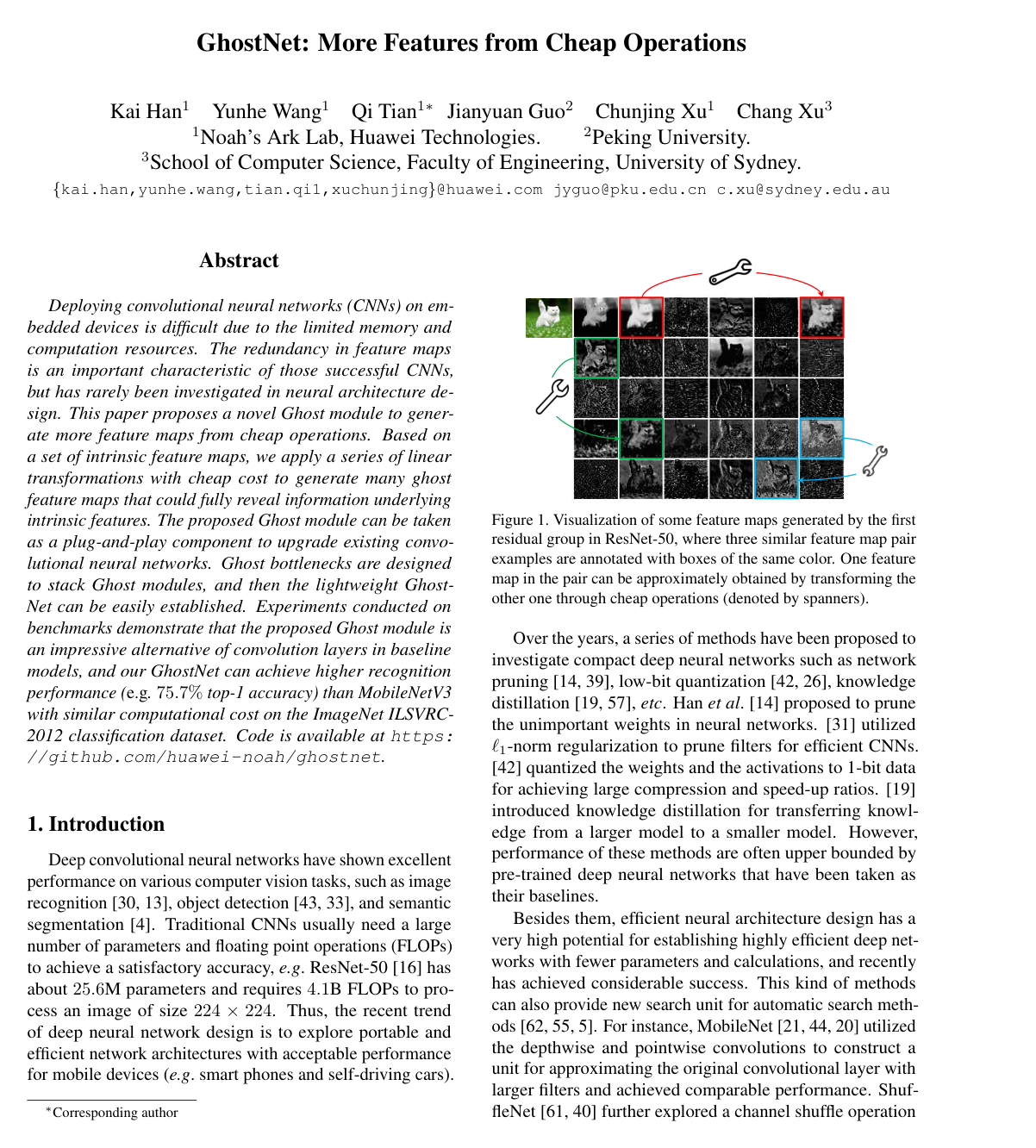
GhostNet: More Features From Cheap Operations
Kai Han, Yunhe Wang, Qi Tian, Jianyuan Guo, Chunjing Xu, Chang Xu
Why you should read this
Proposes a plug-and-play Ghost module that uses low-cost linear transformations to generate redundant feature maps, enabling a lightweight vision architecture that outperforms MobileNetV3 on ImageNet classification at equivalent computational budgets.
Deploying convolutional neural networks (CNNs) on embedded devices is difficult due to the limited memory and computation resources. The redundancy in feature maps is an important characteristic of those successful CNNs, but has rarely been investigated in neural architecture design. This paper proposes a novel Ghost module to generate more feature maps from cheap operations. Based on a set of intrinsic feature maps, we apply a series of linear transformations with cheap cost to generate many ghost feature maps that could fully reveal information underlying intrinsic features. The proposed Ghost module can be taken as a plug-and-play component to upgrade existing convolutional neural networks. Ghost bottlenecks are designed to stack Ghost modules, and then the lightweight GhostNet can be easily established. Experiments conducted on benchmarks demonstrate that the proposed Ghost module is an impressive alternative of convolution layers in baseline models, and our GhostNet can achieve higher recognition performance (e.g. top-1 accuracy) than MobileNetV3 with similar computational cost on the ImageNet ILSVRC-2012 classification dataset. Code is available at this https URL
Added
2026-09-11
ShuffleNet: An Extremely Efficient Convolutional Neural Network for Mobile Devices
Xiangyu Zhang, Xinyu Zhou, Mengxiao Lin, Jian Sun
Why you should read this
Proposes ShuffleNet, an efficient convolutional network architecture that pairs pointwise group convolutions with channel shuffling to achieve superior accuracy over MobileNet on low-power mobile hardware.
We introduce an extremely computation-efficient CNN architecture named ShuffleNet, which is designed specially for mobile devices with very limited computing power (e.g., 10-150 MFLOPs). The new architecture utilizes two new operations, pointwise group convolution and channel shuffle, to greatly reduce computation cost while maintaining accuracy. Experiments on ImageNet classification and MS COCO object detection demonstrate the superior performance of ShuffleNet over other structures, e.g. lower top-1 error (absolute 7.8%) than recent MobileNet on ImageNet classification task, under the computation budget of 40 MFLOPs. On an ARM-based mobile device, ShuffleNet achieves ~13x actual speedup over AlexNet while maintaining comparable accuracy.
Added
2026-09-11
Encoder-Decoder with Atrous Separable Convolution for Semantic Image Segmentation
Liang-Chieh Chen, Yukun Zhu, George Papandreou, Florian Schroff, Hartwig Adam
Why you should read this
Establishes a strong, general semantic segmentation pipeline using atrous convolutions (ASPP) with an encoder–decoder refinement. This is the modern template for natural-image segmentation.
Spatial pyramid pooling module or encode-decoder structure are used in deep neural networks for semantic segmentation task. The former networks are able to encode multi-scale contextual information by probing the incoming features with filters or pooling operations at multiple rates and multiple effective fields-of-view, while the latter networks can capture sharper object boundaries by gradually recovering the spatial information. In this work, we propose to combine the advantages from both methods. Specifically, our proposed model, DeepLabv3+, extends DeepLabv3 by adding a simple yet effective decoder module to refine the segmentation results especially along object boundaries. We further explore the Xception model and apply the depthwise separable convolution to both Atrous Spatial Pyramid Pooling and decoder modules, resulting in a faster and stronger encoder-decoder network. We demonstrate the effectiveness of the proposed model on PASCAL VOC 2012 and Cityscapes datasets, achieving the test set performance of 89.0\% and 82.1\% without any post-processing. Our paper is accompanied with a publicly available reference implementation of the proposed models in Tensorflow at \url{this https URL}.
Added
2026-02-21
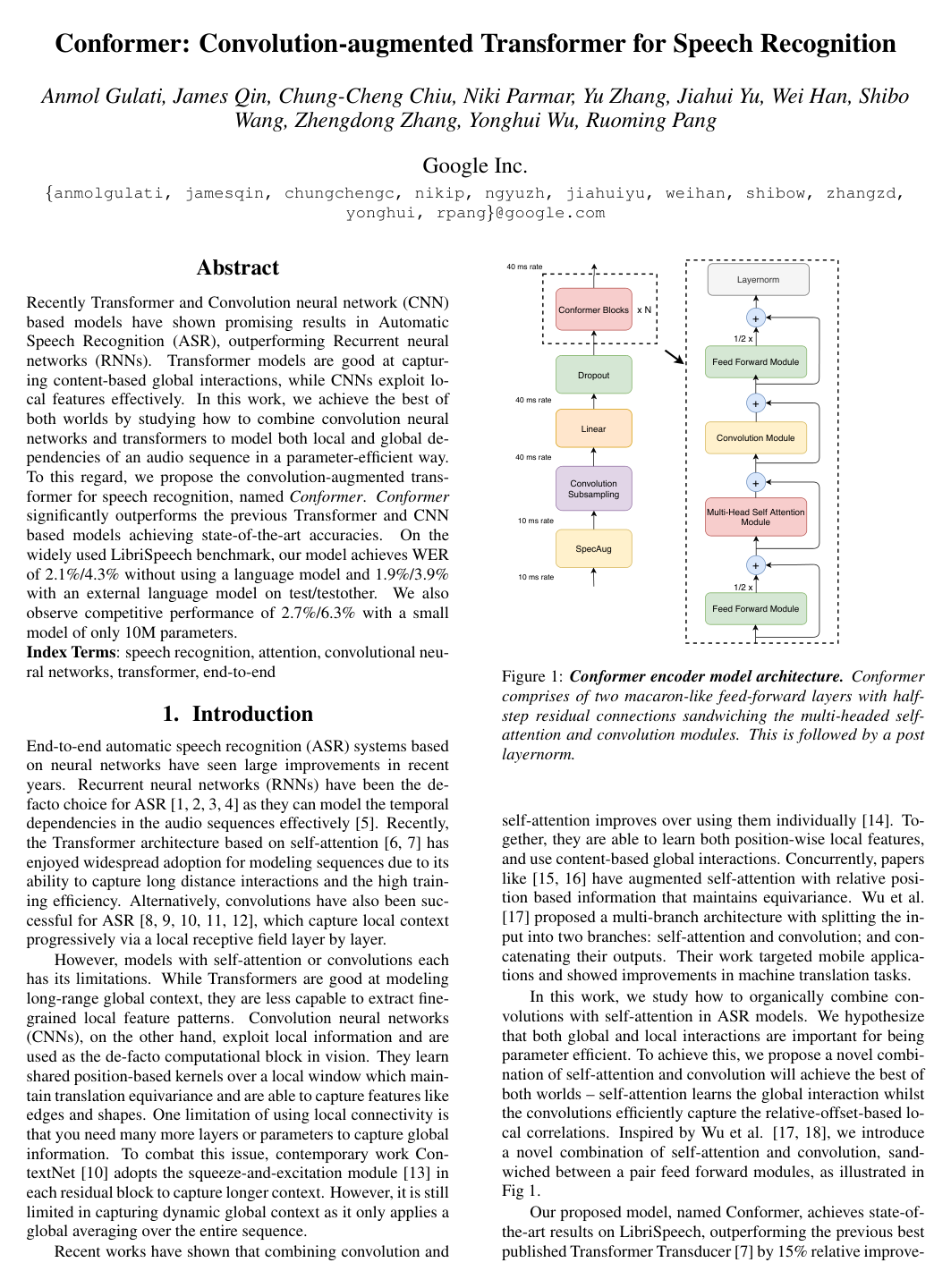
Conformer: Convolution-augmented Transformer for Speech Recognition
Anmol Gulati, James Qin, Chung‐Cheng Chiu, Niki Parmar, Yu Zhang, Jiahui Yu, Wei Han, Shibo Wang, Zhengdong Zhang, Yonghui Wu, Ruoming Pang
Why you should read this
Integrates convolution modules into the self-attention structure to capture both local and global dependencies required for audio processing.
Recently Transformer and Convolution neural network (CNN) based models have shown promising results in Automatic Speech Recognition (ASR), outperforming Recurrent neural networks (RNNs).Transformer models are good at capturing content-based global interactions, while CNNs exploit local features effectively.In this work, we achieve the best of both worlds by studying how to combine convolution neural networks and transformers to model both local and global dependencies of an audio sequence in a parameter-efficient way.To this regard, we propose the convolution-augmented transformer for speech recognition, named Conformer.Conformer significantly outperforms the previous Transformer and CNN based models achieving state-of-the-art accuracies.On the widely used LibriSpeech benchmark, our model achieves WER of 2.1%/4.3%without using a language model and 1.9%/3.9%with an external language model on test/testother.We also observe competitive performance of 2.7%/6.3%with a small model of only 10M parameters.
Added
2026-02-09