
keyword
deep neural networks
Deep neural networks are artificial neural networks composed of multiple interconnected processing layers situated between an input layer and an output layer. In machine learning, the presence of these multiple hidden layers enables the model to progressively learn complex, hierarchical, and non-linear representations directly from raw or high-dimensional data such as images, audio, tabular records, and text. As data passes through each successive layer, the network extracts increasingly abstract features, transforming simple low-level patterns into high-level concepts. Deep neural networks are typically trained by adjusting their internal connection weights through gradient-based optimization algorithms, such as backpropagation and stochastic gradient descent, allowing them to perform tasks ranging from classification and regression to pattern recognition and data generation.
91 items
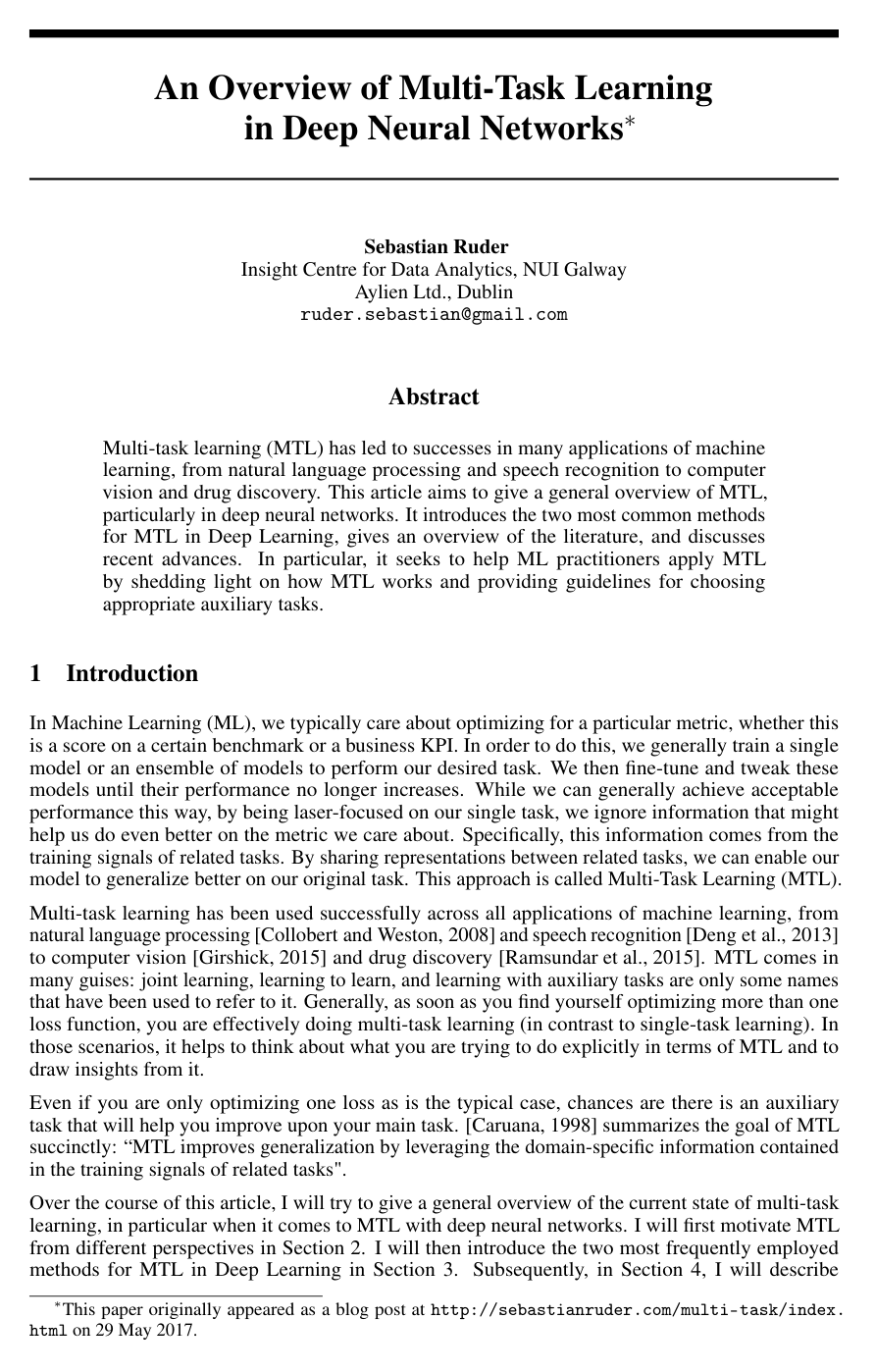
An Overview of Multi-Task Learning in Deep Neural Networks
Sebastian Ruder
Why you should read this
Explains the core architectures and working mechanisms of multi-task learning in deep neural networks, offering practical guidelines on selecting auxiliary tasks to improve model generalization.
Multi-task learning (MTL) has led to successes in many applications of machine learning, from natural language processing and speech recognition to computer vision and drug discovery. This article aims to give a general overview of MTL, particularly in deep neural networks. It introduces the two most common methods for MTL in Deep Learning, gives an overview of the literature, and discusses recent advances. In particular, it seeks to help ML practitioners apply MTL by shedding light on how MTL works and providing guidelines for choosing appropriate auxiliary tasks.
Added
2026-10-04
License
Published with permission
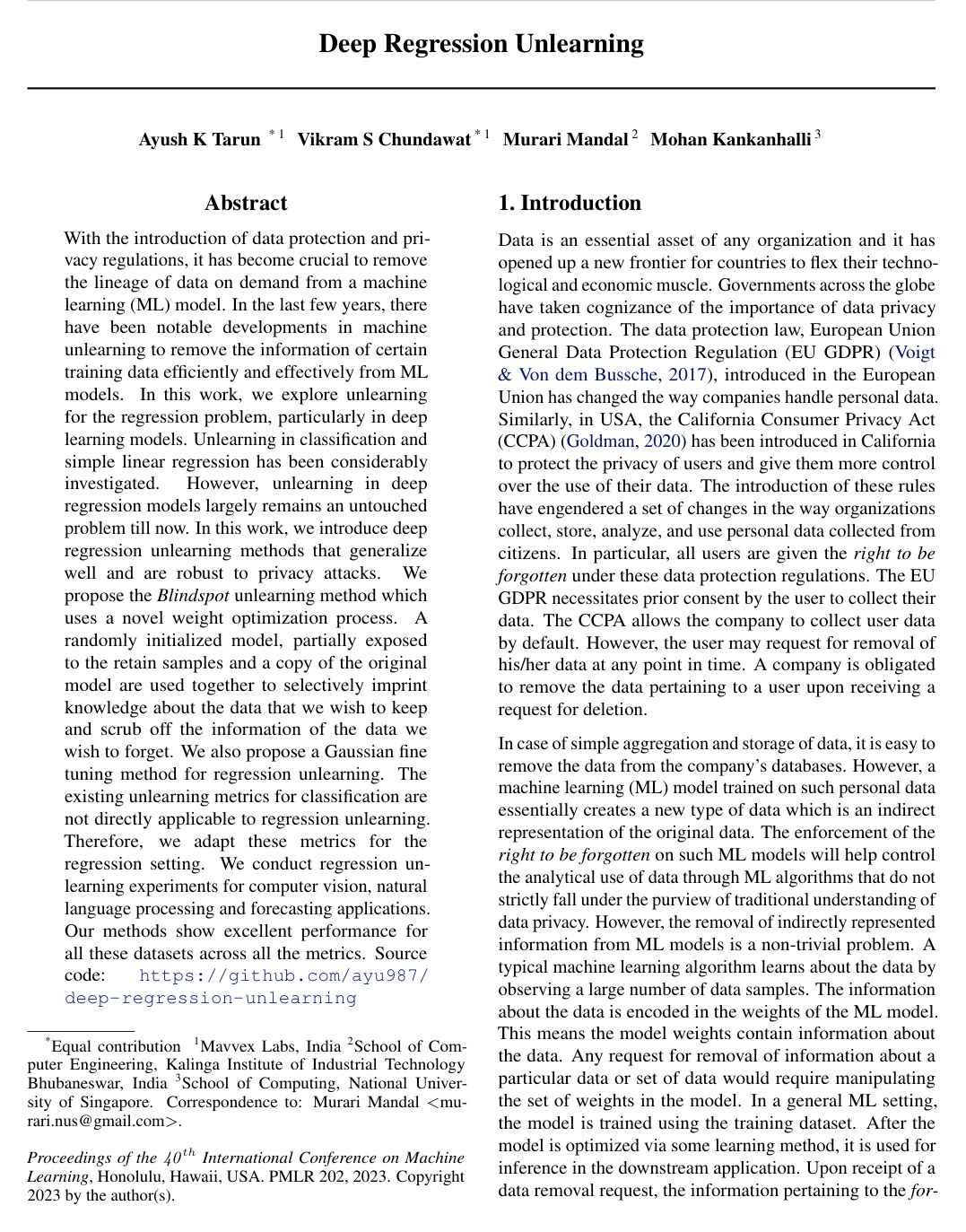
Deep Regression Unlearning
Ayush Kumar Tarun, Vikram Singh Chundawat, Murari Mandal, Mohan S. Kankanhalli
Why you should read this
Presents the first machine unlearning frameworks designed specifically for deep regression and forecasting models, introducing a weight-optimization method called Blindspot alongside adapted evaluation metrics to effectively scrub targeted data while defending against privacy attacks.
With the introduction of data protection and privacy regulations, it has become crucial to remove the lineage of data on demand from a machine learning (ML) model. In the last few years, there have been notable developments in machine unlearning to remove the information of certain training data efficiently and effectively from ML models. In this work, we explore unlearning for the regression problem, particularly in deep learning models. Unlearning in classification and simple linear regression has been considerably investigated. However, unlearning in deep regression models largely remains an untouched problem till now. In this work, we introduce deep regression unlearning methods that generalize well and are robust to privacy attacks. We propose the Blindspot unlearning method which uses a novel weight optimization process. A randomly initialized model, partially exposed to the retain samples and a copy of the original model are used together to selectively imprint knowledge about the data that we wish to keep and scrub off the information of the data we wish to forget. We also propose a Gaussian fine tuning method for regression unlearning. The existing unlearning metrics for classification are not directly applicable to regression unlearning. Therefore, we adapt these metrics for the regression setting. We conduct regression unlearning experiments for computer vision, natural language processing and forecasting applications. Our methods show excellent performance for all these datasets across all the metrics. Source code: https://github.com/ayu987/deep-regression-unlearning
Added
2026-10-03
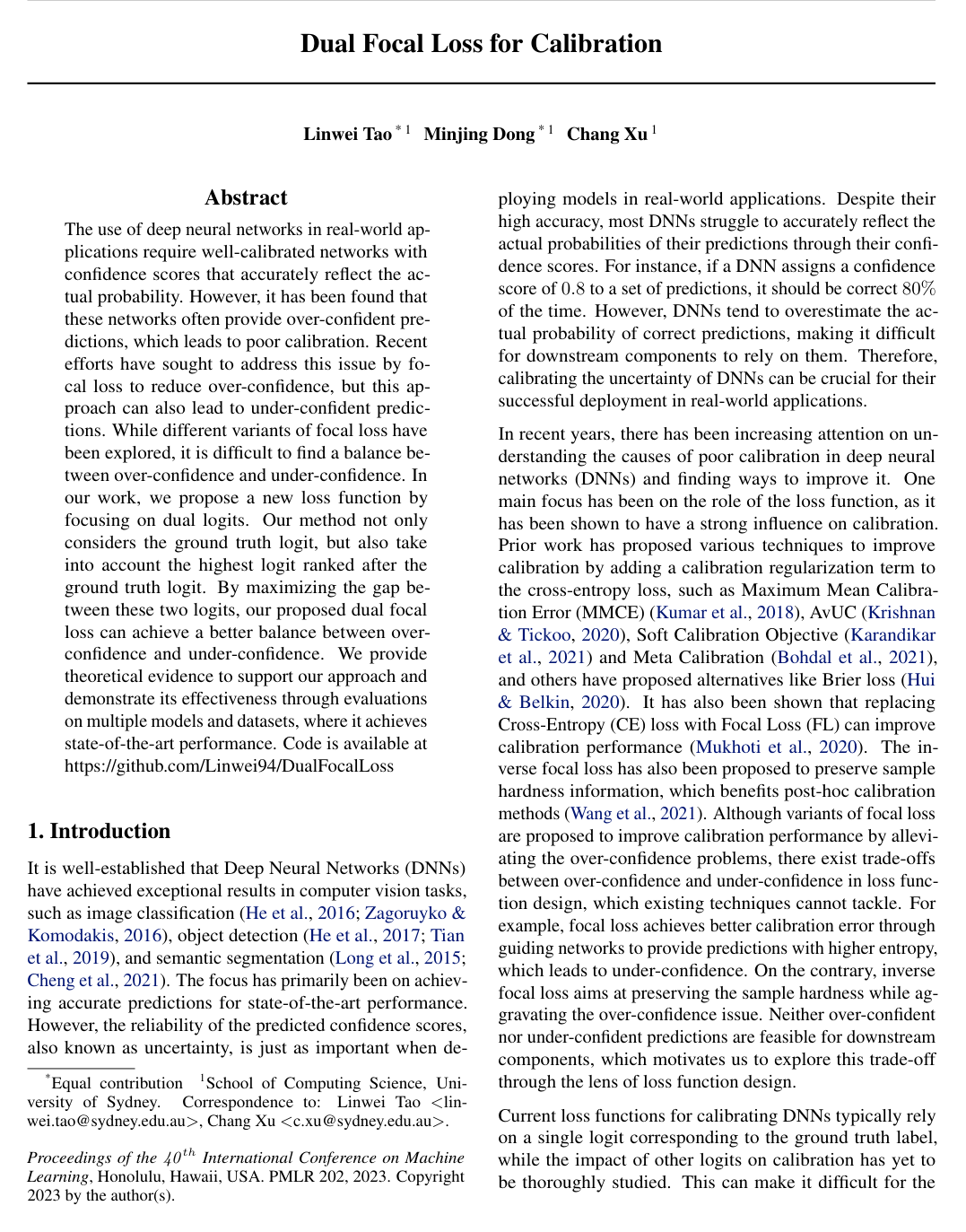
Dual Focal Loss for Calibration
Linwei Tao, Minjing Dong, Chang Xu
Why you should read this
Proposes Dual Focal Loss, a training objective that balances over-confidence and under-confidence in neural network calibration by maximizing the gap between the ground-truth logit and the highest-ranked competing logit.
The use of deep neural networks in real-world applications require well-calibrated networks with confidence scores that accurately reflect the actual probability. However, it has been found that these networks often provide over-confident predictions, which leads to poor calibration. Recent efforts have sought to address this issue by focal loss to reduce over-confidence, but this approach can also lead to under-confident predictions. While different variants of focal loss have been explored, it is difficult to find a balance between over-confidence and under-confidence. In our work, we propose a new loss function by focusing on dual logits. Our method not only considers the ground truth logit, but also take into account the highest logit ranked after the ground truth logit. By maximizing the gap between these two logits, our proposed dual focal loss can achieve a better balance between over-confidence and under-confidence. We provide theoretical evidence to support our approach and demonstrate its effectiveness through evaluations on multiple models and datasets, where it achieves state-of-the-art performance. Code is available at https://github.com/Linwei94/DualFocalLoss
Added
2026-10-03
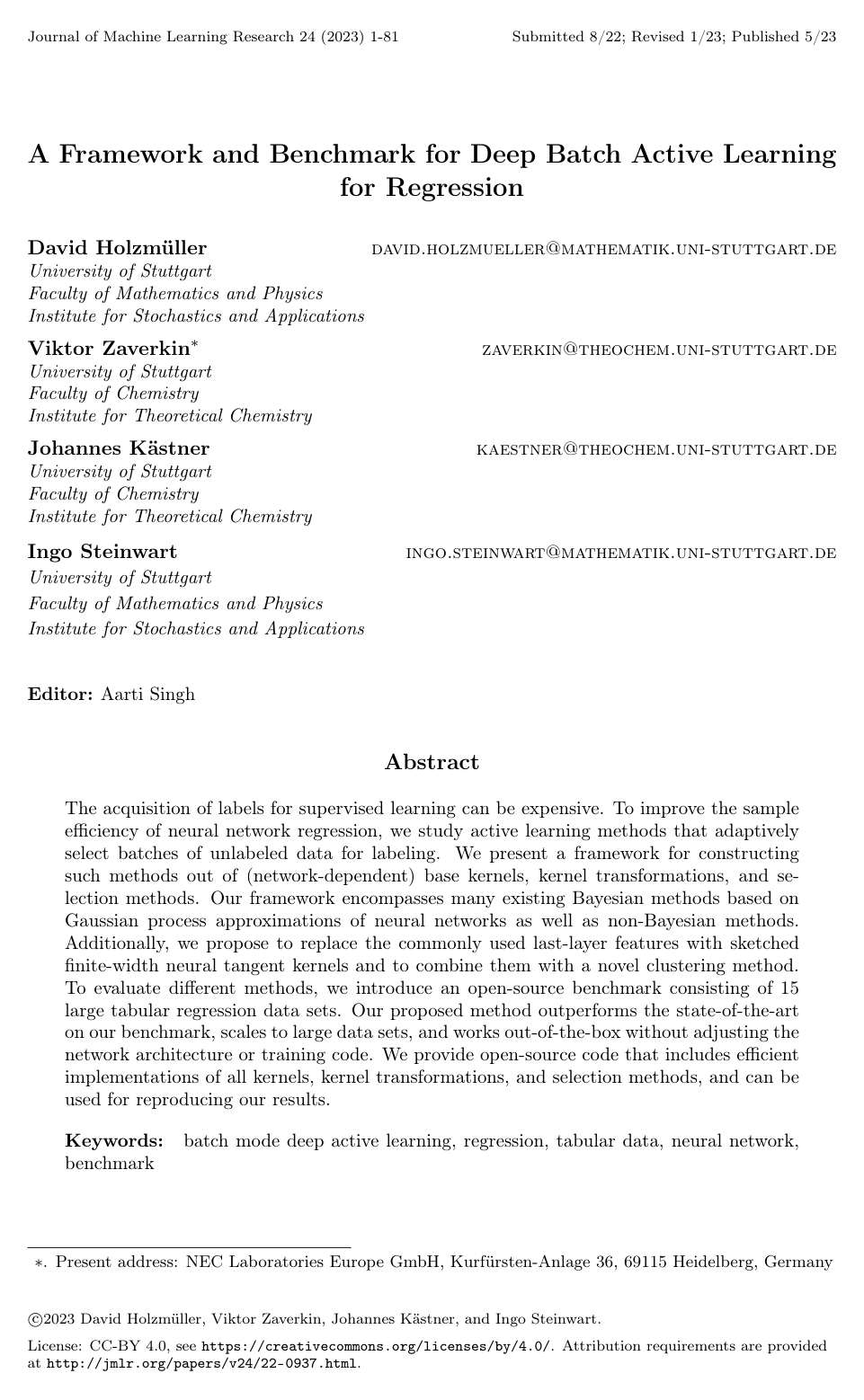
A Framework and Benchmark for Deep Batch Active Learning for Regression
David Holzmüller, Viktor Zaverkin, Johannes Kästner, Ingo Steinwart
Why you should read this
Presents a modular kernel-based framework, an efficient neural tangent kernel sketching technique paired with a novel clustering selection method, and an open-source 15-dataset benchmark to advance deep batch active learning for regression.
The acquisition of labels for supervised learning can be expensive. To improve the sample efficiency of neural network regression, we study active learning methods that adaptively select batches of unlabeled data for labeling. We present a framework for constructing such methods out of (network-dependent) base kernels, kernel transformations, and selection methods. Our framework encompasses many existing Bayesian methods based on Gaussian process approximations of neural networks as well as non-Bayesian methods. Additionally, we propose to replace the commonly used last-layer features with sketched finite-width neural tangent kernels and to combine them with a novel clustering method. To evaluate different methods, we introduce an open-source benchmark consisting of 15 large tabular regression data sets. Our proposed method outperforms the state-of-the-art on our benchmark, scales to large data sets, and works out-of-the-box without adjusting the network architecture or training code. We provide open-source code that includes efficient implementations of all kernels, kernel transformations, and selection methods, and can be used for reproducing our results.
Added
2026-10-03
Estimating Instance-dependent Bayes-label Transition Matrix using a Deep Neural Network
Shuo Yang, Erkun Yang, Bo Han, Yang Liu, Min Xu, Gang Niu, Tongliang Liu
Why you should read this
Proposes modeling instance-dependent label noise by estimating transitions from Bayes optimal labels to noisy labels using a deep neural network, shrinking the search space and improving classification accuracy on noisy datasets.
In label-noise learning, estimating the transition matrix is a hot topic as the matrix plays an important role in building statistically consistent classifiers. Traditionally, the transition from clean labels to noisy labels (i.e., clean-label transition matrix (CLTM)) has been widely exploited to learn a clean label classifier by employing the noisy data. Motivated by that classifiers mostly output Bayes optimal labels for prediction, in this paper, we study to directly model the transition from Bayes optimal labels to noisy labels (i.e., Bayes-label transition matrix (BLTM)) and learn a classifier to predict Bayes optimal labels. Note that given only noisy data, it is ill-posed to estimate either the CLTM or the BLTM. But favorably, Bayes optimal labels have less uncertainty compared with the clean labels, i.e., the class posteriors of Bayes optimal labels are one-hot vectors while those of clean labels are not. This enables two advantages to estimate the BLTM, i.e., (a) a set of examples with theoretically guaranteed Bayes optimal labels can be collected out of noisy data; (b) the feasible solution space is much smaller. By exploiting the advantages, we estimate the BLTM parametrically by employing a deep neural network, leading to better generalization and superior classification performance.
Added
2026-10-03
DAVINZ: Data Valuation using Deep Neural Networks at Initialization
Zhaoxuan Wu, Yao Shu, Bryan Kian Hsiang Low
Why you should read this
Proposes a training-free data valuation framework that leverages neural tangent kernel theory and domain-aware generalization bounds to accurately quantify dataset contributions to deep neural networks at initialization without expensive model training.
Recent years have witnessed a surge of interest in developing trustworthy methods to evaluate the value of data in many real-world applications (e.g., collaborative machine learning, data marketplaces). Existing data valuation methods typically valuate data using the generalization performance of converged machine learning models after their long-term model training, hence making data valuation on large complex deep neural networks (DNNs) unaffordable. To this end, we theoretically derive a domain-aware generalization bound to estimate the generalization performance of DNNs without model training. We then exploit this theoretically derived generalization bound to develop a novel training-free data valuation method named data valuation at initialization (DAVINZ) on DNNs, which consistently achieves remarkable effectiveness and efficiency in practice. Moreover, our training-free DAVINZ, surprisingly, can even theoretically and empirically enjoy the desirable properties that training-based data valuation methods usually attain, thus making it more trustworthy in practice.
Added
2026-10-02
Handcrafted Backdoors in Deep Neural Networks
Sanghyun Hong, Nicholas Carlini, Alexey Kurakin
Why you should read this
Exposes a major blind spot in neural network security by directly editing model weights to insert stealthy backdoors without poisoning training data, bypassing standard defenses while maintaining high attack success rates and benign task accuracy.
When machine learning training is outsourced to third parties, backdoor attacks become practical as the third party who trains the model may act maliciously to inject hidden behaviors into the otherwise accurate model. Until now, the mechanism to inject backdoors has been limited to poisoning. We argue that a supply-chain attacker has more attack techniques available by introducing a handcrafted attack that directly manipulates a model's weights. This direct modification gives our attacker more degrees of freedom compared to poisoning, and we show it can be used to evade many backdoor detection or removal defenses effectively. Across four datasets and four network architectures our backdoor attacks maintain an attack success rate above 96%. Our results suggest that further research is needed for understanding the complete space of supply-chain backdoor attacks.
Added
2026-09-26
Harmonizing the object recognition strategies of deep neural networks with humans
Thomas Fel, Ivan F. Rodriguez Rodriguez, Drew Linsley, Thomas Serre
Why you should read this
Demonstrates across 84 models that higher-accuracy deep neural networks increasingly diverge from human visual recognition strategies, and introduces a drop-in neural harmonizer training method that corrects this misalignment while improving classification performance.
The many successes of deep neural networks (DNNs) over the past decade have largely been driven by computational scale rather than insights from biological intelligence. Here, we explore if these trends have also carried concomitant improvements in explaining the visual strategies humans rely on for object recognition. We do this by comparing two related but distinct properties of visual strategies in humans and DNNs: where they believe important visual features are in images and how they use those features to categorize objects. Across 84 different DNNs trained on ImageNet and three independent datasets measuring the where and the how of human visual strategies for object recognition on those images, we find a systematic trade-off between DNN categorization accuracy and alignment with human visual strategies for object recognition. State-of-the-art DNNs are progressively becoming less aligned with humans as their accuracy improves. We rectify this growing issue with our neural harmonizer: a general-purpose training routine that both aligns DNN and human visual strategies and improves categorization accuracy. Our work represents the first demonstration that the scaling laws [1–3] that are guiding the design of DNNs today have also produced worse models of human vision. We release our code and data at https://serre-lab.github.io/Harmonization to help the field build more human-like DNNs.
Added
2026-09-26
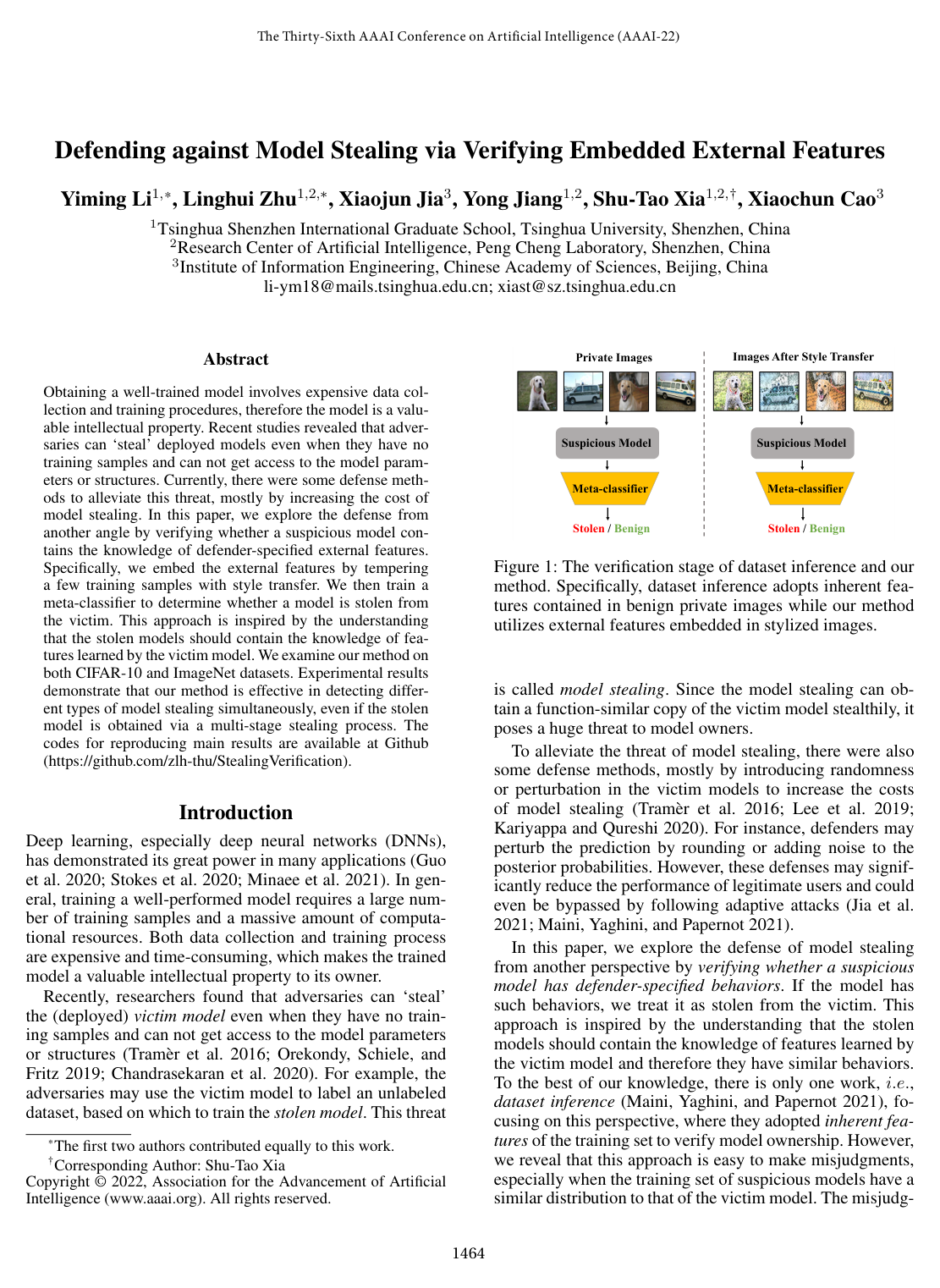
Defending against Model Stealing via Verifying Embedded External Features
Yiming Li, Linghui Zhu, Xiaojun Jia, Yong Jiang, Shu-Tao Xia, Xiaochun Cao
Why you should read this
Proposes embedding defender-specified external features into training images via style transfer to reliably verify stolen models across multiple types of model stealing attacks without degrading baseline performance.
Obtaining a well-trained model involves expensive data collection and training procedures, therefore the model is a valuable intellectual property. Recent studies revealed that adversaries can ‘steal’ deployed models even when they have no training samples and can not get access to the model parameters or structures. Currently, there were some defense methods to alleviate this threat, mostly by increasing the cost of model stealing. In this paper, we explore the defense from another angle by verifying whether a suspicious model contains the knowledge of defender-specified external features. Specifically, we embed the external features by tempering a few training samples with style transfer. We then train a meta-classifier to determine whether a model is stolen from the victim. This approach is inspired by the understanding that the stolen models should contain the knowledge of features learned by the victim model. We examine our method on both CIFAR-10 and ImageNet datasets. Experimental results demonstrate that our method is effective in detecting different types of model stealing simultaneously, even if the stolen model is obtained via a multi-stage stealing process. The codes for reproducing main results are available at Github (https://github.com/zlh-thu/StealingVerification).
Added
2026-09-26
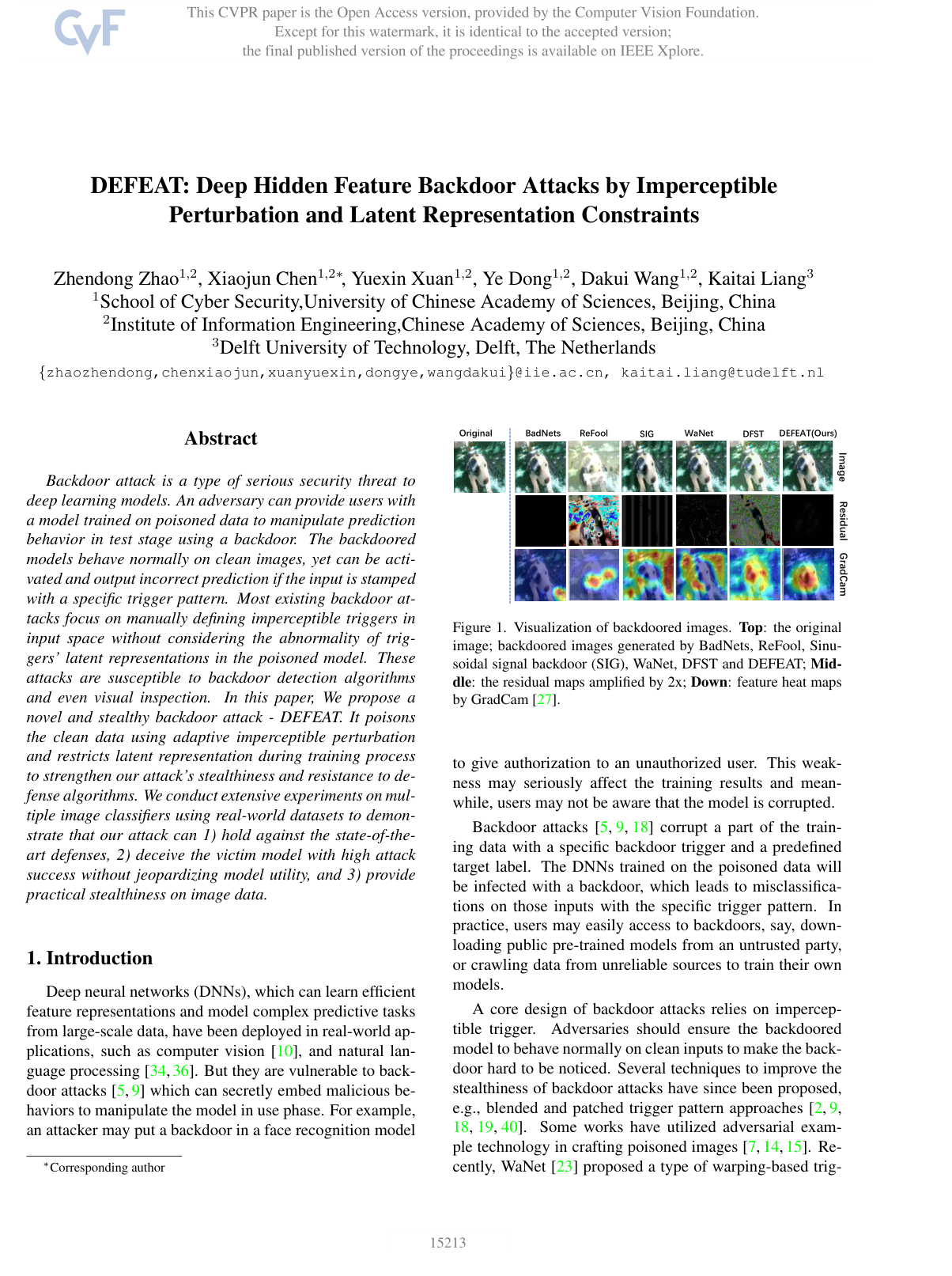
DEFEAT: Deep Hidden Feature Backdoor Attacks by Imperceptible Perturbation and Latent Representation Constraints
Zhendong Zhao, Xiaojun Chen, Yuexin Xuan, Ye Dong, Dakui Wang, Kaitai Liang
Why you should read this
Develops DEFEAT, a backdoor attack mechanism that pairs adaptive imperceptible perturbations with latent feature constraints during training to bypass state-of-the-art backdoor defense algorithms without degrading standard classification accuracy.
Backdoor attack is a type of serious security threat to deep learning models. An adversary can provide users with a model trained on poisoned data to manipulate prediction behavior in test stage using a backdoor. The backdoored models behave normally on clean images, yet can be activated and output incorrect prediction if the input is stamped with a specific trigger pattern. Most existing backdoor attacks focus on manually defining imperceptible triggers in input space without considering the abnormality of triggers' latent representations in the poisoned model. These attacks are susceptible to backdoor detection algorithms and even visual inspection. In this paper, We propose a novel and stealthy backdoor attack - DEFEAT. It poisons the clean data using adaptive imperceptible perturbation and restricts latent representation during training process to strengthen our attack's stealthiness and resistance to defense algorithms. We conduct extensive experiments on multiple image classifiers using real-world datasets to demonstrate that our attack can 1) hold against the state-of-the-art defenses, 2) deceive the victim model with high attack success without jeopardizing model utility, and 3) provide practical stealthiness on image data.
Added
2026-09-26
Adam-mini: Use Fewer Learning Rates To Gain More
Yushun Zhang, Congliang Chen, Ziniu Li, Tian Ding, Chenwei Wu, Diederik P. Kingma, Yinyu Ye, Zhi-Quan Luo, Ruoyu Sun
Why you should read this
Proposes Adam-mini, a lightweight optimizer that cuts AdamW's memory footprint in half and accelerates large language model training by assigning single learning rates to parameter blocks based on Hessian structure while matching or exceeding task performance.
We propose Adam-mini, an optimizer that achieves on par or better performance than AdamW with 50% less memory footprint. Adam-mini reduces memory by cutting down the learning rate resources in Adam (i.e., ). By investigating the Hessian structure of neural nets, we find Adam's might not function at its full potential as effectively as we expected. We find that 99.9% of these learning rates in could be harmlessly removed if we (1) carefully partition the parameters into blocks following our new principle on Hessian structure; (2) assign a single but good learning rate to each parameter block. We then provide one simple way to find good learning rates and propose Adam-mini. Empirically, we verify that Adam-mini performs on par or better than AdamW on various language models sized from 39M to 13B for pre-training, supervised fine-tuning, and RLHF. The reduced memory footprint of Adam-mini also alleviates communication overheads among GPUs, thereby increasing throughput. For instance, Adam-mini achieves 49.6% higher throughput than AdamW when pre-training Llama 2-7B on A800-80GB GPUs, which saves 33% wall-clock time for pre-training.
Added
2026-09-26
Overcoming catastrophic forgetting with hard attention to the task
Joan Serrà, Dídac Surís, Marius Miron, Alexandros Karatzoglou
Why you should read this
Proposes a task-based hard attention mechanism that learns parameter masks to protect prior knowledge during continual training, cutting catastrophic forgetting rates by 45 to 80%.
Catastrophic forgetting occurs when a neural network loses the information learned in a previous task after training on subsequent tasks. This problem remains a hurdle for artificial intelligence systems with sequential learning capabilities. In this paper, we propose a task-based hard attention mechanism that preserves previous tasks' information without affecting the current task's learning. A hard attention mask is learned concurrently to every task, through stochastic gradient descent, and previous masks are exploited to condition such learning. We show that the proposed mechanism is effective for reducing catastrophic forgetting, cutting current rates by 45 to 80%. We also show that it is robust to different hyperparameter choices, and that it offers a number of monitoring capabilities. The approach features the possibility to control both the stability and compactness of the learned knowledge, which we believe makes it also attractive for online learning or network compression applications.
Added
2026-09-25
Deep Neural Networks and Tabular Data: A Survey
Vadim Borisov, Tobias Leemann, Kathrin Seßler, Johannes Haug, Martin Pawelczyk, Gjergji Kasneci
Why you should read this
Surveys deep learning methods for tabular data and benchmarks eleven neural models against traditional machine learning, demonstrating that gradient-boosted tree ensembles still mostly outperform deep networks on real-world datasets.
Heterogeneous tabular data are the most commonly used form of data and are essential for numerous critical and computationally demanding applications. On homogeneous data sets, deep neural networks have repeatedly shown excellent performance and have therefore been widely adopted. However, their adaptation to tabular data for inference or data generation tasks remains challenging. To facilitate further progress in the field, this work provides an overview of state-of-the-art deep learning methods for tabular data. We categorize these methods into three groups: data transformations, specialized architectures, and regularization models. For each of these groups, our work offers a comprehensive overview of the main approaches. Moreover, we discuss deep learning approaches for generating tabular data, and we also provide an overview over strategies for explaining deep models on tabular data. Thus, our first contribution is to address the main research streams and existing methodologies in the mentioned areas, while highlighting relevant challenges and open research questions. Our second contribution is to provide an empirical comparison of traditional machine learning methods with eleven deep learning approaches across five popular real-world tabular data sets of different sizes and with different learning objectives. Our results, which we have made publicly available as competitive benchmarks, indicate that algorithms based on gradient-boosted tree ensembles still mostly outperform deep learning models on supervised learning tasks, suggesting that the research progress on competitive deep learning models for tabular data is stagnating. To the best of our knowledge, this is the first in-depth overview of deep learning approaches for tabular data; as such, this work can serve as a valuable starting point to guide researchers and practitioners interested in deep learning with tabular data.
Added
2026-09-25
Adversarial Patch
Tom B. Brown, Dandelion Mané, Aurko Roy, Martín Abadi, Justin Gilmer
Why you should read this
Introduces printable, scene-agnostic adversarial patches capable of overriding deep learning image classifiers in the physical world to force the prediction of an arbitrary target class.
We present a method to create universal, robust, targeted adversarial image patches in the real world. The patches are universal because they can be used to attack any scene, robust because they work under a wide variety of transformations, and targeted because they can cause a classifier to output any target class. These adversarial patches can be printed, added to any scene, photographed, and presented to image classifiers; even when the patches are small, they cause the classifiers to ignore the other items in the scene and report a chosen target class. To reproduce the results from the paper, our code is available at this https URL
Added
2026-09-25
Fine-Pruning: Defending Against Backdooring Attacks on Deep Neural Networks
Kang Liu, Brendan Dolan-Gavitt, Siddharth Garg
Why you should read this
Proposes Fine-Pruning, a defense combining neural network pruning and fine-tuning that neutralizes backdoor attacks from untrusted training pipelines while maintaining classification accuracy on clean inputs.
Deep neural networks (DNNs) provide excellent performance across a wide range of classification tasks, but their training requires high computational resources and is often outsourced to third parties. Recent work has shown that outsourced training introduces the risk that a malicious trainer will return a backdoored DNN that behaves normally on most inputs but causes targeted misclassifications or degrades the accuracy of the network when a trigger known only to the attacker is present. In this paper, we provide the first effective defenses against backdoor attacks on DNNs. We implement three backdoor attacks from prior work and use them to investigate two promising defenses, pruning and fine-tuning. We show that neither, by itself, is sufficient to defend against sophisticated attackers. We then evaluate fine-pruning, a combination of pruning and fine-tuning, and show that it successfully weakens or even eliminates the backdoors, i.e., in some cases reducing the attack success rate to 0% with only a 0.4% drop in accuracy for clean (non-triggering) inputs. Our work provides the first step toward defenses against backdoor attacks in deep neural networks.
Added
2026-09-25
BOHB: Robust and Efficient Hyperparameter Optimization at Scale
Stefan Falkner, Aaron Klein, Frank Hutter
Why you should read this
Proposes BOHB, an algorithm that combines Bayesian optimization with Hyperband's bandit-based resource allocation to find optimal deep learning hyperparameters significantly faster and more reliably than either method alone.
Modern deep learning methods are very sensitive to many hyperparameters, and, due to the long training times of state-of-the-art models, vanilla Bayesian hyperparameter optimization is typically computationally infeasible. On the other hand, bandit-based configuration evaluation approaches based on random search lack guidance and do not converge to the best configurations as quickly. Here, we propose to combine the benefits of both Bayesian optimization and bandit-based methods, in order to achieve the best of both worlds: strong anytime performance and fast convergence to optimal configurations. We propose a new practical state-of-the-art hyperparameter optimization method, which consistently outperforms both Bayesian optimization and Hyperband on a wide range of problem types, including high-dimensional toy functions, support vector machines, feed-forward neural networks, Bayesian neural networks, deep reinforcement learning, and convolutional neural networks. Our method is robust and versatile, while at the same time being conceptually simple and easy to implement.
Added
2026-09-25
On the Number of Linear Regions of Deep Neural Networks
Guido Montúfar, Razvan Pascanu, Kyunghyun Cho, Yoshua Bengio
Why you should read this
Establishes that deep neural networks with piecewise linear activations can partition input space into exponentially more linear regions than shallow networks, providing a fundamental theoretical justification for the representational power of depth.
We study the complexity of functions computable by deep feedforward neural networks with piecewise linear activations in terms of the symmetries and the number of linear regions that they have. Deep networks are able to sequentially map portions of each layer's input-space to the same output. In this way, deep models compute functions that react equally to complicated patterns of different inputs. The compositional structure of these functions enables them to re-use pieces of computation exponentially often in terms of the network's depth. This paper investigates the complexity of such compositional maps and contributes new theoretical results regarding the advantage of depth for neural networks with piecewise linear activation functions. In particular, our analysis is not specific to a single family of models, and as an example, we employ it for rectifier and maxout networks. We improve complexity bounds from pre-existing work and investigate the behavior of units in higher layers.
Added
2026-09-25
Exploring Generalization in Deep Learning
Behnam Neyshabur, Srinadh Bhojanapalli, David McAllester, Nathan Srebro
Why you should read this
Establishes a theoretical link between loss surface sharpness and PAC-Bayes bounds while evaluating which scale-normalized capacity measures genuinely explain generalization in deep neural networks.
With a goal of understanding what drives generalization in deep networks, we consider several recently suggested explanations, including norm-based control, sharpness and robustness. We study how these measures can ensure generalization, highlighting the importance of scale normalization, and making a connection between sharpness and PAC-Bayes theory. We then investigate how well the measures explain different observed phenomena.
Added
2026-09-25
Image Denoising and Inpainting with Deep Neural Networks
Junyuan Xie, Linli Xu, Enhong Chen
Why you should read this
Proposes stacked sparse denoising auto-encoders with a specialized training scheme to perform blind image inpainting and denoising, enabling the automatic removal of complex corruptions such as superimposed text without prior mask information.
We present a novel approach to low-level vision problems that combines sparse coding and deep networks pre-trained with denoising auto-encoder (DA). We propose an alternative training scheme that successfully adapts DA, originally designed for unsupervised feature learning, to the tasks of image denoising and blind inpainting. Our method's performance in the image denoising task is comparable to that of KSVD which is a widely used sparse coding technique. More importantly, in blind image inpainting task, the proposed method provides solutions to some complex problems that have not been tackled before. Specifically, we can automatically remove complex patterns like superimposed text from an image, rather than simple patterns like pixels missing at random. Moreover, the proposed method does not need the information regarding the region that requires inpainting to be given a priori. Experimental results demonstrate the effectiveness of the proposed method in the tasks of image denoising and blind inpainting. We also show that our new training scheme for DA is more effective and can improve the performance of unsupervised feature learning.
Added
2026-09-25
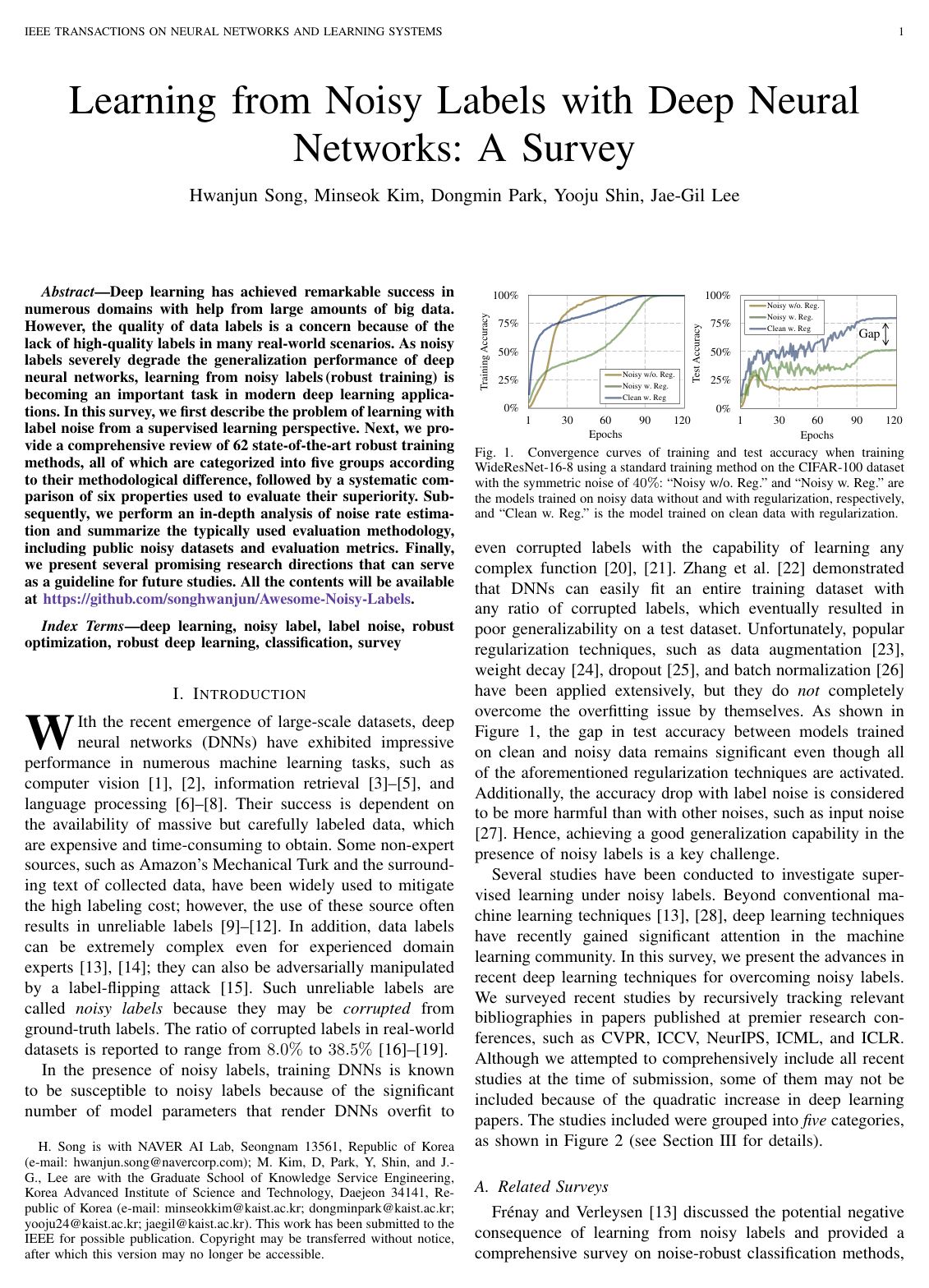
Learning From Noisy Labels With Deep Neural Networks: A Survey
Hwanjun Song, Minseok Kim, Dongmin Park, Yooju Shin, Jae-Gil Lee
Why you should read this
Categorizes 62 methods for training deep neural networks with label noise across five distinct paradigms, providing a comparative analysis of evaluation properties, noise estimation techniques, and standard benchmarks.
Deep learning has achieved remarkable success in numerous domains with help from large amounts of big data. However, the quality of data labels is a concern because of the lack of high-quality labels in many real-world scenarios. As noisy labels severely degrade the generalization performance of deep neural networks, learning from noisy labels (robust training) is becoming an important task in modern deep learning applications. In this survey, we first describe the problem of learning with label noise from a supervised learning perspective. Next, we provide a comprehensive review of 62 state-of-the-art robust training methods, all of which are categorized into five groups according to their methodological difference, followed by a systematic comparison of six properties used to evaluate their superiority. Subsequently, we perform an in-depth analysis of noise rate estimation and summarize the typically used evaluation methodology, including public noisy datasets and evaluation metrics. Finally, we present several promising research directions that can serve as a guideline for future studies. All the contents will be available at this https URL.
Added
2026-09-25