
keyword
computational learning theory
Computational learning theory is a branch of theoretical computer science and artificial intelligence dedicated to the formal mathematical analysis of machine learning algorithms. The field investigates the fundamental capabilities, computational limits, and efficiency of learning systems by establishing rigorous guarantees on their performance. Key areas of study include sample complexity, which quantifies the volume of data needed for reliable generalization, computational time complexity, and regret bounds in sequential decision-making. It encompasses foundational models and concepts such as Probably Approximately Correct learning, statistical query frameworks, online convex optimization, and capacity measures like the Vapnik-Chervonenkis dimension, providing the theoretical foundations used to design provably effective and robust learning algorithms.
9 items
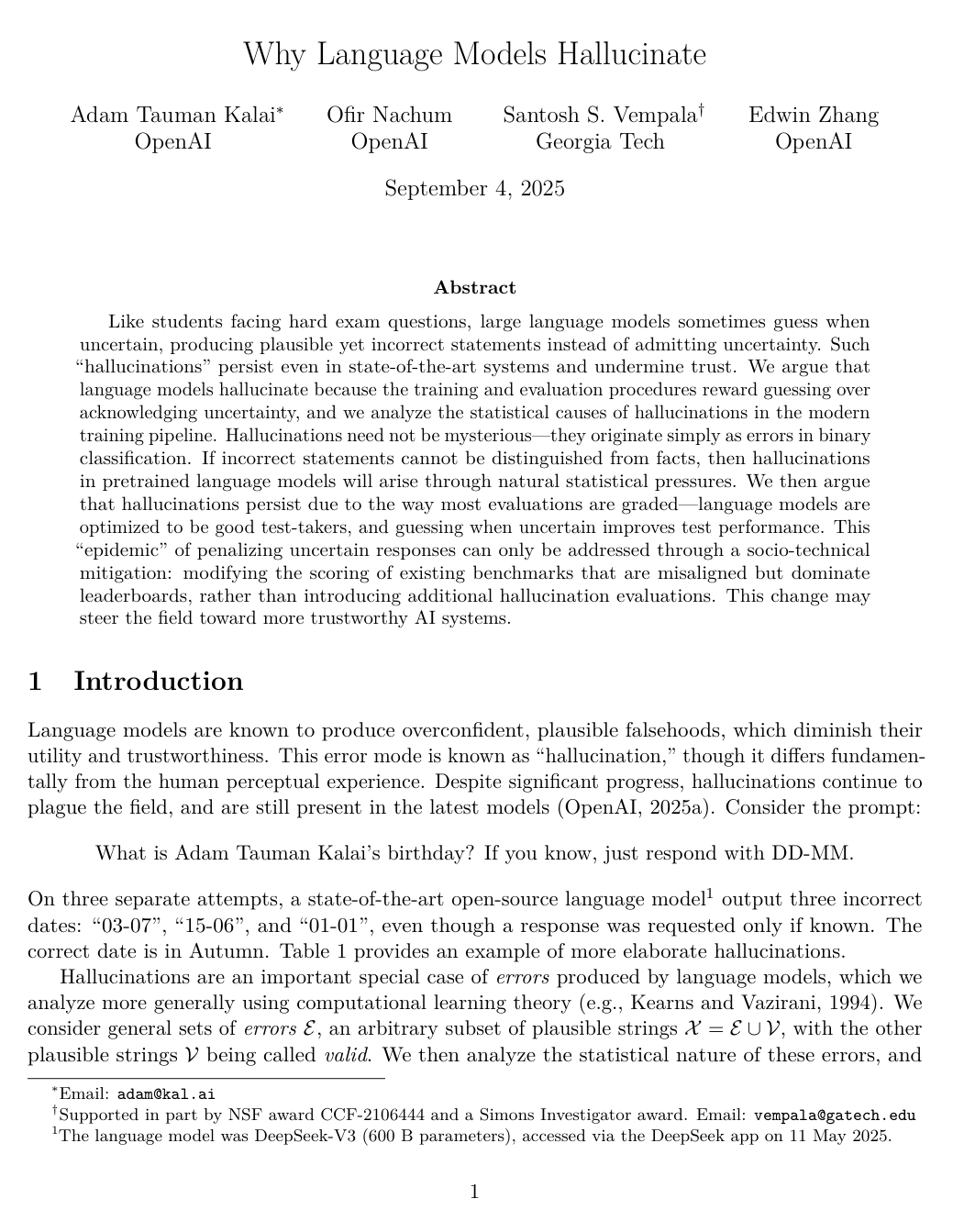
Why language models hallucinate
Adam Tauman Kalai, Ofir Nachum, Santosh S. Vempala, Edwin Zhang
Why you should read this
Explains how standard training objectives and benchmark scoring inherently reward language models for guessing rather than expressing uncertainty, framing hallucinations as predictable statistical classification errors that require reformed evaluation metrics to fix.
Like students facing hard exam questions, large language models sometimes guess when uncertain, producing plausible yet incorrect statements instead of admitting uncertainty. Such "hallucinations" persist even in state-of-the-art systems and undermine trust. We argue that language models hallucinate because the training and evaluation procedures reward guessing over acknowledging uncertainty, and we analyze the statistical causes of hallucinations in the modern training pipeline. Hallucinations need not be mysterious -- they originate simply as errors in binary classification. If incorrect statements cannot be distinguished from facts, then hallucinations in pretrained language models will arise through natural statistical pressures. We then argue that hallucinations persist due to the way most evaluations are graded -- language models are optimized to be good test-takers, and guessing when uncertain improves test performance. This "epidemic" of penalizing uncertain responses can only be addressed through a socio-technical mitigation: modifying the scoring of existing benchmarks that are misaligned but dominate leaderboards, rather than introducing additional hallucination evaluations. This change may steer the field toward more trustworthy AI systems.
Added
2026-10-05
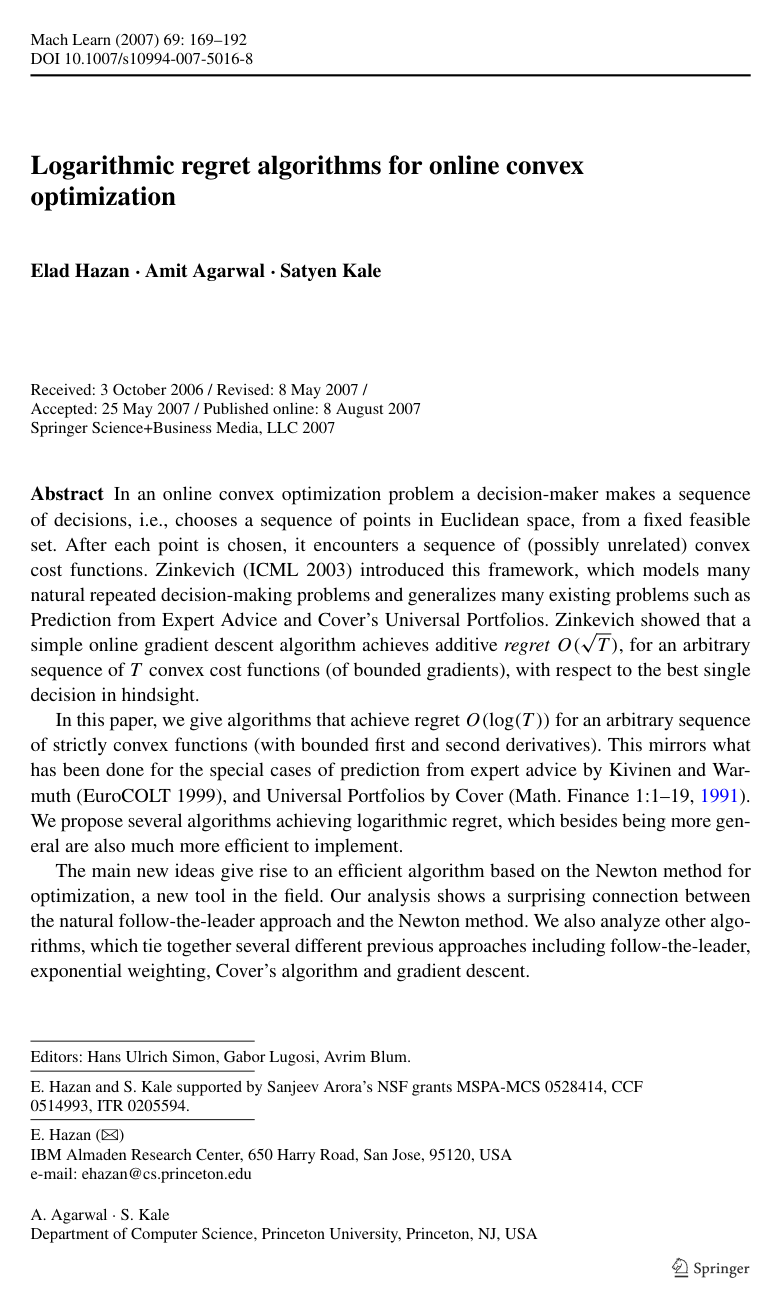
Logarithmic regret algorithms for online convex optimization
Elad Hazan, Amit Agarwal, Satyen Kale
Why you should read this
Introduces the computationally efficient Online Newton Step algorithm alongside generalized Follow-the-Leader methods, proving they achieve optimal logarithmic regret for online convex optimization over strictly convex functions.
In an online convex optimization problem a decision-maker makes a sequence of decisions, i.e., chooses a sequence of points in Euclidean space, from a fixed feasible set. After each point is chosen, it encounters a sequence of (possibly unrelated) convex cost functions. Zinkevich (ICML 2003) introduced this framework, which models many natural repeated decision-making problems and generalizes many existing problems such as Prediction from Expert Advice and Cover's Universal Portfolios. Zinkevich showed that a simple online gradient descent algorithm achieves additive regret O(√T), for an arbitrary sequence of T convex cost functions (of bounded gradients), with respect to the best single decision in hindsight. In this paper, we give algorithms that achieve regret O(log(T)) for an arbitrary sequence of strictly convex functions (with bounded first and second derivatives). This mirrors what has been done for the special cases of prediction from expert advice by Kivinen and Warmuth (EuroCOLT 1999), and Universal Portfolios by Cover (Math. Finance 1:1–19, 1991). We propose several algorithms achieving logarithmic regret, which besides being more general are also much more efficient to implement. The main new ideas give rise to an efficient algorithm based on the Newton method for optimization, a new tool in the field. Our analysis shows a surprising connection between the natural follow-the-leader approach and the Newton method. We also analyze other algorithms, which tie together several different previous approaches including follow-the-leader, exponential weighting, Cover's algorithm and gradient descent.
Added
2026-09-25
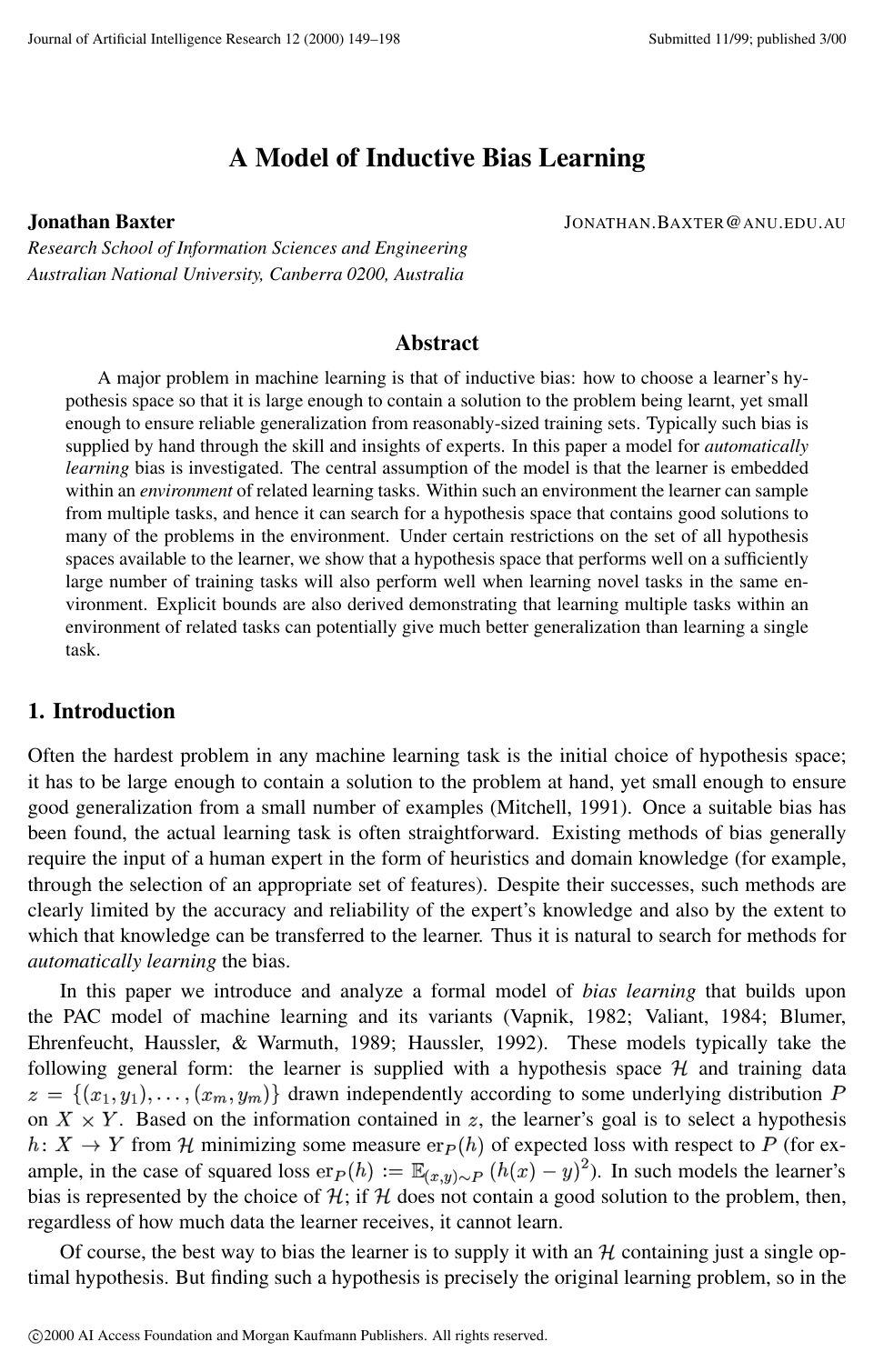
A Model of Inductive Bias Learning
Jonathan Baxter
Why you should read this
Establishes a foundational theoretical framework for automatically learning inductive biases across related tasks, proving explicit generalization bounds that demonstrate how multi-task experience drastically reduces the sample complexity required to learn novel problems.
A major problem in machine learning is that of inductive bias: how to choose a learner's hypothesis space so that it is large enough to contain a solution to the problem being learnt, yet small enough to ensure reliable generalization from reasonably-sized training sets. Typically such bias is supplied by hand through the skill and insights of experts. In this paper a model for automatically learning bias is investigated. The central assumption of the model is that the learner is embedded within an environment of related learning tasks. Within such an environment the learner can sample from multiple tasks, and hence it can search for a hypothesis space that contains good solutions to many of the problems in the environment. Under certain restrictions on the set of all hypothesis spaces available to the learner, we show that a hypothesis space that performs well on a sufficiently large number of training tasks will also perform well when learning novel tasks in the same environment. Explicit bounds are also derived demonstrating that learning multiple tasks within an environment of related tasks can potentially give much better generalization than learning a single task.
Added
2026-09-25
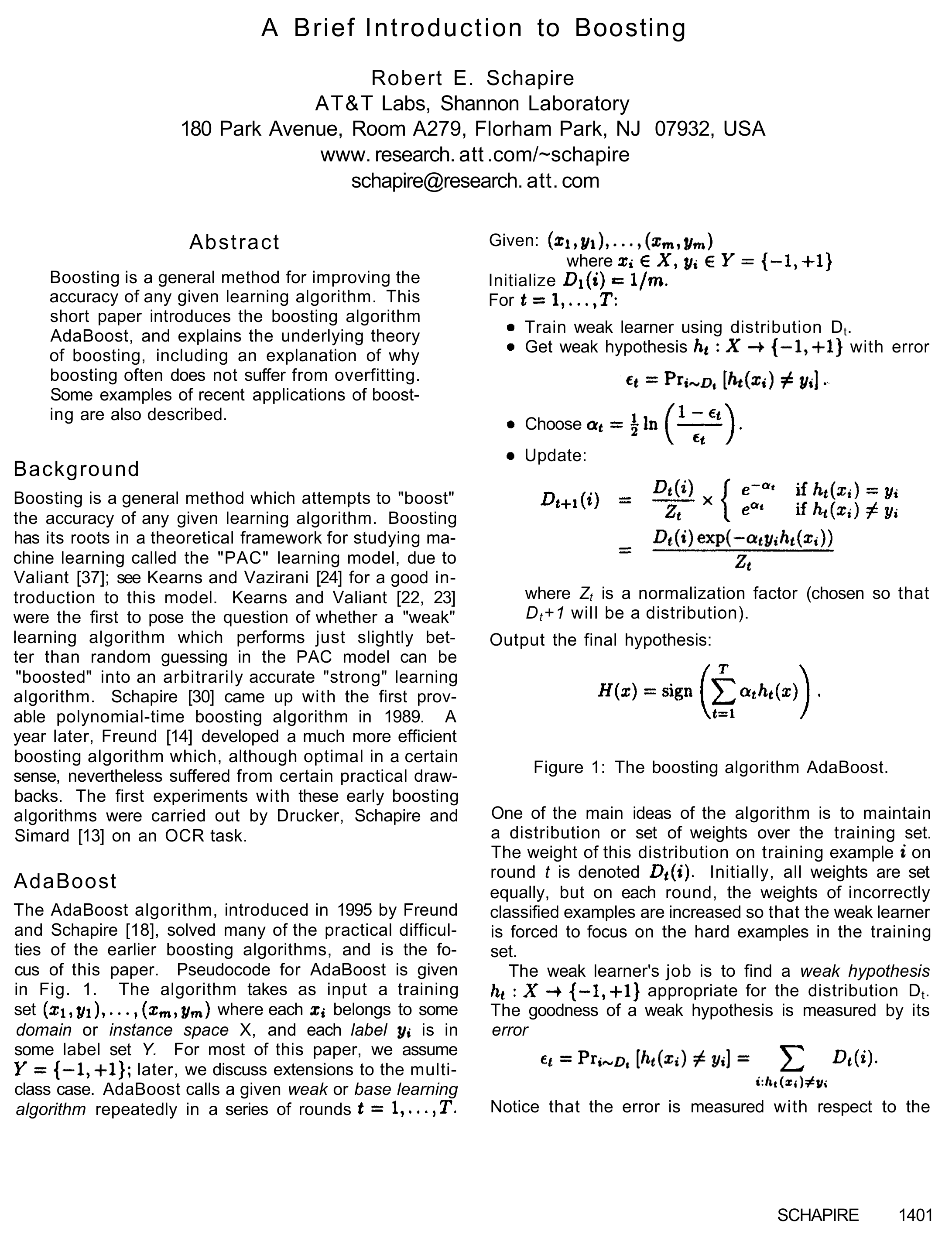
A Brief Introduction to Boosting
R. Schapire
Why you should read this
Explains the theoretical foundations and mechanics of AdaBoost, providing clear proofs of exponential training error reduction alongside a margin-based explanation for why boosting resists overfitting even after achieving zero training error.
Boosting is a general method for improving the accuracy of any given learning algorithm. This short paper introduces the boosting algorithm AdaBoost, and explains the underlying theory of boosting, including an explanation of why boosting often does not suffer from overfitting. Some examples of recent applications of boosting are also described.
Added
2026-09-24
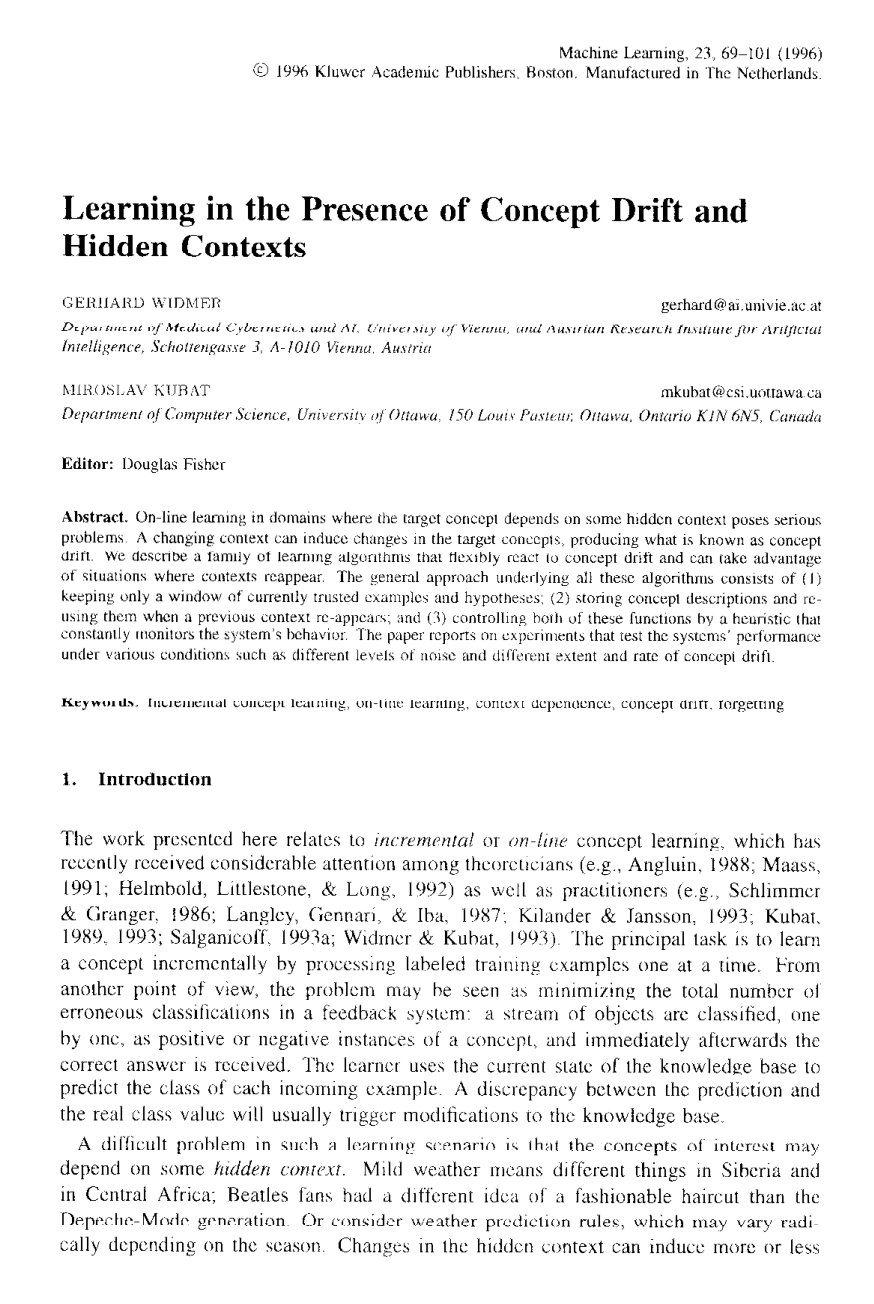
Learning in the Presence of Concept Drift and Hidden Contexts
G. Widmer, M. Kubát
Why you should read this
Presents the FLORA framework of incremental learning algorithms that dynamically adjust sample windows and reuse past concept descriptions to handle recurring hidden contexts and concept drift in continuous data streams.
On-line learning in domains where the target concept depends on some hidden context poses serious problems. A changing context can induce changes in the target concepts, producing what is known as concept drift. We describe a family of learning algorithms that flexibly react to concept drift and can take advantage of situations where contexts reappear. The general approach underlying all these algorithms consists of (1) keeping only a window of currently trusted examples and hypotheses; (2) storing concept descriptions and re-using them when a previous context re-appears; and (3) controlling both of these functions by a heuristic that constantly monitors the system's behavior. The paper reports on experiments that test the systems' performance under various conditions such as different levels of noise and different extent and rate of concept drift.
Added
2026-09-24
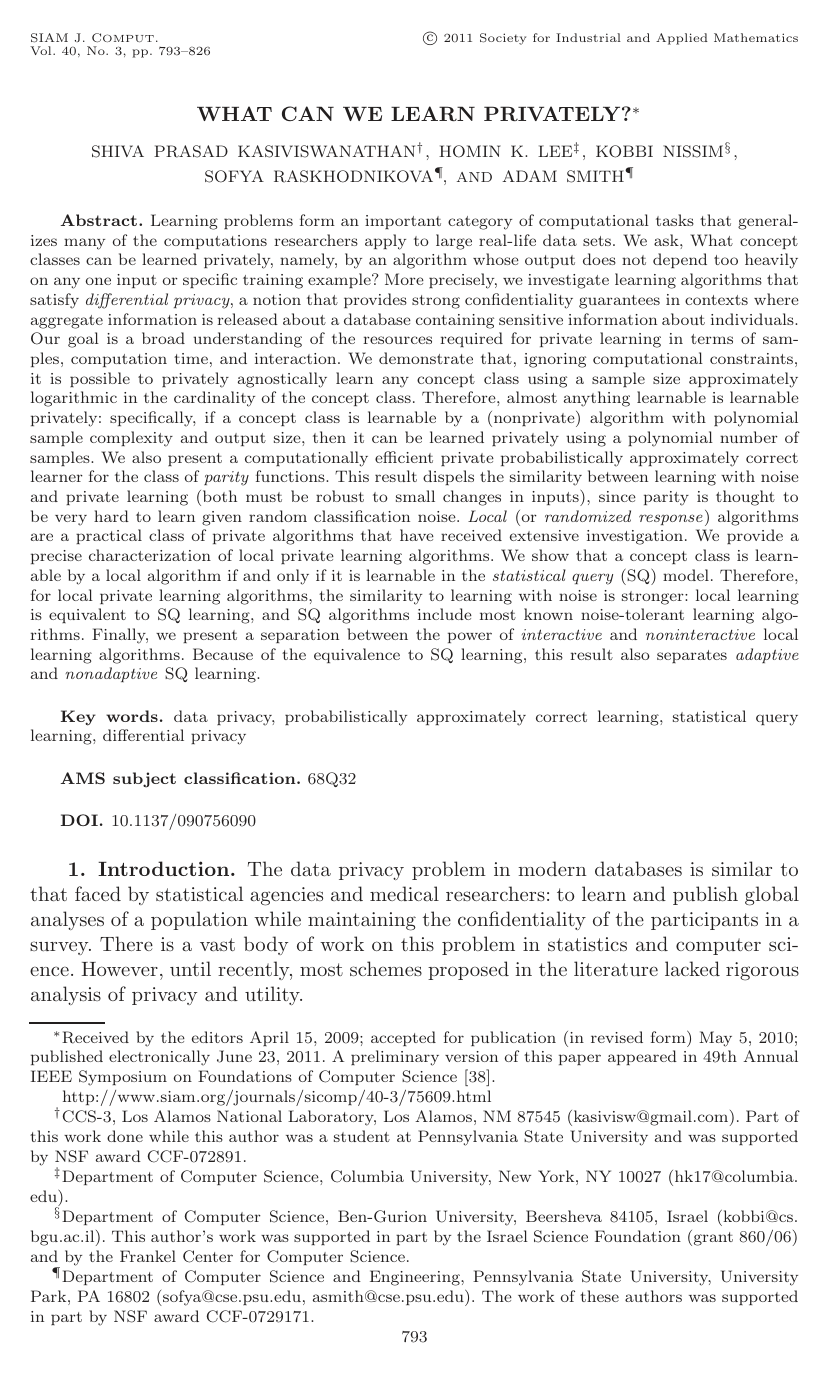
What Can We Learn Privately?
Shiva Prasad Kasiviswanathan, Homin K. Lee, Kobbi Nissim, Sofya Raskhodnikova, Adam Smith
Why you should read this
Establishes the theoretical foundations of private machine learning by proving that any concept class learnable with polynomial sample complexity is also privately learnable, while demonstrating that local differential privacy is equivalent to the statistical query model.
Learning problems form an important category of computational tasks that generalizes many of the computations researchers apply to large real-life data sets. We ask: what concept classes can be learned privately, namely, by an algorithm whose output does not depend too heavily on any one input or specific training example? More precisely, we investigate learning algorithms that satisfy differential privacy, a notion that provides strong confidentiality guarantees in contexts where aggregate information is released about a database containing sensitive information about individuals. We demonstrate that, ignoring computational constraints, it is possible to privately agnostically learn any concept class using a sample size approximately logarithmic in the cardinality of the concept class. Therefore, almost anything learnable is learnable privately: specifically, if a concept class is learnable by a (non-private) algorithm with polynomial sample complexity and output size, then it can be learned privately using a polynomial number of samples. We also present a computationally efficient private PAC learner for the class of parity functions. Local (or randomized response) algorithms are a practical class of private algorithms that have received extensive investigation. We provide a precise characterization of local private learning algorithms. We show that a concept class is learnable by a local algorithm if and only if it is learnable in the statistical query (SQ) model. Finally, we present a separation between the power of interactive and noninteractive local learning algorithms.
Added
2026-09-24
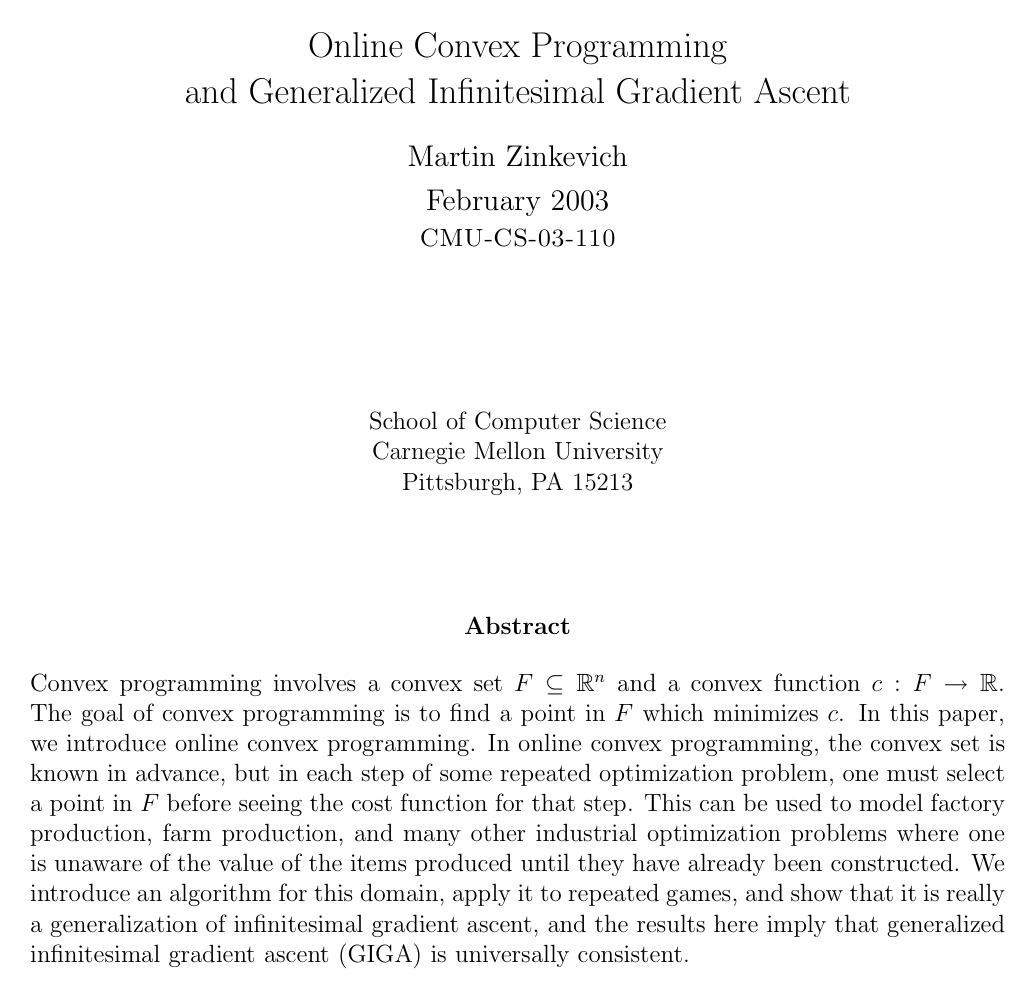
Online Convex Programming and Generalized Infinitesimal Gradient Ascent
Martin A. Zinkevich
Why you should read this
Introduces online convex programming alongside a projected gradient descent algorithm that guarantees regret against arbitrary sequences of convex cost functions and proves universal consistency in repeated games.
Convex programming involves a convex set F ⊆ ℝⁿ and a convex function c : F → ℝ. The goal of convex programming is to find a point in F which minimizes c. In this paper, we introduce online convex programming. In online convex programming, the convex set is known in advance, but in each step of some repeated optimization problem, one must select a point in F before seeing the cost function for that step. This can be used to model factory production, farm production, and many other industrial optimization problems where one is unaware of the value of the items produced until they have already been constructed. We introduce an algorithm for this domain, apply it to repeated games, and show that it is really a generalization of infinitesimal gradient ascent, and the results here imply that generalized infinitesimal gradient ascent (GIGA) is universally consistent.
Added
2026-09-14
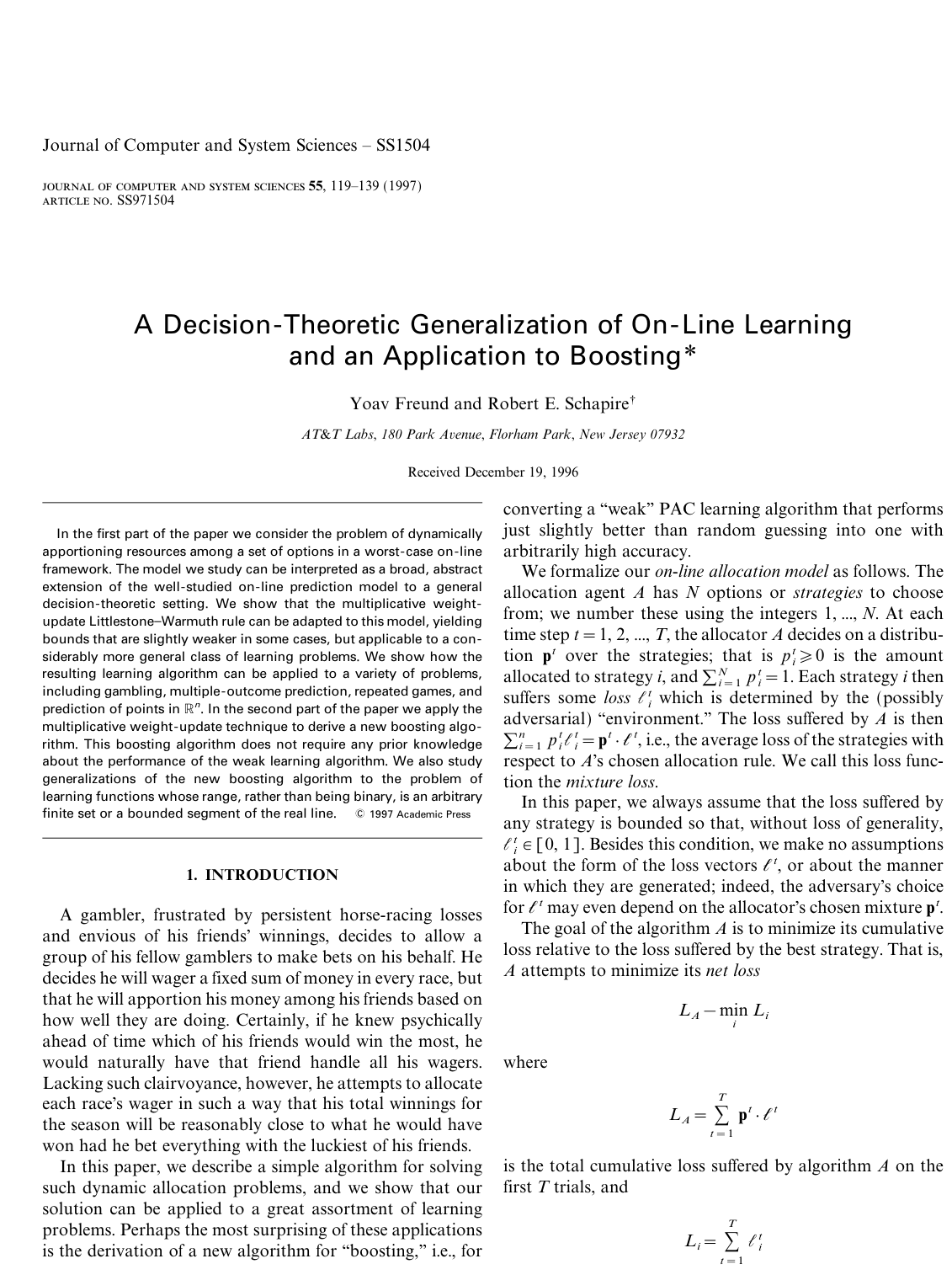
A Decision-Theoretic Generalization of On-Line Learning and an Application to Boosting
Yoav Freund, Robert E. Schapire
Why you should read this
Presents the AdaBoost algorithm that guarantees exponentially decaying error rates by sequentially combining weak learners into a strong classifier.
In the first part of the paper we consider the problem of dynamically apportioning resources among a set of options in a worst-case on-line framework. The model we study can be interpreted as a broad, abstract extension of the well-studied on-line prediction model to a general decision-theoretic setting. We show that the multiplicative weight-update Littlestone–Warmuth rule can be adapted to this model, yielding bounds that are slightly weaker in some cases, but applicable to a considerably more general class of learning problems. We show how the resulting learning algorithm can be applied to a variety of problems, including gambling, multiple-outcome prediction, repeated games, and prediction of points in R^n. In the second part of the paper we apply the multiplicative weight-update technique to derive a new boosting algorithm. This boosting algorithm does not require any prior knowledge about the performance of the weak learning algorithm. We also study generalizations of the new boosting algorithm to the problem of learning functions whose range, rather than being binary, is an arbitrary finite set or a bounded segment of the real line.
Added
2026-05-14
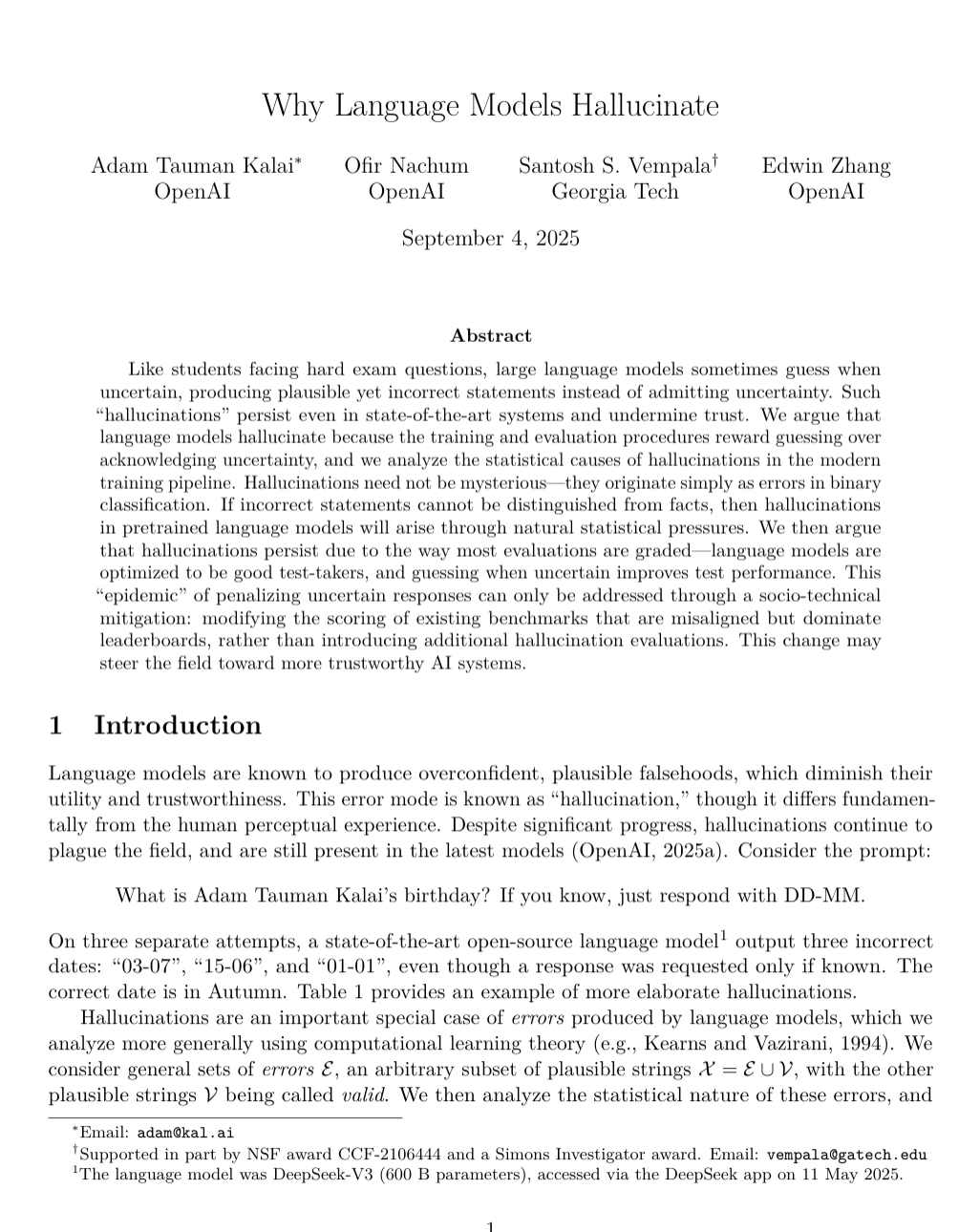
Why Language Models Hallucinate
Adam Tauman Kalai, Ofir Nachum, Santosh S. Vempala, Edwin Zhang
Why you should read this
Demonstrates that language model hallucinations arise from statistical pressures and misaligned evaluation metrics that reward guessing, proposing a socio-technical solution to foster more trustworthy AI.
Like students facing hard exam questions, large language models sometimes guess when uncertain, producing plausible yet incorrect statements instead of admitting uncertainty. Such "hallucinations" persist even in state-of-the-art systems and undermine trust. We argue that language models hallucinate because the training and evaluation procedures reward guessing over acknowledging uncertainty, and we analyze the statistical causes of hallucinations in the modern training pipeline. Hallucinations need not be mysterious -- they originate simply as errors in binary classification. If incorrect statements cannot be distinguished from facts, then hallucinations in pretrained language models will arise through natural statistical pressures. We then argue that hallucinations persist due to the way most evaluations are graded -- language models are optimized to be good test-takers, and guessing when uncertain improves test performance. This "epidemic" of penalizing uncertain responses can only be addressed through a socio-technical mitigation: modifying the scoring of existing benchmarks that are misaligned but dominate leaderboards, rather than introducing additional hallucination evaluations. This change may steer the field toward more trustworthy AI systems.
Added
2025-10-14
