
keyword
attention network
An attention network is an artificial neural network architecture that incorporates an attention mechanism to dynamically weight and focus on the most relevant parts of input data during processing. Instead of treating all input elements equally or compressing entire inputs into a static summary representation, the network computes adaptive weights that quantify the relative importance of individual components, such as specific words in a sentence, regions within an image, or distinct entities in a structured group. By selectively prioritizing informative features and filtering out irrelevant noise, attention networks effectively model complex dependencies across data, improve task performance across various domains, and provide greater interpretability by revealing which inputs most heavily influence the model decisions.
4 items
Data-efficient and weakly supervised computational pathology on whole-slide images
Ming Y. Lu, Drew F. K. Williamson, Tiffany Y. Chen, Richard J. Chen, Matteo Barbieri, Faisal Mahmood
Why you should read this
Presents CLAM, a data-efficient deep learning framework that uses clustering-constrained attention to classify gigapixel whole slide images and identify clinically relevant morphological patterns using only slide-level labels.
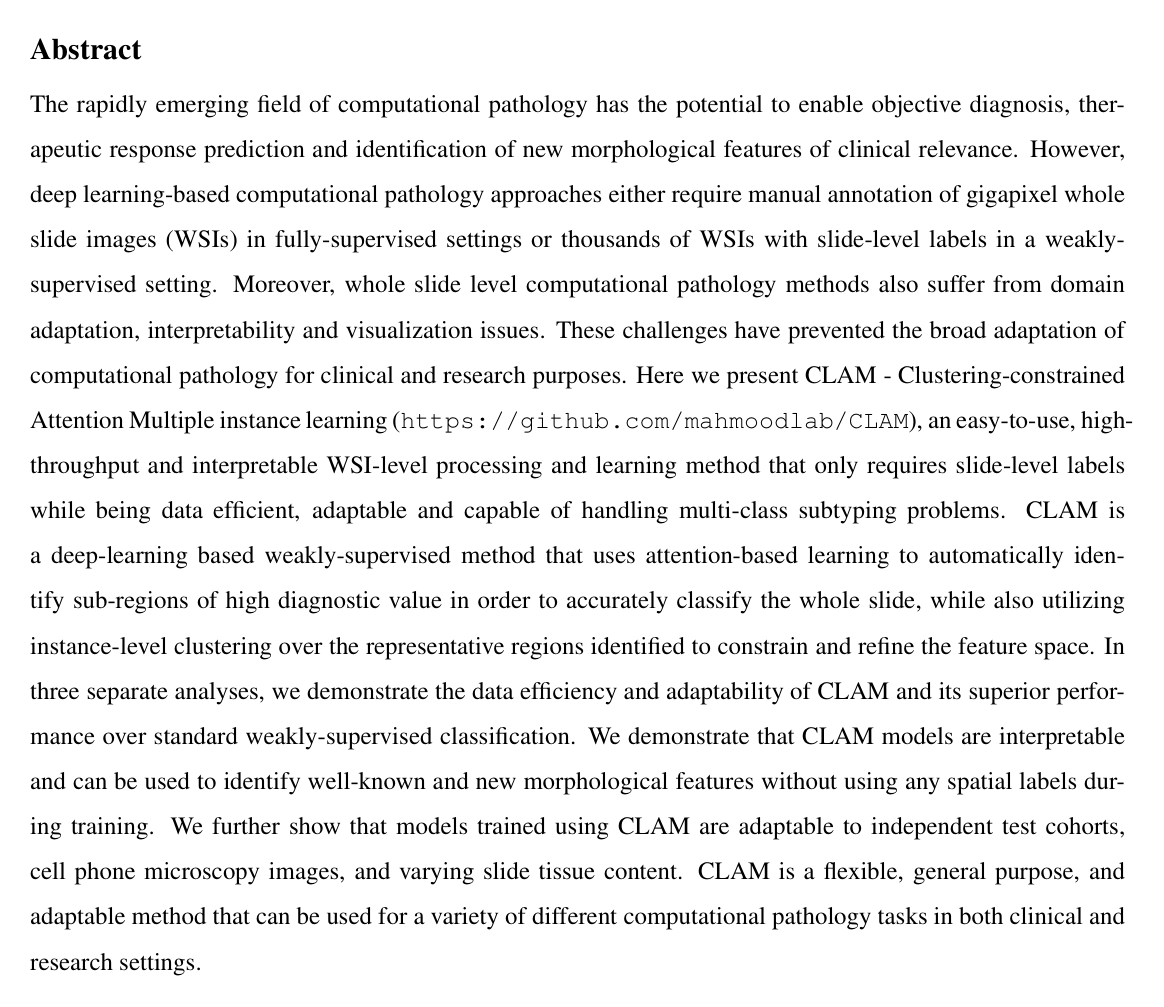
The rapidly emerging field of computational pathology has the potential to enable objective diagnosis, therapeutic response prediction and identification of new morphological features of clinical relevance. However, deep learning-based computational pathology approaches either require manual annotation of gigapixel whole slide images (WSIs) in fully-supervised settings or thousands of WSIs with slide-level labels in a weakly-supervised setting. Moreover, whole slide level computational pathology methods also suffer from domain adaptation and interpretability issues. These challenges have prevented the broad adaptation of computational pathology for clinical and research purposes. Here we present CLAM - Clustering-constrained attention multiple instance learning, an easy-to-use, high-throughput, and interpretable WSI-level processing and learning method that only requires slide-level labels while being data efficient, adaptable and capable of handling multi-class subtyping problems. CLAM is a deep-learning-based weakly-supervised method that uses attention-based learning to automatically identify sub-regions of high diagnostic value in order to accurately classify the whole slide, while also utilizing instance-level clustering over the representative regions identified to constrain and refine the feature space. In three separate analyses, we demonstrate the data efficiency and adaptability of CLAM and its superior performance over standard weakly-supervised classification. We demonstrate that CLAM models are interpretable and can be used to identify well-known and new morphological features. We further show that models trained using CLAM are adaptable to independent test cohorts, cell phone microscopy images, and biopsies. CLAM is a general-purpose and adaptable method that can be used for a variety of different computational pathology tasks in both clinical and research settings.
Added
2026-09-15
Graph Neural Networks for Social Recommendation
Wenqi Fan, Yao Ma, Qing Li, Yuan He, Eric Zhao, Jiliang Tang, Dawei Yin
Why you should read this
Develops GraphRec, a graph neural network framework that captures user-item interactions, rating opinions, and social ties with varying relationship strengths to improve social recommendation accuracy.
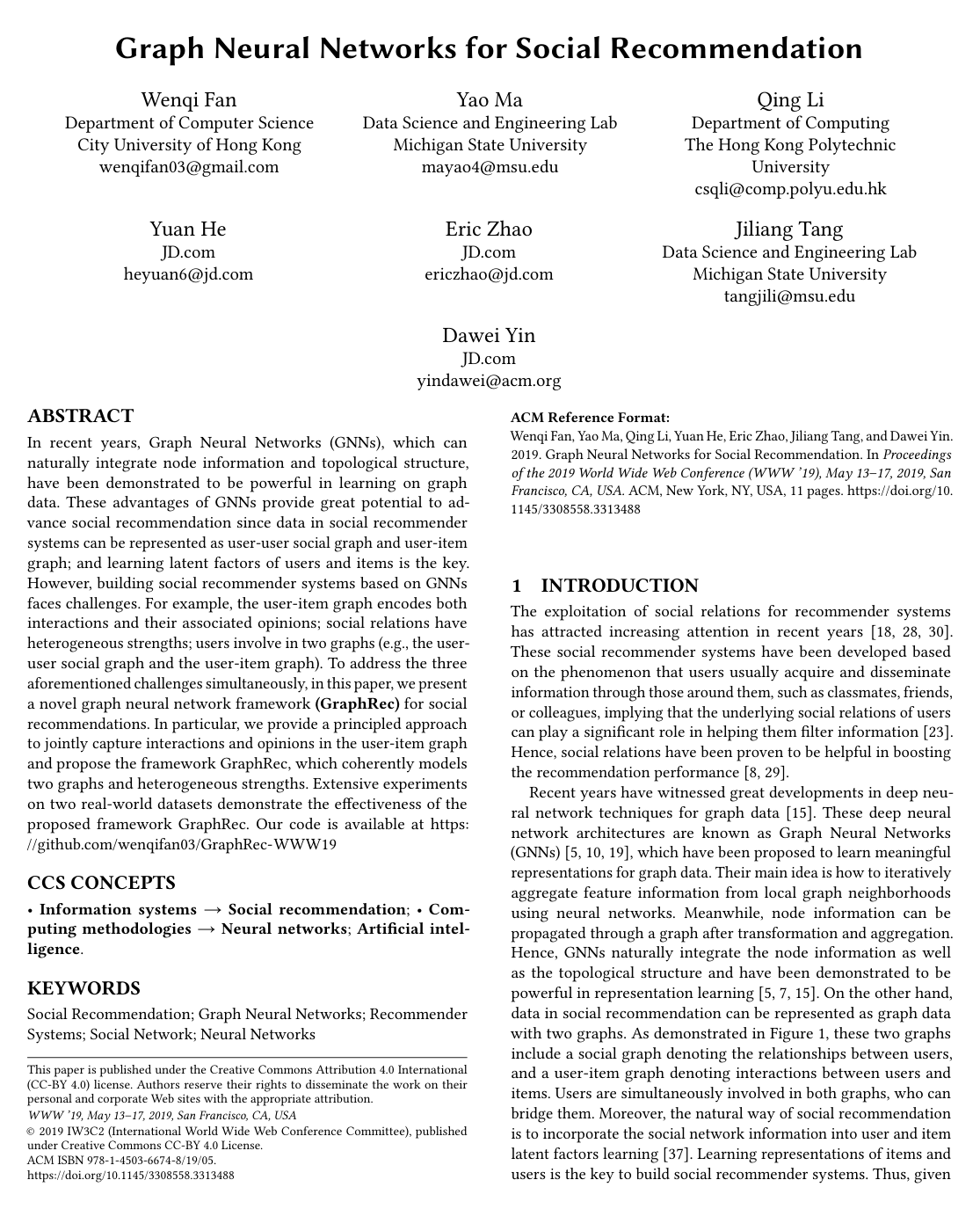
In recent years, Graph Neural Networks (GNNs), which can naturally integrate node information and topological structure, have been demonstrated to be powerful in learning on graph data. These advantages of GNNs provide great potential to advance social recommendation since data in social recommender systems can be represented as user-user social graph and user-item graph; and learning latent factors of users and items is the key. However, building social recommender systems based on GNNs faces challenges. For example, the user-item graph encodes both interactions and their associated opinions; social relations have heterogeneous strengths; users involve in two graphs (e.g., the user-user social graph and the user-item graph). To address the three aforementioned challenges simultaneously, in this paper, we present a novel graph neural network framework (GraphRec) for social recommendations. In particular, we provide a principled approach to jointly capture interactions and opinions in the user-item graph and propose the framework GraphRec, which coherently models two graphs and heterogeneous strengths. Extensive experiments on two real-world datasets demonstrate the effectiveness of the proposed framework GraphRec. Our code is available at \url{this https URL}
Added
2026-09-14
Attention-based Deep Multiple Instance Learning
Maximilian Ilse, Jakub M. Tomczak, Max Welling
Why you should read this
Proposes an attention-based aggregation operator for deep multiple instance learning that achieves high classification accuracy on histopathology benchmarks while identifying the exact contribution of each individual instance to the overall bag label.
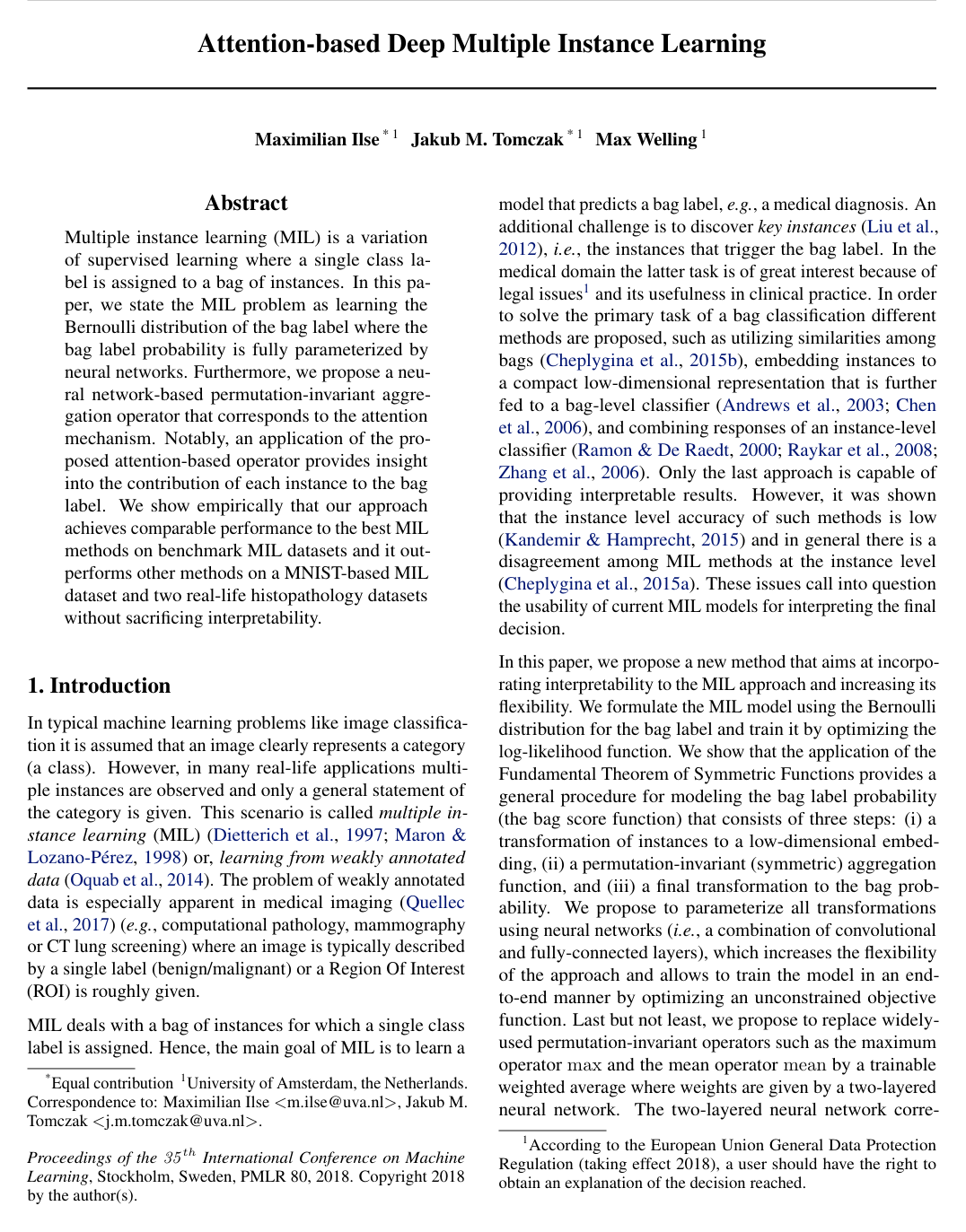
Multiple instance learning (MIL) is a variation of supervised learning where a single class label is assigned to a bag of instances. In this paper, we state the MIL problem as learning the Bernoulli distribution of the bag label where the bag label probability is fully parameterized by neural networks. Furthermore, we propose a neural network-based permutation-invariant aggregation operator that corresponds to the attention mechanism. Notably, an application of the proposed attention-based operator provides insight into the contribution of each instance to the bag label. We show empirically that our approach achieves comparable performance to the best MIL methods on benchmark MIL datasets and it outperforms other methods on a MNIST-based MIL dataset and two real-life histopathology datasets without sacrificing interpretability.
Added
2026-09-14
Google's Neural Machine Translation System: Bridging the Gap between Human and Machine Translation
Yonghui Wu, Mike Schuster, Zhifeng Chen, Quoc V. Le, Mohammad Norouzi, Wolfgang Macherey, Maxim Krikun, Yuan Cao, Qin Gao, Klaus Macherey, Jeff Klingner, Apurva Shah, Melvin Johnson, Xiaobing Liu, Łukasz Kaiser, Stephan Gouws, Yoshikiyo Kato, Taku Kudo, Hideto Kazawa, Keith Stevens, George Kurian, Nishant Patil, Wei Wang, Cliff Young, Jason Smith, Jason Riesa, Alex Rudnick, Oriol Vinyals, Greg Corrado, Macduff Hughes, Jeffrey Dean
Why you should read this
Presents the architecture and engineering design behind Google's production neural machine translation system, demonstrating how deep recurrent networks, subword tokenization, and low-precision inference overcome practical latency and vocabulary challenges to reduce translation errors by 60% over phrase-based baselines.
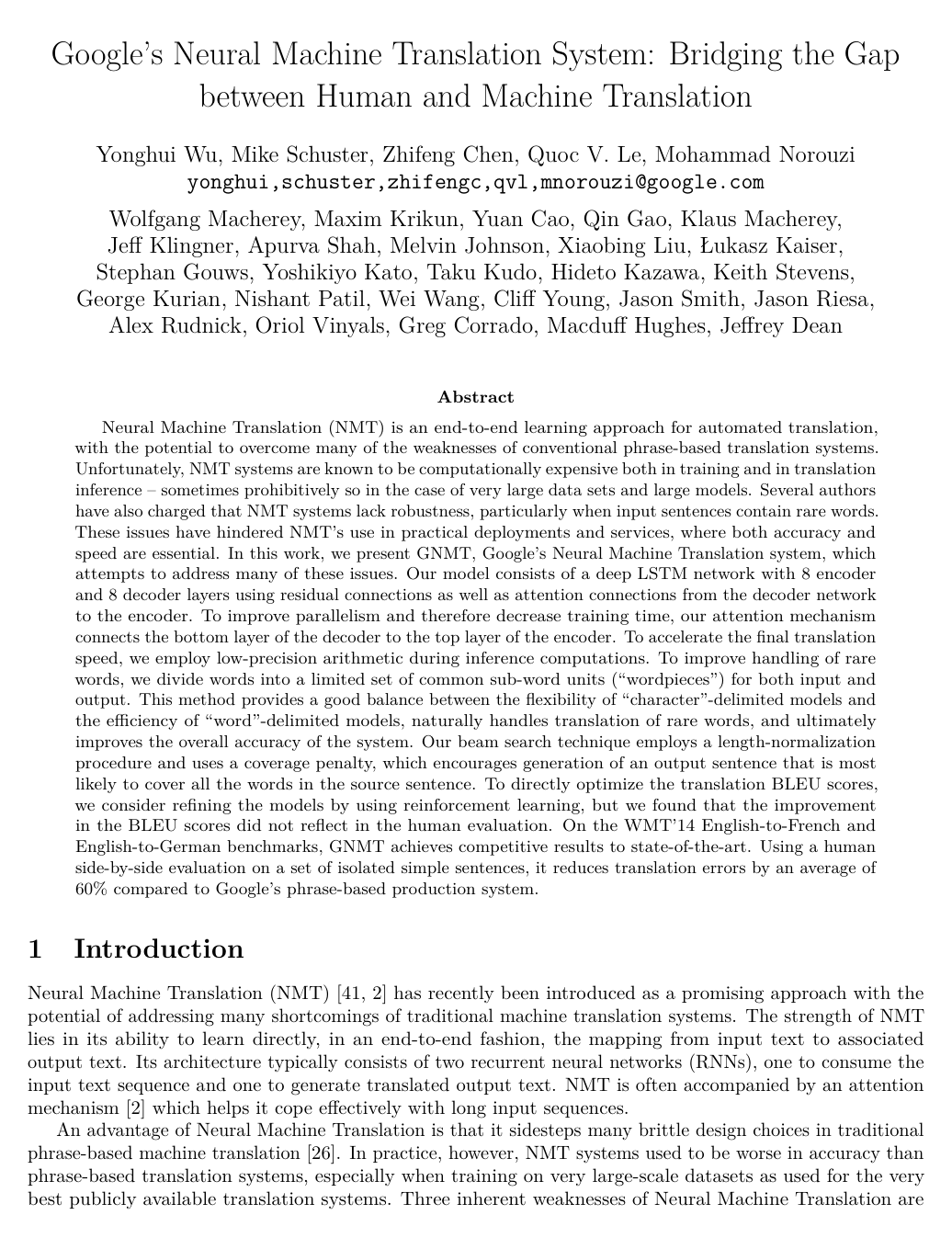
Neural Machine Translation (NMT) is an end-to-end learning approach for automated translation, with the potential to overcome many of the weaknesses of conventional phrase-based translation systems. Unfortunately, NMT systems are known to be computationally expensive both in training and in translation inference. Also, most NMT systems have difficulty with rare words. These issues have hindered NMT's use in practical deployments and services, where both accuracy and speed are essential. In this work, we present GNMT, Google's Neural Machine Translation system, which attempts to address many of these issues. Our model consists of a deep LSTM network with 8 encoder and 8 decoder layers using attention and residual connections. To improve parallelism and therefore decrease training time, our attention mechanism connects the bottom layer of the decoder to the top layer of the encoder. To accelerate the final translation speed, we employ low-precision arithmetic during inference computations. To improve handling of rare words, we divide words into a limited set of common sub-word units ("wordpieces") for both input and output. This method provides a good balance between the flexibility of "character"-delimited models and the efficiency of "word"-delimited models, naturally handles translation of rare words, and ultimately improves the overall accuracy of the system. Our beam search technique employs a length-normalization procedure and uses a coverage penalty, which encourages generation of an output sentence that is most likely to cover all the words in the source sentence. On the WMT'14 English-to-French and English-to-German benchmarks, GNMT achieves competitive results to state-of-the-art. Using a human side-by-side evaluation on a set of isolated simple sentences, it reduces translation errors by an average of 60% compared to Google's phrase-based production system.
Added
2026-09-10
License
Published with permission