Attention-based Deep Multiple Instance Learning

Maximilian IlseJakub M. TomczakMax Welling

article2018ICML2,842 citations

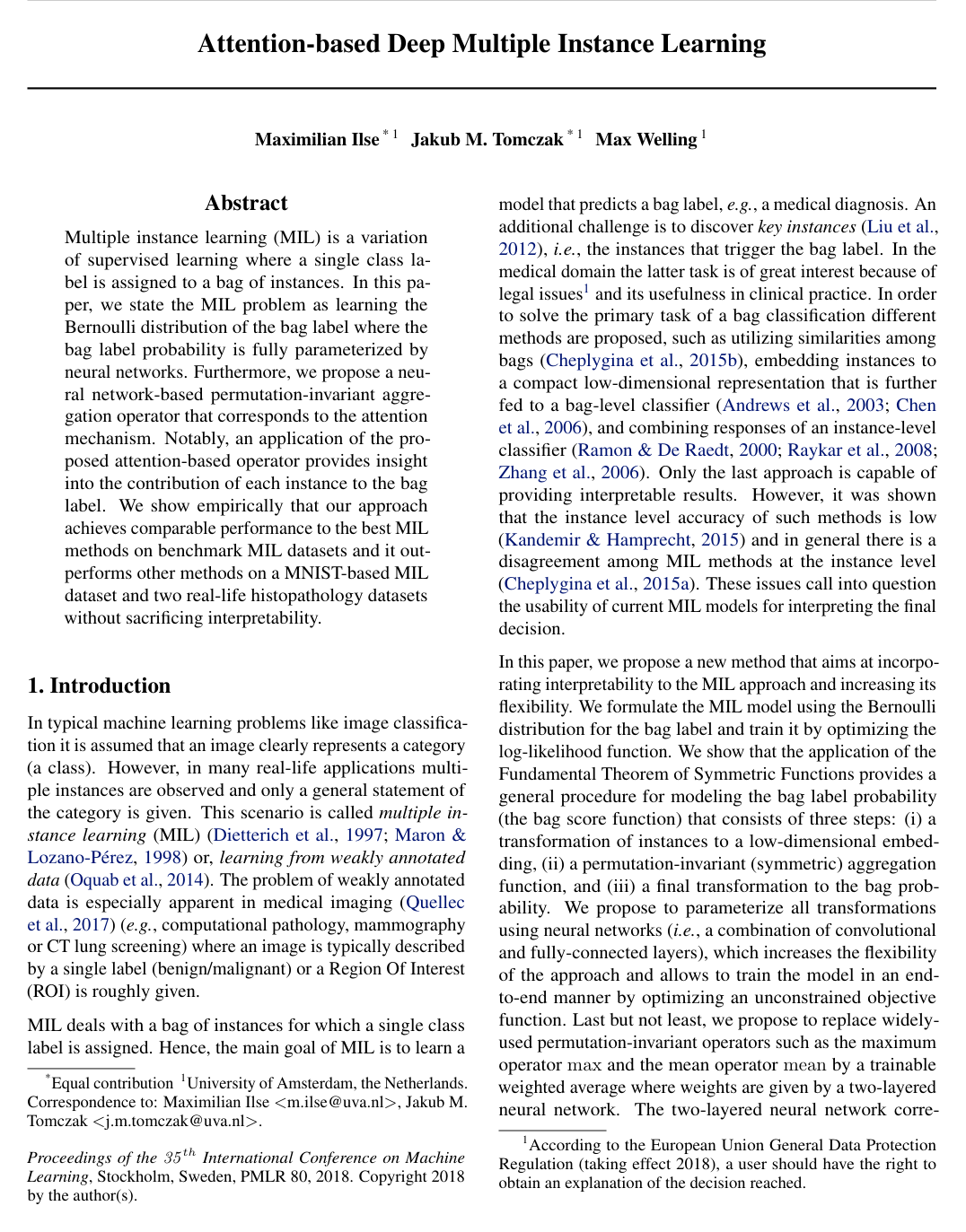
Proposes an attention-based aggregation operator for deep multiple instance learning that achieves high classification accuracy on histopathology benchmarks while identifying the exact contribution of each individual instance to the overall bag label.

Listen

The article addresses the challenge of multiple instance learning (MIL), where a single label applies to an entire bag of instances rather than individual ones. This setup arises frequently in medical imaging tasks such as cancer detection in histopathology slides, where only image-level labels are available and pixel-level annotations are costly or impractical. The problem matters now because regulatory requirements increasingly demand explanations for automated decisions, and current MIL methods often lack both strong predictive performance and reliable interpretability.

The article set out to develop a flexible, end-to-end trainable MIL model that maintains or improves bag-level classification accuracy while providing insight into which instances drive the bag label. The authors formulated the bag label as a Bernoulli probability fully parameterized by neural networks and replaced fixed pooling operators with a trainable attention mechanism that produces a weighted average of instance embeddings.

They evaluated the approach on five classical MIL benchmark datasets, a custom MNIST-based image dataset with controlled bag sizes, and two real histopathology collections (breast cancer and colon cancer slides). Experiments used 10-fold cross-validation with multiple repetitions, compared instance-level and embedding-level architectures, and measured accuracy, precision, recall, F-score, and AUC against prior MIL methods including max and mean pooling baselines.

The attention-based models achieved performance on par with the strongest classical methods on the benchmark datasets and outperformed other neural-network MIL variants on the MNIST-bags task and both histopathology datasets, with particularly large gains in the small-sample regime. Attention weights successfully highlighted diagnostically relevant instances or regions of interest, and the gated attention variant further improved results on the breast cancer data. Embedding-level models generally outperformed instance-level ones, and the attention operator proved more effective than fixed max or mean pooling.

These results indicate that a trainable attention pooling layer can deliver both higher accuracy and built-in interpretability without added computational cost at inference time. In clinical settings the approach could reduce pathologist workload by supplying both a diagnosis and highlighted regions from weakly labeled whole-slide images, while satisfying emerging requirements for decision explanations.

The authors recommend extending the framework to multi-class problems, incorporating instance dependencies, and exploring repulsion points where certain instances force a negative bag label. They note that further validation on larger, more diverse medical datasets would strengthen confidence before clinical deployment. The main limitations are the focus on binary classification, reliance on relatively small datasets in some experiments, and the assumption of instance independence within bags; results on the classical benchmarks carry higher uncertainty due to larger standard errors.

arXiv: 1802.04712AMLab-Amsterdam/AttentionDeepMIL
  • Paper: Show, Attend and Tell: Neural Image Caption Generation with Visual Attention, Kelvin Xu et al. (2015). Introduces the foundational soft and hard attention mechanisms for neural networks, which directly underpin the attention-pooling formulation used for multiple instance learning.
  • Paper: Learning Deep Features for Discriminative Localization, Bolei Zhou et al. (2016). Establishes weakly-supervised localization via global pooling and weighted feature aggregation, providing essential conceptual groundwork for extracting interpretable instance regions from bag-level supervision.
  • Paper: A survey on deep learning in medical image analysis, Geert Litjens et al. (2017). Surveys the core deep learning architectures and weak supervision challenges in medical image analysis, supplying essential domain context for whole-slide histopathology classification.
  • Paper: The Mythos of Model Interpretability, Zachary C. Lipton (2016). Clarifies the theoretical taxonomy and motivations for model interpretability, contextualizing the source's objective of delivering built-in, reliable decision explanations.
Cover for Attention-based Deep Multiple Instance Learning

Abstract

Multiple instance learning (MIL) is a variation of supervised learning where a single class label is assigned to a bag of instances. In this paper, we state the MIL problem as learning the Bernoulli distribution of the bag label where the bag label probability is fully parameterized by neural networks. Furthermore, we propose a neural network-based permutation-invariant aggregation operator that corresponds to the attention mechanism. Notably, an application of the proposed attention-based operator provides insight into the contribution of each instance to the bag label. We show empirically that our approach achieves comparable performance to the best MIL methods on benchmark MIL datasets and it outperforms other methods on a MNIST-based MIL dataset and two real-life histopathology datasets without sacrificing interpretability.

Table of Contents

  • 1 Introduction
  • 2 Methodology
  • 2.1 Multiple instance learning (MIL)
  • 2.2 MIL with Neural Networks
  • 2.3 MIL pooling
  • 2.4 Attention-based MIL pooling
  • 3 Related work
  • 4 Experiments
  • 4.1 Classical MIL datasets
  • 4.2 MNIST-bags
  • 4.3 Histopathology datasets
  • 5 Conclusion
  • References
  • 6 Appendix
  • 6.1 Deep MIL approaches
  • 6.2 Code
  • 6.3 Classical MIL datasets
  • 6.4 MNIST-bags
  • 6.5 Histopathology datasets

Knowls

  1. Knowl 1 — Attention-Based Multiple Instance Learning Pooling Operator

    model/method

    In multiple instance learning (MIL), standard non-trainable pooling operators (such as max\max or mean) are replaced with a trainable, permutation-invariant aggregation function parameterized by a two-layer neural network.

    Given a bag of KK instance embeddings H={h1,,hK}H = \{h_1, \dots, h_K\} where each hkRMh_k \in \mathbb{R}^M, the attention-based MIL pooling computes a bag representation zRMz \in \mathbb{R}^M as a weighted average:

    z=k=1Kakhkz = \sum_{k=1}^{K} a_k h_k

    where the attention weight ak[0,1]a_k \in [0, 1] associated with instance kk is given by:

    ak=exp{wtanh(Vhk)}j=1Kexp{wtanh(Vhj)}a_k = \frac{\exp\{w^\top \tanh(V h_k^\top)\}}{\sum_{j=1}^K \exp\{w^\top \tanh(V h_j^\top)\}}

    Here wRL×1w \in \mathbb{R}^{L \times 1} and VRL×MV \in \mathbb{R}^{L \times M} are learnable parameters, and LL is the dimension of the attention hidden layer. The hyperbolic tangent tanh()\tanh(\cdot) introduces an element-wise non-linearity containing both positive and negative values to facilitate gradient flow. Because k=1Kak=1\sum_{k=1}^K a_k = 1, the aggregation is invariant to variable bag sizes KK and permutations of instances.

  2. Knowl 2 — Gated Attention Mechanism for Multiple Instance Pooling

    model/method

    Because tanh(x)\tanh(x) is approximately linear in the interval x[1,1]x \in [-1, 1], relying solely on tanh()\tanh(\cdot) can restrict the network's ability to learn complex relationships among instances. To introduce an additional learnable non-linearity, a gating mechanism is combined with the hyperbolic tangent in the attention pooling operator.

    For a bag of instance embeddings H={h1,,hK}H = \{h_1, \dots, h_K\} with hkRMh_k \in \mathbb{R}^M, the gated attention weights aka_k are defined as:

    ak=exp{w(tanh(Vhk)sigm(Uhk))}j=1Kexp{w(tanh(Vhj)sigm(Uhj))}a_k = \frac{\exp\left\{w^\top \left(\tanh(V h_k^\top) \odot \text{sigm}(U h_k^\top)\right)\right\}}{\sum_{j=1}^K \exp\left\{w^\top \left(\tanh(V h_j^\top) \odot \text{sigm}(U h_j^\top)\right)\right\}}

    where wRL×1w \in \mathbb{R}^{L \times 1}, VRL×MV \in \mathbb{R}^{L \times M}, and URL×MU \in \mathbb{R}^{L \times M} are learnable parameters, \odot denotes element-wise multiplication, and sigm(v)=11+ev\text{sigm}(v) = \frac{1}{1 + e^{-v}} denotes the element-wise sigmoid non-linearity.

  3. Knowl 3 — Deep Multiple Instance Learning Formulation and Symmetric Decomposition

    model/method

    In binary Multiple Instance Learning (MIL), a training sample is a bag of unordered, independent instances X={x1,,xK}X = \{x_1, \dots, x_K\} where xkRDx_k \in \mathbb{R}^D and KK can vary across bags. Hidden binary instance labels yk{0,1}y_k \in \{0, 1\} are not observed during training; only the bag label Y{0,1}Y \in \{0, 1\} is provided, satisfying the standard MIL assumption Y=maxk{yk}Y = \max_k \{y_k\}.

    The MIL task is formulated as estimating the Bernoulli parameter θ(X)=P(Y=1X)[0,1]\theta(X) = P(Y = 1 \mid X) \in [0, 1] parameterized by neural networks and trained via log-likelihood maximization. By the Fundamental Theorem of Symmetric Functions, any permutation-invariant scoring function θ(X)\theta(X) can be decomposed into three consecutive differentiable steps:

    1. Instance transformation: Instances xkx_k are mapped to low-dimensional embeddings hk=fψ(xk)RMh_k = f_\psi(x_k) \in \mathbb{R}^M using a neural network fψf_\psi.
    2. Symmetric aggregation: The variable-sized set of embeddings {h1,,hK}\{h_1, \dots, h_K\} is aggregated into a fixed-dimensional bag representation z=σ({h1,,hK})RMz = \sigma(\{h_1, \dots, h_K\}) \in \mathbb{R}^M using a permutation-invariant pooling operator σ\sigma.
    3. Bag classification: The bag representation zz is transformed into the final bag probability θ(X)=gϕ(z)[0,1]\theta(X) = g_\phi(z) \in [0, 1] using a bag-level classifier network gϕg_\phi.
  4. Knowl 4 — Key Instance Identification and Heatmap Generation via Attention Rescaling

    model/method

    In embedding-level MIL, instance-level classifiers are avoided to eliminate classification bias on individual unannotated instances. Instead, the attention weights aka_k from the attention pooling layer serve as proxy importance scores that indicate key instances (instances with yk=1y_k = 1) within positive bags (Y=1Y = 1).

    To generate spatial heatmaps and identify Regions of Interest (ROIs) across an image divided into patches x1,,xKx_1, \dots, x_K, the attention weights are rescaled across the bag:

    ak=akmin(a)max(a)min(a)a'_k = \frac{a_k - \min(a)}{\max(a) - \min(a)}

    where a={a1,,aK}a = \{a_1, \dots, a_K\}. Multiplying each image patch xkx_k by its normalized attention score aka'_k produces an interpretable heatmap highlighting the contributing regions while training solely on weak bag-level labels.

  5. Knowl 5 — Histopathology Classification Performance on Breast Cancer and Colon Cancer

    data/table

    Experiments evaluated deep MIL methods on two weakly labeled histopathology datasets using 5 repetitions of 10-fold cross-validation: the Breast Cancer dataset (58 images, 32×3232 \times 32 patches, 672 patches per bag) and the Colon Cancer dataset (100 images, 27×2727 \times 27 patches, 22,444 marked nuclei). Performance metrics include Classification Accuracy, Precision, Recall, F-Score, and AUC (mean ±\pm standard error of the mean).

    Method Accuracy Precision Recall F-Score AUC
    Breast Cancer Dataset
    Instance+max 0.614±0.0200.614 \pm 0.020 0.585±0.0300.585 \pm 0.030 0.477±0.0870.477 \pm 0.087 0.506±0.0540.506 \pm 0.054 0.612±0.0260.612 \pm 0.026
    Instance+mean 0.672±0.0260.672 \pm 0.026 0.672±0.0340.672 \pm 0.034 0.515±0.0560.515 \pm 0.056 0.577±0.0490.577 \pm 0.049 0.719±0.0190.719 \pm 0.019
    Embedding+max 0.607±0.0150.607 \pm 0.015 0.558±0.0130.558 \pm 0.013 0.546±0.0700.546 \pm 0.070 0.543±0.0420.543 \pm 0.042 0.650±0.0130.650 \pm 0.013
    Embedding+mean 0.741±0.0230.741 \pm 0.023 0.741±0.0230.741 \pm 0.023 0.654±0.0540.654 \pm 0.054 0.689±0.0340.689 \pm 0.034 0.796±0.0120.796 \pm 0.012
    Attention 0.745±0.0180.745 \pm 0.018 0.718±0.0210.718 \pm 0.021 0.715±0.0460.715 \pm 0.046 0.712±0.0250.712 \pm 0.025 0.775±0.0160.775 \pm 0.016
    Gated-Attention 0.755±0.0160.755 \pm 0.016 0.728±0.0160.728 \pm 0.016 0.731±0.0420.731 \pm 0.042 0.725±0.0230.725 \pm 0.023 0.799±0.0200.799 \pm 0.020
    Colon Cancer Dataset
    Instance+max 0.842±0.0210.842 \pm 0.021 0.866±0.0170.866 \pm 0.017 0.816±0.0310.816 \pm 0.031 0.839±0.0230.839 \pm 0.023 0.914±0.0100.914 \pm 0.010
    Instance+mean 0.772±0.0120.772 \pm 0.012 0.821±0.0110.821 \pm 0.011 0.710±0.0310.710 \pm 0.031 0.759±0.0170.759 \pm 0.017 0.866±0.0080.866 \pm 0.008
    Embedding+max 0.824±0.0150.824 \pm 0.015 0.884±0.0140.884 \pm 0.014 0.753±0.0200.753 \pm 0.020 0.813±0.0170.813 \pm 0.017 0.918±0.0100.918 \pm 0.010
    Embedding+mean 0.860±0.0140.860 \pm 0.014 0.911±0.0110.911 \pm 0.011 0.804±0.0270.804 \pm 0.027 0.853±0.0160.853 \pm 0.016 0.940±0.0100.940 \pm 0.010
    Attention 0.904±0.0110.904 \pm 0.011 0.953±0.0140.953 \pm 0.014 0.855±0.0170.855 \pm 0.017 0.901±0.0110.901 \pm 0.011 0.968±0.0090.968 \pm 0.009
    Gated-Attention 0.898±0.0200.898 \pm 0.020 0.944±0.0160.944 \pm 0.016 0.851±0.0350.851 \pm 0.035 0.893±0.0220.893 \pm 0.022 0.968±0.0100.968 \pm 0.010

    Attention and Gated-Attention models achieve higher accuracy, recall, and AUC compared to instance-level models and standard embedding-level baselines with fixed pooling operators. Gated attention yields the highest overall accuracy (0.7550.755) and recall (0.7310.731) on Breast Cancer, while plain Attention achieves the highest accuracy (0.9040.904) and precision (0.9530.953) on Colon Cancer.

  6. Knowl 6 — Sample Efficiency of Attention-Based Deep MIL on MNIST-Bags

    empirical result

    On the synthetic MNIST-Bags benchmark (where a bag is labeled positive if it contains one or more '9' digits), the attention-based deep MIL model demonstrates a substantial performance advantage in the small sample size regime (e.g., 50–150 training bags).

    When bags have an average of 10 instances with 50 training bags, Attention achieves a test AUC of 0.768±0.0540.768 \pm 0.054 and Gated-Attention achieves 0.753±0.0540.753 \pm 0.054, compared to 0.553±0.0530.553 \pm 0.053 for Instance+max, 0.663±0.0140.663 \pm 0.014 for Instance+mean, 0.713±0.0160.713 \pm 0.016 for Embedding+max, and 0.697±0.0540.697 \pm 0.054 for MI-SVM.

    With 50 instances on average per bag and 50 training bags, Attention achieves an AUC of 0.967±0.0100.967 \pm 0.010 and Gated-Attention achieves 0.920±0.0420.920 \pm 0.042, compared to 0.576±0.0590.576 \pm 0.059 for Instance+max, 0.737±0.0140.737 \pm 0.014 for Instance+mean, 0.872±0.0390.872 \pm 0.039 for Embedding+max, and 0.824±0.0670.824 \pm 0.067 for MI-SVM.

    This behavior is attributed to attention acting as a gradient update filter during backpropagation: instances assigned higher attention weights contribute proportionally more gradient signal to updating the instance feature extraction network, accelerating learning when few bags are present.

  7. Knowl 7 — Localization Accuracy of Attention Heatmaps vs Instance-Level MIL Classifiers

    empirical result

    In colon cancer histopathology experiments, heatmaps produced by multiplying patch embeddings with rescaled attention weights aka'_k show high spatial concordance with the ground-truth locations of epithelial cell nuclei, despite training strictly on weak image-level labels.

    In contrast, instance-level classifiers trained under the MIL framework (Instance+max) identify only a sparse subset of the actual positive patches within a bag. Because individual instance labels are unobserved during training, instance-level classifiers suffer from noisy gradient updates and under-training, resulting in low instance-level sensitivity. Attention-based embedding pooling avoids this degradation because the bag-level loss regularizes the representation while the attention weights distribute emphasis across all relevant patches.

  8. Knowl 8 — Performance Comparison on Benchmark Multiple Instance Learning Datasets

    data/table

    Experiments compared attention-based deep MIL architectures against classical MIL approaches on five standard benchmark datasets: MUSK1 (92 bags, 476 instances, 166 features), MUSK2 (102 bags, 6598 instances, 166 features), FOX (200 bags, 1302 instances, 230 features), TIGER (200 bags, 1220 instances, 230 features), and ELEPHANT (200 bags, 1391 instances, 230 features). Results report average classification accuracy ±\pm standard error of the mean over 5 repetitions of 10-fold cross-validation.

    Method MUSK1 MUSK2 FOX TIGER ELEPHANT
    mi-SVM 0.8740.874 0.8360.836 0.5820.582 0.7840.784 0.8220.822
    MI-SVM 0.7790.779 0.8430.843 0.5780.578 0.8400.840 0.8430.843
    MI-Kernel 0.880±0.0310.880 \pm 0.031 0.893±0.0150.893 \pm 0.015 0.603±0.0280.603 \pm 0.028 0.842±0.0100.842 \pm 0.010 0.843±0.0160.843 \pm 0.016
    EM-DD 0.849±0.0440.849 \pm 0.044 0.869±0.0480.869 \pm 0.048 0.609±0.0450.609 \pm 0.045 0.730±0.0430.730 \pm 0.043 0.771±0.0430.771 \pm 0.043
    mi-Graph 0.889±0.0330.889 \pm 0.033 0.903±0.0390.903 \pm 0.039 0.620±0.0440.620 \pm 0.044 0.860±0.0370.860 \pm 0.037 0.869±0.0350.869 \pm 0.035
    miVLAD 0.871±0.0430.871 \pm 0.043 0.872±0.0420.872 \pm 0.042 0.620±0.0440.620 \pm 0.044 0.811±0.0390.811 \pm 0.039 0.850±0.0360.850 \pm 0.036
    miFV 0.909±0.0400.909 \pm 0.040 0.884±0.0420.884 \pm 0.042 0.621±0.0490.621 \pm 0.049 0.813±0.0370.813 \pm 0.037 0.852±0.0360.852 \pm 0.036
    mi-Net 0.889±0.0390.889 \pm 0.039 0.858±0.0490.858 \pm 0.049 0.613±0.0350.613 \pm 0.035 0.824±0.0340.824 \pm 0.034 0.858±0.0370.858 \pm 0.037
    MI-Net 0.887±0.0410.887 \pm 0.041 0.859±0.0460.859 \pm 0.046 0.622±0.0380.622 \pm 0.038 0.830±0.0320.830 \pm 0.032 0.862±0.0340.862 \pm 0.034
    MI-Net with DS 0.894±0.0420.894 \pm 0.042 0.874±0.0430.874 \pm 0.043 0.630±0.0370.630 \pm 0.037 0.845±0.0390.845 \pm 0.039 0.872±0.0320.872 \pm 0.032
    MI-Net with RC 0.898±0.0430.898 \pm 0.043 0.873±0.0440.873 \pm 0.044 0.619±0.0470.619 \pm 0.047 0.836±0.0370.836 \pm 0.037 0.857±0.0400.857 \pm 0.040
    Attention 0.892±0.0400.892 \pm 0.040 0.858±0.0480.858 \pm 0.048 0.615±0.0430.615 \pm 0.043 0.839±0.0220.839 \pm 0.022 0.868±0.0220.868 \pm 0.022
    Gated-Attention 0.900±0.0500.900 \pm 0.050 0.863±0.0420.863 \pm 0.042 0.603±0.0290.603 \pm 0.029 0.845±0.0180.845 \pm 0.018 0.857±0.0270.857 \pm 0.027

    The Attention and Gated-Attention models perform comparably within standard errors to specialized classical MIL methods on these small precomputed feature sets, achieving 0.9000.900 on MUSK1, 0.8630.863 on MUSK2, 0.8450.845 on TIGER, and 0.8680.868 on ELEPHANT.

  9. Knowl 9 — Neural Architectures and Optimization Configurations for Deep Multiple Instance Learning

    experimental setup

    The deep Multiple Instance Learning models are trained with a batch size of 1 bag per iteration on an NVIDIA TITAN X Pascal GPU with Glorot & Bengio parameter initialization and zero biases:

    1. Classical MIL Datasets: Embedding architecture uses fc-256 + ReLU \to dropout \to fc-128 + ReLU \to dropout \to fc-64 + ReLU \to dropout \to MIL pooling layer (L=64L=64) \to fc-1 + sigmoid. Optimized with SGD (momentum 0.90.9, learning rates 0.00010.0001 to 0.00050.0005, weight decays 0.0050.005 to 0.030.03, 100 epochs).
    2. MNIST-Bags Dataset: LeNet5 backbone with conv(5,1,0)-20 + ReLU \to maxpool(2,2) \to conv(5,1,0)-50 + ReLU \to maxpool(2,2) \to fc-500 + ReLU \to MIL pooling (L=128L=128) \to fc-1 + sigmoid. Optimized with Adam (learning rate 0.00050.0005, β=(0.9,0.999)\beta = (0.9, 0.999), weight decay 0.00010.0001, 200 epochs).
    3. Histopathology Datasets: Feature extractor uses conv(4,1,0)-36 + ReLU \to maxpool(2,2) \to conv(3,1,0)-48 + ReLU \to maxpool(2,2) \to fc-512 + ReLU \to dropout \to fc-512 + ReLU \to dropout \to MIL pooling (L=128L=128) \to fc-1 + sigmoid. Optimized with Adam (learning rate 0.00010.0001, β=(0.9,0.999)\beta = (0.9, 0.999), weight decay 0.00050.0005, 100 epochs). Data augmentation includes H&E color space decomposition with random scaling, random rotation, mirroring, and patch color normalization.

Coverage note — None was omitted; all contributed models, equations, empirical benchmarks (classical MIL, MNIST-bags, and histopathology), interpretability analyses, and experimental configurations are represented.

References

  1. 1.Andrews, Stuart, Tsochantaridis, Ioannis, and Hofmann, Thomas. Support vector machines for multiple-instance learning. In NIPS, pp. 577–584, 2003.
  2. 2.Bahdanau, Dzmitry, Cho, Kyunghyun, and Bengio, Yoshua. Neural machine translation by jointly learning to align and translate. arXiv preprint arXiv:1409.0473, 2014.
  3. 3.Chen, Yixin, Bi, Jinbo, and Wang, James Ze. MILES: Multiple-instance learning via embedded instance selection. IEEE Transactions on Pattern Analysis and Machine Intelligence, 28(12):1931–1947, 2006.
  4. 4.Cheplygina, Veronika, Sørensen, Lauge, Tax, David MJ, de Bruijne, Marleen, and Loog, Marco. Label stability in multiple instance learning. In MICCAI, pp. 539–546, 2015a.
  5. 5.Cheplygina, Veronika, Tax, David MJ, and Loog, Marco. Multiple instance learning with bag dissimilarities. Pattern Recognition, 48(1):264–275, 2015b.
  6. 6.Dauphin, Yann N, Fan, Angela, Auli, Michael, and Grangier, David. Language modeling with gated convolutional networks. arXiv preprint arXiv:1612.08083, 2016.
  7. 7.Dietterich, Thomas G, Lathrop, Richard H, and Lozano-Pérez, Tomás. Solving the multiple instance problem with axis-parallel rectangles. Artificial intelligence, 89 (1-2):31–71, 1997.
  8. 8.Doran, Gary and Ray, Soumya. A theoretical and empirical analysis of support vector machine methods for multiple-instance classification. Machine Learning, 97(1-2):79–102, 2014.
  9. 9.Feng, Ji and Zhou, Zhi-Hua. Deep MIML Network. In AAAI, pp. 1884–1890, 2017.
  10. 10.Gärtner, Thomas, Flach, Peter A, Kowalczyk, Adam, and Smola, Alexander J. Multi-instance kernels. In ICML, volume 2, pp. 179–186, 2002.
  11. 11.Gelasca, Elisa Drelie, Byun, Jiyun, Obara, Boguslaw, and Manjunath, BS. Evaluation and benchmark for biological image segmentation. In IEEE International Conference on Image Processing, pp. 1816–1819, 2008.
  12. 12.Glorot, Xavier and Bengio, Yoshua. Understanding the difficulty of training deep feedforward neural networks. In AISTATS, pp. 249–256, 2010.
  13. 13.Hou, Le, Samaras, Dimitris, Kurc, Tahsin M, Gao, Yi, Davis, James E, and Saltz, Joel H. Patch-based convolutional neural network for whole slide tissue image classification. In CVPR, pp. 2424–2433, 2016.
  14. 14.Kandemir, Melih and Hamprecht, Fred A. Computer-aided diagnosis from weak supervision: a benchmarking study. Computerized Medical Imaging and Graphics, 42:44–50, 2015.
  15. 15.Kandemir, Melih, Zhang, Chong, and Hamprecht, Fred A. Empowering multiple instance histopathology cancer diagnosis by cell graphs. In MICCAI, pp. 228–235, 2014.
  16. 16.Kandemir, Melih, Haußmann, Manuel, Diego, Ferran, Rajamani, Kumar T, van der Laak, Jeroen, and Hamprecht, Fred A. Variational Weakly Supervised Gaussian Processes. In BMVC, 2016.
  17. 17.Keeler, James D, Rumelhart, David E, and Leow, Wee Kheng. Integrated segmentation and recognition of hand-printed numerals. In NIPS, pp. 557–563, 1991.
  18. 18.Kingma, Diederik P and Ba, Jimmy. Adam: A method for stochastic optimization. arXiv preprint arXiv:1412.6980, 2014.
  19. 19.Kraus, Oren Z, Ba, Jimmy Lei, and Frey, Brendan J. Classifying and segmenting microscopy images with deep multiple instance learning. Bioinformatics, 32(12):i52–i59, 2016.
  20. 20.LeCun, Yann, Bottou, Léon, Bengio, Yoshua, and Haffner, Patrick. Gradient-based learning applied to document recognition. Proceedings of the IEEE, 86(11):2278–2324, 1998.
  21. 21.Lin, Zhouhan, Feng, Minwei, Santos, Cícero Nogueira dos, Yu, Mo, Xiang, Bing, Zhou, Bowen, and Bengio, Yoshua. A structured self-attentive sentence embedding. 2017.
  22. 22.Litjens, Geert, Kooi, Thijs, Bejnordi, Babak Ehteshami, Setio, Arnaud Arindra Adiyoso, Ciompi, Francesco, Ghafoorian, Mohsen, van der Laak, Jeroen A.W.M., van Ginneken, Bram, and Sánchez, Clara I. A survey on deep learning in medical image analysis. Medical Image Analysis, 42:60 – 88, 2017.
  23. 23.Liu, Guoqing, Wu, Jianxin, and Zhou, Zhi-Hua. Key instance detection in multi-instance learning. In JMLR, volume 25, pp. 253–268, 2012.
  24. 24.Maron, Oded and Lozano-Pérez, Tomás. A framework for multiple-instance learning. In NIPS, pp. 570–576, 1998.
  25. 25.Oquab, Maxime, Bottou, Léon, Laptev, Ivan, Sivic, Josef, et al. Weakly supervised object recognition with convolutional neural networks. In NIPS, 2014.
  26. 26.Pappas, Nikolaos and Popescu-Belis, Andrei. Explaining the stars: Weighted multiple-instance learning for aspect-based sentiment analysis. In EMNLP, pp. 455–466, 2014.
  27. 27.Pappas, Nikolaos and Popescu-Belis, Andrei. Explicit Document Modeling through Weighted Multiple-Instance Learning. Journal of Artificial Intelligence Research, 58:591–626, 2017.
  28. 28.Pinheiro, Pedro O and Collobert, Ronan. From image-level to pixel-level labeling with convolutional networks. In CVPR, pp. 1713–1721, 2015.
  29. 29.Qi, Charles R, Su, Hao, Mo, Kaichun, and Guibas, Leonidas J. PointNet: Deep learning on point sets for 3d classification and segmentation. In CVPR, 2017.
  30. 30.Quellec, Gwenolé, Cazuguel, Guy, Cochener, Béatrice, and Lamard, Mathieu. Multiple-instance learning for medical image and video analysis. IEEE Reviews in Biomedical Engineering, 2017.
  31. 31.Raffel, Colin and Ellis, Daniel PW. Feed-forward networks with attention can solve some long-term memory problems. 2015.
  32. 32.Ramon, Jan and De Raedt, Luc. Multi instance neural networks. In ICML Workshop on Attribute-value and Relational Learning, pp. 53–60, 2000.
  33. 33.Raykar, Vikas C, Krishnapuram, Balaji, Bi, Jinbo, Dundar, Murat, and Rao, R Bharat. Bayesian multiple instance learning: automatic feature selection and inductive transfer. In ICML, pp. 808–815, 2008.
  34. 34.Ricci-Vitiani, Lucia, Lombardi, Dario G, Pilozzi, Emanuela, Biffoni, Mauro, Todaro, Matilde, Peschle, Cesare, and De Maria, Ruggero. Identification and expansion of human colon-cancer-initiating cells. Nature, 445(7123):111, 2007.
  35. 35.Ruifrok, Arnout C and Johnston, Dennis A. Quantification of histochemical staining by color deconvolution. Analytical and Quantitative Cytology and Histology, 23(4): 291–299, 2001.
  36. 36.Scott, Stephen, Zhang, Jun, and Brown, Joshua. On generalized multiple-instance learning. International Journal of Computational Intelligence and Applications, 5(01): 21–35, 2005.
  37. 37.Sirinukunwattana, Korsuk, Raza, Shan E Ahmed, Tsang, Yee-Wah, Snead, David RJ, Cree, Ian A, and Rajpoot, Nasir M. Locality sensitive deep learning for detection and classification of nuclei in routine colon cancer histology images. IEEE Transactions on Medical Imaging, 35 (5):1196–1206, 2016.
  38. 38.Wang, Fei, Jiang, Mengqing, Qian, Chen, Yang, Shuo, Li, Cheng, Zhang, Honggang, Wang, Xiaogang, and Tang, Xiaoou. Residual Attention Network for Image Classification. In CVPR, 2017.
  39. 39.Wang, Xinggang, Yan, Yongluan, Tang, Peng, Bai, Xiang, and Liu, Wenyu. Revisiting multiple instance neural networks. Pattern Recognition, 74:15–24, 2016.
  40. 40.Wei, Xiu-Shen, Wu, Jianxin, and Zhou, Zhi-Hua. Scalable algorithms for multi-instance learning. IEEE Transactions on Neural Networks and Learning Systems, 28(4): 975–987, 2017.
  41. 41.Xu, Kelvin, Ba, Jimmy, Kiros, Ryan, Cho, Kyunghyun, Courville, Aaron, Salakhudinov, Ruslan, Zemel, Rich, and Bengio, Yoshua. Show, attend and tell: Neural image caption generation with visual attention. In ICML, pp. 2048–2057, 2015.
  42. 42.Zaheer, Manzil, Kottur, Satwik, Ravanbakhsh, Siamak, Poczos, Barnabas, Salakhutdinov, Ruslan, and Smola, Alexander. Deep Sets. In NIPS. 2017.
  43. 43.Zhang, Cha, Platt, John C, and Viola, Paul A. Multiple instance boosting for object detection. In NIPS, pp. 1417–1424, 2006.
  44. 44.Zhang, Qi and Goldman, Sally A. Em-dd: An improved multiple-instance learning technique. In NIPS, pp. 1073–1080, 2002.
  45. 45.Zhou, Zhi-Hua, Sun, Yu-Yin, and Li, Yu-Feng. Multi-instance learning by treating instances as non-iid samples. In ICML, pp. 1249–1256, 2009.
  46. 46.Zhu, Wentao, Lou, Qi, Vang, Yeeleng Scott, and Xie, Xiaohui. Deep multi-instance networks with sparse label assignment for whole mammogram classification. In MICCAI, pp. 603–611, 2017.

Citation

MLA
Ilse, M., et al. “Attention-based Deep Multiple Instance Learning”. arXiv, 2018, https://doi.org/10.48550/arxiv.1802.04712.
APA
Ilse, M., Tomczak, J. M., & Welling, M. (2018). Attention-based Deep Multiple Instance Learning. arXiv. https://doi.org/10.48550/arxiv.1802.04712
Chicago
Ilse, M., J. M. Tomczak, and M. Welling. 2018. “Attention-based Deep Multiple Instance Learning”. Preprint, ArXiv. https://doi.org/10.48550/arxiv.1802.04712.
Harvard
Ilse, M., Tomczak, J.M. and Welling, M. (2018) “Attention-based Deep Multiple Instance Learning”. arXiv. Available at: https://doi.org/10.48550/arxiv.1802.04712.
Vancouver
1. Ilse M, Tomczak JM, Welling M (2018) Attention-based Deep Multiple Instance Learning. https://doi.org/10.48550/arxiv.1802.04712

BibTeX

@misc{https://doi.org/10.48550/arxiv.1802.04712,
  doi = {10.48550/ARXIV.1802.04712},
  url = {https://arxiv.org/abs/1802.04712},
  author = {Ilse, Maximilian and Tomczak, Jakub M. and Welling, Max},
  keywords = {Machine Learning (cs.LG), Machine Learning (stat.ML), FOS: Computer and information sciences, FOS: Computer and information sciences},
  title = {Attention-based Deep Multiple Instance Learning},
  publisher = {arXiv},
  year = {2018},
  copyright = {arXiv.org perpetual, non-exclusive license}
}
Metadata:DOI registry

Source Code

This paper has an official code repository available. Click below to access the source code.

View Repository

Access the Paper

This paper is available from its original source. Click below to access the PDF.

Open PDF

License: https://creativecommons.org/licenses/by/4.0/