
keyword
anomaly localization
Anomaly localization is the computational process of identifying and pinpointing the precise spatial regions, pixels, or coordinates where defects or irregular patterns occur within a data sample, such as a digital image or three-dimensional model. While standard anomaly detection determines whether an entire sample is normal or abnormal at a global level, anomaly localization provides fine-grained analysis by generating pixel-level or point-level anomaly heatmaps and segmentation masks that highlight the exact areas of abnormality. Often implemented through unsupervised or one-class learning techniques trained primarily on normal data, localization methods identify irregularities by measuring feature discrepancies, distribution distances, or reconstruction errors relative to nominal patterns. The technique is widely applied in domains such as automated industrial inspection, manufacturing quality control, and medical image analysis to accurately delineate structural, textural, or geometric flaws.
8 items
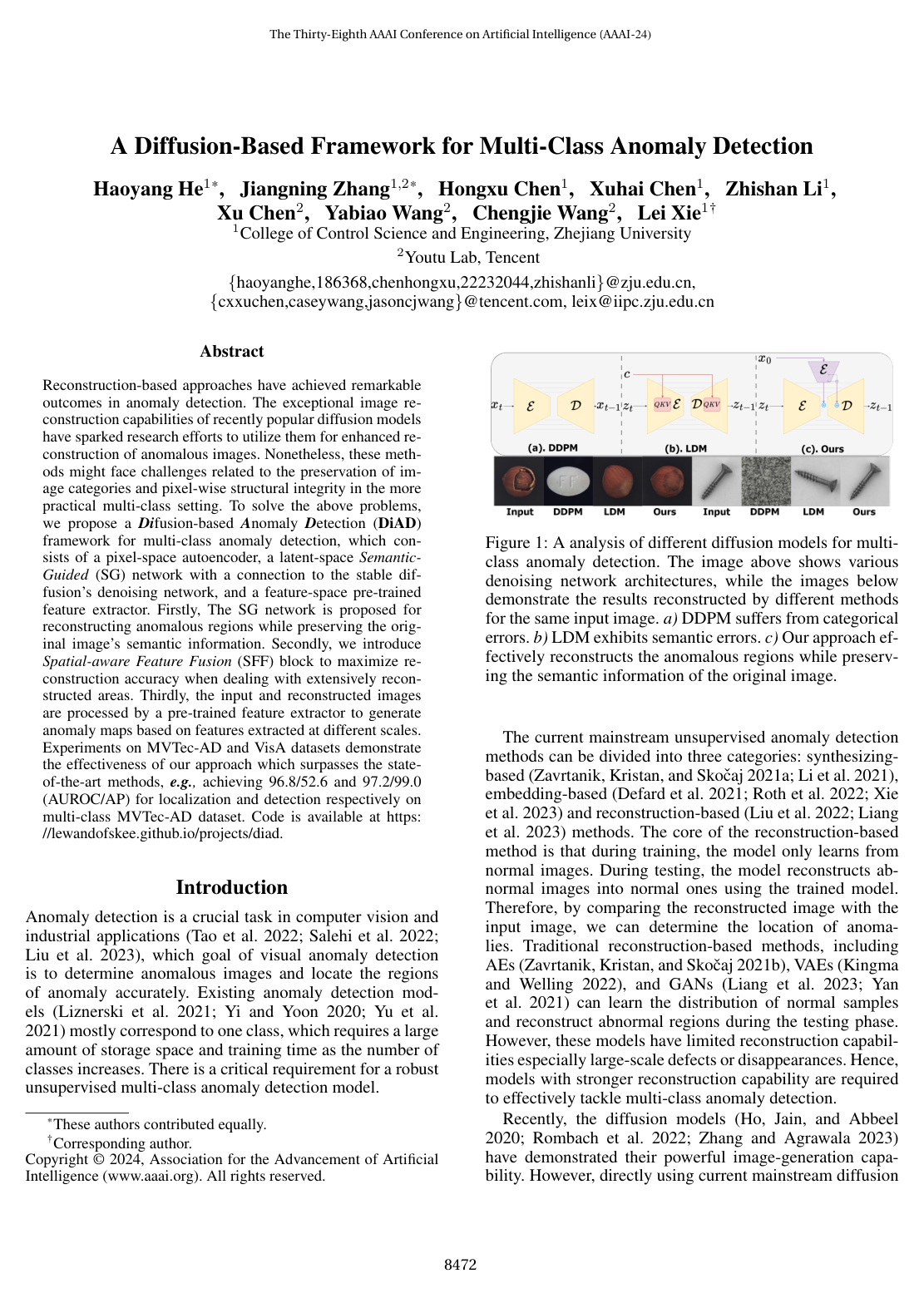
A Diffusion-Based Framework for Multi-Class Anomaly Detection
Haoyang He, Jiangning Zhang, Hongxu Chen, Xuhai Chen, Zhishan Li, Xu Chen, Yabiao Wang, Chengjie Wang, Lei Xie
Why you should read this
Proposes a semantic-guided diffusion framework that solves class confusion and structural distortion during reconstruction, achieving state-of-the-art multi-class anomaly detection and localization on the MVTec-AD and VisA benchmarks.
Reconstruction-based approaches have achieved remarkable outcomes in anomaly detection. The exceptional image reconstruction capabilities of recently popular diffusion models have sparked research efforts to utilize them for enhanced reconstruction of anomalous images. Nonetheless, these methods might face challenges related to the preservation of image categories and pixel-wise structural integrity in the more practical multi-class setting. To solve the above problems, we propose a Diffusion-based Anomaly Detection (DiAD) framework for multi-class anomaly detection, which consists of a pixel-space autoencoder, a latent-space Semantic-Guided (SG) network with a connection to the stable diffusion's denoising network, and a feature-space pre-trained feature extractor. Firstly, the SG network is proposed for reconstructing anomalous regions while preserving the original image's semantic information. Secondly, we introduce Spatial-aware Feature Fusion (SFF) block to maximize reconstruction accuracy when dealing with extensively reconstructed areas. Thirdly, the input and reconstructed images are processed by a pre-trained feature extractor to generate anomaly maps based on features extracted at different scales. Experiments on MVTec-AD and VisA datasets demonstrate the effectiveness of our approach which surpasses the state-of-the-art methods, e.g., achieving 96.8/52.6 and 97.2/99.0 (AUROC/AP) for localization and detection respectively on multi-class MVTec-AD dataset. Code is available at https://lewandofskee.github.io/projects/diad.
Added
2026-10-05
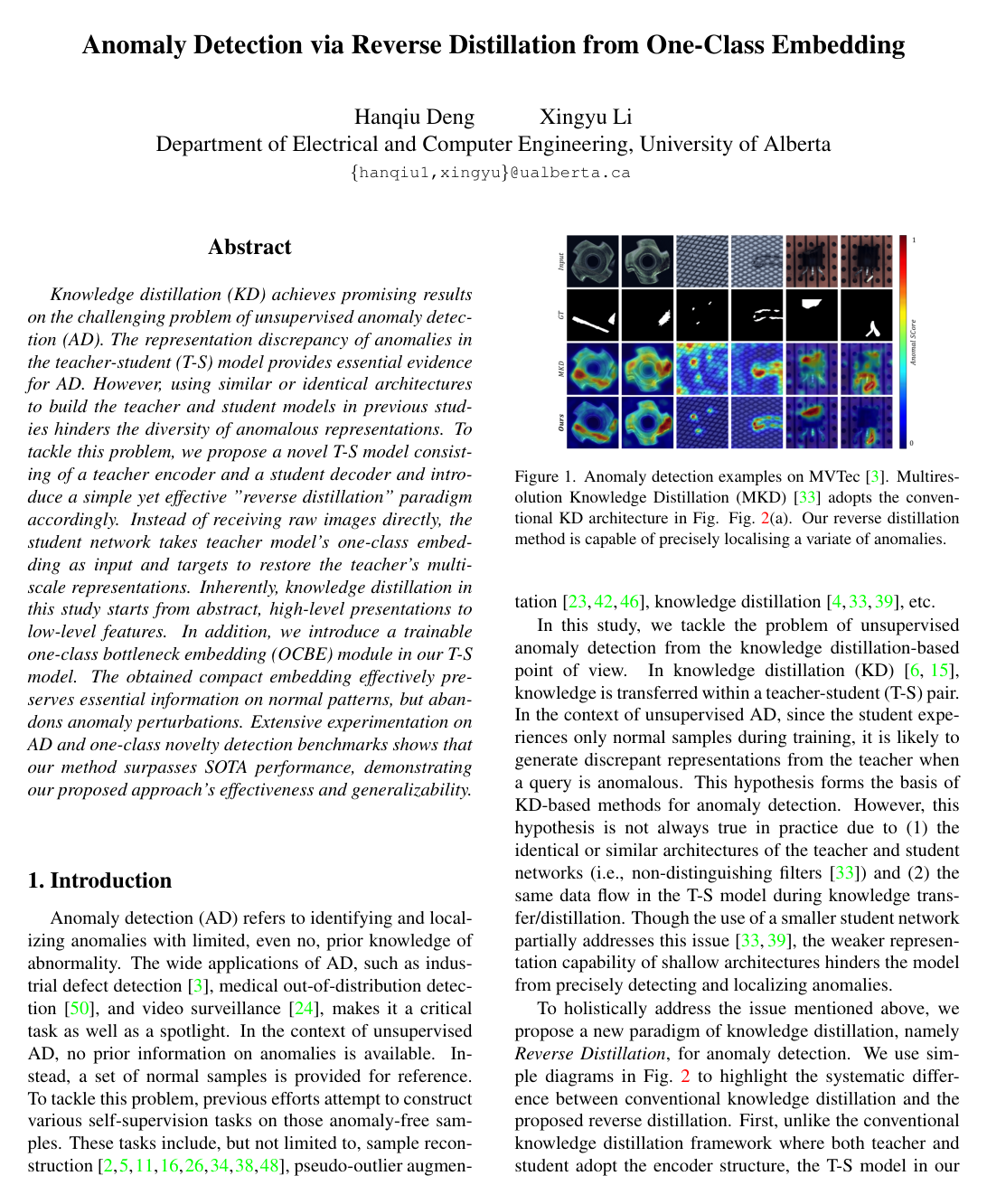
Anomaly Detection via Reverse Distillation from One-Class Embedding
Hanqiu Deng, Xingyu Li
Why you should read this
Introduces a reverse knowledge distillation paradigm that reconstructs multiscale teacher features from a one-class bottleneck embedding, preventing the student network from restoring anomalies and establishing new state-of-the-art accuracy in unsupervised anomaly detection.
Knowledge distillation (KD) achieves promising results on the challenging problem of unsupervised anomaly detection (AD).The representation discrepancy of anomalies in the teacher-student (T-S) model provides essential evidence for AD. However, using similar or identical architectures to build the teacher and student models in previous studies hinders the diversity of anomalous representations. To tackle this problem, we propose a novel T-S model consisting of a teacher encoder and a student decoder and introduce a simple yet effective "reverse distillation" paradigm accordingly. Instead of receiving raw images directly, the student network takes teacher model's one-class embedding as input and targets to restore the teacher's multiscale representations. Inherently, knowledge distillation in this study starts from abstract, high-level presentations to low-level features. In addition, we introduce a trainable one-class bottleneck embedding (OCBE) module in our T-S model. The obtained compact embedding effectively preserves essential information on normal patterns, but abandons anomaly perturbations. Extensive experimentation on AD and one-class novelty detection benchmarks shows that our method surpasses SOTA performance, demonstrating our proposed approach's effectiveness and generalizability.
Added
2026-10-05
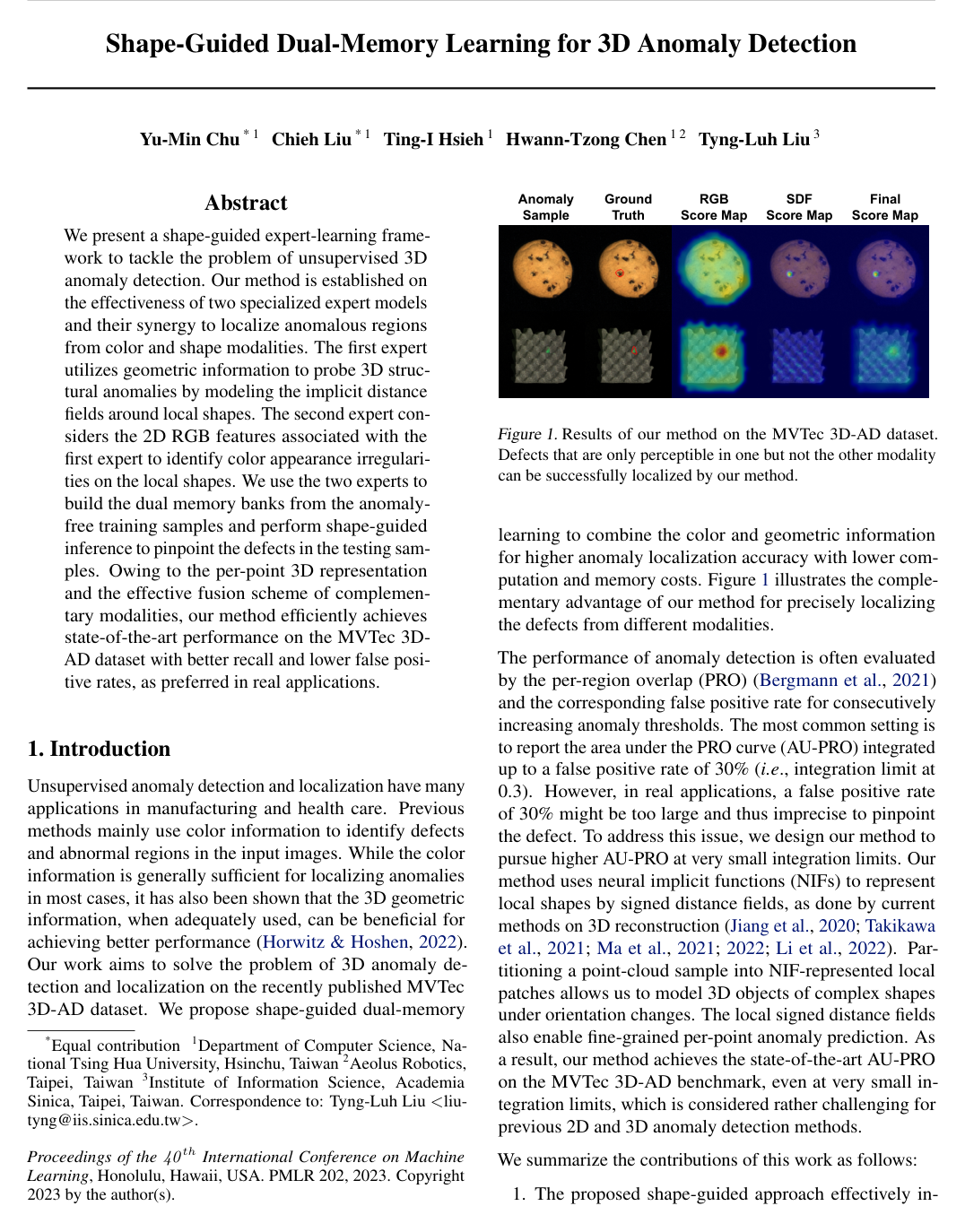
Shape-Guided Dual-Memory Learning for 3D Anomaly Detection
Yu-Min Chu, Chieh Liu, Ting-I Hsieh, Hwann-Tzong Chen, Tyng-Luh Liu
Why you should read this
Proposes a shape-guided dual-memory framework that combines neural implicit signed distance fields with aligned 2D visual features to achieve state-of-the-art unsupervised 3D anomaly detection and localization on the MVTec 3D-AD benchmark.
We present a shape-guided expert-learning framework to tackle the problem of unsupervised 3D anomaly detection. Our method is established on the effectiveness of two specialized expert models and their synergy to localize anomalous regions from color and shape modalities. The first expert utilizes geometric information to probe 3D structural anomalies by modeling the implicit distance fields around local shapes. The second expert considers the 2D RGB features associated with the first expert to identify color appearance irregularities on the local shapes. We use the two experts to build the dual memory banks from the anomaly-free training samples and perform shape-guided inference to pinpoint the defects in the testing samples. Owing to the per-point 3D representation and the effective fusion scheme of complementary modalities, our method efficiently achieves state-of-the-art performance on the MVTec 3D-AD dataset with better recall and lower false positive rates, as preferred in real applications.
Added
2026-10-02
SoftPatch: Unsupervised Anomaly Detection with Noisy Data
Xi Jiang, Jianlin Liu, Jinbao Wang, Qiang Nie, Kai Wu, Yong Liu, Chengjie Wang, Feng Zheng
Why you should read this
Proposes SoftPatch, a patch-level denoising and memory re-weighting method that prevents defective training samples from distorting decision boundaries in real-world unsupervised anomaly detection.
Although mainstream unsupervised anomaly detection (AD) algorithms perform well in academic datasets, their performance is limited in practical application due to the ideal experimental setting of clean training data. Training with noisy data is an inevitable problem in real-world anomaly detection but is seldom discussed. This paper considers label-level noise in image sensory anomaly detection for the first time. To solve this problem, we proposed a memory-based unsupervised AD method, SoftPatch, which efficiently denoises the data at the patch level. Noise discriminators are utilized to generate outlier scores for patch-level noise elimination before coreset construction. The scores are then stored in the memory bank to soften the anomaly detection boundary. Compared with existing methods, SoftPatch maintains a strong modeling ability of normal data and alleviates the overconfidence problem in coreset. Comprehensive experiments in various noise scenes demonstrate that SoftPatch outperforms the state-of-the-art AD methods on the MVTecAD and BTAD benchmarks and is comparable to those methods under the setting without noise.
Added
2026-09-26
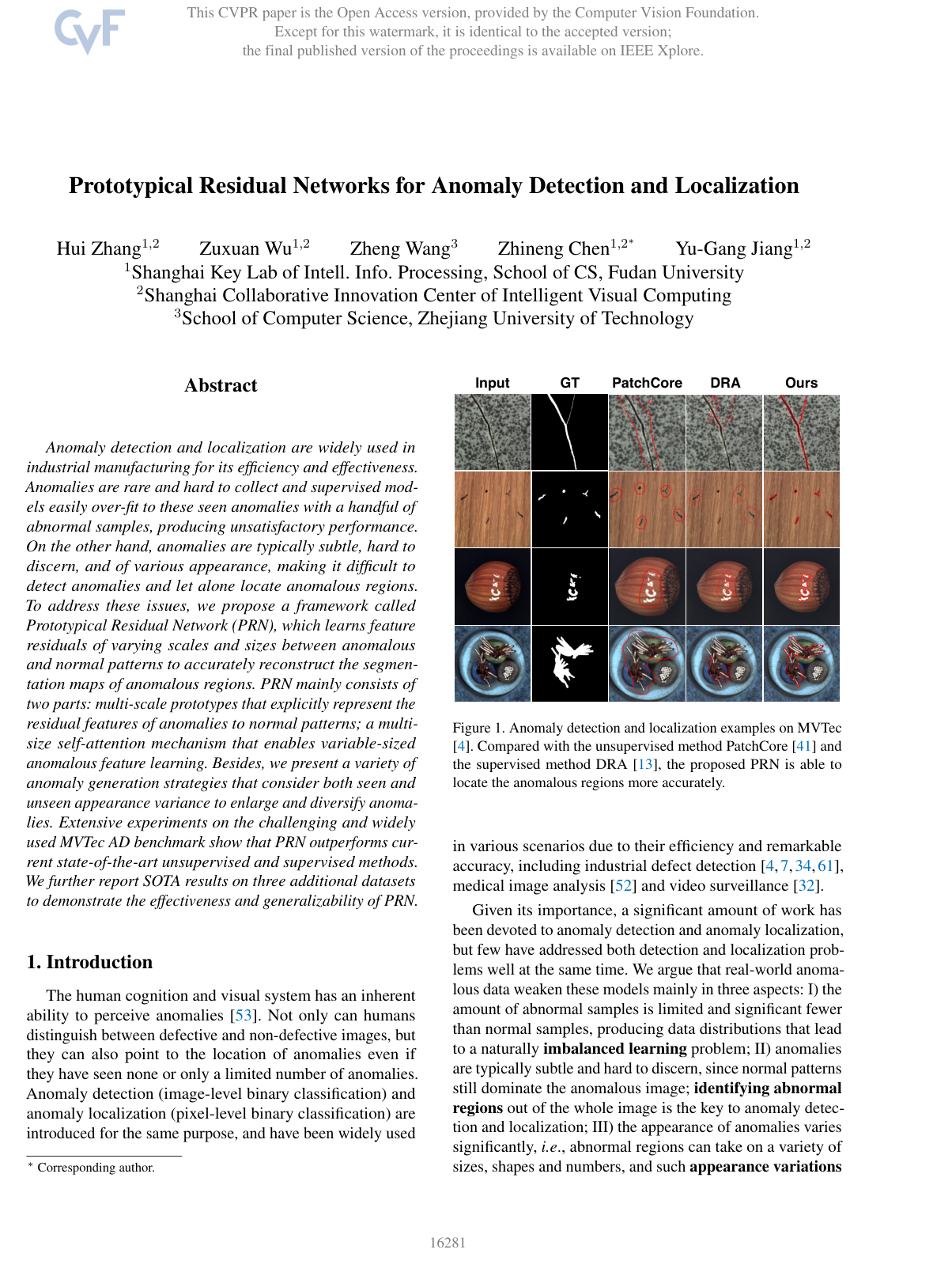
Prototypical Residual Networks for Anomaly Detection and Localization
Hui Zhang, Zuxuan Wu, Zheng Wang, Zhineng Chen, Yu-Gang Jiang
Why you should read this
Proposes a prototypical residual network that captures multi-scale feature deviations and variable-sized defects to achieve state-of-the-art anomaly detection and precise pixel-level localization across industrial benchmarks.
Anomaly detection and localization are widely used in industrial manufacturing for its efficiency and effectiveness. Anomalies are rare and hard to collect and supervised models easily over-fit to these seen anomalies with a handful of abnormal samples, producing unsatisfactory performance. On the other hand, anomalies are typically subtle, hard to discern, and of various appearance, making it difficult to detect anomalies and let alone locate anomalous regions. To address these issues, we propose a framework called Prototypical Residual Network (PRN), which learns feature residuals of varying scales and sizes between anomalous and normal patterns to accurately reconstruct the segmentation maps of anomalous regions. PRN mainly consists of two parts: multi-scale prototypes that explicitly represent the residual features of anomalies to normal patterns; a multi-size self-attention mechanism that enables variable-sized anomalous feature learning. Besides, we present a variety of anomaly generation strategies that consider both seen and unseen appearance variance to enlarge and diversify anomalies. Extensive experiments on the challenging and widely used MVTec AD benchmark show that PRN outperforms current state-of-the-art unsupervised and supervised methods. We further report SOTA results on three additional datasets to demonstrate the effectiveness and generalizability of PRN.
Added
2026-09-26
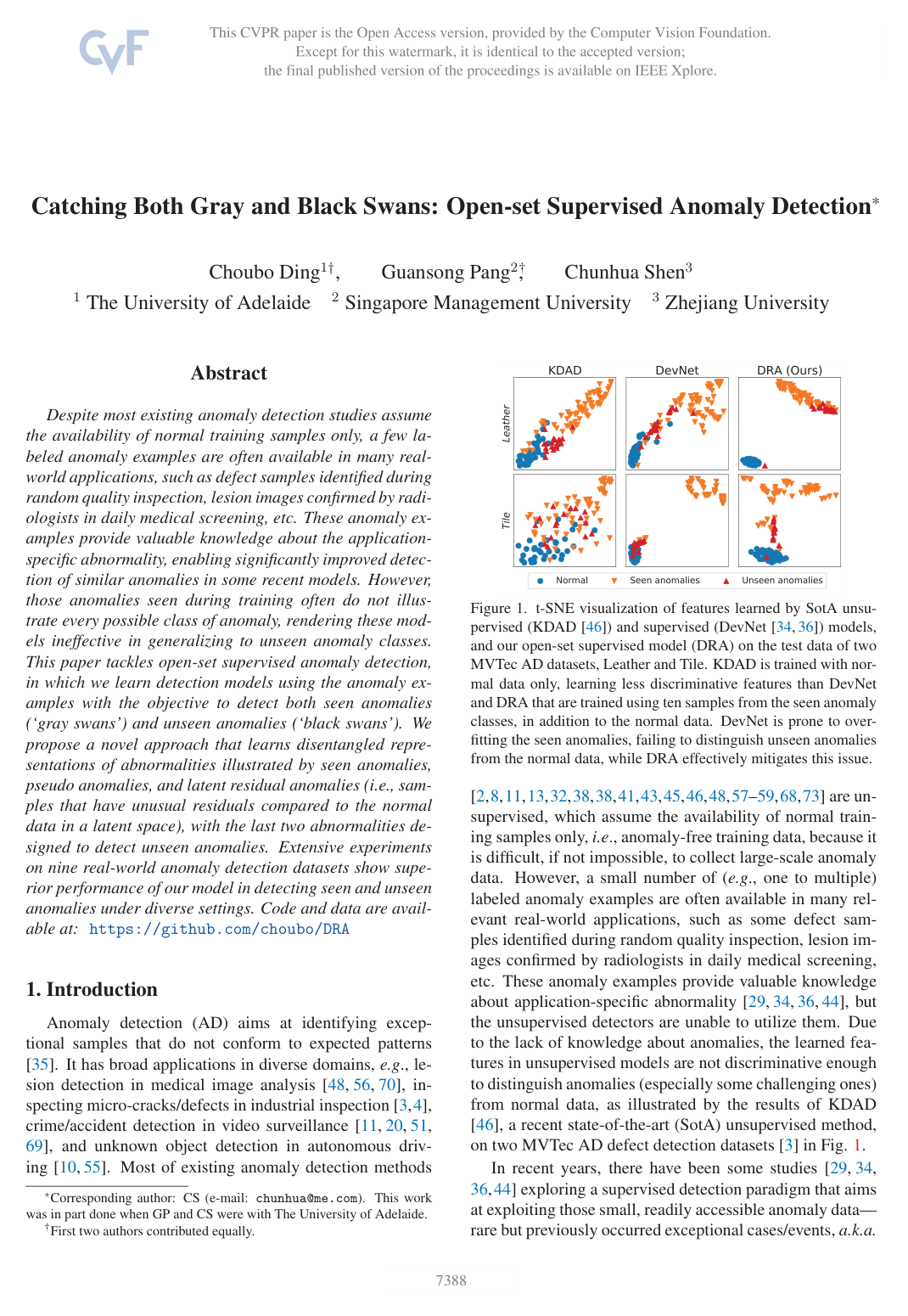
Catching Both Gray and Black Swans: Open-set Supervised Anomaly Detection
Choubo Ding, Guansong Pang, Chunhua Shen
Why you should read this
Proposes a multi-head framework that disentangles known, pseudo, and latent residual abnormalities to effectively detect both seen and novel anomaly classes using only a small set of labeled anomaly examples.
Despite most existing anomaly detection studies assume the availability of normal training samples only, a few labeled anomaly examples are often available in many real-world applications, such as defect samples identified during random quality inspection, lesion images confirmed by radiologists in daily medical screening, etc. These anomaly examples provide valuable knowledge about the application-specific abnormality, enabling significantly improved detection of similar anomalies in some recent models. However, those anomalies seen during training often do not illustrate every possible class of anomaly, rendering these models ineffective in generalizing to unseen anomaly classes. This paper tackles open-set supervised anomaly detection, in which we learn detection models using the anomaly examples with the objective to detect both seen anomalies ('gray swans') and unseen anomalies ('black swans'). We propose a novel approach that learns disentangled representations of abnormalities illustrated by seen anomalies, pseudo anomalies, and latent residual anomalies (i.e., samples that have unusual residuals compared to the normal data in a latent space), with the last two abnormalities designed to detect unseen anomalies. Extensive experiments on nine real-world anomaly detection datasets show superior performance of our model in detecting seen and unseen anomalies under diverse settings. Code and data are available at: https://github.com/choubo/DRA
Added
2026-09-26
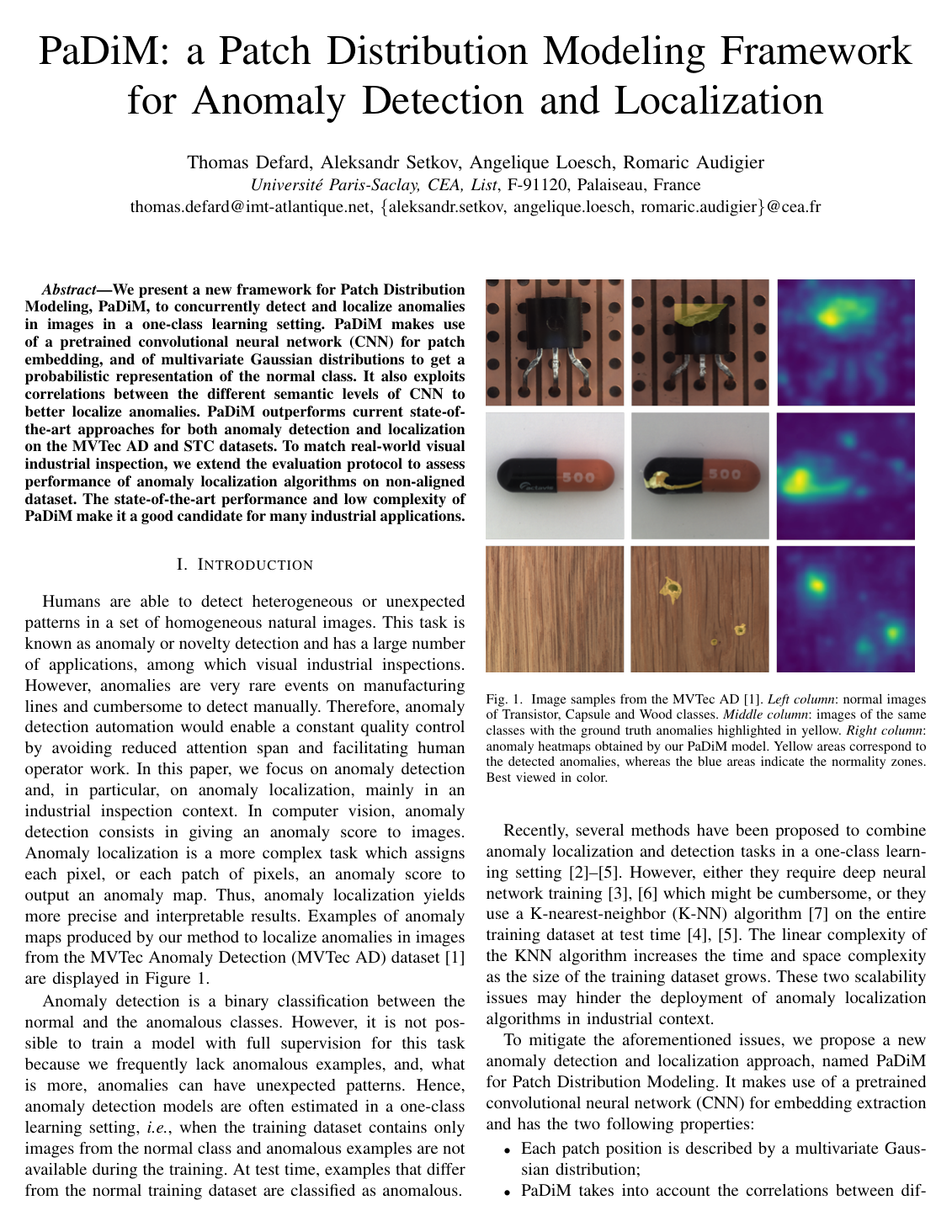
PaDiM: a Patch Distribution Modeling Framework for Anomaly Detection and Localization
Thomas Defard, Aleksandr Setkov, Angélique Loesch, Romaric Audigier
Why you should read this
Presents a patch distribution modeling framework that combines multi-scale pretrained CNN embeddings with multivariate Gaussian distributions to achieve accurate, computationally efficient image anomaly detection and localization for industrial inspection.
We present a new framework for Patch Distribution Modeling, PaDiM, to concurrently detect and localize anomalies in images in a one-class learning setting. PaDiM makes use of a pretrained convolutional neural network (CNN) for patch embedding, and of multivariate Gaussian distributions to get a probabilistic representation of the normal class. It also exploits correlations between the different semantic levels of CNN to better localize anomalies. PaDiM outperforms current state-of-the-art approaches for both anomaly detection and localization on the MVTec AD and STC datasets. To match real-world visual industrial inspection, we extend the evaluation protocol to assess performance of anomaly localization algorithms on non-aligned dataset. The state-of-the-art performance and low complexity of PaDiM make it a good candidate for many industrial applications.
Added
2026-09-25
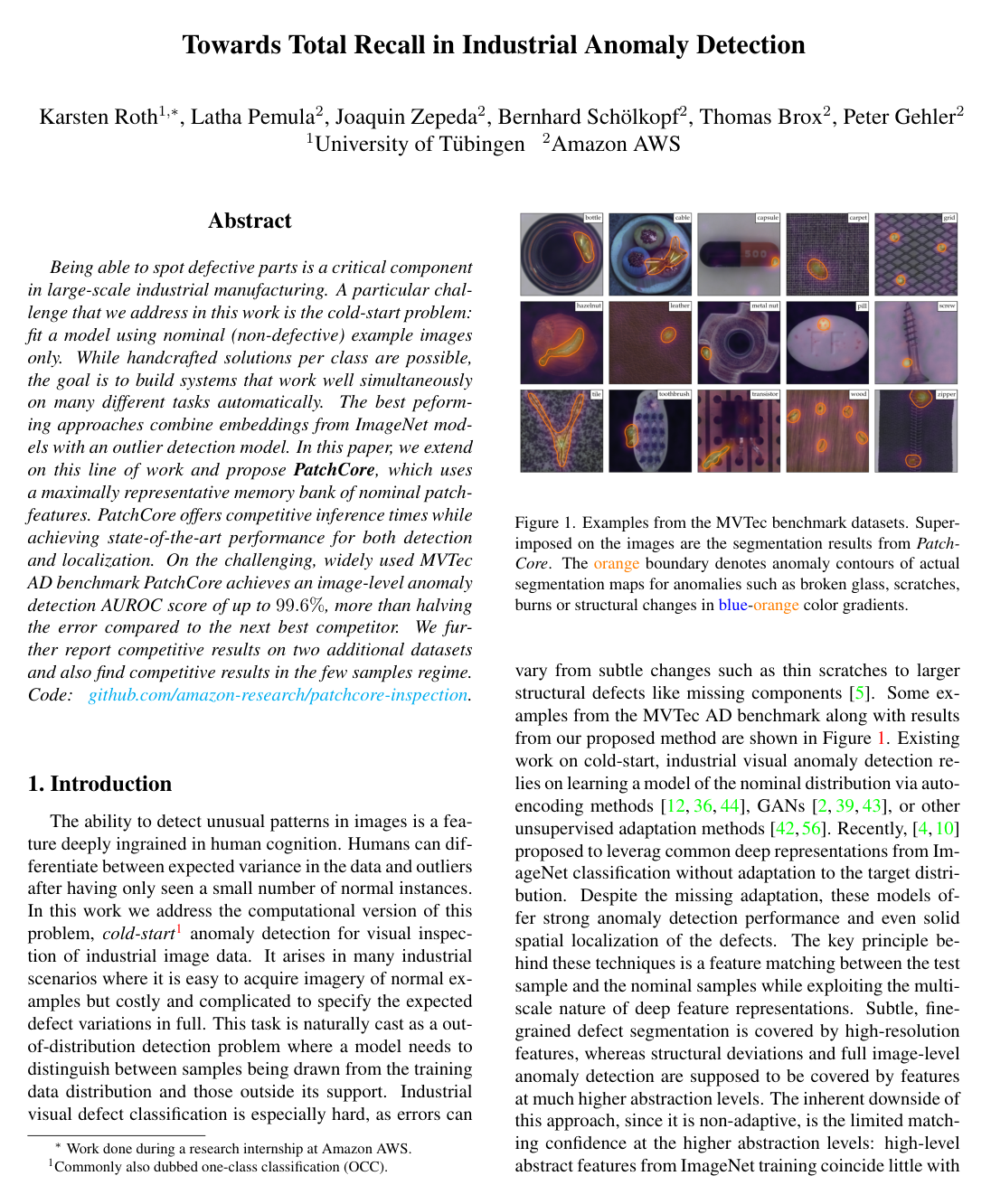
Towards Total Recall in Industrial Anomaly Detection
Karsten Roth, Latha Pemula, Joaquin Zepeda, Bernhard Schölkopf, Thomas Brox, Peter Gehler
Why you should read this
Introduces PatchCore, an industrial anomaly detection method that leverages a representative memory bank of patch features to more than halve error rates on the standard MVTec AD benchmark while maintaining fast inference speeds.
Being able to spot defective parts is a critical component in large-scale industrial manufacturing. A particular challenge that we address in this work is the cold-start problem: fit a model using nominal (non-defective) example images only. While handcrafted solutions per class are possible, the goal is to build systems that work well simultaneously on many different tasks automatically. The best performing approaches combine embeddings from ImageNet models with an outlier detection model. In this paper, we extend on this line of work and propose \textbf{PatchCore}, which uses a maximally representative memory bank of nominal patch-features. PatchCore offers competitive inference times while achieving state-of-the-art performance for both detection and localization. On the challenging, widely used MVTec AD benchmark PatchCore achieves an image-level anomaly detection AUROC score of up to , more than halving the error compared to the next best competitor. We further report competitive results on two additional datasets and also find competitive results in the few samples regime.\freefootnote{ Work done during a research internship at Amazon AWS.} Code: this http URL.
Added
2026-09-18