
topic
perturbation analysis
Perturbation analysis is the study of how small changes to a system’s inputs, parameters, or data affect its outputs or behavior. In signal processing, it is used to assess how disturbances such as noise or errors influence signal representations and algorithm results.
2 items
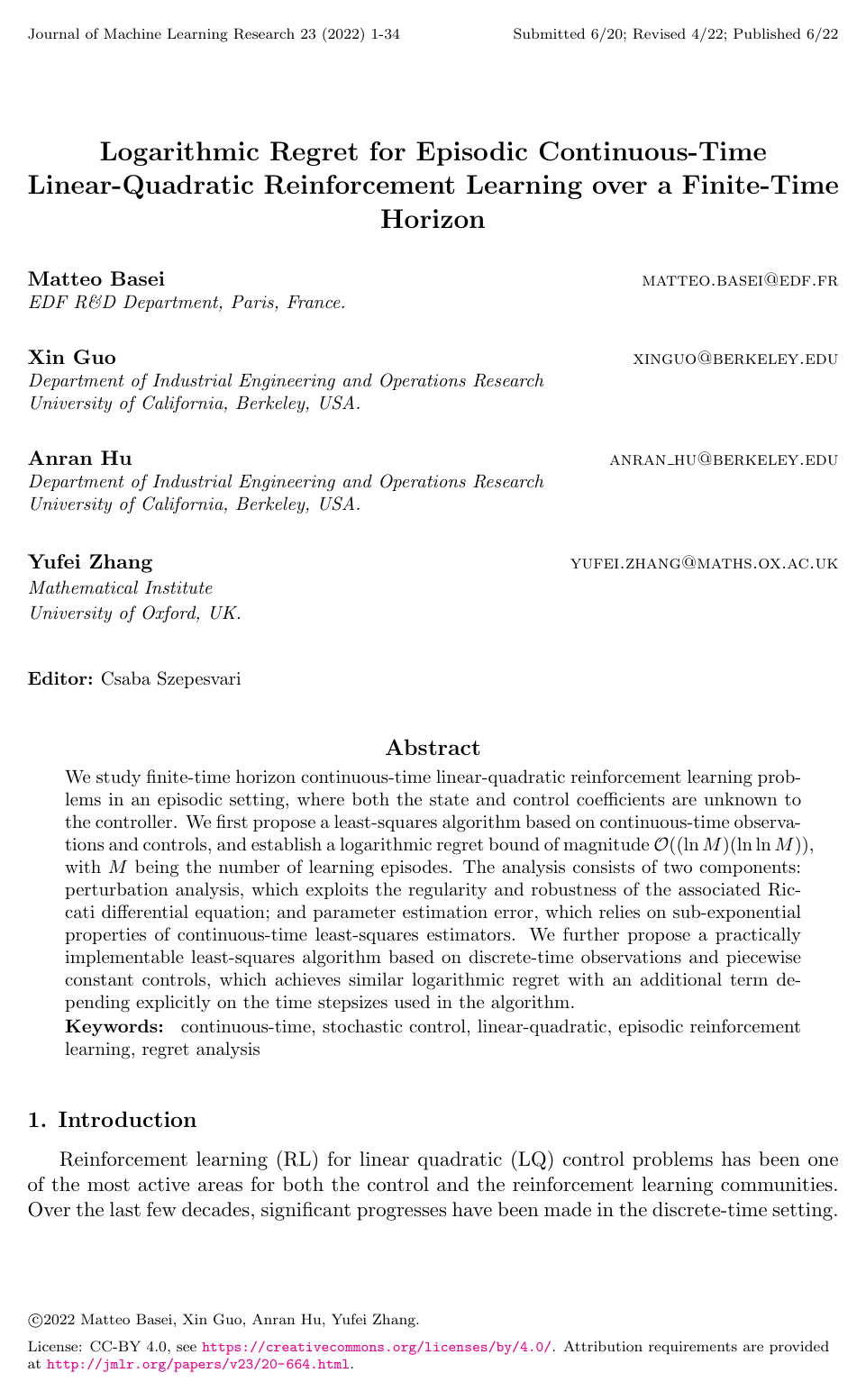
Logarithmic Regret for Episodic Continuous-Time Linear-Quadratic Reinforcement Learning over a Finite-Time Horizon
Matteo Basei, Xin Guo, Anran Hu, Yufei Zhang
Why you should read this
Establishes the first near-logarithmic regret bounds for episodic continuous-time linear-quadratic reinforcement learning with unknown dynamics, providing both theoretical guarantees via Riccati differential equation analysis and a practical discrete-time implementation that quantifies the impact of discretization stepsizes.
We study finite-time horizon continuous-time linear-quadratic reinforcement learning problems in an episodic setting, where both the state and control coefficients are unknown to the controller. We first propose a least-squares algorithm based on continuous-time observations and controls, and establish a logarithmic regret bound of magnitude O((ln M)(ln ln M)), with M being the number of learning episodes. The analysis consists of two components: perturbation analysis, which exploits the regularity and robustness of the associated Riccati differential equation; and parameter estimation error, which relies on sub-exponential properties of continuous-time least-squares estimators. We further propose a practically implementable least-squares algorithm based on discrete-time observations and piecewise constant controls, which achieves similar logarithmic regret with an additional term depending explicitly on the time stepsizes used in the algorithm.
Added
2026-10-03
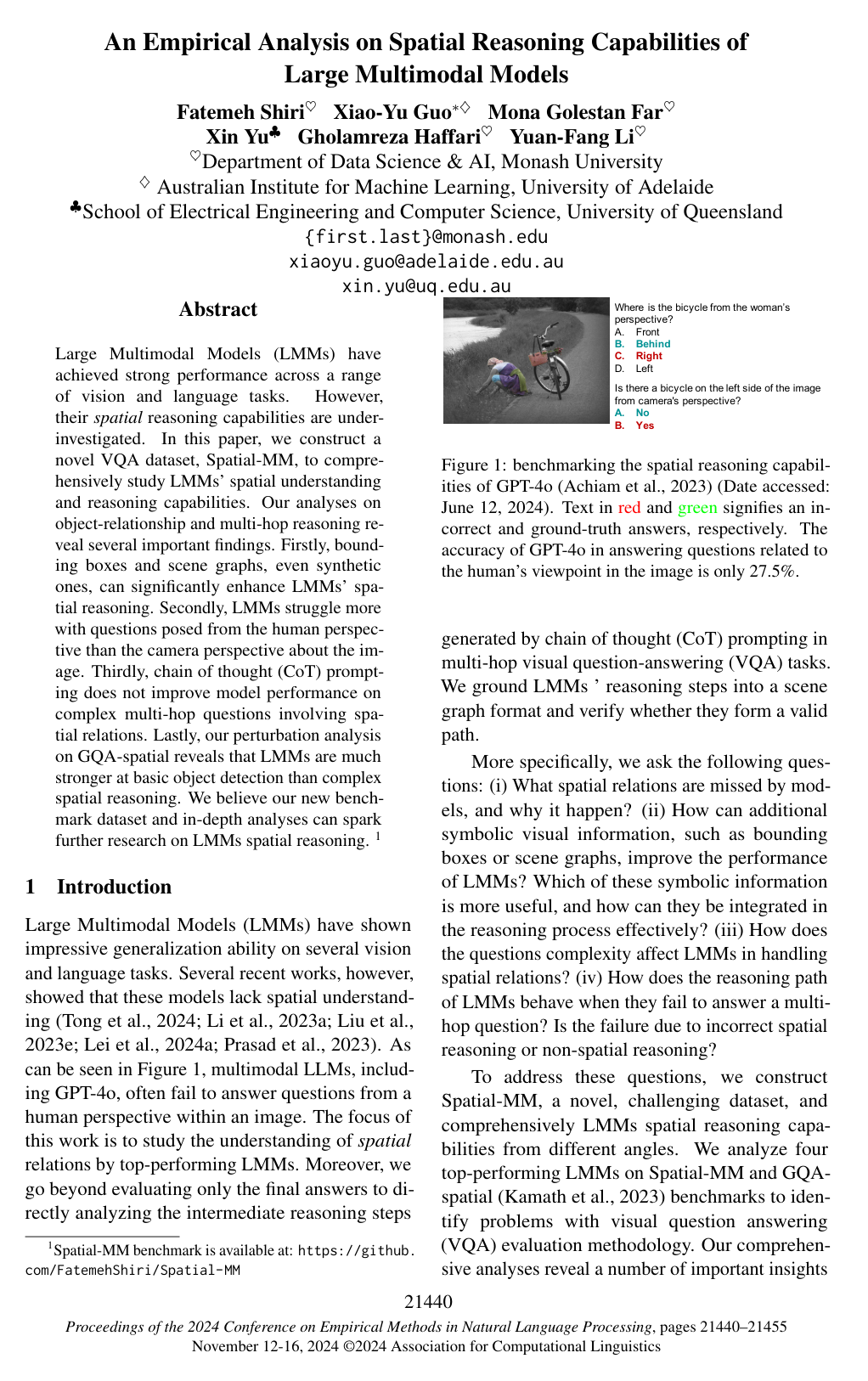
An Empirical Analysis on Spatial Reasoning Capabilities of Large Multimodal Models
Fatemeh Shiri, Xiao-Yu Guo, Mona Far, Xin Yu, Reza Haf, Yuan-Fang Li
Why you should read this
Presents the Spatial-MM benchmark to expose critical weaknesses in large multimodal models, showing that while symbolic aids like bounding boxes improve performance, models still fail on human-perspective viewpoints and gain no benefit from chain-of-thought prompting on complex spatial questions.
Large Multimodal Models (LMMs) have achieved strong performance across a range of vision and language tasks. However, their spatial reasoning capabilities are under-investigated. In this paper, we construct a novel VQA dataset, Spatial-MM, to comprehensively study LMMs' spatial understanding and reasoning capabilities. Our analyses on object-relationship and multi-hop reasoning reveal several important findings. Firstly, bounding boxes and scene graphs, even synthetic ones, can significantly enhance LMMs' spatial reasoning. Secondly, LMMs struggle more with questions posed from the human perspective than the camera perspective about the image. Thirdly, chain of thought (CoT) prompting does not improve model performance on complex multi-hop questions involving spatial relations. Lastly, our perturbation analysis on GQA-spatial reveals that LMMs are much stronger at basic object detection than complex spatial reasoning. We believe our new benchmark dataset and in-depth analyses can spark further research on LMMs spatial reasoning.
Added
2026-10-03