
topic
gibbs sampler (gibbs samplers)
A Gibbs sampler is a Markov chain Monte Carlo algorithm for generating samples from a joint probability distribution by repeatedly sampling each variable from its conditional distribution given the current values of the others. It is useful when direct sampling from the joint distribution is difficult but sampling from the conditional distributions is feasible, and is commonly used in Bayesian inference.
2 items
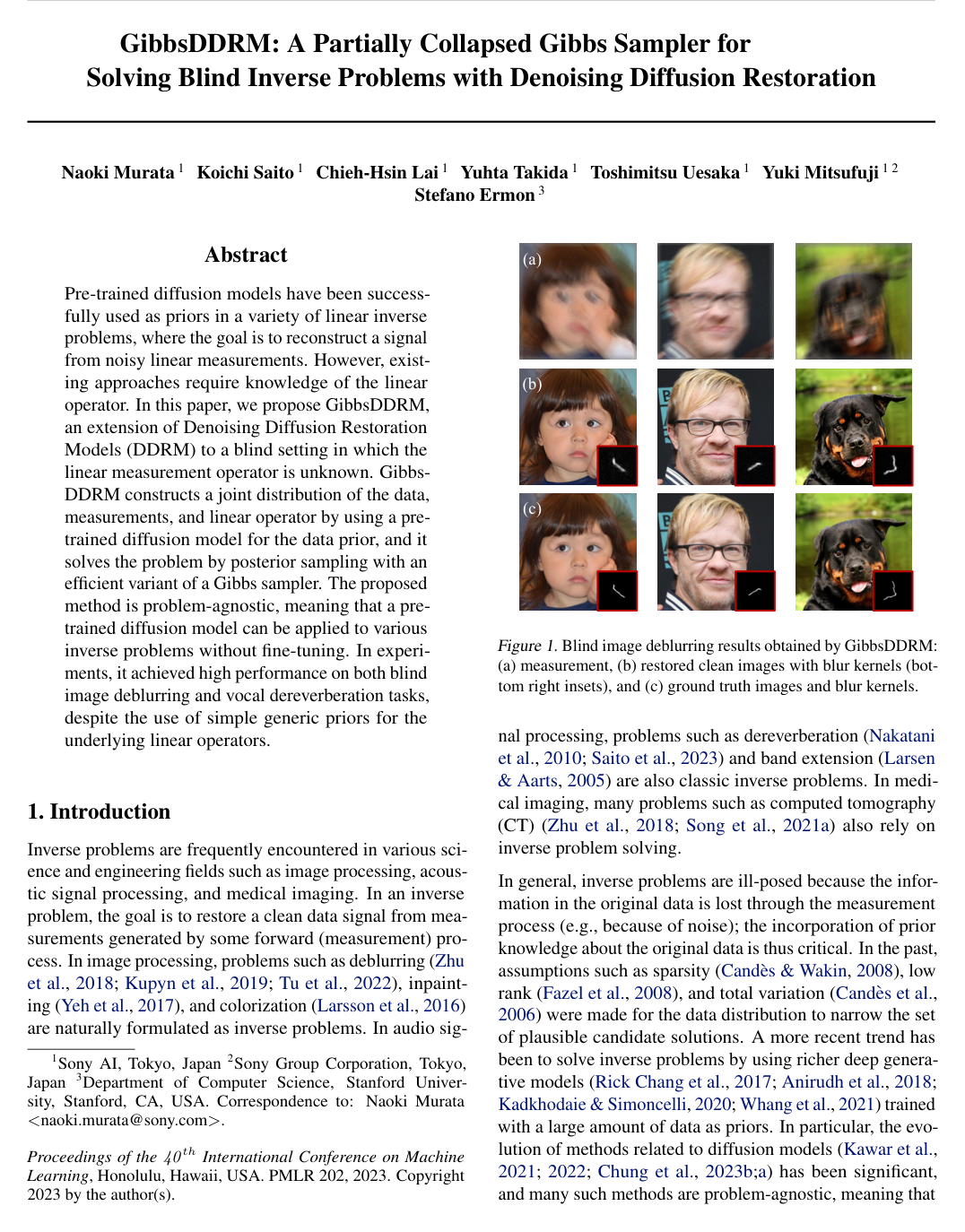
GibbsDDRM: A Partially Collapsed Gibbs Sampler for Solving Blind Inverse Problems with Denoising Diffusion Restoration
Naoki Murata, Koichi Saito, Chieh-Hsin Lai, Yuhta Takida, Toshimitsu Uesaka, Yuki Mitsufuji, Stefano Ermon
Why you should read this
Proposes a partially collapsed Gibbs sampling framework that enables pre-trained diffusion models to solve blind inverse problems like image deblurring and vocal dereverberation without requiring fine-tuning or specialized priors for the unknown measurement operator.
Pre-trained diffusion models have been successfully used as priors in a variety of linear inverse problems, where the goal is to reconstruct a signal from noisy linear measurements. However, existing approaches require knowledge of the linear operator. In this paper, we propose GibbsDDRM, an extension of Denoising Diffusion Restoration Models (DDRM) to a blind setting in which the linear measurement operator is unknown. GibbsDDRM constructs a joint distribution of the data, measurements, and linear operator by using a pre-trained diffusion model for the data prior, and it solves the problem by posterior sampling with an efficient variant of a Gibbs sampler. The proposed method is problem-agnostic, meaning that a pre-trained diffusion model can be applied to various inverse problems without fine-tuning. In experiments, it achieved high performance on both blind image deblurring and vocal dereverberation tasks, despite the use of simple generic priors for the underlying linear operators.
Added
2026-10-02
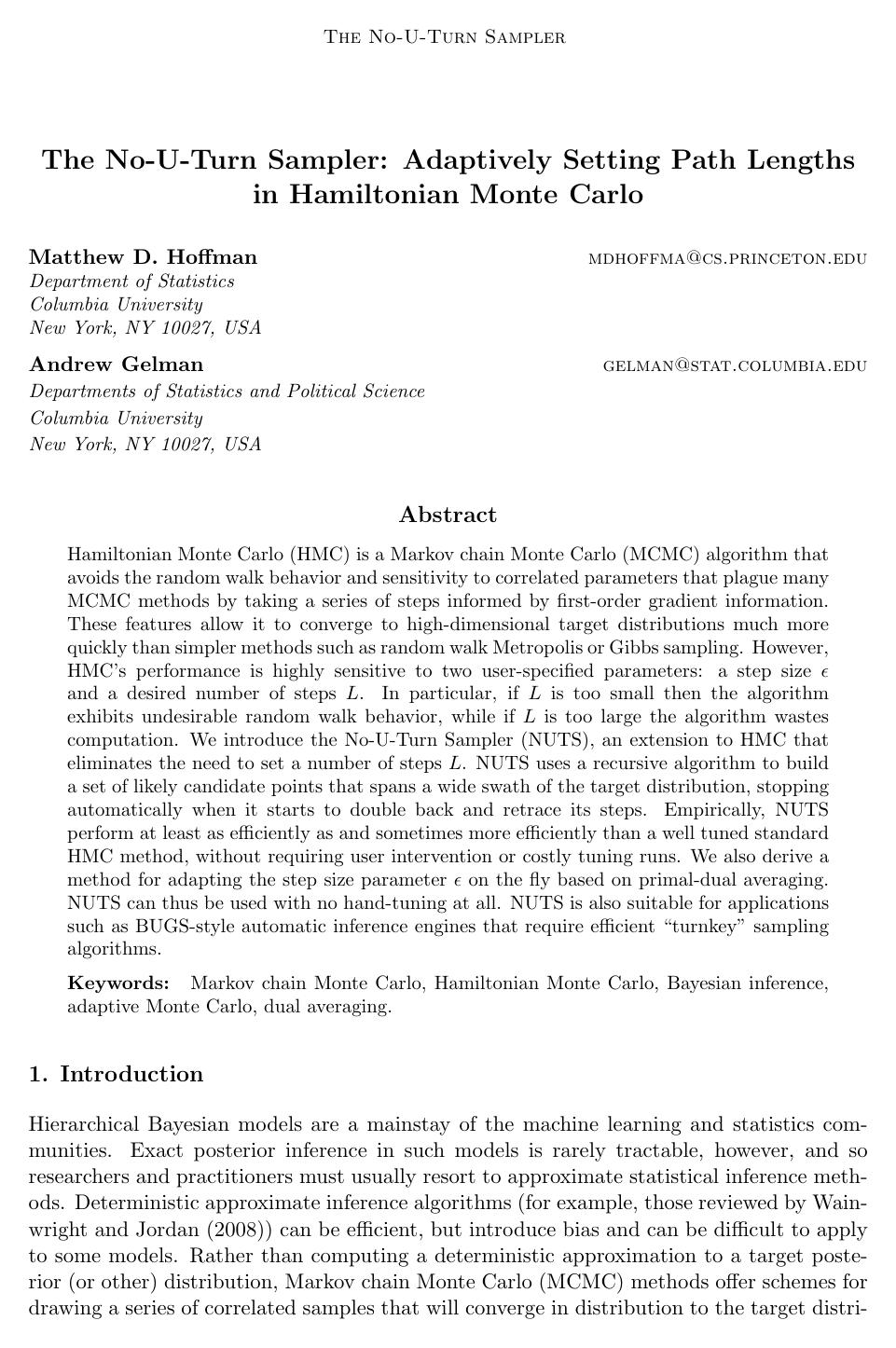
The No-U-turn sampler: adaptively setting path lengths in Hamiltonian Monte Carlo
Matthew D. Hoffman, Andrew Gelman
Why you should read this
Introduces the No-U-Turn Sampler (NUTS), an algorithm that automates path length selection and step-size adaptation in Hamiltonian Monte Carlo to enable efficient, hands-free sampling for high-dimensional Bayesian models.
Hamiltonian Monte Carlo (HMC) is a Markov chain Monte Carlo (MCMC) algorithm that avoids the random walk behavior and sensitivity to correlated parameters that plague many MCMC methods by taking a series of steps informed by first-order gradient information. These features allow it to converge to high-dimensional target distributions much more quickly than simpler methods such as random walk Metropolis or Gibbs sampling. However, HMC's performance is highly sensitive to two user-specified parameters: a step size {\epsilon} and a desired number of steps L. In particular, if L is too small then the algorithm exhibits undesirable random walk behavior, while if L is too large the algorithm wastes computation. We introduce the No-U-Turn Sampler (NUTS), an extension to HMC that eliminates the need to set a number of steps L. NUTS uses a recursive algorithm to build a set of likely candidate points that spans a wide swath of the target distribution, stopping automatically when it starts to double back and retrace its steps. Empirically, NUTS perform at least as efficiently as and sometimes more efficiently than a well tuned standard HMC method, without requiring user intervention or costly tuning runs. We also derive a method for adapting the step size parameter {\epsilon} on the fly based on primal-dual averaging. NUTS can thus be used with no hand-tuning at all. NUTS is also suitable for applications such as BUGS-style automatic inference engines that require efficient "turnkey" sampling algorithms.
Added
2026-09-09
