
topic
difference equations (difference equation)
Difference equations are mathematical relationships that express the value of a sequence or discrete variable as a function of its previous values. Serving as the discrete counterpart to differential equations, a difference equation characterizes changes occurring over distinct intervals rather than over a continuous domain. In computer science, numerical analysis, and scientific computing, these equations provide a foundational framework for modeling discrete-time dynamical systems, analyzing recursive algorithms, and constructing numerical schemes to approximate solutions for continuous differential equations.
5 items
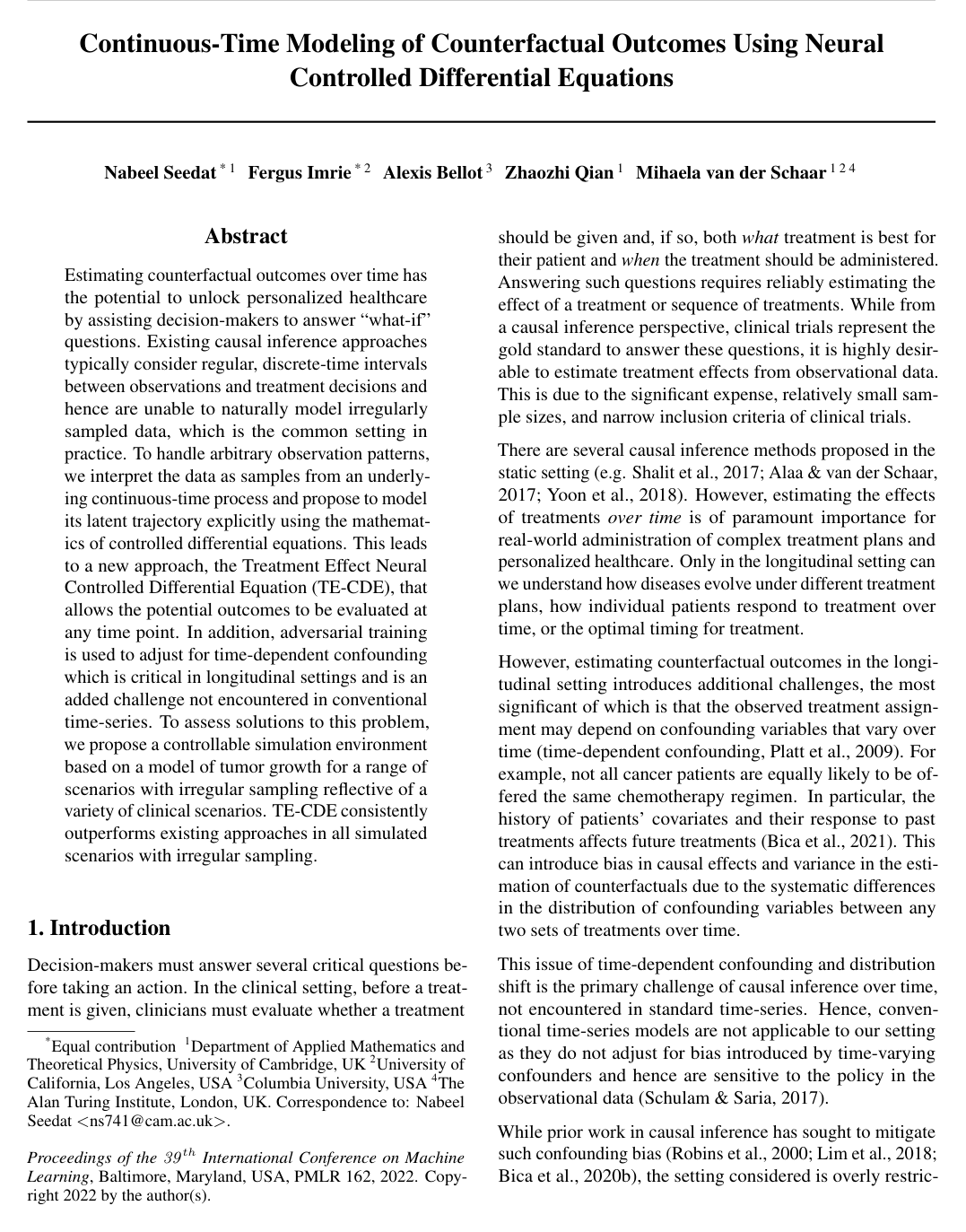
Continuous-Time Modeling of Counterfactual Outcomes Using Neural Controlled Differential Equations
Nabeel Seedat, Fergus Imrie, Alexis Bellot, Zhaozhi Qian, Mihaela van der Schaar
Why you should read this
Proposes a continuous-time causal inference framework using neural controlled differential equations and adversarial training to reliably estimate individual treatment effects from irregularly sampled longitudinal data subject to time-dependent confounding.
Estimating the effect of interventions – alternatively referred to as treatments or actions – is central to decision-making in many sequential settings, ranging from healthcare to economics to robot control. Motivated primarily by the analysis of longitudinal data arising in medicine, we here consider continuous-time 'treatment' trajectories which are observed intermittently over time: Each observation thus jointly reflects two ongoing processes of interest - the evolution of individual patient covariates over time, and delays in the measurement process driven by events (e.g., visits doctors). Our contributions are threefold: First, we formalize 'continuous-time potential outcomes', extending counterfactual theory traditionally developed for fixed treatment times; Second, we frame causal inference in terms of differential equations whose solution defines outcome paths; Third, we introduce Neural CDEs as powerful means towards their estimation.
Added
2026-10-02
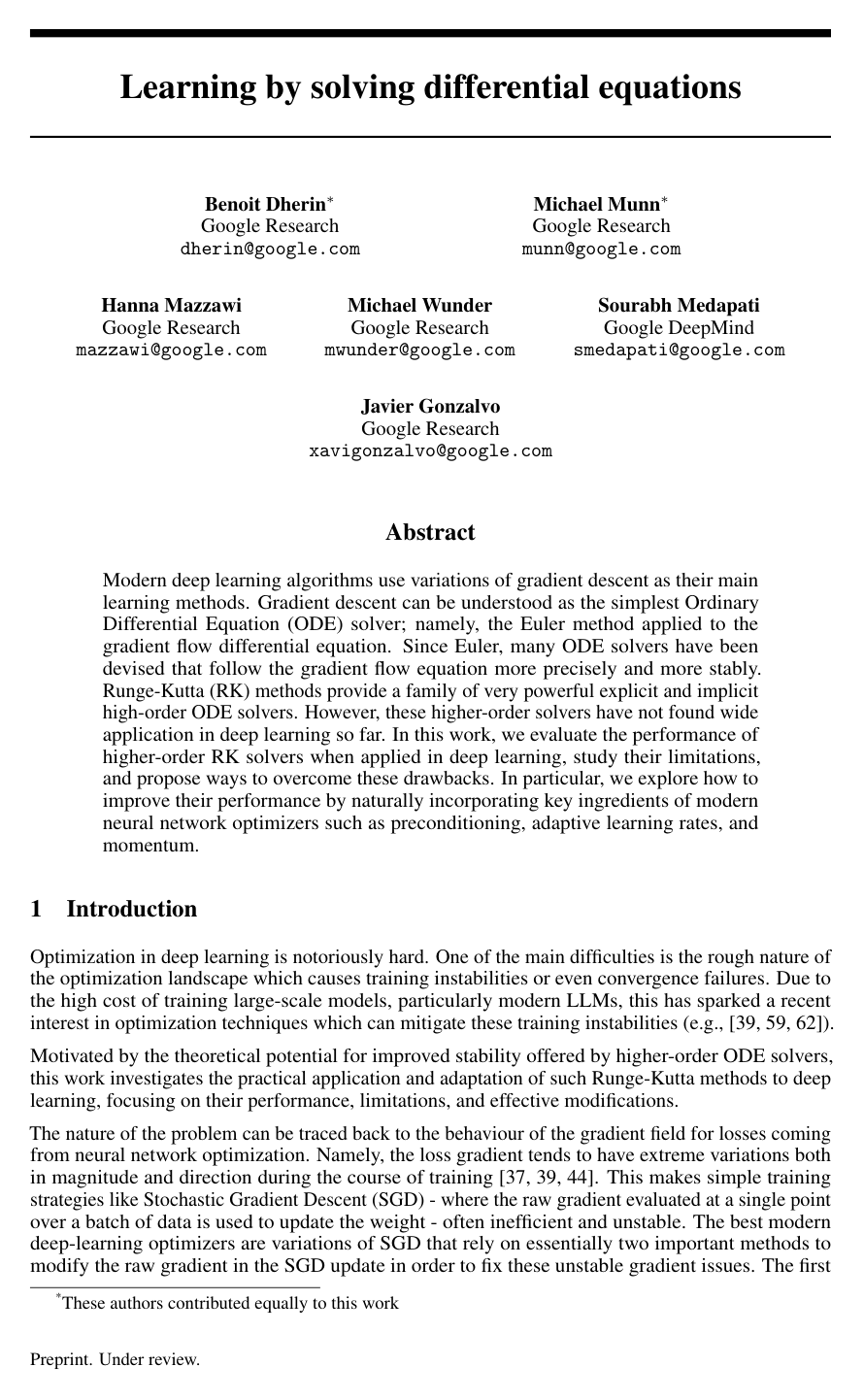
Learning by solving differential equations
Benoit Dherin, Michael Munn, Hanna Mazzawi, Michael Wunder, Sourabh Medapati, Xavi Gonzalvo
Why you should read this
Demonstrates how to adapt higher-order Runge-Kutta differential equation solvers for deep neural network training by integrating momentum, adaptive learning rates, and preconditioning to improve optimization stability beyond standard gradient descent.
Modern deep learning algorithms use variations of gradient descent as their main learning methods. Gradient descent can be understood as the simplest Ordinary Differential Equation (ODE) solver; namely, the Euler method applied to the gradient flow differential equation. Since Euler, many ODE solvers have been devised that follow the gradient flow equation more precisely and more stably. Runge-Kutta (RK) methods provide a family of very powerful explicit and implicit high-order ODE solvers. However, these higher-order solvers have not found wide application in deep learning so far. In this work, we evaluate the performance of higher-order RK solvers when applied in deep learning, study their limitations, and propose ways to overcome these drawbacks. In particular, we explore how to improve their performance by naturally incorporating key ingredients of modern neural network optimizers such as preconditioning, adaptive learning rates, and momentum.
Added
2026-09-30
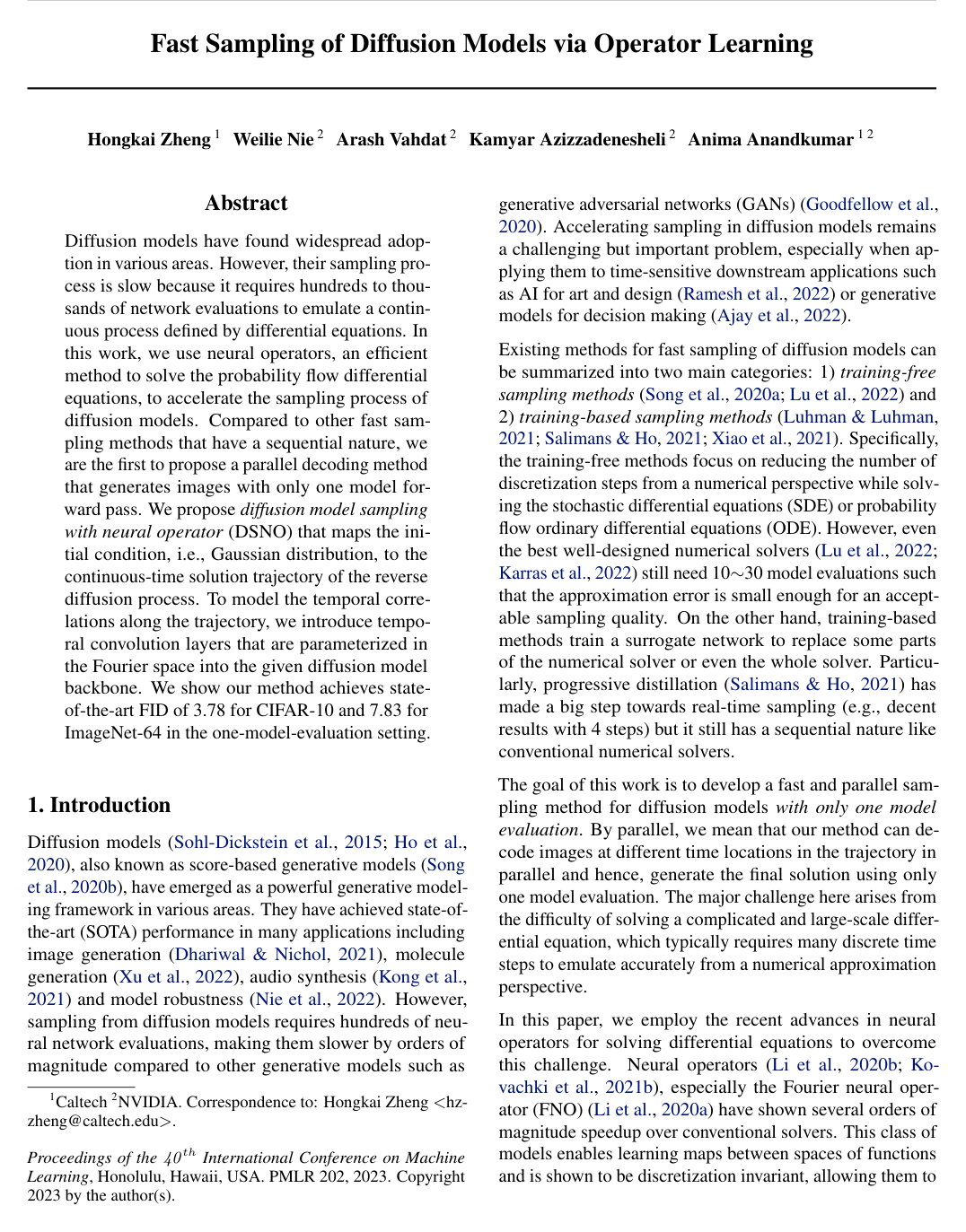
Fast Sampling of Diffusion Models via Operator Learning
Hongkai Zheng, Weili Nie, Arash Vahdat, Kamyar Azizzadenesheli, Anima Anandkumar
Why you should read this
Proposes a neural operator framework that uses Fourier-parameterized temporal convolutions to map noise to complete reverse diffusion trajectories, enabling state-of-the-art image generation in a single forward pass through parallel decoding.
Diffusion models have found widespread adoption in various areas. However, their sampling process is slow because it requires hundreds to thousands of network evaluations to emulate a continuous process defined by differential equations. In this work, we use neural operators, an efficient method to solve the probability flow differential equations, to accelerate the sampling process of diffusion models. Compared to other fast sampling methods that have a sequential nature, we are the first to propose a parallel decoding method that generates images with only one model forward pass. We propose diffusion model sampling with neural operator (DSNO) that maps the initial condition, i.e., Gaussian distribution, to the continuous-time solution trajectory of the reverse diffusion process. To model the temporal correlations along the trajectory, we introduce temporal convolution layers that are parameterized in the Fourier space into the given diffusion model backbone. We show our method achieves state-of-the-art FID of 3.78 for CIFAR-10 and 7.83 for ImageNet-64 in the one-model-evaluation setting.
Added
2026-09-26
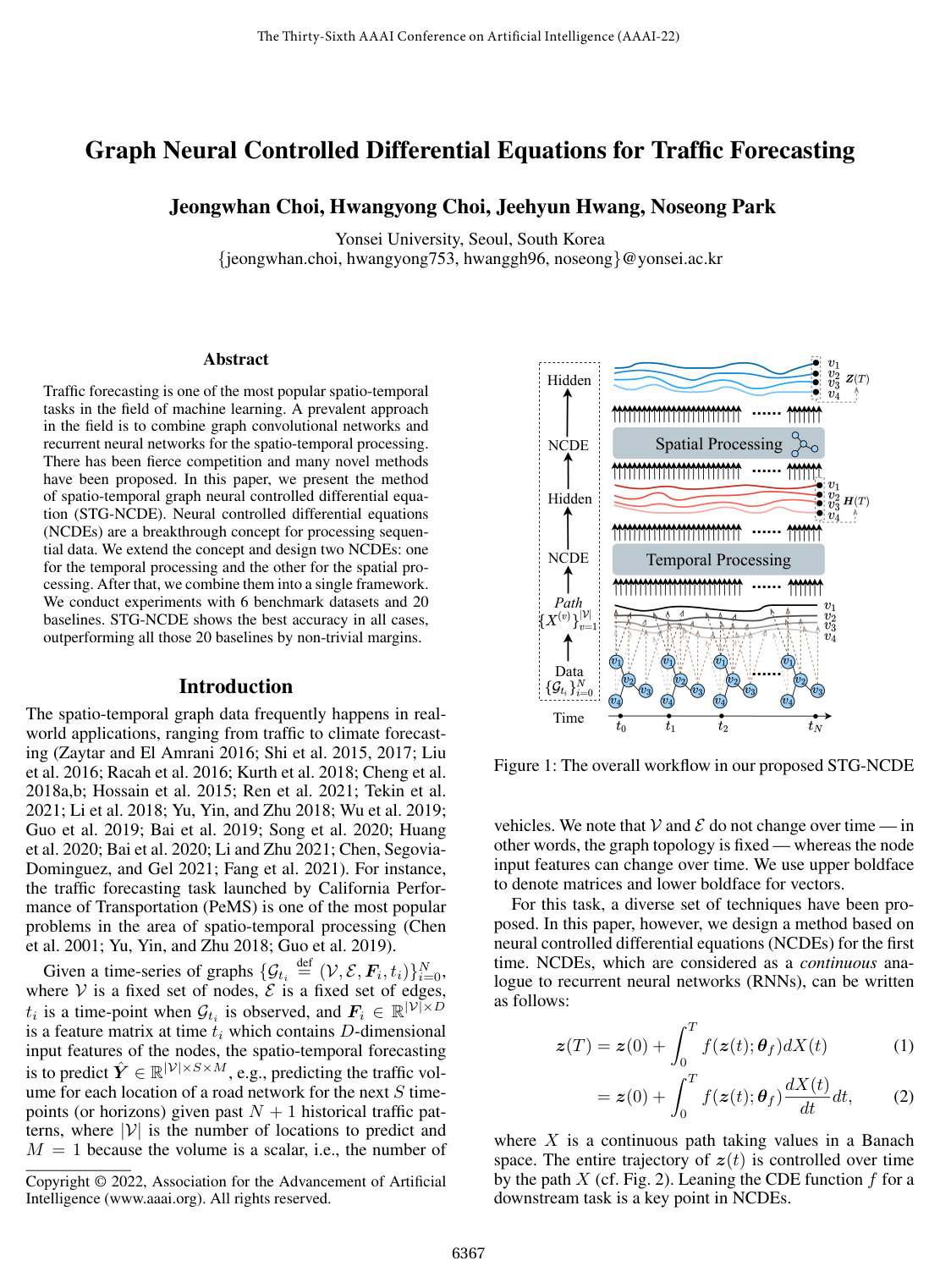
Graph Neural Controlled Differential Equations for Traffic Forecasting
Jeongwhan Choi, Hwangyong Choi, Jeehyun Hwang, Noseong Park
Why you should read this
Develops a unified spatio-temporal neural controlled differential equation framework that continuously models both spatial graph dynamics and temporal traffic patterns, significantly outperforming existing baselines across benchmark forecasting datasets.
Traffic forecasting is one of the most popular spatio-temporal tasks in the field of machine learning. A prevalent approach in the field is to combine graph convolutional networks and recurrent neural networks for the spatio-temporal processing. There has been fierce competition and many novel methods have been proposed. In this paper, we present the method of spatio-temporal graph neural controlled differential equation (STG-NCDE). Neural controlled differential equations (NCDEs) are a breakthrough concept for processing sequential data. We extend the concept and design two NCDEs: one for the temporal processing and the other for the spatial processing. After that, we combine them into a single framework. We conduct experiments with 6 benchmark datasets and 20 baselines. STG-NCDE shows the best accuracy in all cases, outperforming all those 20 baselines by non-trivial margins.
Added
2026-09-26
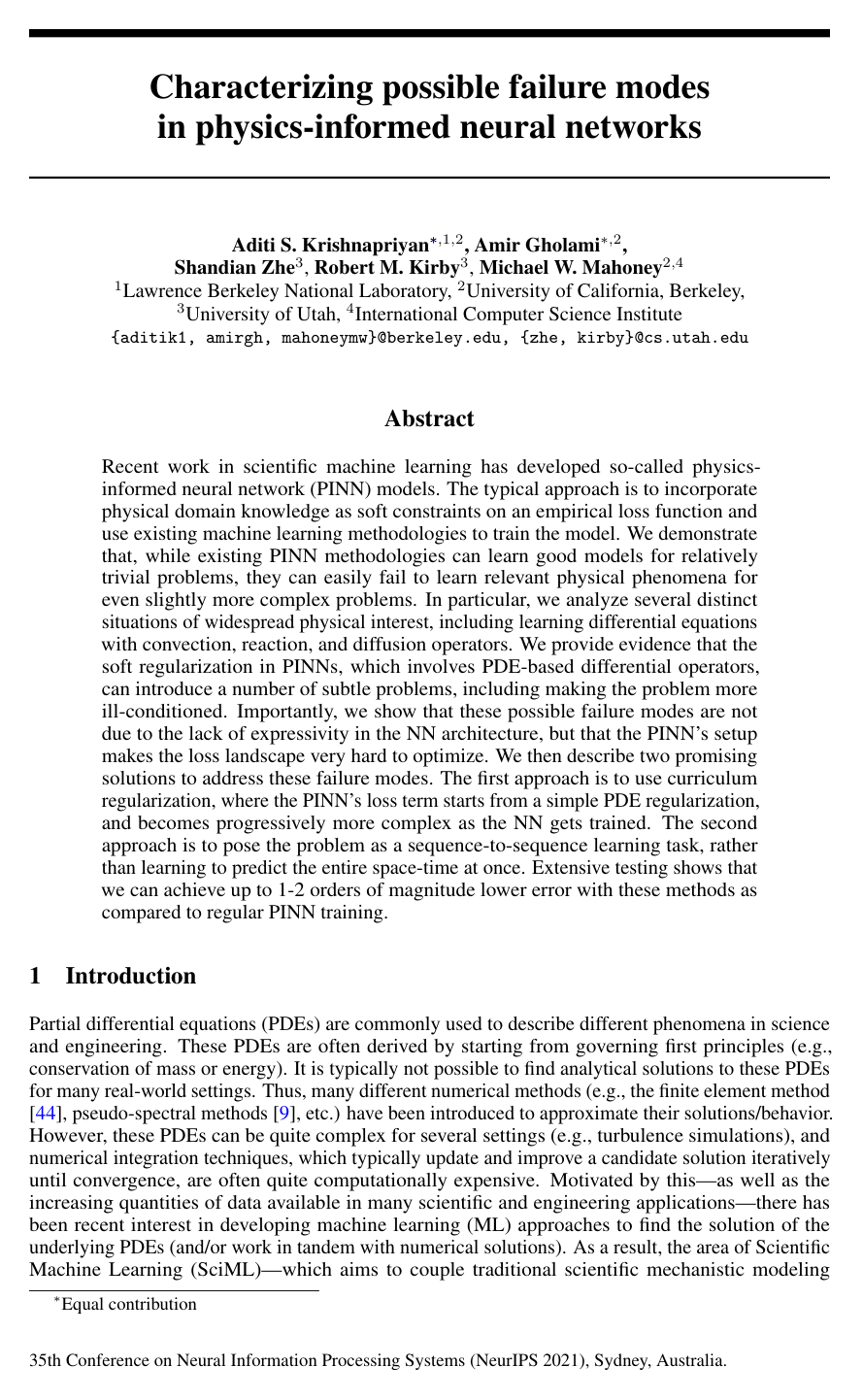
Characterizing possible failure modes in physics-informed neural networks
Aditi S. Krishnapriyan, Amir Gholami, Shandian Zhe, Robert M. Kirby, Michael W. Mahoney
Why you should read this
Demonstrates that physics-informed neural networks fail on complex differential equations due to severe optimization bottlenecks rather than limited model capacity, proposing curriculum regularization and sequence-to-sequence training to reduce prediction error by up to two orders of magnitude.
Recent work in scientific machine learning has developed so-called physics-informed neural network (PINN) models. The typical approach is to incorporate physical domain knowledge as soft constraints on an empirical loss function and use existing machine learning methodologies to train the model. We demonstrate that, while existing PINN methodologies can learn good models for relatively trivial problems, they can easily fail to learn relevant physical phenomena for even slightly more complex problems. In particular, we analyze several distinct situations of widespread physical interest, including learning differential equations with convection, reaction, and diffusion operators. We provide evidence that the soft regularization in PINNs, which involves PDE-based differential operators, can introduce a number of subtle problems, including making the problem more ill-conditioned. Importantly, we show that these possible failure modes are not due to the lack of expressivity in the NN architecture, but that the PINN's setup makes the loss landscape very hard to optimize. We then describe two promising solutions to address these failure modes. The first approach is to use curriculum regularization, where the PINN's loss term starts from a simple PDE regularization, and becomes progressively more complex as the NN gets trained. The second approach is to pose the problem as a sequence-to-sequence learning task, rather than learning to predict the entire space-time at once. Extensive testing shows that we can achieve up to 1-2 orders of magnitude lower error with these methods as compared to regular PINN training.
Added
2026-09-25