
Built independently by an author, for readers. Read the story and support ChapterPal

topic

computer assisted diagnosis

Computer assisted diagnosis is a specialized branch of artificial intelligence and medical informatics that analyzes clinical data and medical images to assist physicians in evaluating, classifying, and characterizing diseases. Unlike computer-aided detection systems that primarily pinpoint the location of suspicious abnormalities, computer assisted diagnosis evaluates identified lesions to estimate disease characteristics such as the probability of malignancy or progression. Utilizing techniques from computer vision, digital image processing, and machine learning, these systems analyze imaging modalities including digital radiography, computed tomography, and mammography to provide an automated, quantitative second opinion that supports clinical decision-making.

1 item
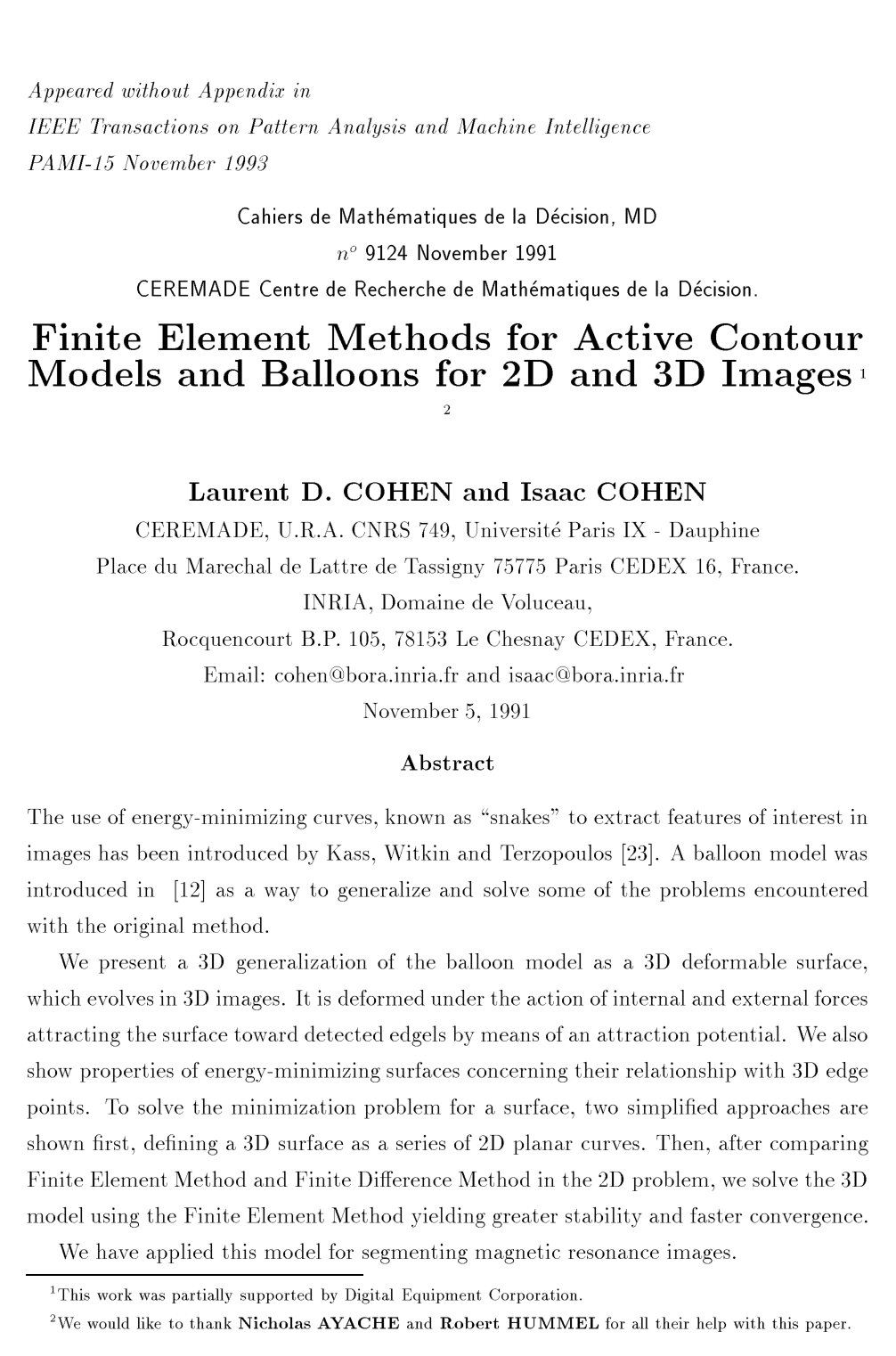
Finite-Element Methods for Active Contour Models and Balloons for 2-D and 3-D Images

Finite-Element Methods for Active Contour Models and Balloons for 2-D and 3-D Images

L. Cohen, I. Cohen

OrganizationsCEREMADEINRIAParis Dauphine University

Why you should read this

Presents a three-dimensional generalization of the balloon deformable surface model and implements a finite element framework that achieves faster convergence and superior numerical stability for volumetric medical image segmentation.

The use of energy-minimizing curves, known as "snakes" to extract features of interest in images has been introduced by Kass, Witkin and Terzopoulos [23]. A balloon model was introduced in [12] as a way to generalize and solve some of the problems encountered with the original method. We present a 3D generalization of the balloon model as a 3D deformable surface, which evolves in 3D images. It is deformed under the action of internal and external forces attracting the surface toward detected edgels by means of an attraction potential. We also show properties of energy-minimizing surfaces concerning their relationship with 3D edge points. To solve the minimization problem for a surface, two simplified approaches are shown first, defining a 3D surface as a series of 2D planar curves. Then, after comparing Finite Element Method and Finite Difference Method in the 2D problem, we solve the 3D model using the Finite Element Method yielding greater stability and faster convergence. We have applied this model for segmenting magnetic resonance images.

Added

2026-09-24