Built independently by an author, for readers. Read the story and support ChapterPal

topic

affective computing

Affective computing is an interdisciplinary field of computer science that focuses on the study and development of systems capable of recognizing, interpreting, processing, and simulating human emotions. Situated largely within human-computer interaction and artificial intelligence, it employs techniques that analyze various indicators of affect, including facial expressions, speech patterns, body gestures, and physiological signals. By enabling computational systems to interpret and respond to human emotional states, affective computing seeks to improve the quality of machine interaction, with broad applications in intelligent agents, educational software, healthcare monitoring, and adaptive user interfaces.

1 item

Micron-BERT: BERT-Based Facial Micro-Expression Recognition

Micron-BERT: BERT-Based Facial Micro-Expression Recognition

Xuan-Bac Nguyen, Chi Nhan Duong, Xin Li, Susan Gauch, Han-Seok Seo, Khoa Luu

OrganizationsConcordia UniversityUniversity of ArkansasWest Virginia University

Why you should read this

Proposes a self-supervised BERT-based framework that captures subtle facial micro-expressions between video frames without manual annotations by pairing diagonal micro-attention with an unsupervised patch-of-interest detector.

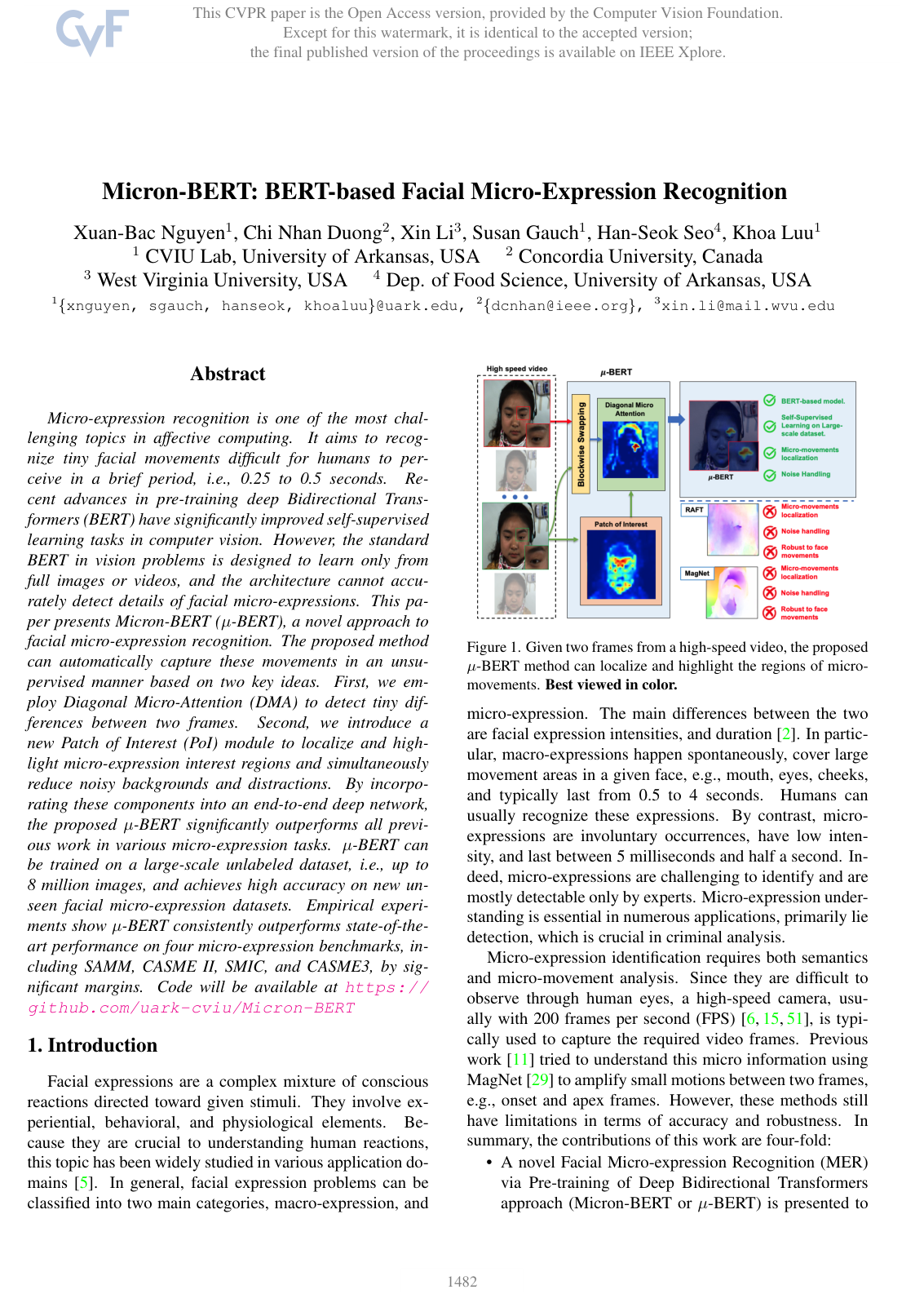
Micro-expression recognition is one of the most challenging topics in affective computing. It aims to recognize tiny facial movements difficult for humans to perceive in a brief period, i.e., 0.25 to 0.5 seconds. Recent advances in pre-training deep Bidirectional Transformers (BERT) have significantly improved self-supervised learning tasks in computer vision. However, the standard BERT in vision problems is designed to learn only from full images or videos, and the architecture cannot accurately detect details of facial micro-expressions. This paper presents Micron-BERT (µ-BERT), a novel approach to facial micro-expression recognition. The proposed method can automatically capture these movements in an unsupervised manner based on two key ideas. First, we employ Diagonal Micro-Attention (DMA) to detect tiny differences between two frames. Second, we introduce a new Patch of Interest (PoI) module to localize and highlight micro-expression interest regions and simultaneously reduce noisy backgrounds and distractions. By incorporating these components into an end-to-end deep network, the proposed µ-BERT significantly outperforms all previous work in various micro-expression tasks. µ-BERT can be trained on a large-scale unlabeled dataset, i.e., up to 8 million images, and achieves high accuracy on new unseen facial micro-expression datasets. Empirical experiments show µ-BERT consistently outperforms state-of-the-art performance on four micro-expression benchmarks, including SAMM, CASME II, SMIC, and CASME3, by significant margins. Code will be available at https://github.com/uark-cviu/Micron-BERT

Added

2026-09-26