RandLA-Net: Efficient Semantic Segmentation of Large-Scale Point Clouds
Qingyong HuBo YangLinhai XieStefano RosaYulan GuoZhihua WangNiki TrigoniAndrew Markham
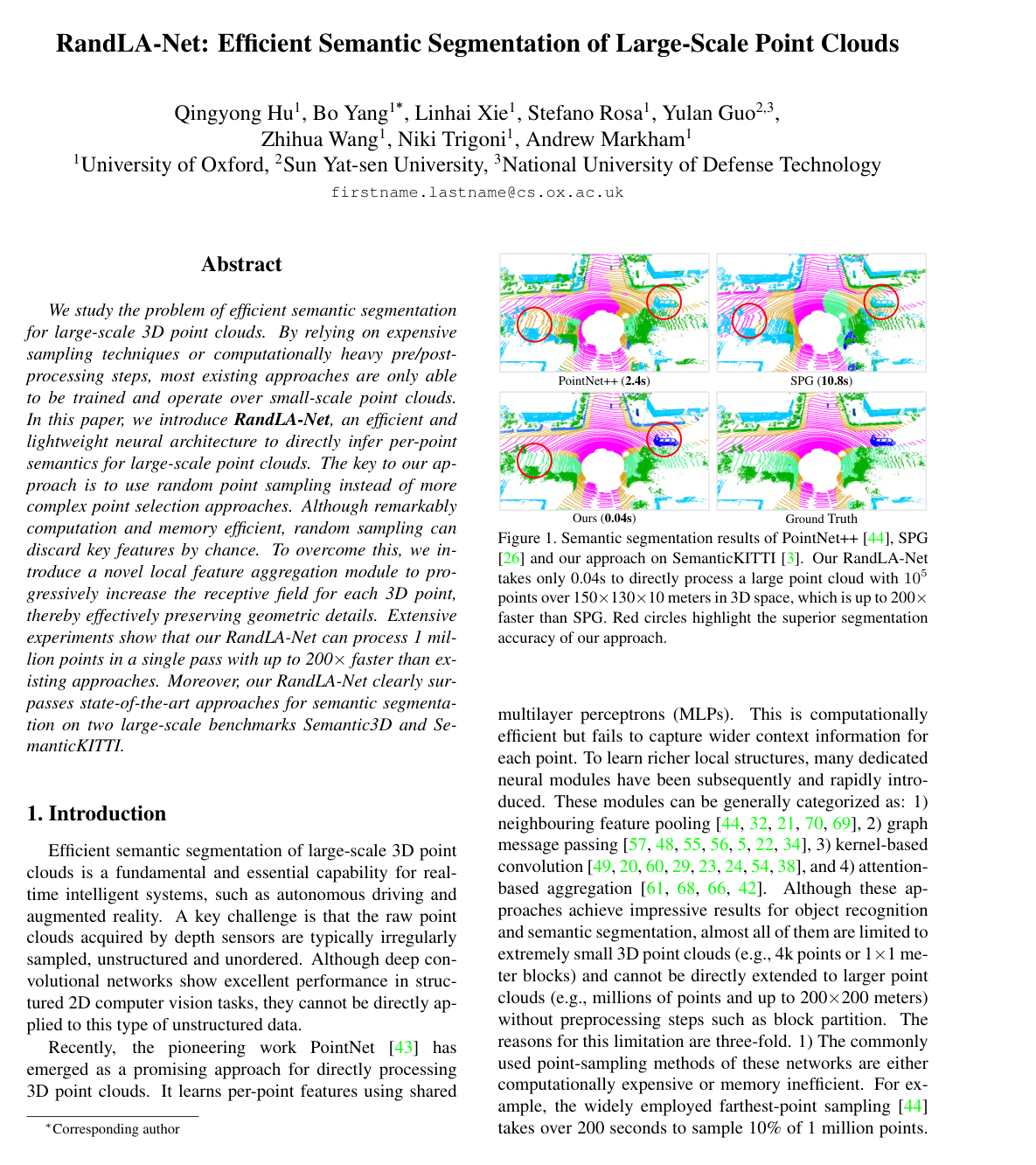
Presents RandLA-Net, a lightweight neural network that couples random point sampling with local feature aggregation to perform semantic segmentation on million-point 3D point clouds up to 200 times faster than existing methods.
Real-time intelligent applications such as autonomous driving and augmented reality rely on 3D point cloud sensors to accurately perceive and segment complex physical surroundings. However, analyzing large-scale point clouds containing millions of points across broad outdoor spaces remains a major operational bottleneck. Existing deep learning methods depend heavily on computationally expensive sampling routines, graph construction, or multi-step preprocessing such as spatial partitioning and voxelization. These heavy requirements prevent current networks from scaling efficiently or operating at speeds required for real-time deployment.
The article sets out to design and validate an efficient, lightweight neural architecture that directly predicts per-point semantic labels from massive 3D point clouds in a single pass without any preprocessing. To achieve this, the authors introduce a framework called RandLA-Net, which combines simple random downsampling with a dedicated local feature aggregation module to maintain geometric accuracy.
The approach was evaluated through computational benchmark experiments and performance comparisons on three large public datasets: the outdoor benchmarks Semantic3D and SemanticKITTI, and the indoor dataset S3DIS. The core architecture uses random sampling to achieve fast, constant-time downsampling across successive neural layers. To prevent the loss of critical geometric details caused by random point removal, the architecture incorporates local spatial encoding to preserve relative 3D positions, an attentive pooling mechanism to weight important local features, and dilated residual blocks that expand each point’s receptive field across multi-hop neighborhoods. Baseline models and ablated configurations were tested on standard computing hardware to assess runtime speed, memory consumption, parameter counts, and segmentation accuracy.
The findings show substantial gains in processing speed, computational efficiency, and accuracy. First, random point sampling took only 0.004 seconds to downsample one million points, whereas traditional heuristic methods required 10 to 200 seconds and alternative learning-based sampling took up to 1,200 seconds or demanded prohibitive memory. Second, the full RandLA-Net architecture processed large-scale scans at roughly 22 frames per second, running up to 200 times faster than competing graph-based pipelines while consuming only 1.24 million parameters. Third, the system outperformed state-of-the-art methods on large-scale outdoor benchmarks, achieving 77.4% mean Intersection-over-Union on Semantic3D and 53.9% on SemanticKITTI. Ablation studies confirmed that stacking local spatial encoding units with attentive pooling was essential, as removing the dilated residual structure decreased segmentation accuracy by over 8 percentage points.
These results demonstrate that organizations can deploy high-accuracy 3D semantic perception directly onto edge computing hardware without incurring prohibitive processing delays or expensive preprocessing workflows. By replacing complex point-selection heuristics with random sampling supported by local feature aggregation, developers can significantly lower system memory footprints and hardware costs while ensuring high-frame-rate performance in safety-critical automated driving workflows.
Organizations developing autonomous navigation and spatial computing systems should consider transitioning from computationally heavy point selection and voxelization pipelines to lightweight random sampling architectures. Future development should focus on extending this architecture toward end-to-end 3D instance segmentation and real-time processing of continuous dynamic point cloud streams.
The findings carry high confidence based on extensive evaluations across established public benchmarks. However, decision-makers should note specific operational limitations: the system exhibited reduced accuracy on small, highly imbalanced object classes (such as bicycles and motorcyclists) and occasionally misclassified visually similar vehicles when color data was unavailable.
- Paper: PointNet: Deep Learning on Point Sets for 3D Classification and Segmentation, Charles R. Qi et al. (2017). Reading PointNet is essential because the source directly builds upon its pioneering architecture for processing unordered point clouds.
- Paper: PointNet++: Deep Hierarchical Feature Learning on Point Sets in a Metric Space, C. Qi et al. (2017). PointNet++ establishes the hierarchical neighborhood aggregation techniques that the source adapts for efficient large-scale point cloud processing.
- Paper: KPConv: Flexible and Deformable Convolution for Point Clouds, Hugues Thomas et al. (2019). KPConv extends the lightweight philosophy of the source by introducing flexible point convolutions that further improve semantic segmentation accuracy on massive 3D scenes.
- Paper: Point Transformer, Nico Engel et al. (2020). Point Transformer builds upon efficient point-based representations like the source by applying attention mechanisms to capture complex geometric structures in large point clouds.