Chain-of-Note: Enhancing Robustness in Retrieval-Augmented Language Models
Wenhao YuHongming ZhangXiaoman PanPeixin CaoKaixin MaJian LiHongwei WangDong Yu
Proposes a sequential note-taking framework for retrieval-augmented language models that systematically evaluates the relevance of retrieved documents, allowing models to filter noise, rely on internal knowledge when appropriate, and admit when an answer is unknown.
Retrieval-augmented language models combine external document search with generative artificial intelligence to provide up-to-date answers and reduce factual inaccuracies. In real-world applications, however, automated retrieval frequently pulls noisy or irrelevant documents that distract the model, cause it to override its own accurate internal knowledge, or trigger misleading responses. Furthermore, standard retrieval systems struggle to recognize when information is entirely missing, often producing confident hallucinations instead of admitting knowledge gaps.
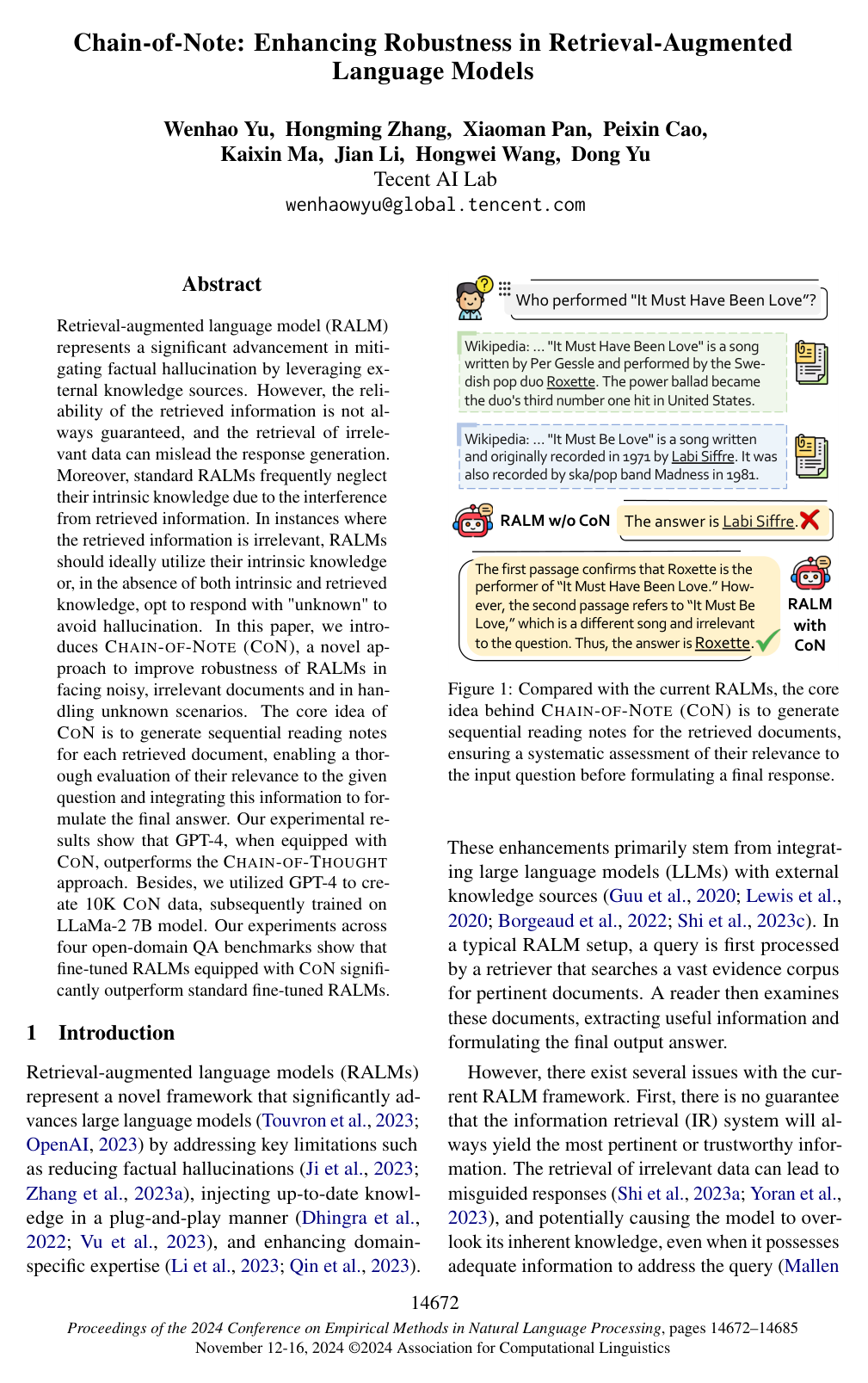
The article evaluates whether introducing a structured note-taking mechanism can enhance model robustness against irrelevant information and improve its ability to decline unanswerable questions. Specifically, it introduces Chain-of-Note, a framework where the model systematically evaluates each retrieved document by generating sequential reading notes to judge its relevance and credibility before formulating a final answer.
To test this concept, the authors prompted GPT-4 to generate 10,000 training examples with reading notes from search queries, fine-tuning an open-source LLaMA-2 7B model. The approach was evaluated across four open-domain question answering datasets under various noise levels and against real-time questions outside the model's pre-training knowledge base. Experiments were also conducted using GPT-4 directly to compare the approach against standard step-by-step reasoning prompts.
The findings show that generating reading notes consistently improves overall accuracy and substantially bolsters reliability under adverse conditions. First, on datasets containing completely noisy documents, the method improved exact match accuracy by an average of about 7.9 points over standard retrieval systems. Second, on completely new, real-time queries outside the training scope, it increased the rejection rate by over 10.5 points, enabling the model to respond with "unknown" rather than guessing incorrectly. Third, on larger systems like GPT-4, the method outperformed standard chain-of-thought prompting by about 2.0 to 4.0 percentage points across various benchmarks.
These results demonstrate that requiring a language model to explicitly assess source relevance mitigates operational and compliance risks tied to factual errors and hallucinations. Rather than blindly trusting retrieved text, the model learns to filter noise, infer answers using inherent knowledge when external data is incomplete, or decline answering when information is absent. This transparency also provides an interpretable reasoning trail for why specific evidence was accepted or dismissed.
For practical deployment, organizations should adopt this note-taking structure or utilize a "hybrid training" approach to balance accuracy and operational costs. The article found that standard note generation increases inference time from about 0.6 seconds to roughly 12 seconds per query on benchmark hardware. However, a hybrid training strategy—training models on both direct answers and note generation—internalizes the reasoning capability, matching standard speed (about 0.6 seconds) while preserving most robustness gains. Decision-makers should validate this method on their proprietary domain data before large-scale deployment to ensure generated notes remain concise and effective.
- Paper: Retrieval-Augmented Generation for Knowledge-Intensive NLP Tasks, Patrick Lewis et al. (2020). This foundational paper establishes the Retrieval-Augmented Generation (RAG) framework that Chain-of-Note aims to make robust against noisy and irrelevant context.
- Paper: Retrieval-Augmented Generation for Large Language Models: A Survey, Yunfan Gao et al. (2023). This survey systematically maps the core paradigms and vulnerabilities of retrieval-augmented generation pipelines, providing essential context on noise sensitivity in RALMs.
- Paper: In-Context Retrieval-Augmented Language Models, Ori Ram et al. (2023). This work analyzes in-context retrieval-augmented language models without model retraining, forming the baseline setup that Chain-of-Note extends through structured reading notes.
- Paper: When Not to Trust Language Models: Investigating Effectiveness of Parametric and Non-Parametric Memories, Alex Troy Mallen et al. (2022). This study analyzes the interaction and trade-offs between parametric memory and external retrieved knowledge, motivating the need to balance intrinsic knowledge with retrieved documents.
- Paper: Evidentiality-guided Generation for Knowledge-Intensive NLP Tasks, Akari Asai et al. (2022). This paper introduces evidentiality modeling to evaluate passage relevance and filter distracting context, directly preceding the relevance-evaluation focus of sequential reading notes.
- Paper: Self-Consistency Improves Chain of Thought Reasoning in Language Models, Xuezhi Wang et al. (2023). This work establishes chain-of-thought prompting as a baseline reasoning strategy that Chain-of-Note benchmarks against and adapts for document evaluation.
- Paper: REALM: Retrieval-Augmented Language Model Pre-Training, Kelvin Guu et al. (2020). This paper establishes retrieval-augmented language model pretraining, providing foundational background on how language models integrate external document indices.
- Paper: Enhancing Noise Robustness of Retrieval-Augmented Language Models with Adaptive Adversarial Training, Feiteng Fang et al. (2024). This work builds directly on the problem of retrieval noise in RALMs by introducing adaptive adversarial training to improve robustness against counterfactual and irrelevant context.
- Paper: RankRAG: Unifying Context Ranking with Retrieval-Augmented Generation in LLMs, Yue Yu et al. (2024). This paper advances retrieval robustness by unifying document ranking and answer generation into a single instruction-tuned model.
- Paper: Steering Knowledge Selection Behaviours in LLMs via SAE-Based Representation Engineering, Yu Zhao 0043 et al. (2025). This study explores representation engineering to resolve memory-versus-context conflicts at inference time, addressing how models decide between intrinsic knowledge and retrieved text.
- Paper: Rationale-Guided Retrieval Augmented Generation for Medical Question Answering, Jiwoong Sohn et al. (2025). This paper extends rationale-guided querying and filtering to high-stakes medical QA pipelines where handling irrelevant and noisy retrieval is critical.
- Paper: Search-R1: Training LLMs to Reason and Leverage Search Engines with Reinforcement Learning, Bowen Jin et al. (2025). This research applies reinforcement learning to train models to autonomously reason, search, and verify retrieved evidence across multi-step tasks.
- Paper: Adaptive-RAG: Learning to Adapt Retrieval-Augmented Large Language Models through Question Complexity, Soyeong Jeong et al. (2024). This work dynamically routes queries between internal memory and single- or multi-step retrieval based on complexity, complementing document-level relevance filtering.
- Paper: DRAGIN: Dynamic Retrieval Augmented Generation based on the Real-time Information Needs of Large Language Models, Weihang Su et al. (2024). This paper develops dynamic, real-time retrieval triggers to avoid unneeded or distracting context during generation.
- Paper: RAGTruth: A Hallucination Corpus for Developing Trustworthy Retrieval-Augmented Language Models, Cheng Niu et al. (2024). This corpus provides fine-grained word-level hallucination benchmarks specifically for evaluating when retrieval-augmented models fabricate unsupported information.