Enhancing Noise Robustness of Retrieval-Augmented Language Models with Adaptive Adversarial Training
Feiteng FangYuelin BaiShiwen NiMin YangXiaojun ChenRuifeng Xu
Presents an adaptive adversarial training framework that dynamically adjusts model training and applies multi-task learning to prevent large language models from being misled by irrelevant, superficial, or counterfactual retrieved contexts.
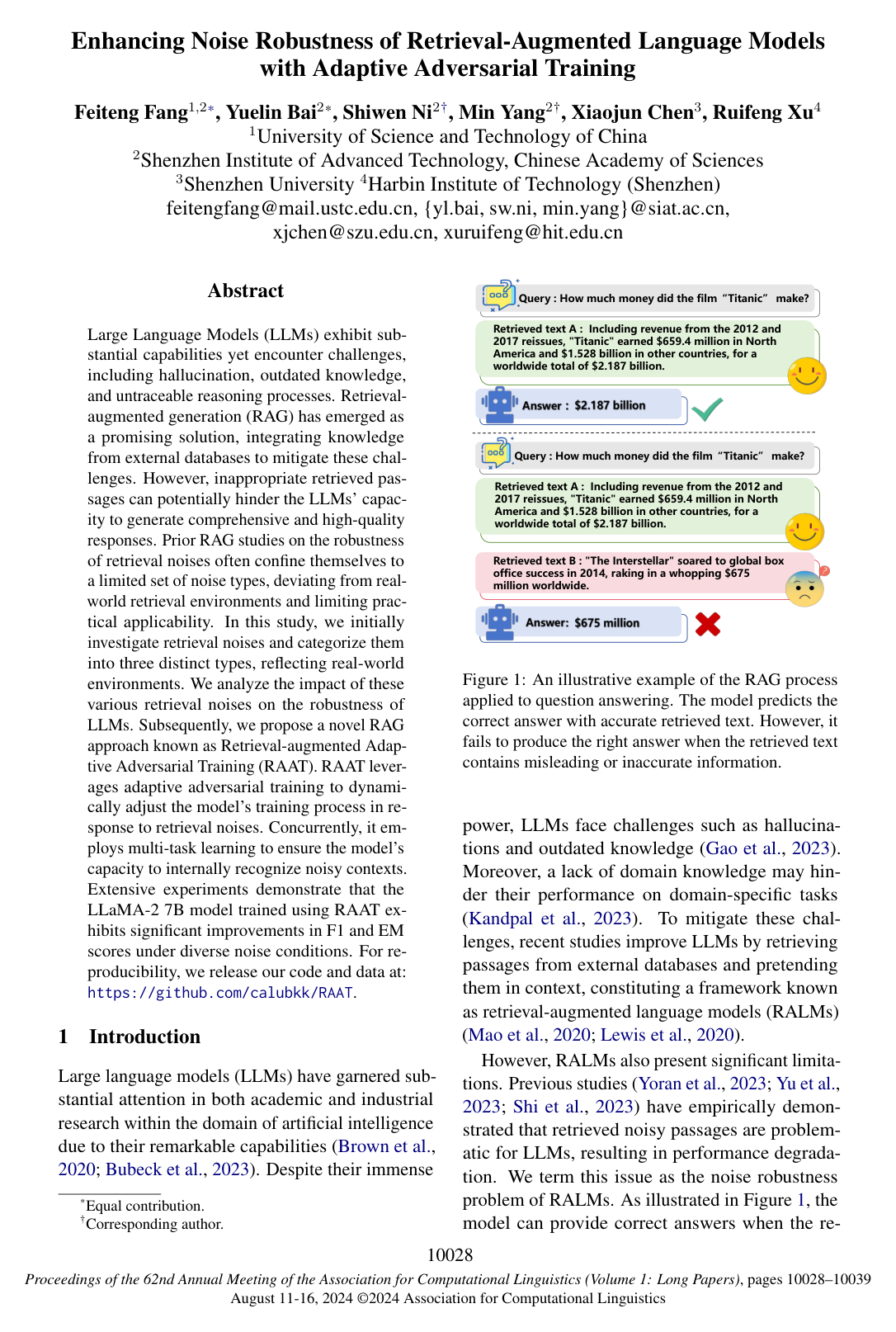
Large language models often struggle with factual inaccuracies and outdated knowledge. To address these issues, organizations increasingly use retrieval-augmented generation to pull relevant facts from external databases before generating answers. However, real-world search mechanisms frequently retrieve imperfect or noisy information. When these models encounter inaccurate or irrelevant context, their accuracy drops significantly, creating serious operational risks for automated decision-making and knowledge systems.
The article evaluates how different categories of retrieval noise impair model performance and demonstrates a new training framework designed to strengthen model resilience against these errors.
The researchers established a benchmark called RAG-Bench using 3,000 test queries drawn from three standard question-answering datasets (Natural Questions, TriviaQA, and WebQ). They categorized retrieval noise into three real-world types: irrelevant text, superficially relevant text lacking the right answer, and counterfactual text containing incorrect facts. They then developed Retrieval-augmented Adaptive Adversarial Training (RAAT), an approach that dynamically identifies the noise types causing the highest generation errors during fine-tuning and prioritizes those examples for model updates. This method also integrates multi-task learning to teach the model to classify noise types internally.
The evaluation revealed several key findings. First, existing leading models experience notable accuracy declines ranging from about 0.2% to 13.4% when exposed to noisy context. Second, counterfactual and superficially relevant noise cause far more degradation than completely irrelevant noise. Third, applying the RAAT method to an open-source 7-billion parameter language model achieved an average exact match score of 82.2% and an F1 score of 86.4% across all noise settings, outperforming standard fine-tuning baselines by roughly 2.1 to 2.5 percentage points. Finally, ablation testing confirmed that both the adaptive regularization and the auxiliary noise-classification tasks are essential for maintaining stable performance across diverse noise conditions.
These findings indicate that retrieval-augmented systems can achieve higher reliability without relying solely on upstream search improvements. By enabling language models to withstand misleading and conflicting evidence, organizations can reduce compliance and operational risks associated with automated outputs. The results challenge the traditional assumption that simple offline data augmentation is sufficient, showing that dynamic, noise-aware adversarial adaptation is necessary for robust performance.
Organizations deploying retrieval-augmented systems should adopt noise-aware training strategies that specifically target counterfactual and partially relevant distractors. For future research and implementation, development teams should validate this method across broader natural language tasks beyond question answering and explore joint training frameworks that optimize both the search retriever and the language generator simultaneously.
The findings are bounded by the study's focus on open-domain question-answering benchmarks and single-model fine-tuning. While confidence in the reported performance gains on standard benchmarks is high, readers should exercise caution before generalizing these results to complex multi-step reasoning tasks or domain-specific enterprise databases without further pilot testing.
- Paper: Retrieval-Augmented Generation for Knowledge-Intensive NLP Tasks, Patrick Lewis et al. (2020). Introduces the foundational retrieval-augmented generation (RAG) framework combining dense retrievers with sequence generators that the source paper directly builds upon and aims to make noise-robust.
- Paper: Retrieval-Augmented Generation for Large Language Models: A Survey, Yunfan Gao et al. (2023). Provides a comprehensive taxonomy and survey of retrieval-augmented generation paradigms and pipeline vulnerabilities, contextualizing the retrieval noise challenges tackled in RAAT.
- Paper: REALM: Retrieval-Augmented Language Model Pre-Training, Kelvin Guu et al. (2020). Establishes fundamental methods for end-to-end retrieval-augmented language model pre-training and conditioning on retrieved text.
- Paper: In-Context Retrieval-Augmented Language Models, Ori Ram et al. (2023). Demonstrates how in-context retrieval augmentation interacts with large language model generation, illustrating how retrieved contexts impact downstream generation quality.
- Paper: When Not to Trust Language Models: Investigating Effectiveness of Parametric and Non-Parametric Memories, Alex Troy Mallen et al. (2022). Examines the boundary between parametric model memory and retrieved non-parametric context, highlighting when and why LLMs are sensitive to external knowledge.
- Paper: A Survey on Hallucination in Large Language Models: Principles, Taxonomy, Challenges, and Open Questions, Lei Huang et al. (2023). Surveys the taxonomy and causes of hallucinations and unfaithfulness in LLMs, including failures arising during retrieval augmentation.
- Paper: Red Teaming Language Models with Language Models, Ethan Perez et al. (2022). Pioneers automated adversarial generation techniques to probe vulnerabilities and stress-test language models under challenging inputs.
- Paper: RankRAG: Unifying Context Ranking with Retrieval-Augmented Generation in LLMs, Yue Yu et al. (2024). Extends noise-mitigation in RAG by instruction-tuning the LLM to unify context reranking and filtering with answer generation.
- Paper: Self-RAG: Learning to Retrieve, Generate, and Critique through Self-Reflection, Akari Asai et al. (2024). Builds upon noise-aware generation by training models to actively reflect on, critique, and self-evaluate the relevance and faithfulness of retrieved passages.
- Paper: Ragas: Automated Evaluation of Retrieval Augmented Generation, Shahul Es et al. (2024). Provides an automated evaluation framework to assess context relevance and faithfulness in RAG systems, offering metrics to benchmark noise robustness.
- Paper: From Local to Global: A Graph RAG Approach to Query-Focused Summarization, Darren Edge et al. (2024). Applies structured hierarchical knowledge graphs to mitigate ungrounded retrieval noise and synthesize high-level, global query responses.
- Paper: Search-R1: Training LLMs to Reason and Leverage Search Engines with Reinforcement Learning, Bowen Jin et al. (2025). Advances beyond static adversarial training by using reinforcement learning to dynamically interleave reasoning, search engine interaction, and evidence verification.
- Paper: REFRAG: Rethinking RAG based Decoding, Xiaoqiang Lin et al. (2025). Addresses the efficiency and context compression challenges of long retrieved documents during RAG decoding.