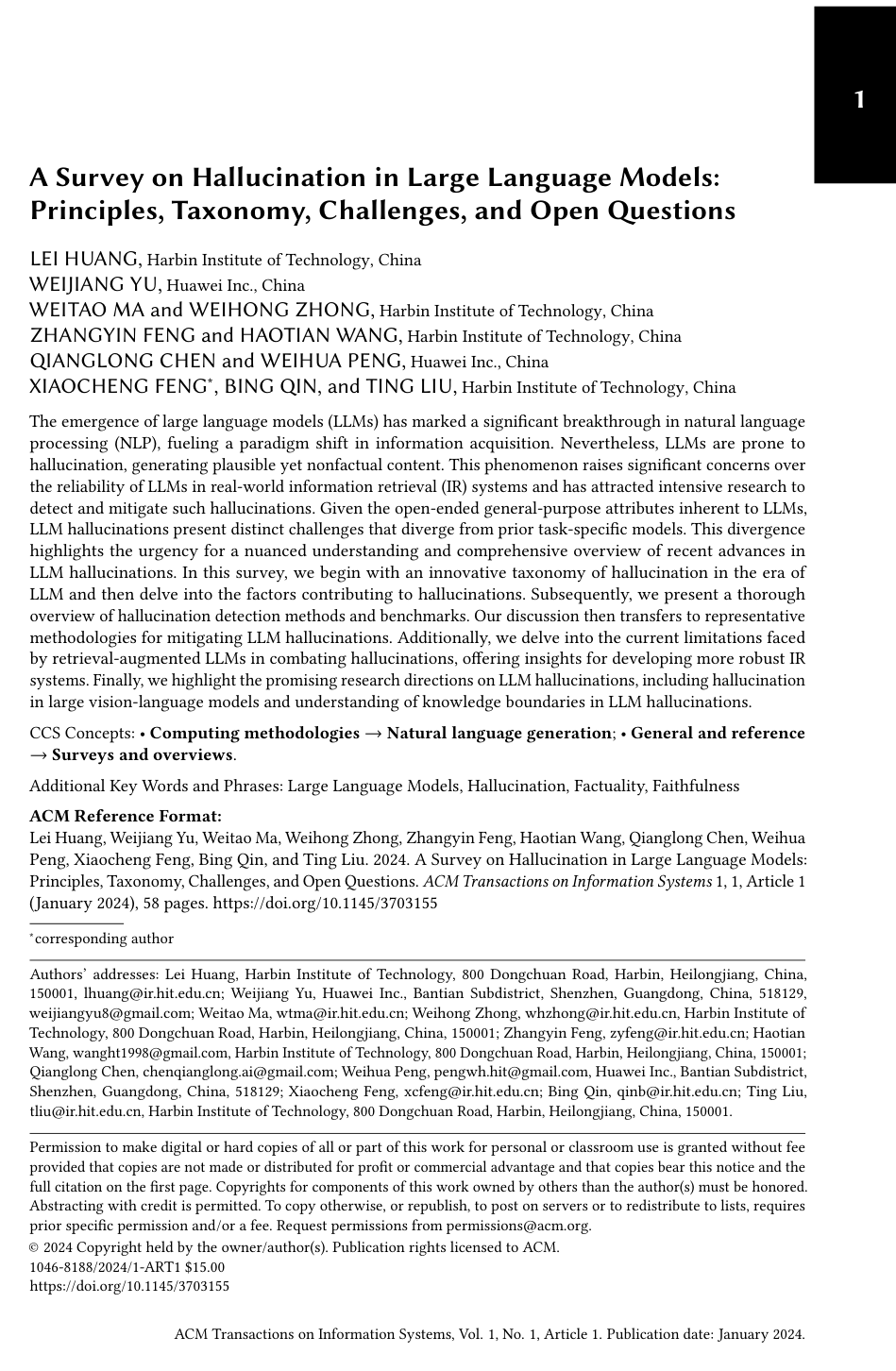
A Survey on Hallucination in Large Language Models: Principles, Taxonomy, Challenges, and Open Questions

Lei HuangWeijiang YuWeitao MaWeihong ZhongZhangyin FengHaotian WangQianglong ChenWeihua PengXiaocheng FengBing Qin

article2023ACM Trans. Inf. Syst.3,747 citations

Presents a structured taxonomy of large language model hallucinations alongside an evaluation of detection benchmarks, mitigation strategies, and key failure modes in retrieval-augmented and vision-language systems.

Listen

Large language models have driven transformative breakthroughs in artificial intelligence and natural language processing, reshaping how organizations retrieve and process information. However, their practical deployment in mission-critical applicationssuch as enterprise search, automated reporting, and customer-facing assistantsis heavily constrained by their tendency to generate plausible yet factually incorrect or ungrounded statements, commonly known as hallucinations. Because these systems produce highly convincing, human-like outputs, detecting and preventing these errors is critical to mitigating operational, reputational, legal, and safety risks.

The article provides a systematic, end-to-end framework to analyze why hallucinations occur in large language models, how to categorize them, and how to reliably detect and mitigate them. It sets out to establish a comprehensive taxonomy tailored to modern general-purpose models, evaluate state-of-the-art detection techniques and benchmarks, and assess mitigation strategies across the machine learning lifecycle, with a dedicated evaluation of retrieval-augmented generation systems.

To accomplish this, the authors conducted an extensive literature review and comparative analysis spanning contemporary generative models, benchmarks, and architectural designs. The analysis synthesizes findings across training pipelinespre-training, supervised fine-tuning, and reinforcement learning from human feedbackas well as inference strategies and external data retrieval mechanisms, evaluating their performance trade-offs, scalability, and practical constraints.

The article outlines several central findings. First, hallucinations are best categorized into two major types: factuality hallucinations (which contradict real-world facts or fabricate unsupported claims) and faithfulness hallucinations (which fail to follow user instructions, misrepresent provided source context, or exhibit internal logical contradictions). Second, hallucinations stem from interconnected vulnerabilities across all operational phases: training data flaws (such as memorized online misinformation, social biases, and unrepresented long-tail knowledge), training misalignments (including exposure bias and models learning sycophantic behavior to please human raters), and decoding limitations during inference (such as random sampling trade-offs and attention degradation across long documents). Third, while retrieval-augmented generation provides an effective mechanism to supply real-time facts, it introduces new failure points, including blind retrieval on simple queries, sensitivity to retrieved noise, query ambiguity, and the tendency of models to ignore information located in the middle of long reference contexts.

These findings indicate that addressing generative errors requires a multi-layered defense rather than a single technological fix. Relying blindly on standard models or unoptimized retrieval systems introduces substantial compliance and reliability risks. Organizations must recognize that factual accuracy and output diversity often exist in direct trade-off, meaning that system pipelines must be calibrated depending on whether a task requires strict precision or creative variability.

To mitigate these risks, decision-makers deploying language models should adopt targeted interventions across system design. Teams should implement curated data filtering, dynamic decoding adjustments, and structured retrieval architectures that use semantic chunking and query rewriting. Furthermore, retrieval systems should incorporate active decision rules to query external sources only when necessary, alongside post-generation verification steps to check outputs against trusted sources before presenting them to end users.

While the analytical framework provides strong confidence in identifying root causes and evaluation methods, the article notes key limitations in current industry capabilities. Existing mitigation strategies often require significant computational overhead, and methods designed to probe a model's internal awareness of its own knowledge boundaries remain developing and inconsistent. Furthermore, as organizations expand into multimodal and vision-language systems, hallucination patterns grow more complex and require continued testing and rigorous pilot evaluations.

Cover for A Survey on Hallucination in Large Language Models: Principles, Taxonomy, Challenges, and Open Questions

Abstract

The emergence of large language models (LLMs) has marked a significant breakthrough in natural language processing (NLP), fueling a paradigm shift in information acquisition. Nevertheless, LLMs are prone to hallucination, generating plausible yet nonfactual content. This phenomenon raises significant concerns over the reliability of LLMs in real-world information retrieval (IR) systems and has attracted intensive research to detect and mitigate such hallucinations. Given the open-ended general-purpose attributes inherent to LLMs, LLM hallucinations present distinct challenges that diverge from prior task-specific models. This divergence highlights the urgency for a nuanced understanding and comprehensive overview of recent advances in LLM hallucinations. In this survey, we begin with an innovative taxonomy of hallucination in the era of LLM and then delve into the factors contributing to hallucinations. Subsequently, we present a thorough overview of hallucination detection methods and benchmarks. Our discussion then transfers to representative methodologies for mitigating LLM hallucinations. Additionally, we delve into the current limitations faced by retrieval-augmented LLMs in combating hallucinations, offering insights for developing more robust IR systems. Finally, we highlight the promising research directions on LLM hallucinations, including hallucination in large vision-language models and understanding of knowledge boundaries in LLM hallucinations.

Table of Contents

  • 1 Introduction
  • 2 Definitions
  • 2.1 Large Language Models
  • 2.2 Training Stages of Large Language Models
  • 2.2.1 Pre-training
  • 2.2.2 Supervised Fine-Tuning
  • 2.2.3 Reinforcement Learning from Human Feedback
  • 2.3 Hallucinations in Large Language Models
  • 2.3.1 Factuality Hallucination
  • 2.3.2 Faithfulness Hallucination
  • 3 Hallucination Causes
  • 3.1 Hallucination from Data
  • 3.1.1 Misinformation and biases
  • 3.1.2 Knowledge Boundary.
  • 3.1.3 Inferior Alignment Data
  • 3.2 Hallucination from Training
  • 3.2.1 Hallucination from Pre-training
  • 3.2.2 Hallucination from Supervised Fine-tuning
  • 3.2.3 Hallucination from RLHF
  • 3.3 Hallucination from Inference
  • 3.3.1 Imperfect Decoding Strategies
  • 3.3.2 Over-confidence
  • 3.3.3 Softmax Bottleneck
  • 3.3.4 Reasoning Failure
  • 4 Hallucination Detection and Benchmarks
  • 4.1 Hallucination Detection
  • 4.1.1 Factuality Hallucination Detection
  • 4.1.2 Faithfulness Hallucination Detection
  • 4.2 Hallucination Benchmarks
  • 4.2.1 Hallucination Evaluation Benchmarks
  • 4.2.2 Hallucination Detection Benchmarks
  • 5 Hallucination Mitigation
  • 5.1 Mitigating Data-related Hallucinations
  • 5.1.1 Data Filtering
  • 5.1.2 Model Editing
  • 5.1.3 Retrieval-Augmented Generation
  • 5.2 Mitigating Training-related Hallucination
  • 5.2.1 Mitigating Pretraining-related Hallucination
  • 5.2.2 Mitigating Misalignment Hallucination
  • 5.3 Mitigating Inference-related Hallucination
  • 5.3.1 Factuality Enhanced Decoding
  • 5.3.2 Faithfulness Enhanced Decoding
  • 6 Hallucinations in Retrieval Augmented Generation
  • 6.1 Retrieval Failure
  • 6.1.1 User Queries
  • 6.1.2 Retrieval Sources
  • 6.1.3 Retriever
  • 6.2 Generation Bottleneck
  • 6.2.1 Contextual Awareness
  • 6.2.2 Contextual Alignment
  • 7 Future discussion
  • 7.1 Hallucination in Large Vision-Language Models
  • 7.2 Understanding Knowledge Boundary in LLMs
  • 8 Conclusion
  • References

Knowls

  1. Knowl 1 — Taxonomy of Large Language Model Hallucinations

    definition

    In large language models (LLMs), hallucination is defined as generated content that is nonsensical, unfaithful to provided sources, or divergent from verifiable real-world facts. Unlike traditional natural language generation tasks that categorize hallucinations into intrinsic and extrinsic types based strictly on source-text fidelity, LLM hallucinations are structured into a two-level taxonomy reflecting open-domain factuality and user-aligned faithfulness:

    1. Factuality Hallucination: Manifests as discrepancies between generated statements and verifiable real-world facts. It is subdivided into:

      • Factual Contradiction: The generated content refers to real-world knowledge but contradicts established facts.
        • Entity-Error Hallucination: The model substitutes incorrect entities (e.g., stating Thomas Edison invented the telephone instead of Alexander Graham Bell).
        • Relation-Error Hallucination: The model assigns an incorrect relation between entities (e.g., stating Thomas Edison invented the light bulb from scratch rather than improving existing designs).
      • Factual Fabrication: The generated content presents claims that cannot be grounded in or verified against real-world knowledge.
        • Unverifiability Hallucination: The generated text describes entities or events that do not exist (e.g., claiming the construction of the Eiffel Tower caused the extinction of the non-existent "Parisian tiger").
        • Overclaim Hallucination: The generated text presents subjective or unproven assertions as established facts without consensus or evidential support.
    2. Faithfulness Hallucination: Manifests as divergence from user directives, contextual inputs, or internal logical consistency. It is subdivided into:

      • Instruction Inconsistency: The output deviates unintentionally from the user's explicit task instructions (e.g., answering a question directly when explicitly instructed to translate it into another language).
      • Context Inconsistency: The output contradicts or alters specific information provided within the user prompt or retrieved reference context.
      • Logical Inconsistency: The output contains internal logical contradictions, where intermediate reasoning steps contradict each other or fail to support the final derived answer.
  2. Knowl 2 — Causes of Hallucinations Across LLM Data, Training, and Inference Lifecycles

    model/method

    Hallucinations in large language models originate across three stages of the model lifecycle:

    1. Data-Induced Causes:

      • Misinformation and Biases: Scraping unverified web corpora introduces fake news, rumors, and societal stereotypes. Due to strong memorization capabilities that scale with parameter size, LLMs learn and replicate these errors as imitative falsehoods.
      • Knowledge Boundaries: LLM pre-training data is inherently bounded. Models exhibit severe degradation on long-tail domain-specific facts (e.g., medical, legal), rapidly evolving real-time events (temporal boundary mismatch), and copyright-protected materials omitted from training corpora.
      • Inferior Alignment Data: Fine-tuning LLMs on Supervised Fine-Tuning (SFT) datasets containing factual knowledge beyond their pre-trained boundary forces models to fabricate information rather than acknowledge uncertainty.
    2. Training-Induced Causes:

      • Pre-training Objective and Architecture: Standard causal language modeling optimizes unidirectional next-token prediction, limiting bidirectional dependency modeling. Soft attention dispersion across long sequences and exposure bias (mismatch between teacher-forcing during training and autoregressive sampling at inference) lead to cascading error accumulation ("snowball effect").
      • Supervised Fine-Tuning (SFT): Standard SFT mandates deterministic output generation without rewarding calibration or explicit refusal of out-of-distribution queries.
      • Reinforcement Learning from Human Feedback (RLHF): Preference models and human evaluators often favor agreeable, fluent, or sycophantic responses over factually accurate ones, causing belief misalignment where the model generates statements conflicting with its internal representations ("sycophancy").
    3. Inference-Induced Causes:

      • Decoding Strategies: Stochastic sampling (such as high sampling temperature) flattens token probability distributions, increasing the sampling probability of low-frequency, ungrounded tail tokens.
      • Over-Confidence and Recency Bias: Causal self-attention mechanisms often focus excessively on recently generated tokens at the expense of early context or prompt instructions.
      • Softmax Bottleneck: The rank limitation of the final linear projection and softmax layer restricts the expressive capacity of output probability distributions, especially for multi-modal semantic targets.
      • Reasoning Failures: Limitations in multi-hop deduction and intrinsic structural asymmetries, such as the "Reversal Curse" (where an LLM trained on "A is B" fails to infer "B is A").
  3. Knowl 3 — Factuality and Faithfulness Hallucination Detection Methods

    model/method

    Methods for detecting hallucinations in large language models are divided into factuality detection and faithfulness detection:

    1. Factuality Hallucination Detection:

      • External Retrieval Fact-Checking: Decomposes generated responses into discrete atomic propositions (e.g., FActScore) and verifies each proposition against external trusted repositories (such as Wikipedia or search APIs) using query expansion and tool-augmented evidence retrieval.
      • Internal Parametric Checking: Probes the model's internal parameters without external retrieval. This includes generating multi-step verification questions over initial drafts (Chain-of-Verification / CoVe), evaluating the direct probability of truthfulness P(True)P(\text{True}), or eliciting direct consistency assessments.
      • Internal State Uncertainty Estimation: Measures token log-probabilities, minimum token confidence across key entity concepts, or entropy spikes over early generated tokens.
      • Behavioral Uncertainty Estimation: Evaluates semantic consistency across multiple stochastic sampling passes (Self-Consistency, indirect open-ended probing) or multi-agent debate (cross-examination frameworks such as LMvLM).
    2. Faithfulness Hallucination Detection:

      • Fact-Overlap Metrics: Computes precision, recall, and F1 scores of extracted entities, dependency relations, or relation triples between the generated output and reference context.
      • Classifier-based Entailment: Uses Natural Language Inference (NLI) models fine-tuned on sentence pairs, dependency-arc decomposition, or adversarially generated unfaithful samples to predict premise-hypothesis entailment.
      • Question-Answering (QA) Consistency: Generates question-answer pairs from the output hypothesis and checks whether the source context yields identical answers when queried with the same questions.
      • Uncertainty Measures: Analyzes length-normalized sequence log-probability, Monte Carlo Dropout variance across hidden layers, or conditional entropy.
      • LLM-as-a-Judge: Uses prompting strategies (e.g., Chain-of-Thought prompting, Likert-scale scoring, or binary judgment with explicit criteria) to evaluate alignment with source contexts.
  4. Knowl 4 — Hallucination Evaluation and Detection Benchmarks

    data/table

    Hallucination benchmarks evaluate the hallucination rates of large language models across diverse domains or assess the accuracy of hallucination detection algorithms.

    Benchmark Data Size Language Factuality Faithfulness Task Type Metric
    TruthfulQA 817 English ×\times Generative / MC QA LLM-Judge / Human Acc
    REALTIMEQA Dynamic English ×\times Generative / MC QA Acc / EM / F1
    SelfCheckGPT-Wikibio 1,908 English ×\times Detection AUROC
    HaluEval 35,000 English ×\times Detection Accuracy
    Med-HALT 4,916 Multilingual ×\times Multi-Choice QA Pointwise Score / Acc
    FACTOR 4,030 English ×\times Multi-Choice QA Likelihood
    BAMBOO 400 English ×\times Detection P / R / F1
    ChineseFactEval 125 Chinese ×\times Generative QA Score
    HaluQA 450 Chinese ×\times Generative QA LLM-Judge
    FreshQA 600 English ×\times Generative QA Human Acc
    FELM 3,948 English Detection Balanced Acc / F1
    PHD 300 English ×\times Detection P / R / F1
    ScreenEval 52 English ×\times Detection AUROC
    RealHall N/A English ×\times Detection AUROC
    LSum 6,166 English ×\times Detection Balanced Acc
    SAC3^3 500 English ×\times Detection AUROC
    HaluEval 2.0 8,770 English ×\times Generative QA MiHR / MaHR

    The benchmark ecosystem splits into two evaluation paradigms:

    1. Factuality Evaluation Benchmarks (e.g., TruthfulQA, HaluQA, FreshQA, REALTIMEQA, HaluEval 2.0) test models on long-tail knowledge, fast-changing events, and adversarial misconceptions to gauge factual contradiction and fabrication.
    2. Faithfulness and Inconsistency Detection Benchmarks (e.g., SelfCheckGPT-Wikibio, HaluEval, FELM, BAMBOO, ScreenEval) evaluate hallucination detectors on their capability to identify ungrounded spans, non-entailed summaries, and reasoning errors using classification metrics such as AUROC, Balanced Accuracy, and F1.
  5. Knowl 5 — Mitigation of LLM Hallucinations Across Data, Training, and Inference

    model/method

    Mitigation approaches for large language model hallucinations are categorized according to the stage of intervention:

    1. Data-Centric Mitigation:

      • Data Quality Filtering and Up-sampling: Scraping curated, high-quality domain corpora (such as scientific literature and textbook datasets) and up-sampling verified factual data during pre-training.
      • Deduplication: Applying suffix arrays for exact substring matching, MinHash for near-duplicate document matching, and semantic embedding clustering (e.g., SemDeDup) to remove redundant, biased, or noisy pre-training examples.
      • Model Editing: Directly modifying factual associations in model weights without retraining via locate-then-edit methods (e.g., ROME, MEMIT) or hyper-network meta-learning (e.g., MEND, MALMEN).
    2. Training-Centric Mitigation:

      • Architectural and Pre-training Modifications: Employing bidirectional autoregression (BATGPT), attention-sharpening regularizers with sparsity penalties to mitigate attention dispersion, prepending entity/topic indicators (TopicPrefix) to preserve standalone factual assertions, and ordering document sequences by topic similarity (In-Context Pretraining).
      • Alignment and Anti-Sycophancy Interventions: Training preference reward models with multi-annotator aggregation, fine-tuning on synthetic counter-sycophantic data where ground truth is decoupled from user opinion, and applying activation steering by subtracting latent sycophancy vectors during forward passes.
    3. Inference-Centric Mitigation:

      • Factuality-Enhanced Decoding: Dynamically adjusting sampling constraints (factual-nucleus sampling), steering intermediate layer representations along truth-correlated directions (Inference-Time Intervention / ITI), contrasting higher-layer semantic logits against lower-layer representations (DoLa), and using multi-turn self-reflection pipelines (Chain-of-Verification / CoVe).
      • Faithfulness-Enhanced Decoding: Contrasting output distributions with and without context (Context-Aware Decoding / CAD), dynamic temperature adjustment based on context-target KL divergence, knowledge-constrained tree search (KCD), and enforcing intermediate symbolic logic representations (SymbCoT).
  6. Knowl 6 — Failure Modes and Bottlenecks in Retrieval-Augmented Generation

    limitation

    While Retrieval-Augmented Generation (RAG) incorporates external reference datastores to mitigate LLM hallucinations caused by knowledge boundaries, RAG systems encounter specific retrieval failures and generation bottlenecks:

    1. Retrieval Failures:

      • Retrieval Intent Failure: Blindly executing retrieval on queries solvable entirely by parametric memory introduces irrelevant or noisy contexts that derail generation.
      • Query Ambiguity and Complexity: Queries containing coreferences, omissions, or multi-hop dependencies cause keyword and dense retrievers to fetch incomplete or off-topic documents.
      • Retrieval Source Bias and Contamination: Datastores contaminated with unverified AI-generated content (AIGC) mislead retrievers due to high lexical and semantic overlap with queries.
      • Retriever Granularity and Domain Shift: Fixed-size chunking fragments semantic dependencies across paragraph boundaries, while dense embedding models struggle to retrieve accurately under domain shifts (e.g., biomedical or legal corpora).
    2. Generation Bottlenecks:

      • Noisy Context Sensitivity: Generators lacking noise robustness incorporate distracting or irrelevant retrieved passages directly into answers.
      • Knowledge Conflicts (Parametric vs. Contextual Prior): When retrieved documents contradict the LLM's internal pre-trained memory, models often exhibit over-confidence in their parametric prior, ignoring verified contextual evidence.
      • Lost-in-the-Middle Phenomenon: Position-dependent attention decay—frequently exacerbated by Rotary Positional Embeddings (RoPE)—causes the model to ignore evidence placed in the middle of long retrieval contexts while prioritizing tokens at the extreme beginning or end.
      • Weak Contextual Alignment and Attribution: Standard autoregressive decoding fails to maintain consistent grounding to retrieved documents, leading to unfaithful generation despite correct retrieval.
  7. Knowl 7 — Advanced Factuality and Faithfulness Decoding Formulations

    model/method

    Advanced decoding algorithms modify token generation dynamics at inference time to mitigate hallucinations without requiring parameter updates:

    1. Contrastive and Layer-Contrasting Factuality Decoding:
      • DoLa (Decoding by Contrasting Layers): Transformer models encode low-level linguistic information in earlier layers and factual/semantic knowledge in later layers. Let logitL(yt)\text{logit}_L(y_t) be the output logit from the final layer LL, and logitj(yt)\text{logit}_j(y_t) be the logit projected from an intermediate layer j<Lj < L. DoLa dynamically selects an optimal lower layer jj and amplifies factual predictions via contrastive logit subtraction:

    Δlogit(yt)=logitL(yt)logitj(yt)\Delta \text{logit}(y_t) = \text{logit}_L(y_t) - \text{logit}_j(y_t)

    • Inference-Time Intervention (ITI): Identifies truthfulness-correlated linear directions v\mathbf{v} in attention head activation spaces and adds a steering offset during inference:

    h=h+αv\mathbf{h}' = \mathbf{h} + \alpha \mathbf{v}

    where h\mathbf{h} is the activation vector, α\alpha is a scaling hyperparameter, and v\mathbf{v} is the truthfulness steering direction.

    1. Context-Aware and Constraint-Driven Faithfulness Decoding:
      • Context-Aware Decoding (CAD): Amplifies the influence of context CC relative to empty context \emptyset for prompt xx and preceding tokens y<ty_{<t} using a Pointwise Mutual Information (PMI) formulation:

    pCAD(yty<t,C,x)p(yty<t,C,x)p(yty<t,,x)γp_{\text{CAD}}(y_t \mid y_{<t}, C, x) \propto \frac{p(y_t \mid y_{<t}, C, x)}{p(y_t \mid y_{<t}, \emptyset, x)^\gamma}

    where γ>0\gamma > 0 controls the penalty strength against relying solely on prior parametric memory.

    • KL-Divergence Guided Temperature Sampling: Computes the Kullback-Leibler divergence DKL(p(C)p())D_{\text{KL}}(p(\cdot \mid C) \parallel p(\cdot \mid \emptyset)) at each decoding step; when divergence is high (indicating context relevance), sampling temperature is lowered to enforce strict context attribution.
  8. Knowl 8 — Knowledge Conflicts and Position-Dependent Context Attenuation in LLMs

    theoretical result

    Two core failure mechanisms govern unfaithful generation in context-augmented and long-context language models:

    1. Knowledge Conflicts: When external context CC provides factual statements that directly contradict the model's internal parametric knowledge base θ\theta, language models experience a competition between prior memory and contextual evidence. Smaller generative models predominantly default to parametric memory. While large foundation models show higher receptivity to external evidence, standard decoding remains vulnerable to over-confidence in parametric priors, especially when counter-evidence is subtly phrased or framed without explicit counterfactual prompting.

    2. Lost-in-the-Middle Phenomenon: Language models exhibit non-uniform contextual reasoning performance across long context windows: retrieval performance and question-answering accuracy follow a U-shaped curve, where factual evidence located in the middle of a multi-document prompt suffers substantial retrieval degradation compared to evidence placed at the absolute beginning or end.

      • Mechanism: The use of relative positional encodings, notably Rotary Position Embedding (RoPE), imposes a long-term decay property that diminishes attention weights on distant intermediate tokens. Additionally, pre-training corpus distributions naturally concentrate critical lead paragraphs at document beginnings and concluding summaries at document ends.
      • Mitigations: Addressed via Multi-scale Positional Encoding (Ms-PoE) that rescales position indices across context windows, prompt structures that explicitly repeat query tokens and indices before generation, or hierarchical incremental summarization.
  9. Knowl 9 — Multimodal Hallucination in Large Vision-Language Models

    limitation

    Large Vision-Language Models (LVLMs) integrate visual encoders with autoregressive language models, introducing multimodal hallucination phenomena where text outputs diverge from visual inputs:

    1. Manifestation of Multimodal Hallucinations:

      • Object Hallucinations: Generating objects that are absent in the input image.
      • Attribute and Relation Errors: Incorrectly predicting object colors, counts, spatial positions, and semantic relationships.
      • Multi-Image Temporal and Logical Disconnection: Misidentifying sequence order, blending features across distinct images, or generating flawed deductions despite correct individual perception.
    2. Underlying Causes:

      • Language Prior Over-Reliance: Due to powerful pre-trained text decoders, LVLMs frequently prioritize linguistic statistical co-occurrences (e.g., associating "dining table" with "chairs" and "forks") over actual visual features present in the image.
      • Adversarial Vulnerability to Prompt Biases: Models are susceptible to leading questions containing false premises about nonexistent visual entities.
    3. Mitigation Paradigms:

      • Visual Contrastive Decoding: Modifying token probabilities at inference time by contrasting logits conditioned on original images against logits conditioned on degraded or blank image inputs.
      • Self-Correction and Tool-Assisted Post-Editing: Using visual expert networks (e.g., object detectors) or multi-agent verification modules (e.g., Woodpecker) to detect and correct discrepancies between initial drafts and visual evidence.
      • Multimodal Instruction Tuning: Training on counterfactual vision-language datasets and applying negative object presence penalties during alignment.

Coverage note — No substantial contributed material was omitted; the knowls cover the survey's redefined taxonomy, root causes across all lifecycle stages, detection methods, evaluation benchmarks, mitigation strategies, RAG limitations and generation bottlenecks, decoding formulations, and LVLM multimodal open questions.

References

  1. 1.Amro Abbas, Kushal Tirumala, Dániel Simig, Surya Ganguli, and Ari S Morcos. 2023. SemDeDup: Data-efficient learning at web-scale through semantic deduplication. ArXiv preprint abs/2303.09540 (2023). https://arxiv.org/abs/2303.09540
  2. 2.Vaibhav Adlakha, Parishad BehnamGhader, Xing Han Lu, Nicholas Meade, and Siva Reddy. 2023. Evaluating correctness and faithfulness of instruction-following models for question answering. ArXiv preprint abs/2307.16877 (2023). https://arxiv.org/abs/2307.16877
  3. 3.Ayush Agrawal, Lester Mackey, and Adam Tauman Kalai. 2023. Do Language Models Know When They’re Hallucinating References? ArXiv preprint abs/2305.18248 (2023). https://arxiv.org/abs/2305.18248
  4. 4.Perplexity AI. 2023. Perplexity AI. https://www.perplexity.ai/
  5. 5.Renat Aksitov, Chung-Ching Chang, David Reitter, Siamak Shakeri, and Yun-Hsuan Sung. 2023. Characterizing Attribution and Fluency Tradeoffs for Retrieval-Augmented Large Language Models. ArXiv preprint abs/2302.05578 (2023). https://arxiv.org/abs/2302.05578
  6. 6.Badr AlKhamissi, Millicent Li, Asli Celikyilmaz, Mona T. Diab, and Marjan Ghazvininejad. 2022. A Review on Language Models as Knowledge Bases. CoRR abs/2204.06031 (2022). https://doi.org/10.48550/ARXIV.2204.06031 arXiv:2204.06031
  7. 7.Rohan Anil, Sebastian Borgeaud, Yonghui Wu, Jean-Baptiste Alayrac, Jiahui Yu, Radu Soricut, Johan Schalkwyk, Andrew M. Dai, Anja Hauth, Katie Millican, David Silver, Slav Petrov, Melvin Johnson, Ioannis Antonoglou, Julian Schrittwieser, Amelia Glaese, Jilin Chen, Emily Pitler, Timothy P. Lillicrap, Angeliki Lazaridou, Orhan Firat, James Molloy, Michael Isard, Paul Ronald Barham, Tom Hennigan, Benjamin Lee, Fabio Viola, Malcolm Reynolds, Yuanzhong Xu, Ryan Doherty, Eli Collins, Clemens Meyer, Eliza Rutherford, Erica Moreira, Kareem Ayoub, Megha Goel, George Tucker, Enrique Piqueras, Maxim Krikun, Iain Barr, Nikolay Savinov, Ivo Danihelka, Becca Roelofs, Anaïs White, Anders Andreassen, Tamara von Glehn, Lakshman Yagati, Mehran Kazemi, Lucas Gonzalez, Misha Khalman, Jakub Sygnowski, and et al. 2023. Gemini: A Family of Highly Capable Multimodal Models. CoRR abs/2312.11805 (2023). https://doi.org/10.48550/ARXIV.2312.11805 arXiv:2312.11805
  8. 8.Anthropic. 2023. Claude. https://claude.ai/
  9. 9.Antropic. 2024. Claude 3 haiku: our fastest model yet. 2024. https://www.anthropic.com/news/claude-3-haiku
  10. 10.ArXiv. 2023. arxiv dataset. https://www.kaggle.com/datasets/Cornell-University/arxiv/versions/134

Citation

MLA
Huang, L., et al. “A Survey on Hallucination in Large Language Models: Principles, Taxonomy, Challenges, and Open Questions”. ACM Transactions on Information Systems, vol. 43, no. 2, 2025, pp. 1–5, https://doi.org/10.1145/3703155.
APA
Huang, L., Yu, W., Ma, W., Zhong, W., Feng, Z., Wang, H., Chen, Q., Peng, W., Feng, X., Qin, B., & Liu, T. (2025). A Survey on Hallucination in Large Language Models: Principles, Taxonomy, Challenges, and Open Questions. ACM Transactions on Information Systems, 43(2), 1–55. https://doi.org/10.1145/3703155
Chicago
Huang, L., W. Yu, W. Ma, et al. 2025. “A Survey on Hallucination in Large Language Models: Principles, Taxonomy, Challenges, and Open Questions”. ACM Transactions on Information Systems 43 (2): 1–55. https://doi.org/10.1145/3703155.
Harvard
Huang, L. et al. (2025) “A Survey on Hallucination in Large Language Models: Principles, Taxonomy, Challenges, and Open Questions”, ACM Transactions on Information Systems, 43(2), pp. 1–55. Available at: https://doi.org/10.1145/3703155.
Vancouver
1. Huang L, Yu W, Ma W, et al (2025) A Survey on Hallucination in Large Language Models: Principles, Taxonomy, Challenges, and Open Questions. ACM Transactions on Information Systems 43:1–55

BibTeX

@article{Huang_2025, title={A Survey on Hallucination in Large Language Models: Principles, Taxonomy, Challenges, and Open Questions}, volume={43}, ISSN={1558-2868}, url={http://dx.doi.org/10.1145/3703155}, DOI={10.1145/3703155}, number={2}, journal={ACM Transactions on Information Systems}, publisher={Association for Computing Machinery (ACM)}, author={Huang, Lei and Yu, Weijiang and Ma, Weitao and Zhong, Weihong and Feng, Zhangyin and Wang, Haotian and Chen, Qianglong and Peng, Weihua and Feng, Xiaocheng and Qin, Bing and Liu, Ting}, year={2025}, month=Jan, pages={1–55} }
Metadata:Crossref

Access the Paper

This paper is available from its original source. Click below to access the PDF.

Open PDF