Asymmetric Transitivity Preserving Graph Embedding
Mingdong OuPeng CuiJ. PeiZiwei ZhangWenwu Zhu
Presents a scalable directed graph embedding algorithm that captures asymmetric transitivity by approximating high-order proximity measures via generalized singular value decomposition, providing theoretical error bounds and superior performance in link prediction and graph reconstruction.
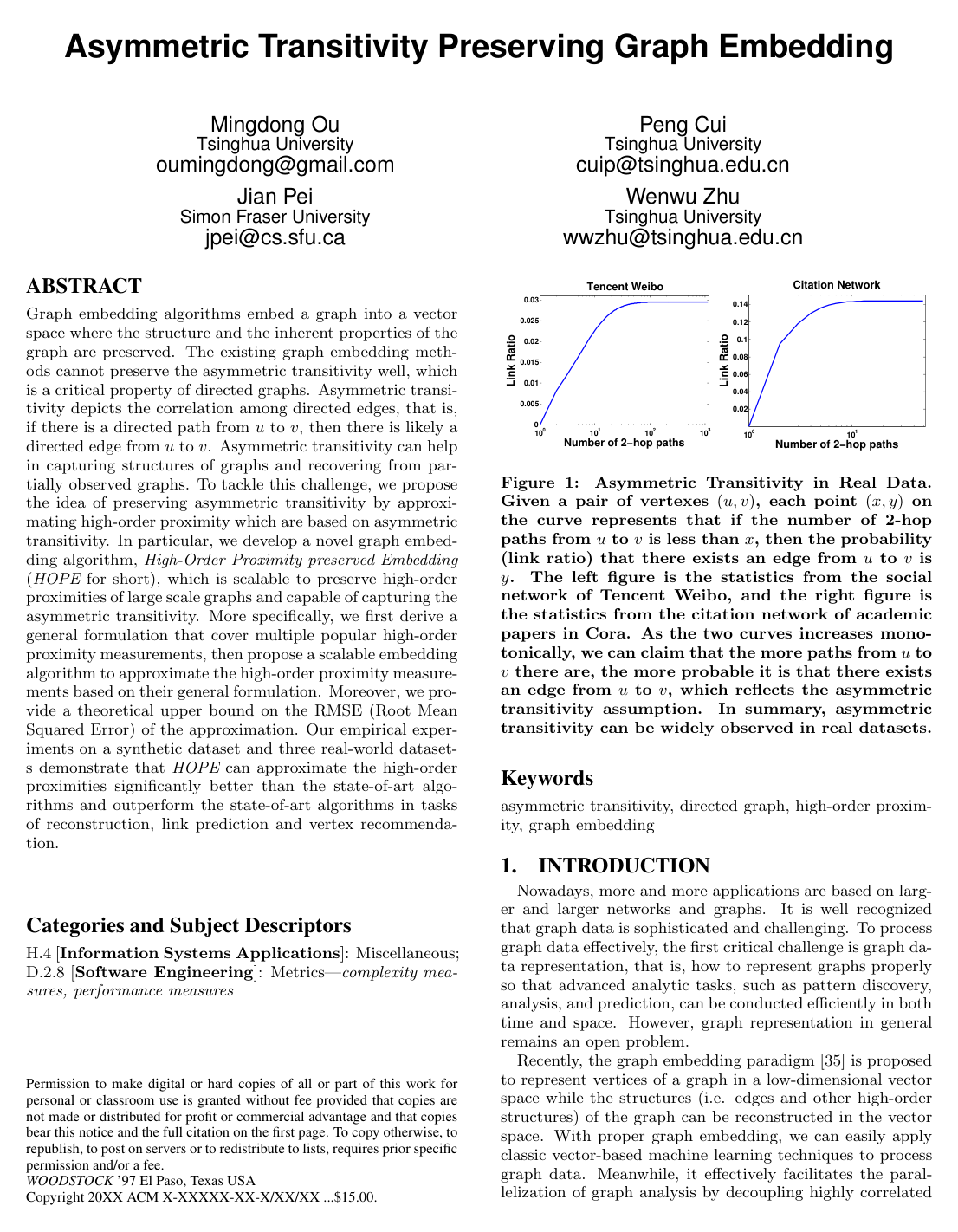
Modern data applications increasingly rely on massive, directed networks such as social platforms, the web, and academic citation graphs. To analyze these graphs efficiently, practitioners embed nodes into low-dimensional vector spaces, enabling standard machine learning tools and parallel processing. However, most existing embedding techniques focus on undirected networks and fail to capture asymmetric transitivity—the principle that a directed path from node A to B implies an edge from A to B is likely, but not necessarily in reverse. Previous directed graph methods either relied on non-transitive metrics or evaluated only partial network blocks, limiting analytical accuracy and scalability.
The article evaluates and demonstrates a scalable embedding method called High-Order Proximity preserved Embedding (HOPE) to properly preserve asymmetric transitivity in directed graphs. The goal is to provide a unified, computationally efficient framework that learns vector representations capable of accurately predicting links, reconstructing graphs, and generating node recommendations across large-scale networks.
To achieve this, the article establishes a general formulation that unifies several common high-order proximity metrics, including Katz index, Rooted PageRank, Common Neighbors, and Adamic-Adar. Instead of directly computing expensive, dense proximity matrices—which traditionally require cubic time complexity—HOPE uses an iterative generalized singular value decomposition technique that scales linearly with the number of edges. Nodes are represented by two distinct vectors (a source vector and a target vector) to maintain edge directionality. The methodology was validated through extensive experiments on synthetic power-law graphs and three real-world datasets: the Cora citation network (over 23,000 nodes), a Twitter subnetwork (over 465,000 nodes), and a Tencent Weibo subnetwork (nearly 2 million nodes and over 50 million edges).
The evaluation produced four key findings. First, HOPE significantly outperformed existing methods in approximating high-order proximities, achieving an approximation error roughly an order of magnitude smaller than the nearest benchmark across testing dimensions. Second, in recommendation accuracy, HOPE demonstrated dramatic improvements over all baselines, achieving at least an 88.5% gain in top-10 mean average precision and over an 81.2% gain in top-50 precision on the large-scale social networks. Third, HOPE consistently achieved superior precision in full-graph reconstruction and link prediction tasks compared to competitive models like LINE and DeepWalk. Fourth, the empirical results confirmed the theoretical error bound, showing that lower-rank proximity matrices yield significantly smaller relative approximation errors.
These findings indicate that preserving high-order asymmetric transitivity is essential for capturing true network topology. For organizations deploying graph-based machine learning, HOPE offers substantial performance and scalability benefits. It eliminates the computational bottleneck of evaluating dense matrix operations on large graphs, reducing processing time and infrastructure costs while delivering higher accuracy in downstream tasks such as friend suggestions, citation forecasting, and fraud detection.
Organizations analyzing massive directed network data should consider adopting dual-vector embedding frameworks that approximate high-order proximities rather than simple first- or second-order connections. To optimize performance, practitioners can tune target proximity metrics (such as Katz or Rooted PageRank) to match the structural characteristics of their specific datasets. The article's authors also identify the exploration of non-linear models as an important next step to capture even more intricate network structures.
Confidence in these findings is supported by theoretical error bounds and multi-dataset empirical validation. However, decision-makers should note that evaluations relied on linear approximations and sampled subgraphs of online networks. Performance in real-time dynamic networks with rapidly shifting connections may require additional validation before full-scale operational deployment.
- Paper: LINE: Large-scale Information Network Embedding, Jian Tang et al. (2015). LINE formalizes first- and second-order proximity objectives for scalable network embeddings, establishing the baseline framework that HOPE extends to higher-order asymmetric proximities.
- Paper: GraRep: Learning Graph Representations with Global Structural Information, Shaosheng Cao et al. (2015). GraRep shows how to capture multi-hop global structural information via matrix factorization, providing a foundational baseline for preserving high-order graph relationships directly relevant to HOPE.
- Paper: The link prediction problem for social networks, David Liben-Nowell et al. (2003). Liben-Nowell and Kleinberg formalize classical high-order path-based topological similarity metrics like Katz and Rooted PageRank that HOPE explicitly approximates and factorizes.
- Paper: Laplacian Eigenmaps and Spectral Techniques for Embedding and Clustering, Mikhail Belkin et al. (2001). Laplacian Eigenmaps introduces spectral graph embedding techniques that underpin the theoretical matrix decomposition methods adapted by HOPE.
- Paper: Graph Embedding and Extensions: A General Framework for Dimensionality Reduction, Shuicheng Yan et al. (2007). This foundational paper establishes the general mathematical framework unifying graph embedding and dimensionality reduction algorithms through affinity matrices.
- Paper: Graph Embedding Techniques, Applications, and Performance: A Survey, Palash Goyal et al. (2017). This survey extensively benchmarks and evaluates representative embedding models including HOPE across multiple downstream tasks such as link prediction and network reconstruction.
- Paper: A Comprehensive Survey of Graph Embedding: Problems, Techniques, and Applications, Hongyun Cai et al. (2017). This comprehensive survey contextualizes high-order matrix factorization techniques like HOPE within the broader taxonomy of modern graph representation learning.
- Paper: Representation Learning on Graphs: Methods and Applications, William L. Hamilton et al. (2017). This review unifies factorization methods such as HOPE alongside random walks and deep architectures into a general encoder-decoder representation learning framework.
- Paper: Neural Graph Collaborative Filtering, Xiang Wang et al. (2019). NGCF builds upon high-order proximity concepts pioneered by methods like HOPE to propagate behavioral signals over user-item bipartite graphs for collaborative filtering.
- Paper: Link Prediction Based on Graph Neural Networks, Muhan Zhang et al. (2018). SEAL advances link prediction by replacing explicit high-order heuristics with graph neural networks trained directly on enclosing subgraphs.