
keyword
nonlinear dimensionality reduction
Nonlinear dimensionality reduction is a category of data processing and machine learning techniques designed to transform high-dimensional data into a lower-dimensional space while preserving the complex, non-linear geometric relationships and structures inherent in the data. Unlike linear methods that project data onto flat hyperplanes, nonlinear approaches typically assume the observed points lie on or near a curved, lower-dimensional manifold embedded within the higher-dimensional space. By focusing on preserving local neighborhood configurations, pairwise proximities, or global topological properties, these techniques capture intricate patterns that linear projections miss, facilitating data visualization, noise reduction, and feature extraction for tasks such as classification and clustering.
9 items
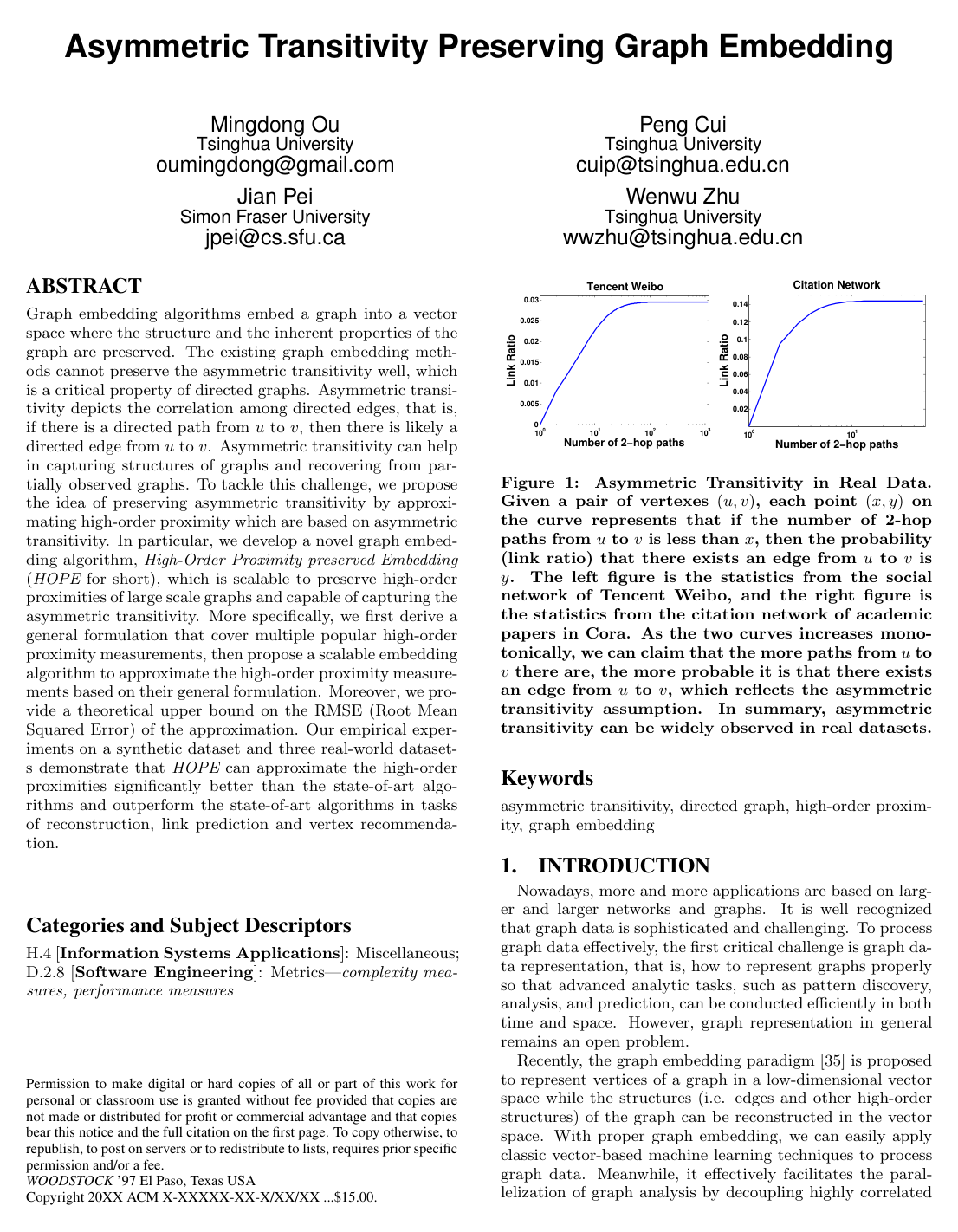
Asymmetric Transitivity Preserving Graph Embedding
Mingdong Ou, Peng Cui, J. Pei, Ziwei Zhang, Wenwu Zhu
Why you should read this
Presents a scalable directed graph embedding algorithm that captures asymmetric transitivity by approximating high-order proximity measures via generalized singular value decomposition, providing theoretical error bounds and superior performance in link prediction and graph reconstruction.
Graph embedding algorithms embed a graph into a vector space where the structure and the inherent properties of the graph are preserved. The existing graph embedding methods cannot preserve the asymmetric transitivity well, which is a critical property of directed graphs. Asymmetric transitivity depicts the correlation among directed edges, that is, if there is a directed path from u to v, then there is likely a directed edge from u to v. Asymmetric transitivity can help in capturing structures of graphs and recovering from partially observed graphs. To tackle this challenge, we propose the idea of preserving asymmetric transitivity by approximating high-order proximity which are based on asymmetric transitivity. In particular, we develop a novel graph embedding algorithm, High-Order Proximity preserved Embedding (HOPE for short), which is scalable to preserve high-order proximities of large scale graphs and capable of capturing the asymmetric transitivity. More specifically, we first derive a general formulation that cover multiple popular high-order proximity measurements, then propose a scalable embedding algorithm to approximate the high-order proximity measurements based on their general formulation. Moreover, we provide a theoretical upper bound on the RMSE (Root Mean Squared Error) of the approximation. Our empirical experiments on a synthetic dataset and three real-world datasets demonstrate that HOPE can approximate the high-order proximities significantly better than the state-of-art algorithms and outperform the state-of-art algorithms in tasks of reconstruction, link prediction and vertex recommendation.
Added
2026-09-25
Think Globally, Fit Locally: Unsupervised Learning of Low Dimensional Manifold
L. Saul, S. Roweis
Why you should read this
Introduces Locally Linear Embedding (LLE), an unsupervised algorithm that recovers the underlying global geometry of high-dimensional data without local minima by solving an efficient sparse eigenvalue problem that preserves local linear relationships.
The problem of dimensionality reduction arises in many fields of information processing, including machine learning, data compression, scientific visualization, pattern recognition, and neural computation. Here we describe locally linear embedding (LLE), an unsupervised learning algorithm that computes low dimensional, neighborhood preserving embeddings of high dimensional data. The data, assumed to be sampled from an underlying manifold, are mapped into a single global coordinate system of lower dimensionality. The mapping is derived from the symmetries of locally linear reconstructions, and the actual computation of the embedding reduces to a sparse eigenvalue problem. Notably, the optimizations in LLE—though capable of generating highly nonlinear embeddings—are simple to implement, and they do not involve local minima. In this paper, we describe the implementation of the algorithm in detail and discuss several extensions that enhance its performance. We present results of the algorithm applied to data sampled from known manifolds, as well as to collections of images of faces, lips, and handwritten digits. These examples are used to provide extensive illustrations of the algorithm's performance—both successes and failures—and to relate the algorithm to previous and ongoing work in nonlinear dimensionality reduction.
Added
2026-09-24
GraRep: Learning Graph Representations with Global Structural Information
Shaosheng Cao, Wei Lu, Qiongkai Xu
Why you should read this
Proposes GraRep, a graph representation learning model that captures high-order relational information by directly factorizing distinct k-step probability transition matrices to preserve global graph structure across separate subspaces without sampling.
In this paper, we present GraRep, a novel model for learning vertex representations of weighted graphs. This model learns low dimensional vectors to represent vertices appearing in a graph and, unlike existing work, integrates global structural information of the graph into the learning process. We also formally analyze the connections between our work and several previous research efforts, including the DeepWalk model of Perozzi et al. [20] as well as the skip-gram model with negative sampling of Mikolov et al. [18] We conduct experiments on a language network, a social network as well as a citation network and show that our learned global representations can be effectively used as features in tasks such as clustering, classification and visualization. Empirical results demonstrate that our representation significantly outperforms other state-of-the-art methods in such tasks.
Added
2026-09-24
Self-taught learning: transfer learning from unlabeled data
Rajat Raina, Alexis Battle, Honglak Lee, Benjamin Packer, Andrew Y. Ng
Why you should read this
Proposes a machine learning framework that applies sparse coding to easily accessible, uncurated, and unlabeled data from entirely different classes to build higher-level feature representations that improve supervised classification performance across image, audio, and text tasks.
We present a new machine learning framework called “self-taught learning” for using unlabeled data in supervised classification tasks. We do not assume that the unlabeled data follows the same class labels or generative distribution as the labeled data. Thus, we would like to use a large number of unlabeled images (or audio samples, or text documents) randomly downloaded from the Internet to improve performance on a given image (or audio, or text) classification task. Such unlabeled data is significantly easier to obtain than in typical semi-supervised or transfer learning settings, making self-taught learning widely applicable to many practical learning problems. We describe an approach to self-taught learning that uses sparse coding to construct higher-level features using the unlabeled data. These features form a succinct input representation and significantly improve classification performance. When using an SVM for classification, we further show how a Fisher kernel can be learned for this representation.
Added
2026-09-18
Stochastic Neighbor Embedding
Geoffrey E. Hinton, S. Roweis
Why you should read this
Introduces Stochastic Neighbor Embedding, a probabilistic dimensionality reduction technique that matches neighborhood probability distributions via Kullback-Leibler divergence to preserve local data structure and naturally accommodate multi-modal or ambiguous objects.
We describe a probabilistic approach to the task of placing objects, described by high-dimensional vectors or by pairwise dissimilarities, in a low-dimensional space in a way that preserves neighbor identities. A Gaussian is centered on each object in the high-dimensional space and the densities under this Gaussian (or the given dissimilarities) are used to define a probability distribution over all the potential neighbors of the object. The aim of the embedding is to approximate this distribution as well as possible when the same operation is performed on the low-dimensional “images” of the objects. A natural cost function is a sum of Kullback-Leibler divergences, one per object, which leads to a simple gradient for adjusting the positions of the low-dimensional images. Unlike other dimensionality reduction methods, this probabilistic framework makes it easy to represent each object by a mixture of widely separated low-dimensional images. This allows ambiguous objects, like the document count vector for the word “bank”, to have versions close to the images of both “river” and “finance” without forcing the images of outdoor concepts to be located close to those of corporate concepts.
Added
2026-09-15
Structural Deep Network Embedding
Daixin Wang, Peng Cui, Wenwu Zhu
Why you should read this
Proposes a semi-supervised deep autoencoder architecture that jointly preserves first-order and second-order proximities, capturing highly non-linear local and global graph structures for effective representation learning on sparse networks.
Network embedding is an important method to learn low-dimensional representations of vertexes in networks, aiming to capture and preserve the network structure. Almost all the existing network embedding methods adopt shallow models. However, since the underlying network structure is complex, shallow models cannot capture the highly non-linear network structure, resulting in sub-optimal network representations. Therefore, how to find a method that is able to effectively capture the highly non-linear network structure and preserve the global and local structure is an open yet important problem. To solve this problem, in this paper we propose a Structural Deep Network Embedding method, namely SDNE. More specifically, we first propose a semi-supervised deep model, which has multiple layers of non-linear functions, thereby being able to capture the highly non-linear network structure. Then we propose to exploit the first-order and second-order proximity jointly to preserve the network structure. The second-order proximity is used by the unsupervised component to capture the global network structure. While the first-order proximity is used as the supervised information in the supervised component to preserve the local network structure. By jointly optimizing them in the semi-supervised deep model, our method can preserve both the local and global network structure and is robust to sparse networks. Empirically, we conduct the experiments on five real-world networks, including a language network, a citation network and three social networks. The results show that compared to the baselines, our method can reconstruct the original network significantly better and achieves substantial gains in three applications, i.e. multi-label classification, link prediction and visualization.
Added
2026-09-14
Manifold Regularization: A Geometric Framework for Learning from Labeled and Unlabeled Examples
Mikhail Belkin, Partha Niyogi, Vikas Sindhwani
Why you should read this
Develops a geometric regularization framework that combines reproducing kernel Hilbert spaces with graph Laplacians to extend algorithms like support vector machines and regularized least squares to semi-supervised learning with out-of-sample generalization.
We propose a family of learning algorithms based on a new form of regularization that allows us to exploit the geometry of the marginal distribution. We focus on a semi-supervised framework that incorporates labeled and unlabeled data in a general-purpose learner. Some transductive graph learning algorithms and standard methods including support vector machines and regularized least squares can be obtained as special cases. We use properties of reproducing kernel Hilbert spaces to prove new Representer theorems that provide theoretical basis for the algorithms. As a result (in contrast to purely graph-based approaches) we obtain a natural out-of-sample extension to novel examples and so are able to handle both transductive and truly semi-supervised settings. We present experimental evidence suggesting that our semi-supervised algorithms are able to use unlabeled data effectively. Finally we have a brief discussion of unsupervised and fully supervised learning within our general framework.
Added
2026-09-11
Locality Preserving Projections
Xiaofei He, Partha Niyogi
Why you should read this
Proposes Locality Preserving Projections, a linear dimensionality reduction method that preserves local neighborhood structure to combine the computational efficiency of linear projections with the geometric fidelity of nonlinear techniques like Laplacian Eigenmaps.
Many problems in information processing involve some form of dimensionality reduction. In this paper, we introduce Locality Preserving Projections (LPP). These are linear projective maps that arise by solving a variational problem that optimally preserves the neighborhood structure of the data set. LPP should be seen as an alternative to principal component analysis (PCA) – a classical linear technique that projects the data along the directions of maximal variance. When the high dimensional data lies on a low dimensional manifold embedded in the ambient space, the Locality Preserving Projections are obtained by finding the optimal linear approximations to the eigenfunctions of the Laplace Beltrami operator on the manifold. As a result, LPP shares many of the data representation properties of non linear techniques such as Laplacian Eigenmap [4] or Locally Linear Embedding [5]. This is borne out by illustrative examples on a couple of high dimensional image data sets.
Added
2026-09-10
Laplacian Eigenmaps and Spectral Techniques for Embedding and Clustering
Mikhail Belkin, Partha Niyogi
Why you should read this
Introduces Laplacian Eigenmaps, a computationally efficient framework for nonlinear dimensionality reduction that uses graph Laplacians to preserve local neighborhood geometry and provide a principled foundation for spectral clustering.
Drawing on the correspondence between the graph Laplacian, the Laplace-Beltrami operator on a manifold, and the connections to the heat equation, we propose a geometrically motivated algorithm for constructing a representation for data sampled from a low dimensional manifold embedded in a higher dimensional space. The algorithm provides a computationally efficient approach to non-linear dimensionality reduction that has locality preserving properties and a natural connection to clustering. Several applications are considered.
Added
2026-09-10