All claims are equal, but some claims are more equal than others: Importance-sensitive factuality evaluation of LLM generations
Miriam WannerLeif AzzopardiPaul ThomasSoham DanBen Van DurmeNick Craswell
Introduces the VITALERRORS benchmark and VITAL metrics to evaluate large language model factuality by weighting claim importance, exposing critical errors in core information that uniform scoring methods overlook.
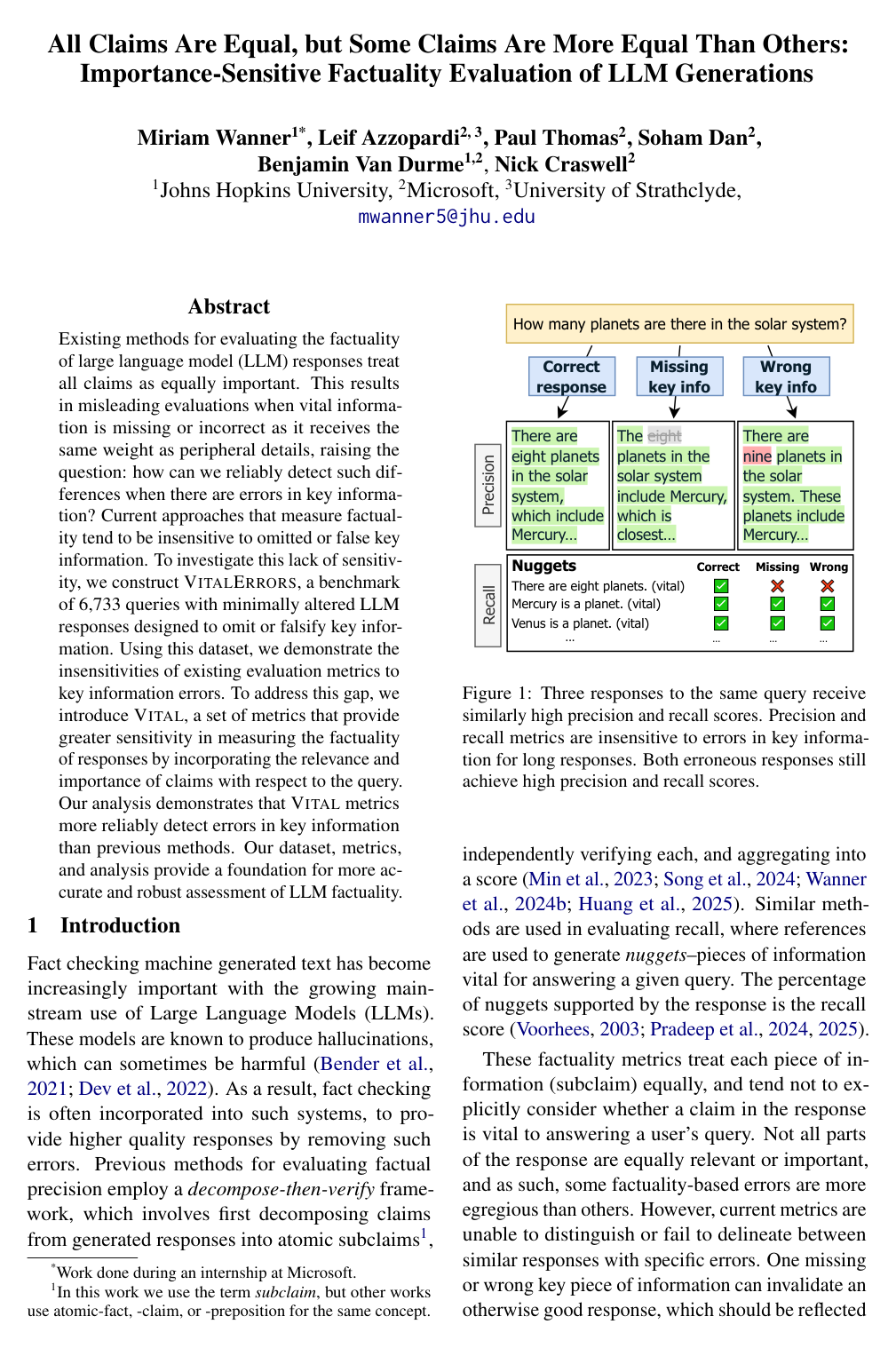
As large language models (LLMs) are increasingly integrated into enterprise applications, verifying the factual accuracy of their outputs is critical to preventing misinformation and maintaining user trust. Standard automated evaluation frameworks typically break model outputs into atomic subclaims and measure factual precision and recall by scoring each subclaim equally. However, this equal-weighting approach creates a significant blind spot: an answer that gets peripheral background details correct can still receive a high factual score even if the core answer is entirely wrong or missing. The article addresses this evaluation flaw by proposing an importance-sensitive evaluation methodology.
The main objective of the article is to demonstrate that conventional factuality metrics fail to detect critical factual errors in LLM generations and to introduce an importance-weighted evaluation framework, termed VITAL, that reliably penalizes missing or incorrect key information.
To conduct this evaluation, the researchers constructed VITALERRORS, a benchmark dataset comprising 6,733 queries drawn from six established question-answering and reasoning datasets covering both open-ended queries (such as biographies) and single-answer queries. Using advanced language models, the authors generated baseline responses alongside minimally altered adversarial variants where the single most important piece of information was either omitted or falsified. They then evaluated these responses using standard factuality metrics (FActScore and Nugget Recall) and compared the results against their proposed VITAL metrics, which prompt an evaluator model to categorize decomposed claims and information nuggets by query importance (vital, okay, or less important).
The analysis yielded several key findings. First, existing factuality metrics proved highly insensitive to critical mistakes; for example, standard precision scores dropped by only 5% to 7% when the core answer was falsified in single-answer queries because the overwhelming volume of correct background claims masked the error. Second, the proposed vital precision metric correctly exposed these failures, showing a substantial drop of roughly 24% to 25% on falsified single-answer responses compared to normal outputs. Third, response-level binary metrics—which flag whether any vital claim is false or omitted—proved to be the most effective error detectors, identifying incorrect vital information in nearly 90% of falsified single-answer responses compared to only 45% in normal responses. Finally, detecting omissions of vital information remains more difficult than detecting explicit factual falsehoods across all metric types.
These findings imply that organizations relying on standard fact-checking metrics are exposed to operational and compliance risks by overestimating the reliability of LLM outputs. In enterprise and high-stakes settings, a single wrong key figure or omitted instruction can render an entire response harmful despite high aggregate precision scores. Incorporating importance weighting aligns automated evaluation more closely with human judgment, where errors in core answers cause disproportionate reputational and operational damage.
The article recommends that organizations developing and auditing LLM systems adopt importance-weighted or response-level vital metrics rather than unweighted factual precision. Evaluators should also benchmark their fact-checking pipelines against adversarial test suites like VITALERRORS to identify whether their evaluation systems are masking severe errors. For production deployment, teams should carefully consider weighting schemes tailored to user preferences and specific task domains.
Confidence in these findings is supported by the consistent results across a large sample of 6,733 diverse queries. However, decision-makers should note certain limitations: the VITAL framework requires an extra model step to rank claim importance, adding computational cost and processing latency. Furthermore, because the framework relies on language models to judge importance and verify facts against reference texts, it inherits the underlying models' potential biases and is constrained by the quality and coverage of the retrieved grounding documents.
- Paper: FActScore: Fine-grained Atomic Evaluation of Factual Precision in Long Form Text Generation, Sewon Min et al. (2023). FActScore establishes atomic claim-level factuality evaluation, the key framework for understanding why VITAL weights claims rather than treating responses as undifferentiated wholes.
- Paper: TRUE: Re-evaluating Factual Consistency Evaluation, Or Honovich et al. (2022). TRUE benchmarks existing factual-consistency metrics and exposes their limitations, providing the evaluation context VITAL advances by testing sensitivity to important errors.
- Paper: Factuality of Large Language Models: A Survey, Yuxia Wang et al. (2024). This survey maps factuality benchmarks and evaluation methods, helping situate VITAL’s importance-sensitive metrics within the broader field.
No sufficiently relevant recommendations were found.