TRUE: Re-evaluating Factual Consistency Evaluation
Or HonovichRoee AharoniJonathan HerzigHagai TaitelbaumDoron KuklianskyVered CohenThomas ScialomIdan SzpektorAvinatan HassidimYossi Matias
Establishes a standardized benchmark and example-level evaluation protocol across eleven datasets to measure how reliably factual consistency metrics detect grounded text generation errors.
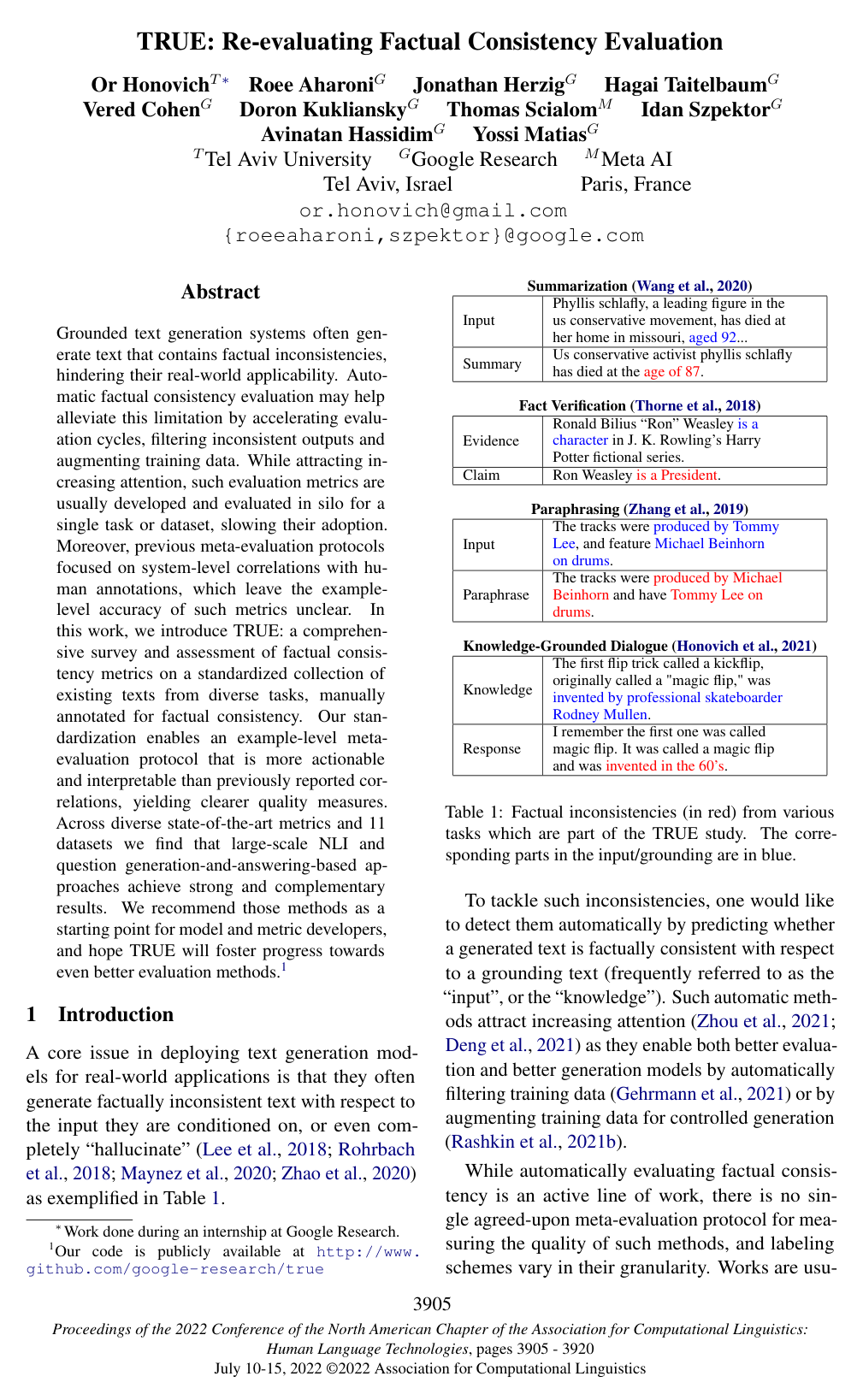
Automated text generation systems frequently produce outputs that are factually inconsistent with their source materials or contain outright fabrications. While automatic evaluation metrics are crucial for filtering inaccurate outputs, cleaning training data, and accelerating model development, research in this area has historically been fragmented across isolated tasks and individual datasets. Furthermore, traditional meta-evaluations rely heavily on system-level correlation scores, which fail to reveal how reliably a metric performs when making binary consistency decisions on individual examples.
The main objective of the article is to establish a standardized benchmark for factual consistency evaluation and systematically assess the performance of existing automated metrics across diverse text generation domains. To achieve this, the authors introduced the TRUE benchmark, which consolidates 11 human-annotated datasets across abstractive summarization, dialogue generation, fact verification, and paraphrasing into a unified binary evaluation format. Rather than relying on system-level correlations, the assessment evaluates 12 metrics using the Area Under the Receiver Operating Characteristic Curve (ROC AUC), providing a direct, interpretable measure of an evaluation tool's ability to distinguish factually consistent from inconsistent text.
The evaluation revealed several key findings regarding metric effectiveness and behavior. First, large-scale Natural Language Inference (NLI) models and Question Generation and Answering (QG-QA) frameworks performed substantially better than standard baselines, with top approaches—such as ANLI, SummaC, and Q2—achieving average ROC AUC scores exceeding 80 across the evaluated benchmarks. In contrast, standard word-overlap metrics like ROUGE and BLEU, along with general learned metrics, performed poorly, averaging ROC AUC scores of 72 or below. Second, NLI and QG-QA methods proved to be complementary; combining them into an ensemble average improved performance by approximately 4.5 points in ROC AUC over any single method. Third, model capacity directly impacts accuracy, as scaling up the underlying model architecture increased average ROC AUC by up to 4.7 points. Finally, metric reliability degraded noticeably across all approaches when source grounding texts exceeded 200 tokens.
These findings indicate that organizations deploying text generation systems do not need to build siloed, task-specific evaluators, as unified NLI and QG-QA frameworks can serve as robust, general-purpose quality filters. Implementing these automated checks reduces the operational and reputational risks associated with deploying ungrounded model outputs in production environments. Error analysis showed that these metrics are occasionally more reliable than human annotators on difficult examples, underscoring their practical value for automated data cleaning.
The article recommends that system and metric developers adopt large-scale NLI and QG-QA methods as the standard baseline for evaluating factual consistency, and report ROC AUC rather than correlation metrics to assess example-level reliability. Organizations seeking peak performance should implement ensemble methods combining NLI and QG-QA, while accepting the higher computational cost of larger models. Despite these strengths, practitioners should remain cautious when applying these metrics to long context documents or conversational text containing subjective, non-factual statements, as both conditions currently increase error rates and require further targeted development.
- Paper: On Faithfulness and Factuality in Abstractive Summarization, Joshua Maynez et al. (2020). Provides foundational empirical analysis and human annotations on faithfulness and factual errors in abstractive summarization that directly motivate TRUE's consolidated evaluation benchmark.
- Paper: BLEURT: Learning Robust Metrics for Text Generation, Thibault Sellam et al. (2020). Introduces learned transformer-based metrics for text generation evaluation, serving as a key baseline evaluated within TRUE.
- Paper: A Broad-Coverage Challenge Corpus for Sentence Understanding through Inference, Adina Williams et al. (2016). Establishes the MultiNLI dataset, the core natural language inference resource foundational to the NLI-based consistency metrics analyzed in TRUE.
- Paper: Don’t Give Me the Details, Just the Summary! Topic-Aware Convolutional Neural Networks for Extreme Summarization, Shashi Narayan et al. (2018). Introduces the XSum dataset and extreme abstractive summarization paradigms that supply core benchmark tasks evaluated in TRUE.
- Paper: Automatic Evaluation of Summaries Using N-gram Co-occurrence Statistics, Chin-Yew Lin et al. (2003). Presents ROUGE n-gram overlap metrics, representing the traditional summarization evaluation baselines that TRUE demonstrates are inadequate for factual consistency.
- Paper: Right for the Wrong Reasons: Diagnosing Syntactic Heuristics in Natural Language Inference, R. Thomas McCoy et al. (2019). Analyzes syntactic heuristics and pitfalls in NLI models, providing essential context for interpreting the behavior of NLI-based factual consistency evaluators.
- Paper: Annotation Artifacts in Natural Language Inference Data, Suchin Gururangan et al. (2018). Examines annotation artifacts in NLI datasets, illuminating systemic limitations when adapting NLI architectures to factual verification tasks.
- Paper: Factuality of Large Language Models: A Survey, Yuxia Wang et al. (2024). Provides a comprehensive survey synthesizing LLM factuality evaluation benchmarks, error types, and mitigation methods that build upon factual consistency frameworks like TRUE.
- Paper: Repairing the Cracked Foundation: A Survey of Obstacles in Evaluation Practices for Generated Text, Sebastian Gehrmann et al. (2023). Surveys broader systemic obstacles across generation evaluation, contextualizing TRUE's findings regarding the limitations of surface overlap metrics and human evaluations.
- Paper: FActScore: Fine-grained Atomic Evaluation of Factual Precision in Long Form Text Generation, Sewon Min et al. (2023). Extends factual consistency evaluation to long-form generation by introducing an atomic fact decomposition framework to address consistency beyond short texts.
- Paper: Enabling Large Language Models to Generate Text with Citations, Tianyu Gao et al. (2023). Applies factual grounding evaluation to citation attribution in retrieval-augmented language models using automated NLI verification.
- Paper: Fine-Tuning Language Models for Factuality, Katherine Tian et al. (2024). Leverages automated factuality evaluation metrics to construct preference datasets for fine-tuning language models toward improved factual precision.
- Paper: LM vs LM: Detecting Factual Errors via Cross Examination, Roi Cohen et al. (2023). Develops reference-free conversational cross-examination between LLMs to detect factual errors without relying exclusively on input premise texts.
- Paper: G-Eval: NLG Evaluation using GPT-4 with Better Human Alignment, Yang Liu et al. (2023). Explores the use of modern large language models like GPT-4 as automated evaluators for natural language generation, advancing beyond earlier NLI and QG-QA frameworks.
- Paper: A Survey on LLM-as-a-Judge, Jiawei Gu et al. (2024). Synthesizes methodologies, biases, and meta-evaluations for using LLMs as automated judges across generation tasks.
- Paper: Generating Literal and Implied Subquestions to Fact-check Complex Claims, Jifan Chen et al. (2022). Refines question-generation and NLI-based fact-checking by generating explicit and implied subquestions to verify complex claims.
- Paper: Position: TrustLLM: Trustworthiness in Large Language Models, Yue Huang et al. (2024). Broadens factual consistency into an extensive multi-dimensional trustworthiness evaluation framework for large language models.