SECAD-Net: Self-Supervised CAD Reconstruction by Learning Sketch-Extrude Operations

Pu LiJianwei GuoXiaopeng ZhangDong-Ming Yan

article2023CVPR60 citations

Proposes a self-supervised neural network that reconstructs editable CAD models from raw 3D geometry by learning implicit 2D sketch representations and differentiable 3D extrusion parameters without requiring ground-truth supervision.

Listen

Reverse engineering computer-aided design (CAD) models from scanned physical objects or raw 3D data is essential for manufacturing, maintenance, and design iteration when original technical files are unavailable. Conventional manual workflows are labor-intensive and require specialized operators, while existing automated methods either demand expensive labeled training data or generate models made of rigid mathematical primitives that engineers cannot easily edit.

The article demonstrates SECAD-Net, a self-supervised deep learning framework that reconstructs high-quality, fully editable 3D CAD models from unannotated shapes without requiring human segmentation or sketch labels. SECAD-Net evaluates the feasibility of learning sketch-and-extrude operations—the standard procedural workflow used in professional CAD software—directly from raw geometry in an end-to-end automated process.

To achieve this, the authors designed a neural network that decomposes an input 3D voxel grid into oriented extrusion boxes, predicts 2D profile sketches as continuous neural implicit fields, applies differentiable extrusion operations to form 3D solid cylinders, and combines them via standard union operations. The models were trained and benchmarked against leading supervised and unsupervised alternatives using thousands of engineering models from the ABC and Fusion 360 datasets, evaluating reconstruction accuracy, edge fidelity, and model compactness.

The evaluation yielded several key findings in order of importance. First, SECAD-Net achieved state-of-the-art geometric accuracy and surface fidelity across standard benchmarks, reducing symmetric Chamfer Distance on the ABC dataset to 0.330 compared to 0.471 for ExtrudeNet and 1.849 for UCSG-Net. Second, the method achieved these results with significantly fewer geometric primitives—averaging roughly 4 to 5 primitives per model, compared to 12 to 17 in competing constructive solid geometry frameworks—which produces simpler, cleaner CAD geometry. Third, the system demonstrated robust editing flexibility; the learned continuous sketch space enabled smooth interpolation between distinct CAD designs, and the resulting models exported directly into standard commercial CAD tools for downstream parameter adjustment.

These findings indicate that industrial reverse engineering can achieve higher modeling fidelity while substantially lowering data annotation costs. Producing compact, editable procedural features rather than static meshes directly reduces post-processing labor, shortens engineering lead times, and allows engineering teams to modify reconstructed parts immediately within existing CAD environments.

Organizations evaluating this approach should consider pilot testing the framework on standard prismatic component catalogs, while pairing it with existing CAD toolchains for interactive editing. Because the current implementation is bounded by sketch-and-extrude operations, deployment should focus on prismatic parts while further research extends the framework to support additional modeling operations such as revolves, sweeps, and fillets, alongside improved generalizability across highly irregular structures.

No sufficiently relevant recommendations were found.
Cover for SECAD-Net: Self-Supervised CAD Reconstruction by Learning Sketch-Extrude Operations

Abstract

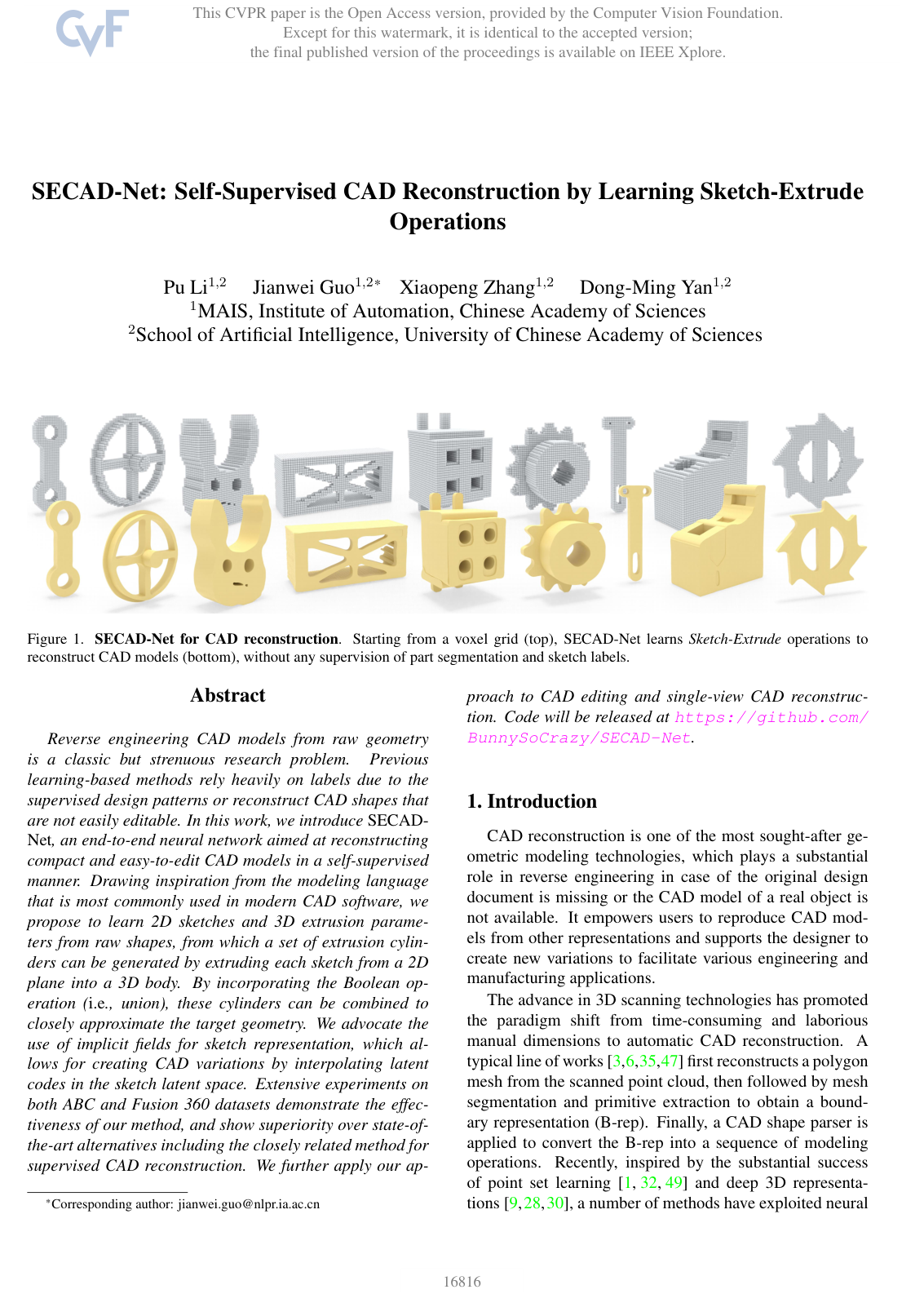
Reverse engineering CAD models from raw geometry is a classic but strenuous research problem. Previous learning-based methods rely heavily on labels due to the supervised design patterns or reconstruct CAD shapes that are not easily editable. In this work, we introduce SECAD-Net, an end-to-end neural network aimed at reconstructing compact and easy-to-edit CAD models in a self-supervised manner. Drawing inspiration from the modeling language that is most commonly used in modern CAD software, we propose to learn 2D sketches and 3D extrusion parameters from raw shapes, from which a set of extrusion cylinders can be generated by extruding each sketch from a 2D plane into a 3D body. By incorporating the Boolean operation (i.e., union), these cylinders can be combined to closely approximate the target geometry. We advocate the use of implicit fields for sketch representation, which allows for creating CAD variations by interpolating latent codes in the sketch latent space. Extensive experiments on both ABC and Fusion 360 datasets demonstrate the effectiveness of our method, and show superiority over state-of-the-art alternatives including the closely related method for supervised CAD reconstruction. We further apply our approach to CAD editing and single-view CAD reconstruction. Code will be released at https://github.com/BunnySoCrazy/SECAD-Net.

Table of Contents

  • 1. Introduction
  • 2. Related work
  • 3. Problem Statement and Overview
  • 3.1. Preliminaries
  • 3.2. Overview
  • 4. Method
  • 4.1. Sketch-Extrude Inferring
  • 4.2. Loss Function
  • 4.3. CAD Reconstruction
  • 4.4. Implementation Details
  • 5. Experimental Results
  • 5.1. Setup
  • 5.2. Comparison on CAD Reconstruction
  • 5.3. CAD Generation via Sketch Interpolation
  • 5.4. Ablations
  • 5.5. Other Applications
  • 6. Conclusion and Future Work
  • References

Knowls

  1. Knowl 1 — SECAD-Net sketch–extrude reconstruction framework

    model/method

    SECAD-Net reconstructs an editable CAD model from a raw 3D voxel shape without ground-truth part segmentation, sketch annotations, or operation sequences. A 3D convolutional encoder maps the input voxel grid to a 256-dimensional shape code z\mathbf{z}. An extrusion-box head predicts several local sketch planes and their extrusion heights; separate sketch heads represent the 2D profiles on those planes as implicit signed-distance fields. A differentiable extrusion operator turns each 2D field into a 3D cylinder field, which is converted to occupancy and combined with a differentiable union. During training, the resulting occupancy is matched to the input shape. During inference, the implicit sketches are converted into explicit spline sketches and assembled as editable sketch–extrude CAD operations.

  2. Knowl 2 — Extrusion boxes and neural implicit sketches

    model/method

    In SECAD-Net, a closed curve is a loop; one or more inner or outer loops enclose a profile; and a sketch consists of a profile together with its loops. A sketch plane is a finite 2D plane of width and length, and an extrusion box is the cuboid centered on that plane whose height is twice the extrusion half-height. Extruding a closed loop gives a cylinder primitive; combining multiple primitives by Boolean operations gives a cylinder.

    Given the encoded shape vector z\mathbf{z}, the extrusion-box head predicts NN boxes Bi=(si,ci,ri)B_i=(\mathbf{s}_i,\mathbf{c}_i,\mathbf{r}_i), where si∈R3\mathbf{s}_i\in\mathbb{R}^3 contains the box dimensions, ci∈R3\mathbf{c}_i\in\mathbb{R}^3 is its center, and ri∈R4\mathbf{r}_i\in\mathbb{R}^4 is a rotation quaternion. The positive local zz-axis determines the sketch-plane normal, and the box height is twice the learned extrusion half-height hih_i.

    For a sample point xi∈R3\mathbf{x}_i\in\mathbb{R}^3 in the coordinate system of box ii, the corresponding sketch-head input is obtained by transforming the point into the box frame, xit=ri−1(xi−ci)\mathbf{x}_i^t=\mathbf{r}_i^{-1}(\mathbf{x}_i-\mathbf{c}_i). The iith multilayer perceptron sketch head fif_i receives the planar point and the global shape code and predicts a signed distance field:

    S^ski=fi(xit,z).\hat{\mathcal{S}}_{\mathrm{sk}}^i=f_i(\mathbf{x}_i^t,\mathbf{z}).

    The predicted distance is negative inside the 2D sketch and positive outside. Each sketch head uses NlayN_{\mathrm{lay}} fully connected layers with Softplus activations and clamps its final distance output to [−1,1][-1,1]. Unlike curve-parameter methods, the neural implicit field imposes no restriction such as star-shaped or non-self-intersecting profiles.

  3. Knowl 3 — Differentiable extrusion of a sketch into a capped cylinder

    equation

    For sketch ii, let S^ski\hat{\mathcal{S}}_{\mathrm{sk}}^i be the signed distance at a local 3D point xi\mathbf{x}_i, let xi,zx_{i,z} be that point's coordinate along the extrusion axis, and let hi>0h_i>0 be the learned half-height. SECAD-Net defines the signed distance of the finite extruded cylinder by

    S^cyli={max⁡(S^ski,∣xi,z∣−hi),S^ski≤0 and ∣xi,z∣≤hi,∣xi,z∣−hi,S^ski≤0 and ∣xi,z∣>hi,S^ski,S^ski>0 and ∣xi,z∣≤hi,∥(S^ski,∣xi,z∣−hi)∥2,S^ski>0 and ∣xi,z∣>hi.\hat{\mathcal{S}}_{\mathrm{cyl}}^i= \begin{cases} \max\left(\hat{\mathcal{S}}_{\mathrm{sk}}^i,|x_{i,z}|-h_i\right), & \hat{\mathcal{S}}_{\mathrm{sk}}^i\le 0\ \text{and}\ |x_{i,z}|\le h_i,\\ |x_{i,z}|-h_i, & \hat{\mathcal{S}}_{\mathrm{sk}}^i\le 0\ \text{and}\ |x_{i,z}|>h_i,\\ \hat{\mathcal{S}}_{\mathrm{sk}}^i, & \hat{\mathcal{S}}_{\mathrm{sk}}^i>0\ \text{and}\ |x_{i,z}|\le h_i,\\ \left\|\left(\hat{\mathcal{S}}_{\mathrm{sk}}^i,|x_{i,z}|-h_i\right)\right\|_2, & \hat{\mathcal{S}}_{\mathrm{sk}}^i>0\ \text{and}\ |x_{i,z}|>h_i. \end{cases}

    Here ∥⋅∥2\|\cdot\|_2 is the Euclidean norm of the two displayed scalar components. Equivalently, the same capped-cylinder field is written compactly as

    S^cyli=min⁡(max⁡(S^ski,∣xi,z∣−hi),0)+∥(max⁡(S^ski,0),max⁡(∣xi,z∣−hi,0))∥2.\hat{\mathcal{S}}_{\mathrm{cyl}}^i=\min\left(\max\left(\hat{\mathcal{S}}_{\mathrm{sk}}^i,|x_{i,z}|-h_i\right),0\right)+\left\|\left(\max\left(\hat{\mathcal{S}}_{\mathrm{sk}}^i,0\right),\max\left(|x_{i,z}|-h_i,0\right)\right)\right\|_2.

    This construction makes the extrusion differentiable with respect to the predicted sketch field, axis, position, and height, allowing the entire sketch–extrude representation to be learned from shape occupancy.

  4. Knowl 4 — Differentiable occupancy conversion and union assembly

    equation

    SECAD-Net converts the signed distance of cylinder ii into a soft occupancy using a sigmoid:

    O^i=Sigmoid⁡(−ηS^cyli),\hat{\mathcal{O}}_i=\operatorname{Sigmoid}\left(-\eta\hat{\mathcal{S}}_{\mathrm{cyl}}^i\right),

    where O^i∈[0,1]\hat{\mathcal{O}}_i\in[0,1] is the predicted occupancy, S^cyli\hat{\mathcal{S}}_{\mathrm{cyl}}^i is the cylinder signed distance, and η\eta is a positive sharpness coefficient. The NN cylinder occupancies are assembled using a soft union rather than explicit intersection or difference operations:

    O^total=∑i=1NSoftmax⁡i(φO^i)O^i,\hat{\mathcal{O}}_{\mathrm{total}}=\sum_{i=1}^{N}\operatorname{Softmax}_i\left(\varphi\hat{\mathcal{O}}_i\right)\hat{\mathcal{O}}_i,

    where Softmax⁡i\operatorname{Softmax}_i normalizes across the cylinder index ii and φ\varphi is a modulation coefficient. The method uses only union at the global assembly stage because overlapping extruded profiles can represent concave shapes while the softmax union avoids vanishing gradients.

  5. Knowl 5 — Self-supervised reconstruction and sketch losses

    equation

    SECAD-Net is trained using only occupancy sampled from the input 3D shape and its cross-sections. Let X\mathcal{X} be the volume from which a point x\mathbf{x} is sampled, Ototal∗(x)\mathcal{O}_{\mathrm{total}}^*(\mathbf{x}) be the ground-truth occupancy, and O^total(x)\hat{\mathcal{O}}_{\mathrm{total}}(\mathbf{x}) be the assembled network occupancy. The reconstruction loss is

    Lrecon=Ex∈X[(O^total(x)−Ototal∗(x))2].\mathcal{L}_{\mathrm{recon}}=\mathbb{E}_{\mathbf{x}\in\mathcal{X}}\left[\left(\hat{\mathcal{O}}_{\mathrm{total}}(\mathbf{x})-\mathcal{O}_{\mathrm{total}}^*(\mathbf{x})\right)^2\right].

    For each extrusion box BiB_i, the 3D input occupancy is projected along the predicted box axis onto the sketch plane. Let O^proji(x)\hat{\mathcal{O}}_{\mathrm{proj}}^i(\mathbf{x}) be the projected predicted occupancy and Ocsi∗(x)\mathcal{O}_{\mathrm{cs}}^{i*}(\mathbf{x}) the corresponding ground-truth cross-section occupancy. The sketch loss is

    Lsketch=∑i=1NEx∈Bi[(O^proji(x)−Ocsi∗(x))2].\mathcal{L}_{\mathrm{sketch}}=\sum_{i=1}^{N}\mathbb{E}_{\mathbf{x}\in B_i}\left[\left(\hat{\mathcal{O}}_{\mathrm{proj}}^i(\mathbf{x})-\mathcal{O}_{\mathrm{cs}}^{i*}(\mathbf{x})\right)^2\right].

    The total objective is

    Ltotal=Lrecon+λLsketch,\mathcal{L}_{\mathrm{total}}=\mathcal{L}_{\mathrm{recon}}+\lambda\mathcal{L}_{\mathrm{sketch}},

    where λ\lambda balances the two terms. The reconstruction loss alone tended to produce fragmented cylinders; the cross-section loss encourages each predicted plane to align with the shape and each implicit profile to cover the complete local cross-section.

  6. Knowl 6 — Conversion from implicit predictions to editable CAD

    algorithm

    SECAD-Net converts its continuous implicit output into explicit CAD operations rather than extracting a mesh with marching cubes.

    Input: predicted shape code, extrusion boxes, sketch-head fields, and cylinder heights.

    Output: editable sketch–extrude CAD model.

    1. For each predicted sketch head, sample a uniform 2D grid on its sketch plane.
    2. Evaluate the sketch head at every grid point and attach the predicted occupancy or signed-distance value to that point.
    3. Extract profile contours and their nesting hierarchy with the Teh–Chin chain approximation.
    4. Fit each extracted contour with a closed B-spline using Dierckx spline fitting.
    5. Extrude every fitted loop by half the height of its associated extrusion box to create cylinder primitives.
    6. Within each sketch, combine nested primitives by alternating union and difference according to contour hierarchy; a hierarchy-0 primitive is subtracted by a hierarchy-1 primitive when the hierarchy indicates an interior hole.
    7. Take the union of the cylinders from all sketch planes to form the CAD model.
    8. For every pair of cylinders with overlap coefficient greater than 0.95, discard the smaller cylinder.
    9. Delete every cylinder whose height is less than 0.01.
    10. Return the remaining explicit sketches, B-splines, extrusion parameters, and Boolean assembly.
  7. Knowl 7 — Training configuration and reconstruction evaluation protocol

    experimental setup

    SECAD-Net was implemented in PyTorch and trained with Adam at learning rate 1×10−41\times10^{-4} and beta parameters (0.5,0.99)(0.5,0.99). The default model used four sketch-head multilayer-perceptrons, four output cylinders, η=150\eta=150 for signed-distance-to-occupancy conversion, φ=25\varphi=25 for soft union, and λ=0.01\lambda=0.01 for the sketch-loss weight. The network was pretrained for 1,000 epochs with batch size 24, requiring about 8 hours on an NVIDIA TITAN RTX GPU; each test shape was then fine-tuned for 300 epochs, requiring about 3 minutes per shape.

    The ABC experiment used 5,000 data groups for training and 1,000 for testing. For Fusion 360, 6,000 meshes were randomly selected, converted into internally filled voxel grids, and split with the same 5,000/1,000 train–test allocation. Both datasets used 64364^3 voxel grids and 8,192 occupancy samples per shape. Because fine-tuning and high-resolution mesh generation were costly, quantitative evaluation used 50 shapes from each dataset. The reported metrics were symmetric Chamfer distance (CD), edge Chamfer distance (ECD), normal consistency (NC), and the number of generated primitives #P\#P, which measures editability and compactness.

  8. Knowl 8 — Quantitative comparison with editable CAD reconstruction baselines

    data/table

    SECAD-Net was compared with UCSG-Net, CSG-Stump, ExtrudeNet, and, on Fusion 360, Point2Cyl. CD and ECD are minimized, NC is maximized, and #P\#P is minimized to obtain compact editable models. The evaluation used 50 test shapes from each dataset under the voxel, sampling, training, and fine-tuning protocol described in the paper.

    Could not parse LaTeX table

    On ABC, SECAD-Net gives the best value in every reported metric while using only 4.30 primitives on average. On Fusion 360, it gives the lowest CD and ECD and a much smaller primitive count than UCSG-Net, CSG-Stump, and ExtrudeNet; ExtrudeNet has higher NC on this dataset, 0.819 versus SECAD-Net's 0.803. Qualitative comparisons reported by the paper show more faithful holes, junctions, and sharp structural features for SECAD-Net.

  9. Knowl 9 — Ablation evidence for sketch heads, depth, cylinder count, and implicit fields

    data/table

    Ablations were evaluated on ABC to test the number of sketch heads NshN_{\mathrm{sh}}, the number of fully connected layers per sketch head NlayN_{\mathrm{lay}}, the number of cylinder outputs NcylN_{\mathrm{cyl}}, and the sketch loss. Settings (a)–(e) vary only these design choices; setting (e) is the reported SECAD-Net configuration.

    Could not parse LaTeX table

    Reducing the number of sketch heads from four to one or increasing the number of cylinder outputs from four to eight degraded reconstruction. Increasing each sketch head from two to four layers improved the metrics, and adding the sketch loss further improved CD and ECD over the otherwise identical no-sketch-loss setting.

    The implicit sketch field was also compared with box primitives and binary space partitioning (BSP). The box baseline predicted 24 rectangles; the BSP baseline used 8 convex shapes with 12 partitions per shape.

    Could not parse LaTeX table

    The neural implicit sketch representation achieves the best CD, ECD, NC, and primitive count among the three representations and produces smoother profiles than the box and BSP alternatives.

  10. Knowl 10 — Sketch interpolation, CAD editing, and single-view reconstruction

    empirical result

    The learned implicit sketch representation supports CAD variation and editing beyond direct voxel reconstruction. For interpolation, the paper encodes the sketches of two shapes, linearly interpolates corresponding latent codes in the continuous sketch latent space, and decodes intermediate profiles. The resulting sketches change gradually even when the endpoint shapes have substantially different structures. Predicted extrusion-box positions remain relatively stable across the interpolated shapes, while a box that contains no geometry produces no sketch, allowing the effective number of output cylinders to adapt to the input.

    The explicit sketch curves and cylinder parameters can be imported into standard CAD software. Demonstrated edits include modifying sketch curves and changing cylinder displacement, rotation, scale, and Boolean relationships, producing interpretable CAD variations.

    SECAD-Net can also be adapted to single-view reconstruction by replacing the voxel encoder with an image encoder. The reported procedure first trains a voxel autoencoding task, then trains the image encoder to predict the corresponding shape feature encoding; the voxel and image data for this experiment come from Fusion 360. This application preserves the same sketch–extrude decoder and illustrates that the representation is not restricted to voxel inputs.

Coverage note — The paper's proposed future extensions to revolve, bevel, and sweep operations, plus its brief observation that current models generalize poorly across large structural and geometric differences, were omitted because they are future-work limitations rather than demonstrated components or evaluated results.

References

  1. 1.Panos Achlioptas, Olga Diamanti, Ioannis Mitliagkas, and Leonidas Guibas. Learning representations and generative models for 3d point clouds. In International conference on machine learning, pages 40–49. PMLR, 2018. 1
  2. 2.Matan Atzmon and Yaron Lipman. SAL: Sign agnostic learning of shapes from raw data. In IEEE Computer Vision and Pattern Recognition (CVPR), pages 2565–2574, June 2020. 2, 4
  3. 3.Roseline Benière, Gérard Subsol, Gilles Gesquière, François Le Breton, and William Puech. A comprehensive process of reverse engineering from 3d meshes to cad models. Computer-Aided Design, 45(11):1382–1393, 2013. 1
  4. 4.Pál Benkő, Ralph R Martin, and Tamás Várady. Algorithms for reverse engineering boundary representation models. Computer-Aided Design, 33(11):839–851, 2001. 2
  5. 5.Pál Benkő and Tamás Várady. Segmentation methods for smooth point regions of conventional engineering objects. Computer-Aided Design, 36(6):511–523, 2004. 2
  6. 6.Francesco Buonamici, Monica Carfagni, Rocco Furferi, Lapo Governi, Alessandro Lapini, and Yary Volpe. Reverse engineering modeling methods and tools: a survey. Computer-Aided Design and Applications, 15(3):443–464, 2018. 1, 2
  7. 7.Dan Cascaval, Mira Shalah, Phillip Quinn, Rastislav Bodik, Maneesh Agrawala, and Adriana Schulz. Differentiable 3d cad programs for bidirectional editing. In Computer Graphics Forum, volume 41, pages 309–323, 2022. 2
  8. 8.Zhiqin Chen, Andrea Tagliasacchi, and Hao Zhang. BSP-Net: Generating compact meshes via binary space partitioning. In IEEE Computer Vision and Pattern Recognition (CVPR), pages 45–54, 2020. 2, 4, 7, 8
  9. 9.Zhiqin Chen and Hao Zhang. Learning implicit fields for generative shape modeling. In IEEE Computer Vision and Pattern Recognition (CVPR), pages 5939–5948, 2019. 1, 2, 6, 8
  10. 10.Julian Chibane, Thiemo Alldieck, and Gerard Pons-Moll. Implicit functions in feature space for 3d shape reconstruction and completion. In IEEE Computer Vision and Pattern Recognition (CVPR), pages 6970–6981, 2020. 2
  11. 11.David Cohen-Steiner, Pierre Alliez, and Mathieu Desbrun. Variational shape approximation. In ACM SIGGRAPH 2004 Papers, pages 905–914. 2004. 2
  12. 12.Frank Dellaert and Lin Yen-Chen. Neural volume rendering: Nerf and beyond. arXiv preprint arXiv:2101.05204, 2020. 2
  13. 13.Boyang Deng, Kyle Genova, Soroosh Yazdani, Sofien Bouaziz, Geoffrey Hinton, and Andrea Tagliasacchi. CvxNet: Learnable convex decomposition. In IEEE Computer Vision and Pattern Recognition (CVPR), pages 31–44, 2020. 4
  14. 14.Paul Dierckx. Algorithms for smoothing data with periodic and parametric splines. Computer Graphics and Image Processing, 20(2):171–184, 1982. 5
  15. 15.Tao Du, Jeevana Priya Inala, Yewen Pu, Andrew Spielberg, Adriana Schulz, Daniela Rus, Armando Solar-Lezama, and Wojciech Matusik. Inversecsg: Automatic conversion of 3d models to csg trees. ACM Trans. Graph., 37(6):1–16, 2018. 2
  16. 16.Kyle Genova, Forrester Cole, Daniel Vlasic, Aaron Sarna, William T Freeman, and Thomas Funkhouser. Learning shape templates with structured implicit functions. In IEEE International Conference on Computer Vision (ICCV), pages 7153–7163, 2019. 2
  17. 17.Haoxiang Guo, Shilin Liu, Hao Pan, Yang Liu, Xin Tong, and Baining Guo. Complexgen: CAD reconstruction by B-rep chain complex generation. ACM Trans. Graph., 41(4):1–18, 2022. 2
  18. 18.Pradeep Kumar Jayaraman, Aditya Sanghi, Joseph G Lambourne, Karl DD Willis, Thomas Davies, Hooman Shayani, and Nigel Morris. Uv-net: Learning from boundary representations. In IEEE Computer Vision and Pattern Recognition (CVPR), pages 11703–11712, 2021. 2
  19. 19.Kacper Kania, Maciej Zieba, and Tomasz Kajdanowicz. UCSG-NET-Unsupervised discovering of constructive solid geometry tree. In Advances in Neural Information Processing Systems, pages 8776–8786, 2020. 2, 4, 6
  20. 20.Diederik P Kingma and Jimmy Ba. Adam: A method for stochastic optimization. In International Conference on Learning Representations (ICLR), 2015. 5
  21. 21.Sebastian Koch, Albert Matveev, Zhongshi Jiang, Francis Williams, Alexey Artemov, Evgeny Burnaev, Marc Alexa, Denis Zorin, and Daniele Panozzo. Abc: A big cad model dataset for geometric deep learning. In IEEE Computer Vision and Pattern Recognition (CVPR), pages 9601–9611, 2019. 2, 5
  22. 22.Joseph George Lambourne, Karl Willis, Pradeep Kumar Jayaraman, Longfei Zhang, Aditya Sanghi, and Kamal Rahimi Malekshan. Reconstructing editable prismatic cad from rounded voxel models. In SIGGRAPH Asia 2022 Conference Papers, pages 1–9, 2022. 3
  23. 23.Joseph G Lambourne, Karl DD Willis, Pradeep Kumar Jayaraman, Aditya Sanghi, Peter Meltzer, and Hooman Shayani. BRepNet: A topological message passing system for solid models. In IEEE Computer Vision and Pattern Recognition (CVPR), pages 12773–12782, 2021. 2
  24. 24.Frank C Langbein, A David Marshall, and Ralph R Martin. Choosing consistent constraints for beautification of reverse engineered geometric models. Computer-Aided Design, 36(3):261–278, 2004. 2
  25. 25.Eric-Tuan Le, Minhyuk Sung, Duygu Ceylan, Radomir Mech, Tamy Boubekeur, and Niloy J Mitra. CPFN: Cascaded primitive fitting networks for high-resolution point clouds. In IEEE International Conference on Computer Vision (ICCV), pages 7457–7466, 2021. 2
  26. 26.Changjian Li, Hao Pan, Adrien Bousseau, and Niloy J Mitra. Sketch2cad: Sequential cad modeling by sketching in context. ACM Trans. Graph., 39(6):1–14, 2020. 2
  27. 27.Lingxiao Li, Minhyuk Sung, Anastasia Dubrovina, Li Yi, and Leonidas J Guibas. Supervised fitting of geometric primitives to 3d point clouds. In IEEE Computer Vision and Pattern Recognition (CVPR), pages 2652–2660, 2019. 2
  28. 28.Lars Mescheder, Michael Oechsle, Michael Niemeyer, Sebastian Nowozin, and Andreas Geiger. Occupancy networks: Learning 3d reconstruction in function space. In IEEE Computer Vision and Pattern Recognition (CVPR), pages 4460–4470, 2019. 1, 2
  29. 29.Ben Mildenhall, Pratul P. Srinivasan, Matthew Tancik, Jonathan T. Barron, Ravi Ramamoorthi, and Ren Ng. Nerf: Representing scenes as neural radiance fields for view synthesis. In European Conference on Computer Vision (ECCV), 2020. 2
  30. 30.Jeong Joon Park, Peter Florence, Julian Straub, Richard Newcombe, and Steven Lovegrove. DeepSDF: Learning continuous signed distance functions for shape representation. In IEEE Computer Vision and Pattern Recognition (CVPR), pages 165–174, 2019. 1, 2
  31. 31.Despoina Paschalidou, Ali Osman Ulusoy, and Andreas Geiger. Superquadrics revisited: Learning 3d shape parsing beyond cuboids. In IEEE Computer Vision and Pattern Recognition (CVPR), pages 10344–10353, 2019. 2
  32. 32.Charles Ruizhongtai Qi, Li Yi, Hao Su, and Leonidas J Guibas. PointNet++: Deep hierarchical feature learning on point sets in a metric space. Advances in neural information processing systems, 30, 2017. 1
  33. 33.Daxuan Ren, Jianmin Zheng, Jianfei Cai, Jiatong Li, Haiyong Jiang, Zhongang Cai, Junzhe Zhang, Liang Pan, Mingyuan Zhang, Haiyu Zhao, et al. CSG-stump: A learning friendly CSG-like representation for interpretable shape parsing. In IEEE International Conference on Computer Vision (ICCV), pages 12478–12487, 2021. 2, 3, 4, 6
  34. 34.Daxuan Ren, Jianmin Zheng, Jianfei Cai, Jiatong Li, and Junzhe Zhang. Extrudenet: Unsupervised inverse sketch-and-extrude for shape parsing. In Computer Vision–ECCV 2022: 17th European Conference, Tel Aviv, Israel, October 23–27, 2022, Proceedings, Part II, pages 482–498, 2022. 3, 6
  35. 35.Aristides AG Requicha and Jarek R Rossignac. Solid modeling and beyond. IEEE computer graphics and applications, 12(5):31–44, 1992. 1
  36. 36.Ruwen Schnabel, Roland Wahl, and Reinhard Klein. Efficient RANSAC for point-cloud shape detection. In Comput. Graph. Forum, volume 26, pages 214–226, 2007. 2
  37. 37.Ari Seff, Yaniv Ovadia, Wenda Zhou, and Ryan P. Adams. SketchGraphs: A large-scale dataset for modeling relational geometry in computer-aided design. In ICML 2020 Workshop on Object-Oriented Learning, 2020. 2
  38. 38.Jami J Shah. Designing with parametric cad: Classification and comparison of construction techniques. In International Workshop on Geometric Modelling, pages 53–68. Springer, 1998. 2
  39. 39.Gopal Sharma, Rishabh Goyal, Difan Liu, Evangelos Kalogerakis, and Subhransu Maji. CSGNet: Neural shape parser for constructive solid geometry. In IEEE Computer Vision and Pattern Recognition (CVPR), pages 5515–5523, 2018. 2
  40. 40.Gopal Sharma, Difan Liu, Subhransu Maji, Evangelos Kalogerakis, Siddhartha Chaudhuri, and Radomír Mech. ParSeNet: A parametric surface fitting network for 3d point clouds. In European Conference on Computer Vision (ECCV), pages 261–276, 2020. 2
  41. 41.Li-Yong Shen, Meng-Xing Wang, Hong-Yu Ma, Yi-Fei Feng, and Chun-Ming Yuan. A framework from point clouds to workpieces. Visual Computing for Industry, Biomedicine, and Art, 5(21):1–18, 2022. 2
  42. 42.Vincent Sitzmann, Michael Zollhofer, and Gordon Wetzstein. Scene representation networks: Continuous 3d-structure-aware neural scene representations. Advances in Neural Information Processing Systems, 2019. 2
  43. 43.C-H Teh and Roland T. Chin. On the detection of dominant points on digital curves. IEEE Trans. Pattern Anal. Mach. Intell., 11(8):859–872, 1989. 5
  44. 44.Shubham Tulsiani, Hao Su, Leonidas J Guibas, Alexei A Efros, and Jitendra Malik. Learning shape abstractions by assembling volumetric primitives. In IEEE Computer Vision and Pattern Recognition (CVPR), pages 2635–2643, 2017. 2
  45. 45.Shubham Tulsiani, Tinghui Zhou, Alexei A Efros, and Jitendra Malik. Multi-view supervision for single-view reconstruction via differentiable ray consistency. In IEEE Computer Vision and Pattern Recognition (CVPR), pages 2626–2634, 2017. 2
  46. 46.Mikaela Angelina Uy, Yen-Yu Chang, Minhyuk Sung, Purvi Goel, Joseph G Lambourne, Tolga Birdal, and Leonidas J Guibas. Point2Cyl: Reverse engineering 3D objects from point clouds to extrusion cylinders. In IEEE Computer Vision and Pattern Recognition (CVPR), pages 11850–11860, 2022. 3, 4, 6
  47. 47.Tamas Varady, Ralph R Martin, and Jordan Cox. Reverse engineering of geometric models—an introduction. Computer-aided design, 29(4):255–268, 1997. 1
  48. 48.Xiaogang Wang, Yuelang Xu, Kai Xu, Andrea Tagliasacchi, Bin Zhou, Ali Mahdavi-Amiri, and Hao Zhang. PIE-Net: Parametric inference of point cloud edges. Advances in Neural Information Processing Systems, pages 20167–20178, 2020. 2
  49. 49.Yue Wang, Yongbin Sun, Ziwei Liu, Sanjay E Sarma, Michael M Bronstein, and Justin M Solomon. Dynamic graph CNN for learning on point clouds. ACM Trans. Graph., 38(5):1–12, 2019. 1
  50. 50.Karl DD Willis, Yewen Pu, Jieliang Luo, Hang Chu, Tao Du, Joseph G Lambourne, Armando Solar-Lezama, and Wojciech Matusik. Fusion 360 gallery: A dataset and environment for programmatic cad construction from human design sequences. ACM Trans. Graph., 40(4):1–24, 2021. 2, 5
  51. 51.Rundi Wu, Chang Xiao, and Changxi Zheng. Deepcad: A deep generative network for computer-aided design models. In IEEE International Conference on Computer Vision (ICCV), pages 6772–6782, 2021. 2
  52. 52.Qiangeng Xu, Weiyue Wang, Duygu Ceylan, Radomir Mech, and Ulrich Neumann. DISN: Deep implicit surface network for high-quality single-view 3d reconstruction. Advances in Neural Information Processing Systems, 2019. 2
  53. 53.Xianghao Xu, Wenzhe Peng, Chin-Yi Cheng, Karl DD Willis, and Daniel Ritchie. Inferring cad modeling sequences using zone graphs. In IEEE Computer Vision and Pattern Recognition (CVPR), pages 6062–6070, 2021. 2
  54. 54.Xiang Xu, Karl DD Willis, Joseph G Lambourne, Chin-Yi Cheng, Pradeep Kumar Jayaraman, and Yasutaka Furukawa. Skexgen: Autoregressive generation of cad construction sequences with disentangled codebooks. In International Conference on Machine Learning, 2022. 2
  55. 55.Dong-Ming Yan, Wenping Wang, Yang Liu, and Zhouwang Yang. Variational mesh segmentation via quadric surface fitting. Computer-Aided Design, 44(11):1072–1082, 2012. 2
  56. 56.Siming Yan, Zhenpei Yang, Chongyang Ma, Haibin Huang, Etienne Vouga, and Qixing Huang. Hpnet: Deep primitive segmentation using hybrid representations. In IEEE International Conference on Computer Vision (ICCV), pages 2753–2762, 2021. 2
  57. 57.Yuezhi Yang and Hao Pan. Discovering design concepts for CAD sketches. In Advances in Neural Information Processing Systems, 2022. 2
  58. 58.Lior Yariv, Yoni Kasten, Dror Moran, Meirav Galun, Matan Atzmon, Basri Ronen, and Yaron Lipman. Multiview neural surface reconstruction by disentangling geometry and appearance. In Advances in Neural Information Processing Systems, 2020. 2
  59. 59.Fenggen Yu, Zhiqin Chen, Manyi Li, Aditya Sanghi, Hooman Shayani, Ali Mahdavi-Amiri, and Hao Zhang. CAPRI-Net: Learning compact cad shapes with adaptive primitive assembly. In IEEE Computer Vision and Pattern Recognition (CVPR), pages 11768–11778, 2022. 2, 3, 4, 5, 6
  60. 60.Long Zhang, Jianwei Guo, Jun Xiao, Xiaopeng Zhang, and Dong-Ming Yan. Blending surface segmentation and editing for 3D models. IEEE Trans. on Vis. and Comput. Graph., 28(8):2879–2894, 2022. 2

Citation

MLA
Li, P., et al. “SECAD-Net: Self-Supervised CAD Reconstruction by Learning Sketch-Extrude Operations”. arXiv, 2023, http://arxiv.org/abs/2303.10613v1.
APA
Li, P., Guo, J., Zhang, X., & Yan, D.-. ming . (2023). SECAD-Net: Self-Supervised CAD Reconstruction by Learning Sketch-Extrude Operations. arXiv. http://arxiv.org/abs/2303.10613v1
Chicago
Li, P., J. Guo, X. Zhang, and D.-. ming . Yan. 2023. “SECAD-Net: Self-Supervised CAD Reconstruction by Learning Sketch-Extrude Operations”. arXiv. http://arxiv.org/abs/2303.10613v1.
Harvard
Li, P. et al. (2023) “SECAD-Net: Self-Supervised CAD Reconstruction by Learning Sketch-Extrude Operations”, arXiv [Preprint]. Available at: http://arxiv.org/abs/2303.10613v1.
Vancouver
1. Li P, Guo J, Zhang X, Yan D-ming (2023) SECAD-Net: Self-Supervised CAD Reconstruction by Learning Sketch-Extrude Operations. arXiv

BibTeX

@article{li2023secad,
  title = {SECAD-Net: Self-Supervised CAD Reconstruction by Learning Sketch-Extrude Operations},
  author = {Li, Pu and Guo, Jianwei and Zhang, Xiaopeng and Yan, Dong-ming},
  year = {2023},
  journal = {arXiv},
  url = {http://arxiv.org/abs/2303.10613v1},
  eprint = {2303.10613}
}
Metadata:arXiv

Source Code

This paper has an official code repository available. Click below to access the source code.

View Repository

Access the Paper

This paper is available from its original source. Click below to access the PDF.

Open PDF
License: IEEE