
Built independently by an author, for readers. Read the story and support ChapterPal

keyword

primitive segmentation

Primitive segmentation is the process of partitioning a complex three-dimensional geometric model, such as a point cloud or polygon mesh, into distinct subsets that each correspond to a simple geometric primitive. These primitives represent standardized mathematical shapes, which commonly include canonical forms like planes, spheres, cylinders, and cones, as well as parametric components used in computer-aided design modeling. By organizing unstructured spatial data into mathematically defined components, primitive segmentation bridges the gap between raw geometry and high-level structural representations. This technique is widely utilized in 3D computer vision, computer graphics, and reverse engineering to enable automated shape reconstruction, compact model storage, semantic scene understanding, and parametric editing.

1 item
SECAD-Net: Self-Supervised CAD Reconstruction by Learning Sketch-Extrude Operations

SECAD-Net: Self-Supervised CAD Reconstruction by Learning Sketch-Extrude Operations

Pu Li, Jianwei Guo, Xiaopeng Zhang, Dong-Ming Yan

OrganizationsInstitute of Automation, Chinese Academy of SciencesUniversity of Chinese Academy of Sciences

Why you should read this

Proposes a self-supervised neural network that reconstructs editable CAD models from raw 3D geometry by learning implicit 2D sketch representations and differentiable 3D extrusion parameters without requiring ground-truth supervision.

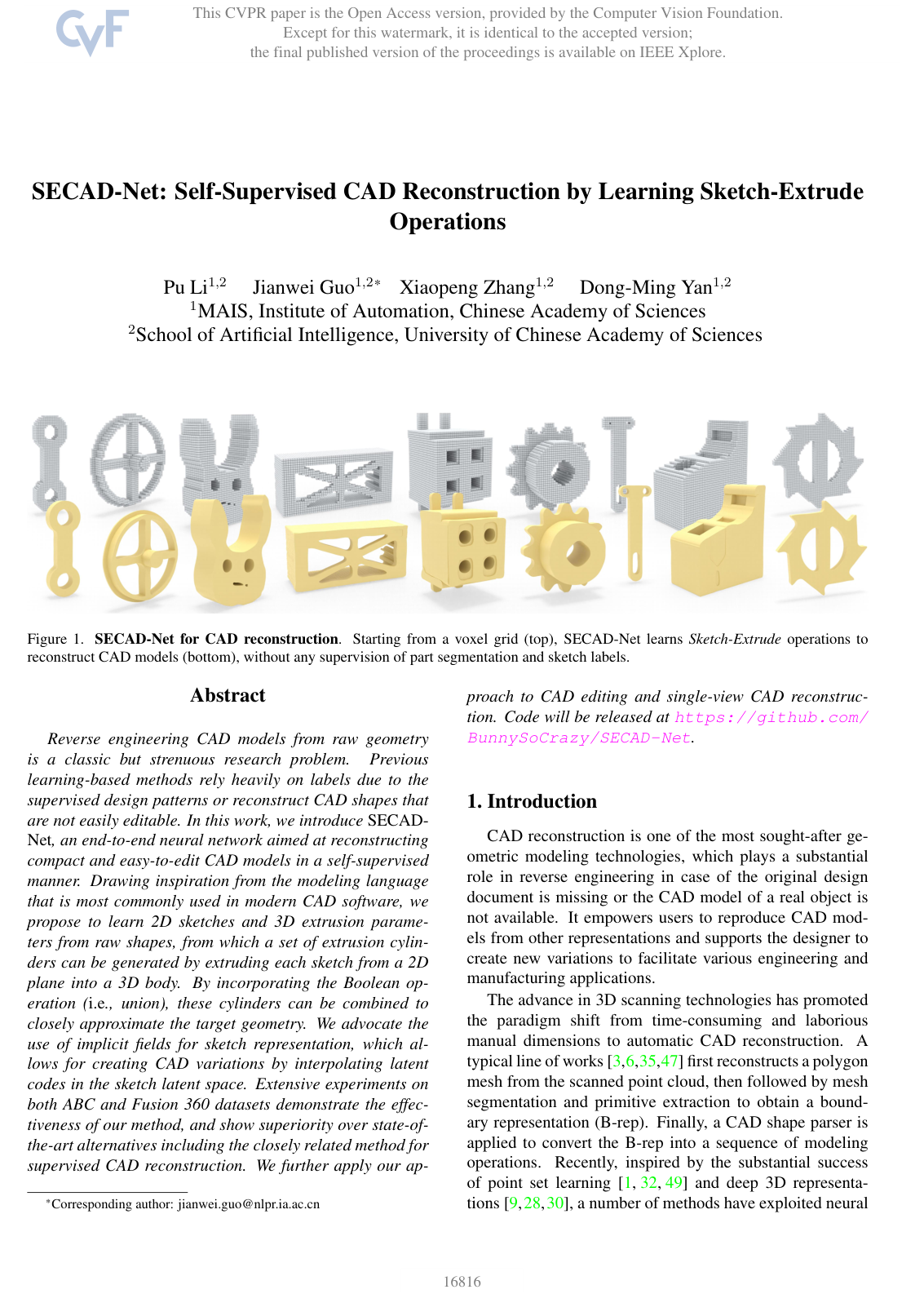
Reverse engineering CAD models from raw geometry is a classic but strenuous research problem. Previous learning-based methods rely heavily on labels due to the supervised design patterns or reconstruct CAD shapes that are not easily editable. In this work, we introduce SECAD-Net, an end-to-end neural network aimed at reconstructing compact and easy-to-edit CAD models in a self-supervised manner. Drawing inspiration from the modeling language that is most commonly used in modern CAD software, we propose to learn 2D sketches and 3D extrusion parameters from raw shapes, from which a set of extrusion cylinders can be generated by extruding each sketch from a 2D plane into a 3D body. By incorporating the Boolean operation (i.e., union), these cylinders can be combined to closely approximate the target geometry. We advocate the use of implicit fields for sketch representation, which allows for creating CAD variations by interpolating latent codes in the sketch latent space. Extensive experiments on both ABC and Fusion 360 datasets demonstrate the effectiveness of our method, and show superiority over state-of-the-art alternatives including the closely related method for supervised CAD reconstruction. We further apply our approach to CAD editing and single-view CAD reconstruction. Code will be released at https://github.com/BunnySoCrazy/SECAD-Net.

Added

2026-09-26