Scalable Adaptive Computation for Iterative Generation
Allan JabriDavid J. FleetTing Chen
Proposes Recurrent Interface Networks, an architecture that routes information between high-dimensional data and a compact set of latent tokens to achieve state-of-the-art pixel diffusion generation up to ten times more efficiently than standard U-Nets.
Generating high-dimensional content such as high-resolution images and videos requires massive computing power. Standard deep learning architectures allocate computation uniformly across all input areas, spending equal effort on complex visual details and simple, redundant regions like empty backgrounds. This rigid allocation creates a significant computational bottleneck that limits scalability, especially on modern accelerator hardware that prefers fixed computation structures.
The article demonstrates and evaluates the Recurrent Interface Network, a neural network architecture designed to decouple heavy computation from input dimensions. The network dynamically routes compute capacity to information-dense regions, enabling efficient, adaptive generation of high-resolution images and video.
To evaluate the system, the authors conducted benchmark experiments applying the architecture to pixel-level denoising diffusion models across standard datasets, including ImageNet at resolutions from 64x64 up to 1024x1024, Kinetics-600 video prediction, and CIFAR-10. The architecture splits hidden units into a lightweight data interface and a compact set of latent tokens that handle the core computation. Stacked blocks alternate between reading data into latents, computing via self-attention, and writing updates back to the interface. To eliminate the high warm-up overhead of routing, the method introduces latent self-conditioning, which reuses latent context from prior iterative generation steps without requiring expensive backpropagation through time.
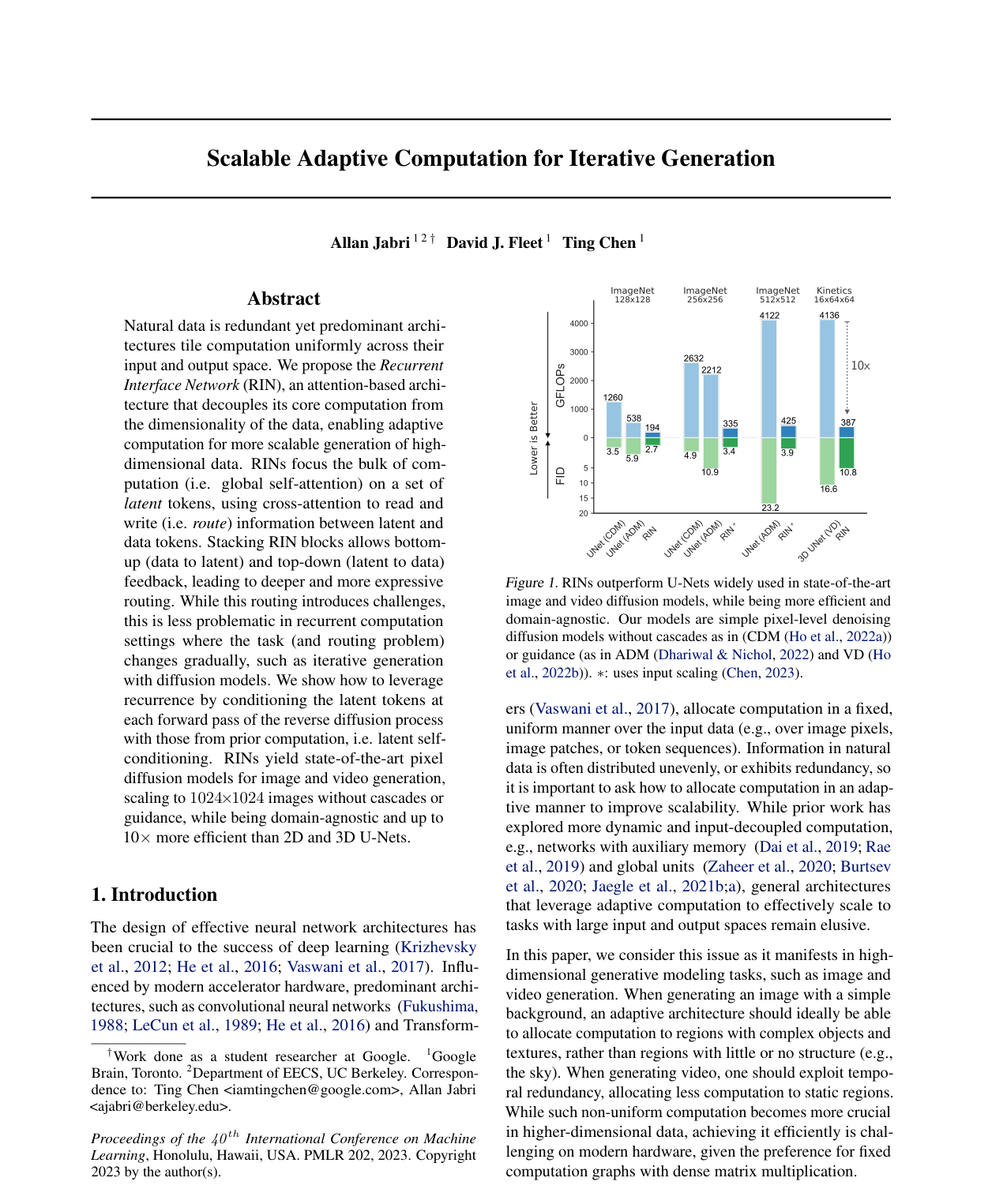
The experiments show that the proposed architecture achieves superior generation quality compared to standard convolutional U-Net models while dramatically improving efficiency. For ImageNet class-conditional generation, the architecture reduced computation per inference step by up to tenfold compared to leading diffusion baselines, scaling directly to 1024x1024 pixel images without relying on cascaded models or guidance techniques. For Kinetics-600 video prediction, the model improved generation quality scores while reducing computation per step tenfold. Ablation analyses confirmed that latent self-conditioning and multi-block iterative routing are critical, as attention visualizations demonstrated that the model learns to selectively focus computation on complex regions and dynamic object motions rather than static backgrounds.
These findings indicate that generative models do not need complex, multi-stage pipelines or hand-crafted spatial architectures to achieve state-of-the-art results. By relying on domain-agnostic attention operations and dynamic resource allocation, organizations can substantially lower inference computation costs and hardware resource requirements for visual generation workloads.
Teams developing high-dimensional generative pipelines should explore adopting decoupled attention architectures and latent self-conditioning to reduce computational overhead. Prior to full production deployment, further work should evaluate combining this architecture with orthogonal techniques, such as classifier guidance and latent diffusion, to assess maximum performance limits. Readers should note that while the empirical results demonstrate robust gains across images and video, evaluating broader data modalities and refining the latent conditioning dynamics remain ongoing areas for further research.
- Paper: General-purpose, long-context autoregressive modeling with Perceiver AR, Curtis Hawthorne et al. (2022). Perceiver AR establishes the latent-bottleneck strategy of routing large inputs through a compact latent array, the architectural premise RIN adapts for scalable generation.
- Paper: Diffusion Models Beat GANs on Image Synthesis, Prafulla Dhariwal et al. (2021). Its diffusion framework and image-synthesis advances provide the generative-modeling foundation needed to understand the diffusion setting in which RIN is developed.
- Paper: Flow Reasoning Models: Turning Flows Into Efficient Recurrent Reasoners, Alec Helbling et al. (2026). Flow Reasoning Models carry iterative self-conditioning into recurrent generation, extending the use of evolving internal state across repeated denoising-like updates.
- Paper: Thinking with Looped Flows, Ayhan Suleymanzade et al. (2026). Thinking with Looped Flows extends recurrent state updates to iterative flow generation, exploring how repeated computation can improve generated solutions.