Dynamic Graph Learning with Content-guided Spatial-Frequency Relation Reasoning for Deepfake Detection
Yuan WangKun YuChen ChenXiyuan HuSilong Peng
Proposes a Spatial-Frequency Dynamic Graph framework for deepfake detection that extracts content-adaptive frequency artifacts and reasons over high-order cross-domain relationships using dynamic graph learning to generalize across diverse face manipulation benchmarks.
Rapid advancements in digital face synthesis tools allow individuals to manipulate facial identities and expressions with unprecedented realism. This technology poses severe risks to security, public trust, and compliance by enabling deceptive media, political disinformation, and non-consensual imagery. While early automated detection tools focused on obvious visual flaws or hand-crafted frequency patterns, modern counterfeit methods easily evade these static defenses. Existing systems struggle primarily because they analyze visual textures and frequency data in isolation without understanding the complex, content-driven relationships between them.
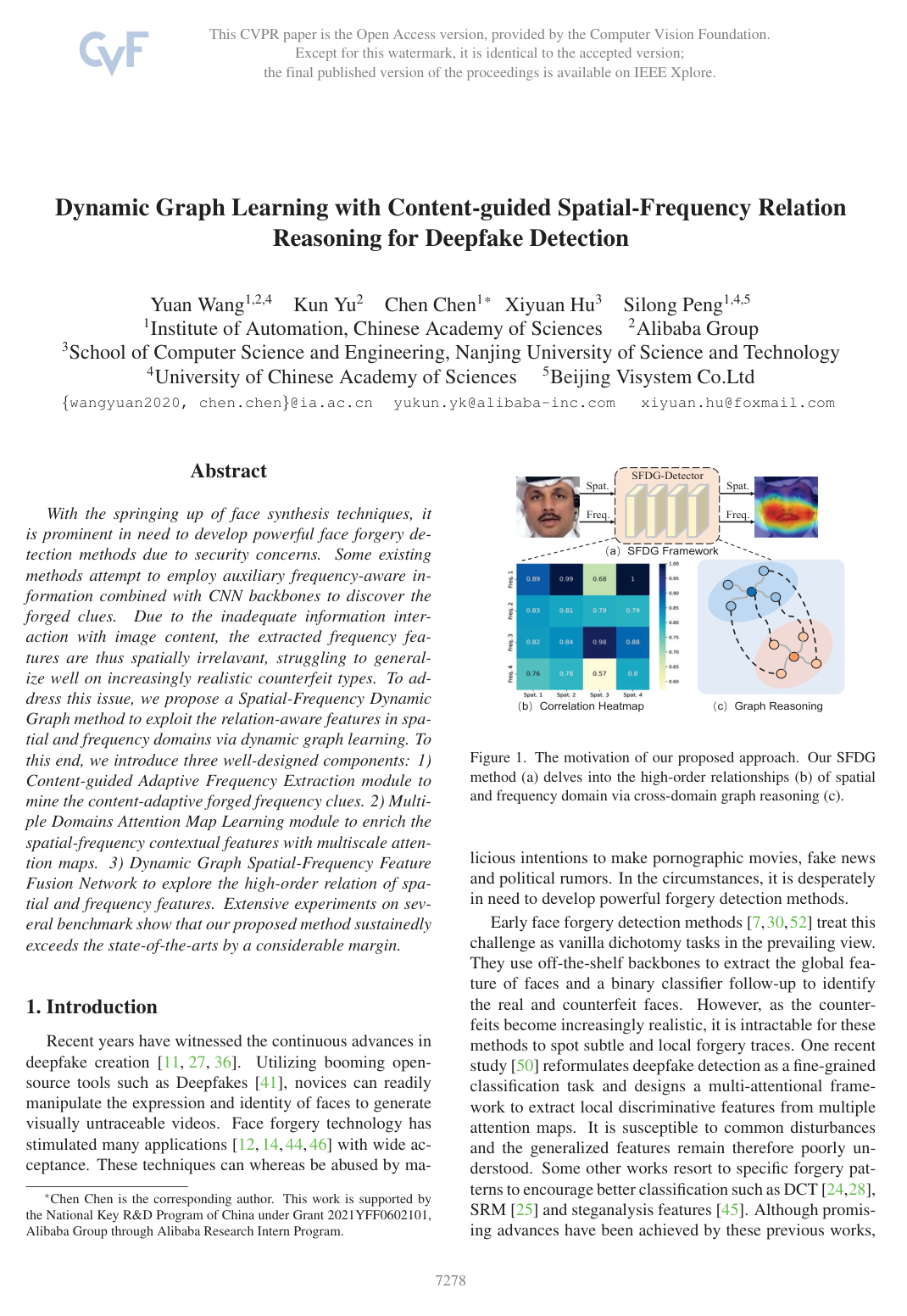
The article demonstrates an advanced deepfake detection framework named Spatial-Frequency Dynamic Graph that captures content-aware frequency clues and reasons about the complex interactions between visual image content and underlying frequency distributions. To accomplish this, the authors introduce a three-stage architecture that adaptively extracts fine and coarse frequency clues using visual masks, generates multi-scale spatial and frequency attention maps to retain rich context, and applies a dynamic graph convolutional network with multi-layer perceptron mixers to evaluate the relationships between both domains.
The system was evaluated across six major industry benchmark datasets—including FaceForensics++, WildDeepfake, Celeb-DF, and Deepfake Detection Challenge—under varying image qualities and cross-dataset testing. The evaluation produced four key findings. First, the proposed framework consistently outperformed leading deepfake detection baselines, achieving 92.28% accuracy and an area under the curve score of 95.98% on low-quality manipulated video tests. Second, in cross-dataset evaluations where the model was trained on one source and tested against unseen manipulation techniques, it attained strong generalization with area under the curve scores of 75.83% on Celeb-DF, 88.00% on DFD, and 73.64% on DFDC, markedly exceeding rival approaches. Third, perturbation stress testing demonstrated superior noise resilience, dropping by only 10.10% accuracy under severe salt-and-pepper noise where competing systems suffered declines between 31% and 49%. Fourth, ablation and parameter studies confirmed that combining content-adaptive extraction with multi-scale attention and a ten-neighbor dynamic graph construction produces the most robust and accurate classification.
These findings indicate that integrating adaptive frequency extraction with relational graph learning significantly reduces the risk of models overfitting to specific, known counterfeit generation tools. By capturing subtle discrepancies across wide semantic areas—such as backgrounds and hair—alongside localized facial anomalies, this approach substantially lowers false-positive and false-negative detection rates in compressed and degraded real-world video pipelines. Consequently, this architecture provides a viable, high-accuracy foundation for operational content moderation and automated media verification systems.
Organizations evaluating this technology should consider moving toward dual-domain, graph-based verification pipelines rather than relying solely on visual or hand-crafted frequency filters. Stakeholders should conduct pilot evaluations on proprietary, real-world media streams to assess computational trade-offs, particularly regarding graph neighbor parameter tuning. While the findings provide strong confidence in controlled and cross-dataset benchmarks, operational deployment must account for potential latency constraints from dynamic graph computations and the need for continued testing against emerging, post-generation adversarial attacks.
- Paper: FaceForensics++: Learning to Detect Manipulated Facial Images, Andreas Rössler et al. (2019). This paper establishes the foundational FaceForensics++ benchmark and standard multi-compression evaluation protocols upon which the source model is trained and assessed.
- Paper: Celeb-DF: A Large-Scale Challenging Dataset for DeepFake Forensics, Yuezun Li et al. (2019). This work introduces the high-quality Celeb-DF dataset that serves as a primary benchmark for testing cross-dataset generalization in the source paper.
- Paper: Exploiting Fine-Grained Face Forgery Clues via Progressive Enhancement Learning, Qiqi Gu et al. (2022). This study introduces fine-grained spatial-frequency decomposition for face forgery detection, establishing the dual-domain artifact mining paradigm that the source paper expands with dynamic graph reasoning.
- Paper: End-to-End Reconstruction-Classification Learning for Face Forgery Detection, Junyi Cao et al. (2022). This paper provides essential background on learning generalizable facial representations to prevent forgery detectors from overfitting to specific manipulation patterns.
- Paper: MesoNet: a Compact Facial Video Forgery Detection Network, Darius Afchar et al. (2018). This foundational paper presents MesoNet, establishing mesoscopic feature analysis for compressed deepfake detection that serves as a key baseline comparison for the source framework.
- Paper: Protecting Celebrities from DeepFake with Identity Consistency Transformer, Xiaoyi Dong et al. (2022). This work formulates semantic inner-versus-outer facial region reasoning for deepfake detection, motivating the source paper's content-aware masking across facial areas.
- Paper: CNN-Generated Images Are Surprisingly Easy to Spot… for Now, Sheng-Yu Wang et al. (2019). This work demonstrates that systematic convolutional synthesis artifacts enable cross-model generalization, providing core motivation for the source's frequency-guided relational learning.
- Paper: Frequency-Aware Deepfake Detection: Improving Generalizability through Frequency Space Domain Learning, Chuangchuang Tan et al. (2024). This paper extends frequency-domain deepfake detection by operating directly within phase and amplitude spectra to achieve cross-generator generalization.
- Paper: Rethinking the Up-Sampling Operations in CNN-Based Generative Network for Generalizable Deepfake Detection, Chuangchuang Tan et al. (2024). This work advances beyond broader frequency and spatial relations by pinpointing localized up-sampling artifacts as a universal signature across generative architectures.
- Paper: DeepfakeBench: A Comprehensive Benchmark of Deepfake Detection, Zhiyuan Yan et al. (2023). This study provides a standardized evaluation benchmark, DeepfakeBench, providing the unified experimental framework needed to rigorously compare advanced detectors like the source model.
- Paper: Hierarchical Fine-Grained Image Forgery Detection and Localization, Xiao Guo et al. (2023). This research broadens dual-domain spatial-frequency detection into a hierarchical framework capable of simultaneous forgery detection, pixel localization, and source attribution.
- Paper: AVFF: Audio-Visual Feature Fusion for Video Deepfake Detection, Trevine Oorloff et al. (2024). This paper expands facial forgery detection beyond visual and frequency analysis by incorporating cross-modal audio-visual feature fusion.
- Paper: Robustness of AI-Image Detectors: Fundamental Limits and Practical Attacks, Mehrdad Saberi et al. (2024). This study investigates the theoretical and practical robustness boundaries of classifier-based AI image detectors under adversarial purification attacks.