Intent Tagging: Exploring Micro-Prompting Interactions for Supporting Granular Human-GenAI Co-Creation Workflows

Frederic GmeinerNicolai MarquardtMichael BentleyHugo RomatMichel PahudDavid BrownAsta RosewayNikolas MartelaroKenneth HolsteinKen Hinckley

article2025International Conference on Human Factors in Computing Systems32 citations

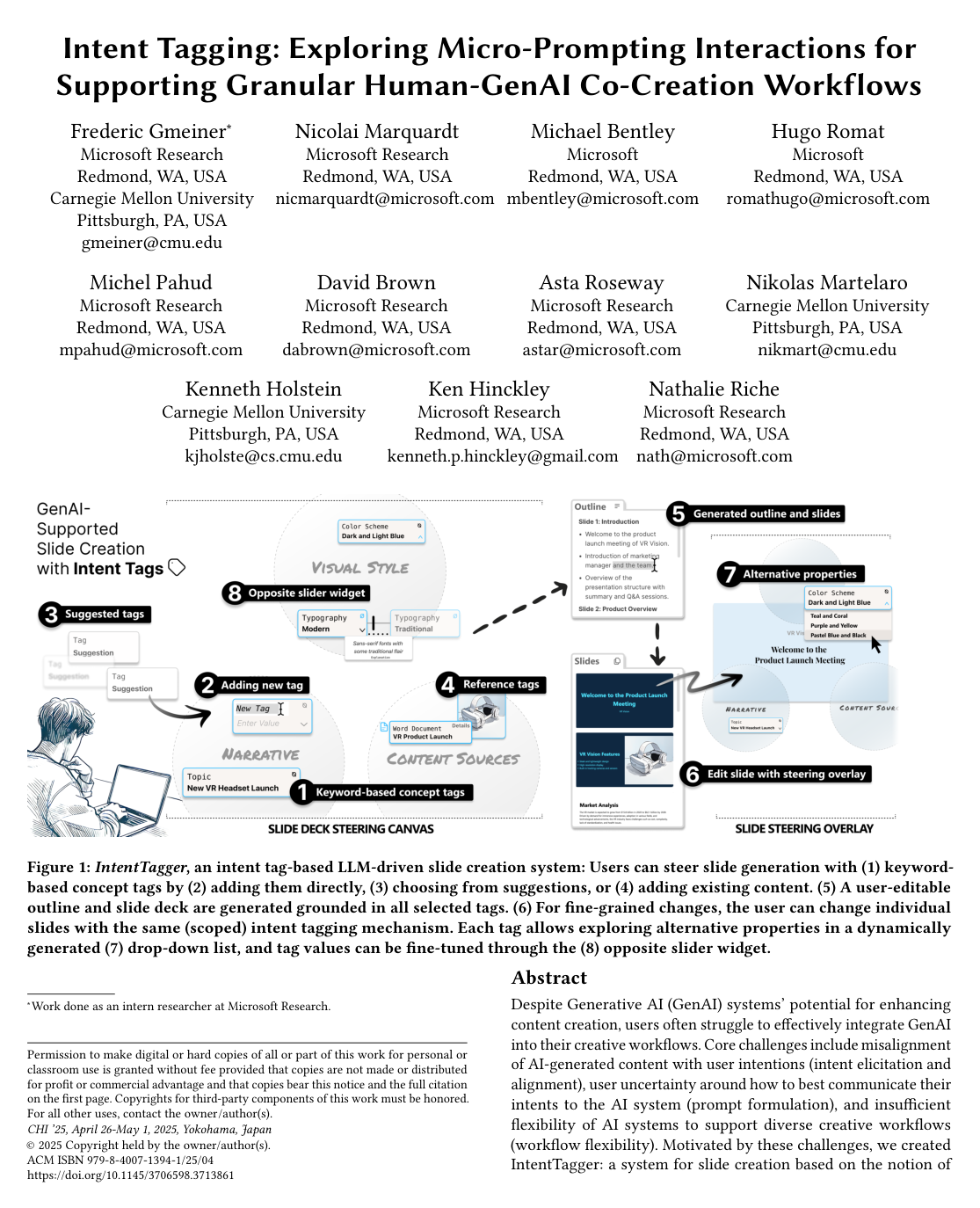
Proposes IntentTagger, an interactive system that decomposes complex prompts into atomic conceptual units to give users flexible, non-linear control over generative AI during collaborative slide design.

Listen

Generative artificial intelligence (GenAI) offers substantial potential for automating and assisting complex content creation tasks, such as authoring slide decks. However, users frequently struggle to integrate current GenAI tools into their creative workflows due to three core friction points: difficulty communicating intent accurately through free-form text prompts, rigid linear workflows imposed by chat interfaces, and the challenge of discovering and articulating creative requirements upfront. The article evaluates a novel interaction method called intent tagging—a graphical micro-prompting approach using atomic conceptual units organized on a visual canvas—and demonstrates its effectiveness in supporting flexible, non-linear human-AI co-creation.

To evaluate this approach, the researchers built IntentTagger, a prototype system driven by large language models that enables users to steer presentation generation across narrative, visual style, and content sources using interactive tags, adaptive widgets, and pre-computed real-time previews. The authors conducted a comparative laboratory user study with 12 professional knowledge workers from a major technology company. Participants completed both structured comparative tasks—benchmarking IntentTagger against commercial chat- and design gallery-based tools (specifically PowerPoint Copilot and Designer)—and open-ended presentation authoring tasks, followed by qualitative video analysis and post-task surveys.

The evaluation revealed several critical findings. First, participants felt significantly more in control when guiding generation toward their intended outcome using intent tags compared to chat-based prompting (a mean difference of 2.67 on a 6-point scale). Second, IntentTagger substantially enhanced iterative refinement, with users rating their ability to provide follow-up information to refine output much higher (a mean difference of 2.83). Third, proactive AI suggestions proved highly valuable rather than intrusive: across open-ended tasks, users incorporated an average of 73.5% of their active tags directly from system suggestions to discover new design directions and overcome creative blocks. Finally, the interface successfully accommodated non-linear workflows, allowing participants to move fluidly between deck-wide parameters, outline adjustments, and single-slide refinements in an average creation time of under nine minutes.

These findings imply that replacing monolithic text prompts and rigid conversational chat streams with modular, graphical micro-prompts significantly reduces user frustration, trial-and-error prompting, and task completion time. Graphical intent elicitation promotes reflection-in-action by functioning as an interactive canvas where the system's dynamic suggestions help users clarify tacit goals. However, as workflows become more non-linear, a key trade-off emerges between high generation flexibility and fine-grained visual stability, as users strongly desire the ability to anchor or lock specific approved elements across iterative generation cycles.

Based on these results, software developers and user experience designers building GenAI tools should transition from pure chat interfaces toward hybrid direct-manipulation interfaces that pair micro-prompt tags with adaptive user interface controls. Development roadmaps should prioritize dynamic pre-computed previews and explicit pinning mechanisms that lock finalized design elements. Furthermore, onboarding experiences should provide scaffolding, such as predefined tag templates, to reduce initial user hesitation around tag naming and placement. Before broad commercial deployment, organizations should conduct longitudinal in-situ pilots to observe how intent tagging performs across diverse corporate domains and extended authoring sessions.

These conclusions are supported by a controlled laboratory study with high statistical significance in user satisfaction metrics. However, readers should note certain limitations: the participant pool was limited to 12 corporate professionals from a single enterprise, tasks were constrained to short slide decks of 6 to 7 slides to maintain sub-15-second generation cycles, and the prototype lacked manual pixel-level formatting tools. Confidence in the usability advantages of intent tagging is strong for rapid initial prototyping, but further empirical study is necessary to validate performance in large-scale document production environments.

arXiv: 2502.18737

No sufficiently relevant recommendations were found.

No sufficiently relevant recommendations were found.
Cover for Intent Tagging: Exploring Micro-Prompting Interactions for Supporting Granular Human-GenAI Co-Creation Workflows

Abstract

Despite Generative AI (GenAI) systems' potential for enhancing content creation, users often struggle to effectively integrate GenAI into their creative workflows. Core challenges include misalignment of AI-generated content with user intentions (intent elicitation and alignment), user uncertainty around how to best communicate their intents to the AI system (prompt formulation), and insufficient flexibility of AI systems to support diverse creative workflows (workflow flexibility). Motivated by these challenges, we created IntentTagger: a system for slide creation based on the notion of Intent Tags - small, atomic conceptual units that encapsulate user intent - for exploring granular and non-linear micro-prompting interactions for Human-GenAI co-creation workflows. Our user study with 12 participants provides insights into the value of flexibly expressing intent across varying levels of ambiguity, meta-intent elicitation, and the benefits and challenges of intent tag-driven workflows. We conclude by discussing the broader implications of our findings and design considerations for GenAI-supported content creation workflows.

Table of Contents

  • 1 Introduction
  • 2 Related Work
  • 2.1 Intent Elicitation in Human-AI Interaction
  • 2.2 Systems for Supporting Prompting and Steering GenAI
  • 2.3 Non-Linear Content Creation and Iterative Design Workflows
  • 2.4 Systems for Supporting Slide Deck Creation
  • 3 Exploring Design Principles for GenAI-supported Rich Content Creation
  • 3.1 Design Principles
  • 4 IntentTagger: An Intent Tagging-based Slide Creation System
  • 4.1 Example Use Case Scenario
  • 4.2 Interface Features
  • 4.2.1 Intent Tags: Concept Tags, Reference Tags and Groups (DP2)
  • 4.2.2 Deck Steering Canvas and Slide Steering Overlay (DP1, DP3)
  • 4.2.3 Outline Editor (DP1)
  • 4.2.4 Editing Intent Tags, Tag Widgets, and System Suggestions (DP3, DP4, DP5)
  • 4.2.5 Steering Slide Generation
  • 4.2.6 Previews of Slides and Slider Values (DP5)
  • 4.2.7 Referencing External Documents (DP2)
  • 4.2.8 Tag Grounding Acts (DP4)
  • 4.3 Implementation Details
  • 5 User Study
  • 5.1 Participants
  • 5.2 Procedure and Tasks
  • 5.3 Collected Data, Measures, and Analysis
  • 6 Study Findings
  • 6.1 Key differences: Chat vs Intent Tag-based Interactions (RQ1)
  • 6.1.1 Observations
  • 6.1.2 Questionnaire
  • 6.2 Observed Content Creation Workflows Using Intent Tags (RQ2)
  • 6.2.1 Workflows
  • 6.2.2 Prompting With Intent Tags
  • 6.2.3 Interactions With System Suggested Tags
  • 6.3 Users’ Perceived Benefits and Challenges for Working with Intent Tags (RQ3)
  • 6.3.1 Expressing Intents with Tags
  • 6.3.2 Supporting Diverse Presentation Needs and Workflows
  • 6.3.3 Meta-Intent Elicitation: Helping Creators Figure Out What They Want and Need
  • 7 Intent Tagging Interactions Beyond Slide Deck Creation
  • 8 Discussion and Design Considerations
  • 8.1 Intent Tagging Enables Non-Linear GenAI Workflows
  • 8.2 Intent Tagging Promotes Human-AI Co-creation and Reflection-In-Action
  • 8.3 Blending Steering Interactions and Manual Content Editing
  • 8.4 Trade-offs between UI Customization and UI Management
  • 8.5 Limitations of the Evaluation
  • 9 Conclusion
  • References
  • A Additional Materials
  • A.1 Further System Implementation Details
  • A.1.1 Tag Suggestion Mechanism
  • A.1.2 Outline Generation From Intent Tags
  • A.1.3 Slide generation mechanism
  • A.1.4 Mechanism to create tags for an existing slide (tag grounding act)
  • A.2 Semi-structured Task Outcomes

Citation

MLA
Gmeiner, F., et al. “Intent Tagging: Exploring Micro-Prompting Interactions for Supporting Granular Human-GenAI Co-Creation Workflows”. Proceedings of the 2025 CHI Conference on Human Factors in Computing Systems, 2025, pp. 1–1, https://doi.org/10.1145/3706598.3713861.
APA
Gmeiner, F., Marquardt, N., Bentley, M., Romat, H., Pahud, M., Brown, D., Roseway, A., Martelaro, N., Holstein, K., Hinckley, K., & Riche, N. (2025). Intent Tagging: Exploring Micro-Prompting Interactions for Supporting Granular Human-GenAI Co-Creation Workflows. Proceedings of the 2025 CHI Conference on Human Factors in Computing Systems, 1–31. https://doi.org/10.1145/3706598.3713861
Chicago
Gmeiner, F., N. Marquardt, M. Bentley, et al. 2025. “Intent Tagging: Exploring Micro-Prompting Interactions for Supporting Granular Human-GenAI Co-Creation Workflows”. Proceedings of the 2025 CHI Conference on Human Factors in Computing Systems, 1–31. https://doi.org/10.1145/3706598.3713861.
Harvard
Gmeiner, F. et al. (2025) “Intent Tagging: Exploring Micro-Prompting Interactions for Supporting Granular Human-GenAI Co-Creation Workflows”, Proceedings of the 2025 CHI Conference on Human Factors in Computing Systems. ACM, pp. 1–31. Available at: https://doi.org/10.1145/3706598.3713861.
Vancouver
1. Gmeiner F, Marquardt N, Bentley M, et al (2025) Intent Tagging: Exploring Micro-Prompting Interactions for Supporting Granular Human-GenAI Co-Creation Workflows. In: Proceedings of the 2025 CHI Conference on Human Factors in Computing Systems. ACM, pp 1–31

BibTeX

@inproceedings{Gmeiner_2025, series={CHI ’25}, title={Intent Tagging: Exploring Micro-Prompting Interactions for Supporting Granular Human-GenAI Co-Creation Workflows}, url={http://dx.doi.org/10.1145/3706598.3713861}, DOI={10.1145/3706598.3713861}, booktitle={Proceedings of the 2025 CHI Conference on Human Factors in Computing Systems}, publisher={ACM}, author={Gmeiner, Frederic and Marquardt, Nicolai and Bentley, Michael and Romat, Hugo and Pahud, Michel and Brown, David and Roseway, Asta and Martelaro, Nikolas and Holstein, Kenneth and Hinckley, Ken and Riche, Nathalie}, year={2025}, month=Apr, pages={1–31}, collection={CHI ’25} }
Metadata:Crossref

Access the Paper

This paper is available from its original source. Click below to access the PDF.

Open PDF
License: https://creativecommons.org/licenses/by/4.0/