Built independently by an author, for readers. Read the story and support ChapterPal

keyword

Intent Tagging

Intent tagging is an interaction technique in generative artificial intelligence workflows where a user expresses and organizes creative intent through small, modular conceptual units rather than traditional monolithic text prompts. These discrete tags encapsulate atomic aspects of a goal, such as style, structure, tone, or specific functional requirements, which users can assemble, modify, and attach to different parts of a project. By decomposing complex instructions into manageable micro-prompts, intent tagging enables granular and non-linear control over generation, mitigates the difficulty of prompt formulation, and improves alignment between user expectations and system outputs during iterative co-creation.

1 item

Intent Tagging: Exploring Micro-Prompting Interactions for Supporting Granular Human-GenAI Co-Creation Workflows

Intent Tagging: Exploring Micro-Prompting Interactions for Supporting Granular Human-GenAI Co-Creation Workflows

Frederic Gmeiner, Nicolai Marquardt, Michael Bentley, Hugo Romat, Michel Pahud, David Brown, Asta Roseway, Nikolas Martelaro, Kenneth Holstein, Ken Hinckley, Nathalie Henry Riche

OrganizationsCarnegie Mellon UniversityMicrosoft

Why you should read this

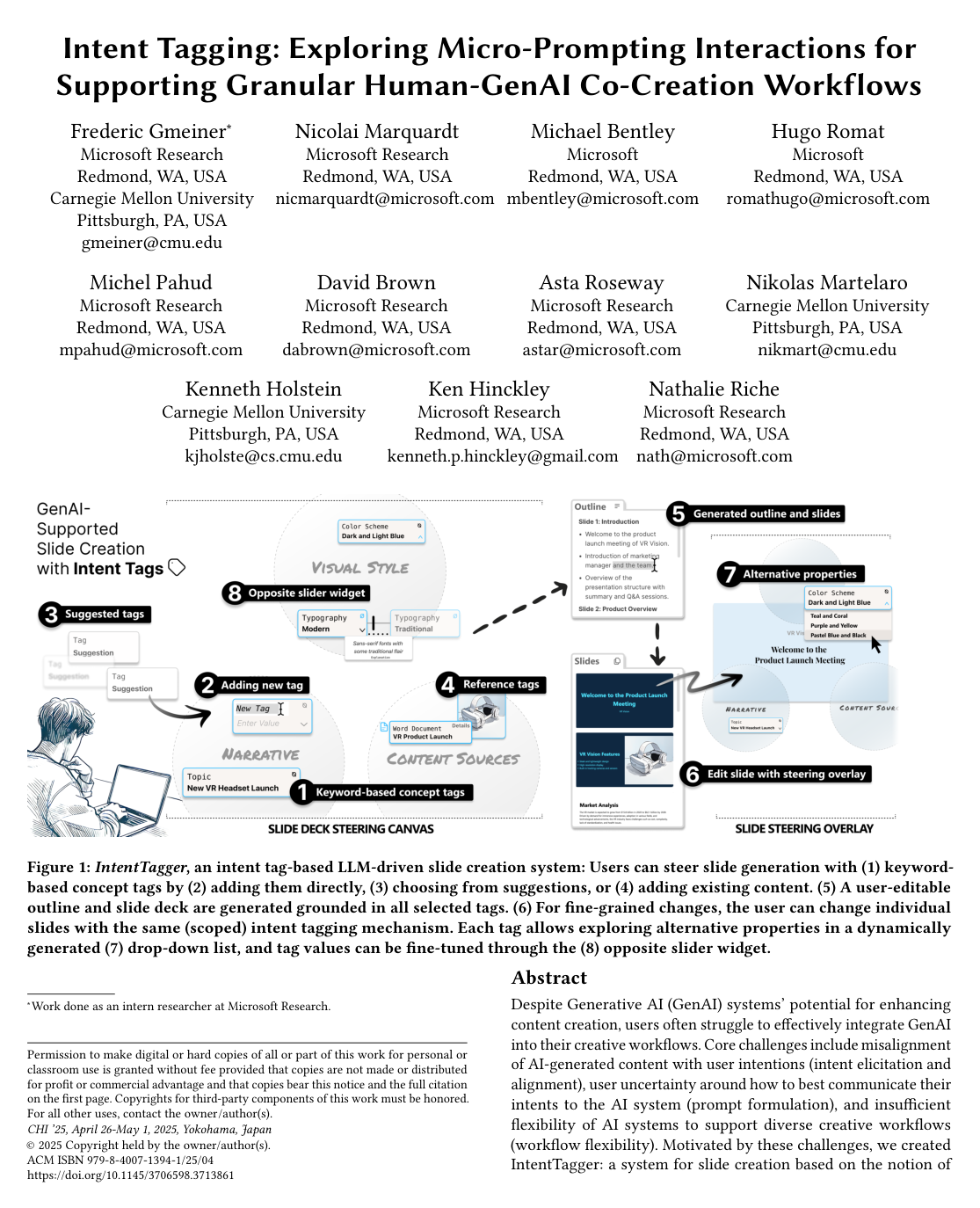
Proposes IntentTagger, an interactive system that decomposes complex prompts into atomic conceptual units to give users flexible, non-linear control over generative AI during collaborative slide design.

Despite Generative AI (GenAI) systems' potential for enhancing content creation, users often struggle to effectively integrate GenAI into their creative workflows. Core challenges include misalignment of AI-generated content with user intentions (intent elicitation and alignment), user uncertainty around how to best communicate their intents to the AI system (prompt formulation), and insufficient flexibility of AI systems to support diverse creative workflows (workflow flexibility). Motivated by these challenges, we created IntentTagger: a system for slide creation based on the notion of Intent Tags - small, atomic conceptual units that encapsulate user intent - for exploring granular and non-linear micro-prompting interactions for Human-GenAI co-creation workflows. Our user study with 12 participants provides insights into the value of flexibly expressing intent across varying levels of ambiguity, meta-intent elicitation, and the benefits and challenges of intent tag-driven workflows. We conclude by discussing the broader implications of our findings and design considerations for GenAI-supported content creation workflows.

Added

2026-09-30