CD2-pFed: Cyclic Distillation-guided Channel Decoupling for Model Personalization in Federated Learning
Yiqing ShenYuyin ZhouLequan Yu
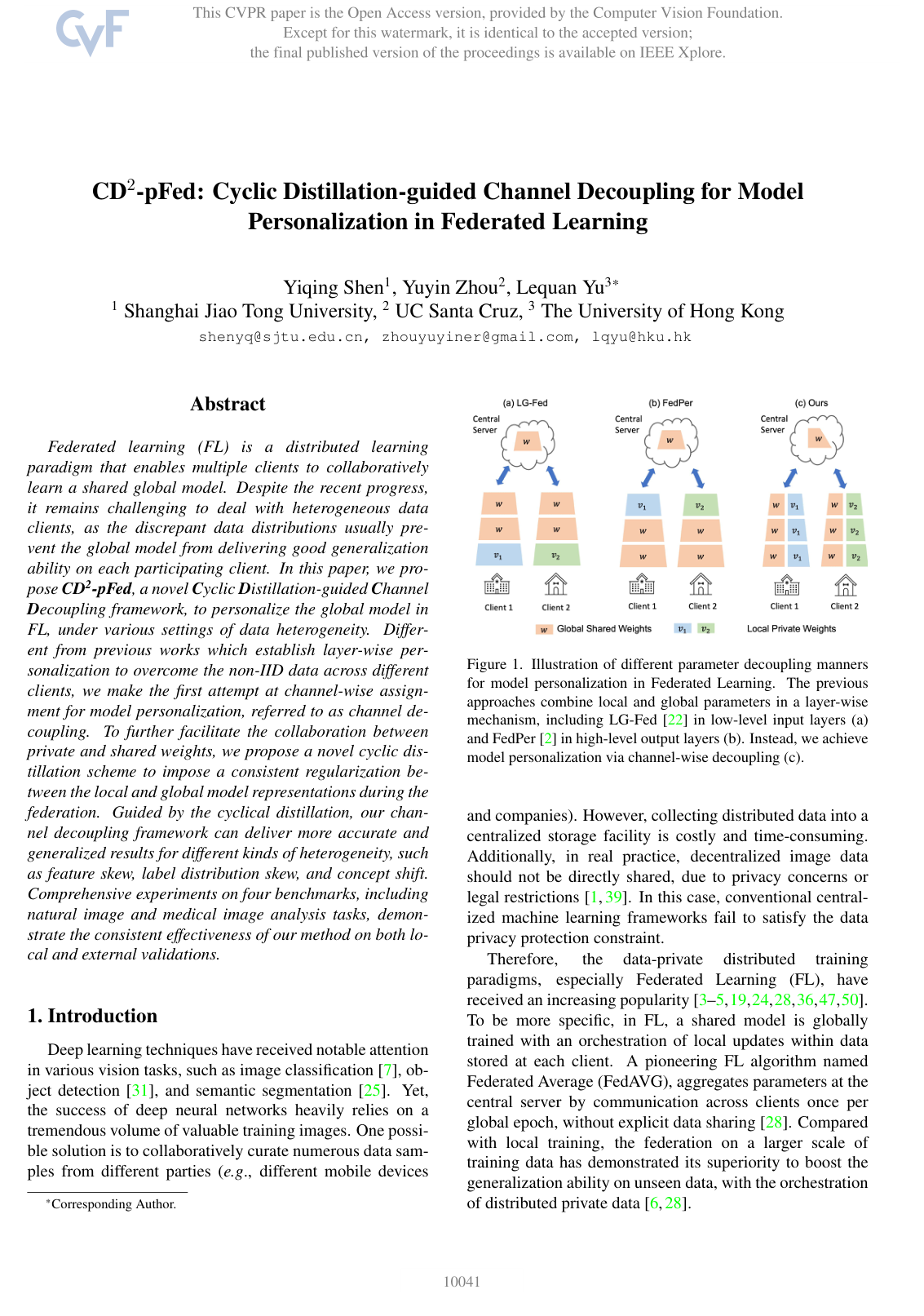
Proposes a personalized federated learning framework that decouples model parameters at the channel dimension rather than across layers, pairing this design with cyclic knowledge distillation to address diverse non-IID data distributions across natural and medical image benchmarks.
Federated learning allows multiple organizations or devices to collaboratively train artificial intelligence models without sharing private, decentralized data. However, real-world deployments encounter severe performance drops due to statistical data heterogeneity across participants, including variations in features, label distributions, and user preferences. Existing personalized federated learning techniques attempt to fix this by splitting models into separate shared and private layers. Because they restrict customization to either the top or bottom of a network, these methods rely on prior assumptions about the data and fail when different forms of data discrepancy co-occur.
The article evaluates and demonstrates CD2-pFed, a framework designed to achieve robust model personalization across diverse data heterogeneity scenarios without requiring manual layer selection. The primary objective is to improve both local customized accuracy and generalizability to unseen data while maintaining data privacy.
The researchers developed an approach that splits model capacity channel by channel across all network layers, allocating private channels for local learning and shared channels for global federation. To align these representations, they introduced a mutual knowledge distillation scheme that regularizes local and global predictions against each other during training, alongside a progressive schedule that increases personalization over time and temporal smoothing for stable updates. The approach was evaluated across four image classification benchmarks covering natural and medical domains, including CIFAR-10, CIFAR-100, the aesthetic assessment dataset FLICKR-AES with REAL-CUR validation, and a multi-center colorectal cancer histology image collection termed HISTO-FED.
The empirical findings demonstrate significant performance advantages. On CIFAR-10 under severe label distribution skew, the method improved local classification accuracy by roughly 32% over standard federated averaging (reaching 91.82%) and outperformed leading layer-wise methods on both local and unseen data tests. On CIFAR-100, local test accuracy increased by about 29% over standard federation, outperforming competing personalized frameworks by 1.2% to 4.7%. On user preference data with concept drift, the approach improved local accuracy from 24.50% to 47.89% and external test accuracy from 20.08% to 45.67%. In medical histology with distinct stain variations, the framework consistently surpassed baseline models across participating centers and maintained the highest accuracy on unseen hospital data (65.66%).
These results demonstrate that channel-level personalization provides a unified and reliable solution to varied data skews, eliminating the need to guess whether top or bottom layers require customization. By bridging the gap between local and global representations, the method delivers faster convergence during training, which reduces communication overhead and network operational costs for distributed systems while maintaining strict data privacy compliance.
Organizations implementing federated systems should consider channel-level decoupling and prediction alignment when managing diverse data endpoints, especially in sensitive sectors such as healthcare and cross-device consumer applications. Before wider operational adoption across complex computer vision systems, technical teams should conduct pilot studies, as the current distillation mechanism is tailored for classification outputs and requires adaptation for tasks like object detection and semantic segmentation.
The primary limitations of this work stem from its reliance on fixed personalization proportions across all layers and the restriction of the distillation scheme to classification tasks. Nonetheless, because the framework was rigorously validated across multiple distinct non-identical data splits and real-world multi-center datasets, confidence in its reported classification advantages remains high.
- Paper: Federated Learning with Personalization Layers, Manoj Ghuhan Arivazhagan et al. (2019). It introduces the concept of layer-wise parameter splitting for personalized federated learning, which CD2-pFed explicitly generalizes to channel-wise decoupling.
- Paper: FedBN: Federated Learning on Non-IID Features via Local Batch Normalization, Xiaoxiao Li et al. (2021). It demonstrates personalizing federated models by isolating specific parameter subsets (batch normalization layers) locally to mitigate feature shift across clients.
- Paper: Ensemble Distillation for Robust Model Fusion in Federated Learning, Tao Lin et al. (2020). It introduces knowledge distillation mechanisms for robust model aggregation under client data heterogeneity, foundational to the distillation regularization used in CD2-pFed.
- Paper: Personalized Federated Learning with Moreau Envelopes, Canh T. Dinh et al. (2020). It provides a core formulation for personalized federated learning that balances shared global models with local client models using bi-level regularized optimization.
- Paper: Personalized Federated Learning with Theoretical Guarantees: A Model-Agnostic Meta-Learning Approach, Alireza Fallah et al. (2020). It formalizes personalized federated learning through meta-learning and provides foundational insights into training models that easily adapt to local non-IID distributions.
- Paper: Towards Personalized Federated Learning, Alysa Ziying Tan et al. (2021). It provides a comprehensive taxonomy of personalized federated learning strategies, including parameter decoupling and knowledge distillation.
- Paper: Federated Learning with Non-IID Data, Yue Zhao et al. (2018). It characterizes the impact of non-IID client data distributions and weight divergence in federated averaging, establishing the primary challenge addressed by CD2-pFed.
- Paper: Communication-Efficient Learning of Deep Networks from Decentralized Data, H. B. McMahan et al. (2016). It establishes the canonical FederatedAveraging algorithm and distributed optimization framework that CD2-pFed builds upon and adapts.
- Paper: FedTGP: Trainable Global Prototypes with Adaptive-Margin-Enhanced Contrastive Learning for Data and Model Heterogeneity in Federated Learning, Jianqing Zhang et al. (2024). It advances the handling of statistical and model heterogeneity in federated learning by moving beyond channel decoupling to learning contrastive, adaptive-margin global prototypes.