DenseCLIP: Language-Guided Dense Prediction with Context-Aware Prompting
Yongming RaoWenliang ZhaoGuangyi ChenYansong TangZheng ZhuGuan HuangJie ZhouJiwen Lu
Proposes a model-agnostic framework that adapts pre-trained vision-language models to dense prediction tasks like semantic segmentation and object detection by converting image-text matching into pixel-text score maps guided by context-aware prompting.
Dense prediction tasks such as semantic segmentation, object detection, and instance segmentation require detailed pixel-level analysis, making them computationally expensive and reliant on costly human annotations. While foundation models pre-trained on paired images and natural language text (such as CLIP) have demonstrated remarkable adaptability across standard image classification benchmarks, their rich linguistic knowledge remains underutilized in dense, fine-grained visual prediction due to the structural gap between image-level language contrast and per-pixel spatial reasoning.
The article introduces and evaluates DenseCLIP, a model-agnostic framework designed to transfer the multi-modal representations of vision-language models into pixel-level prediction pipelines. The core objective is to determine whether incorporating explicit language-guided matching and visual context prompting can boost the accuracy and computational efficiency of standard dense prediction models.
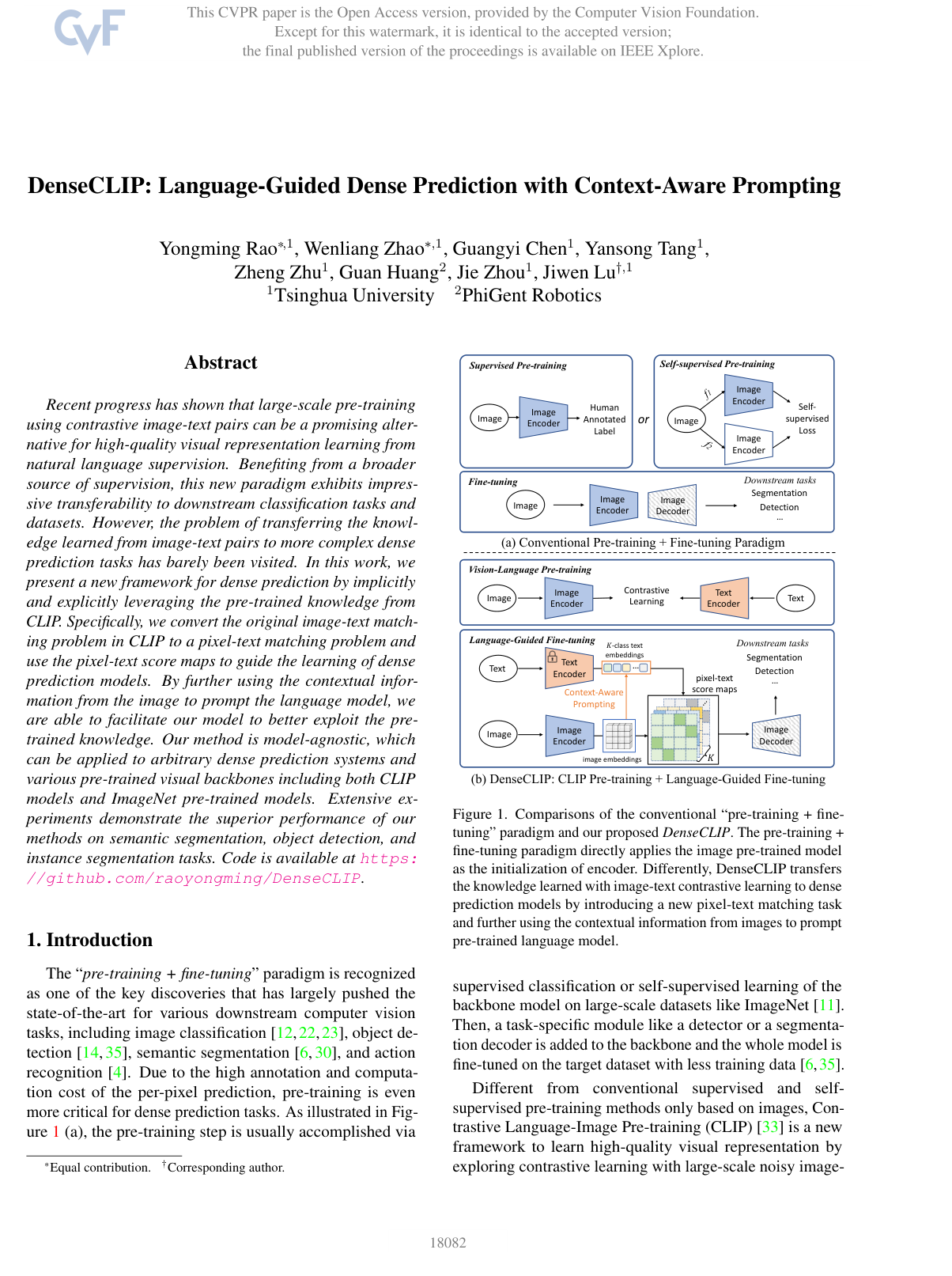
To bridge the gap between image-level concepts and individual pixels, the authors reformulated the contrastive vision-language problem into a pixel-text matching mechanism. This mechanism computes spatial score maps between visual features and language embeddings to explicitly guide downstream task decoders and auxiliary objectives. In addition, the method incorporates context-aware prompting via Transformer modules to refine text embeddings using image context. The framework was evaluated across standard benchmarks, including the ADE20K semantic segmentation dataset and the COCO detection and instance segmentation benchmarks, across standard convolutional and Transformer backbones.
The empirical findings demonstrate notable performance gains across multiple tasks. On the ADE20K segmentation benchmark, a standard ResNet-50 backbone equipped with DenseCLIP achieved a 43.5% mean intersection-over-union score, outperforming conventional ImageNet pre-training by 4.9 percentage points and basic vision-language fine-tuning by 3.9 percentage points. A ResNet-101 model paired with DenseCLIP achieved 46.5% multi-scale segmentation accuracy, surpassing heavier competitive architectures while requiring only about one-third of the computation. The framework also delivered consistent gains on the COCO benchmark, yielding a 2.6 percentage point increase in detection average precision and a 2.9 percentage point increase in instance segmentation mask precision over supervised ImageNet baselines, while also improving standard vision backbones like Swin Transformers by up to 2.6 percentage points.
These results demonstrate that language priors can significantly improve spatial representation learning and holistic object recognition in computer vision systems without adding prohibitive computational overhead. In practice, adopting DenseCLIP enables organizations to deploy lightweight decoders that deliver superior segmentation accuracy at a fraction of the computational expense, offering substantial cost and latency savings for production deployments. DenseCLIP also proves flexible enough to guide arbitrary image backbones, allowing existing visual pipelines to integrate language guidance flexibly.
Engineering teams should consider adopting vision-language fine-tuning with post-model prompting for dense spatial tasks to optimize the trade-off between computational budget and predictive accuracy. Specifically, practitioners should adopt customized fine-tuning hyperparameters—such as AdamW optimization and reduced backbone learning rates—to preserve pre-trained knowledge. Future development should explore integrating dense, localized supervision during initial multi-modal pre-training or refining spatial locality mechanisms to further close the performance gap on object detection tasks.
The primary limitation highlighted in the article is that performance gains in object detection were comparatively modest compared to the substantial improvements in segmentation, as image-level contrastive pre-training naturally lacks fine-grained spatial locality constraints. However, the evaluation across multiple recognized benchmarks and diverse neural network architectures provides high confidence in the framework's effectiveness and practical utility for dense prediction systems.
- Paper: Learning Transferable Visual Models From Natural Language Supervision, Alec Radford et al.. DenseCLIP adapts CLIP’s shared image–text representations for pixel-level prediction, so CLIP’s contrastive pretraining and zero-shot transfer provide the essential foundation.
- Paper: Language-driven Semantic Segmentation, Boyi Li et al. (2022). LSeg establishes language embeddings as pixel-level labels for zero-shot segmentation, making its dense text–visual alignment a direct precursor to DenseCLIP’s pixel–text matching.
- Paper: Open Vocabulary Semantic Segmentation with Patch Aligned Contrastive Learning, Jishnu Mukhoti et al. (2023). PACL extends language-guided dense prediction by explicitly aligning image patches with text, developing the local contrastive alignment that DenseCLIP identifies as crucial for segmentation.
- Paper: SegCLIP: Patch Aggregation with Learnable Centers for Open-Vocabulary Semantic Segmentation, Huaishao Luo et al. (2023). SegCLIP carries language-guided segmentation toward open-vocabulary categories by learning semantic regions that connect image patches to text labels.
- Paper: Open-Vocabulary Universal Image Segmentation with MaskCLIP, Zheng Ding et al. (2023). MaskCLIP extends CLIP-based dense prediction to universal segmentation, combining text-driven recognition with mask proposals for open-vocabulary objects.
- Paper: CLIP is Also an Efficient Segmenter: A Text-Driven Approach for Weakly Supervised Semantic Segmentation, Yuqi Lin et al. (2023). CLIP-ES continues text-driven segmentation with a training-free approach, showing how CLIP’s localization and prompt mechanisms can produce masks without task-specific fine-tuning.